Ivan P. Bratukhin, one of the pioneer figures in Soviet rotorcraft development, was a senior member of the division formed under Boris N. Yuriev at the TsAGI (Central Aero and Hydrodynamic Institute) to carry out research into problems associated with rotary-winged flight. In 1925 Boris Nikolayevich Yur’yev organised a vertolyet (helicopter) group and in 1927 tested a 6m two-blade rotor driven by 120hp M-2. In 1928, from at least four project studies, design picked for 1-EA (Eksperimentalnii Apparat) and machine built at ZOK under G.Kh.Sabinin. Chief designer Aleksei Mikhailovich Cheryemukhin and Aleksandr Mikhailovich Izakson. The TsAGI’s first helicopter, begun in 1928, was the 1-EA, which made its first tethered flights in August 1930.
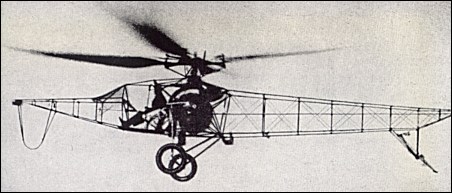
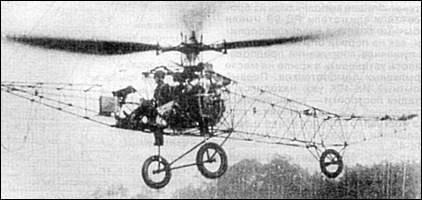
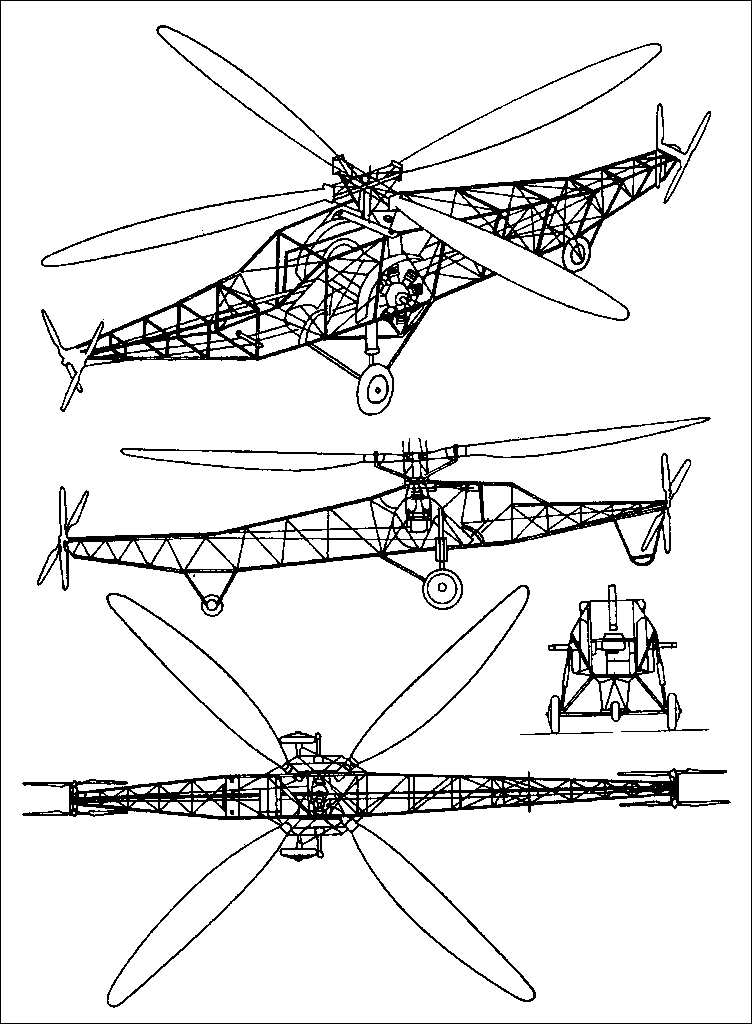
An open framework machine, the 1-EA was powered by two 120hp M-2 rotary engines, driving a single 4-blade lifting rotor and small 2-blade (with variable pitch) steering rotors at the nose and tail. The anti-torque rotors turned in the opposite direction from the other.
Fuselage welded from M1 mild-steel tube forming spaceframe resting on tailwheel landing gear with rubber springing. Twin engines at centre with reduction and bevel gears to vertical shaft to main rotor and side-by-side pairs of 1.8m anti-torque rotors at nose and tail. Chief development task was finding best structure for main rotor blades, an all-metal blade being rejected in favour of one with dural spar, wood ribs and stringers and ply/fabric skin. Four-blade main rotor with 5 degree coning angle driven at 153 rpm.
The single-seater helicopter had a four-bladed rotor with cyclic and collective pitch control operated by means of a hanging stick directly connected with the swash-plate, and pedal control of nose/tail rotors from pilot seat just ahead of engines. Flight testes began on June 26, 1932. In July-August 1-EA was demonstrated to M.N.Tukhachevskij and Ya.I.Alksnis.
M.N.Tukhachevskij suggested small series production, but A.M.Izakson (one of designers) insisted that more development is needed and resources should not be dispersed on production of ‘raw’ machine.
Fuselage was simple frame made of steel tubes, its construction was optimized during tests. Original rectangular structure with tension wires was replaced by more solid triangular without wires.
M-2 engines were selected because they did not require any special cooling in hovering regime. Because main rotor had solid blades, no special clutch was required and rotor started to spin once engines started (with compressed air).
Cheryemukhin elected to fly 1-EA himself, making first tethered run Aug 1930. No disasters and by 1932 reliable flights of up to 12 min. 1 Aug 1932 Cheremukhin reached 160m, 3 Aug 230m, 5 Aug 285m and on 1932 14 Aug 605m. The USSR at the time was not a member of an International Aviation Federation (plus secrecy), and this record could not be formally registered, the world record remaining 18m (d’Ascanio).
The 1-EA story was flown safely mostly due to well designed control system and pilot’s skills of A.M.Cheremukhin. Simple straight link of main rotor to the power plant does not provide enough stability. Smallest variations in engine regime caused aircraft to move up or down, and required full attention of a pilot.
One built, and the 1-EA continued to fly until at least 1934.
TsAGI 1-EA
Engine: 2 x M-2 rotary, 120hp
Main rotor diameter: 11.0m
Max take-off weight: 1145kg
Max speed: 20-30km/h
Hovering ceiling: 605m
 All Aero