Australia
Built in 1936 six examples of the Gannet twin-engined, high-wing monoplane for cartographic survey/ambulance duties for the RAAF, designed by Wg Cdr L. J. Wackett. Taken over 1936 by Commonwealth Aircraft Corporation.
Inter-Wars
TsAGI A-15
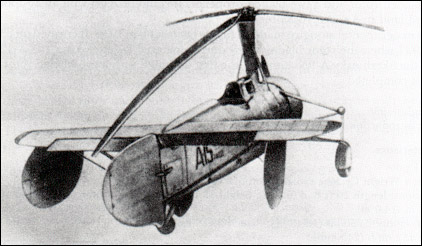
Intended as fastest autogyro of day, two-seat wingless machine using A-12 and A-14 technology and with usual welded KhMA structure. Scheibe fins on braced tailplane with elevators and direct-control rotor. Main gears with vertical shock struts carried on triangulared outriggers each side of fuselage. Pilot with synchronized ShKAS and observer with twin ShKAS and AFA-13 reconnaissance camera. Chief designer M.L.Mil, construction manager A.A.Kuznetsov. Completed April 1937 and taxi tests began by Chyernavskii and Ivanov, but A-12 crash caused further work to be halted. No reason to doubt airworthiness of A-15 but effectively terminated Soviet autogyro development. Autogyros picked up again at Kharkov, Kuibyshev and Riga 30 years later.
A-15
Engine: 1 x M-25V
Rotor diameter: 18.0m
Length: 8.6m
Height: 4.1m
Weight empty: 1695kg
Fuel+oil: 385+40kg
Weight loaded: 2560kg
Est. max speed: 260km/h
Min speed: 50km/h
Ceiling: 6400m
Take-off run: 35-60m
Landing run: 0m
TsAGI A-13
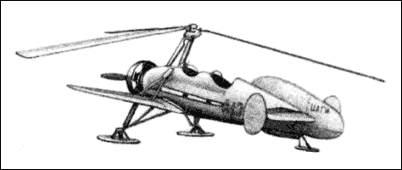
Two-seat liaison machine developed from A-6 and A-8. Direct-control inclined rotor with folding blades, folding dihedralled wings and twin-finned tail, internal engine starter and clutch-in drive for rotor before take-off. First flown on skis March 1936.
A-13
Engine: 1 x M-11
Rotor diameter: 11.5m
Wing area: 5.6sq.m
Weight empty: 540kg
Fuel+oil: 50kg
Weight loaded: 802kg
Max speed: 151km/h
Min speed: 45km/h
Ceiling: 3000m
Endurance: 2h
Range: 250km
Take-off run: 40m
Landing run: 0m
TsAGI A-12
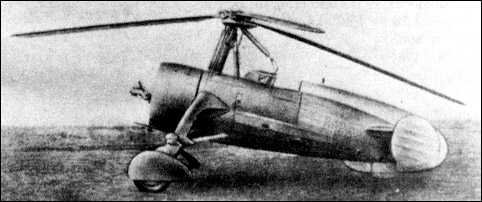
The 6th Brigade under Skrzhinskii designed A-10 six-seat transport autogyro with M-22 in 1934 but dropped this in favour of high-speed wingless machine with fully controllable rotor. Design in parallel with small A-14 which flew first and assisted perfection of A-12 wingless autogyro. Direct-control rotor derived from A-7, with similar engine drive before takeoff. Roll control by rotor only, tail with central rudder (extension of fuselage) and two Scheibe fins on strut-braced tailplane with elevators. Shavrov loosely describes fuselage and engine as I-16 (fighter); in fact steel tube with fabric, and engine cowl with gills. Two-position Hamilton prop, single-seat cockpit, very strong main gears with oleo struts and wide-track spatted wheels with toe brakes. Cautious taxiing and hops 10 May 1936 by A.P.Charnyavskii, eventually 17h 55min in 43 flights until rotor blade came off 23 May 1937 killing I.Kozyrev. Cause never found but ascribed fatique; almost halted autogyro work.
A-12
Engine: 1 x 670hp Wright Cyclone (later M-25)
Rotor diameter: 14.0m
Length: 6.3m
Weight empty: 1343kg
Fuel+oil: 165+17kg
Weight loaded: 1687kg
Max speed: 245km/h
Min speed: 52km/h
Ceiling: 5570m
Endurance: 1.5h
Take-off run: 25m
Landing run: 5-10m
TsAGI A-8
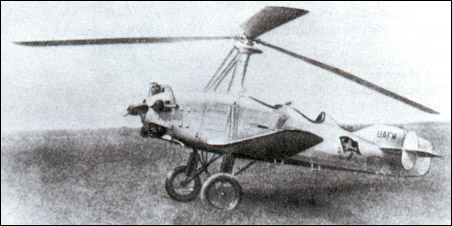
First flown 29 June 1934, this was virtually an A-6 with two major alterations: wings had 5 degree dihedral instead of upturned tips, and as well as ailerons direct rotor control of roll was provided, even during autorotation (and found to be vastly superior to ailerons except at max speed). Other changes included auxiliary fins on tailplane and first air/oil shock struts in Soviet Union.
A-8
Engine: 1 x M-11
Rotor diameter: 11.0m
Wing area: 5.8sq.m
Length: 6.3m
Height: 3.2m
Weight empty: 595kg
Fuel/oil: 67kg
Weight loaded: 837kg
Max speed: 142km/h
Min speed: 48km/h
Ceiling: 2560m
Endurance: 2.5h
Take-off run: 50m
Landing run: 0m
TsAGI A-6
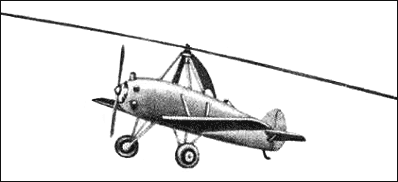
Light autogyro designed by Kuznetsov. First rotary-wing machine with folding blades, and also folding wings. Construction as before except balloon tyres instead of shock struts. Flown Ts.A.Korsinshchikov aerly 1933 and from start showed outstandingly good flying qualities, far better than A-4 on which all official attention was polarized. Following various research programmes in winter 1933, one of which was testing V (butterfly) tail.
A-6
Engine: 1 x M-11
Rotor diameter: 11.0m
Wing area: 5.9sq.m
Length: 6.3m
Height: 3.2m
Weight empty: 562kg
Fuel/oil: 67kg
Weight loaded: 815kg
Max speed: 142km/h
Min speed: 53km/h
Ceiling: 2000m
Endurance: 2.5h
Take-off run: 50m
Landing run: 0m
TsAGI A-4
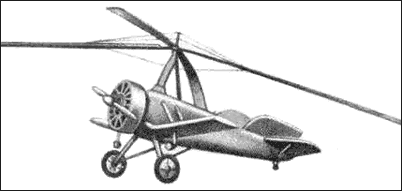
Designation from Avtozhir (autogyro), decree by NII VVS 1932 for all-Soviet autogyro, and preparations for production organized forthwith for use as military trainer and observation machine. Design led by N.K.Skrzhinskii using known Cierva technology, regarded as minimal risk. Structure similar to 2-EA but single fin, more power, dual controls. First flight 6 Nov 1932, second flight three days later resulted in unexplained rotor vibration and loss of lift, with heavy impact on ground despite maximum power. Production had begun and frantic research with different rotors eventually yielded satisfactory machine, passing NII tests late 1933. Ten delivered 1934 (possibly a few more later) and served as trainers and in field manoeuvres.
A-4
Engine: 1 x M-26
Rotor diameter: 13.0m
Span: 6.7m
Length: 7.2m
Weight empty: 1065kg
Fuel+oil: 95+20kg
Weight loaded: 1365kg
Max speed: 176km/h
Min speed: 50km/h
Ceiling: 4100m
Range: 185km
Take-off run: 70-100m
Landing run: 3-10m
TsAGI ANT-51
During 1937 8, Sukhoi was primarily concerned with the design of a light reconnaissance bomber intended to succeed the R 10, this being the ANT 51 two seat mid wing monoplane which, powered by an M 62 radial, flew in 1938. During the following year, Sukhoi established his own design bureau, and began the redesign of the ANT 51 with an M 88B engine, a low wing and an increased offensive load, this emerging as the BB 1, entering series production in 1940, and being redesignated Su 2 in 1941.
TsAGI ANT-31 / I-14
In 1932 Sukhoi was responsible for the design of a single-seat low-wing cantilever monoplane fighter, incorporating an enclosed cockpit and retractable undercarriage. This aircraft, the ANT-31 or I-14, flew in October 1933, and series production of an improved version, the I-14bis which first flew on 14 February 1934, was ordered but cancelled two years later when it was found impossible to eradicate some of the fighter’s shortcomings.
TsAGI 5-EA
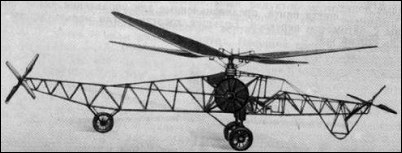
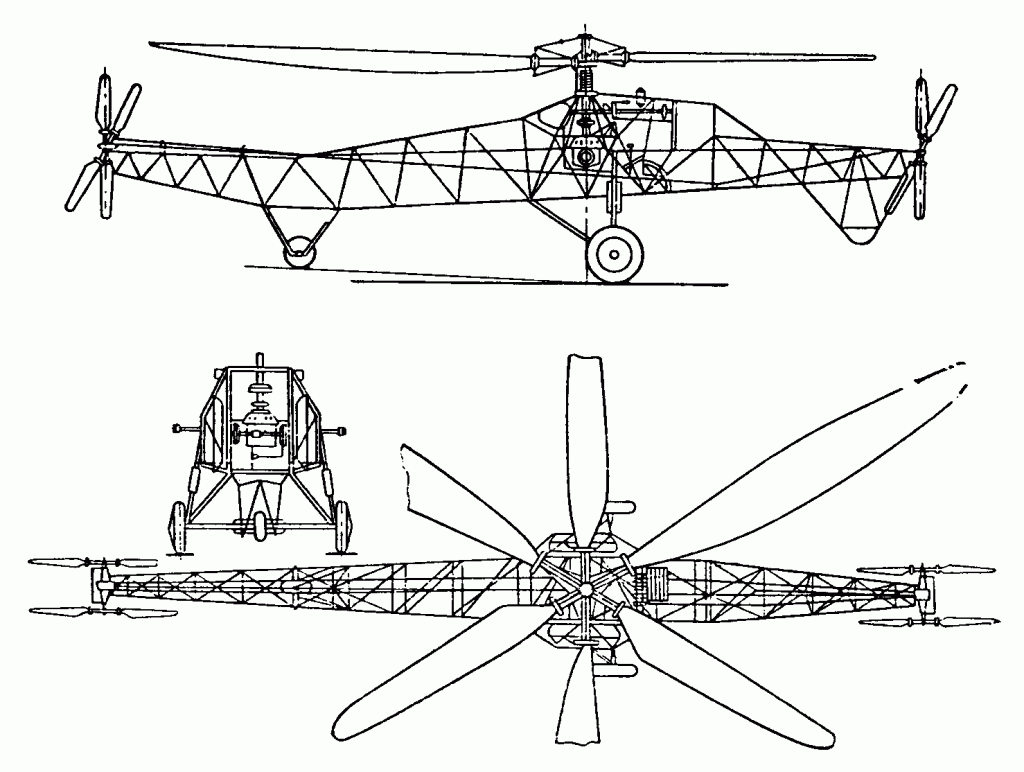
Broadly similar to predecessors, incorporated new rotor proposed by I.P.Bratukhin with three large blades with articulated roots which provided lift, and three smaller blades with rigid attachment which provided control. Some accounts incorrectly state large and small rotors superimposed; all blades were in same plane, large and small alternating. This rotor worked, yet 5-EA appears not to have reached any considerable height or endurance (Western figures 13 miles and 1200 feet not confirmed in Soviet accounts). 5-EA flew from 1933 until late 1935 and was instrumental in providing research basis for machine with more powerful and more modern engine.
5-EA
Engine: 2 x M-2 piston, 120hp
Rotor diameter: 12.0m and 7.8m
Max take-off weight: 1210kg
Empty weight: 1047kg
Max speed: 20km/h
Ceiling: 40m
Endurance: 0.7h
Crew: 1
 All Aero