1929: 20th Century Aircraft Corp (pres; Fred Arnoldi) Ravena NY. USA
The company was set up by the Ravena Board of Trade in mid-Sep 1929 and Fred Arnoldi, who left Curtiss Co, appointed to head it. Intention was to build three types to be known as “Sky Kings”. The first was shipped to NYC for display at the American Legion Aviation Show in Feb 1930, a second ship was partially completed and a third started. Then a brief article in a local newspaper on 1/2/31 reported that the factory closed and moved to Amsterdam.
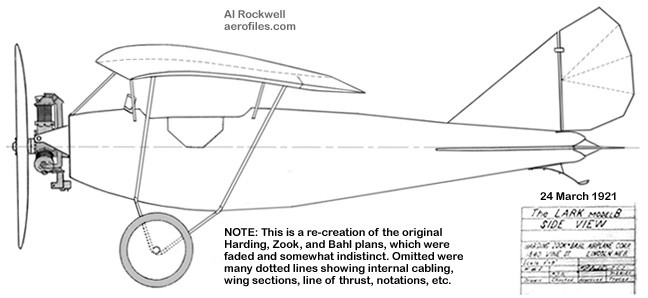
This Lark was built in 1921 by the Harding, Zook, & Bahl Airplane Co of Lincoln, Nebraska. The original design having been worked out by E.G. Bahl. It featured a layered wood-strip monocoque fuselage with only four bulkheads.
A Frankensteinian creation (NC5003?) reportedly from pieces of two Curtiss JN-4s, a Thomas-Morse S4C, and other wrecks, won an efficiency trophy at the 1921 Omaha Air Races. Sold in 1922 and moved to Richards Field, Kansas City, where it was badly damaged in a landing accident.
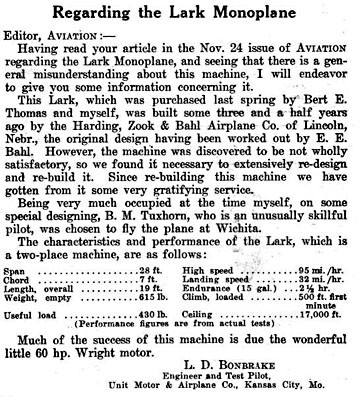
The Lark was purchased in the spring of 1924 by Bert E. Thomas and L.DeweyBonbrake, to what extent is uncertain.
The machine was re-designed and rebuilt by Thomas and Bonbrake, with a Wright 60 hp engine, to improve flight characteristics. B.M, Tuxhorn was chosen to fly the plane at Wichita.
Purchased by Blaine Tuxhorn in 1924, redesigned by L D Bonbrake and rebuilt with 60hp Wright-Gale L-4, and reregistered as Tuxhorn Lark, again in 1929 as Bonbrake Parasol.
It became the Bonbrake Parasol in 1928, said to not have flown very well in its original form, but the basic design evolved into the Inland Sport.
Recent documentation found by John M Jarratt puts this Lark back at square one, and we start over. The airplane appearing as [NC5003] is a far cry from the one pictured in the 1/8/22 Denver Post, and its lengthy article about the Harding, Zook & Bahl operation indicate much of the data above describes another plane (that “wood-strip monocoque fuselage” certainly does not fit the picture), but which one is yet to be solved.
Specs mentioned in the news item: 65hp 2-cylinder Rockwell (Hugh M Rockwell—SEE Rockwell Corp entry); load: 607# v: 90/x/25; $2,500 planned market price. Empty wt: 650#. The article also mentions prior production at Lincoln, and that a "considerable number had been sold in the US, Canada, and Mexico" and they will "turn out 100 Lark monoplanes within a year." (2/28/02)
Trying to sort out this mess, we proceed another step further (or is it backwards?). From research by John M Jarratt and Vincent J Berinati, it seems that prototypical Bahl Lark was parts of the fuselage of surplus Standard J-1 [NC2119] mated with the wing of a Thomas-Morse something. Later on its meandering path it was reregistered as [NC1940], which shows in regs as a Standard J-1 because of its fuselage’s original c/n, but might have been Tuxhorn Lark at the time. (3/14/02)
Abstracts from NASM show that this ship had nothing to do with Bahl, Bonebrake, or Tuxhorn, but was a Nicholas-Beazley Standard J-1 remodeled with a monoplane wing and new tail by Joseph C Freeze, Kansas City KS. (— John M Jarratt 7/18/02)
The 1925 Tuxhorn Air Liner was an open cockpit and cabin biplane powered by a 400hp Liberty 12 engine. The Air Liner featured an oversized, steerable tailwheel, and the pilot and one passenger in an open cockpit behind cabin.
The one built was used as a carrier between Omaha NB and Little Rock AR.
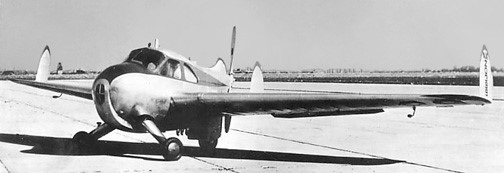
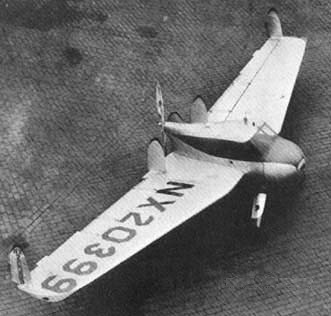
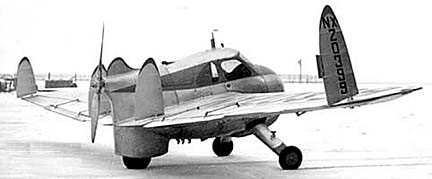
Designed by Thomas Hoff the H-70 two-place derivative of the Stearman-Hammond Y was a tailless (except for wingtip rudders), flying-wing with rudders mounted at the trailing edge and trailing-edge flap-type controllers, was originally built by Management & Research under a DoC program contract for lightplane development. Registered NX20399 and powered by a 95hp Menasco B-4 pusher engine, the one built did fly, although difficult to turn, but crashed in testing on 27 January 1938.
Tuscar H-71 NX20399
It was rebuilt by Tuscar as the H-71 and flown at Floyd Bennett Field for about 60 hours before crashing to finality in August 1945.
The origins of aircraft construction in Turkey can be traced back to the first maintenance unit of the Turkish Air Force officially established on 1 June 1911, set up at the airport in Yesilköy / Istanbul. During the First World War maintenance facilities were established in Baghdad, Damascus, Izmir and Konya. They were under the umbrella of the 9th Department of Aviation Affairs (9 Hava Isleri Subesi), which was established on 15 Febuary 1915. The main task of this maintenance facilities was the maintenance of the aircraft of the German Air Force but due to the war situation could not always be guaranteed the supply of spare parts. The technicians at the front often no choice but to produce the items urgently needed themselves. In 1917 the Baghdad facility built a “new airplane”, the Baghdad first, which was built from parts of Albatros C III and from captured aircraft parts “redesigned”. During the Liberation War, which began immediately after the end of the First World War, the need for a separate aircraft production became increasingly clear.
The first steps for national aircraft production were initiated. Firstly reconstructions were performed on available aircraft types on the Gaziemir / Izmir Air Force Base. In 1922 two captured Airco DH 9 were retrofitted with dual controls. In 1924, the unreliable original engines were replaced on four B.1 Aviatik SAML training aircraft with older, but proven, Mercedes engines.
Turkish aircraft in the true sense began only after the founding of the Republic in 1923. A small delegation was dispatched to Europe to procure aircraft for the new Turkish Air Force. After evaluation it was decided to obtain 16 Bréguet XIV A-2, 39 Caudron C-27 and 32 Caudron C-59 aircraft. These aircraft were dismantled in 1924 and shipped to the Gaziemir / Izmir Air Force Base under French supervision. After the first requirements of the Turkish Air Force, the armed force withdrew from the assembly of planes however, this plan did not last long. When in the course of technical development, the maintenance became more complicated and more complex, the maintenance facilities of these forces were again entrusted with the manufacture of spare parts or installation or modernization of aircraft. So the 1st Air Supply and Maintenance Center emerged (1 Ikmal Hava ve Bakim Merkezi, 1.HIBM) in Eskisehir (1926), the 901 Home Depot and production plant for aircraft (the 901.Hava Araci Ana Depo ve Fabrika Komutanligi, nine hundred and first HAADFK) in Polatlı (1948, 1962 in Ankara) and the 2nd Air Supply and Maintenance Center (2nd Hava Ikmal ve Bakim Merkezi, 2.HIBM) in Kayseri (1950).
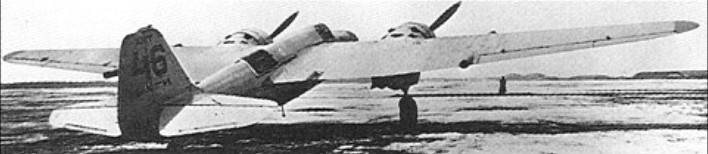
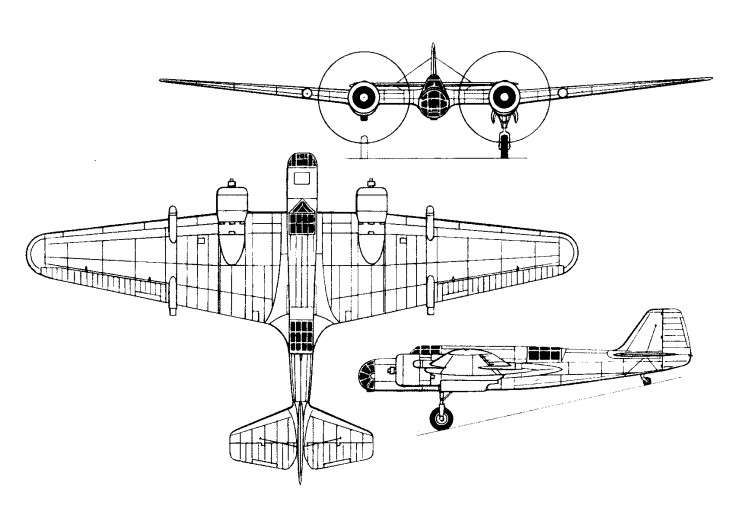
Ordered in December 1934 as a single prototype under the designation DI-8, the ANT-46 was a two-seat fighter (Dvukhmestny istrebitel) derivative of Aleksandr Arkhangelsky’s SB high-speed bomber (ANT-40). Featuring a lightened structure and powered by two 800hp Gnome-Rhone 14Krsd 14-cylinder air-cooled radial engines, the ANT-46 was intended to carry two 100mm Kurchevski APK-100 recoilless guns as its primary armament, these weapons being buried in the outer wings between the ailerons and the flaps, and projecting fore and aft. In addition, it was intended to mount a battery of four 7.62mm guns in the extreme nose, but these were not carried by the prototype, which featured a glazed nose generally similar to that of the SB.
First flown on 9 August 1935, the ANT-46 was actually flown before the ANT-29, the factory flight test programme being completed successfully in June 1936, but state acceptance testing was not undertaken as official interest in the recoilless gun – for which the ANT-46 had been specifically developed – had terminated with the arrest, in February 1936, of Leonid Kurchevski.
Max take-off weight: 5553 kg / 12242 lb Empty weight: 3487 kg / 7688 lb Wingspan: 20.30 m / 67 ft 7 in Length: 12.24 m / 40 ft 2 in Wing area: 55.70 sq.m / 599.55 sq ft Max. speed: 388 km/h / 241 mph Range: 1780 km / 1106 miles
In December 1934, Tupolev was asked to design a naval heavy bomber (Morksoi Torpedonosets Bombardirovshik = naval torpedo bomber = MTB). With his seaplane specialist Ivan Pogosski dead, he gave the project to Aleksander Golubkov who came up with a more conventional design than the earlier ANT ‘hydroplanes’ – a single hull with a high-wing profile, made entirely from duraluminium. It was an amphibian with a retractable wheeled undercarriage, and the floats, mounted near the wingtips on struts, were load-carrying. Powerplants were four Gnome-Rhone 14Krsds, which gave 810hp each, and were mounted in the wing leading edges. The wing shape resulted in the ANT-44, as the project was designated, being called the Chaika (Seagull).
Construction of the prototype began on 4 October 1935, and the aircraft was manufactured with smooth sheets of duraluminium, which were now becoming available in place of the former corrugated ones. The work was carried out in the TsAGI-ZOK factory N156. It was completed in March 1937, and brought by road to Khodinka, from where it made its first flight on a fixed wheeled undercarriage (because the retractable mechanisation was not yet ready) on 19 April 1937. Its pilot was Timofei Riabenko. State tests were conducted with the undercarriage fixed down; maximum speed was measured at 355km/h, maximum take-off weight at 18,500kg, and range with a bomb or torpedo load of 2,500kg was 2,500km. The state tests were completed in July.
A second aircraft was completed in June 1938. By now the first had its undercarriage modified to retract, while the second aircraft had a retractable one from the start. It had 840hp Mikulin M-87As fitted and was dubbed the ANT-44bis or -44D.
By September, both aircraft were taken on service with the Soviet Navy, as the MTB-2A.
No production was ordered, and they served some operations in the Great Patriotic War from bases in the Black Sea. Led by Ivan Sukhomlin, the MTB-2As were used to bomb oil refineries in Bulgaria and Romania, both then under Nazi occupation.
Before the Soviet Union was invaded by Germany, Ivan Sukhomlin had earned four world records, with the ANT-44bis. In June 1940, he set several records lifting different loads to record altitudes for amphibians, and on 7 October he achieved a record for amphibians by carrying a two-tonne load over a 1,000km closed circuit at an average speed of 241.999km/h. Although this record was not acknowledged by the FAI until after the war, it stood unbeaten until 1957.
MTB-2A Engine: 4 x M-87 Max take-off weight: 21500 kg / 47400 lb Wingspan: 37.0 m / 121 ft 5 in Length: 24.0 m / 79 ft 9 in Height: 9.0 m / 30 ft 6 in Wing area: 144.7 sq.m / 1557.54 sq ft Max. speed: 350 km/h / 217 mph Cruise speed: 250 km/h / 155 mph Ceiling: 7200 m / 23600 ft Range: 4500 km / 2796 miles Range w/max.payload: 2500 km / 1553 miles Crew: 4-5 Armament: 6 x 7.62mm machine-guns Bombload: 2000kg



 All Aero