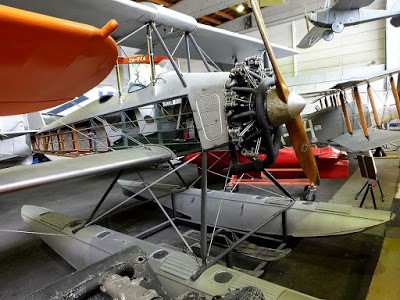
The 1919 Van Berkel seaplane is a twin-float seaplane, shown at the E.L.T.A. exhibition without engine, but intended for a Mercedes. The fuselage is built up of a light framework covered with three-ply wood. The ply-wood covering of the rear portion of the fuselage is continued outwards over the tail plane, which latter is built integral with the body. The fuselage is very deep at the rear, where it performs the function of a fin, no other vertical fin being fitted. The tail plane is at the top of the fuselage and the rudder has its balanced portion projecting below the stern.
The two floats, which are single step, are flat-bottomed as regards their front portion, but to the rear of the step the bottom gradually changes from flat to Vee bottom, finally corning to a point at the heel of the float. The construction is very similar to that of the fuselage, brass screws and nails being used throughout. The floats are fitted with water-tight bulkheads, detachable inspection doors being provided in the deck for examining the interior.
The wing bracing is only one pair of struts on each side. The upper plane is of slightly greater span than the bottom, and the inter-plane struts slope outwards. The lift and landing loads are taken by tubes sloping from the floats outward to the lower surface of the bottom plane at the points where occur the inter-plane struts. A speed of 155 km. per hour is estimated.
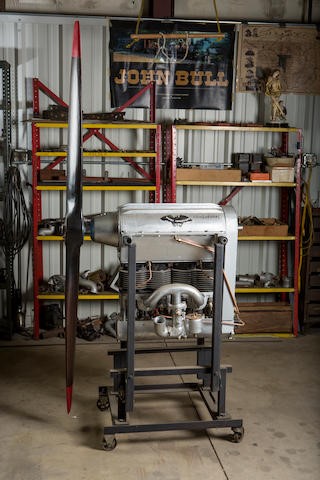
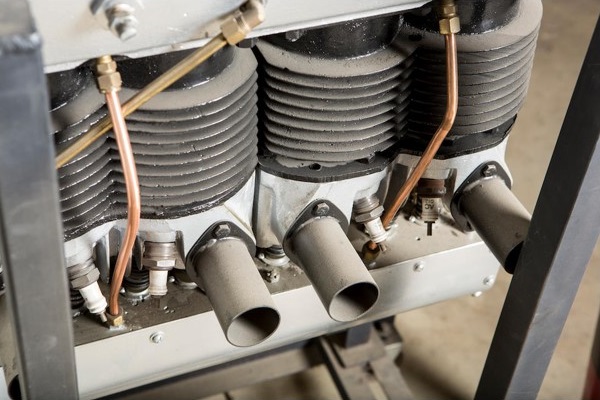
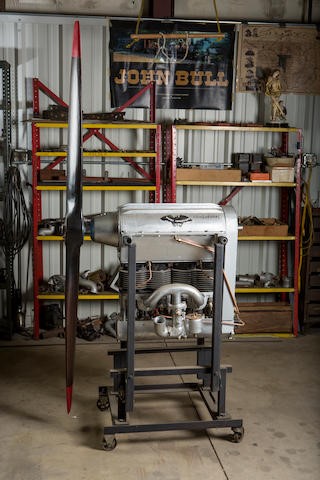
A 4 cylinder in-line engine, fitted with Zenith carburetor and manifold, mounted on wheeled display base, the engine fitted with 1860mm diameter two bladed wooden propeller.
With the original engine the VanDersarls left good data on the cylinders, the copper cooling fins—all the specifications we needed to build the engine from scratch. The engine was used to power the VAMP Bleriot.
Jules “J.J.” VanDersarl and his younger brother, Frank, lived just outside Denver, Colo.; their mother worked as a housekeeper; and they barely made it through grade school. But both brothers proved to have innate mechanical talents that made them proficient at machining, carpentry and other skills. J.J. experimented with gliders at age 12, and later, a few months after Blériot’s 1909 Channel flight, he and Frank obtained all the publications and photographs they could, they used those references to build their own Blériot XI in 1911…then learned to fly it.
According to Javier Arango, director of The Aeroplane Collection in Paso Robles, Calif., who now owns the VanDersarl Blériot, the brothers “must have had some guidance and lots of information,” because the dimensions of their airplane are close to those of the original. Their homebuilt differs from the standard Blériot XI in three respects, however. First and foremost, instead of the 25-hp Anzani 3-cylinder radial or Gnome rotary engine that normally powered Blériots, the VanDersarls, using their general knowledge and machining skills, adapted a 4-cylinder inline air-cooled automobile engine with a reworked oil system to aerial use. Just what that engine was remains uncertain, though Arango said it was “close in dimensions” to the power plant used in the Metz, a car equipped with a liquid-cooled engine that the company had planned to adapt to aviation but which never quite materialized.
VAMP Bat engine
A second difference, Arango noted, was that “some of the structure around the empennage is placed slightly differently than in most Blériots.” Finally, he said, “The French Blériots were built to a high quality, but our plane was built by teen agers in Colorado who just wanted to go fly—it’s a little rougher than pristine Blériots.” Even so, the handmade airplane worked remarkably well. “There is a photo of the first flight, which ended up in a landing that broke the landing gear,” Arango reported. “But it was repaired and flew again. Both brothers flew it.”
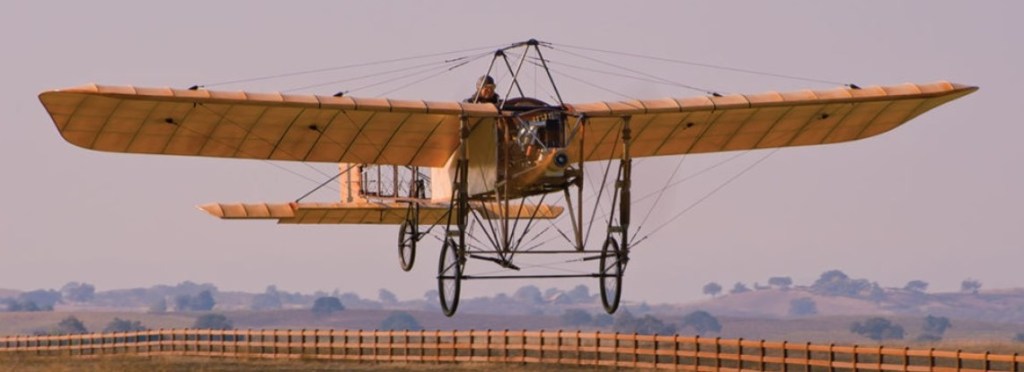
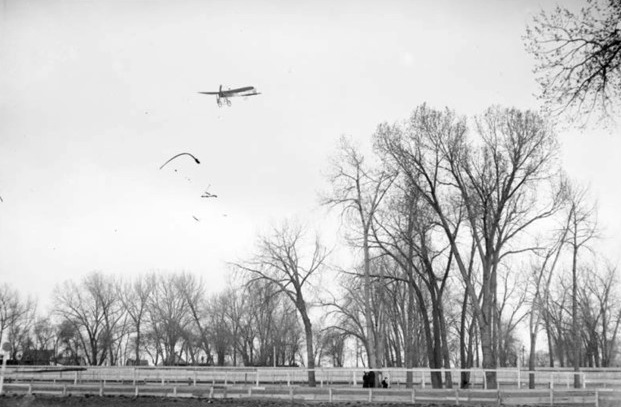
Over a Denver, Colorado field, local photographer Harry M. Rhoades captured what is believed to be the only known picture of the Vandersarl Blériot in flight.
VAMP actually stood for VanDersarl Aeroplane Motor Products in its original iteration (George Thompson).
1913: VAMP (Van Dersarl Motor Products) Aircraft Co, Denver CO. USA
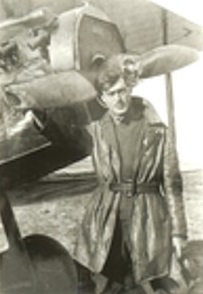
Frank A. Van Dersarl worked for Mountain Flyers where he was General Manager and Chief Pilot, giving aviation demonstrations, entertaining flights and exhibitions. They did stunts, flew with fireworks, did aerial photography and sold rides.
The VanDersarls went on to fly Curtiss JN-4 Jennys and Standards, and in the 1920s, Arango said, “Frank started an airport and barnstorming operation.” The most remarkable thing, though, is that Frank kept the homebuilt in which he and J.J. had first learned how to fly.
He founded Rocky Mountain Airlines in 1921. For seven years he ran the Denver Post airshows, and was the owner of the Vamp Aircraft Company. At one time, Frank and his brothers employed Charles A. Lindbergh in their Denver enterprise.
The VAMP Company, owned by Frank A. Van Dersarl (1895-1983), was based in Denver, and built several types of aircraft, believed 40+ machines in total, powered by their own VAMP engines, including replicas of Bleriot monoplanes and Cessna mid-wings.
Frank owned and ran the first aviation school in Denver in 1930-32 and also was the Chief of the Curtiss-Wright Denver branch. He built the first Mooney airplane. He constructed a total of about 46 airplanes. In later years, he worked on the Boeing B-29 program. Frank also owned and operated the Denver Union Airport, but the depression put an end to this enterprise.
During WWII, he worked at the Denver Opportunity School and trained hundreds of workers and mechanics for the aviation industry. After the war, and until his retirement in 1967, he worked for the Colorado State Highway Department.
All three brothers were present for the awards presentation by the Colorado Hall of Fame, when Frank was the first to be honored.
In the 1960s Frank VanDersarl tried to restore the Blériot, but he died before completing the project. After J.J. VanDersarl died in Raton, N.M., in November 1977, the monoplane was exhibited at the Museum of New Mexico. In 1994 it was bought by Joseph Gertler, who loaned it to Dowling College in Bayport, N.Y. There it was further restored by John Zale, Frankie Mineo, Russ Moore and the Bayport Aerodrome Society. Then in 2009 Arango’s C.C. Air Corporation purchased it and added it to The Aeroplane Collection, with the ultimate goal of making it airworthy for the first time in a century.
“When we got it the plane was minimally restored,” Arango explained. “It was extremely authentic.” That meant it served as a useful reference toward the inevitable replacement of deteriorated material and components. “Chuck Wentworth from Antique Aero, who is really the main character in the restoration project, inspected it and went through everything,” he said. “The entire fuselage was in good shape. There were busted wires and turnbuckles that had to be reproduced and replaced to get it back to original condition. Chuck had to find parts of 1911 vintage to get the correct look, based on plans and photos. For example, they’d stuck a fake control wheel in the cockpit for display. We took all of that out.
“The wings were difficult—they were not the same age as the fuselage. They were probably damaged and were repaired or rebuilt by the VanDersarls. It took a lot of work with the wings to make them airworthy. The cotton covering was difficult to work with, and we even had to find the ‘honey-colored coating’ the VanDersarls described. We used a varnish that was tinted to get the correct honey color.”
Though he considered obtaining an Anzani engine, Arango decided to heed the advice of the National Air and Space Museum and “keep it as it was” by reconstructing the original engine. Fortunately for the restoration team, the VanDersarls “left good data on the cylinders, the copper cooling fins—all the specifications we needed to build the engine from scratch. The engine was put together with help from period publications and photos of the original.” The most difficult part was getting period components, but they managed to obtain a 1905 Bosch magneto, a brass carburetor of 1909 vintage, a tachometer, a magneto switch and a 1910 automobile oil gauge. In 2011 Wentworth unveiled the Blériot at the National Aviation Heritage Invitational in Reno, Nev. There on September 18 it won the event’s top award, the RollsRoyce Aviation Heritage Trophy.
Once the four-year project was completed, Arango and his team went through a systematic process toward getting it approved for flight by the Federal Aviation Administration. This presented some challenges, Arango said, since the Blériot XI predated the Civil Aeronautics Administration, let alone the FAA, and “there is no certificate and no paperwork of the age to make it current.” After the FAA inspected the aircraft, however, it finally registered the VanDersarl Blériot as an experimental airplane on August 16, 2012. This meant it could be flown under certain restrictions, such as not carrying a passenger for hire and with limits on the number of flights and travel radius around the airfield. “That was fine by us,” said Arango, “because we were happy to just fly, more or less in a straight line.”
Even with FAA approval, the VanDersarl Blériot underwent testing, reinspection and taxiing trials before it finally got airborne for the first time in more than a century on November 3, 2012. Since then, Arango keeps its flight itinerary at Paso Robles under tight self-imposed restrictions. “It’s a marginal airplane,” he explained, “with a 50-hp engine and very cambered wings that cause a lot of drag. It’s a good-flying airplane, but I’m not going to risk the airframe. It’s one of a kind, touched twice by its creators, and once by Chuck. I wanted it authentic to its own type.”
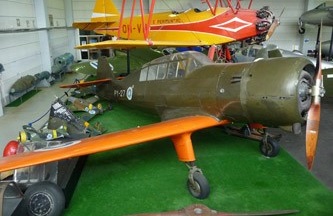
V.L. Pyry II – Registration number: PY-27, Serial number: 26
After VL was reorganized in 1936 and moved to Tampere, it produced Pyry monoplane trainers.
A two-seat advanced trainer designed in Finland. The prototype Pyry I, maiden flight was on 29 march 1939. The Finish Air Force had 40 aircrafts in use in 1941 – 1962.
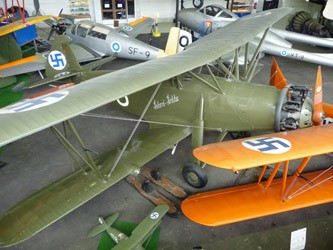
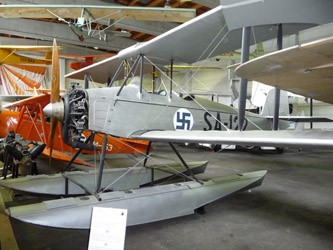
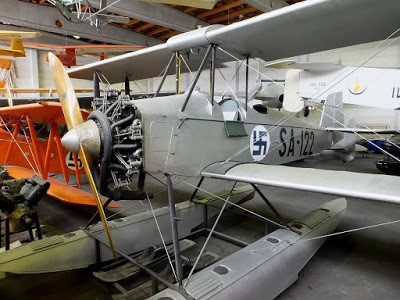
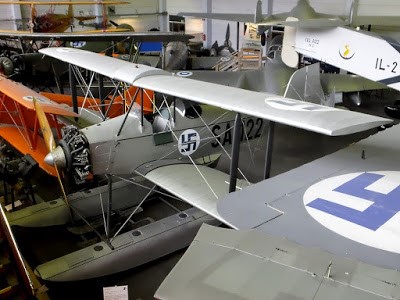
V.L. Sääski II – Registration number: SÄ-122, Serial number: 11
First VL product was the Saa’ski two-seat trainer. A trainer designed by engineer K.W. Berger and A. Nieminen. The first aircraft designed in Finland for mass production. The Finnish Air Force used 34 Sääski aircraft in 1928 – 1941. In addition, 5 aircraft were in civilian and official use.
Finland Finnish State Aircraft Factory, created February 1928 from former IVL (Ilmailuvoimien Lentokonetehdas = Aviation Force Aircraft Factory) which, from its formation near Helsinki in 1921, had built Hansa-Brandenburg W.33 seaplanes and Caudron C 60 trainers under license for Finnish Air Force, plus the Finnish-designed Kotka maritime reconnaissance/bomber biplane. First VL product was the Saa’ski two-seat trainer, followed by license production of de Havilland Moths and Blackburn Ripons. After producing the Vima light trainer and Tuisku advanced training/ reconnaissance biplanes, the VL was reorganized in 1936 and moved to Tampere, where it produced Pyry monoplane trainers, Fokker C.X. biplanes, Fokker D.XXI fighters and Bristol Blenheim bombers under license. Next indigenous product was single-seat Myrsky fighter of 1942-1945. Became part of Valtion after Second World War.
The names of aircrafts of the State Aircraft Factory (Valtion Lentokonetehdas) since 1933 are different kind of winds. Therefore “Humu” means “Whirl”.
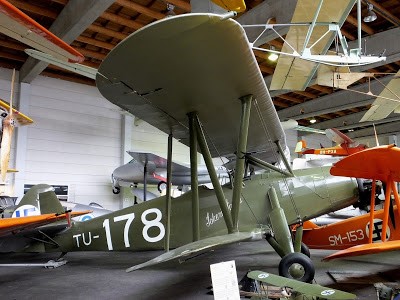
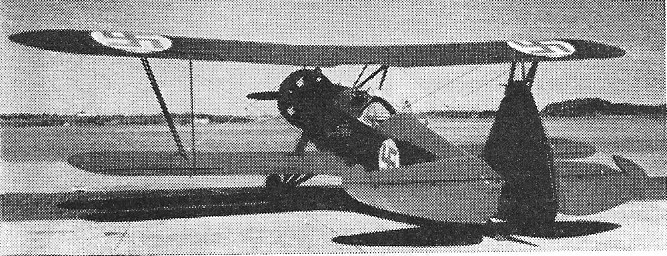
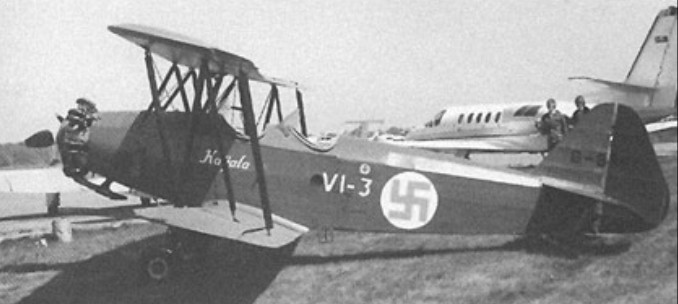
Two-seat trainer designed by engineer Arvo Ylinen. The Finnish Air Force had 22 aircrafts in use in 1937 – 1963, in addition the civilian aircraft OH-ILM was added as VI-40 in 1953.


 All Aero