VEF I-15

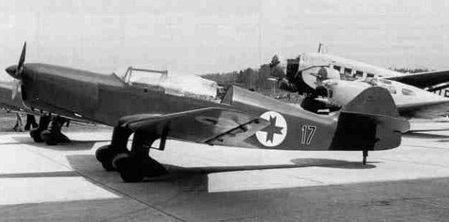
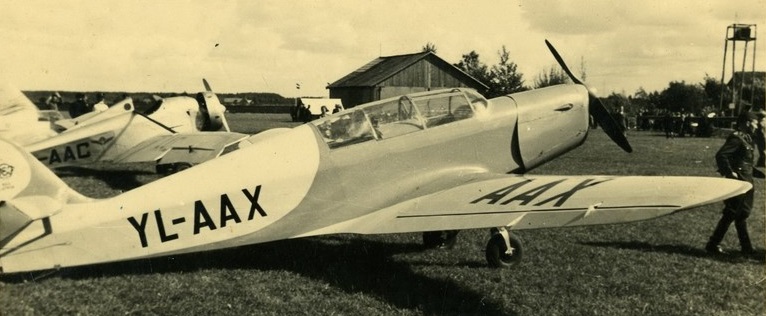
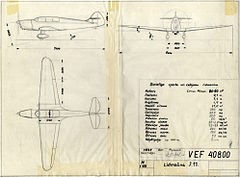
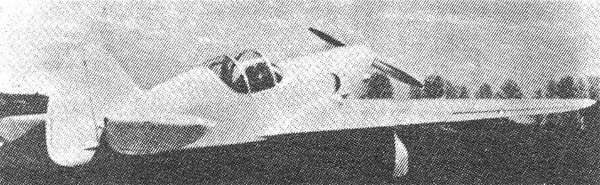
In the summer of 1938, the Latvian aircraft designer Kārlis Irbītis, working at the Valsts Elektrotehniskā Fabrika (VEF) at Riga commenced design of a single-seat advanced trainer as a follow on to his earlier, similar VEF I-14 aircraft.

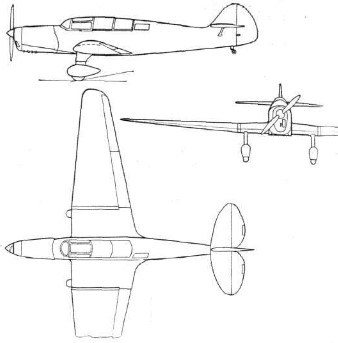
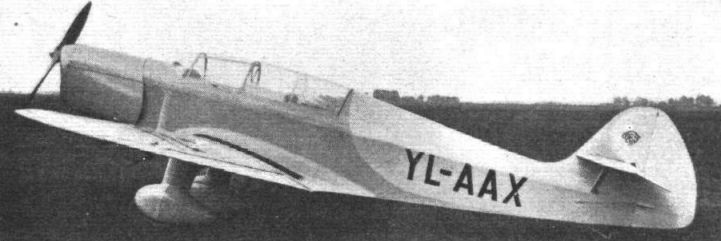
The I-15 was a low-winged monoplane of all-wooden construction, powered by a single de Havilland Gipsy Six air-cooled engine, and fitted with a fixed tailwheel undercarriage.

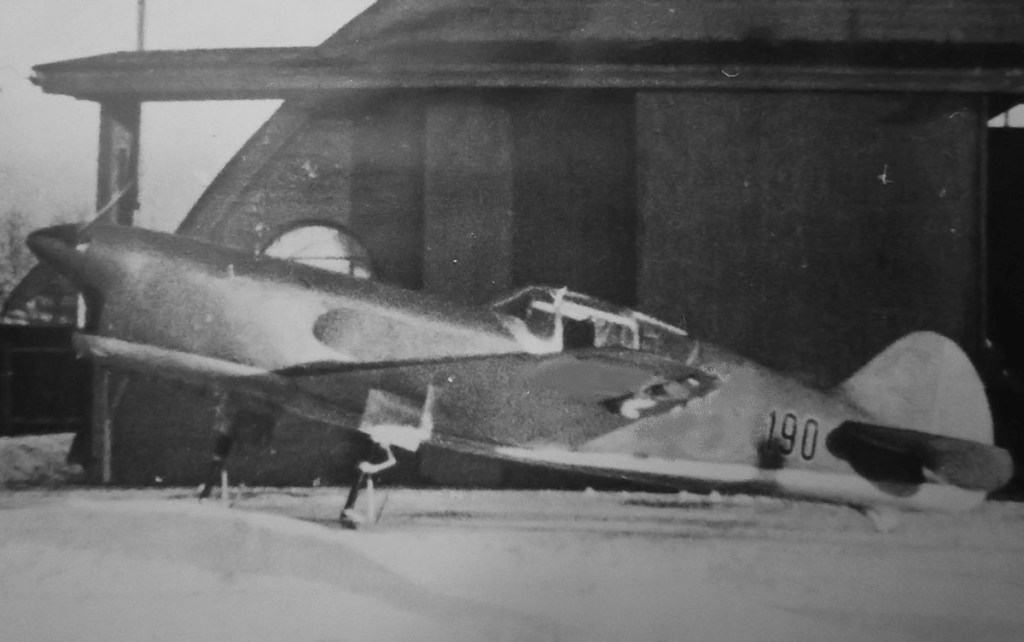
The design of the I-15 was in general similar to the earlier I-14, but it was carried out taking into account the requirements of the Air Force of Latvia. The fuselage and wing were slightly redesigned, a new de Havilland Gipsy Six-I engine (200 hp) was installed with a two-bladed fixed-pitch wooden propeller.

In April 1939, the first prototype, the I-15a with the registration number “190”, made its maiden flight, while a second prototype, the I-15b (“191”), was powered by a 220 hp (167 kW) Gypsy Six II engine driving a variable-pitch propeller, and armed with a single synchronised machine gun followed, this demonstrating improved performance, increasing speed from 314 to 330 km / h.

The two I-15 prototypes were transferred to the Latvian Air Force for use as advanced trainers, while a further two aircraft, to be designated I-15bis and powered by Hispano-Suiza 6 Mb engines were ordered by the Air Force, but on 17 June 1940, the Soviet Union occupied Latvia, ordering all aviation related work to be stopped.

Work on I-15 was discontinued in 1940, when a more advanced I-16 fighter was successfully tested.

15a
Engine: 185/200-hp de Havilland Gypsy 6-I
Prop: 2-blade wooden propeller
Max Speed: 314 km/hr

I-15b
Engine: 1 × de Havilland Gipsy Six Series II, 160 kW (220 hp)
Prop: DH constant speed, variable pitch metal
Wingspan: 8.00 m (26 ft 3 in)
Wing area: 10.77 m2 (115.9 sq ft)
Length: 7.10 m (23 ft 4 in)
Height: 2.10 m (6 ft 11 in)
Empty weight: 750 kg (1,653 lb)
Gross weight: 960 kg (2,116 lb)
Maximum speed: 331 km/h (206 mph; 179 kn)
max continuous Cruise speed: 300 km/h (186 mph; 162 kn)
Range: 610 km (379 mi; 329 nmi)
Service ceiling: 7,000 m (23,000 ft)
Armament: 1× machine gun
Crew: 1

VEF I-12

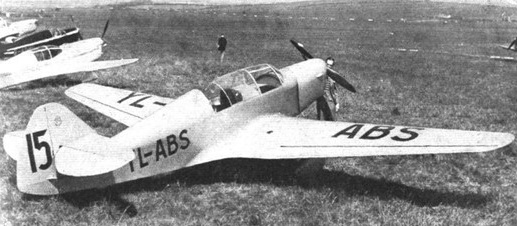
The VEF I-12 was a tandem, two seat Latvian trainer aircraft designed by Kārlis Irbītis and produced by VEF in Riga. By the end of 1936 Karlis Irbitis started work on the improved version in most aspect similar to the I-11, the, I-12. Main improvement was the wing construction with a smaller chord/thickness ratio and positioning of the fuel tanks in the wing center section.

The single engine, tandem, two seat I-12 was a development of the similarly laid out I-11, strengthened for aerobatics. It was an all wood low wing monoplane, entirely plywood covered apart from the tail control surfaces and with a fixed, conventional undercarriage. Its cantilever wing was built around a main and an auxiliary box spar, both made from spruce and plywood. The short wing centre section was integral with the fuselage, with the main undercarriage legs on it. These and the wheels, fitted with brakes, were faired. Outboard, the wing panels tapered to rounded tips, carrying both the balanced and slotted differential ailerons and hand operated camber changing split flaps.

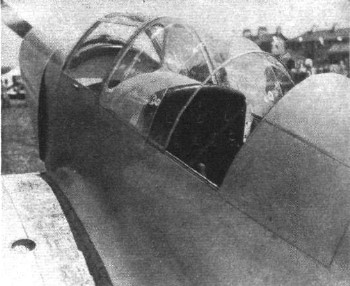
The fuselage was a rectangular box formed from spruce longerons, with a ply roof behind the cabin, where a long, multipart canopy enclosed the pilot and passenger’s seats. The pilot sat at the rear; both had removable sections for access. In front of them the 90 hp (67 kW) Blackburn Cirrus four cylinder in-line, inverted engine was mounted on steel bearers, driving a wooden propeller. At the rear of the fuselage the empennage was conventional, with the tailplane mounted on the fin above the fuselage line and braced from below with a steel strut on each side. The elevators were hinged forward of the rudder, which carried a trim tab, but were shaped to allow its movement as it extended to the keel.

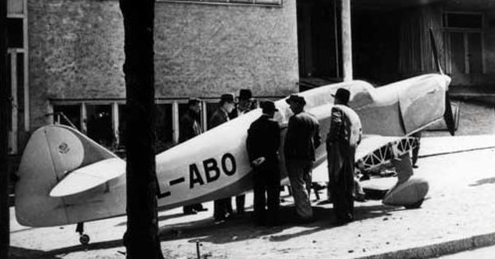
The first flight was made on 26 June 1937. The aircraft proved good and it has used in several air competition in Europe. One machine, YL-ABO, was lost at 17 May 1938 during the International Aircraft Exhibition in Helsinki. After the demonstrating of spin from 200 meters, the pilot did not manage to recover and the aircraft crashed killing its pilot.

The first prototype, on a European tour begun in July 1937, made several demonstrations in Paris. In the UK it raced at Ramsgate, coming fifth in the handicapped Thanet Air Race at Ramsgate, as well as winning first prize for the best turned out aircraft. Late in August it came in second in the Cinque Ports Wakefield Cup races at Lympne. Its tour ended the following July, flown back to Riga by P. Avery in a record nine hours, non-stop from London. Avery flew another I-12 in 1939, coming fifth in the London to Isle of Man race and competing in the Isle of Man competition in May.

Several were accepted for service and in 1939 the I-12 was accepted by Air registration Board for sale in UK. Rollasons were designated as distributors after the I-12 had been adjusted to meet UK certification requirements. It was also offered on sale in the UK by D.R.P. Engines at £750 but no examples reached the UK civil register.

Versions of this aircraft include a single seat fighter plane trainer where the front cockpit was covered and the canopy was single seat.

In total twelve I-12 was built.

VEF-Irbitis I-12 Latvian AF

In the 1939 V.E.F. I-12 entered service with the Latvian Air Force. They later operated four I-12 with two converted as single seat trainers. They also used gun camera for combat practices. The aircraft were painted Dark Green topside, with Light Grey lower wing surfaces. National insignia was Auskelis cross in Dark Red on a White disc are used in six positions. Serial number on fuselage was Black with a White outline.

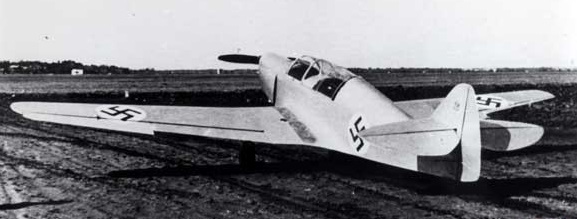
Germany used two or three captured I-12 captured from the Soviets, who had captured this machines previously.

Gallery

Engine: 1 × Blackburn Cirrus Minor, 90 hp
Propellers: 2-bladed
Wingspan: 9.3 m (30 ft 6 in)
Wing area: 11.3 sq.m (122 sq ft)
Length: 7.1 m (23 ft 4 in)
Height: 1.9 m (6 ft 3 in)
Empty weight: 458 kg (1,010 lb)
Gross weight: 680 kg (1,499 lb)
Fuel capacity: 17.5 imp gal (79.6 l; 21.0 US gal)
Maximum speed: 230 km/h (143 mph; 124 kn)
Cruise speed: 198 km/h (123 mph; 107 kn)
Range: 724 km; 391 nmi (450 mi)
Landing speed: 47 mph (76 km/h)
Crew: 1 or 2

VEF I-11 / Irbītis I-11

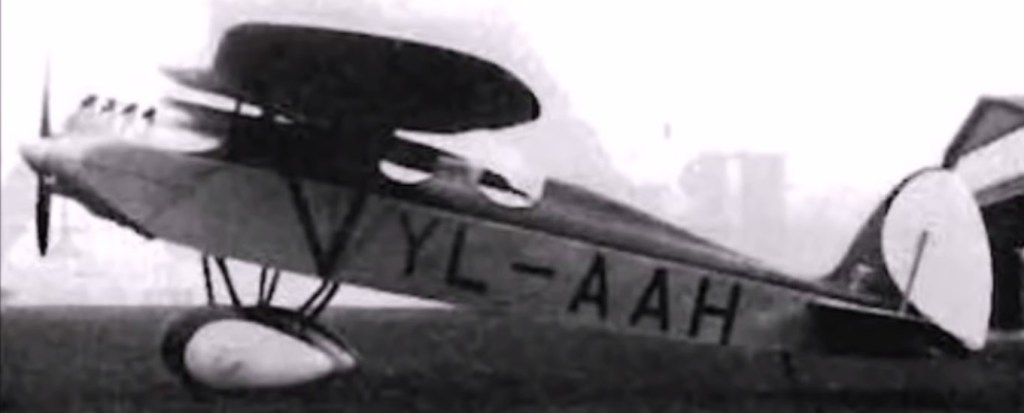
The VEF I-11 (also called the Irbītis I-11) was a Latvian light aircraft designed by Kārlis Irbītis in 1936 and built by VEF. It was a low-wing monoplane with a two-seat tandem cockpit and fixed conventional landing gear.

In February, 1936 the aircraft’s wings underwent structural testing.

On June 23, 1936, the I-11 made its maiden flight at Spilve and on April 26, 1937, it flew a 1,000 km (621 mi) flight around Latvia in 5 1/2 hours.

Gallery

Engine: 90-hp Cirrus Minor
Wing Span: 9.3 m
Length: 7.1 m
Height: 1.9 m
Max Speed: 230 km/hr
Range: 800 km
Maximum Ceiling: 4,000

Vaxmistrov AVF-8

During his student years at the Air Fleet Academy, Valdimir Vaxmistrov was swept away by the enthusiasm for glider manufacturing that existed at the institution.

In 1924 Vaxmistrov designed a single-seater training glider. Designated ” Kondor ” by its constructor, it received the consecutive 8 in the control of the academy. It was built on the transport base of the Sovnarkom in Moscow.

The Vaxmistrov AVF-8 “Kondor” (Russian: Вахмистров АВФ-8 «Кондор») was designed as a strut-braced monoplane with a triangular tail unit and a large-area rectangular rudder. The structure was made of wood with a fabric covering.

This single-seat glider first flew on September 22, 1924. It was damaged during the II National Sailing Competitions.

AVF-8 “Kondor”
Wingspan: 13.8 m
Wing area: 22.6 m²
Aspect ratio: 8.4
Length: 4.6 m
Height: 2.6 m
Empty weight: 70 kg.
Wing loading: 6.2 kg / m²
Elevator area: 3 m²
Rudder surface area: 1.2 m²
Accommodation: 1

Vaxmistrov, Vladimir Sergueyevich

Vladimir Vaxmistrov was born on June 27, 1897 in Moscow. In 1915 he finished his studies at the Royal School in Moscow. At the age of 17 he voluntarily entered the army and was posted to the Mikhailovsk Artillery School (Petrogradsky). At the age of 19 he participated in several combats, but his interests were far from artillery. In 1916 he managed to be admitted as an aviation observer (partly thanks to his brother Boris who commanded a brigade in this group.

With the triumph of the October Revolution he joined the Red Army. He already participated as a pilot in battles over Orenburg and later the aviation group in which he served was sent to Turkistan. In 1921 he was able to continue his studies, initially at the Turkistan State University and later at the Air Fleet Academy.

The study stage coincided with the period of development of gliding in the USSR. His first design was the AVF-8 “Kondor” of 1924. Together with MK Tijonrarov he built the AVF-22 “Zmei Gorinich” glider in 1925. This glider was so effective that it was selected to participate in international flying competitions in Penske, Germany.

From that year on, Vaxmistrov participated in all competitions in Crimea. In 1927, together with Dubrovin and Tijonrarov, he presented the “Zhar-Ptitsa” glider, which established a 15 km range record in the competitions of that year. A year later these three friends presented the “Gamayún” glider in which for the first time in the USSR the pilot AB Yumashiev soared in a thermal over the plain for 375 meters. The “Skif” glider, also built by the trio, established in the VI National Competitions in 1929a Soviet altitude record at 1,520 meters and an improved version of the “Zhar Ptitsa-2” glider set a new range record of 32 km with return.

Between February and April 1926 Vaxmistrov participated as a crew member during the state tests of the Túpolev R-3 (ANT-3) reconnaissance aircraft, which were flown by MM Gromov.

Upon finishing his studies at the Air Fleet Academy in 1930, VS Vaxmistrov went on to work at the NII VVS, where he was able to develop his idea of combined aircraft. The first step in this direction came through a competition for an aerial target promoted by the institute and in which the idea presented by Vaxmistrov was the winner. The aerial target was fixed to a Polikarpov R-1 and at the precise moment it was released. The mother plane left the firing zone as the target began gliding.

The idea of transporting a small plane on a larger plane gradually took shape and became the famous “Zvenó” or “Chains”. In the next few years Vaxmistrov’s work was directly linked to the development of these combined flying structures that were used successfully in some missions during the initial stage of the Great Patriotic War.

In 1937 after the arrest of Mikhail Tukhachevsky the project of the “Zvenó” was stopped. Vaxmistrov was able to escape the process with only a demotion from principal constructor to brigade chief in KB-29 itself. Between 1937 and 1940 new versions of the “Zvenó” were developed. A version known as SPB was used successfully at the beginning of World War II in the attack against a bridge of strategic value in Romania.

In the pre-war years the KB-29 under the leadership of Vaxmistrov also developed a novel idea of fighting against enemy bomber formations known as PTP. It was a three kilogram bomb tied to a 100 meter rope that ended in a parachute. These bombs were to be dropped in large quantities to meet the bomber formation. When the enemy plane’s wings or fuselage met the rope, the resistance of the parachute caused the rope to move upwards. Making contact with the body of the plane activated the fuse that made the bomb explode. Despite satisfactory results in state tests, this method was never used.

From 1940, Vaxmistrov went to work in the OKB of NN Polikarpov, being soon appointed his replacement in aircraft development group and directed parallel the repair of I-16.

Between 1943 and 1945 Vaxmistrov worked on two new composite aircraft projects. The first known as TP (Transport Glider) was composed of gliders linked by fighters that guaranteed the motive power and the second included fighters linked with bomb planes.

After the Great Patriotic War, Vaxmistrov kept working in the aeronautical industry. In 1949 he worked on the development of an in-flight refuelling system.

He died in 1972 in Moscow.

Aeronautical production

Stage at the Air Fleet Academy

AVF-8 “Kondor” Glider (1924)
Glider AVF-22 “Zmiei Gorinich” (1925)
Glider “Zhar-Ptitsa” (1927)
Glider “Gamayún” (1928)
Glider “Skif” (1928)
Glider “Konsomolskaya Pravda” or “Zhar Ptitsa-2” (1929)
Glider “Skif-2” (1931 ).

Stage at TsAGI and KB-29

Zvenó or Zvenó-1 (1931).
Zvenó-1A (1933).
Zvenó-2 (1932) Project.
Zvenó-2A (1934)
Zvenó-3 (1934)
Zvenó-4 (1934)
Zvenó-5 (1935)
Zvenó-6 (1935)
Zvenó Aviamatka PVO (1935)
Zvenó-SPB (1937)
Vaxmistrov I-Ze (1937) Project.
Zvenó-7 (1938)

Other projects
An unrealized project of Vaxmistrov’s composite aircraft based on a TB-7 bomber.

Vladimir Vaxmistrov designed even other more complex versions such as the I-16 8-fighter transport project(Two fighters under the wing, and the other 6 in special structures located on the wing structure). Five of these fighters had to fly with the engines running to ensure the necessary power thrust. To avoid wasting its own fuel, the feeding was conceived directly from the tanks of the mother plane. The patrol time of this version was estimated at 6.5 hours, which was quite high for the time. Once the mission was over, the planes made contact with the bomber at a speed of 150 – 170 km / h. The bomber crew had to manually ensure the fixation of the fighter to the attachment point on the structure. The fighter-bomber contact system was tested in 1938 by the experienced NII VVS test pilots. Stepán Suprún and Piotr Stefanovski , demonstrating the feasibility of the system. However this version of 8 fighters was never built.

In the first half of the 1930s VS Vaxmistrov presented the preliminary design of a flying aircraft carrier which he also called Aviamatka. Vaxmistrov’s Aviamatka was designed as a monoplane with a parabolic-shaped flying wing scheme. 10 M-34FRN engines were placed in pairs on the wing leading edge moving 5 traction propellers. The parasitic fighters were located semi-inserted in the thick wing and were raised to the extraction by means of elevators, as is customary in aircraft carriers. This gigantic aircraft was also envisioned as a transport and tanker aircraft.

After the successful realization of the SPB project, Vaxmistrov conceived other improved variants of “Zvenó” SPB among which the following stand out:

A Pe-8 bomber (ANT-42 or TB-7) loading two I-16 SPBs or two more modern MiG-3 or Lavochkin-Gorbunov-Goudkov LaGG-3 fighters with two FAB-250 bombs each. The maximum takeoff weight of this configuration did not exceed 33,500 kg and the maximum speed had to reach 405–420 km / h at 6,000 meters of altitude working the six engines at nominal speed, with a range of 1,320–1450 km. The Petlyakov Pe-8 was withdrawn from production in 1942 and the project was left on paper.

A flying boat GST (version the Consolidated PBY Catalina in the USSR ) carrying an I-16SPB on each wing.

An MTB-2 (ANT-44) heavy hydrofoil with two fighters.

Other projects included:

A composite transport glider raised by fighters installed under the wings and designed to guarantee the change of base of fighter squadrons in the absence of transport aircraft.

A double empennage glider attached to a fighter with two 1000 kg FAB-1000 ropes, one on each tail cone (a concept generally similar to the German Mistel of the final stage of the war).

A missile with delta wing configuration propelled by a ramjet and combined with a fighter.

None of these projects went beyond the drawing board. Vaxmistrov never managed to realize his idea of winged aircraft carriers.
Vanderford 1923 Experimental

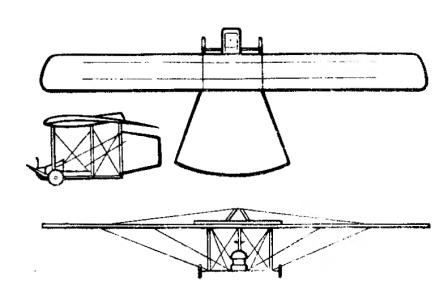
In 1923 William Vanderford of Gladbrook IA. Built a single place, open cockpit, high wing monoplane, powered by a 2-cyl Harley-Davidson engine, which was not the only motorcycle part used. Open frame fuselage.

On the first run of the engine the airplane spun around, ran over a small tree, and almost made it to the neighbor’s porch. Taxiing trials were made, but the airplane would not rise, so it ended up instead as a powered sled.