Verville-Sperry R-3

Verville-Sperry R-3 1922

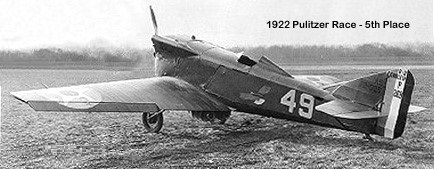
On 23 May 1922 Army contract #7388 was awarded to the Lawrence Sperry Aircraft Vo for three special Army Sir Service R-3 racing aircraft. The price was set at $25,000 per aircraft without powerplant. The special Wright H-3 High Compression engines were to be furnished by the Air Service, but installation was to be done by the builder. Serial numbers 22-326, 22-327 and 22-328 were assigned to the three racers. Three propellers were shipped from McCook Field to the Sperry plant in Farmingdale, Long Island, but these were never used. They were but the first of a long series of props designed to get the most out of the special Wright engines.

The Air Service contract with Wright Aeronautical called for modification of three engines originally designed for the MB-3, at $750 engine each. After the 1922 race, they were to be returned to Wright, re-modelled and re-consigned to Boeing Aircraft Co.

Alfred Verville had the R-3 design finalised, the work got underway at the Sperry plant. Things progressed normally except for a few items. There were no 200mph airspeed indicators. But Pioneer Instrument Company built enough for the planes entered in the Pulitzer race.

New birch propellers were ordered from the Hartzell Walnut Propeller outfit on 18 August. It was decided that several different props would afford a better test range, so two of the new props were 99 inch in diameter, 100 inc pitch, the other two 96 inch in diameter with 104.5 inch pitch. Whirl tests were to be conducted on all, and if they did not turn 2000 rpm, they would be trimmed until they did. Trhee props were delivered to Sperry on 15 September. But just three days before that, the Engineering Division at McCook Field notified the contractor that they had designed four different type of props and were building them at McCook Field.

Verville-Sperry R-3 Prep for 1923 St Louis Air Meet

The first was refitted with a 500hp Curtiss D-12 in 1923 and won the Pulitzer Trophy in 1924 at 216.5 mph.

Verville-Sperry R-3 Advertising art

Engine: 400hp Wright H-3
Wingspan: 29’3″
Length: 22’5″
Speed: 191 mph
Seats: 1
Verville Aircraft Co

USA
Alfred V. Verville was formerly a designer with Engineering Division of US Army Air Service, producing his first (unsuccessful) aeroplane in 1915. He is best known for his later Verville-Packard and Verville-Sperry racing aircraft of the early 1920s. In 1925-1927 he produced the Buhl-Verville Airster two-seat biplane, first civil aircraft to be certificated in U.S. (March 1927).

1925:
(Alfred V) Verville Aircraft Co,
Green & Melville Aves,
Detroit MI
USA
In the former Rickenbacker automobile plant.

Vermont Gull Wing

Schill Gull Wing NX6929

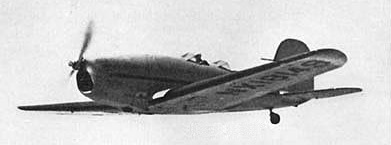
The 1929 Vermont Air Transport Co Gull Wing was constructed at Harrison NJ. The four place Gull Wing featured two side-by-side cockpits. Wide-chord, birdlike wings permitted landings in 300-400′.

The one built NX6929, planned for entry in the Guggenheim competition, but was damaged beyond repair in a rough-field landing at St Albans VT.

Schill Gull Wing NX6929

Engine: Anzani
Max speed: 80 mph
Stall: 30 mph
Seats: 4

Velie

1902: (Willard L) Velie Carriage Co.

1908: Velie Motor Co.

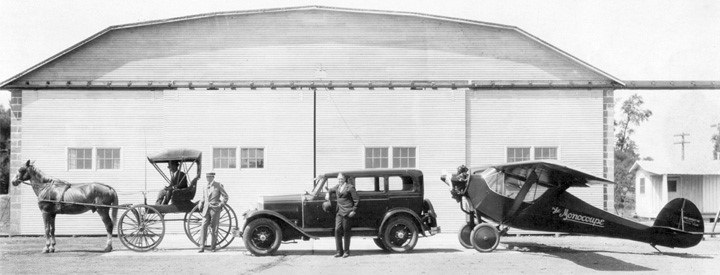
More known for his carriages, automobiles and racers, and motors, Velie (grandson of John Deere) also capitalized and manufactured the initial 55-65hp Monocoupe aircraft upon acquisition of controlling interest in Central States Aircraft Co in 1927, hence early popular reference to “Velie Monocoupes” signifying not only the powerplant but the constructor.

Velie product lineup

When Velie died of an embolism in Oct 1928, his son took the reins but he, too, suffered a heart attack in Mar 1929 and Don Luscombe took over.

1928: Mono-Aircraft Corp (pres: W L Velie),
1616 McGee St,
Moline IL.
USA

Vega Flying Test Stand / Lockheed Altair 8-D

Vega Flying Test Stand NX18149

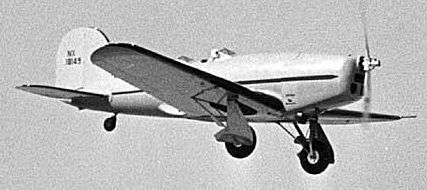
The 1938 Vega Flying Test Stand (ATC 2-423) was designed by Jack Wassall and W N “Wally” Wallace, and assembled from various Lockheed components. First designated Lockheed Altair 8-G and registered NX18149, it was used to test experimental 520hp Menasco U-520 Unitwin (twin 260hp Super B with single propeller) for use in a planned Starliner.

Sold to Lockheed dealer Howard Batt when it was no longer needed, repowered with 450hp P&W Wasp SC under (2-423) in 1939 and reregistered as Lockheed Altair 8-D in 1940.

Vega Flying Test Stand NX18149

Engine: 520hp Menasco U-520 Unitwin
Wingspan: 42’9″
Length: 28’11”
Seats: 2

Vega Aircraft Corp / Airover Co

Vega Airplane Company

USA
Vega Airplane Co was known formerly as Airover Company, Victory Blvd and Empire Ave, Burbank, California, formed at 923 E San Fernando Rd, Burbank, California, as associated company of Lockheed Aircraft Corporation in 1937. Began research/development experiments with light aircraft, devising (with Menasco) a unit called Unitwin; two small engines coupled side-byside to drive single propeller flight-tested in Lockheed Altair in 1938. Then designed five/six-seat Starliner twin-tailed low-wing cabin monoplane using similar powerplant. Small batch of radio-controlled targets built in 1939. Factory expanded 1940, and mid-year received contract to build large numbers of Lockheed Ventura bombers for RAF. Then, in conjunction with Boeing and Douglas, mass-produced Boeing B-17 Flying Fortress bombers; became wholly owned subsidiary of Lockheed in 1941 as Vega Aircraft Corporation (pres: Courtland S Gross).

From 1941 Vega Aircraft Corp became Vega Airplane Company; continued production of Lockheed-Vega B-34 Ventura twin-engined medium bomber for USAAF/USN/RAF and Boeing B-17 Flying Fortress for USAAF between 1941 and 1944. Absorbed into Lockheed Aircraft Corporation 30 November 1943; name Vega abandoned; Vega plant became Lockheed’s Factory A. Ventura B-34 production ended 1943; PV-1 naval version and Boeing B-17 manufacture continued until 1944 under responsibility of Lockheed.

VEF JDA-10M

The VEF JDA-10M was a Latvian twin-engine, multi-purpose aircraft built in 1939 by VEF. It remains the only twin-engine aircraft ever built in Latvia. The builder of JDA-10M was American-Latvian engineer Jānis D. Akermanis (John.D.Akerman), a professor at the University of Minnesota.

Construction started in 1937, but the first flight of the JDA-10M was in September 1939. After the beginning of the Second World War it was planned to transform airplane into a light bomber for the military.