1204 Wilson Blvd,
Camden NJ.
USA
Airplane builder circa 1929.
1204 Wilson Blvd,
Camden NJ.
USA
Airplane builder circa 1929.
Designed by William L Shaffer, the 1928 SS-1 was a three-place, open-cockpit biplane. It was fabric-covered steel-tube fuselage with wood-framed wings.
No production data was found about this short-lived company, who announced they would keep the initial selling price at $2,000, except for a sole registry of NX5626 c/n 1. Some records show the 50hp Hallett H-526 installation replaced by a 90hp Curtiss OX-5 engine. The X license was cancelled on 2 January 1930 and the ID cancelled 2 July 1934.
Engine: 150hp Hallett H-526
Wingspan: 31’0″
Length: 23’4″
Seats: 3
pres: Forrest W Hicks,
Victory Airport,
8016 Lankershim Blvd at Strathern St,
North Hollywood CA.
USA
Built the SS-1 model airplane in 1928.

The Vickers Vanncock was designed to meet the Air Ministry Specification B.19/27 calling for a long-range night bomber.
Only one prototype was built, J9131, but it was twice modified and given new type numbers.
The Vanncock Mk.I, Type 150, was powered by two Rolls-Royce Kestrels and fitted with single-bay outer wings.
The Vanncock Mk.II, Type 195, was re-engined with two Bristol Pegasus I,M.3s and had a three-bay wing. The four-seat Mk.II had an AUW of 16,000 lb, span of 76 ft 6 in, and length of 60 ft 4 in.
The final Type 255 reverted to two-bay wings of increased area, retaining the Pegasus engines.

Following the first Lympne trials held in 1923 for single-seat motor-gliders, the Air Ministry organised a similar event in 1924, this time for low-powered two-seat aircraft. The engine capacity limit was set at 1,100 cc. and, as before, the wings had to fold for easy transport and storage.

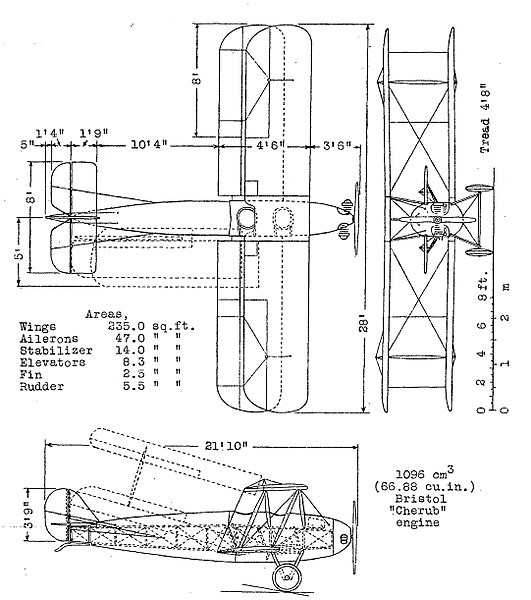
The Vickers Type 98 Vagabond was Vickers’ entrant for the second Lympne light aircraft competition, held in 1924. Designed by R.K. Pierson, it was a single-bay, wire-braced biplane with wings of constant chord except towards the rounded trailing tips. The wings had equal span and carried marked stagger. There were ailerons on both upper and lower wings, with flaps inboard on the lower wings which could be folded to assist wing-folding. The pilot and passenger sat in open cockpits, the latter under the upper wing. The pilot’s upward view was enhanced by a small cutout in the trailing edge of the top wing. The fuselage had a more rounded cross-section than that of the earlier Viget, Vickers’ single-seat entry to the 1923 competition, extending a little below the lower wing. The 32 hp (24 kW) Bristol Cherub III flat twin engine was mounted in a smooth nose with the finned cylinders exposed for air cooling. The horizontal tail was similar to that of the Viget, but the fin and rudder were much more rounded. Because of the stagger, the mainwheels were in front of the lower wing, braced to the lower fuselage logeron aft to the front wing spar and forward to a point roughly below the upper wing leading edge.

A most unusual feature of the Vagabond was the method of longitudinal trimming. Rather than changing the angle of the tailplane with respect to the fuselage, the whole rear part of the fuselage was hinged just ahead of the lower wing’s trailing edge. This was controlled via a handwheel between the two cockpits; the rear fuselage was raised at the start of a landing descent to increase drag and slow the aircraft.
Early flight trials, with H.J.Pain as pilot revealed a need to stiffen the engine mountings. When this was done, the Vagabond, now fitted with a three-cylinder 1,095 cc Blackburne Thrush radial engine flew well enough at Lympne, but was eliminated in the preliminary rounds. The trials took place between 29th September and 4th October 1924.
Nevertheless, the aircraft and engine performance were improved once it had been eliminated from the main event and it subsequently took part in the 100-mile Grosvenor Challenge Cup Race, which was won by Bert Hinkler flying the Avro Avis.
Only one Vagabond, registered as G-EBJF on 1 July 1924 was built. It was deregistered on 24 January 1928.
Powerplant: 1 × Bristol Cherub III, 32 hp (24 kW), later 1,095 cc Blackburne Thrush
Wingspan: 28 ft 0 in (8.53 m)
Wing area: 235 sq ft (21.8 m2)
Width: 10 ft 0 in (3.05 m) (width wings folded)
Length: 21 ft 10 in (6.65 m)
Empty weight: 527 lb (239 kg)
Gross weight: 887 lb (402 kg)
Maximum speed: 77 mph (124 km/h, 67 kn)
Crew: 1
Capacity: 1 passenger
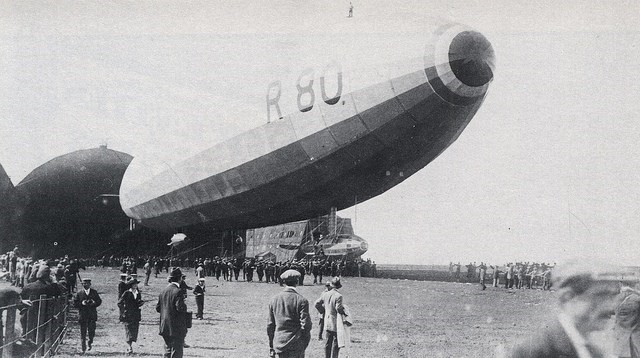
Circa 1921 was the R80; the only example of the Small R33 Class. She was the last rigid to be planned before World War One ended. Measuring 534 ft in length, 70 ft in diameter, with a volume capacity of 1,250,000 cu ft she was fitted with four 250hp Wolsey Maybachs giving a maximum speed of 65mph. R80 was designed by Barnes Wallis and built by Vickers. When at Pulham decisions were reached that she was too small to be a lot of commercial use, and was laid up there after only 73 hours flying time. She was finally broken up in 1924.
R80
Length: 534 ft
Diameter: 70 ft.
Volume capacity: 1,250,000 cu ft.
Engines: four 250hp Wolsey Maybachs.
Maximum speed: 65mph.

Vickers Vedette were operated by the Canadian Air Force pre-WW2 on photo-survey duties.
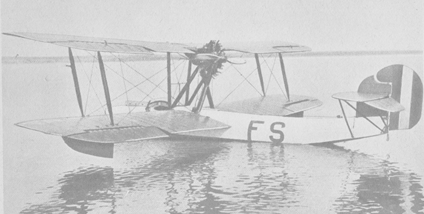
Engine: Lynx

In 1935, to meet Air Ministry Specification F5/34, calling for a single seat monoplane interceptor armed with six or eight machine guns, a retractable undercarriage was required and an enclosed cockpit; a speed of at least 275mph (442kph) at 15,000ft (4,572m) was stipulated. This requirement was taken up by a number of firms. Bristol produced the Type 146 (835hp/622kW Bristol Perseus). Vickers brought their Jockey Mk II into approximate line with the requirements as the Venom (625hp/466kW Bristol Aquila). Henry Folland produced his last design for Gloster, the G.38 (840hp/626kW Bristol Mercury IX). James Martin also looked at F5/34 and surprisingly found it to his taste. None of the aircraft built to this specification achieved production status.
Fundamentally a redesigned and improved Type 151 Jockey and, indeed, initially known as the Jockey II, the Type 279, for which Vickers adopted the name Venom, was intended to meet the requirements of Specification F.5/34. Powered by a 625hp Bristol Aquila AE.3S nine-cylinder sleeve-valve radial engine enclosed by a long-chord NACA cowling, the Venom was a highly sophisticated aircraft, with a metal monocoque fuselage, its stressed skin being affixed by countersunk rivets. It was unique at the time it entered flight test, on 17 June 1936, in having 90°-deflection flaps. The Venom retained the sideways-hinging engine feature of the Type 151, and a battery of eight 7.7mm machine guns was mounted in the wings from the start of test flying. The Venom proved exceptionally manoeuvrable, with outstanding roll rate and turning radius, but it lacked the power to compete seriously with its Rolls-Royce liquid-cooled Vee-type-engined contemporaries, and, as no sufficiently compact British air-cooled radial of adequate power was available for installation, it was scrapped in 1939.
Engine: Bristol Aquila, 625hp/466kW
Max take-off weight: 1885 kg / 4156 lb
Wingspan: 9.98 m / 33 ft 9 in
Length: 7.36 m / 24 ft 2 in
Height: 3.27 m / 11 ft 9 in
Wing area: 13.56 sq.m / 145.96 sq ft
Max. speed: 502 km/h / 312 mph
Ceiling: 9755 m / 32000 ft


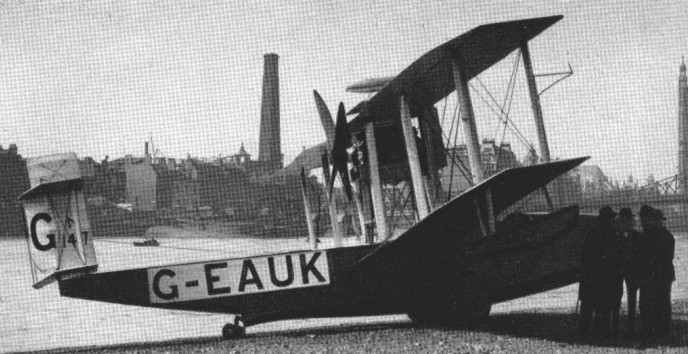
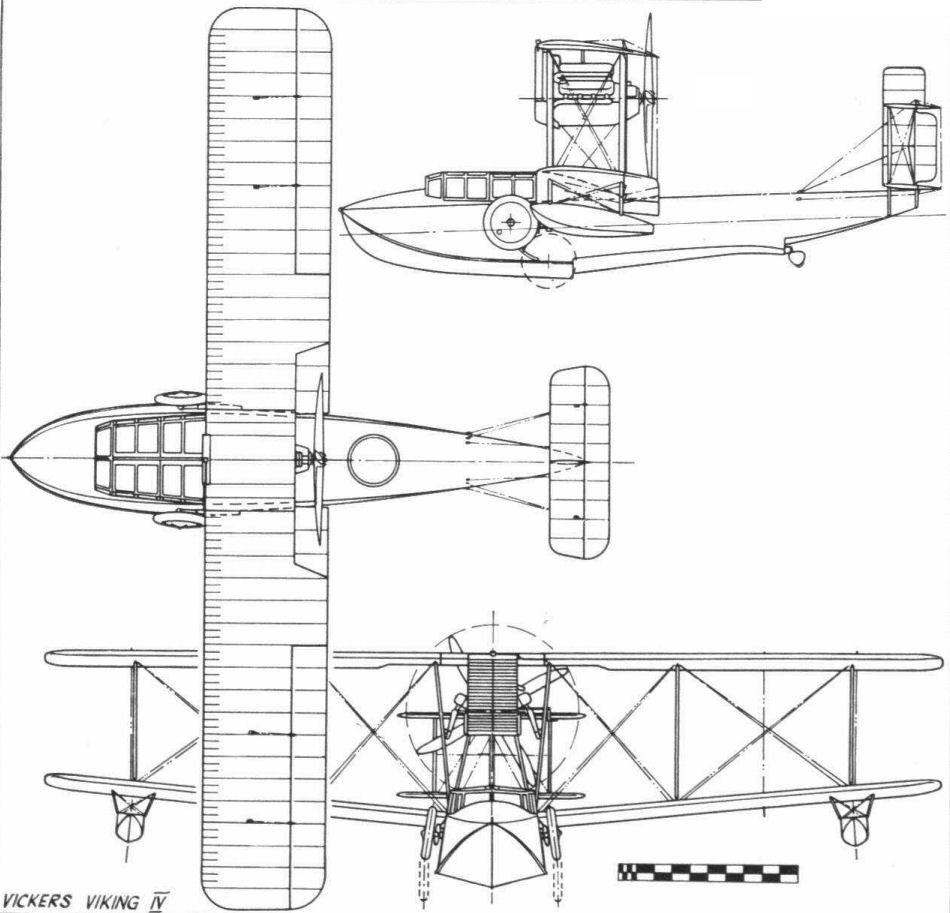
Direct London to Paris flights were pioneered in 1921 by a Vickers Viking III.
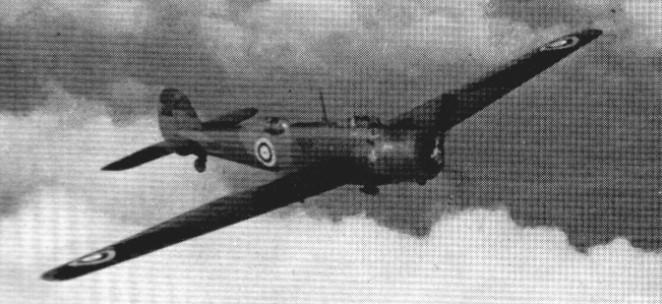
Air Ministry Specification G.4/31 called for a General Purpose aircraft, capable of level bombing, army co-operation, dive bombing, reconnaissance, casualty evacuation and torpedo bombing. The Vickers Type 253 won against the Fairey G.4/31, Westland PV-7, Handley Page HP.47, Armstrong Whitworth AW.19, Blackburn B-7, Hawker PV-4 and the Parnell G.4/31.
Designed by Rex Pierson, the Type 253 was the first aircraft built which partly used the Barnes Wallis geodetic design in the fuselage. Despite an order for 150, Vickers offered their private venture monoplane design the Type 246. This used the same geodetic design principles for both the fuselage and the wings, and first flew on 19 June 1935. It had superior performance to the 246 but did not attempt to meet the multi-role requirement, being a day and night bomber only. First flown with PV 0-9 markings, the 253 showed a lower tare weight, better performance and larger payload, partly as a result of the 8.85 – 1 high aspect ratio wing.
The Wellesley evolved from Vickers’ design for a general-purpose day and night bomber and coastal-defence torpedo-carrier biplane to satisfy Air Ministry Specification G.4/31, the company having decided to develop and build a monoplane aircraft to meet the same specification. When evaluated there was little doubt that the monoplane was superior, with the result that the Air Ministrv contract for the biplane was cancelled, being replaced on 10 September 1935 by one for 96 examples of the monoplane under a rewritten G.22/35 specification. The RAF ultimately ordered 176, named Wellesely, to a newly written specification 22/35, with a 14 month production run starting in March 1937.
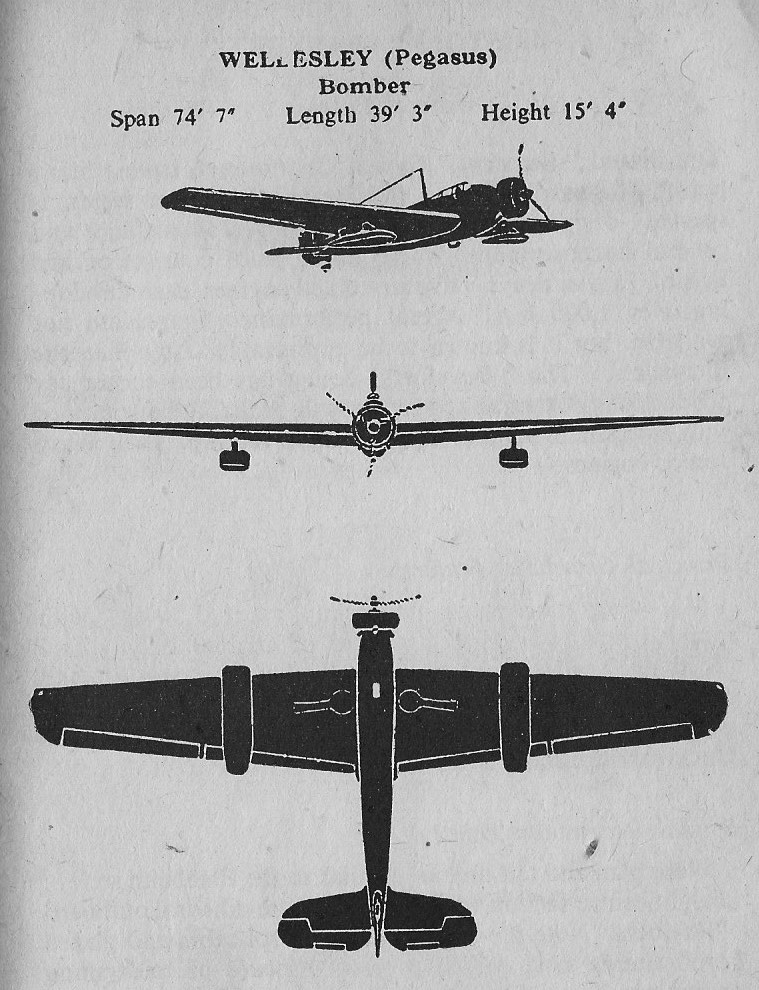
Named the Wellesley, it was the first RAF aircraft to utilise the geodetic form of construction devised by Barnes (later Sir Barnes) Wallis; offering a lightweight structure of great strength, it was adopted later for the Wellington. The other highly unusual feature was the provision of a pannier beneath each wing to serve as a bomb container. The low-set monoplane wing was also of geodetic construction, the main landing gear was hydraulically retractable, and power plant comprised a single Bristol Pegasus radial piston engine.
To avoid disrupting the geodetic structure, the bombload was carried in two streamlined panniers under the wings. The Wellesly Mk.1 had two separate cockpits, but this was changed in the Mk.II to a single piece cockpit canopy covering the pilot and navigator positions.
Wellesley Mk Is entered RAF service in April 1937 but by the outbreak of World War II most of them had been transferred to the Middle East, where they remained operational into 1941. The RAF received the first Welleselys in April 1937, for 76 Sqn at Finningley, and eventually equipped six RAF Bomber Command squadrons in the UK, Nos 35, 76, 77 and 148 Sqdns. Later a number were sent out to No.223 Sqdn, and as the home based machines were replaced, they too were sent out to the Middle East.
The primary use of the Wellesely during the econd World War was maily in the Middle East with only four examples remaining in Britain at the start of the war. Among its significant wartime operations was the bombing of Addis Ababa in August 1940, and Wellesleys of 223 Sqn were among aircraft that wiped out an Italian destroyer flotilla attack on Port Sudan in April 1941. Losses to Italian CR.42 fighters did occur when intecepted, as the Wellesley’s defensice armament of one fixed gun flexibly mounted firing aft was poor. They remained in the region until 1941 performing maritime reconnaissance duties.

The type is remembered especially in service with the RAF’s Long Range Development Flight, which was established at RAF Upper Heyford, Oxon, in January 1938. Equipment comprised six Wellesley Mk.Is modified by the installation of 28.7 lt 1010 hp / 753 kW Pegasus Mk XXII engines installed in NACA long-chord cowlings, and driving 3 blade Rotol ‘Incredible Hub’ constant-speed propellers; plus other changes which included strengthened landing gear, increased fuel capacity and the introduction of an autopilot. Adding a third crew member and a rest bunk and a folding pilot’s seat to allow mid-air pilot exchange. Between 5 and 7 November 1938, two of a flight of three of these aircraft (led by Sqn Ldr R. Kellett) succeeded in establishing a new world long-distance record, covering non-stop the 11,526km between Ismailia, Egypt, and Darwin, Australia, in just over 48 hours.

Wellesley Mk.I
Engine: 1 x Bristol Pegasus XX, 690kW / 937 hp
Max take-off weight: 5035 kg / 11100 lb
Empty weight: 2889 kg / 6369 lb
Wingspan: 22.73 m / 74 ft 7 in
Length: 11.96 m / 39 ft 3 in
Height: 3.76 m / 12 ft 4 in
Wing area: 58.53 sq.m / 630.01 sq ft
Max. speed: 198 kts / 367 km/h / 228 mph
Service ceiling: 10600 m / 34,700 ft
Range: 964 nm / 1786 km / 1110 miles
Crew: 2
Armament: 2 x 7.7mm machine-guns
Bombload: 900kg

 All Aero