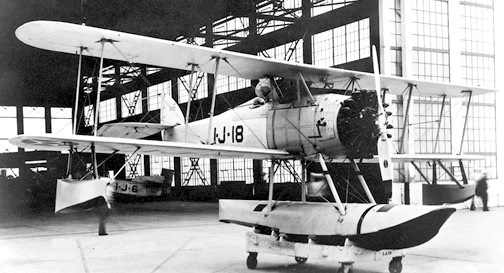
Vought FU-1 / FU-2

Vought FU-1 A-7372 Floatplane

In January 1927 the Chance Vought company produced a single seat fighter version of its mass produced VO 1 shipboard observation aircraft. A two bay biplane, the VO 1 was not entirely suitable as the basis for a competitive fighter, and with only the same engine as before, the 200 hp Wright R 1790 Whirlwind, performance was inadequate. Nevertheless, 20 FU 1 fighters were converted from UO-3 for the US Navy, most of them being central float seaplanes (at least two were fitted with wheels for airfield use).

Despite being pleasant to fly, the FU was really only suitable for training. In their first year, ending in the winter 1928 29, the FU 1s equipped fighter squadron VF 2B aboard the carrier Langley. Thereafter the 18 that survived were converted into FU 2 trainers, still with a fixed Marlin machine gun. They remained in use as trainers and general-purpose aircraft into the 1930s.

Equipped for catapult launch, they were the last fighter so equipped.

FU
Engine: 220hp Wright J-5 (supercharged R-1790)
Span: 10.46 m (34 ft 4 in)
Length: 7.44 m (24 ft 5 in)
Gross weight: 1093 kg (2400 lb)
Useful load: 694 lb
Maximum speed: 236 km/h (147 mph)
Stall: 53 mph
Range: 430 mi
Seats: 1-2

Vought VO-1

In January 1927 the Chance Vought company produced a single seat fighter version of its mass produced VO 1 shipboard observation aircraft. A two bay biplane, the VO 1 was not entirely suitable as the basis for a competitive fighter, and with only the same engine as before, the 200 hp Wright R 1790 Whirlwind, performance was inadequate. Nevertheless, 20 FU 1 fighters were built for the US Navy.

von Cosel 1930 monoplane

In 1930 Carl T von Cosel, of Key West FL. Built a two-place cabin, high-wing monoplane amphibian, registered N879Y and powered by a 180hp LeRhône rotary engine.

The wings were never attached, so the plane was never flown. Some reports claimed that von Cosel, an undertaker by trade, kept his dead wife in it for an unstated period of time.

When he left Key West in 1940, he took the plane with him and both disappeared.

Volvo Aero

Volvo Aero
Nohab Flygmotorfabriker AB
Svenska Flygmotor AB

Nohab Flygmotorfabriker AB was founded in Trollhättan, Sweden, in 1930 to produce aircraft engines for the Swedish Board of Aviation. As the name of the company indicates it was a subsidiary to NOHAB. In 1937 it became a part of the newly founded SAAB but already in 1941 Volvo acquired a majority of the stock and the name was changed to Svenska Flygmotor AB (SFA), and later on Volvo Flygmotor.

Since the 1950s the company have been the major engine supplier to the Swedish Air Force. The Volvo Aero Group has 3,600 employees and in 2003 had total sales of 0.9 billion euros. Today Volvo Aero is a partner in more than ten commercial engine programmes. Components from Volvo Aero are installed in more than 90% of all large commercial aircraft engines sold.

On 6 July 2012 Volvo Aero was acquired by the British aerospace manufacturer GKN in a SEK 6.9 billion deal.

Volvo Aero was a supplier of single-engine systems for military aircraft. These have largely been in partnership with other engine manufacturers, such as the RM1 (de Havilland Goblin) for the Saab 21R, RM2 (de Havilland Ghost) for the Saab J29, RM5 and RM6 (Rolls-Royce Avon) for the Saab 32 Lansen, the RM6B for the Saab 35 Draken, and the RM8 (Pratt & Whitney JT8D) for the Saab 37 Viggen. The Saab JAS 39 Gripen’s RM12 engine is a derivative of the General Electric F404.

Svenska Flygmotor also designed the B42, horizontally-opposed four-cylinder engine, intended for the SAAB Safir. However, SAAB decided on using engines from de Havilland and Lycoming for the Safir. In the end the B42 came to power the Infanterikanonvagn 103 assault gun. A follow-up called B44 powered the Pansarbandvagn 301 armoured personnel carrier.

Volvo Aero delivered engine components, mainly complex engine structures like turbine exhaust casings, turbine mid frames, LPT cases, compressor housings, LPT shafts, vanes, and large rotating parts.

Volvo Aero also had a facility in Trollhättan where they did maintenance on aircraft engines and stationary gas turbines. The aircraft engines are Pratt & Whitney Canada PW100 and TFE-731 engines. The Stationary gas turbines is General Electric LM1600 engine, and the DR990, which Volvo bought the OEM responsibility from Dresser Rand.

Volvo Aero manufactured combustion chambers, nozzles and turbines for commercial launch vehicles.

The company have produced the F-series hydraulic motors under the Volvo Flygmotor and VOAC brands.

Volvo Aero subsidiaries were located in the United States and Norway, in addition to Volvo’s home country, Sweden. The Norwegian plant, in Kongsberg, is the former Norsk Jetmotor, itself formerly a part of Kongsberg Våpenfabrikk.
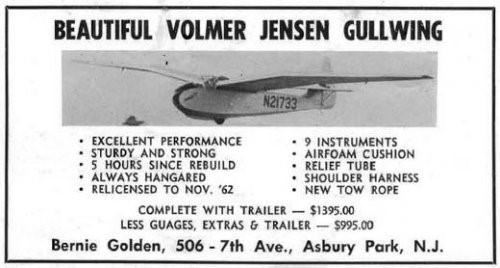
Volmer M-1 / Martin M-1

Jim Martin contracted Volmer Jensen to design and built him a glider for contest flying just before the Second World War.

The aircraft was constructed with a wooden structure and covered in doped aircraft fabric covering. The cantilever gull-style wing employed a NACA 4400 series airfoil. The tail was a conventional low-tail design and featured strut-bracing. The M-1 was registered as an Experimental – Amateur-built aircraft and was not type certified.

Jensen completed the aircraft in 1939.

Martin flew the aircraft in a number of US Nationals, as did a later owner of the M-1, Emil Lehecka. While Lehecka owned it the aircraft picked up the nickname of the Whatsit. By the 1970s the aircraft was owned by Francis Kalinowsky and was based at the Circle X airport in Florida. At that time it was reportedly in good repair and was well maintained.

The aircraft was removed from the Federal Aviation Administration registry and its whereabouts are unknown.

M-1
Wingspan: 48 ft 0 in (14.63 m)
Wing area: 180 sq ft (17 m2)
Aspect ratio: 12.8:1
Airfoil: NACA 4400 series
Empty weight: 438 lb (199 kg)
Gross weight: 631 lb (286 kg)
Maximum glide ratio: 28 at 50 mph (80 km/h)
Rate of sink: 132 ft/min (0.67 m/s) at 40 mph (64 km/h)
Crew: one

Volmer 1927 Glider / VJ-3

Volmer S. Jensen was born in Milwaukee in 1909. He began to design and build sailplanes in 1925 at age 16. using plans published in the Boy Mechanic Magazine. He built a second one the following year from additional plans from the same source, and in 1927 he built his first glider with aerodynamic controls, an enclosed cockpit and a wheeled landing gear. It was based on the MIT glider Eddie Allen had taken to Europe in the mid-20s to compete against the Germans.

Volmer Aircraft

Volmer S. Jensen was born in Milwaukee in 1909. He began to design and build sailplanes in 1925 at age 16. using plans published in the Boy Mechanic Magazine. He built a second one the following year from additional plans from the same source, and in 1927 he built his first glider with aerodynamic controls, an enclosed cockpit and a wheeled landing gear. The latter was based on the MIT glider Eddie Allen had taken to Europe in the mid-20s to compete against the Germans.

Volmer had moved to Seattle in 1925 to serve an apprenticeship as a machinist, and in 1928 he built a cantilever wing glider for a wealthy sportsman named Thomas Stimson. Volmer called it his VJ-4 and would utilize that numbering system for the remainder of his long aircraft design and construction career.

Throughout the late 1920s and 1930s his designs consisted of a series of increasingly sophisticated gliders, including the VJ-10 he built in 1939 which was the first two-place, side-by-side sailplane in the United States. During this period, Volmer was employed by a succession of aircraft companies, including Boeing, Consolidated, and Northrop, so his glider design and building were done in his spare time.

1946: Acquired Jarvis Aircraft Co assets.
Plans and component kits marketed by Herr Engr Corp, Lakeland FL.

To EAA members he is best known as the designer of the Volmer VJ-22 Sportsman, the first amphibian made available for home construction. To sailplane enthusiasts, he is revered as one of the pioneers of U. S. glider design and construction, with his first original design dating back to 1928. Hang glider pilots are amazed to learn that he built his first weight-shift biplane glider in 1925 when he was 16 … and ultralight pilots recall that he added an engine to his Sunfun hang glider in 1975.

Produces plans to construct VJ-22 Sportsman two-seat amphibian (first flown 1958) and VJ-24W SunFun single-seat open microlight (earlier VJ-23 Swingwing is recognised as having been the first modern microlight).

1995-8: Box 5222, Glendale, CA 91201, USA.

Volmer Jensen was the builder of the model of the Starship Enterprise that was used in the filming of the TV series and movies! (although it was designed by cabin Waco owner, Matt Jeffries.)

Volmer Jensen,
Burbank CA.
USA