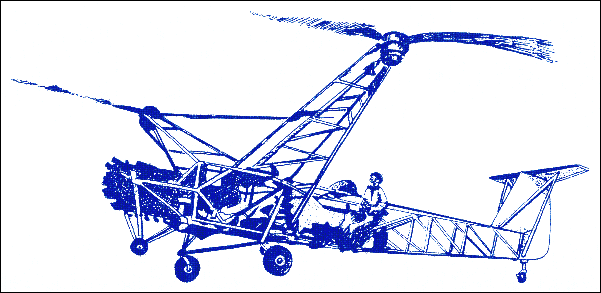
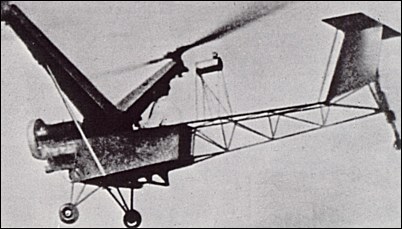
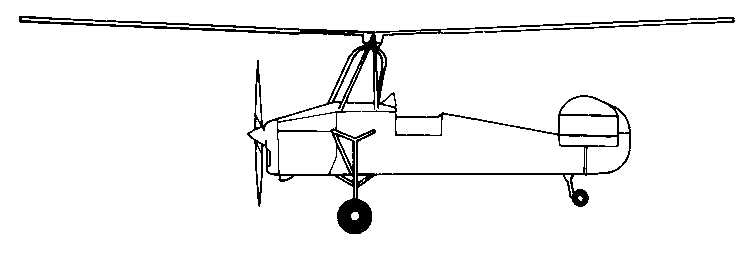
Much larger than its predecessors, this two-seater helicopter was powered by a more powerful fan-cooled engine located in the nose. Each of the two rotors had three blades made of compressed wood with leading edges in metal. They rotated at 275 r.p.m. and had both cyclic and collective control all enclosed within the hub. A ratchet-type freewheeling device was used for flying in auto-rotation. The maiden flight took place in Scotland in October 1939, but World War II, then in its early stages, caused all work to be stopped on the W.6 in the middle of 1940.
Weir’s chief designer, C.G.Pullin, first thought of converting the W.4 autogyro into a helicopter by using two co-axial rotors, but he finally adopted the system of rotors carried by outriggers on either side of the fuselage, like the 1937 Focke 61.
The W.5 was a single-seater powered by a 50 hp 4-cylinder air-cooled Weir engine; each of the two two-bladed rotors had cyclic and collective pitch control and they turned at 430 r.p.m.
This helicopter made its first flight at Dalrymple, Ayrshire, on 7th June 1938, when it was piloted by R.A.Pullin, son of the chief designer. By the outbreak of World War II it had logged eighty hours’ flying time.
Seats: 1 Engine: 1 x Weir, 50hp Rotor diameter: 4.57m Gross weight: 381kg Max. speed: 112km/h Rate of climb: 122m/min
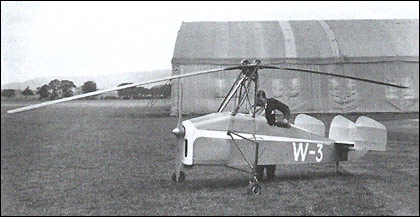
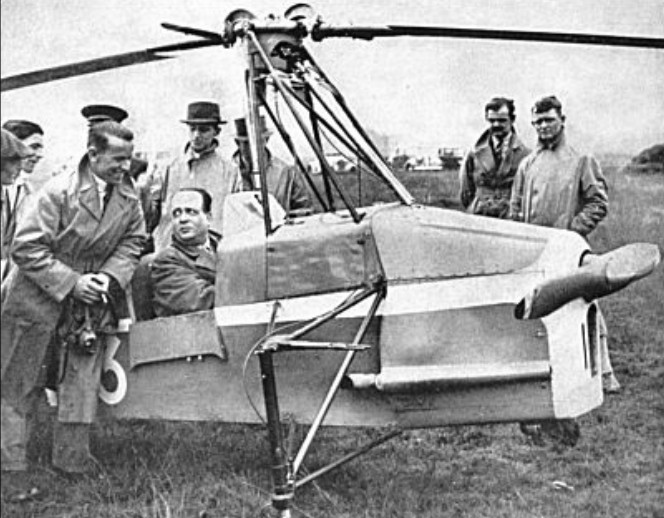
This single-seater was powered by an inverted 4-cylinder in-line engine and fitted with a two-bladed ‘auto-dynamic’ rotor. It could make a ‘jump take-off’: to do this, the rotor was run at overspeed in flat pitch then suddenly given sufficient positive pitch to produce the jump while the engine was declutched. The W.3 was publicly displayed at Hounslow Heath on 23rd July 1936.
UK This engineering firm of Cathcart, Glasgow, built Airco D.H.9 and RAF B.E.2c, B.E.2e and F.E.2b aircraft under subcontract during First World War. In 1930s built Autogiros under Cierva license; C.28/W-1 in 1933, W-2 in 1934, W-3 and W-4 in 1936. In 1937-1938 built and flew W-5 twin-rotor helicopter under Focke license, followed by W-6 of 1938-1939, world’s first helicopter to carry a passenger. Outbreak of war ended development.
In his lifetime (1861-1940), Lehman Weil invented several devices, including an early washing machine and a traffic light. The 1927 Ornithopter he built was his only flying machine.
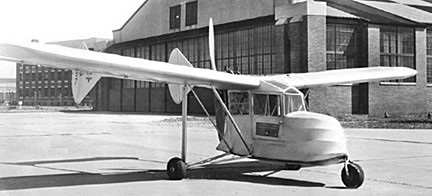
As the assistant chief of the aerodynamics division at Langley Field, in Virginia, Fred Weick was the guiding force behind development of the W 1, a pusher with an unorthodox wing configuration and decidedly unusual performance. The wing had an open slot behind the main spar controlled by a small aileron on the top surface and trailing-edge ailerons.
Although Weick’s research director at Langley wanted to have the aircraft built as a NACA project, Weick preferred to keep it free of smothering bureaucratic supervision. So, with the help of a handful of enthusiastic engineers, he built it in his garage, thereby early betraying an independent spirit.
Weick W-1-A Wind tunnel test NX67
The W 1 indeed turned out to have good stability and control and, according to Weick, was “automatically nonspinning.” It also would get in and out of unusually small spaces, off in 200 feet with no wind to an altitude of 50 feet. It landed in 100 ft, was spin- and stall-proof.
The W 1 also possessed a mildly revolu¬tionary device called a tricycle landing gear, which is what Weick says he first called it in his SAE report on the aircraft. The Weick W 1 team adopted the tricycle gear as a way to reduce ground-looping as well as a means of simplifying the entire land¬ing and takeoff process. Other noteworthy features were flaps, slot-lip ailerons, a pusher engine and twin fins.
With twin-boom, twin-tail; tricycle gear, the wing had an open slot behind the main spar controlled by a small aileron on the top surface and trailing-edge ailerons. Took off in 120′, landed in 100′, was spin- and stall-proof.
Purchased in 1934 by DoC for $5,000, plane was handed to Fairchild (Kreider-Reisner) to produce a modified W-1-A, with flaps in place of slots (NX213Y, NS67, NX67. It was Corp transferred to the NACA, it was damaged in testing and scrapped in 1938.
Engine: 85hp Pobjoy Cruising Speed: 80 mph Stall: 35 mph Span: 30’0″ TO ground roll: 120 ft Seats: 1


 All Aero