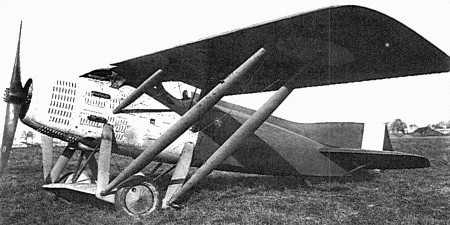
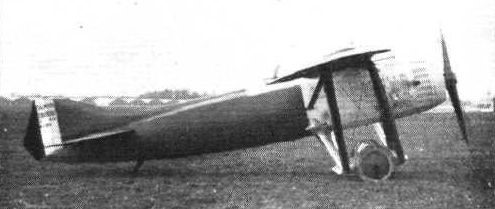
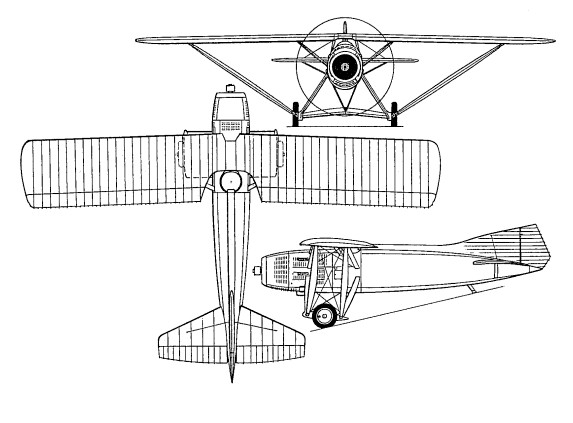
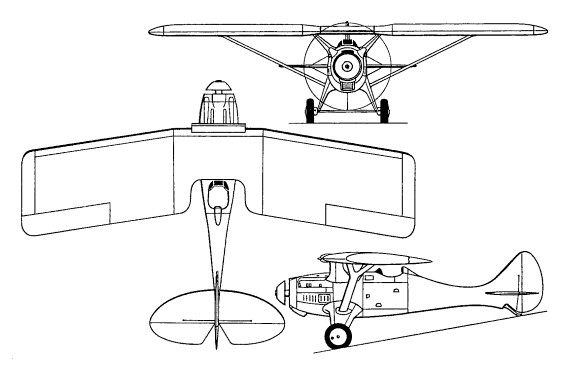
A derivative of the Letord-Bechereau 2 embodying some redesign and built by Buscaylet Pere et Fils- Bobin, the BB2 single-seat fighter was tendered to meet the requirements of the 1923 C1 programme and the sole prototype was flown in 1924. Powered by a 500hp Salmson 18Cm 18-cylinder water-cooled engine driving the propeller via an extension shaft, the BB2 was of essentially similar configuration to that of the earlier LB2, but replaced the inclined aerofoil surfaces between the undercarriage structure and mid span with very substantial struts. Armament comprised the standard pair of 7.7mm machine guns. Prototype trials proved disappointing and the aircraft was discarded from the official short list of contenders. However, further development as a two-seat fighter was later undertaken by its designer, Louis Bechereau, after his appointment as chief of the airframe design staff of the Salmson company.
The 1921 Letord-Béchereau LB-2 design for Établissements Letord (Émile-Louis Letord) was continued as the 1924 Buscaylet-Béchereau BB-2. It was also known as the Buscaylet-Bechereau C.1 (to 1923 C1 contest).
Engine: 500hp Salmson 18Cm Take-off weight: 1758 kg / 3876 lb Empty weight: 1350 kg / 2976 lb Wingspan: 14.00 m / 46 ft 11 in Length: 10.00 m / 33 ft 10 in Height: 3.00 m / 10 ft 10 in Wing area: 39.00 sq.m / 419.79 sq ft Max. speed: 250 km/h / 155 mph
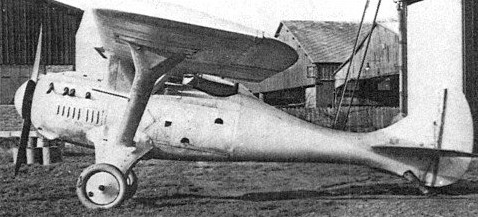
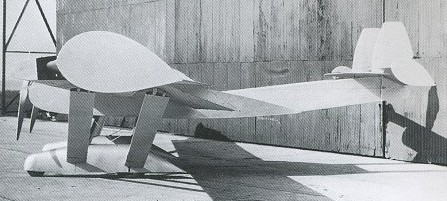
During 1922, Buscaylet Pere et Fils-Bobin produced a single-seat parasol fighter monoplane designed by Louis de Monge. Known as the Buscaylet- de Monge 5/2, the fighter was of metal construction with metal fuselage skinning and wooden wing skinning. Provision was made to fit auxiliary stub wings (serving to increase the wing area from 24sq.m to 32sq.m to convert the aircraft to sesquiplane configuration for the high altitude role. Powered by a 300hp Hispano-Suiza 8Fb water-cooled engine and carrying an armament of two 7.7mm synchronised machine guns, the Buscaylet-de Monge 5/2 was flown for the first time in 1923 at Villacoublay, but was declared to modern for service use, further development being abandoned.
Engine: 300hp Hispano-Suiza 8Fb Take-off weight: 1350 kg / 2976 lb Wingspan: 10.90 m / 36 ft 9 in Length: 7.15 m / 23 ft 5 in Height: 2.70 m / 9 ft 10 in Wing area: 24.0 sq.m / 258.33 sq ft Max. speed: 270 km/h / 168 mph
France Built aircraft under subcontract during the First World War. In 1923 secured services of Louis de Monge as a designer, producing in 1924 a single-seat monoplane fighter with 300 hp Hispano-Suiza engine. It was notable for being of all-metal construction, except for fabric covering of wing and tail surfaces.
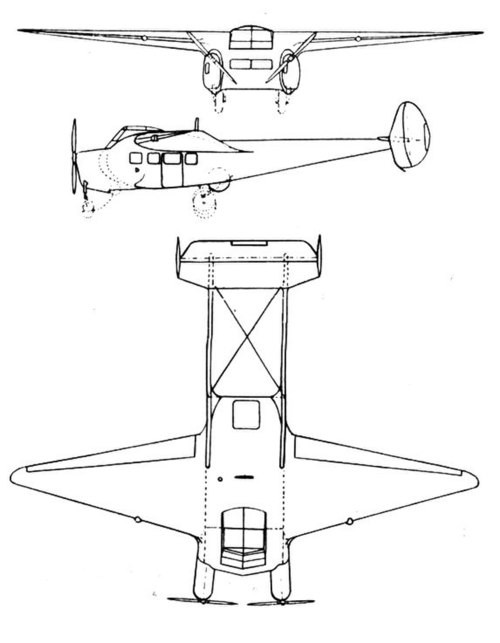
The CB-16 monoplane was built as an executive transport for banker Paul W. Chapman and was designed by Vincent Burnelli. The design of Burnelli’s first monoplane embodied his ‘lifting body’ techniques, which involved a more extensive blending of the fuselage with the wing to provide greater lift – and accident survival. The high-wing, open-cockpit CB-16 is also notable for being the first multi-engined aircraft capable of single-engined operation, and possesses a retractable landing gear and an all-stressed metal design. Despite its promising nature and Burnelli’s ideas, the CB-16 was lost due to a maintenance error.
Engine: 2 x 371kW Curtiss Conqueror Crew: 2 Passengers: 20 Wingspan: 27.40 m / 89 ft 11 in Length: 14.00 m / 45 ft 11 in Cruise speed: 185 km/h / 115 mph Range: 1287 km / 800 miles
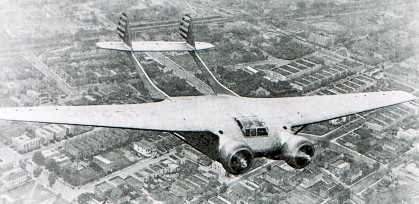
The Burnelli UB-14 and a developed variant named OA-1 Clyde Clipper were 1930s American prototype lifting-fuselage airliners designed by Vincent Burnelli, who was responsible for constructing the first two examples. Following on from his earlier designs Vincent Burnelli designed a commercial transport version using the lifting-fuselage concept. Burnelli’s designs were based on the idea that an airfoil-section fuselage could contribute to the lift generated. The Burnelli UB-14 first flew in 1934, and had an airfoil-section fuselage that formed the centre-section of the wing. The aircraft had twin tailbooms and a widespan tailplane and elevator fitted with twin fins and rudders. The UB-14 had retractable landing gear and was powered by two Pratt & Whitney radial engines. An enclosed cockpit for the crew of two was located on the centre wing’s upper surface. The cabin could hold 14 to 18 passengers. The first prototype, UB-14, was destroyed in a 1935 accident attributed to faulty maintenance on the aileron control system. Burnelli then designed and built an improved version, the UB-14B. An extensively modified version of the UB-14B design was built under licence in the United Kingdom by Cunliffe-Owen Aircraft, powered by two Bristol Perseus XIVC radials as the Cunliffe-Owen OA-1 Clyde Clipper. The UB-14B was to have been built by Scottish Aviation, but with more streamlined inline engines. Burnelli applied to the CAA for approval to fly a transatlantic flight with Clyde Edward Pangborn as the pilot in September 1936, however it failed its airworthiness certification due to an excessively long takeoff run and poor quality control. Its performance was later tested at A&AEE Boscombe Down in 1939.
After appropriate work, in June 1941 Jim Mollison and an Air Transport Auxiliary crew delivered the Cunliffe-Owen OA-1, now registered as G-AFMB to Fort Lamy, Chad. It was then fitted out as a personal transport for General De Gaulle. At one time it landed in Vichy France while en route to Fort Lamy. It was later abandoned at RAF Kabrit in Egypt, and burned during VJ-Day celebrations.
Variants UB-14 Prototype, powered by Pratt & Whitney engines, registered as NX14740. Built by Burnelli Company. Destroyed 13 January 1935, without injury. UB-14B Second prototype with modifications, registered as NC15320. Built by Burnelli Company. Exported to Nicaragua in 1943 as AN-ABH. OA-1 Third prototype, registered as G-AFMB, built by Cunliffe-Owen Aircraft under licence with further modifications, in the United Kingdom.
UB-14B Crew: two Capacity: 14–18 passengers Length: 44 ft 0 in (13.41 m) Wingspan: 71 ft 0 in (21.64 m) Height: 10 ft 0 in (3.05 m) Wing area: 686 sq ft (63.7 m2) Airfoil: Fuselage: NACA 4323 Outer wing root: NACA 2412 Outer wing tip: NACA 2409 Empty weight: 9,200 lb (4,173 kg) Gross weight: 17,500 lb (7,938 kg) Powerplant: 2 × Pratt & Whitney Hornet, 750 hp (560 kW) each Maximum speed: 210 mph (340 km/h, 180 kn) Cruise speed: 205 mph (330 km/h, 178 kn) Range: 1,240 mi (2,000 km, 1,080 nmi) Service ceiling: 22,000 ft (6,700 m)
USA Founded 1920, the Remington-Burnelli Airliner was produced in that year. Vincent Burnelli concentrated on the development of fuselage structures which would contribute some degree of lift, augmenting that of the wing. Uppercu-Burnelli Aircraft Corp formed 1930 to develop the theories of Vincent Bumelli on aerofoil-shaped fuselage structures; occupied the former Aeromarine Plane & Motor Company plant at New Jersey. First project was Model 101 high-speed twin-engined transport developed from earlier Remington-Burnelli Airliner projects, the 1920 RB-2,1927 CU-16 and 1929 UB-20. Subsequently became the Bumelli Aircraft Corporation. The Burnelli VB-14B transport of 1936 could accommodate a crew of two and 14 passengers in a fuselage which was virtually an integral part of the wing. In 1935 the assets of Aeromarine Plane & Motor Co were sold to Burnelli Aircraft Corp.
Established at Marblehead, Massachusetts, originally built Wright types under license. By arrangement built three single-float seaplane variants of the British Dunne tailless biplane, two of which were sold to the U.S. Navy which carried out its first experiments in aerial gunnery using these aircraft. Produced also in the period 1916-1918 a number of training and experimental seaplanes of original design.
In 1931 K. Bunyard designed and built a small biplane flying-boat, following this with a design for an unusual amphibian which failed to materialize in prototype form. At the end of the Second World War he began production of a three-seat lightweight amphibian flying-boat know as the Bunyard BAX-3 Sportsman. A four-seat version was designated BAX-4.
The company was founded in 1931 in Westchester, N.Y. and around 1946 had a slight name change and moved to Flushing, N.Y.