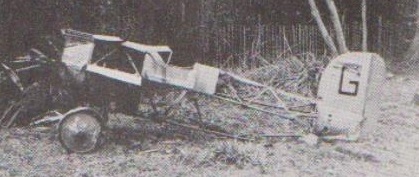
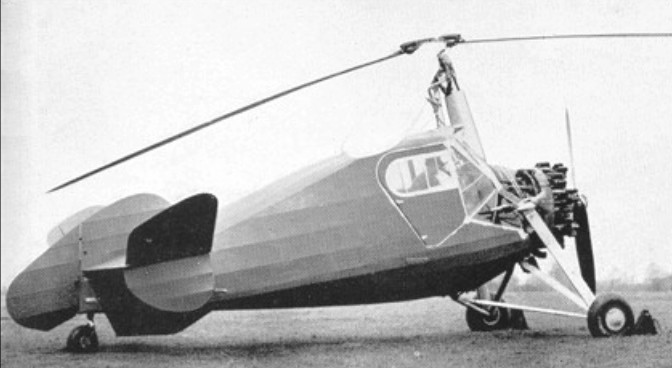
White 25 / Smith 1933 biplane / Sorrell Peer Gynt

In 1929, as White 25, with a 25hp Henderson De Luxe engine, was built by L J White, Pasadena CA. USA.

Not even the “De Luxe” addition helped very much. The aircraft would hardly fly.

Elmer L Smith bought it, increased the span of the upper wing, mounted the more powerful engine and flew it successfully as N10684.

After WW2 it was acquired by Hobart Sorrell in Rochester WA, who refitted a 65hp Continental, reregistered it as N4940V, and renamed it Peer Gynt. It was active at least into the 1970s.

White 25
Engine: 25hp Henderson De Luxe
Wingspan: 22’5″
Length: 15’6″
Seats: 1

Smith 1933 biplane
Engine: 45hp Salmson
Wingspan: 22’5″
Length: 15’6″
Speed: 95 mph
Seats: 1

Sorrell Peer Gynt
Engine: 65hp Continental
Wingspan: 22’5″
Length: 15’6″
Seats: 1
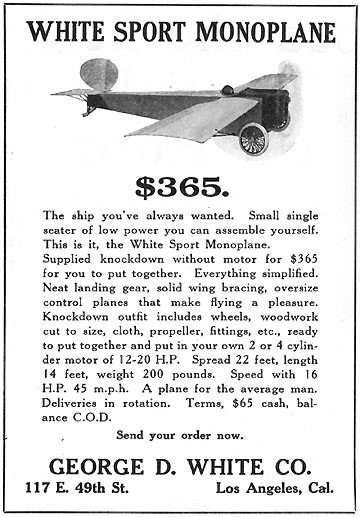
Wheeler Slymph

Wheeler Slymph G-ABOT at Old Warden in March 1965.

A single-seat mid-wing monoplane designed and built by A.H.Wheeler in 1931. Construction was started in Hinaidi, Iraq, that year. It was fitted with a Blackburn Tomtit engine.

It was not flown and brought to Henlow where it was registered G-ABOI c/n AHE.1.

In 1932 it was converted to an ABC Scorpion engine but it was never flown.

It was donated to the Shuttleworth Trust at Old Warden and stored there until loaned to the Midland Aircraft Preservation Society. It was stored in the Coventry area.

Span: 22.00 ft
Length: 14.09 ft

Weymann

France
Charles Weymann designed and built in 1916 an all-metal biplane with conventional fuselage. In 1929 joined with lePere, and Weymann-lePere was formed from the remains of a separate company called Avimeta which had closed in 1928. Weymann-lePere held a Cierva license; when lePere left in 1930 Weymann reverted to original name.

Westland-Cierva C.29 / Cierva C.29

In 1934 the Westland design staff, in co-operation with the Cierva Autogiro Company, produced a large five-seat cabin autogiro in Duralumin tubing, powered with a 600hp Armstrong Siddeley Panther engine.

The fuselage was of square-section steel and duralumin tubing, arranged in the characteristic Westland style, with composite stringers and formers to give a deep oval section. The fabric-covered tailplane and vertical and oblique fins were built up of duralumin tubing and pressings, the aerofoil section of the port half of the tailplane being inverted, to offset airscrew torque effect. The seating in the cabin was arranged in the 2-3 plan.

It was much larger and heavier than anything of its kind previously attempted. The Cierva Company was responsible for the rotors and rotor mechanism, the direct control system being employed, while the airframe was designed and built by Westland.

Test of this machine, which was known as the C.29 Autogiro, disclosed vibration problems with the rotor system, which could not be immediately solved. In the circumstances it was decided to shelve this particular design, until further experience had been gained with other experimental autogiros, but the untimely death of Senor Cierva ultimately prevented development of this work. This aircraft never flew.

Westland-Cierva C.29
Engine: Armstrong Siddeley Panther, 600hp
Rotor diameter: 15.23m
Length: 11.58m
Height: 3.88m
Loaded weight: 2268kg
Empty weight: 1461kg