General Aircraft Ltd

General Aircraft Ltd, Feltharn, UK.
Established 1931 at Croydon Airport. Chief designer was Swiss H. J. Stieger. Acquired world rights from Monospar Company for its system of construction for aircraft up to 1,360kg laden weight. First type was ST-3 three-seat enclosed cabin monoplane with two 45 hp Salmson radial engines. Later built series of light twins; GAL 41 Monospar of 1939 was first British aircraft with pressurized cabin. Single-engined pre-Second World War Cygnet monoplane was first light all-metal stressed-skin civil aircraft in U.K.; also an experimental open-cockpit version, the Owlet. Took over premises of British Aircraft Manufacturing Company in 1938. Built Hotspur training gliders and later Hamilcar assault gliders during Second World War. Postwar work included conversion of Mosquitoes as target tugs and design of GAL- 60 Universal Freighter, built as the Beverley after General Aircraft merged with Blackburn in January 1949.

The Monospar company was established in 1926 and was later absorbed by the General Aircraft Company.
General Aircraft Ltd
During 1948, discussions between General Aircraft Ltd and the Humberside firm of Blackburns led to a merger of the two companies under the joint name of Blackburn & General Aircraft Ltd. The new company was formed on 1 January 1949 and it was proposed that all work in progress at the various factories be completed as originally planned.
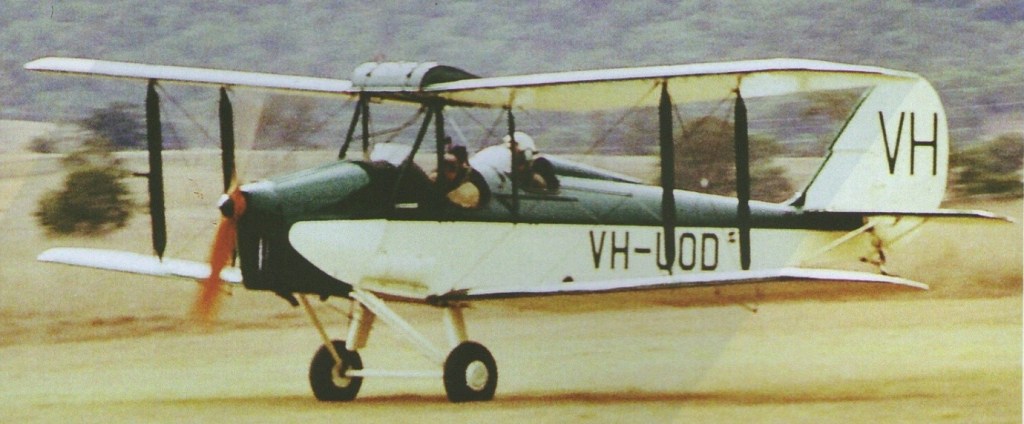
General Aircraft Genairco

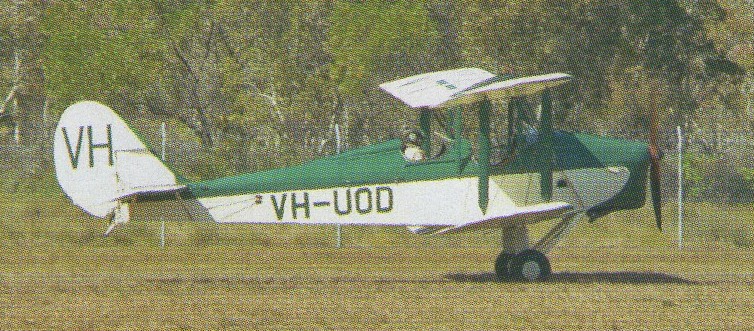
The first Genairco flew on December 20, 1929, and bore a marked similarity to the D.H.60, although it had a two-place front cockpit. The seventh and eighth aircraft produced were modified into cabin biplanes, resembling the D. H, 83 Fox Moth. The Depression and availability of D.H. types put General Aircraft out of business by early 1933.

Genairco VH-UOD

General Aircraft built about 12 Genaircos from late 1929 in ‘cabin’ and ‘open’ forms. A three-seater, two passengers are side-by-side in the front and pilot behind.

General Aeronautique

France
Formed in February 1930 by a number of the most important French aircraft manufacturers, and one engine manufacturer, as a result of a concentration and rationalization of policy proposed by the French Air Minister. Companies were Lorraine-Hanriot, Chantiers Aero-Maritimes de la Seine, Nieuport-Delage, Societe Aerienne Bordelaise, Societe d’Emboutissage et de Constructions Aeronautiques, Latham, and Societe Lorraine.

Granville Bros / Gee Bee R6H / QED

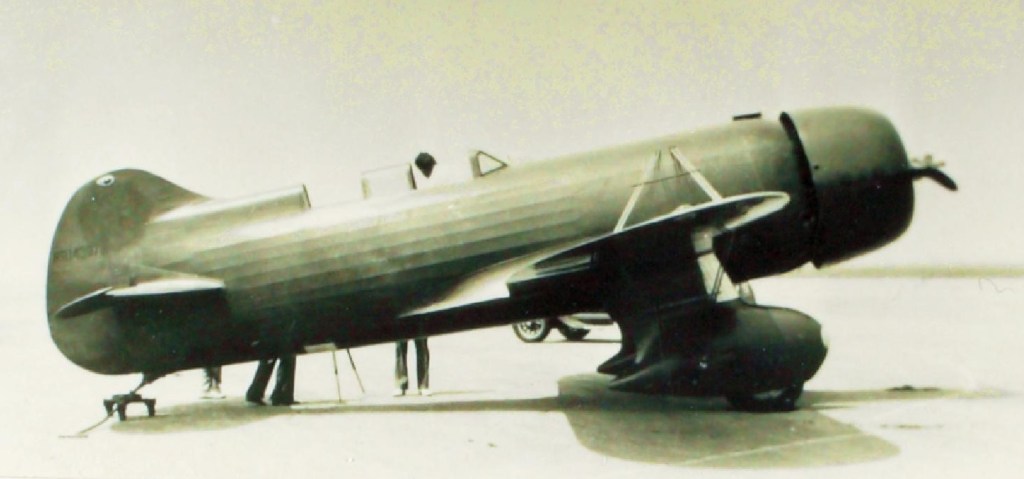
After liquidation the workforce built the QED, and the ‘Time Flies’ a racer for Frank Hawks. The Gee Bee R6 (later designated Q.E.D.) was designed and built as a two place transcontinental air racer specifically to complete in the MacRobertson Trophy Race – a transcontinental air race from London to Melbourne, Australia. The QED was powered by a 650 hp P&W R-1690 Hornet engine.

The QED did not finish the MacRobertson Trophy Race only reaching Bucharest and in 1939 was sold to Mexican competition pilot Francisco Sarabia.

After setting a new speed record from Mexico City to New York City in 10 hrs 48 minutes, tragedy struck and Sarabia was killed when the engine quit on take off from Washington D.C. and the aircraft plunged into the Potomac River.

The Q.E.D. was not badly damaged, and was restored and is now on display in Mexico as a tribute to Francisco Sarabia.

Replica:
Moss Gee Bee QED

Granville Bros / Gee Bee R-2

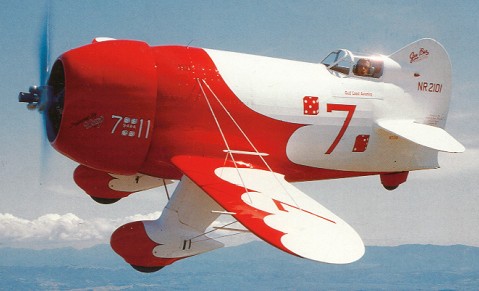
The Granvilles and their new chief engineer, Howell “Pete” Miller, came up with two of the most powerful models yet—the R Series Super Sportsters, race numbers 7 and 11—tailor-made to win the 1932 Nationals. For the Bendix there was No. 7, the Wasp Jr.-powered R 2; for the Thompson Trophy event there was No. 11, the Gee Bee R 1.

Gee Bee R 2 Super Sportster

P&W R-985, 535 hp
Built for the Bendix trophy.
302 USG fuel cap.
Fixed tailwheel.

Granville Bros / Gee Bee R-1

Jimmy Doolittle and the Gee Bee R-1

The Granvilles and their new chief engineer, Howell “Pete” Miller, came up with two of the most powerful models yet—the R Series Super Sportsters, race numbers 7 and 11—tailor-made to win the 1932 Nationals. For the Bendix there was No. 7, the Wasp Jr.-powered R 2; for the 1932 Thompson Trophy event there was No. 11, the Gee Bee R 1.

The Granvilles needed a pilot, and Jimmy Doolittle needed a plane. Doolittle flew to Springfield for a look. The Granvilles rolled out their creation, in a scalloped, black-piped, red-and-white paint scheme, set off by red 11s and dice showing 5 and 6. The R 1, essentially a scaled-up version of the Model Z, struck Doolittle as “all engine with minuscule wings and a bomblike fuselage.” The Granvilles had simply streamlined a Wasp Sr. engine with a modicum of bodywork, adding just enough wing and control surface area to keep it airborne, barely under control, and moving at nearly 300 mph.

Doolittle knew the airplane would be “extremely hot to handle.” After his one brief test flight, Boardman had reported severe directional instability, and the Granvilles had added two square feet of fin to the rudder. Doolittle clambered into the cockpit and asked that the engine be fired up. As the Wasp Sr. roared to life, one of the Granvilles, no doubt thinking ahead to locating the wreckage, asked where he was headed.

“I’m going to Cleveland, of course!” answered Doolittle. He took off and, without even a turn around the field, headed west. In less than two hours the Granvilles received a telegram: “Landed in Cleveland O.K., Jim.”

(replica)

Granville Brothers Gee Bee R-1 Article

Gallery

Super Sportster R-1
Engine: Pratt & Whitney R-1340, 800 hp
Length: 17.749 ft / 5.41 m
Height: 8.104 ft / 2.47 m
Wingspan: 25.0 ft / 7.62 m
Wing area: 79.654 sq.ft / 7.4 sq.m
Max take off weight: 3065.0 lb / 1390.0 kg
Weight empty: 1841.2 lb / 835.0 kg
Max. speed: 254 kt / 470 km/h
Landing speed: 103 kt / 190 km/h
Service ceiling: 4921 ft / 1500 m
Wing loading: 38.54 lb/sq.ft / 188.0 kg/sq.m
Endurance: 1 h
Crew: 1
Fuel capacity 160 USG.
Steerable tailwheel.

Granville Bros / Gee Bee Z Super Sportster

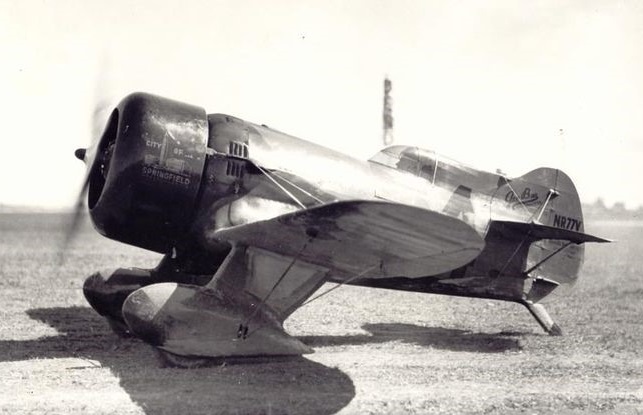
Gee Bee Z, NR77V, City of Springfield

The Granville brothers first Gee Bee Sportster were fairly orthodox: but in 1931 they produced the Super Sportster Model Z which was pure racer, with a huge radial engine in a barrel like fuselage, stubby braced wings and enormous wheel spats.
With an engine borrowed from Pratt & Whitney and propeller borrowed from Curtiss, the Gee Bee Model Z Sportser entered competition. In one race, the Gee Bee averaged 267.342 miles per hour, the fastest speed ever recorded for a land plane. Later in the year with a upgraded 800-hp Pratt & Whitney R-1340, the model Z was clock in at 281.75 mph.
Piloted by Lowell Bayles it won the 1931 Thompson Trophy Race at 236 mph. In December 1931, while trying to set a new air speed record, Lowell Bayles had crashed in the Gee Bee and died. Movie footage and analysis of the wreckage revealed that a loose fuel cap had come off and smashed the Model Z’s canopy, causing Bayles to lose control

Engine 535-hp, supercharged Pratt & Whitney R-985 Wasp Jr.
Span 25 ft
Length 17 ft. 9 in
Height 8 ft. 2 in
Wing area 75 sq. ft
Gross wt. 2,280 lb
Empty wt. 1,400 lb
Fuel capacity 103 USG
Top speed 270 mph.
Cruise speed 230 mph.
Seats 1