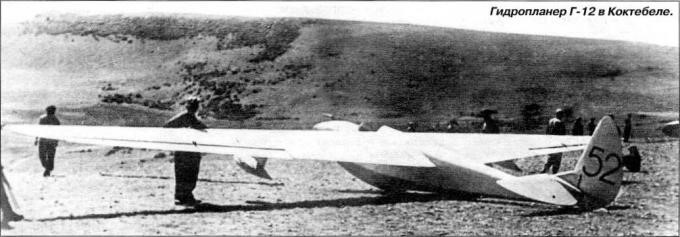
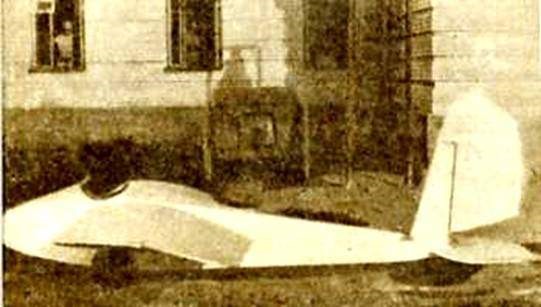
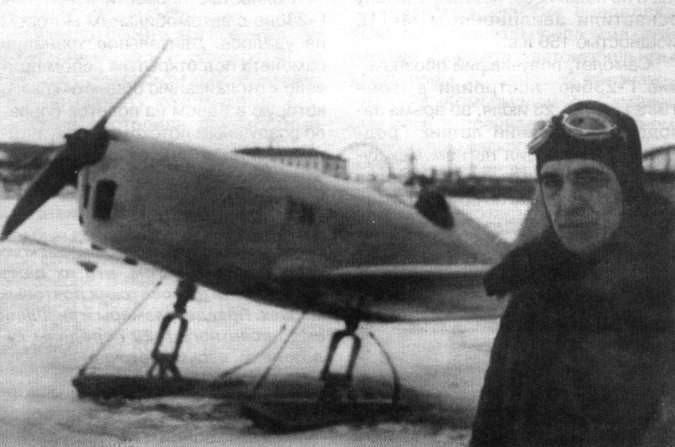
Gribovski G-12 glider during competitions at Koktebel.
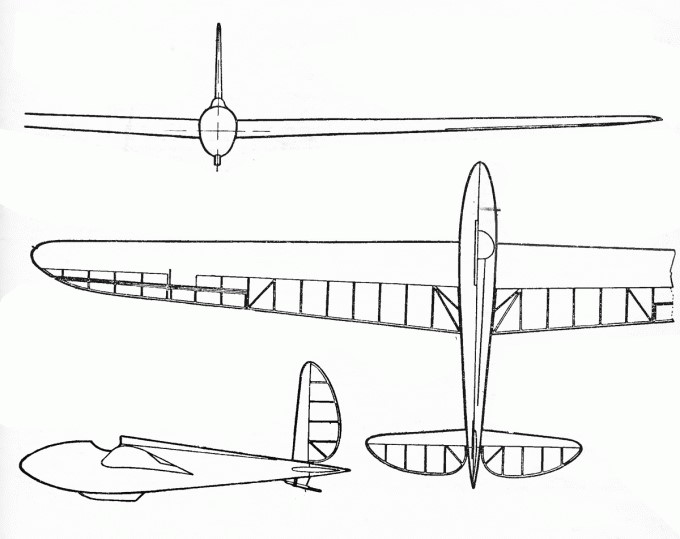
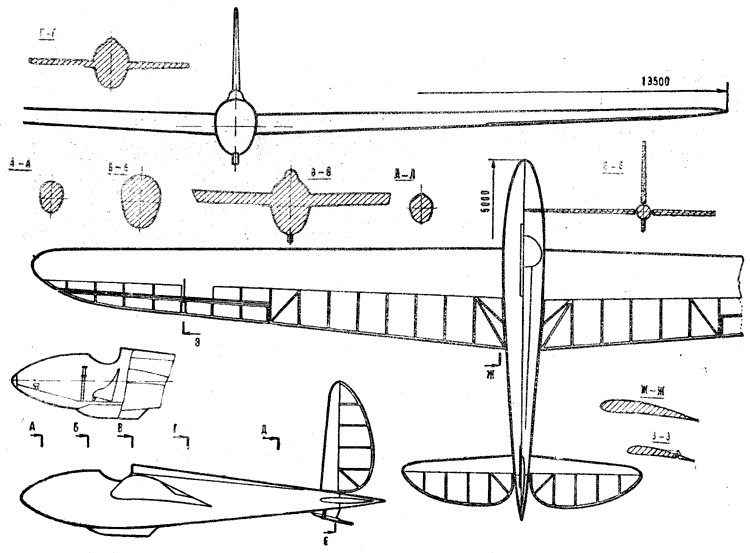
With the objective of studying the potential of take-off and landing on the water, Gribovski decided in 1933 to build an experimental hydrofoil that received the name G-12 (Russian: Грибовский Г-12).
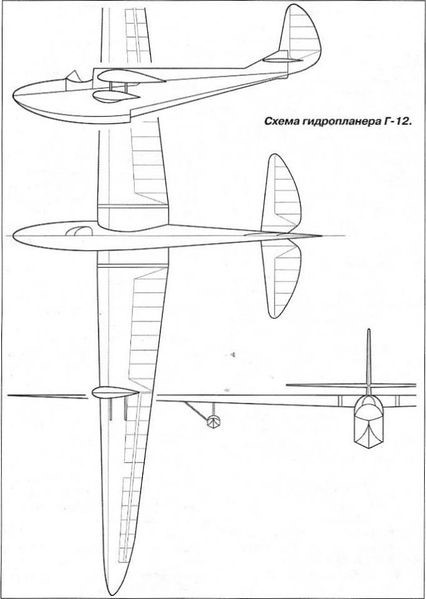
The G-12 glider was designed as a single-seater hydrofoil with a single-beam hull and high cantilever wing that had stabilization floats fixed to a support and braced by means of uprights on its external side. The wing structure comprised two box-like spars, joined together by light ribs. The wing was covered with 1 – 1.5 mm thick plywood, creating a flexible but strong structure. The wing had a fabric covering.
The hull had straight sides with a curved top and a 19-frame structure, a tail spar and five stringers. The entire hull was covered with 1.5 – 3 mm thick plywood nailed to the structure with zinc-plated lace and covered with glued canvas and enamelled in silver. Oil paint was used internally.
The G-12 glider was designed to operate in the water and on land, so the entire outer skin up to the tail post featured an ash skid designed for land landing at the bottom.
The tail area made transition towards the empennage and the thin stabilizer braced in its lower part by two short uprights.
The pilot was located in an open cockpit forward, in front of the wing leading edge.
The entire glider was painted silver.
The Gribovski G-12 glider was designed and built at the Moscow Construction Bureau (MKB) in 1933.
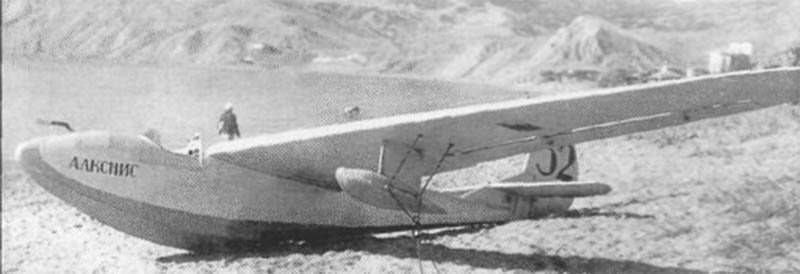
With the number “52” painted in black on its empennage and the name of the VVS chief “Alksnis” on the sides of the bow, it participated in the IX National Sailing Competitions. After the development of the normal flight tests, the G-12, piloted by AK Ioost, took off from the Uzun-Cyrt mountain, landing in the waters of the bay at Koktebel. It is noteworthy that landing proved to be considerably smoother than landing.
G-12 “Alksnis” hydrofoil on the Crimean beach during testing.
Later, in this same bay, an attempt would be made to carry out take-off tests from the water. Towing attempts from a motorboat and then from a Shavrov Sh-2 amphibious hydrofoil were unsuccessful. During the drag, when one of the side floats touched the water, they sank and slowed the glider. As a result of this the tests of aquatic operations were cancelled and from that moment the G-12 was only used on land.
G-12 Wingspan: 15.20 m Wing area: 15.40 m² Length: 6.50 m Height: 1.45 m Empty weight: 157 kg Wing loading: 15.4 kg / m² Stabilizers surface: 0.22 m² Elevator area: 1.77 m² Empennage surface: 0.9 m² Rudder surface area: 0.9 m² Aileron surface: 1.3 m² Accommodation: 1
From the end of 1931 and in parallel with the development of the G-9 glider, Gribovski began the development of a new model designed to carry six people. In many characteristics the new G-11 (Russian: Грибовский Г-11) repeated the double fuselage scheme of the unsuccessful G-3. The main difference between these two models was in the spacious cabins with capacity for three crew members, located in each of the fuselage structures and with side access doors.
Designed in 1931 – 1932, construction began at the OSOVIAJIM factory in 1932. The prototype was 80% complete by mid- 1933, when OSOVIAJIM decided to cancel it. Gribovski at this time was transferred to the post of substitute for the head of the Osoaviajim Construction Bureau (MKB), created in 1932 as an adjunct to the Glider Factory.
In the fall of 1931 Gribovski began towing experiments with the G-2bis glider, using as a tug a U-1 school biplane (a copy of the Avro 504K built in the USSR).
The experience gained during these flights allowed Gribovski to develop glider versions conceived from the outset to be aero-towed. Up to this time in the USSR the gliders only took off from heights with the help of some elastic tensioners that, when released, generated the necessary force to launch the glider.
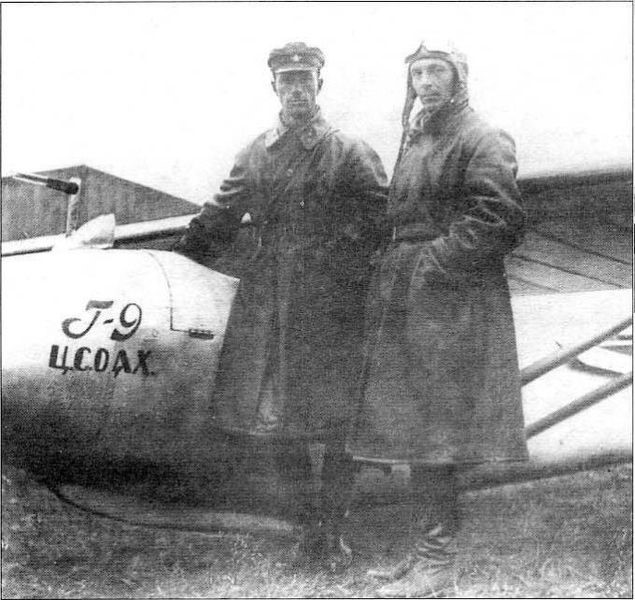
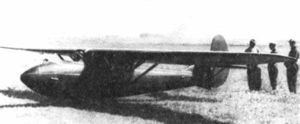
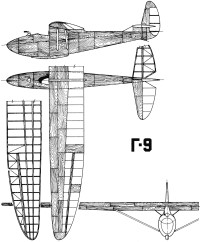
The Gribovski G-9 (Russian: Грибовский Г-9) was designed as a single-seater glider with a braced high wing, specially prepared for aero-tow.
The wing, with a double spar, featured removable rectangular consoles in the central section and elliptical ends. This plane was braced by means of a pair of uprights located on each side and fixed to the fuselage structure in the lower section of the gunwales. The entire front of the wing was covered with 1mm plywood sheets, up to the position of the second spar. The rest of the wing and ailerons were covered with fabric. The wing design used the TsAGI R-II profile proposed by PP Krasilschikov.
The tail unit had planes braced also by simple uprights and located directly at the bottom of the empennage. The leading edge of the empennage and horizontal planes also featured plywood overlay. The rudders were covered with fabric.
The fuselage had a semi-monocoque structure with 12 frames and plywood covering between 1.5 and 2 mm thick. At its bottom was a ski-shaped landing gear with air suspension using a bicycle inner tube. The pilot was located in an open cockpit located in front of the wing leading edge.
Built by Gribovski in 1932, the first of these gliders appeared in the winter of 1931 – 1932.
In parallel with the construction of the G-9 Gribovski began the organization of a long-range towed flight on this glider. To develop this flight Gribovski invited the experienced glider pilot VA Stepanchonok. The flight was planned for the Moscow – Koktebel route in order to arrive in time to participate in the VIII National Sailing Competitions.
On the 29 of September of 1932 the G-9 flown by VA Stepanchonok, towed by a Polikarpov U-2 piloted by Gribovski, it took-off from Tushino airfield for the flight. The arrival in Koktebel was on October 6 at 6:00 p.m. The selected route covered: Moscow – Ryazan – Tambov – Zadonsk – Voronezh – Evdókovo – Kantemirovka – Lugansk – Yeisk – Chernoerkovski – Kerch – Koktebel, covering a total distance of 1700 km in 19 hours of flight. This long-range flight demonstrated the potential of using towed gliders to transport cargo and people.
Gribovski and Stepanchonok
During the competitions in Koktebel the flight tests were carried out with excellent results. On September 5, during competitions in Koktebel, Stepanchonok set a new record for high school aerobatics flights. During 2 hours and 6 minutes, the G-9 would execute 115 loops, 13 spin turns and inverted flight for 1 minute and 8 seconds.
The first prototype G-9 would be destroyed in an accident the 31 of October of 1932, when piloted by the collaborator of the TsAGI LV Kozlov, collided with another competitor, the SH-3. As a result, it lost part of the wing and ended up hitting the side of a rise backwards. The pilot died instantly. The plane, with its bow destroyed, slid down about 10 meters, losing its wings.
Despite the unfortunate accident, for which only the pilot was blamed, the G-9 had shown its excellent flying qualities. In the No.1 of the Magazine “Samoliot” of 1933 it was written: “The G-9 built by Gribovski is an excellent glider. The large reserve of structural strength, necessary for drag and flight figures, did not greatly increase its weight or limit its flight capabilities. Its excellent stability and ease of handling make it an excellent flight planner. “
The excellent results obtained in the competition played an important role in the fate of the glider, which was built in series at the OSOVIAJIM Glider Factory until 1939, being considered one of the main Soviet gliders for trailing and flight training.
There are documented data on production in the Glider Factory until 1937 with the following distribution: 1933: 4, 1934: 43, 1935: 75, 1936: 110, 1937: 50. In total, 282 copies were built in these years. Production data for 1938 are not known.
In 1936 the Gribovski G-9 glider began to be built in Turkey, where Soviet specialists helped to develop sport gliding.
By the end of the Great Patriotic War the VVS had understood the importance of massive air landings using gliders. At that time it was necessary to have a robust and simple apparatus to train pilots of heavy landing gliders. At this point the G-9 was again remembered. On the basis of the few existing examples, the plans were reconstructed, from which a small series of gliders was built.
The Gribovski G-9 established several records were and it was used in the development of a series of experiments.
In 1933 the pilot Yudin made a towed flight of 3550 km. The pilot SN Anojin (later a test pilot and Hero of the Soviet Union), together with the pilot Gavrish, carried out inverted towing maneuvers on the G-9.
In 1934 Simonov set a world record for flight duration, covering 35 hours and 11 minutes of continuous flight.
Continuing the school figure execution records, the 200 figures executed by VA Stepanchonok would soon be surpassed by the results achieved by VG Borodin. Later Simonov would set another record by running acrobatic figures on the G-9 glider for 5 continuous hours, including 300 loops and 10 reversals.
The 5 of May of 1935 in Samara catching a G-9 was carried out by a Polikarpov U-2 flying at a speed of 120 km / h. The glider this time was piloted by Yudin and the tug plane by Borovkov. Later in Túshino, experiments were carried out to capture the glider in flight, being carried out by the pilots Vasyani and Boordin.
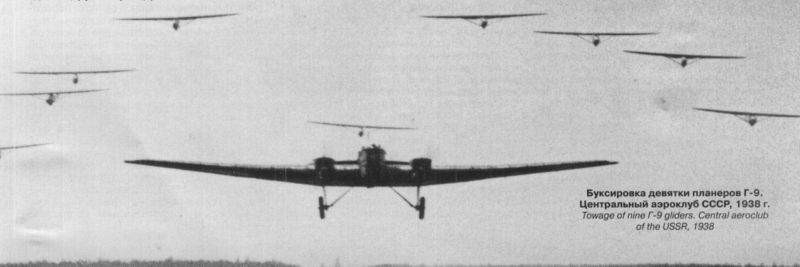
In 1938, a glider train made up of nine G-9 gliders towed from a Túpolev TB-1 bomber was presented during the air festival over Túshino A year later this story would repeat itself, but in this case with nine gliders.
Nine G-9 gliders are towed in flight over the Central Aeroclub by a TB-1 bomber.
In order to test the possibility of using gliders as an escape pod from stratostats in emergencies, a Gribovski G-9 was specially modified. The first test of this type was developed in 1936, when the glider, piloted Borodin, rose to the height of 2500 meters.
A second test took place on July 4, 1938, when the pilot V. Ílchenko was towed by the “CCCP VP-61” stratostat up to a height of 5100 meters and released, making a successful landing.
In 1936 the pilot PM Stefanovski reached the record height of 10360 meters in the G-9, towed by a Polikarpov I-15. A year later Flerov would surpass this mark when reaching 12,105 meters. On this flight the G-9 was towed by a Polikarpov RZ to a height of 8500 meters and then the glider ascended another 3605 meters while being towed. This was done with the help of a special tow cable designed by A. Ya. Scherbakov. At the time of takeoff, the glider was dragged by a normal 100-meter cable. Once a certain height was reached, when the wind turbulence disappeared, the new 0.2 mm steel cable was unwound, allowing the glider to increase the distance from the tugboat by 7000 meters.
G-9 Wingspan: 12.10 m Wing area: 13.00 m² Length: 5.77 m Height: 1.45 m Empty weight: 152 kg Maximum takeoff weight: 230 kg Wing loading: 17.7 kg / m² Glide ratio: 17.50 Accommodation: 1 Stabilizers surface: 2.1 m² Elevator area: 0.84 m² Spoiler area: 1.72 m²
The G-7 (Russian: Грибовский Г-7) was a successful development of the previous types. As the tests of the high wing model G-6 did not bring the expected results, Gribovski decided to return to the configuration with mid wings, successfully tested on the G-2.
The G-7 glider was designed as a cantilever high-wing aircraft with medium deployment and E-385 profile. The wing had two wooden spars with a box-like structure and a sparse distribution of the wing rib. This characteristic caused the wing covering to form kind of waves on the wing surface.
The fuselage had a monocoque structure with plywood covering and its lower part ended in a ski, which guaranteed landing.
The tail was of the conventional monoplane type, with a very tall tail.
The pilot sat in an open cockpit just ahead of the wing’s leading edge.
The glider was designed and built at the Orenburg Flight School in 1929, during Gribovski’s years as an instructor. Due to the lack of space for construction, the group of enthusiastic builders relied on an abandoned church, working in the area of its bell tower. The different finished parts were lowered to the ground using ropes and then assembled.
In the VI National Competitions of 1929 Gribovski presented with the G-2 and G-6 models, participants in previous years and with the new G-7. Characteristic of Gribovski , the three designs stood out for their small dimensions, light weight and constructive simplicity.
The G-7 was one of the best gliders among the participants in the VI National Sailing Competitions, both for its stability in flight and for ease of control.
On October 16 1928, the pilot VA Stepanchonok tried to set a new flight record in this model. It originally took off from the north slope at 4:00 am, but the absence of wind caused the glider to soon descend. At 6:17 am he made the attempt again and this time with success. The glider stayed aloft throughout the day setting a Soviet record for flight duration of 10 hours 22 minutes. Throughout the day the average flight height did not exceed 150 meters. Only in late afternoon and with the appearance of some cloudiness, Stepanchonok managed to ascend to about 500 meters.
A year later the G-7 would participate again in the competitions. On this occasion it would once again be a reference by achieving a continuous flight of 23 hours and 40 minutes.
G-7 Wingspan: 14.50 m Wing area: 15.00 m² Length: 5.45 m Surface of the horizontal plane: 2.16 m² Vertical plane surface: 1.08 m² Spoiler area: 2.2 m² Aspect ratio: 14 Empty weight: 143 kg Wing loading: 14.9 kg / m² Glide ratio: 25.4 Accommodation: 1
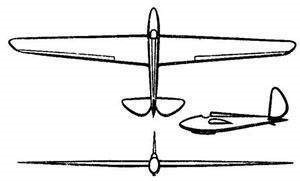
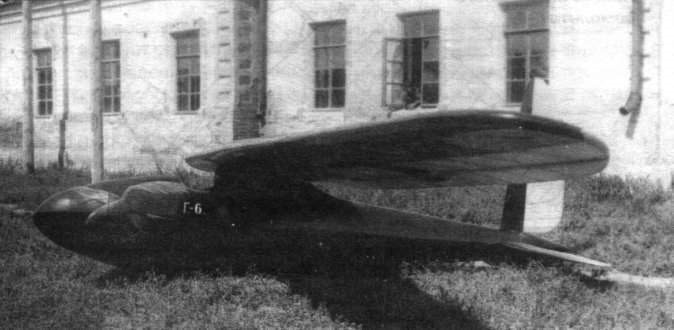
The Gribovski G-6 (Russian: Грибовский Г-6) was designed as a record-setting glider taking into account the theoretical principles that established the superiority of the high wing for the glider’s flight conditions.
The G-6 was built entirely of wood. The G-6 glider differed from its predecessor G-2 fundamentally in the location of the cantilever wing in a high position behind the cockpit.
Its fuselage was covered with birch planks and featured an oval cross section and landing gear with a central ski.
The tail was of the conventional monoplane type, and maintained the high-rise tail of the G-2 glider.
The G-6 glider was painted dark cherry-red and in its bow section, on the left gunwale, an eagle was painted in flight with its wings spread.
The construction of the G-6 was started at the school in Orenburg in the winter of 1928 and by September of that year the glider could be successfully presented to the V National Sailing Competitions. At the end of the competitions, the G-6 was handed over to the Sinferópol Flight School.
A year later, in 1929, the G-6 would participate together with the G-2 and the G-7 in the VI competitions.
Despite showing acceptable results, the new scheme did not report noticeable advantages and for this reason this glider did not have a further development.
After long enough use the G-6 glider was damaged. It is known that its builder kept the piece of coating with the drawing of the eagle among his personal belongings for a long time.
G-6 Wingspan: 13.00 m Wing area: 13.00 m² Length: 5.00 m Horizontal plane surface: 1.6 m² Vertical plane surface: 0.7 m² Spoiler area: 1.4 m² Empty weight: 101 kg Wing loading: 14 kg / m² Glide ratio: 20 Accommodation: 1
In 1926 and almost in parallel with the construction of the G-2 (Russian: Грибовский Г-3) glider, Gribovski would begin the construction of a four-seater transport glider that received the G-3 designation.
Unlike the previous models, the G-3 had a double fuselage composition, in each one of which two crew members or the corresponding load weight were located.
Unfortunately, the idea of transport gliders had not yet been sufficiently valued in the USSR, so the project did not receive the approval of the OSOVIAJIM Technical Committee and for that reason it was not produced.
In 1932 Gribovski would try again to venture into the design of double fuselage transport gliders with the G-11, which was also unsuccessful.
After returning from the competitions in Koktebel in 1925, Gribovski was transferred to serve as an instructor at the Higher School of Aerial Shooting and Bombing known popularly as “Strelba” (Shooting), located in the city of Serpukhov.
Gribovski set to the construction of a new and improved competition glider known as G-2 (Russian: Грибовский Г-2). Like all Gribovski gliders, the G-2 was built entirely in wood and quite simply. The attachment points for the rudders and ailerons were quite simple and the attachments were made with normal screws. In his gliders Gribovski would hardly use welding, mainly due to the lack of a productive base with the necessary equipment.
The G-2 glider differed from its predecessor in its fuselage structure, constructed of birch planks and featuring an oval cross-section and landing gear with a central ski, which innovatively included air-cushioning using a bicycle inner tube.
The large wing was located in the middle position of the fuselage and was designed with the PR-385 wing profile. This wing consisted of two long trapezoidal consoles with rounded ends. Each console consisted of two box-type stringers, made of wood and 16 ribs. The entire forward part of the wing, up to the location of the second spar, was covered in plywood. From there and up to the trailing edge the covering would be made of fabric. This would be a distinctive feature of most of Gribovski’s wing designs. Long louvered ailerons were located on the wing trailing edge.
The tail was of the conventional monoplane type, with a very tall tail. The planes could pivot on their axis integrally, which, according to Gribovski, should facilitate the control of the glider. During the evaluation before the competition, the technical committee expressed doubts regarding the effectiveness of its short horizontal planes. Practice would show that they were unfounded.
The pilot sat in an open cockpit just ahead of the wing leading edge and was protected by a transparent celluloid windshield.
The G-2 glider was built in 1927, first flown that September, and successfully participated in the IV National Sailing Competitions held that year, showing quite good performance. The G-2 was the first Soviet glider capable of harnessing thermals for free flight.
On September 27, taking off in the valley, he managed to reach a good height and fly over the southern slope of the Klementiev Mountains. The flights carried out in the G-2 were noted for their good stability and behavior, which contributed to the popularity that the model would soon achieve. On October 4, flying from Klementiev Mountain, would land beyond the competition staff.
In 1928 the G-2 was the glider that opened the annual event at Koktebel. In these competitions Gribovski, taking advantage of a weak wind, took off from Feodosia and landed after traveling seven kilometers. The next flight on the G-2 ended with a landing over a vineyard, causing the glider to be damaged.
A year later the G-2 would appear again during the VI National Sailing Competitions, this time accompanying the G-6 and G-7 gliders.
Its results in the competitions in Koktebel between 1927 and 1929 were so positive that soon flying clubs throughout the USSR began to build it.
The 31 of October of 1932, during the VIII convocation of skills, the glider G-2, piloted by NG Baruzdin set a national record of a 43.5 km uninterrupted flight.
G-2
The G-2bis appeared in 1930 as an improved development of the G-2. The main changes introduced included a decrease in the sensitivity of the rudders to the controls.
This glider was built by a considerable number of sailing clubs and workshops throughout the country until a date as late as 1935.
Taking into account the popularity acquired by the model, the organization “Snabosoaviajim” developed the set of plans with explanation of the main construction details and assembly forms, which considerably facilitated the construction of the model in workshops and by aviation enthusiasts. The own “Snabosoaviajim”, predecessor of the Factory of Gliders of Túshino, built two copies of the model.
The G-2bis played a very important role in the preparation of the Soviet plane pilots. Despite being a somewhat difficult model to control in flight, it would become the main training glider in its time in the USSR. At the Kacha flight school instructors VA Stepanchonok and MA Nyuxtikov trained Soviet pilots in glide flight using this model.
The G-2bis would be used in the drag take-off tests carried out in Moscow by the pilot PM Stefanovski. For this purpose Gribovski developed a fixing system for the cable, which was successfully tested.
G-2bis
G-2 Wingspan: 13.00 m Wing area: 14.00 m² Length: 4.90 m Height: 1.90 m Empty weight: 98.5 kg Wing loading: 12.7 kg / m² Elevator area: 1.7 m² Rudder surface area: 0.85 m² Ailerons surface: 1.4 m² Glide ratio: 18 Accommodation: 1
After his participation in the First National Gliding Competitions, held in Crimea, Gribovski entertained the idea of building a glider of his own design.
The Gribovski G-1 (Russian: Грибовский Г-1) was the first glider built by Vladislav Konstantinovich Gribovski. This glider was constructed entirely of wood and featured plywood and fabric overlay. Structurally, it was a high-wing cantilever-type monoplane with wing profile PR-426. The glider was noted for its constructive cleanliness.
The fuselage had a rectangular section with a forward cockpit for the pilot. The weight of the wing with the ailerons was 34 kg, while the fuselage and empennage weighed only 30 kg. A speed measurement instrument designed and built by Gribovski himself was installed on the G-1.
The tailplanes and empennage were highlighted by the large rudder area. A distinctive feature of this glider was the presence of a landing gear with wooden wheels, located on the sides of the fuselage, under the wing.
In the spare time that he was leaving the service and with the help of a group of colleagues who served in the same unit in Kiev, in the winter of 1924 – 1925 the glider was built.
In the fall of 1925 the Gribovski G-1 glider was included in the list of competitors of the III National Sailing Competitions in Koktebel. The evaluation committee made a positive assessment of the model.
The constructor carried out a series of short flights that demonstrated the rationality of the construction and quite acceptable flight characteristics.
On the 22 of September of 1925, dragging to the point of start, The G-1 was hit by a gust of wind land that launched it to one side, damaging it considerably. The wing was preserved, it suffered little and was later used by Professor VP Vietchinkin for static tests, which demonstrated the validity of its constructor’s calculations in relation to structural resistance.
G-1 Wingspan: 11.2 m Wing area: 15.00 m² Length: 5.3 m Empty weight: 71 kg Wing loading: 10.2 kg / m² Elevator surface: 2.5 m² Surface of the fixed part of the empennage: 0.34 m² Rudder surface area: 1.2 m² Spoiler area: 2.7 m² Glide ratio: 5.2 Accommodation: 1
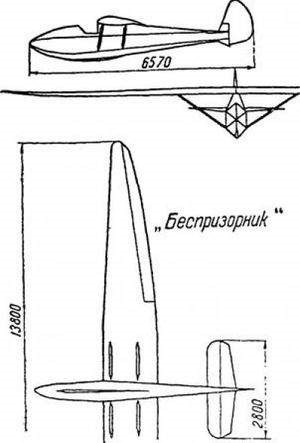
The Gribovski Biezprizornik (Russian: Грибовский “Беспризорник”) competition glider came from a Gribovski concept project. Its designer barely had time to pay attention to its construction, so it was decided not to include it in the numbering sequence of his creations. Rejected by his “father” the model would be jokingly nicknamed “Biezprizornik” (neglected or neglected).
The Biezprizornik construction was carried out by Groshiev, Sirken and Filyushkin, belonging to the Construction Bureau of the Union of Defense and Aviation Assistance Societies-Chemical Construction of the USSR (OSOVIAJIM).
Construction was carried out at the Moscow OSOVIAJIM Glider Factory during 1932.
Constructively, it was a high-wing monoplane with a sunshade, braced to the lower fuselage structure by four struts.
With the aim of reducing construction times and being able to participate in the 1932 competitions, instead of the original Gribovski wing, the brigade adapted the wing of an Antonov “Upar” (Ps-1) glider to the model. In its central part, this wing had a rectangular shape, but towards the ends the chord was tapering until it ended almost at a point. Much of the trailing edge of these outer sections was occupied by long louvered ailerons. The selected wing profile was the TsBPK (ЦБПК) and the entire construction was made of wood, with fabric covering.
The fuselage featured a hexagonal section with lightened frames and six stringers, constructed of 12 x 12 mm slats. Due to a mistake by the constructors, the glider received a too long nose, which resulted in a deterioration of its handling in turns. A landing skid was located in the ventral region of the fuselage.
The tail was of the monoplane type with a large area rudder attached to a small keel built integrally with the fuselage. The two horizontal planes shared a single spar. The assembly process for these plans was very labor intensive, as the builders left very small hatches on the sides for service.
The pilot was located in a cockpit just in front of the wing leading edge. The control from the cabin was carried out with the help of the lever and pedals. The transmission system to the ailerons was copied from that of the Antonov Us-4 and Ps-2 gliders. An interesting detail was that the bow, up to the first frame, could be pivoted open to one side, to give easy access to the control systems.
Gribovski, busy with the problems of keeping the MKB open, could not devote much attention to monitoring the construction, so he decided not to assign the glider its numbering, although he did not refuse to register it under his authorship.
The name “Biezprizornik” was given to the glider in jest. Once the initial tests were completed, the glider was sent in a railway car to the Koktebel Superior School of Planning . In some inexplicable way the glider got lost on the way and for about six months it travelled along the railroad tracks until it finally reached the school, well into 1933. The flight instructors at Koktebel decided to nickname it “Biezprizornik” in reference to the lack of a “Owner” who cares about his delivery for the competitions.
During the glider tests it was decided to change the wing attack angle, but this modification had little influence on the behaviour. The rudder control system had to be revised on several occasions and the ski was replaced, which suffered ruptures due to the great gap between its points of support and the lack of a suspension system.
It participated in the IX and X editions of the National Sailing Competitions. During the IX call the glider “Biezprizornik” would achieve the longest flight of the competition by staying in the air for 62 hours and 30 minutes.
The glider was used for several years as a trainer at the Koktebel High School of Planerismo. From 1933 on in the pilot training practice, aerobatic flights on gliders were included. The Gribovski G-9 and Sheremetiev Sh-5 gliders were used for this purpose. Preliminary preparation was carried out on the “Biezprizornik” glider and included the execution of barrels, eights and the entry training in thermal currents, with a duration of 5 hours of flight.
Only the one copy was built.
Biezprizornik Wingspan: 13.8 m Wing area: 17.00 m² Length: 6.57 m Height: 1.42 m Empty weight: 117 kg Wing loading: 11.0 kg / m² Glide ratio: 15.20 Stabilizers surface: 1.1 m² Elevator area: 0.85 m² Empennage surface: 0.07 m² Rudder surface area: 0.70 m² Ailerons surface: 1.72 m² Accommodation: 1
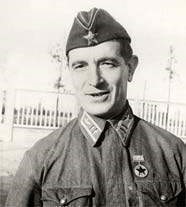
Vladislav Konstantinovich Gribovski (Russian: Владислав Константинович Грибовский) was born on September 7, 1899 in Saint Petersburg. Soon his parents died and Gribovski was forced to enter an orphanage in Gatchina where he would receive high school education. In 1909 during an excursion he visited the local airfield and according to his own statement, from that moment he fell in love with aviation. From an early age he began to read all the materials he found on aviation, made a series of model airplanes and helped the mechanics at the airfield. In 1919 he would leave the orphanage, joining the Red Army. He tried to enter the aviation school, but did not succeed, being assigned to the artillery courses in Petrograd. As part of a group of cadets from the school he would participate in combat against Yudenish, being wounded. In the fall of 1920 he was promoted to commander in the Second Moscow Artillery Brigade.
In 1921, he was finally able to enter the Yegorevsk Aviation Theoretical School. He would continue his pilot studies at the Kacha (Sevastopol) and Moscow (VAShL) flight schools in 1923. In 1924 he passed the Higher School of Aerial Shooting and Bombing in Serpukhov. In this way, in just three years, he passed the entire program of preparation courses and became a fighter pilot. Upon graduation in 1924 Gribovski would be assigned to serve in the 3rd Fighter Squadron based in Kiev.
VK Gribovski began flying gliders practically from the moment he joined the unit in Kiev.
In 1924 in Kiev he designed his first glider, the G-1. This aircraft was included in the list of competitors of the III National Sailing Competitions in Koktebel. After some short test flights, the 22 of September of 1925 the G-1 was hit by a gust of wind that destroyed land.
In 1924 he participated in the II National Sailing Competitions in Koktebel and was one of the first pilots who managed to keep his glider in horizontal flight for some time. In these tests, the category of pilot-planerista was established, which was reached after achieving 5 flights with a total duration of 60 seconds of which, at least one, had to exceed 30 seconds. The title of “paritiel” pilot or thermal exploiter was received by those who managed to keep their glider in flight without losing altitude for 3 minutes.
In the II National Competitions of 1924 Artseúlov, Gribovski, Zernov, Kalan, Kravtsov, Rudzig, Seregeyev, Tarasov and Yakovchuk received the title of pilots “paritiel”.
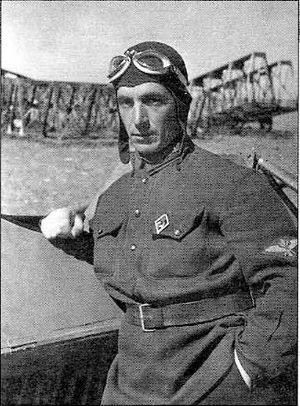
VK Gribovski.
Gribovski became an instructor at the Serpukhov Flight School in 1927. In the workshops of this institution he would build his second glider, which was launched as G-2 in 1927. The G-2 would fly with great success in the IV, V and VI National Sailing Competitions, becoming one of the main Soviet training gliders in those early years.
In parallel with the G-2, Gribovski designed in 1926 a 4-seater transport glider that received the designation G-3 and was not approved. The G-4 was a never-completed project for a low-power Bristol Cherub-powered light aircraft, designed in conjunction with AB Yumashiev. Its construction also began in 1926 in the workshops of the Serpukhov Flight School. Following the transfer of the flight school to Orenburg, Gribovski would successfully build and fly the G-5 light aircraft.
The G-6 (1928) and G-7 (1929) gliders were also built in Orenburg. The G-7 was one of the best gliders among the participants in the VI National Sailing Competitions. In this glider, the renowned pilot VA Stepanchonok set the Soviet record for flight duration by staying in the air for more than 10 hours.
At the beginning of 1930 Gribovski was appointed head of the OSOVIAJIM Flight School in Moscow. Based on his initiative, the famous Túshino aerodrome was built and the OSOVIAJIM Central Aeroclub was created on the basis of the school. Towing tests of Gribovski’s G-2bis glider were carried out in the autumn of 1931 in Túshino and from their results the G-9 towed glider was built, which was manufactured in series and became one of the main training gliders. of the USSR in the pre-war period.
In 1931, in the workshops of the OSOVIA Flight School, Jim Gribovski would build the excellent G-8 light single-seater training aircraft. This small plane with a takeoff weight of only 483 kg and a 60 hp engine reached a speed of 150 km / h and a flight height of 3000 meters. In the autumn of 1932 the G-8 was used by the pilot D. Koshits to carry out a flight that covered a dozen cities in the USSR, covering a total of 4,500 km.
In 1932 Gribovski began working at the Bureau of Construction of Moscow (MKB) of OSOVIAJIM and a year later would steer. The MKB was financed from donation funds and was located in an apartment in the basements of building No19 on Sadovo-Spaskaya Street in Moscow. In addition to the MKB, the founders of the GIRD – creators of the first Soviet rockets – were also located in this basement. Currently at the entrance is a memorial plaque.
Under Gribovski’s direction, the G-512 and G-16 hydro-gliders were built. In the latter, for the first time in the USSR, a takeoff was made from the water in a glider, towed by a Shavrov Sh-2. Another interesting example was the G-14 towed glider, used for different tow tests. The G-14TsL-2A tanker glider was built on the basis of this model in the “Aviajim” factory for the first time in the world, conceived for long-distance flights from the refueling of the tow plane from the glider itself.
Also noteworthy are the G-15 light tourist aircraft and the G-22 and G-23 single – seaters. In the G-22 the pilot Ye. Miednikov set a world speed record in its category in July 1938 by reaching 165 km / h and pilot I. Grodzyanski in the G-23 set a height record of 7266 meters.
Among light Gribovski models include the G-20 in 1935. With a 100 hp M-11 engine this light aircraft reached 210 km / h and a ceiling of 4000 meters. In 1937, after the installation of a more powerful 150 hp engine, the pilots of the aero club began to perform high school acrobatics on this airplane.
In 1938 on the basis of the MKB OSOVIAJIM and the glider factory, the Experimental Department (Opitni Otdiel – OO) was created under the leadership of Gribovski. Its latest models for OSOVIAJIM were built in this department: the G-26 fast plane and the G-27 twin – engine trainer . This latest model was designed as a crew trainer for the newly introduced Túpolev SB and Ilyushin DB-3 bombers. Although the G-27 in weight did not exceed the Polikarpov U-2, it introduced a two-seater cabin for the pilots and a glass nose for the navigator. This aircraft presented excellent performance but was too demanding in piloting, so it was not considered suitable for teaching. The builders proposed to improve it, but this was never realized. At the beginning of 1939 the glider factory was closed.
VK Gribovski with the G-26 light aircraft during testing.
The Glider Factory of the OSOVIAJIM, in which the Gribovski models were built, was closed in March 1939 and its facilities transferred to Professor Lievkov, who would build air-cushioned aircraft there. The experimental department was dissolved and Gribovski went into the reserve of the Aviation Directorate of the Union of Defense and Aviation Assistance Societies-Chemical Construction of the USSR (OSOVIAJIM). Through his own efforts, Gribovski managed to be transferred to the system of the Commissariat of the Aeronautical Industry (NKAP). Initially, in December 1939, a new Construction Bureau was created as a subsidiary of Factory No.301. This new organization was based on a garage under construction belonging to the “Mosvoyentorg” located in the Pavshino village, belonging to the Moscow suburbs.In March 1940 Gribovski was appointed to command the newly created OKB-28 and by May 22 of next year the Gr-28 “Krechet” (TI-28) training fighter had been created under his leadership. The cockpit of this trainer had been configured to allow training in day and night flight. The TI-28 featured a synchronized ShKAS machine gun, a photo-machine gun and a collimator for aiming. Under the wings it could carry training bombs of up to 40 kg. The beginning of the war prevented its production.
With the start of the war the OKB was tasked with building an 11-seater landing glider. To carry out this task, Gribovski asked only 2 months. AS Yakovlev thought the answer was not serious and asked the builder to put this in writing. Work on the new glider, known as Gr-29 (serially as G-11), began on July 7 and its maiden flight was made on September 2. After a week of test flights, its series production was decided. This model was produced until June 1942.
When the production of the G-11 ceased in 1942, the OKB-28 collective was integrated into the technical staff of Factory No. 471, re-destined to produce the Yakovlev Yak-6. Gribovski was placed at the disposal of the Commissariat for the Aviation Industry.
For the invaluable contribution of his planners in the tasks of support to the guerrilla groups of Belarus, Vladislav Cheranovski was one of the few Soviet servicemen in the rear to be awarded the 2nd rank “Guerrilla of the Patriotic War” medal.
In 1943, production of the G-11 was re – established in Ryazan, where Gribovski was appointed chief builder and factory manager. The production of this model was maintained until 1948 in different versions.
In these years Gribovski would work on the development of an improved version of the G-11 glider, which, called G-31, was not approved because priority was given to the Moscaliov SAM-28 (which would not be produced either).
In 1946 he would work on the 3 and 6 ton transport glider projects that would not be built either. A year later Gribovski would be tasked with designing a two-seater training glider with spacious cabins located in tandem. Two specimens were produced that began to fly in the spring of 1948. The dissolution of Gribovski’s KB prevented further work.
In 1948 Gribovski would present a new design for a primary training two-seater aircraft with tandem seats and a 90 hp M-10 engine, conceived to participate in the light aircraft competition promoted by DOSAV. This would be his last “official” job. In 1948 his KB had been disintegrated as part of the process of reorganization and contraction of the aeronautical industry.
After the liquidation of the Construction Bureau (KB) in 1948, Gribovski received proposals to go on to work in the Scientific-Technical Committee of the VVS, to dedicate himself to the development of aeronautical technology. Declining this proposal, he requested his retirement from the ranks of the Red Army, passing to the reserve with the military rank of colonel.
In later years he would participate in various sports glider projection competitions and would work on sports boat design, photography and painting.
Vladislav Konstantinovich Gribovski designed 20 gliders and 14 airplanes between 1925 and 1948, not counting the unrealized or finished projects. Virtually all of his designs were successful and some of his gliders were mass-built. Their small collective included specialists including VV Abramov and BK Landyshev.
It should be noted that despite his activity as an aeronautical constructor, Vladislav Gribovski flew actively. He was generally the first to test his designs in flight. He personally participated in various aviation competitions, public demonstrations and propaganda flights.
Most of his designs, built basically in wood, were characterized by their simplicity. For this same reason, their models did not stand out for their performance, but in all cases they were characterized by their robustness and ease of maintenance.
Gribovski was a great defender of the airplane accessible to anyone and fought for the development of sports and tourist aviation.
The pilot and aeronautical constructor Vladislav Gribovski passed away in 1977.