Founded in April 1937, this company was originally a manufacturer of hydraulic and other precision components for the U.S. aircraft industry. Produced in 1940 the Cadet two-seat light cabin monoplane which, after U.S. entry into the Second World War, was developed as a light liaison and observation aircraft for the U.S. Army. Designed and built a number of drone aircraft prototypes for both U.S. Army and Navy. All were pilotless radio-controlled weapon carriers.
Inter-Wars
International Aircraft Corp F-18 Air Coach
A six-seat enclosed cabin biplane.
International Aircraft Corp F17 Sportsman
The F-17 Sportsman was a three-seat open cockpit biplane.
International Aircraft Corp
USA
Founded at Cincinnati, Ohio, the company was incorporated in 1928. Production included the International F-17 Sportsman, a three-seat open cockpit biplane, and the F- 18 Air Coach, a six-seat enclosed cabin biplane.
Instituto de Pesiquas Technologicas / IPT
In 1899 in São Paulo the Strength of Material Laboratory of the Engineering Faculty Escola Politécnica was created. In the first years of its existence, the Laboratory performed tests with materials mostly employed in the civil construction. In 1926, the Laboratory evolved itself into the Laboratory for Material Testing also gaining research attributions and in turn gave later birth to the Instituto de Pesquisas Tecnológicas (IPT). The interest of IPT in aviation appeared from studies looking for application areas of wood in engineering. A report containing properties of numerous wooden elements, result of an extensive and systematic research, was published by IPT and was worldwide acknowledged. In 1938, Frederico Brotero and Orthon Hoover designed a monoplace aircraft of wooden structure. The first one of the four prototypes of the aircraft was constructed in the IPT facilities and finished in Rio Claro, a city located in the countryside in the State of São Paulo. The airplane was nicknamed Bichinho de Rio Claro (Rio Claro’s mascot) but later it gained the IPT-0 denomination.
In 1948, the Divison of Aeronautics of the IPT was created, originated from the Section of Aeronautics. The IPT designed a glider for primary instruction, the Gafanhoto, which was designated IPT-1. A public-domain report was published by IPT containing the required information to build the glider.
IPT built 17 different types of aircraft along its aeronautical activities.
Institute of Glider Technology / Instytut Techniki Szybownictwa
Instytut Techniki Szybownictwa (Institute of Glider Technology) was a research and certification institution located in Lwów (using facilities of local Institute of Technology) created in 1932. Under it’s auspices during the 1930s a number of glider designs were made (some of which were subsequently built) and final years of the decade a series of designs for light but aerodynamically advanced sports aircraft was made: ITS Drozd (Thrush), ITS Jaskółka (Swallow) and ITS Wróbel (Sparrow).
Inland Aviation Super Sport
The more powerful Super Sport, with an 110 hp Warner Scarab engine, established an American altitude record on October 25,1929, and a world speed record for light aircraft on February 12,1930.
Inland Aviation Sport
Island Aviation built a two-seat monoplane of braced parasol-wing configuration, known as the Inland Sport.
Inland Aviation Co
USA
Founded in the late 1920s, this company built a two-seat monoplane of braced parasol-wing configuration, known as the Inland Sport. The more powerful Super Sport, with an 110 hp Warner Scarab engine, established an American altitude record on October 25,1929, and a world speed record for light aircraft on February 12,1930.
Ilyushin Il-38
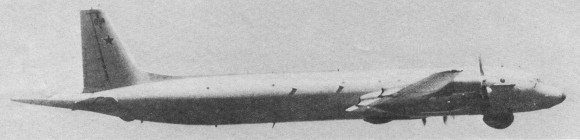
First disclosured in 1974, the Soviet Naval Air Arm (AV-MF) used the Il-18 trans¬port as the basis for the considerably changed Il-38, known to NATO by the code-name of “May’. Com¬pared with the transport it has a wing moved forward and a considerably longer rear fuselage, showing the gross shift in centre of gravity resulting from the changed role. The rear fuselage of the Il-38 contains only sensors, sonobuoy launchers of several kinds and a galley, with the main tactical compartment just behind and above the wing, with a probable tactical crew of eight. Most of the heavy stores and consoles are ahead of the wing, together with the search radar stinger, not a heavy it in the tail.
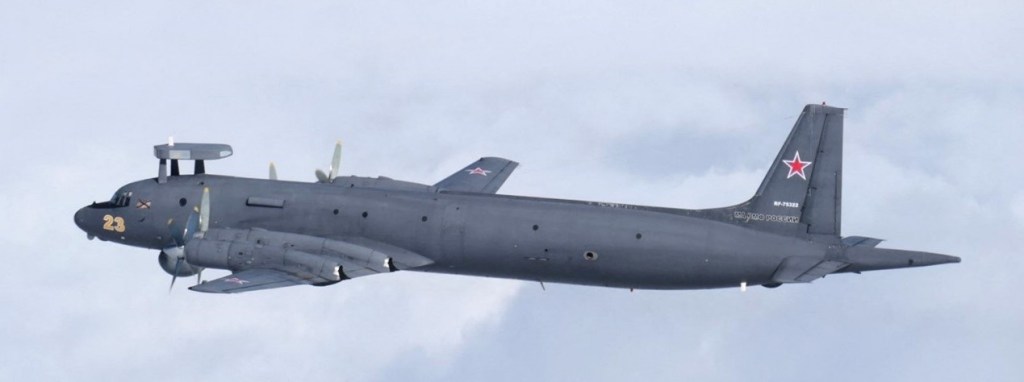
Il-38 has been a standard SovNavAir open-ocean maritime surveillance aircraft since entering service in 1970, with some 60 in inventory mid-1987. NATO code name ‘May’. One of two current service military derivatives of commercial Il-18 (other being Il-20 Coot-A ELINT aircraft ), Il-38 has bays fore and aft of wing for sonobuoys and various attack weapons. Power is provided by four 4,250 ehp AI-20M turboprops. About 60 were believed to be in use by the Soviet naval air force. Three ex-SovNavAir operated by Indian Navy.
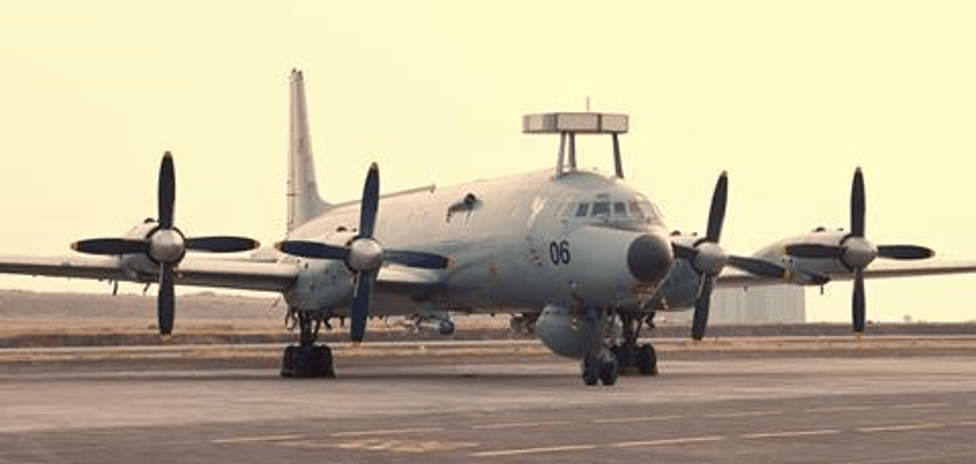
Some external modifications included an additional radome under the fuselage were reported by NATO as the May-B.
II-38
Type: maritime patrol and anti-submarine.
Engines: 4 x Ivchenko Al-20 single-shaft turbo-props, 5,000 shp approx.
Wing span 122 ft 8½ in (37.4 m)
Length 129 ft 10 in (39.6 m)
Height about 35 ft (10.7 m)
Empty weight approx 90,000 lb (40,820 kg)
Maximum loaded weight, approx 180,000 lb (81.650 kg)
Maximum speed, about 450 mph (724 km/h)
Maximum cruising speed, about 400 mph (644 km/h)
Range with typical mission load, about 4,500 miles (7240 km)
Endurance, about 15 hr.
Armament: internal weapon bay.

