Designed by Willie Messerschmitt, and made its first flight on 7 May 1921. A tail-less glider which proved to be dangerously unstable. Considerable modification failed to make it safe to fly.
Inter-Wars
Messerschmitt S8
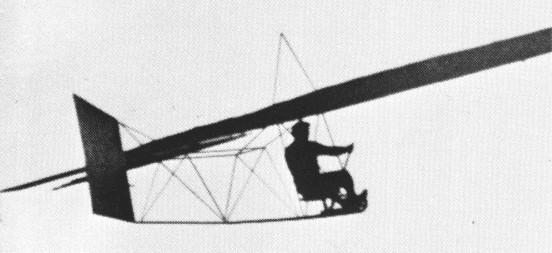
On 13 September 1921 the S8 glider set an endurance record by remaining airborne for 21 minutes.
Messerschmitt Flugzeugbau GmbH / Bayerische Flugzeugwerke (BFW)
Founded by Willi Messerschmitt at Bamberg in 1923 as Messerschmitt Flugzeugbau and became GmbH April 28,1926.
It was in Augsburg that on 30 July 1926, the Bayerische Flugzeugwerke (BFW) was incorporated and established itself in the former Rumperwerke factory.
S-16 powered glider flown 1924; M-18 three-passenger, single-engined airliners built for Nordbayerische Verkehrsflug AG and others 1925. Developed into M-20 and M-20b built for Lufthansa 1928. Highly successful M-23 two-seat sporting monoplane introduced 1929.
A number of crashes led Lufthansa to refuse to accept any more M20s, which resulted in the Messerschmitt company, Bayerische Flugzeugwerke (BFW) going bankrupt on 1 June 1931. An agreement was reached with all creditors in December 1932 and on 1 May 1933 the BFW AG was able to start a new career. Renamed Messerschmitt AG 11 July 1938.
Messerschmitt airplanes are variously coded with the letters Bf and Me; they refer to Bayerische Flugzeugwerke and Messerschmitt AG, respectively firm names under which he did business. The Bf designation was dropped in 1938, but designs executed before that time properly carry the prefix Bf.
After being renamed in 1938 continued production of BFW’s Bf 108 and of Bf 109 fighter, Bf 110 twin-engined long-range fighter. Rocket-powered Me 163 fighter first flown August 1941, and first of Me 262 twin-jet fighters on 18 July 1942. Bf 110 developed into Me 210 fighter-bomber first flown September 2,1939, built up to 1944, and reengined Me 410, which made maiden flight in late 1942. Me 321 Gigant troop carrier/cargo glider (54.68m wingspan) introduced 1941; 175 built together with 201 of Me 323 powered version with six Gnome- Rhone radial engines.
Reconstituted postwar company formed Flugzeug-Union Sud with Heinkel in August 1956, building Fouga Magister under license and later taking part in programs for Fiat G.91, Lockheed F-104G, Transall C.160 and Bell UH-1D.
Amalgamated with Bolkow as Messerschmitt Bolkow GmbH 1968 and then with Hamburger Flugzeugbau to form Messerschmitt-Bolkow-Blohm 14 May 1969.
Merriam 1922 Glider
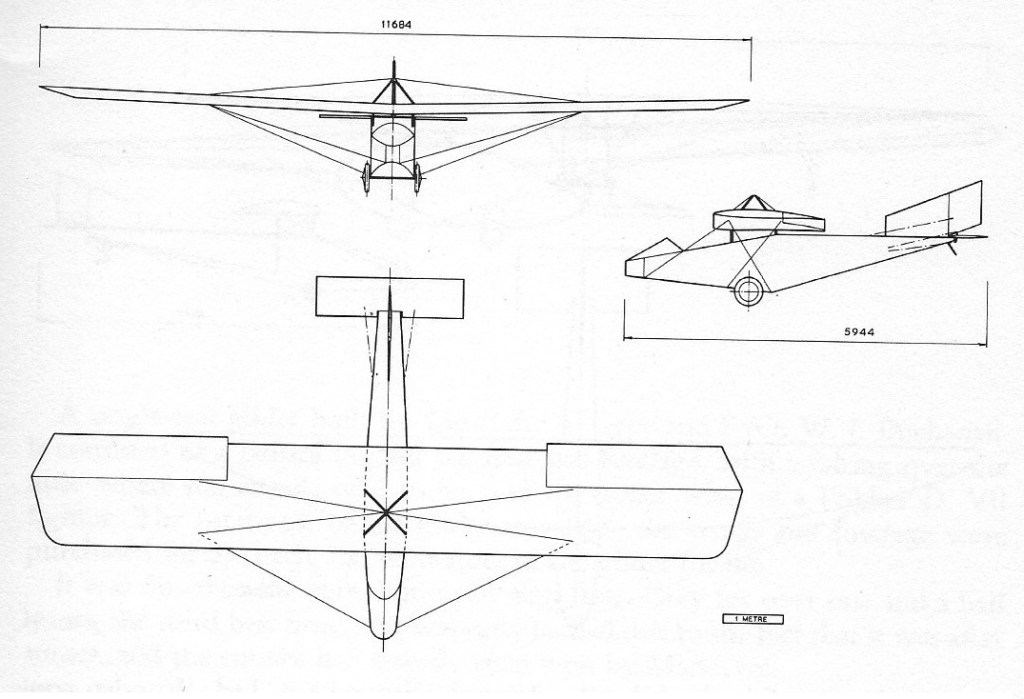
A single-seat glider designed and built by Capt. F.W. Merriam at Whiteley Bank in the Isle of Wight.
Of wooden construction with wire braced wings, the undercarriage has fixed centre twin main wheels, plus tail skid. No airbrakes or flaps ae fitted.
Only one was built, for the 1922 Itford competition as No.18. After the contest it was used at the Whiteley Bank School of gliding on the Isle of Wight, and was converted to a two-seater, with dual controls. It was still in existence at the newly formed Isle of Wight Gliding Club in 1930.
Wingspan: 11.68 m / 38 ft 4 in
Length: 5.94 m / 19 ft 6 in
Wing area: 20.90 sq.m / 225 sq.ft
Aspect ratio: 6.54
Wing section: RAF 15
Empty weight: 90.72 kg / 200 lb
AUW: 163.3 kg / 360 lb
Wing loading: 7.81 kg/sq.m / 1.6 lb/sq.ft
Seats: 1-2
Meridionali-Aerfer Spa
Meridionali-Aerfer Spa succeeded Societa Aninima Industrie Aeronautiche Romeo, which had been formed in 1934 to absorb Officine Ferroviarie Meridionali’s aviation activities. Became part of Societa Italiana Ernesto Breda group. Developed Ro.37 two-seat reconnaissance biplane which served October 1936 with Italian Aviacion Legionaria during Spanish Civil War and equipped Italian Air Force reconnaissance units during Second World War. Also used operationally were Ro.43 two-seat, single-float catapult seaplane and single-seat fighter version, Ro.44.
Menasco 50 hp
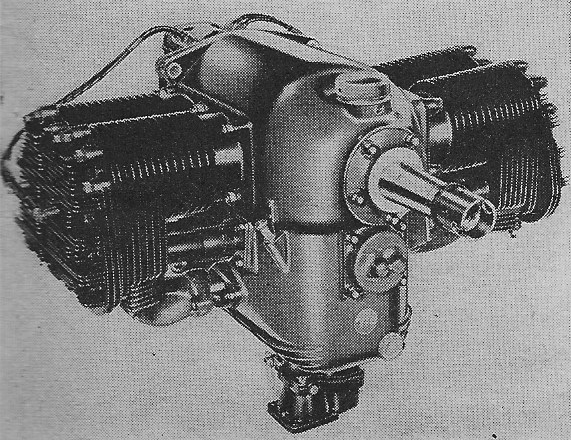
The 1938 Menasco 50 hp aero engine.
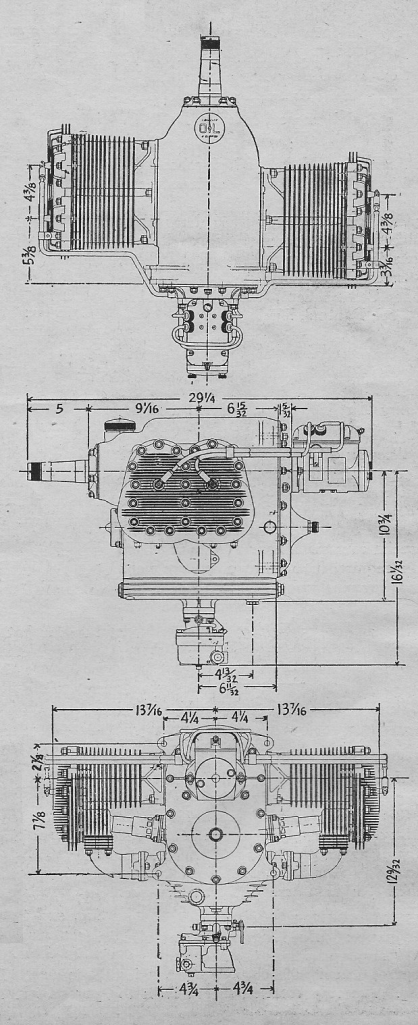
Menasco 6 Buccaneer / Super Buccaneer
The Menasco Buccaneer was a series of six-cylinder, air-cooled, in-line, inverted, aero-engines, that were manufactured by Menasco Motors Company for light general aviation and sport aircraft during the 1930s and 1940s.
The six-cylinder Menasco engines had the name Buccaneer, while the four-cylinder engines had the name Pirate. The Menasco engines came in both supercharged and normally aspirated models. The supercharged models, with the S suffix added to their designation, had superior performance at higher altitudes with a relatively small increase in dimensions and weight.
Variants:
Menasco A6 Buccaneer
Menasco B6 Buccaneer
Menasco C6 Buccaneer
Menasco C6S Super Buccaneer
Menasco D6 Super Buccaneer
Specifications:
Menasco B6S Buccaneer
Type: 6-cylinder, air-cooled, in-line, inverted engine
Bore: 4.5 in (114 mm)
Stroke: 5.125 in (130 mm)
Displacement: 489 cu in (8 L)
Length: 60.125 in (1,527 mm)
Width: 15 in (381 mm)
Height: 28.3 in (719 mm)
Dry weight: 423 lb (192 kg)
Valvetrain: 1 inlet and 1 exhaust valve per cylinder
Fuel system: 1 Stromberg Carburetor
Fuel type: 73 octane
Cooling system: Air
Power output: 200hp at 2,250 RPM max/150hp at 2,025 RPM cruise
Compression ratio: 5.5:1
Power-to-weight ratio: 2.82 lb/hp at cruise
Menasco 4 Pirate / M-50 Pirate / L-365
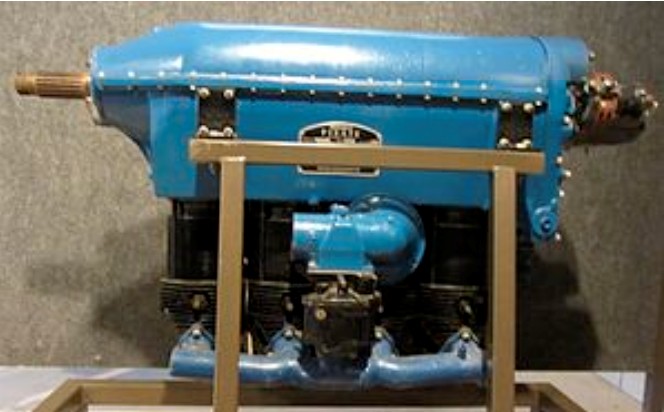
The Menasco 4 Pirate series were 4-cylinder, air-cooled, in-line, inverted, aero-engines, for use in light general and sport aircraft during the 1930s and 1940s. The Menasco engines were interesting in that they came in both normally aspirated and supercharged forms, with the supercharged models exhibiting superior performance at higher altitudes, with a relatively small increase in dimensions and weight. The supercharged models had the S suffix added to their designation to show supercharging.
Variants:
Menasco A-4 Pirate (also listed as Menasco 4A)
90hp
Menasco B-4 Pirate
95hp
Menasco C-4 Pirate (Military designation L-365)
125hp
compression ratio 5.8: 1, dry weight 300lbs
Menasco Pirate C-4S
150hp
Menasco D-4 Pirate
125hp, compression ratio 5.5: 1, dry weight 311lbs
Menasco D-4-87 Super Pirate
compression ratio 6: 1, dry weight 310lbs
Menasco M-50 Pirate
Applications:
Stearman-Hammond Y-1
Willoughby Delta 8
Specifications:
Menasco C4S Pirate
Type: 4-cylinder, air-cooled, in-line, inverted engine
Bore: 121 mm (4.75 in)
Stroke: 130 mm (5.125 in)
Displacement: 5.9 L (363 cu in)
Length: 1,206 mm (47.5 in)
Width: 449 mm (17.7 in)
Height: 724 mm (28.5 in)
Dry weight: 135 kg (299 lb)
Valvetrain: 1 inlet and 1 exhaust valve per cylinder
Fuel system: 1 Stromberg Carburetor
Fuel type: 73 octane
Cooling system: Air
Power output: 150 hp at 2,260 RPM max/112hp at 2,025 RPM cruise
Compression ratio: 5.5:1
Power-to-weight ratio: 0.37hp/lb at cruise
Mead Primary Glider / Rhon Ranger / Renaut Primary
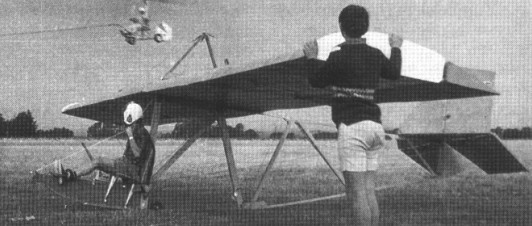
The “Rhon Ranger” is a type of primary glider (or Zogling variant), designed in Europe, for which plans were published in America in the 1930s. In America it is called the “Mead” primary glider after the Chicago firm that marketed Rhon Ranger kits and plans there.
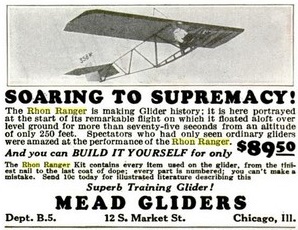
The glider consists of a simple open wooden frame fuselage with doped fabric covered section at rear, fabric covered wooden framed wing of constant cord, fabric covered wooden framed tailplane, elevators and rudder.
The airframe, when assembled, is braced with tubular metal struts. In addition the wing root joint between the wings is covered by plywood panel fairings.
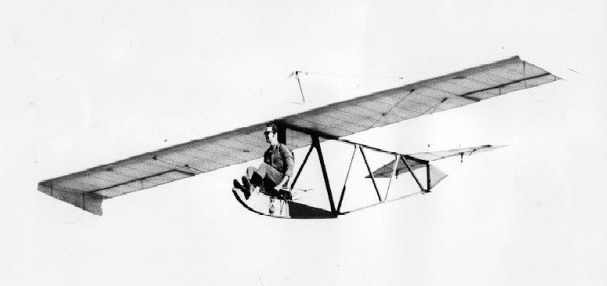
A Rhon Ranger was built by Mr Renaut of South Shiels, UK, in 1932, as the Renaut Primary. It was first flown at Simonside in July 1932.
Wing span: 9.8 m
McCarthy Air Scout
A two-seat cabin monoplane with Anzani radial engine.
 All Aero