Monte R Ruble, Charles L Semans, Clarence J Vogel
Uniontown PA
USA
Circa 1928 built the P-1 Sport
Monte R Ruble, Charles L Semans, Clarence J Vogel
Uniontown PA
USA
Circa 1928 built the P-1 Sport
Czechoslovakia
The Skoda company was the largest industrial organisation in Czechoslovakia in the 1920s, manufacturing engines of indigenous design alongside license-built Hispano-Suiza and Lorraine Dietrich aero engines, Dewoitine aircraft and Curtiss Reed propellers. Skodovy Zavody had a controlling interest in the Czech Avia company and in Ceskoslovenska Letecka Spolecnost, the Czech airline. Parent company has also made cars, firearms, etc.

In 1928 Zaschka carried out experiments with a two-rotor helicopter at Tempelhof Airport in Berlin.
“His [Engelbert Zaschka’s] plane, the first helicopter, which ever worked so successfully in miniature, not only rises and descends verticially, but is able to remain stationary at any height. Herr Zaschka is fully aware that the perfection of his invention will be the greatest forward step in aviation since the Wright brothers made their historical hop. As he pointed out, the danger of flying would immediately be decreased by at least 80 per cent, since four fifths of the accidents in flying occur either in the takeoff or in landing. […] A motor giving thirty to forty horsepower is installed in Zaschka’s present experimental machine. It is so delicately adjusted that he has been able to keep the plane at a height of several feet above the ground, with no movement either up or down.”
Source: German Plane Promises New Stunts in Air, The Bee. Danville, Virginia, USA, June 25, 1927, p. 16.
1938 saw the flight of the Snipe light aircraft, the first Filipino aircraft, designed and built by Dr.
Gregorio Zara.
Built in 1934 by Charles A Zajicek, the C-2 and C-3 Sport were single place, open cockpit monoplanes.
The C-2, N13692, was powered by a 65hp Velie engine and the C-3, N18243, by a 40hp Salmson AD-9.
Charles A Zajicek
Berwyn IL.
USA
Circa 1934 airplane builder
Designed by Felix Knoll during 1929-1930, the Y-1 and Y-2 were three place open cockpit biplanes.
The Y-1 N421N c/n 1 was powered by a 165hp Warner. When the company floundered it sold for a whole dollar ($1) to Carrol Beckwith of Larned KS. The registration was cancelled by CAA 7 January 1933 after he informed them it was dismantled.
The Y-2 N490N c/n 2 was powered by a165hp Wright R-540A. the Y-2 crashed on 27 March 1930 and its registration was cancelled.
Established in 1929
(George C) Yunker Aircraft Co
115 Osage St
Wichita KS.
USA
Airplane builder
In receivership in 1930.
AB Yumashiev built the Yu-1 glider in Kiev in 1925. Designed as a training glider, it was developed with a view to participating in the competitions that year in Crimea.
The Yumashiev Yu-1 (Russian: Юмашев Ю-1) was conceived as a single-seat training glider. It was conceived as a high-wing cantilever monoplane. The wing, with the Pr-426 profile, had a double spar structure and a trapezoidal shape in the plane.
The fuselage was built with a plywood frame structure and had an aerodynamic wing profile shape (curved at the top and flat at the bottom). The front 2/3s were covered in sheets of plywood. The tail section was covered with fabric.
The Yu-1’s offset rudders featured a rounded shape.
The landing gear featured a conventional wheeled structure, but for record flights they could be concealed within the fuselage. For training flights they were kept exposed.
First flying in September 1925, the Yu-1 glider was entered in the III National Sailing Competitions held in Koktebel in 1925. On September 30, Yumashiev managed to stay in the air in this glider for 1 hour and 30 minutes, which was a national record.
A day later, on October 1, Yumashiev at the controls of the Yu-1 would achieve for the first time in the USSR, a long-distance flight taking advantage of thermal currents. This flight recorded 4800 meters and was considered a national record, because in the competitions the longest flight value would be 24.4 km, reached by the German Nering on his “Consul” glider. For this flight Yumashiev would receive the award for second place in the competition.
Yumashiev Yu-1
Wingspan: 12.20 m
Wing area: 17.20 m²
Length: 5.70 m
Empty weight: 83 kg
Wing loading: 9.5 kg / m²
Rudder surface area: 2.00 m²
Ailerons surface: 3.00 m²
Wing elongation ratio: 8.7
Accommodation: 1
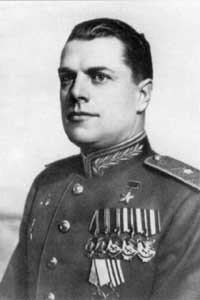
Andrei Borísovich Yumashiev (Russian: Андрей Борисович Юмашев) Andrei Yumashiev was born in Saint Petersburg on March 31, 1902. He finished art school. He joined the Red Army in 1918. In October 1920 and February 1921 he participated in combat actions on the southern front as a soldier in an artillery division. In 1921 he finished artillery courses in Sevastopol.
In 1923 he finished training at the Yegórievsk Aviation Theoretical-military School and in 1924 the Borisoglebsk Higher Flight School and the Serpukhov Higher School of Air Combat, Shooting and Bombing. He later served in the VVS. Between 1926 and 1927 he worked as an instructor pilot at the Serpukhov school.
Between 1927 and 1937 he worked on the NII VVS as a test pilot. He made the first flight and tests of the Bartini Stal-6 (1933). He ran the state tests of the models of A. N Túpolev I-4 (1927), R-3 (1928), TB-1bis (1929 – 1930), R-7 (1930), R-6 (1931), TB -3 (1933), the Polikarpov I-3 fighter (1928 -1929) and the Bartini Stal-7 transport (1936 – 1937).
At the Third National Flying Competitions in Koebel, held in 1925, one of the best Soviet gliders was the Yu-1 designed and built by Yumashiev. This glider demonstrated staying in the air for an hour and a half and reaching 375 meters in height. These results were national records.
He set six world records (including two as co-pilot): in 1936 two flight weight records in the Tupolev TB-3TB-3 and in 1937 two flight distance records aboard the Túpolev ANT-25 as a crew member of MM Gromov.
Between 1937 and 1941 he worked as a test pilot for the TsAGI. During this period, it made the first flight and tests of the BOK-7 (1939). It participated in the crew tests in preparation for the projected long-range voyage on the BOK-15 (1940).
He participated in the Winter War with Finland. Between January and March 1940 he was appointed substitute for the commander of the 85 bombing regiment, carrying out more than 10 combat sorties. As of March 1941 he went on to serve as a substitute for the head of the LII (MM Gromov), attending the flight section. He participated in the flights of the Yakovlev UT-2 with an air cushion and the Gribosvki G-28 “Krechet”.
He fought in the Great Patriotic War. Between July and August 1941, he led the second independent fighter squadron subordinate to the Moscow Air Defense (PVO). In January and February 1942 he commanded the 237th Fighter Aviation Regiment on the Kalinin Front. Between March and August 1942 he was appointed substitute for the commander of the 3rd Air Army and between August 1942 and February 1943, substitute for the commander of the 1st Air Army. Between March and June 1943 he commanded the 6th Fighter Aviation Corps and between July 1943 and December 1944 he led the PVO of the Western and Southern fronts.
Between 1945 and 1946 he was appointed head of the Directorate of Hunting Aviation of the Main Directorate of Combative Preparation of the VVS. From 1946 it went to the reserve.
Lived in Moscow. In his spare time he devoted himself to painting, forming part of the Union of Painters of the USSR. He died on May 20, 1988. His remains rest in the Bagankovsky Cemetery in Moscow.
Awards and distinctions:
Hero of the Soviet Union (1-09- 1937)
Two Order of Lenin
Five Order of the Red Banner
Order of the Patriotic War 1st rank
Order of the Red Star
Medals
He received the De la Vaux medal awarded by the FAI (1937).
 All Aero