Established in Milan in 1933 by three brothers. Nardi’s first aircraft was the F.N.305 tandem two-seat lightplane, which flew in 1935 and was intended as a fighter-trainer. A1938 successor, the F.N.315, was exported to six countries, and a light-attack version was flown experimentally.
The first postwar product was the F.N.333 amphibian, a three/four-seat twin-boom design later acquired by SIAI-Marchetti and marketed from 1962 as the Riviera, and in America as the North Star amphibian.
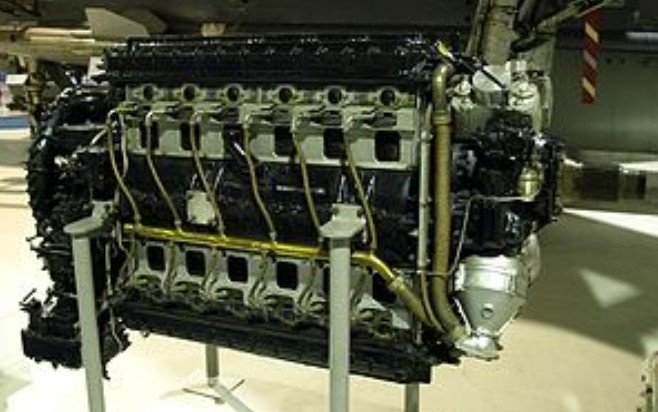
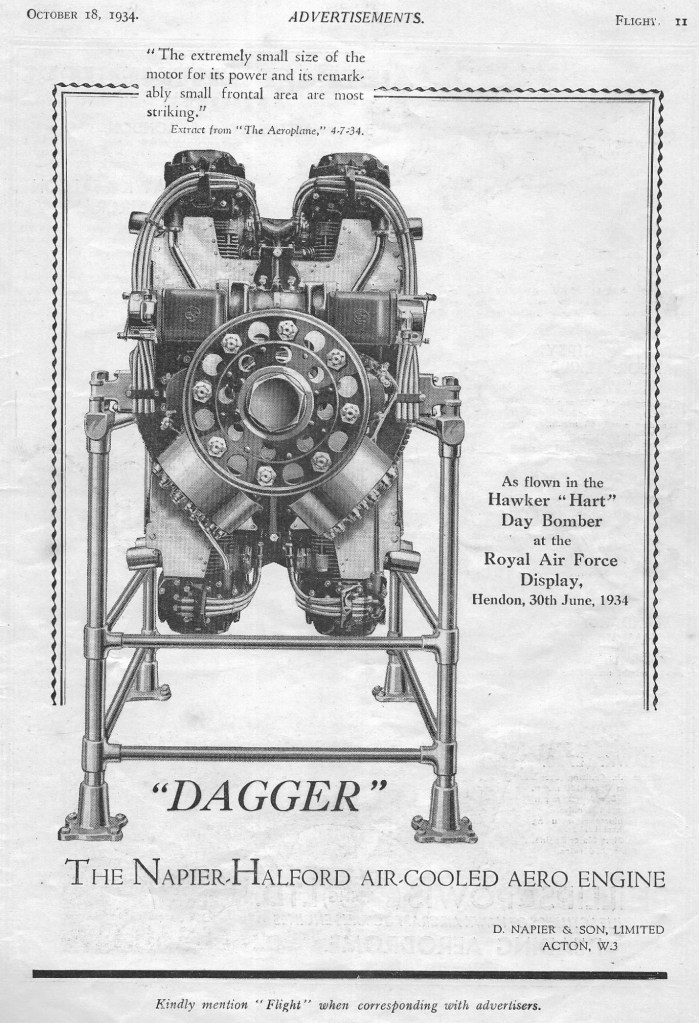
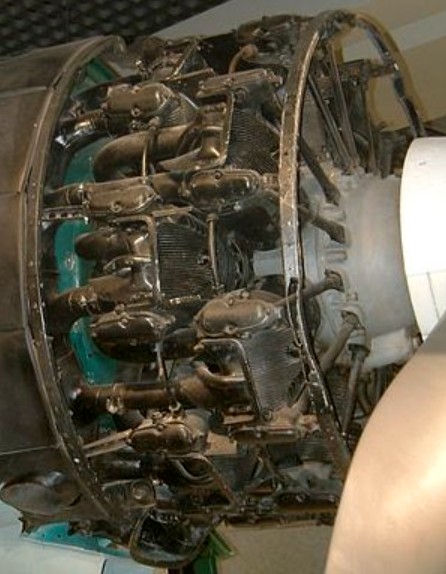
A development of the earlier Napier Rapier, the Napier Dagger was a 24-cylinder H-pattern (or H-Block) air-cooled engine designed by Frank Halford and built by Napier and first run in 1934.
The H-Block has a compact layout, as it essentially consists of two vertically opposed inline engines lying side-by-side and driving side-by-side crankshafts. Since the cylinders are opposed, the motion in one is balanced by the opposite motion in the one on the opposite side, leading to very smooth running.
The Dagger had fast rotation, running at up to 4,000 rpm, but it had conventional poppet valves.
There were problems with cooling, maintenance, manufacturing, and weight, which were not solved during the Dagger’s lifetime and went unresolved well into its successors lifetime, (Napier Sabre). The Dagger powered the Hawker Hector army co-operation aircraft and the Handley Page Hereford (a variant of the Hampden) bomber. The operational usefulness of the Hector was restricted by engine cooling problems, which made it unsuitable for operations in the tropics, and the Hereford was found to be unsuitable for combat because its Dagger VIII engines were noisy and unreliable. The Dagger also found an application in the experimental Martin-Baker MB 2 fighter.
Variants: Napier-Halford Dagger I 1934 – 650 hp.
Dagger II 1938 – 755 hp
Dagger IIIM 1938 – 725 hp
Dagger VIII 1938 – 955 hp, intermediate altitude supercharger, initially known as E.108
Specifications: Napier Dagger III MS Type: Twenty-four-cylinder supercharged air-cooled H engine Bore: 3.813 in (96.8 mm) Stroke: 3.75 in (95.25 mm) Displacement: 1,027 cu.in (16.8 lt) Length: 80 in (2,032 mm) Width: 22.5 in (584 mm) Height: 45.125 in (1,146 mm) Dry weight: 1,358 lb (616 kg) Valvetrain: One inlet and one exhaust valve per cylinder Supercharger: Single-speed centrifugal type supercharger, 5.04:1 reduction Fuel system: Napier-Claudel-Hobson carburettor Fuel type: 87 Octane petrol Cooling system: Air-cooled Reduction gear: Spur, 2.69:1 Power output: 725 hp (541 kW) at 3,500 rpm for takeoff 794 hp (592 kW) at 4,000 rpm at 5,000 ft (1,520 m) Specific power: 0.77 hp/in³ (35.13 kW/l) Compression ratio: 7.75:1 Specific fuel consumption: 0.43 lb/(hp•h) (261 g/(kW•h)) Oil consumption: 0.18-0.35 oz/(hp•h) (7-13 g/(kW•h)) Power-to-weight ratio: 0.62 hp/lb (1.02 kW/kg)
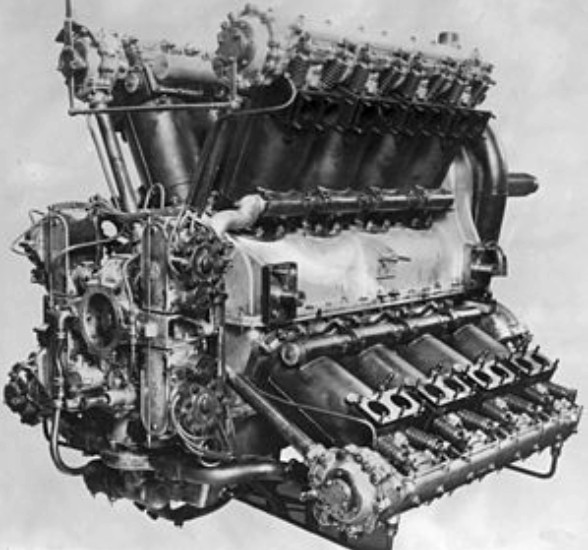
The Napier Cub was a large experimental 1,000 horsepower (750 kW) 16-cylinder ‘X’ pattern liquid-cooled aero engine built by the British engine company Napier & Son. The Cub was the only Napier ‘X’ engine design.
The four banks of four cylinders were arranged in a flattened ‘X’ when viewed from the front. The angle between the upper cylinders was 52.5 degrees, the lower cylinders 127.5 degrees which gave an angle of 90 degrees between the outer cylinder banks. The cylinders consisted of separate individual steel forgings with welded steel water cooling jackets. The carburettor was situated below the propeller reduction gear at the front of the engine and fed the inlet valves through four inlet manifolds. The valve drive gear, magnetos and pumps were fitted to the rear of the crankcase.
First run in 1919 and first flown on 15 December 1922 in an Avro Aldershot biplane bomber aircraft, the only other application was in the Blackburn Cubaroo. Only six engines of this type were ordered and produced.
Specifications: Type: 16-cylinder liquid-cooled X engine Bore: 6.25 in (158.75 mm) Stroke: 7.5 in (190.5 mm) Displacement: 3,681 cu in (60.32 L) Dry weight: 2,450 lb (1,111 kg) Valvetrain: Single overhead camshaft with four poppet valves per cylinder Fuel system: Updraught carburettor Fuel type: Petrol Cooling system: Liquid cooled Reduction gear: Spur geared, reduction ratio 0.489:1, left hand tractor Power output: 1,000 hp at 1,800 rpm Compression ratio: 5.3:1 Power-to-weight ratio: 0.4 hp/lb
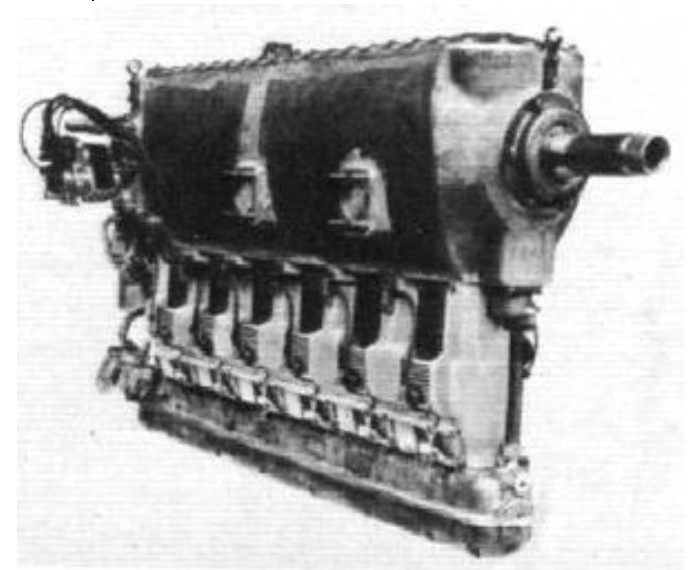
The Napier Javelin was a British six-cylinder air-cooled aero engine designed by Frank Halford and built by Napier & Son. The six cylinders were arranged inverted and inline. Unlike the similar, the poppet valves operated by a single gear driven overhead camshaft.
First run in 1932 and flown in March 1934 in the prototype of the Percival Mew Gull racing aircraft, the engine was also used in the Spartan Arrow biplane and the Percival Gull.
Variants: Javelin I Initial version producing 150 hp.
Javelin III A longer stroke and increased capacity version of 160 hp.
Javelin IIIA A Mark III with a starter motor, generator and other improvements for the Martin Baker MB.1.
Specifications: Javelin I Type: 6-cylinder inverted inline air-cooled engine. Bore: 4.5 in (114.3 mm) Stroke: 5.25 in (133.35 mm) Displacement: 501 cu in (8.21 lt) Length: 58.5 in (1486 mm) Width: 26 in (660.4 mm) Height: 31.5 in (800 mm) Dry weight: 410 lb (186 kg) Valvetrain: Overhead cam poppet-valves Fuel system: Twin updraught carburettors Fuel type: Petrol Cooling system: Air-cooled Reduction gear: Direct drive, left hand tractor Power output: 150 hp (112 kW) at 2,000 rpm Compression ratio: 5.3:1
By 1931, during the Great Depression, Bentley was having financial difficulties. When funds ran out in 1931, the receivers were negotiating with D.Napier & Sons Ltd for the sale of the remains of Bentley. However, Rolls-Royce put in a secret bid through a Liechtenstein company, and secured Bentley Motors for £125,256. For this, Rolls-Royce got the factory equipment, a number of incomplete car chassis, and the services of Walter Bentley for three years.
The Nakajima Sakae (栄, Prosperity) was a two-row, 14-cylinder air-cooled radial engine used in a number of combat aircraft of the Imperial Japanese Navy and Imperial Japanese Army before and during World War II.
The engine was designed by Nakajima Aircraft Company after acquiring a license for the French Gnome-Rhone 14K. The Imperial Japanese Army Air Force called the first of the series the Ha-25 (ハ25) and later versions were designated Ha35, Ha105 and Ha115, while the Imperial Japanese Navy Air Service designation was Nakajima NK1, with sub-types identified by Model numbers; thus Nakajima NK1 Sakae 10, 20 and 30 series.
A total of 21,166 were made by Nakajima; 9,067 were manufactured by other firms.
Variants: Army Type 99 975 hp Air-cooled Radial Long Army designation for the Nakajima NK1 radial engine named Sakae.
Nakajima Ha25 Short Army designation for the initial production version of the Nakajima NK1 radial engine named Sakae.
Nakajima Ha35 Nakajima Ha35 Model 11 Nakajima Ha35 Model 12 Nakajima Ha35 Model 23 – 1,150 hp (858 kW)
Nakajima Ha105
Nakajima Ha115 Nakajima Ha115-I Nakajima Ha115-II
Nakajima NK1 NK1C Sakae 12 – 925 hp (690 kW), 940 hp (701 kW), 975 hp (727 kW) NK1D Sakae 11 – 970 hp (723 kW), 985 hp (735 kW) NK1F Sakae 21 – 1,115 hp (831 kW), 1,130 hp (843 kW) NK1E Sakae 31 – 1,130 hp (843 kW), boosted to 1,210 hp (902 kW) with water-methanol injection
In 1917, Chikuhei Nakajima set up the “Airplane Institute” at Ojima Town in Gunma Prefecture. In 1918 they built their first airplane; the “Nakajima Type 1” with a U.S.A. made engine. In 1920 the company sent Kimihei Nakajima to France to study European advances, and in 1922 started their own engine factory in Tokyo. This led to production of engines based on the Lawrence A-3 two-cylinder air-cooled horizontally opposed engine.
At the time the Lawrence was an oddity. Most air-cooled engines at that time were using cylinders that rotated together with the propeller, but Kimihei overheard that an engine with good cooling capability with fixed cylinders was being developed in England. He observed the English Gloster Gamecock fighter with its Bristol Jupiter engine, which was an advanced design for the era with an automatic adjustment device for tappet clearance, spiral piping for even intake distribution, and a four-valve intake and exhaust system. He acquired a manufacturing license for the Jupiter in 1925. In 1927, after inviting two production engineer instructors from the Bristol company, the Jupiter Type 6 of 420 PS and Type 7 of 450 PS with a turbocharger were put into production at the Nakajima factory.
After studying the Pratt & Whitney Wasp 9-cylinder radial, Nakajima tried to combine the good points found in Jupiter design with the rational design of the Wasp. Nakajima then produced a series of engine types, named “AA”, “AB”, “AC”, and “AD”, as engineering exercises. The next engine design, the “AE”, was innovative, with a bore of 160 mm and a stroke of 170 mm.
Prototypes were made and performance tests were done, but this engine was not adopted due to its very complex engineering. Nakajima continued testing different cylinder designs. In 1929, the “AH” design, with bore and stroke of 146 × 160 mm and a total displacement of 24.1 L, was completed. This was to be the final version of this basic engine design.
In June 1930 the first prototype of was completed and it passed the durability test for the type approval in the summer. Then flight tests were started using a Nakajima A2N carrier plane. Nakajima had designed the first Japanese originally designed air-cooled 9-cylinder engine, the 450 PS “Kotobuki”.
In December 1931, this engine was approved and adopted by the Navy as the Ha-1 Ko for the Type 97 carrier fighter. The engine was named, in connection with the Jupiter engine, “Kotobuki” (寿, “Longevity”).
The “Kotobuki” engine was improved and developed into the “Hikari (light)” engine with the bore and stroke expanded to the limit of the cylinder (160 × 180 mm for a displacement of 32.6 L), with the power was increased to 720 PS. The “Hikari” was used in Type 95 carrier fighters and Type 96 Carrier Attack Plane.
In search of more power the basic design was extended into a 14-cylinder 2-row engine, the “Ha-5 Ha-41 Ha-109” series.
Variants: 2-Kai-1 – 585 hp (436 kW) 2-Kai-3 – 610 hp (455 kW) 3-Kai – 710 hp (529 kW)
Specifications: Type: 9-cylinder radial piston engine Bore: 146 mm (5.75 in) Stroke: 160 mm (6.3 in) Displacement: 24.1 L (1,471.2 cu in) Dry weight: 350 kg (772 lb) Cooling system: Air-cooled Power output: 550-780 hp
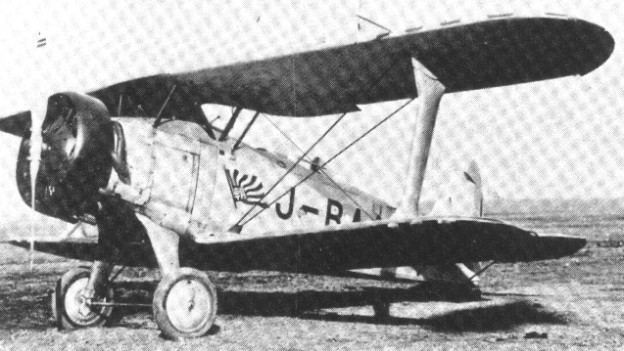
With the destruction of the NAF-1 shipboard two-seat fighter prototype in April 1933, Kiyoshi Akegawa began design of a further two-seater to meet an 8-Shi requirement, the NAF-2. Of all metal construction with fabric skinning, the NAF-2 was powered by a 580 hp Nakajiina Kotobuki 2 nine-cylinder radial and was a single-bay staggered biplane with pronounced sweepback on the upper wing. Armament comprised three 7,7-mm guns, two fixed and one on a flexible mount, and the first of two prototypes was completed in March 1934, these differing in that the first had N-type interplane struts and the second had aerofoil-section I-type struts. Although the NAF-2 met Imperial Navy requirements, a change in policy led to the abandonment of the two-seat fighter concept, and both prototypes were sold to the Asahi Press.
Engine: Nakajiina Kotobuki 2, 580 hp Max speed, 186 mph (300 km/h) Time to 9,845 ft (3 000 m), 9.66 min Endurance, 4.5 hrs Empty weight, 2,718 lb (1 233 kg) Loaded weight, 3,770 lb (1 710 kg) Span, 33 ft 9.5 in (10,30 m) Length, 23 ft 9.8 in (7,26 m) Height, 9 ft 4.2 in (2,85 m) Wing area, 283.64 sq ft (26,35 sq.m)
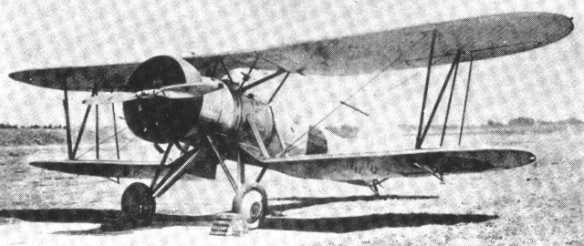
In 1931, the Imperial Navy instructed Nakajima to design and build, as part of a 6-Shi programme, a two-seat shipboard fighter with secondary dive-bombing capability and provision for an auxiliary fuel tank to suit the aircraft for long-range reconnaissance missions. Of all-metal construction with fabric skinning and designed by Kiyoshi Akegawa, the fighter received the company designation NAF-1. The wings could be folded aft, provision was made for an external 616 Imp gal (280 lt) auxiliary fuel tank and power was provided by a 530 hp Bristol Jupiter engine. Armament comprised two fixed for¬ward-firing 7,7-mm guns and a gun of similar calibre on a flexible mount. The sole prototype was completed in the summer of 1932, but delivery to the Navy did not take place until the following year, the NAF-1 being destroyed in a forced landing on 8 April 1933, and the programme being cancelled.
NAF-1 Engine: Bristol Jupiter, 530 hp Max speed, 173 mph (278 km/h) Time to 9,845 ft (3 000 m), 7.5 min Endurance (without external tank), 4 hrs Empty weight, 2,800 lb (1 270 kg) Loaded weight, 4,065 lb (1 844 kg) Span, 35 ft 2.25 in (10,72 m) Length, 23 ft 7 in (7,19 m) Height, 9 ft 3 in (2,82 m) Wing area, 316.36 sq ft (29,39 sq.m) Armament: two fixed for¬ward-firing 7.7-mm guns and 1 gun of 7.7 mm on a flexible mount.
Nakajima’s chief designer Yasumi Koyama had evolved an advanced single seat fighter from the company’s unsuccessful PA or Ki-11 low-wing monoplane prototype during 1934. While this private -venture low wing cantilever monoplane was still under development, Japanese army air headquarters issued a requirement to three major aircraft manufacturers, including Nakajima, for a similar aircraft in mid-1935. Nakajima responded with a single-seat monoplane fighter derived from the company’s Type P.E., which it had started to develop as a private venture.
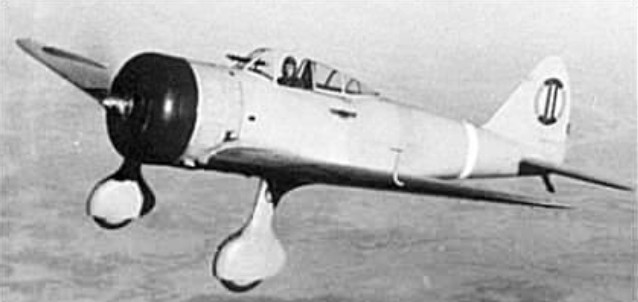
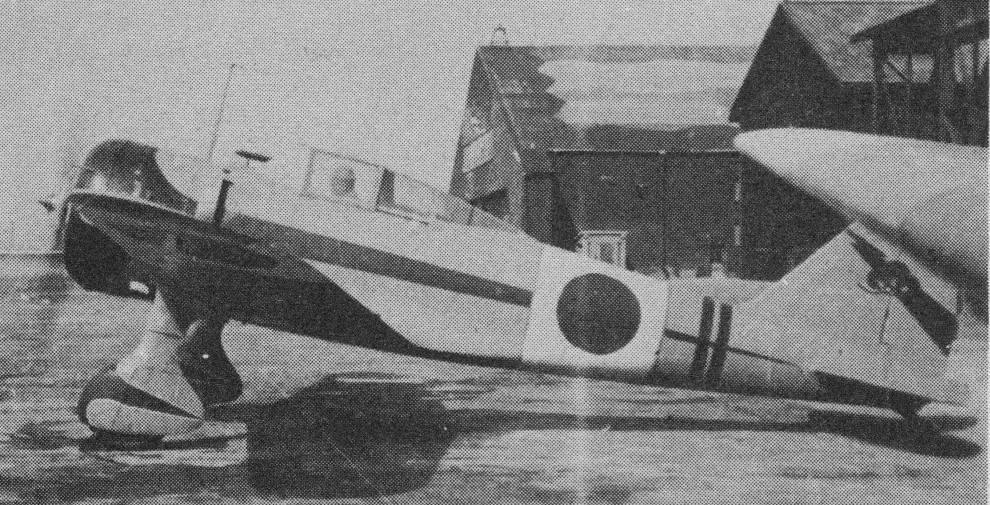
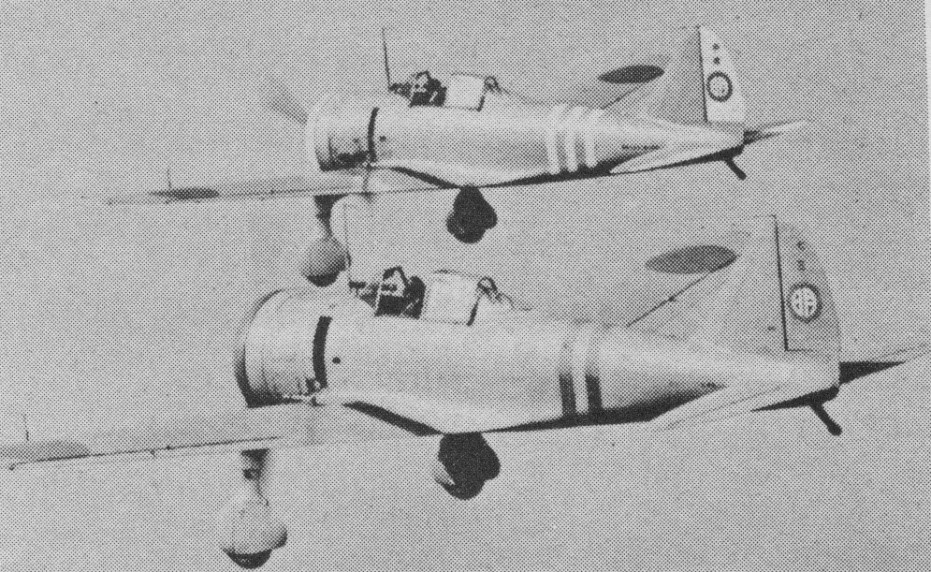
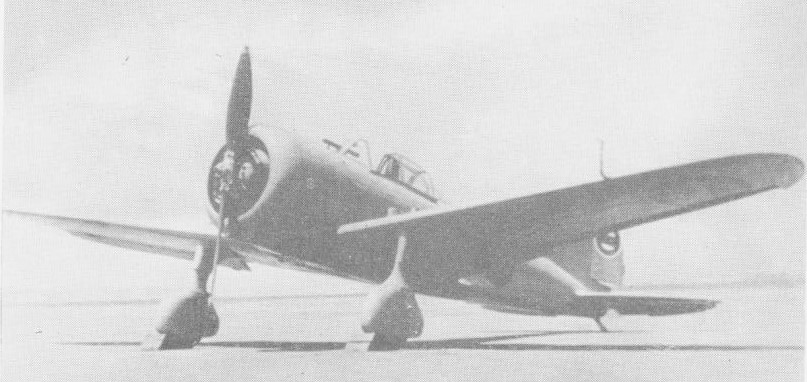
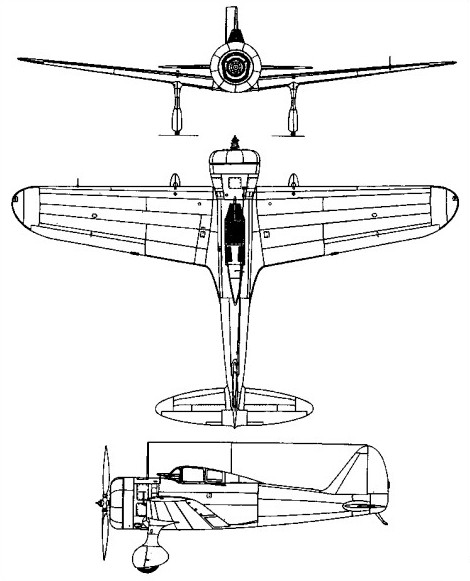
The Ki 11 first flew in July 1936; the first prototype Ki 27, built to the official requirement, flew three months later. They differed only in detail, both being powered by a 650hp Nakajima Ha la radial engine and having a fixed, spatted cantilever single strut undercarriage. The Ki 27 had a redesigned and fully enclosed pilot’s cockpit canopy, and there were changes in the engine cowling, wheel spats and fin and rudder. A second Ki 27 prototype flew in December 1936, followed by ten pre-production aircraft. Different wing forms were tested and the Ki 27s were flown against rival prototypes Kawasaki’s Ki 28 and Mitsubishi’s Ki 33 developed from the navy A5M carrier fighter. Although achieving a maximum speed of’467 km/h (290 mph) at 4000 m (13 120 ft), it was still 15 km/h (10 mph) slower than the Ki 28 and took 28 seconds longer than its rival to reach 5000 m (16400 ft). The Ki 27 was nevertheless preferred to the Kawasaki fighter because of its outstanding manoeuvrability, due in part to the remarkable lightness of the structure and to the special aerofoil section developed by Koyama’s team.
Pre-production Ki 27s had a wing with span increased to 11.31 m (37 ft 1 in) which became standard on Ki 27a production aircraft. These appeared from December 1937 onwards, designated as the Army Type 97 Fighter. The standard engine was the Ha 1b developing 780 hp at 2900 m (9510 ft).
The original allied name assigned to the Ki.27 met in China by the CBI, “Abdul” was also called “Nate” by Col. MacCoy. The name Abdul was still caried in Naval recognition manual as late as February 1943. It was finally dropped in favour of the officially adopted “Nate”.
From spring 1938 Ki 27a fighters flew in northern China, and before the end of 1938 six Sentais (groups) newly established by the army were fully equipped with the Ki 27a. The Ki 27a model was, however, soon phased out of production in favour of Ki 27b, which had a wholly glazed pilot’s canopy and provision for two 130 litre (29 Imp gal) slipper type underwing drop tanks or four 25 kg (55 1b) bombs.
Ki.27a
Ki 27s were again in action in May 1939 when fighting broke out between Japanese and Soviet troops at Nomonhan along the border with Outer Mongolia. About 200 were ultimately engaged in full scale air battles with Soviet Polikarpov I 15bis biplanes and I 16 monoplanes. The Japanese acquitted themselves well in a most bloody conflict, and claimed many victories. The highest score of 58 enemy aircraft destroyed was claimed by Sergeant Shinobara of the 11th Sentai.
The poor state of the Allied air forces in the Far East in 1941 42 allowed Nakajima’s nimble fighter, despite its poor armament of twin synchronized 7.7 mm (0.303 in) Type 89 machine guns, to control the air over Burma, the Philippines and the Dutch East Indies. British, American, Australian and Dutch pilots all acquired a healthy respect for ‘Nate’, as the type was codenamed by the Allies, and they were careful to avoid getting entangled with it in an old style close dogfight. The Ki 27 achieved the distinction of shooting down the first Allied aircraft of the Pacific war, when an aircraft of the 1st Sentai destroyed a Consolidated Catalina flying boat of No 205 Squadron RAF while covering Japanese landings on the Malayan coast.
With the advent of newer types, Ki 27s were relegated to advanced training or home defence. In the latter role they were at a stroke rendered impotent when the Boeing B 29 Superfortress came on the scene, and as the war drew to a close, Ki 27s were adapted as suicide attackers, a number of their pilots sacrificing themselves while endeavouring to crash into enemy ships or land positions carrying a 500 kg (1100 lb) bombload.
Mansyu Kikoki Seizo K K (Manchurian Aeroplane Manufacturing Company), based in the Japanese puppet state, built 1379 Ki-27s at its Harbin factory as against 2020 built by Nakajima up to December 1942, when all production by the parent firm ceased. Production included two Ki 27 Kai prototypes, even lighter than the standard machine, which reached a maximum of 475 km/h (295 mph) during tests in summer 1940.
In 1942 Mansyu redesigned the Ki 27 as an advanced trainer which went into production the same year as the Army Type 2 Advanced trainer.
Ki-27a Engine: 1 x Nakajima Ha-1b, 529kW Max take-off weight: 1790 kg / 3946 lb Empty weight: 1110 kg / 2447 lb Wingspan: 11.31 m / 37 ft 1 in Length: 7.53 m / 24 ft 8 in Height: 3.25 m / 10 ft 8 in Wing area: 18.55 sq.m / 199.67 sq ft Max. speed: 470 km/h / 292 mph Ceiling: 12250 m / 40200 ft Range w/max.fuel: 625 km / 388 miles Armament: 2 x 7.7mm machine-guns Crew: 1
Ki-27b Engine: Hitachi Ha-1b, 750 hp Wing span: 11.31 m / 37 ft 1 in Wing area: 18.56 m2 Length: 7.53 m / 24 ft 8 in Height: 3.28 m / 9 ft 2 in Empty weight: 1110 kg / 2447 lb Loaded weight: 1547 kg / 3946 lb Max speed: 470 km/h at 3500 m Max speed: 286 mph at 16,400 ft Time to 5000m: 5m 22s Service ceiling: 12,250 m Service Range: 627 km Max range: 1100 km Armament: 2 x 7,7-mm Type 89 machine guns Crew: 1 Bombload: 220 lb
 All Aero