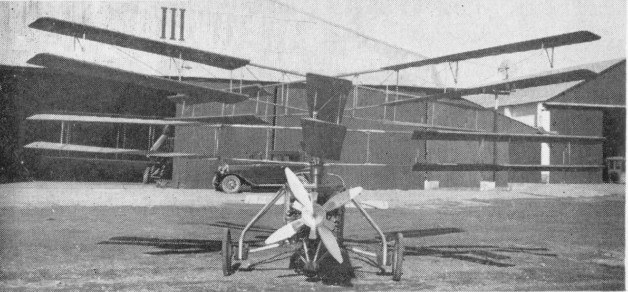
In 1919 the Marquis Raul Pateras de Pescara began trials with a series of helicopters leading to his 1924 biplane helicopter which had 16 rotorblades mounted co axially with both cyclic and collective pitch control. He flew it in France rather than his native Argentina, succeeding in directing its flight at a speed around 8 kph (13 mph) and 700 yards, making autorotative descents with the blades free¬wheeling.
2nd flight
The Pescara No.3 was flown backwards in 1924 on second flight. It later flew for 670 seconds.
By 1965 it was in reserve storage at the Musee de L’Air.
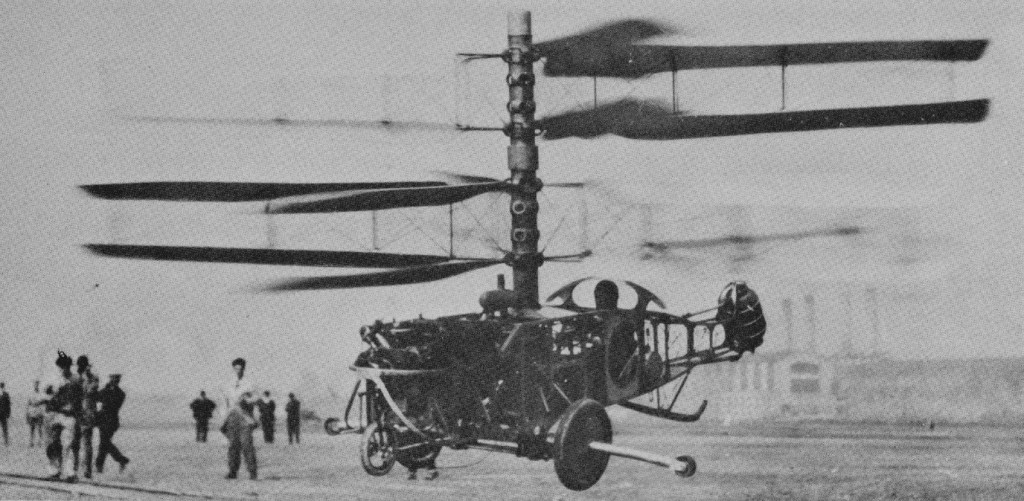
In 1923 Thomas O Perry / Chicago Helicopters Ltd built a two-place helicopter with coaxial counter-rotating rotors, collective pitch control. A novel approach to power-off descent was used—with a hand crank, the rotors could be moved to a position perpendicular to the direction of flight, transforming the helicopter into a sort-of biplane. A horizontal tail surface mounted on a boom was then used as elevator. A prototype was built by Plamondon Mfg Co of Chicago and flight-tested at Lombard IL. Results were not publicized but apparently were unsatisfactory.
This aircraft started off as a Mignet HM.14 Pou du Ciel (Flying Flea), and as such, was registered as G-ADZG (C of R 6568) on 16.12.35 with the c/no EGP/SS/56. However, the registration G-ADZG was not taken up.
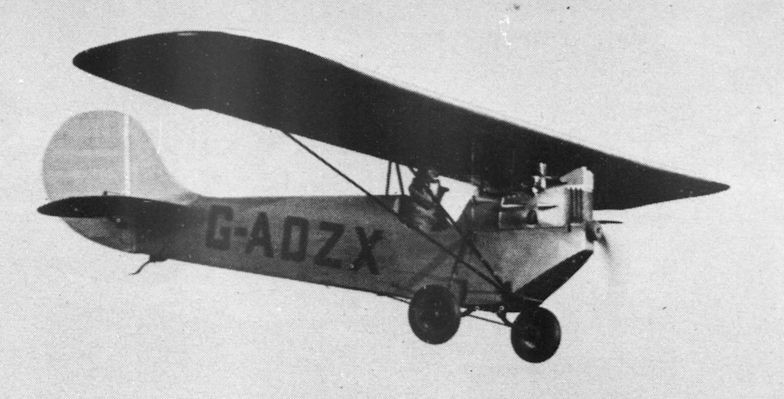
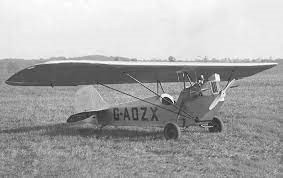
In 1936, together with Frank William Broughton, Perman developed a project for a small airplane called the Perman Parasol. Instead, the basic Flying Flea airframe was heavily modified and redesigned, and the aircraft was first registered (C of R 6593) on 2.5.36 as G-ADZX to E.G. Perman & Co, Gravesend Airport, Gravesend, Kent. The aircraft was described to the Air Ministry (per the aircraft’s record card) as a “Perman Parasol”. The Perman Parasol was a single seat ultra light monoplane, designed and built by E.S. Penman & Co Ltd. of London.
It was a single-seat parasol strut-wing monoplane powered by a Perman-Ford (Perman Poupower) engine with a claimed power of 32 hp with a two-bladed wooden propeller.
One only – G-ADZX – flew for the first time 23.5.36 (at Gravesend), powered by a 30 hp Perman-Ford engine, and flown by Mr A E Clouston.
Sold on for £175 and re-registered (C of R 6593) 13.10.36 to Airworthiness Ltd., Gravesend Airpoprt, Gravesend, Kent. According to the aircraft record card, they re-named the aircraft as a “Brown Pigeon” (“formerlly called Parasol”)
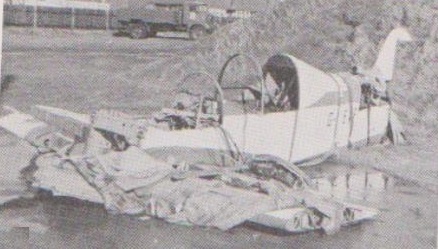
On the night of 31 July 1937, fire broke out in one of the hangars at Gravesend Airport. By the time it was extinguished, no fewer than five aircraft had been destroyed or damaged beyond economic repairThese were Blackburn Bluebird G-EBRF, two Robinson Redwings, G-ABDO and G-ABOK, DH60M Moth G-AAUH — and the one and only Perman Parasol, G-ADZX.
The blaze has been described elsewhere as “a firefighting exercise”. A local newspaper reported that “an aeroplane’s petrol tank exploded in a mysterious fire”. The airfield was also known as London East.
Written off (destroyed) by or on 31.7.37 when burnt out in a hangar fire at Gravesend Airport, Gravesend, Kent. Registration G-ADZX formally cancelled by the Air Ministry 31.12.38 due to “destruction or permanent withdrawl from use of aircraft”. The aircraft record card also noted “Census 1938”, which indicates that the cancellation was as a result on the Air Ministry’s 1938 Census into all surviving British-registered civilian aircraft.
The Perman Parasol was developed into the Perman Grasshopper.
Engine: Perman-Ford, 32 hp Wingspan: 7.80 m Wing area: 11.60 sq.m Length: 4.75 m Height: 1.80 m Empty weight: 192 kg Maximum takeoff weight: 272 kg Maximum speed: 120 km/h Cruise speed: 109 km/h Range: 450 km Crew: 1
The rights to the Perman Grasshopper, a development of the Perman Parasol, were taken over by Broughton-Blayney and marketed as the Broughton-Blayney Brawney.
A single-seat parasol monoplane, three Broughton-Blayney Brawney were built at Hanworth; G-AENM c/n BB/50 – written off 21 March 1937 G-AERF c/n BB/51 – written off 6 June 1937 G-AERG c/n BB/52 – withdrawn from use in 1937
Broughton-Blayney Brawney Engine: Carden Ford Wingspan: 25.06 ft Length: 15.06 ft
During 1935, E. G. Perman advertised Mignet’s Pou-du-Ciel in aviation magazines and even went as far as proposing the formation of a Flea Constructors’ Club.
There was a link between the firm of E. G. Perman & Co of Brownlow House, 50-51 High Holborn, London WC1, and F. W. Broughton who later went on to design the trio of Broughton-Blayney Brawney single-seaters.
That Perman began in aviation building Fleas is well-documented and the business can be traced back to 24 Brownlow Mews, Guilford Street off Gray’s Inn Road. It was to this address which Flea G-ADOV was registered on 1 October 1935, to G. A. Puttnam, described as “trading as E. G. Perman & Co”. The same attribution goes to G-ADPW later the same month. The following January we find G-ADPV, this time registered to Perman & Co alone, as were G-ADPX and ’PY. Then there is a gap until G-AECM.
Appleby (1912-84) had formed the G. A. Puttnam company as Flea builders in March 1936. Where the name Puttman came from is unknown. His other directors were Martin Payne (formerly with Sir John Carden), Samuel W. Soden and his wife Gertrude, described as furriers, and Dr Harold A. Tracey, a medical practitioner. The firm went on to advertise “the PAC Pou […] fitted with the Carden Aero engine”, trumpeting how, “every machine made by PAC is test flown and passed by Stephen V. Appleby”. The price, with Carden-Ford engine, was £175 and hire-purchase terms were available. It advertised its Flea extensively, an added expense for the fledgling company.
Less than six months later, we find the firm was put up for sale as a going concern. Martin Payne had died suddenly after major surgery and without his financial backing the business could not continue.
With 3,000 sq ft of office and manufacturing space — which, an advertisement tells us, was centrally heated — the asking price was £1,000.
Whether or not the outfit was sold is not recorded. In its brief life, Puttnam had built some five aircraft at its Hornsey Road premises. Appleby now went on to share his time between a job at Heston Airport and Edward Dixon Abbott’s business, bespoke coachbuilders at Wrecclesham. Through its connection with Baynes, the Abbott company also made gliders including the Farnham Sailplane. It later teamed up with Baynes as Abbott-Baynes Sailplanes to build the famous Scud series of small gliders.
Perman simply disappears off the aviation radar after 1936.
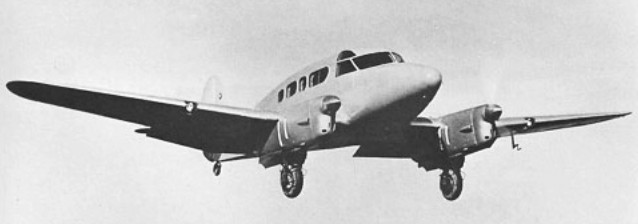
Engine : 2 x De Havilland Gipsy Six, 202 hp Length : 32.251 ft / 9.83 m Height : 9.744 ft / 2.97 m Wingspan : 46.654 ft / 14.22 m Wing area : 278.034 sq.ft. / 25.83 sq.m Max take off weight : 5501.5 lb / 2495.0 kg Weight empty : 3501.5 lb / 1588.0 kg Max. speed : 170 kt / 314 km/h Cruising speed : 152 kt / 282 km/h Service ceiling : 20997 ft / 6400 m Wing load : 19.89 lb/sq.ft / 97.0 kg/sq.m Range : 652 nm / 1207 km Crew : 2 Payload : 2-4pax
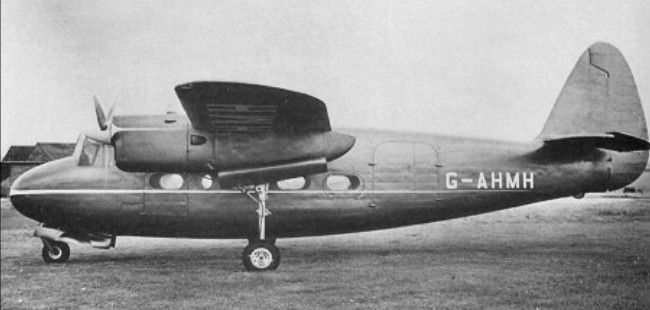
The Percival Merganser was a light, civil transport of the late 1940s. It was a twin-engine, high-wing monoplane of all-metal, stressed skin construction with retractable tricycle undercarriage. The Merganser was designed as a five-passenger, light airliner with an emphasis on “passenger appeal”. To this end, a high-wing configuration and tricycle landing gear were chosen to provide the best view and a low, level floor for easy access. The fuselage, having been completed in November 1946, was shipped by train ferry to Paris to be displayed at the Aero Show. By this time, the Merganser was already doomed, since it was designed to be powered by de Havilland Gipsy Queen engines and neither these nor any suitable substitute were available.
Only one Merganser was flown; when it made its first flight on 9 May 1947 from Luton Airport, the engines were on loan from the Ministry of Supply. The company was able to carry out extensive flight trials and obtain much valuable data. Although it appeared at the SBAC Show at Radlett in September 1947, it was scrapped at Luton in August 1948.
A second Merganser was used as a static and structural test airframe. Although the Merganser never entered production, further development, based on the data gathered from its test programme, would lead to the larger Prince, President and Pembroke series for which a suitable powerplant was available.
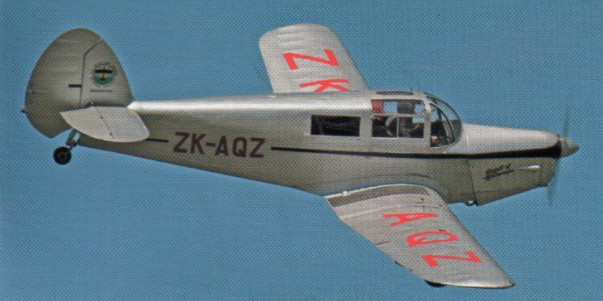
The Proctor as a type dates back to 1939, being designed as a radio trainer and light communications machine for the Royal Air Force by A.A.Bage. A development of the pre-war Vega Gull with Percivals incorporating RAF design requirements into the Vega Gull airframe, the Proctor was produced in five versions – Mks I to III being three seaters for the RAF, while Mks 4 and 5 (Arabic mark numbers replaced Roman in 1948) were four seaters, and incorporated folding wings, the last variant being targeted at the immediate post war civil market, a purely post-war civil version of the RAF’s Mk.4.
In all, 246 Mk.1s were built by Percival, at Luton.
The Mks II and IIIs for the Navy had a quick release dingy installed in the wing centre sections.
A total of 200 Mk.2s and 436 Mk.3s were built. All by F.Hills & Sons at Manchester.
Percival P34A Proctor 3 OO-JDB (c/n RAF H211)
In 1943, the Mk. III fuselage was redesigned and strengthened to accommodate two side-by-side pairs and the windscreen and cabin windows were enlarged. This was originally known as the Preceptor but was renamed Mk.4. The added visibility from the Mk.4 enabled carrier deck landing trials to be undertaken. Eight pre-production aircraft and 250 production aircraft were built by F.Hills & Sons at Manchester.
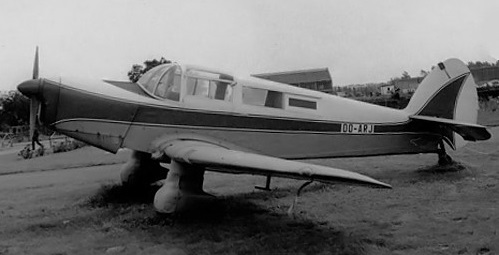
Percival P31C Proctor IV OO-ARJ (c/n H642)
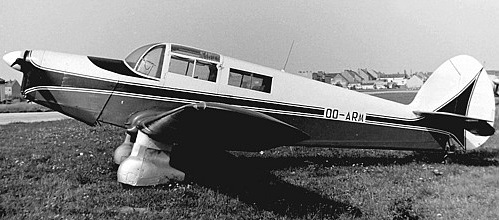
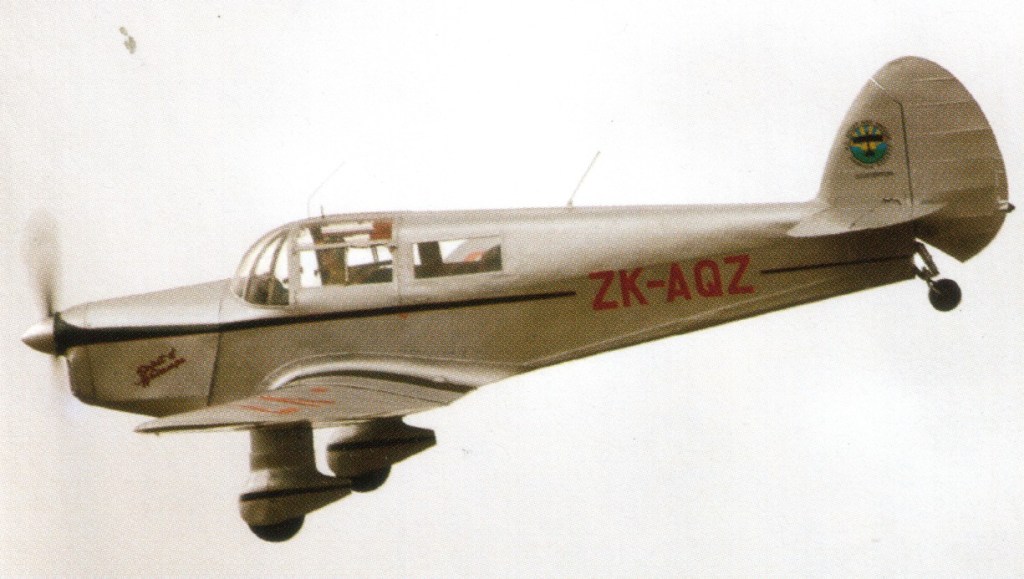
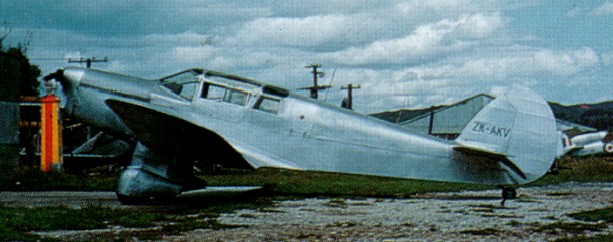
The Proctor V is a civil version of the Proctor IV. The Proctor 5 is a low-wing cantilever monoplane of all-wood construction powered by a six cylinder de Havilland Gipsy Queen II engine driving a two-bladed, variable pitch propellor with constant speed control. The fabric covered wings fold upwards and rearwards to lessen hanger area. Access to the engine is easy with large cowl flaps either side hinging upwards to reveal the whole engine. Fuel is contained in two tanks just outboard of the centre sections and a 5 gallon oil tank is located on the right side in front of the fuel tank. The undercarriage – fixed cantilever with compression springs coupled with oil dampers and recoil springs – is fully covered by “trousers” and most of the wheels by “spats.
Series production of the Mk.V began at Luton in May 1946, with three converted from Mk.4s, and 150 newly built. All were powered by a DH Gipsy Queen II of 208 hp, providing a maximum speed of 160 mph, a cruising range of some 500 miles and a ceiling of 14000 feet.
Percival P.44 Proctor V OO-ARM (c/n AE84)
Of the hundreds built for RAF use, 225 Mk. 1, 2, and 3 found their way onto the civil register to join at least 150 Mk.5s specially made for the civil market at Percival’s Luton plant. Some continued in service with the RAF until 1955.
The one and only Mk.6 was built as a floatplane for the Hudson Bay Trading Company of Toronto, Canada. It was basically a Mk.5 fitted with floats and a Gipsy Queen 32 engine of 250 hp.
More than 1200 Proctors were produced. The airworthiness design standard of the Percival Proctor was A.P. 1208, dated November 1937 for the Proctor III and October 1938 for the Proctor IV. The design organisation with Type Responsibility Authorisation in 2011 was Tenecia Ltd, at Coventry Airport.
Mk.I Engine: De Havilland Gipsy Queen II, 210 hp Wing span: 39 ft 6 in 12.04 m Wing area: 202.04 sq.ft / 18.77 sq.m Length: 25 ft 10 in Height: 7 ft 3 in / 2.21 m Max take off weight: 3501.5 lb / 1588.0 kg Weight empty: 2370.4 lb / 1075.0 kg Max speed: 165 mph Range: 660 miles Cruising speed: 121 kt / 225 km/h Service ceiling: 13993 ft / 4265 m Wing loading: 7.43 lb/sq.ft / 85.0 kg/sq.m Crew: 2
Mk.II Engine: De Havilland Gipsy Queen II, 210 hp Max speed: 165 mph Range: 660 miles Wing span: 39 ft 6 in Length: 25 ft 10 in Height: 7 ft 3 in
Mk.III Engine: De Havilland Gipsy Queen II, 210 hp Max speed: 165 mph Range: 660 miles Wing span: 39 ft 6 in Length: 25 ft 10 in Height: 7 ft 3 in
Mk.4 Engine: De Havilland Gipsy Queen II, 210 hp Max speed: 157 mph Range: 500 miles Wing span: 28 ft 2 in / 8.59 m Length: 25 ft 10 in Height: 7 ft 3 in / 2.21 m Max take-off weight: 1588 kg / 3501 lb Service ceiling: 4265 m / 14000 ft
Mk.5 Engine: De Havilland Gipsy Queen II, 208 hp Max speed: 220 mph Cruise: 124 mph Vne: 200 mph Range: 520 miles Ceiling: 14000 ft Wing span: 38 ft 6 in Length: 38 ft 1 5/8 in Fuel cap: 40 Imp.Gal MAUW: 3500 lb Height: 7 ft 3 in
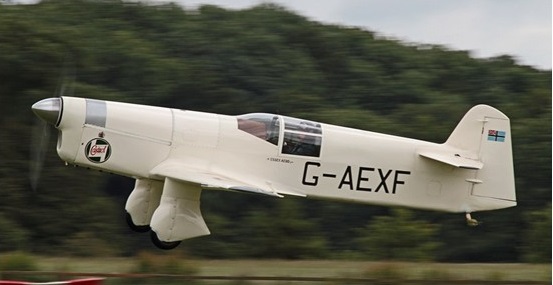
The Percival Mew Gull G-AEXF was designed by Captain Edgar W. Percival and produced in 1936. This clean, low-winged monoplane, with a finely streamlined cockpit cover and a spatted undercarriage, was designed for racing and six were built.
Alex Henshaw exchanged his de Havilland Leopard Moth for a Mew Gull in 1937, and achieved the fastest times in many air races and won the Folkestone Aero Trophy in the same year.
During this period Alex met Jack Cross of Essex Aero Ltd who made mechanical and structural alterations to XF in order to win the 1938 King’s Cup. The effect was a dramatic increase in performance and resulted in winning success in the King’s Cup at a speed of 380.2km/h (236.25mph).
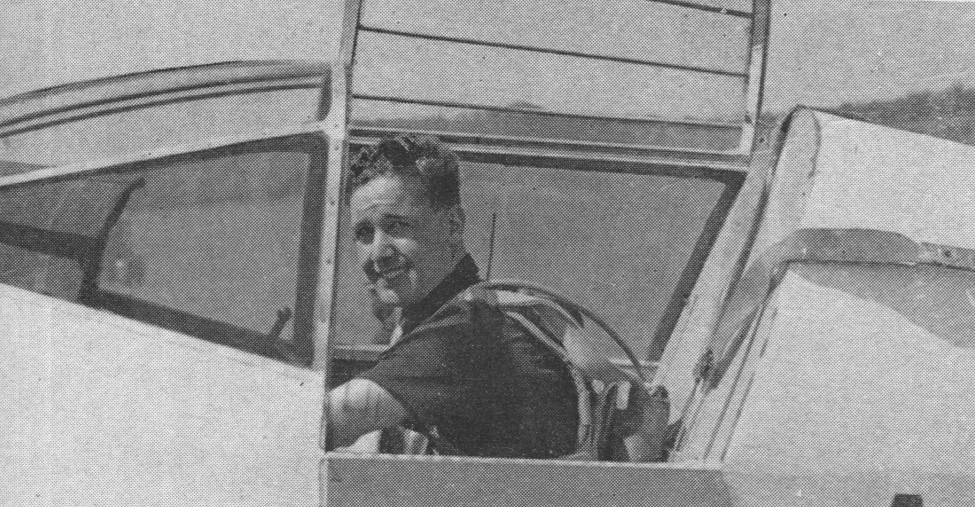
Alex Henshaw in Mew Gull
Alex then decided to attempt the solo records on the England to Cape Town route. He set off from Gravesend on 5 February 1939 and after four days returned having broken all records on this route. They remain unbroken to this day for an aircraft in this class. Each leg took 39 hours 23 minutes at an average speed of approximately 334.7km/h (208mph).
The Mew Gull was sold in the late summer of 1939 to a Frenchman. XF remained hidden from the Germans throughout the Second World War occupation of France. It then passed through a number of different owners before eventually being bought by Robert Fleming in 2002.
Mew Gull G-AEXF ‘displayed’ at Reflectaire Museum at Squires Gate on 20 February 1971, prior to restoration by Tom Storey
In 2008 XF was still operated by The Real Aeroplane Company at Breighton in Yorkshire.
Engine: 165 hp Napier Javelin Length: 18.23 ft (5.56m) Wing span: 24 ft (7.32m) Weight empty: 1,000 lb (450 kg) Max speed: 195 mph (314 kph) Range: 550 miles (885 km) Seats: 1


 All Aero