In early/mid-1930s, at Linkoping, Svenska Jarnvagsverkstaderna built Viking three-seat cabin monoplane with wheel or float landing gear, developed later into Viking II four-seater.
Inter-Wars
Svenska Jarnvagsverkstaderna ab
Sweden
In early/mid-1930s, at Linkoping, built Viking three-seat cabin monoplane with wheel or float landing gear, developed later into Viking II four-seater; also Type 2 light multipurpose aircraft; and produced under license Raab-Katzenstein Tigerschwalbe trainers for Swedish Air Force. In 1939 company’s Aircraft Division amalgamated with Svenska Aeroplan AB., helping to form SAAB.
Sutton Airedale
The Sutton Airedale was built by Mr Sutton in 1920/1 and first flown at Weeton, UK, on 15 February 1931.
Surrey AL.1

The one-off Surrey AL.1 G-AALP was a side-by-side trainer designed by Joe Bewsher and powered by a 95 hp Salmson A.C.7 radial engine. It was built by Surry Flying Services at Croydon in 1929 and registered to F.J.Grant for a couple of years before returning to its maker.
The biplane was unused at Croydon for several years before being sold to Bertram Arden in May 1938 and kept at Honiton Clyst, Devon. It was noted still intact there in early 1974.
Engine: Salmson AC.7
Wingspan: 28.09 ft
Length: 20.00 ft.
Supermarine Sparrow

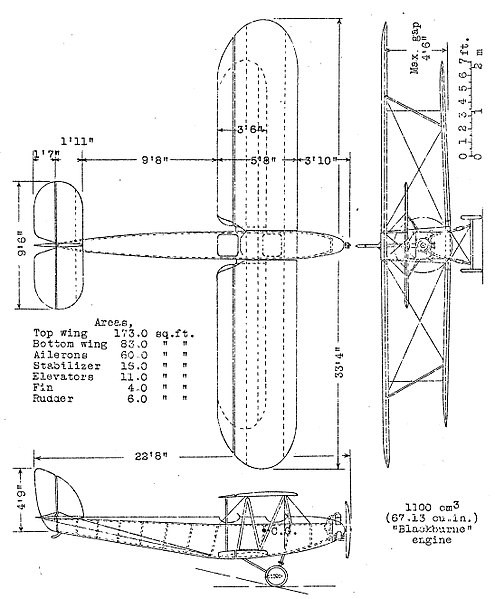
The Sparrow I was designed by R.J. Mitchell and built by Supermarine at Woolston, Southampton, for the 1924 Lympne light aircraft trials. It was a two-seat biplane powered by a 35 hp (26 kW) Blackburne Thrush piston engine, with dual controls.
The Sparrow I (registered G-EBJP) first flew on 11 September 1924. The Thrush, a three-cylinder radial engine proved to be extremely unreliable and the Sparrow was eliminated from the light aircraft trial due to engine failure. In the Grosvenor Trophy Race at Lympne Aerodrome on 14 October 1924, it came fourth with a speed of 62.08 mph (99.91 km/h).
The aircraft was rebuilt for the 1926 Lympne Trials as a parasol monoplane (and redesignated the Sparrow II) and re-engined with a 32 hp (24 kW) Bristol Cherub III engine. During the trials the Sparrow force landed near Beachy Head on 12 September 1926, again being eliminated from the competition, which was won by the Hawker Cygnet.
After use for testing wing sections, the aircraft was sold to the Halton Aero Club, remaining in existence until 1933.
Sparrow I
Powerplant: 1 × Blackburne Thrush, 35 hp (26 kW)
Propeller: 2-bladed fixed-pitch
Wingspan: 33 ft 4 in (10.16 m)
Wing area: 256 sq ft (23.8 m2)
Airfoil: root: NACA; tip: NACA
Length: 22 ft 8 in (6.91 m)
Height: 7 ft 5 in (2.26 m)
Empty weight: 215 lb (98 kg)
Gross weight: 390 lb (177 kg)
Maximum speed: 116 mph (187 km/h, 101 kn)
Service ceiling: 3,350 ft (1,020 m)
Seats: 2
Supermarine Air Yacht
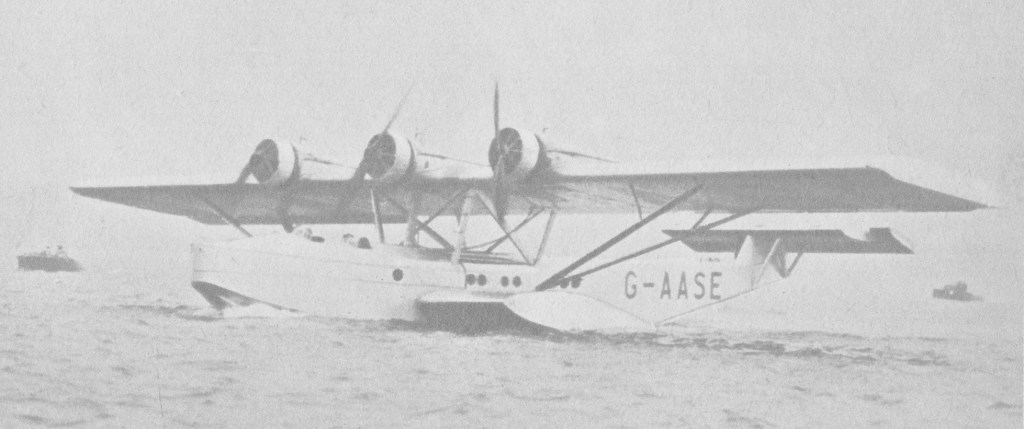
The Supermarine Air Yacht was a three Jaguar engines, all metal luxury passenger carrying flying boat designed and built in 1930 for the Hon. Arthur Guinness for pleasure flights around the Mediterranean. It carried a crew of four and six passengers, and was to replace his Supermarine Solent, but was rejected by Guinness.
The Air Yacht was first flown in February 1930. The only one built, G-AASE, was then sold to Mrs J.J.James who named it ‘Windward III’.

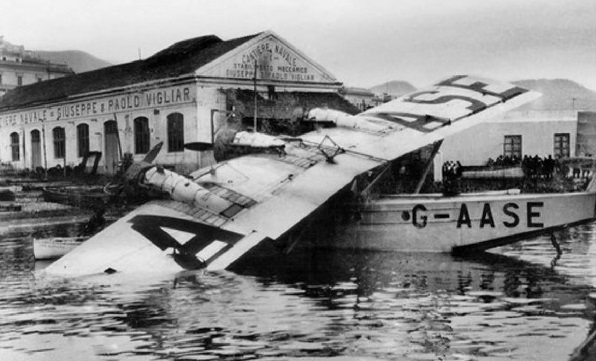
The aircraft crashed on 25 January 1933 near Positano in the Gulf of Salerno with no casualties, The wreckage was taken to Giuseppe & Paolo Vigliar shipyard, Salerno. and was later scrapped.
Supermarine 322 / S.24/37
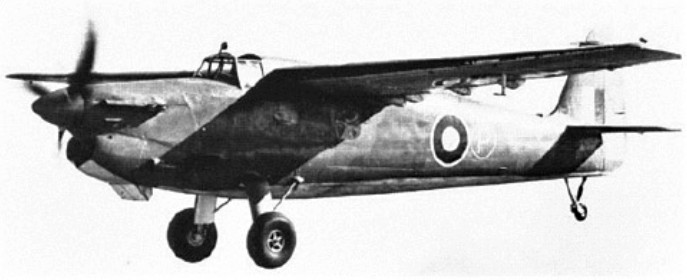
The first prototype flew on February 6, 1943. Did not enter production. Two built.
322 Dumbo
Engine: 1 x Rolls-Royce Merlin 32, 1230kW
Armament: 2 x 7.7mm machine-guns
Bombload: 6 x 113-kg or a torpedo
322 Dumbo
Engine: 1 x 1300hp Rolls-Royce Merlin 30
Max take-off weight: 5448 kg / 12011 lb
Empty weight: 4165 kg / 9182 lb
Wingspan: 15.24 m / 50 ft 0 in
Length: 12.19 m / 40 ft 0 in
Height: 4.32 m / 14 ft 2 in
Wing area: 29.68 sq.m / 319.47 sq ft
Max. speed: 449 km/h / 279 mph
Range: 1328 km / 825 miles
Crew: 3
Armament: 2 x 7.7mm machine-guns
Bombload: 6 x 113-kg or a torpedo
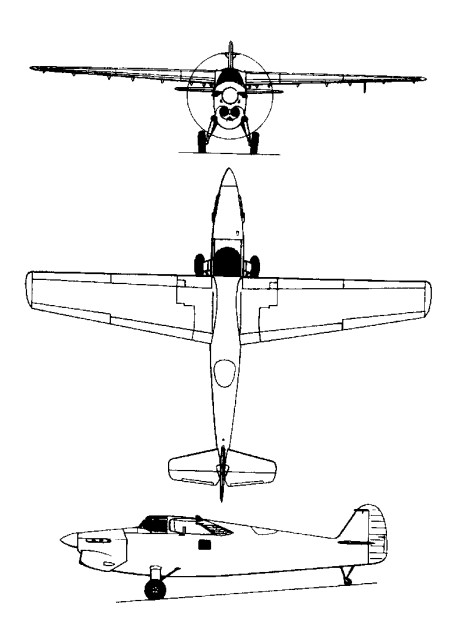
Supermarine 224 / F7/30 Fighter
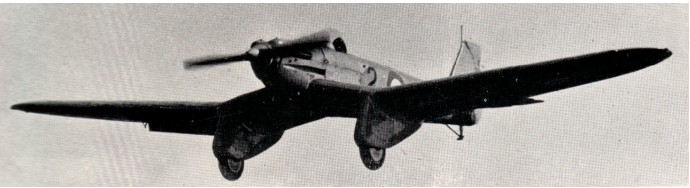
Issue of Specification F.7/30 in 1930 for a single-seat fighter led Supermarine to build its first aircraft intended for this role. Designed under the direction of Reginald J Mitchell as Type (or Drawing) 224, Supermarine’s proposal was one of three to gain Air Ministry backing for prototype construction (along with Westland and Blackburn), an order for one aircraft being placed in 1932.
Based on experience gained with the Supermarine float seaplanes designed for participation in the Schneider Trophy contests, the Type 224 was of all-metal construction with fabric covering of the wing aft of the mainspar and of the tail surfaces. Its 600hp Rolls-Royce Goshawk II engine had an evaporative cooling system, which was to prove to be a major reason for the eventual failure of the Type 224 to gain acceptance. Armament comprised two 7.7mm guns in the fuselage and one in each mainwheel fairing.
First flown on 19 February 1934, the Type 224 failed to achieve its performance estimates, and, after a prolonged sojourn at the RAE Farnborough, went to the A&AEE and eventually ended its days as a gunnery target.
Engine: 600hp Rolls-Royce Goshawk II
Max take-off weight: 2151 kg / 4742 lb
Empty weight: 1552 kg / 3422 lb
Wingspan: 13.97 m / 46 ft 10 in
Length: 8.97 m / 29 ft 5 in
Height: 3.63 m / 12 ft 11 in
Wing area: 27.40 sq.m / 294.93 sq ft
Max. speed: 367 km/h / 228 mph
Ceiling: 11825 m / 38800 ft
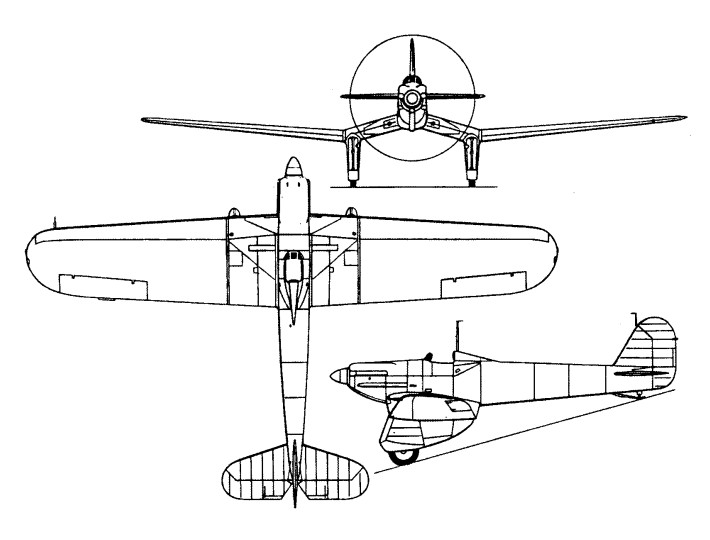
Supermarine Scarab / Sheldrake
Well-known maritime aircraft included the Seal/Seagull/Scarab/Sheldrake series developed during 1920s and 1930s.
Supermarine S.6

The Air Ministry felt that it could no longer stand by and see foreign aircraft winning the Schneider Trophy contest, so it ordered a number of racing seaplanes and formed a special RAF High Speed Flight to enter them in the 1927 contest at Venice.
One of the types ordered was the Supermarine S.5, that won the race at a speed of 281.65 mph. Two years later (the contest became biannual from 1927) the success was repeated by a slightly larger machine on the same lines, the S.6, with a 1,900 h.p. Rolls¬Royce R engine.
In 1929, the world absolute speed record went up to 358 mph when a British Supermarine S-6 seaplane made an official run.

The Air Ministry financed the Schneider racers until 1929, when they decided the cost was too high to continue. Two years later, at the last minute, Lady Houston provided the cash which enabled Britain to win a the third consecutive victory. Pilots of the winning machines in 1927, 1929, and 1931 were members of the specially formed RAF High Speed Flight.
In 1931 Britain gained the Trophy outright when the S.6B with its Rolls¬Royce engine boosted to give 2.300 h.p. won the third consecutive contest at 340.6 mph over the 189 mile course. The S.6 and S.6B also set up new world speed records of 357.74 and 406.99 mph (29 September 1931) respectively. They were forerunners of Mitchell’s Spitfire.
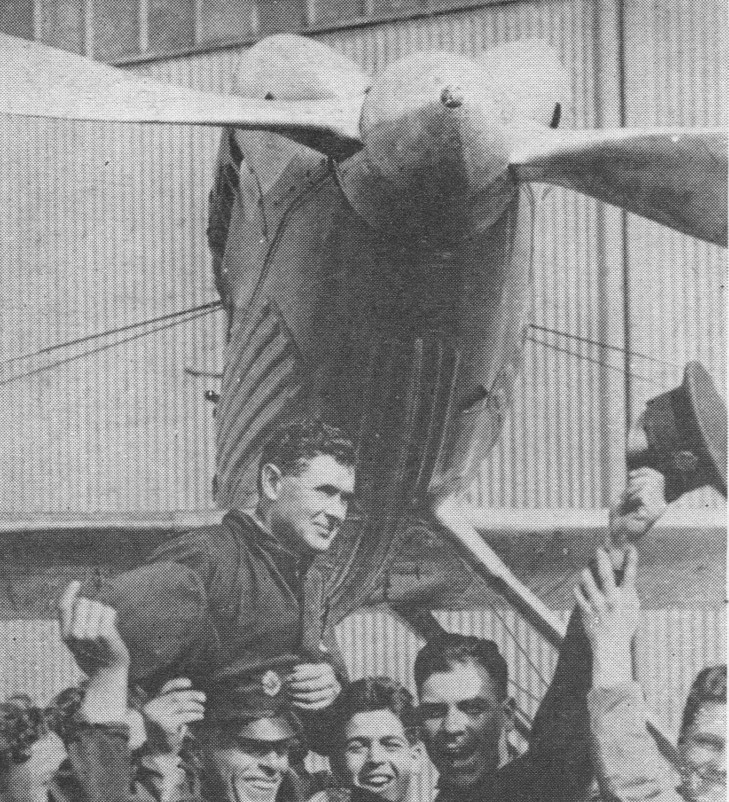

S.6B
Engine: 1900 hp Rolls-Royce ‘R’
Span 30 ft
Length 28 ft. 10 in
Height 12 ft. 3 in
Wing area 145 sq.ft
Weight empty 4,560 lb
Loaded weight 6,066 lb

