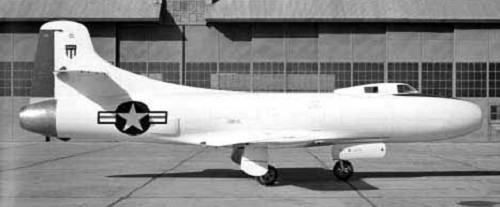
The Douglas company’s initial essay into high-speed research aircraft was the D-558-1 Skystreak which first flew on 14 April 1947 at the beginning of a programme to investigate free-flight air load measurements of the type that were then unobtainable in wing tunnel tests. The D-558-1 was fitted with a pressure-recording system connected to 400 points on the aeroplane’s surface, and powered by a 4,000-lb (1814-kg) Allison J35-A-23 turbojet yielded invaluable research data. The type was later re-engined with the 5000-lb (2 268-kg) thrust J35-A-11, and secured two world air speed records during 1947. The Skystreak set two speed records in 1947. Pilot on the second attempt was Major Marion Carl USMC who averaged 650.92 mph in two runs over a 3 km course.
The three D-558-I Skystreaks were turbojet-powered aircraft that took off from the ground under their own power. The D-558-1 Skystreak broke sound barrier in 1948. Of the three built, the first aircraft is on display at the Naval Aviation Museum in Pensacola, Florida. The second D-558-I crashed on3 May 1948, killing NACA pilot Howard C. Lilly. The third Skystreak is owned by the Carolinas Historical Aviation Museum located at the Charlotte International Airport in North Carolina.
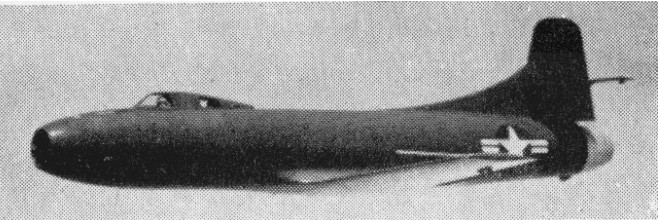
Developed from D-558-1 the Skystreak, the D-558-II Skyrocket (first flown 4 February 1948) was built primarily to investigate the properties of swept wings for high-speed flight. The D-558-2 Skyrocket was in essence a swept-wing version of the straight-winged D-558-1 powered by a 3000-lb (1361-kg) thrust Westinghouse J34-WE-22 turbojet supplemented by a 6000-lb (2722-kg) thrust Reaction Motors XLR-8 rocket motor. The type first flew in February 1948 and the rocket engine enabled the Skyrocket to exceed Mach 1 in October 1947 and later, on 20 November 1953, piloted by NACA test pilot A. Scott Crossfield with the turbojet removed and the rocket fuel capacity doubled, it reached Mach 2.01 (1327 mph) at a height of 65,000ft after being released from a Superfortress mother-plane. Three months earlier it had reached 83,235 ft after a similar launch. The D-558-II last flew on 12 December 1956.
D-558-2
The rocket-powered air-launched D-558-II Skyrocket became the first aircraft to exceed Mach 2. The first D-558-II is on display at the Planes of Fame Museum in Chino, California. The number two Skyrocket, the aircraft used by Scott Crossfield to first break Mach 2, is on display at the National Air and Space Museum in Washington DC. The last D-558-II is displayed on a pedestal at Antelope Valley College, Lancaster, California.
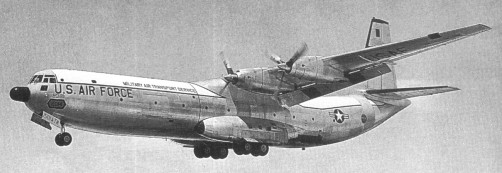
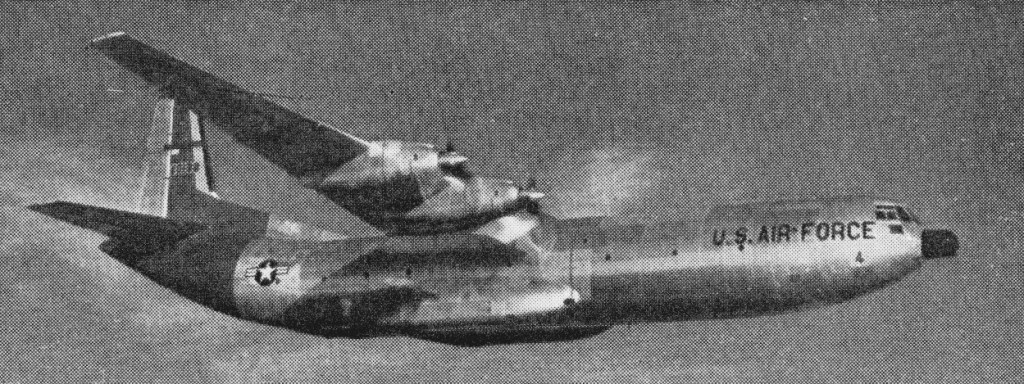
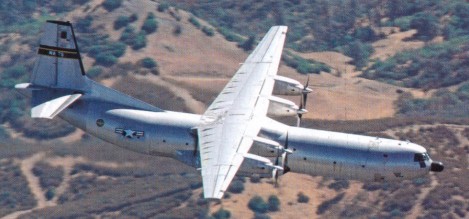
Resulting from studies aimed towards a successor to the Globemaster II, the C-133 Cargomaster was worked up by Douglas’ designers beginning in February 1953, and the first aircraft was rolled out on 27 March 1956.
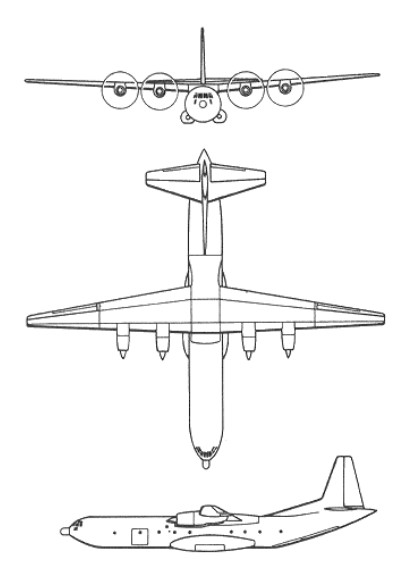
A huge airlifter with high-mounted wings powered by four 5,700-shp Pratt & Whitney T34-P-3 turboprop engines, the C-133 had its cargo-loading door in the rear fuselage. It was designed to carry heavier and bigger loads than the Lockheed C-130 Hercules, although its internal capacity did not represent a significant increase over the C-124 Globemaster II. First flown on 23 April 1956 and delivered to MATS on 1 August 1957, 35 C-l33As were followed by 15 C-l33Bs powered by 7,500 hp / 5,589kW T34-P-9W turboprops, the latter with an improved cargo door and increased payload. Some Cargomasters were used to transport the first generation of intercontinental ballistic missiles (ICBMs) and intermediate-range missiles such as Atlas, Thor and Redstone. Production ended in April 1961.
The Cargomaster fleet served for a decade and the aircraft were seen everywhere, including in Vietnam in the early days. They were stressed for a limited airframe life and could not be kept in service longer. In service until 1971.
C-133A Engines: 4 x Pratt & Whitney T34-P-3 (later -7WA), 6500 shp. Wing span: 179 ft 7.75 in. Length: 157ft 6.5 in. Height 48ft 3in. Wing area: 2,673sqft. Empty weight: 120,263 lb. Loaded weight: 275,000lb. Max speed: 359 mph. Ser¬vice ceiling: 29,950ft.
C-133B Engines: 4 x Pratt & Whitney T34-P-9W, 7500 shp / 4410kW Max take-off weight: 129700-136000 kg / 285941 – 299830 lb Empty weight: 54600 kg / 120373 lb Wingspan: 54.8 m / 179 ft 9 in Length: 48.0 m / 157 ft 6 in Height: 14.7 m / 48 ft 3 in Wing area: 248.3 sq.m / 2672.68 sq ft Max. speed: 558 km/h / 347 mph Cruise speed: 500 km/h / 311 mph Ceiling: 6125 m / 20100 ft Range w/max.fuel: 7000 km / 4350 miles Range w/max.payload: 3600 km / 2237 miles Crew: 4 Passengers: 200
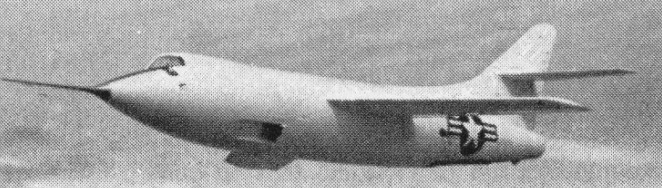
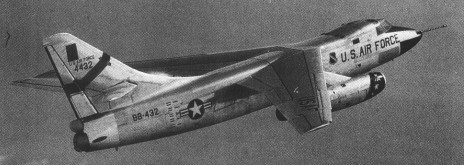
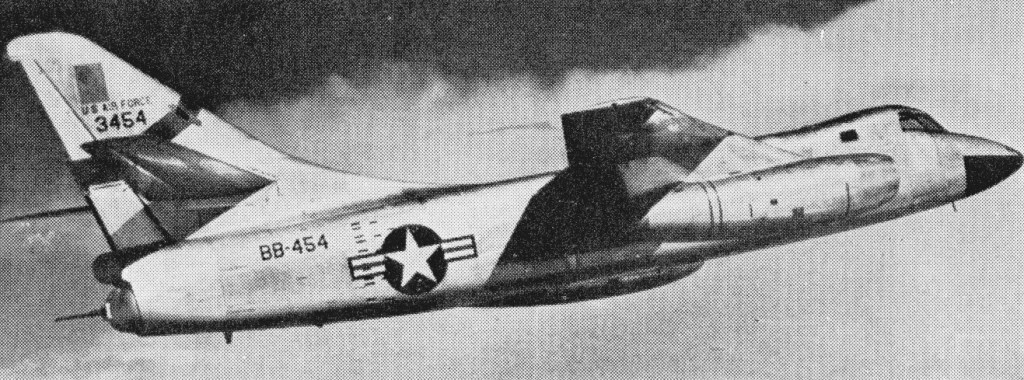
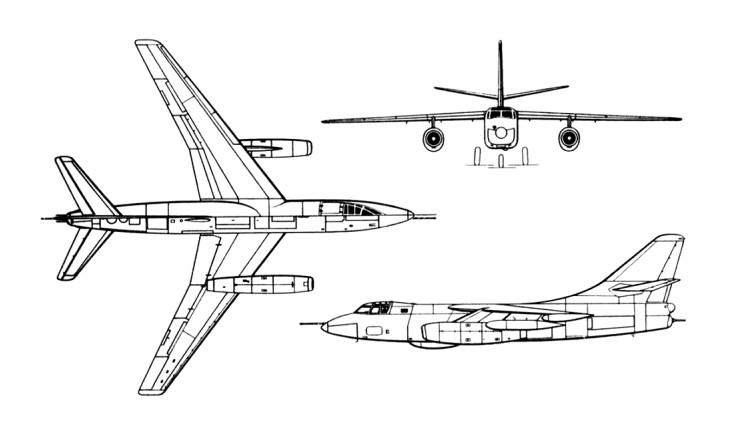
US Air Force involvement in the Korean War highlighted an urgent need for a high performance day/night tactical bomber. To speed the availability of such an aircraft it was planned to procure a land-based version of the A3D Skywarrior then being developed for the US Navy. To this end Douglas was given a contract for five pre-production Douglas RB-66A all-weather/night photo-reconnaissance aircraft, the first of which was flown on 28 June 1954 at the Long Beach plant. Although retaining the basic overall configuration of the A3D Skywarrior, the USAF’s RB-66A Destroyer dispensed with the arrester gear, strengthened landing gear and wing-folding of the naval version; it introduced aerodynamic changes in the wing design, revised accommodation for the three-man crew who were provided with ejection seats, and detail changes in equipment, including a multiple-camera installation and the provision of bombing and navigation radar. Power for this initial version was provided by two 4341kg thrust Allison YJ71-A-9 turbojets.
Successful testing of the RB-66As led to a contract for the first production version, the RB-66B powered by 4627kg thrust Allison J71-A-11s or J71-A-13s. The first of 145 RB-66Bs was flown in March 1955 and deliveries to the USAF began on 1 February 1956.
Deliveries of RB-66 were made to the USAF 19th Tactical Reconnaissance Squadron at RAF Sculthorpe, Norfolk, in 1957 to replace North American RB-45 Tornado.
Production versions included also the B-66B bomber (72 built), which had the same powerplant as the RB-66B and could carry up to 6804kg of bombs in place of reconnaissance equipment.
The new Douglas factory at Torrance (Plant B-6) in May 1954 was in volume production with both the AD-5 and 6 Skyraider and the F4D-1 Skyray, the latter with the J57 turbojet with afterburner. This leaves the El Segundo division almost clear to turn out twin-jet Skywarriors. The U.S.A.F. version of this machine (B-66) is made at Long Beach, and the main factory, at Santa Monica, makes Globemasters and DC-7s.
The RB-66C (36 built), was an electronic reconnaissance and ECM-aircraft with J71-A-11 or J71-A-13 turbojets and a crew of seven including five specialist radar operators, four of them accommodated in what had initially been the bomb bay. The WB-66D (36 built) was a combat-area weather reconnaissance aircraft with J71-A-13 engines and a crew of five (two plus equipment in the bomb bay).
B-66B
ECM versions of the B-66/RB-66 proved of great value during operations in Vietnam, locating, classifying and jamming enemy radars, but withdrawal of US forces from Southeast Asia brought retirement of these aircraft.
RB-66A Reconnaissance-bomber Engines: 2x Allison J71-A-9 turbojets, 10,000 lb (approx) thrust. Loaded weight: about 75,000 lb. Max. speed: over 650 m.p.h. Ceiling: over 45,000 ft. Range: over 1,500 miles Crew: 3 Armament: 2 x 20 mm. tail guns.
RB-66B Engines: 2 x 4627kg / 10,200 lb thrust Allison J71-A-11s or J71-A-13s Wingspan: 22.1 m / 72 ft 6 in Wing area: 72.46 sq.m / 779.95 sq ft Length: 22.9 m / 75 ft 2 in Height: 7.19 m / 23 ft 7 in Max take-off weight: 37648 kg / 83,000 lb Empty weight: 19720 kg / 43475 lb Internal fuel: 3738 USG Max. speed: 1015 km/h / 631 mph at 10,000 ft Cruise speed: 845 km/h / 525 mph Ceiling: 11855 m / 38900 ft Range: 3000 km / 1864 miles Crew: 3. Armament: 2 x 20mm M-24A-1 cannon.
RB-66C Engines: 2 x 4627kg thrust Allison J71-A-11 or J71-A-13 turbojets
Curtiss, who was a motorcycle fiend and engine genius, had actually asked the Wright Brothers if they wanted one of his 50 hp engines when he went to discuss some aviation data, but they said no, unaware that Curtiss and the AEA would soon be a major competitor.
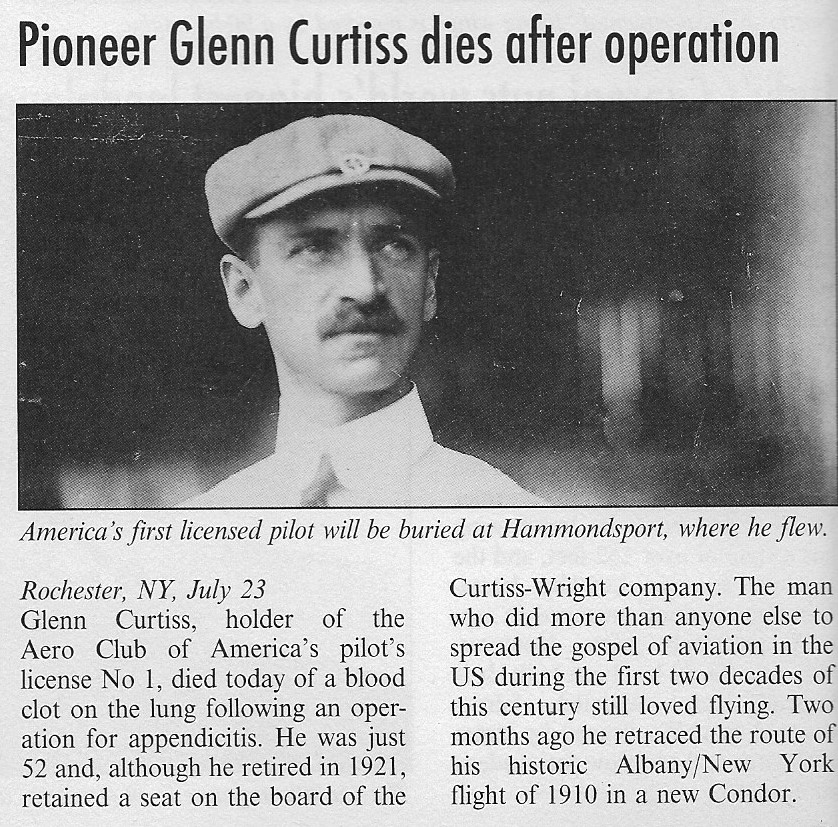
As a member of Alexander Graham Bell’s Aerial Experiment Association (AEA), Glenn Curtiss built the engines for the Red Wing and the White Wing early in 1908, piloted his first plane, and built and flew the June Bug that June.
The AEA disbanded in 1909, and Curtiss formed the Herring-Curtiss Company on 20 March 1909 with Augustus Herring. Its first customer was the Aeronautic Society of New York. Curtiss delivered his first plane to them, the Curtiss No. 1, built to their specifications, on May 29, 1909.
When the Herring partnership split up, Curtiss founded the Curtiss Exhibition Company, the Curtiss Aeroplane Company in December 1911 in Hammondsport, New York, and the Curtiss Motor Company.
As business expanded, the Hammondsport factory became unable to fill all the orders. Curtiss extended its operation to Buffalo, where it rented the site of the company that had supplied Curtiss with his first bicycle engine years before. Curtiss also opened a new plant in Toronto. The quarters in Buffalo quickly became inadequate, and a new 120,000-square-foot (1,115-square-meter) building was constructed that became the company headquarters. Soon after, a new plant that sprawled over 72 more acres was added.
1909-early 1911 – While A, B, and C models are known (or thought) to have existed during this historically important period for Curtiss, where they were applied is not. Numerical assignments, as well, were guesses—Model 2 has appeared for both Rheims Racer and Charles Willard’s Banshee Express but not verified (Willard unjustifiably claimed authorship of that design). By 1910, Model D had been established, in some references tied to Curtiss-Herring, which was actually built after the partners’ dissolution. But there were at least 9 aircraft known to have been produced in this period, the “official” Model D, in one of its many forms, formally appeared in the first company catalog on mid-1911 along with its companion Model E. Production of concurrent Curtiss-Aero Society Model Ds unknown but the design quickly evolved into the Curtiss D (Standard). A Herring-Curtiss, for which plans were published for home-builders of the time, differed from Curtiss D with its ailerons on the front wing struts instead of the rear wing struts. Herring’s contribution, besides that as a temporary partner, was his alleged invention of a gyroscopic stabilization device (claimed, but unsubstantiated, 1909 US patent #12,256), which would circumvent the Wright’s aileron patents, but which was never used on any Curtiss machine.
Curtiss designed and built the following planes during 1908 – 4, 1909 – 2, 1910 – 4, 1911 – 5, 1912 – 3, 1913 – 3, total – 21.
In 1916, the Curtiss Aeroplane & Motor Company, Ltd. went public with Curtiss as president. By that time Curtiss had become the world’s largest aviation company, employing as many as 18,000 at Buffalo and 3,000 at Hammondsport.
The Curtiss Aeroplane and Motor Company was created 13 January 1916 from the Curtiss Aeroplane Company of Hammondsport, New York and Curtiss Motor Company of Bath, New York. Burgess Company of Marblehead, Massachusetts, became a subsidiary in February 1916. In 1916 the company moved its headquarters and most manufacturing activities to Buffalo, New York, where there was far greater access to transportation, manpower, manufacturing, and much needed capital. It became the largest aircraft manufacturer in the world during World War I, employing 18,000 in Buffalo and 3,000 in Hammondsport, New York. Curtiss produced 10,000 aircraft during that war, and more than 100 in a single week. A third factory (Garden City, Long Island, NY) became boat hull department for flying-boat production. Burgess Company of Marblehead, Massachusetts, became a subsidiary in February 1916. Aircraft built during First World War included A and AH biplanes for USN, Models D and E for U.S. Army, Model F flying-boats for USN, H-4 Small Americas, H-12 Large Americas and H-16 Large Americas (plus 150 by Naval Aircraft Factory). Best-known were JN-4/JN-6 “Jenny” trainers (5,000 built, plus 1,200 by Canadian Curtiss), HS flying-boats, MF flying-boats, N-9 floatplanes, British S.E.5a fighters, Orenco D fighters, and 5L flying-boats. Total wartime was 4,014 aircraft and 750 aero engines.
After the war, Curtiss, fell on hard times. In August 1920, the company was forced into receivership. Clement Keys, a Canadian financier, obtained funds to manage the company’s debt and led it again to sound financial status. The Buffalo facility became the major facility, and the company remained the largest U.S. aircraft company through the 1920s.
Postwar production, mostly in 1920s, included NC- 1/2/3/4 transatlantic flying-boats (four only); Oriole, Eagle, and Seagull civil types (little success achieved with the few built). Followed by a series of Army (R-6/R-8 etc.) and Navy (CR/R2C/R3C etc.) racers. Twelve B-2 Condor biplane bombers were followed by PW-8 biplane fighters, P-1/P- 6 U.S. Army Hawks, F6C U.S. Navy Hawks, and O-1/11/39 and A-3 Falcons for U.S. Army. The few Carrier Pigeons and Larks were followed by one Tanager biplane, which won 1929 Guggenheim Safe Airplane Competition. Subsequently produced N2C Fledgling, F8C/OC Falcon, and F8C/02C Helldivers for USN.
Foundation of Curtiss-Robertson division in 1928 was followed by, on July 5, 1929, Curtiss Aeroplane and Motor Company became part of Curtiss-Wright Corporation, together with 11 other Wright and Curtiss affiliated companies. In 1929, shortly before Curtiss died, the Curtiss Aeroplane & Motor Company, Ltd., merged with the Wright Aeronautical Corporation to form the Curtiss-Wright Corporation.
1930
Neither Curtiss or Wright successfully made the transition to the jet age and substantially all aircraft assets were sold to McDonnell and North American by 1950.
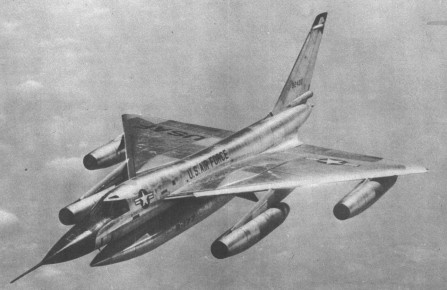
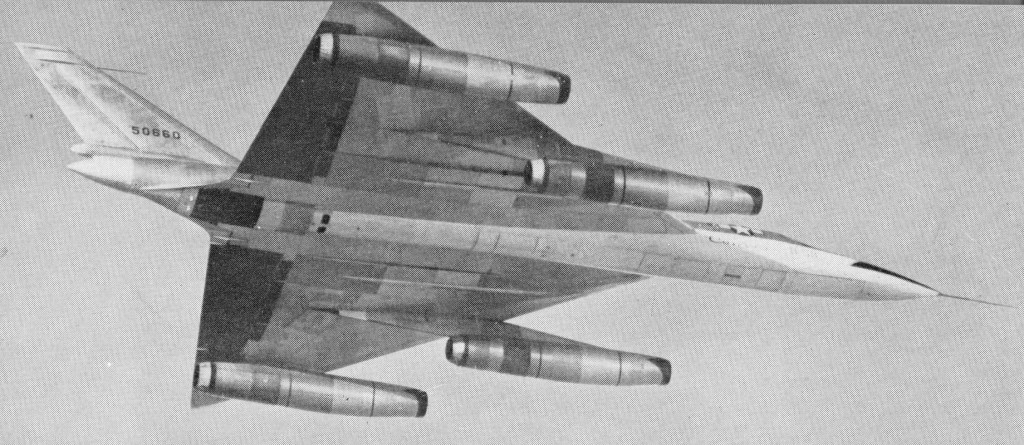
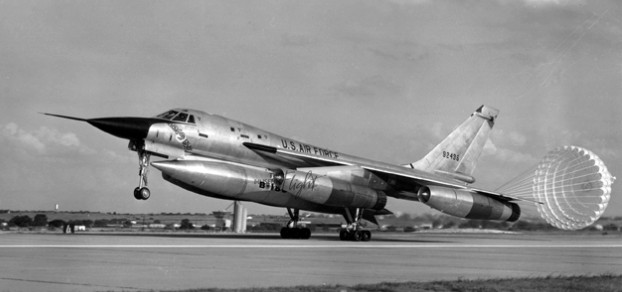
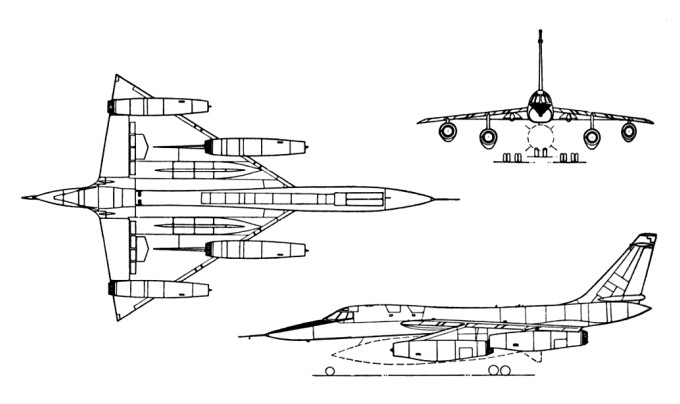
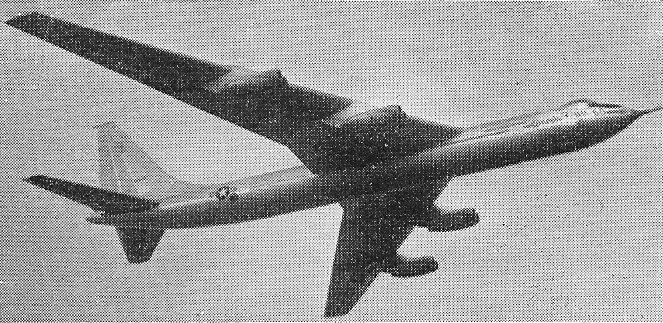
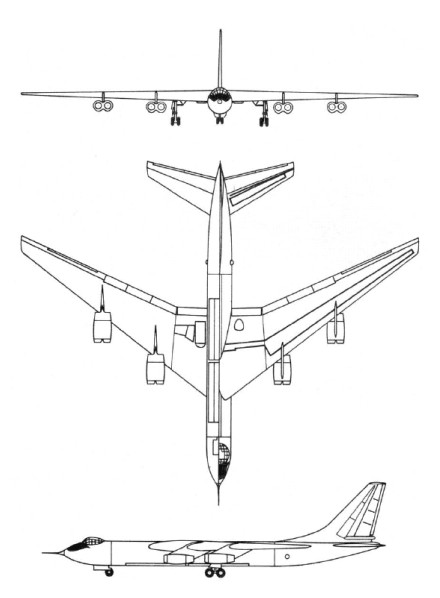
In March 1949 the US Air Force’s Air Research and Development Command (ARDC) invited proposals for a supersonic bomber, and after submissions had been reduced to two, from Boeing and Consolidated-Vultee’s Fort Worth Division, the latter was selected in August 1952 to develop its Convair Model 4 designed to the hardware stage under contract MX-1964. On 10 December 1952 the designation B-58 was allocated and late in that year Convair received a contract for 18 aircraft, to be powered by a new J79 engine for which General Electric received a development contract at the same time. The performance requirement for the new aircraft demanded considerable advances in aerodynamics, structures and materials. The resulting design, one of the first to incorporate the NACA/ Whitcomb-developed area-rule concept, was a delta-winged aircraft with four engines in underslung pods, a slim fuselage and, an under-fuselage pod. The thin fuselage provided some engineering issues early on as it prevented internal carriage of bombs and the required amount of fuel to power the four turbojet engines and allow for any reasonable operating radius to be achieved. As a result, a large external droppable two-component 18.90m long pod was affixed to the underside of the fuselage. This pod contained extra fuel and a nuclear weapon along with other mission-specific specialized gear. The three-man crew, in individual tandem cockpits, were provided with jettisonable escape capsules.
Distinctive features of the B-58 included sophisticated inertial guidance navigation and bombing systems. Extensive use of heat-resistant honeycomb sandwich skin panels were integrated into the construction of the wings and fuselage for high altitude-high velocity flight.
XB-58
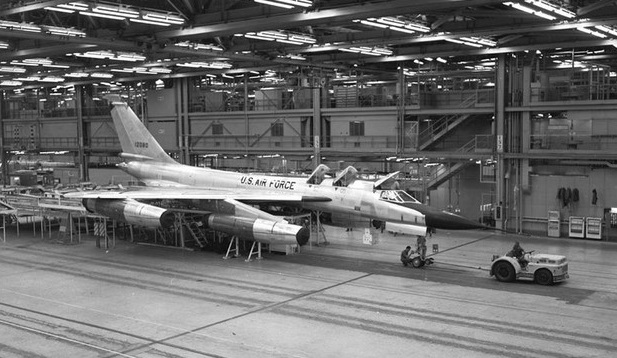
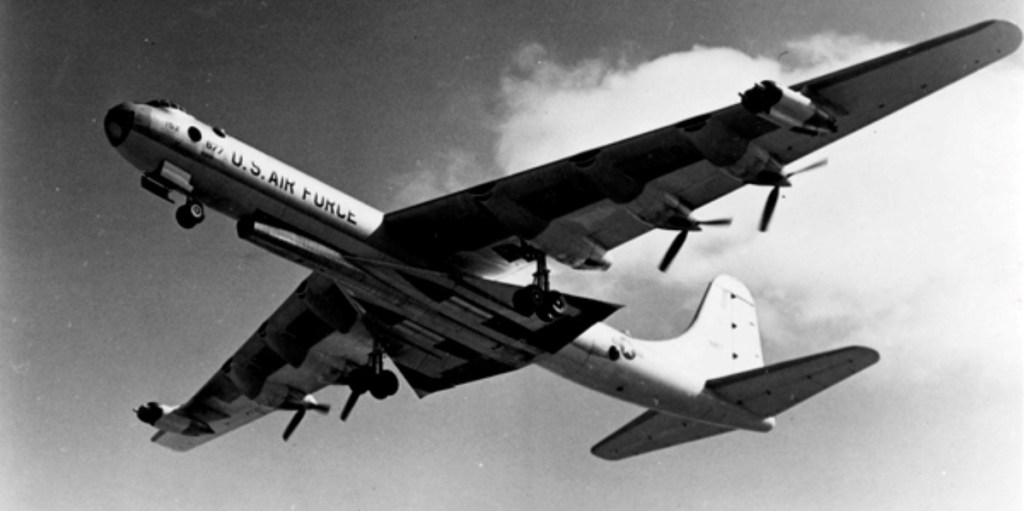
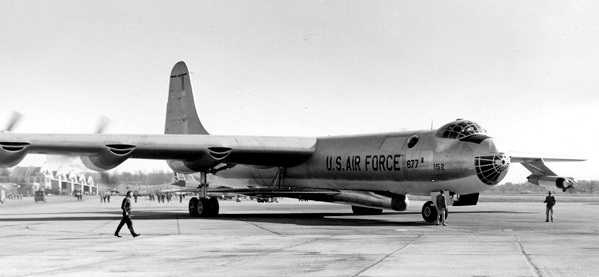
B-36 transporting the XB-58 airframe using eight of ten engines (note both of the inboard propellers have been removed for this flight)
Convair easily transported the XB-58 prototype by air from Ft. Worth TX to Wright-Patterson Air Force Base (AFB) in Ohio for testing with the use of a modified Peacemaker bomber.
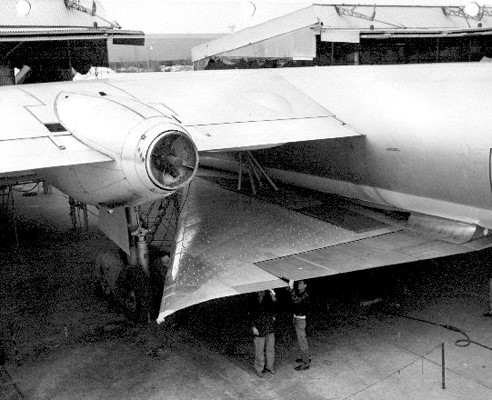
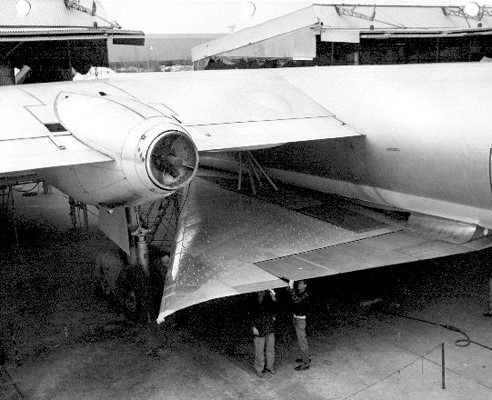
B-36 and XB-58 airframe mating, note the propeller has been removed from the wing’s inboard engine as well as the strut assembly joining the two wings together.
The left and right inboard engines had their propellers removed, along with the bomb bay doors since they did not clear the wings of the XB-58 which was mounted underneath the bomber.
Since the airframe was the subject of testing the XB-58 did not have the engines attached and the vertical fin assembly was left off, as well.
In June 1954 the 18-aircraft order was reduced to two XB-58 prototypes and 11 YB-58A pre-production examples, together with 31 pods. The first of these was rolled out at Fort Worth on 31 August 1956, making its first flight on 11 November 1956 piloted by B. A. Erikson. On 30 December, still without a pod, the XB-58 became the first bomber to exceed Mach 1.
A further 17 YB-58As were ordered on 14 February 1958, together with 35 MB-1 bomb pods, to bring to 30 the number of aircraft available for the manufacturer’s test programme and ARDC service trials with the 6592nd Test Squadron and the 3958th Operational Test and Evaluation Squadron at Carswell AFB.
The United States Air Force ordered between September 1958 and 1960 86 total Hustlers, which were operational in the Strategic Air Command (SAC) between 1960 and 1970.
The 86 production B-58A Hustlers were supplemented by 10 YB-58As which were brought up to production standard to equip the 43rd Bomb Wing, initially at Carswell but later assigned to Little Rock AFB, Arkansas, and the 305th Bomb Wing at Bunker Hill AFB, Indiana. The first was handed over to the 65th Combat Crew Training Squadron at Carswell on 1 December 1959 and the 43rd Bomb Wing, activated as the first B-58 unit on 15 March 1960, became operational on 1 August 1960. The 116th and last B-58A was delivered on 26 October 1962, the 116 having cost $3.2 billion.
By 1964 80 were reported as still operational. The type was withdrawn from Strategic Air Command service on 31 January 1970.
B-58s as a whole set 19 world speed and altitude records and won five different aviation trophies during their operational run – a vast engineering achievement realized. Despite these performance successes, the B-58 still suffered from limitations in operating range, payload capacity and overall series growth potential.
With such outstanding performance it was clear that the B-58A had record-breaking potential. On 12 January 1961 Major Henry Deutschendorf and his crew secured the 2000km closed-circuit record at 1708.8km/h and on 14 January Major Harold E. Confer’s aircraft raised the 1000km record to 2067.57km/h. On 10 May Major Elmer Murphy won the trophy presented by Louis Bleriot in 1930 for the first pilot to exceed 2000km/h for a continuous period of 30 minutes. Sixteen days later Major William Payne and his crew flew from Carswell to Paris setting, en route, record times of 3 hours 39 minutes 49 seconds from Washington and 3 hours 19 minutes 51 seconds from New York. The Hustler crashed at the Paris Air Show on 3 June with the loss of the crew. Other flights included a supersonic endurance record of 8 hours 35 minutes from Haneda, Tokyo to London, on 16 October 1963.
Convair built 86 standard B 58A bombers as well as 11 development aircraft later brought up to production standard and 17 YB 58A pre-production aircraft which were modified as RB 58A reconnaissance machines, Eight aircraft were converted into TB 58A trainers with a tandem pair of pilot stations. The regular bomber seated pilot, nav/bomb aimer and defensive systems operator in tandem cockpits containing special escape capsules which, in emergency, could close around the occupant, seat and controls and be ejected as a sealed package.
In 1970 the 43rd and its partner, the 305th Wing at Grissom AFB, were disbanded because of high operating cost. The last B-58 would be officially retired in January 1970.
Convair B-58A Hustler Engines: 4 x General Electric J79-GE 5A, -5B or 5C turbojet, 69.3kN / 15,600lbs thrust with reheat capability Length: 96 ft. 10 in (29.49m) Wingspan: 56 ft 10 in (17.32m) Wing area: 143.25 sq.m / 1541.93 sq ft Height: 31 ft 5 in (9.60m) Empty Weight: 55,561lbs (25,202kg) Maximum Take-Off Weight: 163,000 lb (73,936kg) Fuel capavity, wing & pod: 12,500+ gal Weight after inflight refuelling: 80237 kg (176,890 lb) Maximum Speed: 1,321mph (2,126kmh / 1,148kts / Mach 2.1) Cruising speed: 610 mph. Maximum Range: 4,400 miles without aerial refueling Service Ceiling: 62,999ft (19,202m; 11.9miles) Armament: 1 x 20mm Vulcan cannon in tail 1 x Under-fuselage pod carrying up to 19,450lb ordnance Crew: 3 Hardpoints: 1 Cost: US$12,442,000
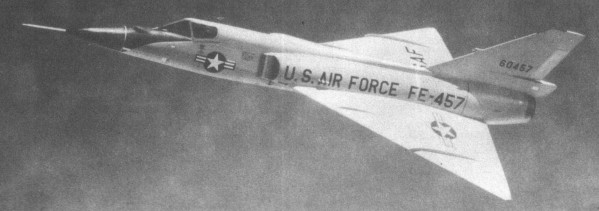
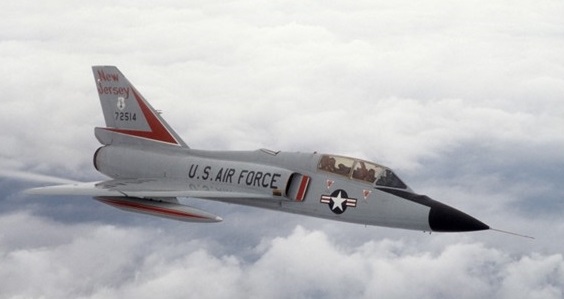
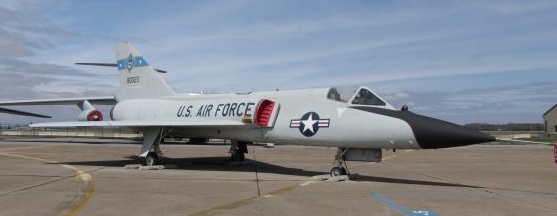
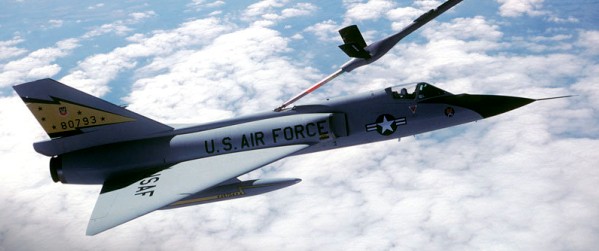
The Convair F-106 Delta Dart began its production life as a direct successor to the interim F-102 Delta Dagger, as the F-102B, built around the advanced Hughes-produced MA-1 fire control system. The F-106 retained many design elements of the F-102 including a small internal bomb bay. Nuclear capability with twin Genie nuclear-tipped missiles was a standard design initiative. An internal 20mm cannon would not be fitted to the system until 1973, when it was found throughout engagements in the Vietnam conflict that close-range fighting was still involved.
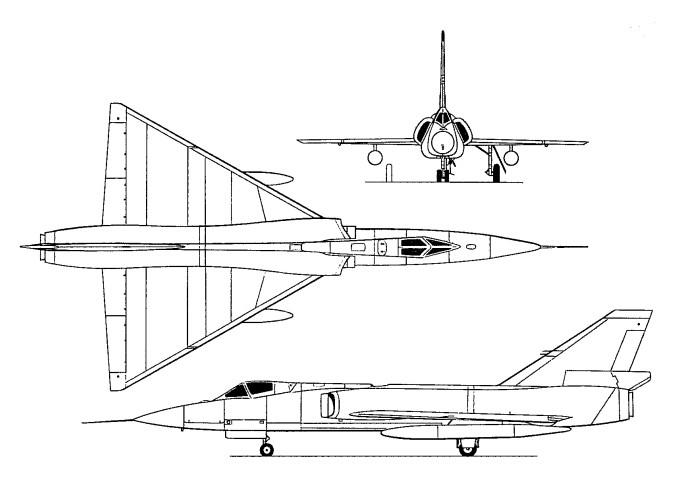
The F-106 has mid-set delta wings, with 60 degrees sweepback, no tailplane, and square-top fin and rudder. Engine air intakes are on each side of the fuselage just forward of the wing leading edges.
The tricycle undercarriage has a single wheel on each main unit and twin nose-wheels. The nosewheels retract forward.
While development of the earlier fighter was delayed by various teething troubles in 1955-6, progress with the later machine became possible with the development of the Hughes MA-1 integrated fire-control system. In November 1955, the USAF placed an order for 17 F-102Bs and in December, a mock-up of the proposed cockpit with radically new equipment and pilot displays was completed. On 17 June 1956, the F-102B was redesignated F-106.
The first of two YF-106A service-test aircraft (56-451/452) flew on 26 December 1956 at Edwards AFB, California. Like most new fighter types in the ‘century series’, the F-106 was initially a disappointment. Maximum speed, rate of climb and overall acceleration were significantly below Air Defense Command expectations with the Pratt & Whitney J57-P-9 turbojet employed in the initial machines and the Wright J67, licence-built Olympus, being contemplated. When the latter powerplant failed to materialise, the USAF reduced its requirement from 1,000 to 360 of the new interceptors.
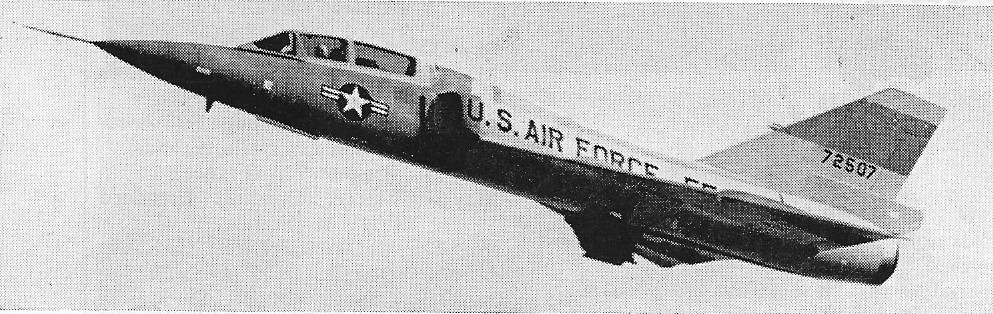
The first flight of the F-106B two-seat trainer was made in April 1958.
F-106B
An F-106A held the world speed record of 1525.05 mph from 15 December 1959 until the autumn of 1961.
Performance was improved with the installation of the 7800kg thrust Pratt & Whitney J75-P-17 turbojet which could provide 11100kg thrust with afterburning.
F-106A
The F-106A attained its initial operating capability with the 498th Fighter-Interceptor Squadron at Geiger AFB, Washington, in October 1959 and subsequently served with 15 ADC and eight Air National Guard squadrons. Except for brief deployments to Europe and to Korea in 1968, the type served exclusively in North America. Totals of 277 F-106A single-seat interceptors served in company with 63 F-106B two-seat combat trainers, 340 machines actually being completed, and the types remained on active duty until 1982.
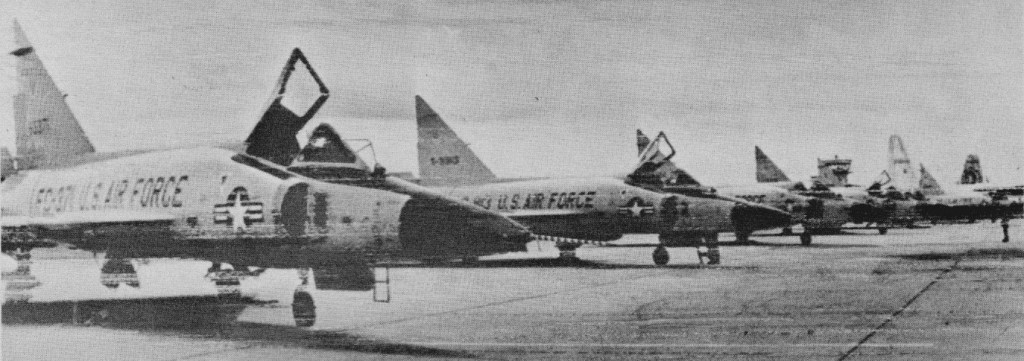
The Convair F-102 Delta Dagger resulted from a 1950 USAF design competition for an integral all-weather interceptor weapon system. Combining the Hughes Falcon air-to-air missile, the 60 degree sweep delta wing platform first flown on the XF-92A, and the 4944kg thrust Pratt & Whitney J57-P-11 turbojet, the first of 10 YF-102s (52-7994/7995 and 53-1779/1786) flew at Edwards AFB, California, on 24 October 1953, piloted by Dick Johnson. The prototype was lost in a mishap nine days later.
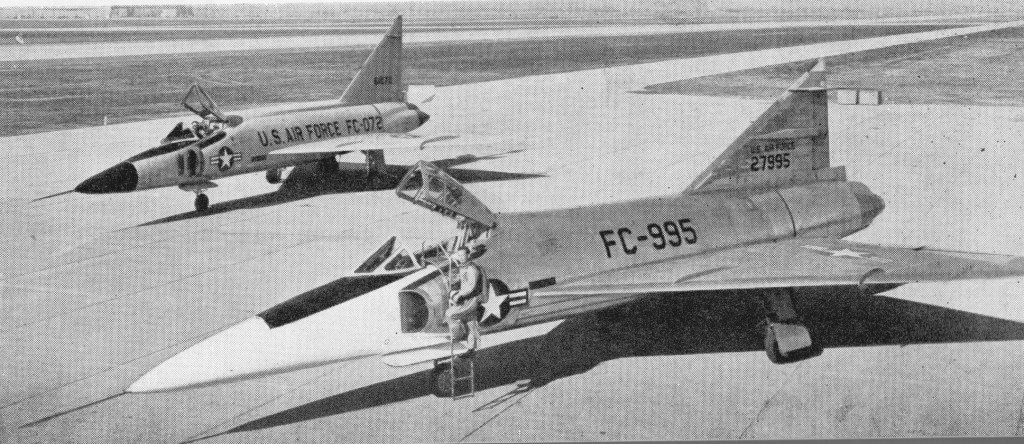
YF-102 (nearest), F-102 (rear)
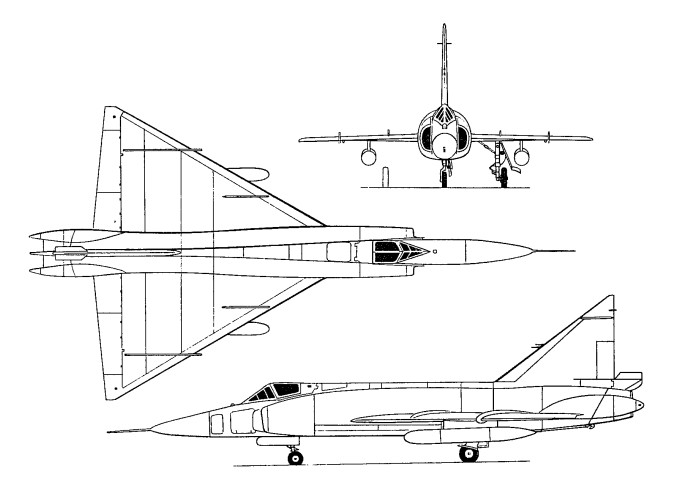
The YF-102 was not a success, proving unable to maintan supersonic speeds in level flight. The fuselage was completely redesigned into a ‘coke bottle’ shape using the area rule concept, and a more powerful engine installed. The indented fuselage or ‘area rule’ configuration was developed by NACA’s Richard Whitcomb was introduced in the much-altered YF-102A, which was assembled in 117 days.
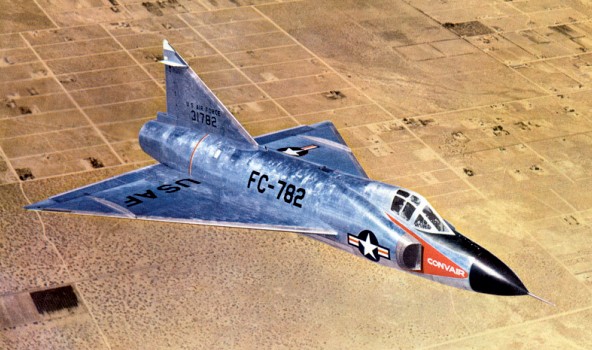
The first of four YF-102As (53-1787/1790) flew at Edwards AFB on 20 December 1954, again piloted by Dick Johnson, not merely with ‘area rule’ but with cambered wing, new canopy (except on 53-1788) and 5443kg thrust Pratt & Whitney J57-P-23. The new design was supersonic and met USAF expectations.
Development included the introduction pf a larger fin from the 23rd production aircraft.
The primary weapon was the Hughes AIM-4 Falcon air-to-air missile, coupled with the Hughes MG-10 fire control system. Introduced later was the AIM-26, some nuclear tipped.
YF-102
The production F-102A began to reach Air Defense Command squadrons in June 1955. The first two-seat TF-102A combat proficiency trainer (54-1351) flew at Edwards AFB 8 November 1955 and operated alongside F-102As in ADC service.
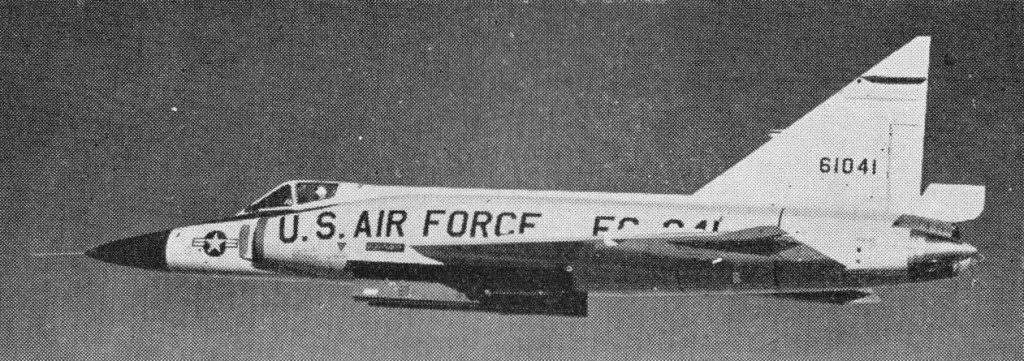
Service entry began with the first examples delivered in April 1956 to the 327th Fighter Interceptor Squadron (FIS) at George, California. The F-102B designation was briefly assigned to a new aircraft completed as the F-106. The little-known YF-102C (53-1806), a converted F-102A model, tested change in the internal fire control system, but these were not adopted.
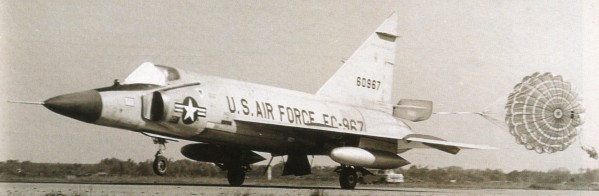
The F-102A eventually served with 32 ADC and 21 States ANG squadrons. Air Defense Command machines went through several modernisation programmes before being relegated to the ANG, the internal provision for rockets being eventually omitted. A few F-102As went to Greece (20 F-102A and 4 TF-102A) and Turkey (40 F-102A and 9 TF-102A).
1964 on arrival at Saigon, Vietnam
A few camouflaged F-102As were deployed to South East Asia in 1964-6, and to Korea in 1968 but, while they flew a few missions over North Vietnam, they are not thought to have actually been in combat. No air-to-air kills were achieved but one F-102A was shot down by a MiG-21 on 5 February 1968.
F-102A
Most F-102A squadrons had converted to other types by the end of 1971. The last US operational user was the Hawaii Air National Guard’s 199th FIS which received its first F-4C Phantom replacement in October 1975. Greece retired their F-102As in 1979, with Turkey withdrawing its last 13 fighters and five trainers on 5 June 1979. In March 1973, the USAF awarded Sperry a contract to convert an initial 6 F-102As as a fully manoeuvrable manned or unmanned target drones under the Pave Deuce programme as PQM-102As. Over 200 were eventually converted, operating until 1986. Numerous F-102A airframes have been saved, the 199th Fighter Interceptor Squadron of the Hawaii Air National Guard having retained no fewer than four non-flyable F-102As for display purposes after transitioning to the F-4C Phantom.
Total Delta Dagger production was exactly 1000 airplanes built at San Diego’s Lindbergh Field, comprising 10 YF-102, 4 YF-102A, 875 F-102A and 111 TF-102A trainers.
Convair F-102A Delta Dagger Engines: 1 x Pratt & Whitney J57-P-23 turbojet, 17,200 lb (5307/7802kp) thrust. Length: 68 ft 4.5 in (20.84m) Wingspan: 38 ft 1.5 in (11.62m) Wing area: 695.031 sqft / 64.57 sq.m Wing loading: 45.31 lb/sq.ft / 221.0 kg/sq.m Height: 21 ft 2.5 in (6.46m) Empty Weight: 19,026lbs (8,630kg) Maximum Take-Off Weight: 31,500lbs (14,288kg) Maximum Speed: 825mph (1,328kmh; 717kts) at 36,000 ft Cruising speed: 469 kts / 869 km/h Cruising altitude: 34449 ft / 10500 m Maximum Range: 1,350miles (2,173km) Rate-of-Climb: 17,400ft/min (5,304m/min) Service Ceiling: 54,003ft (16,460m) Armament: 6 x AIM-4A / AIM-4C Falcon Air-to-Air Missiles 2 x 2.75″ Rocket Pods (24-shot, unguided rockets) Nuclear Capable munitions as needed. Accommodation: 1 Hardpoints: 6
Convair F-102A Delta Dagger Engine: 1 x Pratt & Whitney J57-P-35 turbojet, 10,900 dry, 17,000 lb afterburner Wingspan: 38 ft 1.5 in (11.62m) Wing area: 661.5 sq.ft Length: 68 ft 4.5 in (20.84m) Height: 21 ft 2.5 in (6.46m) Wheel track: 14 ft 2.25 in Wheelbase: 22 ft 4.5 in Maximum Take-Off Weight: 27,000 lbs Maximum Speed: 825 mph (1,328kmh; 717kts, M1.25) at 36,000 ft Service Ceiling: 54,000 ft (16,460m) Armament: 6 x AIM-4A / AIM-4C Falcon Air-to-Air Missiles 2 x 2.75″ Rocket Pods (24-shot, unguided rockets) Nuclear Capable munitions as needed. Accommodation: 1 Hardpoints: 6
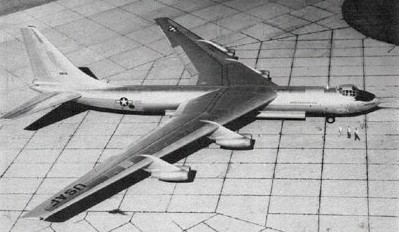
In April 1945 the USAF’s predecessor, the USAAF, had issued its specification for a B-35/B-36 replacement with turbine propulsion. The Convair submission to the 1945 requirement was the Convair YB-36G, which was in essence the B-36 recast with flying surfaces swept at 35 degrees and with a powerplant of eight Pratt & Whitney J57-P-3 turbojets. The type was redesignated YB-60 before two prototypes were ordered on 15 March 1951. They retained the basic fuselage of the B-36 with a modified nose and generally similar wing centre-section and landing gear offering a 75 per cent structural commonality with the B-36. The first was flown on 18 April 1952, but the type failed to gain a production contract, the USAF ordering instead the Boeing B-52. In addition to its new wings and tail, the YB-60 had a revised landing gear arrangement and a considerably larger fuel capacity. Maximum speed was 550 mph (885 km/h) at 55,000 ft (16765 m), but in all operational aspects the competing Boeing aeroplane was superior, as well as offering far greater development potential.
Engines: 8 x 4080kg J57-P-3 Max take-off weight: 300000 kg / 661390 lb Empty weight: 150000 kg / 330695 lb Wingspan: 206 m / 675 ft 10 in Length: 171 m / 561 ft 0 in Height: 50 m / 164 ft 1 in Max. speed: 520 km/h / 323 mph Ceiling: 45000 m / 147650 ft Range: 8000 km / 4971 miles Crew: 10
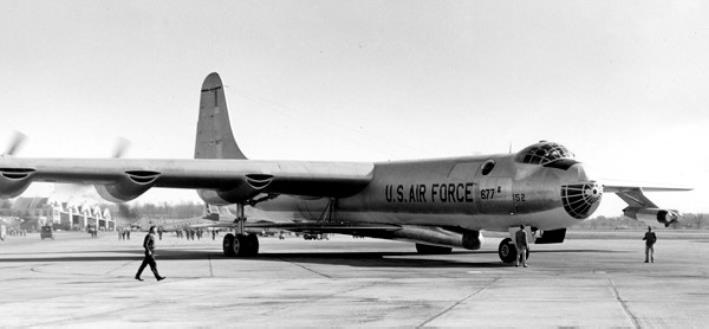
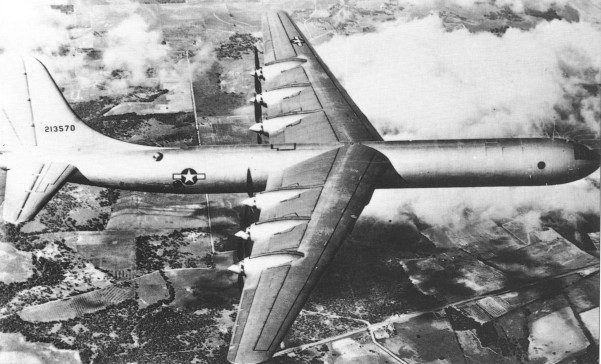
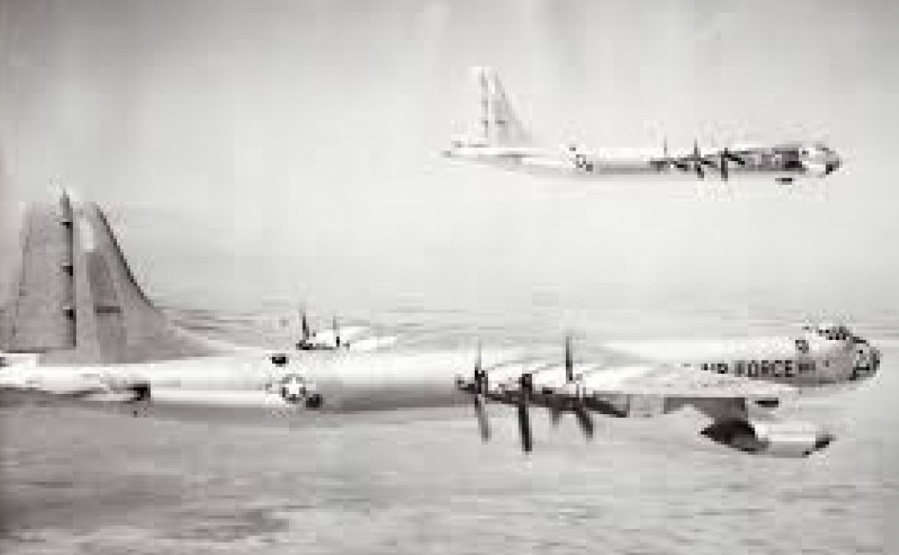
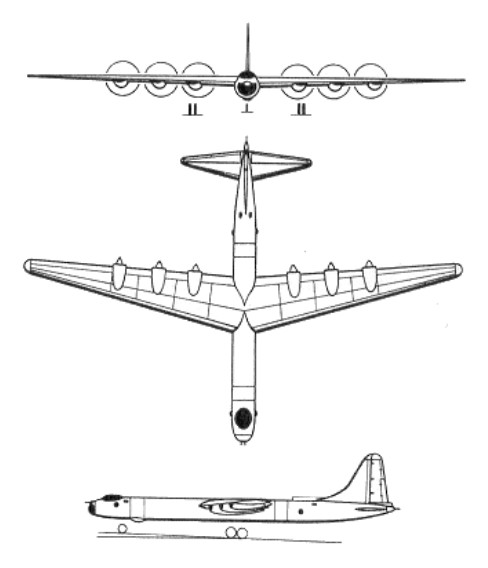
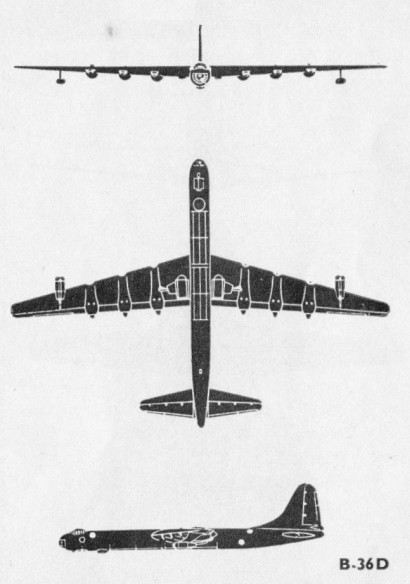
The first intercontinental bomber, the Convair B-36 originated from a US Army Air Force specification issued on 11 April 1941 which called for an aircraft with ability to carry a maximum bombload of 72,000 lb / 32659kg and to deliver 10,000-lb / 4536kg of bombs on European targets from bases in the United States. A radius of 5000 miles / 8047 km. An unrefuelled range of 16093km was a prime requirement, with a maximum speed of 386-483km/h and ceiling of 35000 ft / 10670m.
A number of designs were submitted and the winner was selected in November 1941 the month before the USAs entry into World War II. It was the Consolidated Model 37, which was ordered in prototype term as the XB-36, becoming the developmental YB-36 trials model, finally built by Convair, as Consolidated became known after its merger with Vultee.
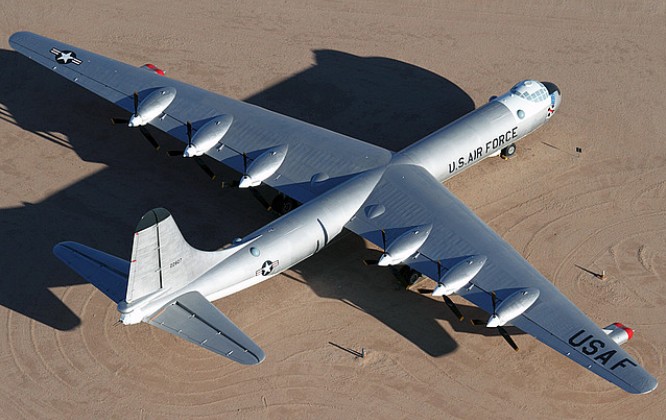
The design was basically conventional by the standards of the time, but with a span of 230 ft (74.10 m) the aeroplane was exceptionally large weighing 102 tonnes (100 tons). The tyres on the prototypes main landing gear were 2.74 m (9 ft) in diameter (they also concentrated too much weight on the run¬ways of the day, and were replaced on production aircraft by four wheel bogie units). The type did introduce some novel features, however, including a slightly swept wing, a fuselage whose two main pressurized compartments were connected by an 80-ft (24.4m) tunnel containing a wheeled cart, and propulsion by six pusher propellers driven by radial engines buried in the thick wings. The wings had a root thickness of 1.83m to permit in-flight access to the six pusher engines. The B 36 used the “wet fuel tankage” pioneered by Consolidated with their B~24 liberator no fuel tanks as such, just big areas of the wing structure sealed and filled with fuel.There were leakage problems. The aircraft was designed originally with twin fins and rudders, but by the time the XB-36 prototype was ready to be rolled out at Fort Worth, on 8 September 1945, single vertical tail surfaces had been substituted. The aircraft’s tailfin was so tall that the nosewheel had to be jacked up to lower the rear and clear the top of the doors.
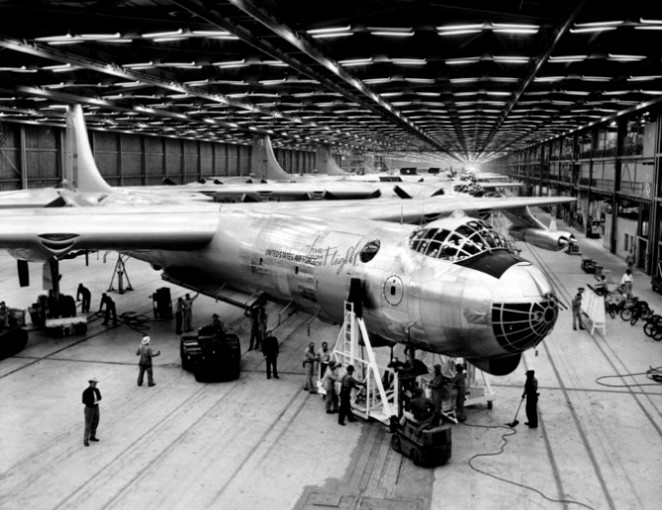
B-36 Peacemaker required a crew of 11 personnel to maintain all systems and weaponry on the aircraft with 4 ‘relief’ personnel flying along as well. There were high maintenance costs. Every flight up to 40 hours aloft cost thousands of man hours on the ground. For instance, every flight began with a new set of spark-plugs in the engines: 336 of them in 168 cylinder heads on six engines.
Defensive armament consisted of sixteen 20mm cannon emplacements in the nose, tail and throughout the fuselage in barbettes – though this defensive armament was not added till the B-36B models.
The prototype programme was initially slowed by World War II’s demands for current aircraft, but then placed at the highest priority in 1943 when the USA realized that strategic blows against Japan could only be struck by long-range strategic bombers.
First flown on 8 August 1946, the XB-36 had single 2.79m diameter main wheels, also a feature of the YB-36 second prototype on which they were replaced later by the four-wheeled bogies adopted for production aircraft. The original single wheel main undercarriages smashed up run way surfaces. In this form the aircraft was designated YB-36A and also differed from the first aircraft by introducing a raised cockpit roof. On 23 July 1943 100 aircraft were ordered but it was more than four years before the first of the 22 unarmed crew-trainer B-36A models took off on its maiden flight, on 28 August 1947. The Convair B-36 Peacemaker entered service with the United States Air Force’s 7th Bombardment Wing (Heavy) on 2 June 1948.
In 1949 cargo carriers were developed by Convair for carriage in the B-36 bomb-bay. One B-36 could carry six containers, each of about 100 cu.ft and maximum load of 14,000 lb. As a tanker, the B-36 could carry four 3000 USG tanks.
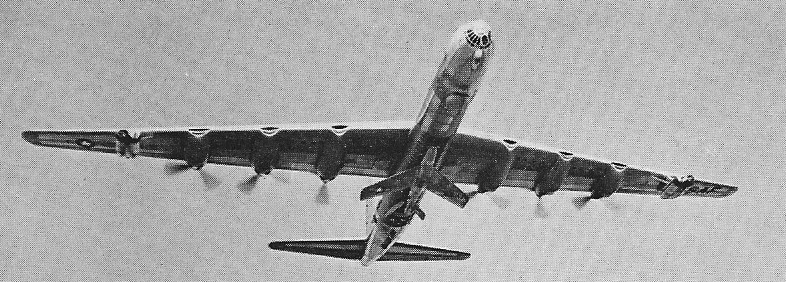
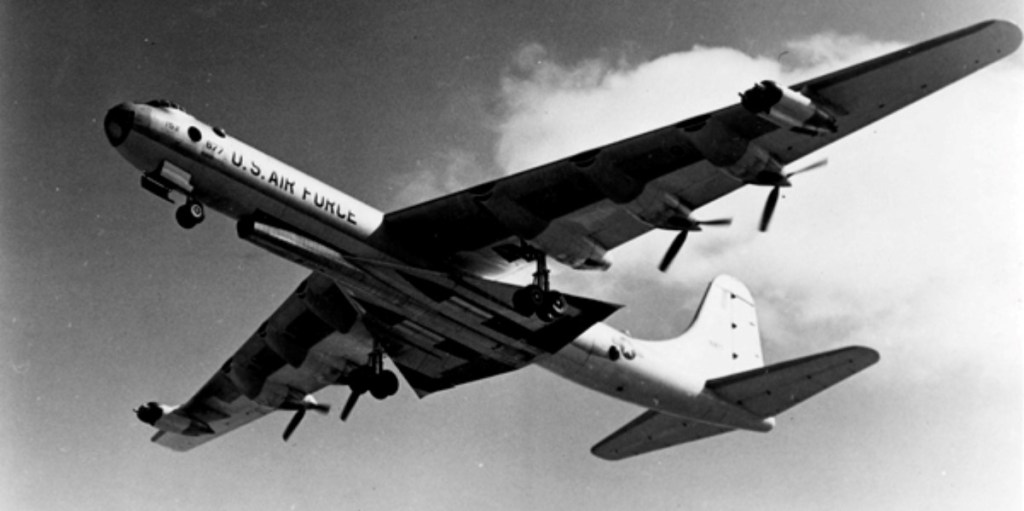
From 1950 the over target height and speed were boosted by adding four 2360 kg (5200 lb) thrust J47 jet engines in under slung pods to boost performance; with the six piston engines also uprated to 3800 hp each. Missions could last up to 50 hours without using the inflight refuelling capability. Complete wings were based in the UK, Morocco, Guam and other areas, as well as in the USA until February 1959. No missions were flown ‘in anger’.
In its final production version the B 36 had a combat overload weight of 208 tonnes (205 tons), more than double that of the prototype, and a maximum flight duration of 42 hours. An arsenal of 16 guns was carried, and crews numbered between 13 and 22 men, depending on the model and type of mission, some of which involved high altitude over-flights of the Soviet Union.
The B 36 was used as an extreme range spy plane (the version carried a photographic work shop instead of the usual bombload). A small number of ‘featherweight’ B-36s – aircraft without their usual armament and other non-essential equipment – with a small crew could fly at extreme altitudes, so keeping out of range of the MiG-15 interceptors. The regular B-36s, equipped with 14 cameras and electronic eavesdropping equipment, could reach 50,000 ft / 15,000 m while the ‘featherweight’ could cruise above the Soviet Union and China at more than 58,000 ft.
The last B-36J was delivered in September 1953 and the ultimate operational B-36 was retired in August 1959.
The GRB-36 operated as an airborne aircraft carrier. When the Convair B 36 Peacemaker bomber went into service with the United States Air Force’s Strategic Air Command, plans were laid for two hook on projects. The first of these was a fighter called the McDonnell XF 85 Goblin, which was 4.57 m (15 ft) long. The Goblin was to have been carried in the B 36’s bomb bay ready for launching in the event of fighter attack. Having won the ensuing dogfight it would then rejoin the mother ship for it did not give it any landing gear of its own.
Convair B-36J Peacemaker
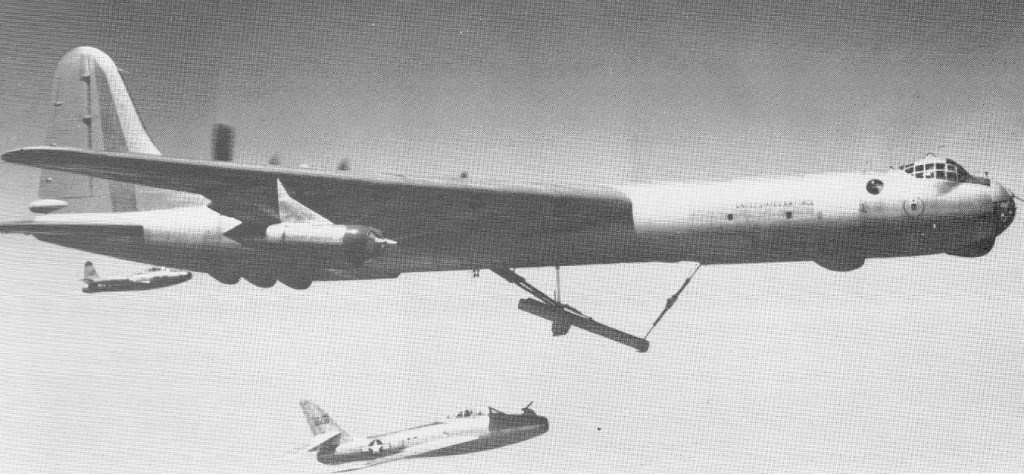
The second attempt to use the B 36 as an aircraft carrier took place in 1955 and 1956. Seeking a reconnaissance aircraft with suffi¬cient range to reach the Soviet Union, the USAF came up with FICON, which stood for Fighter In CONvair.
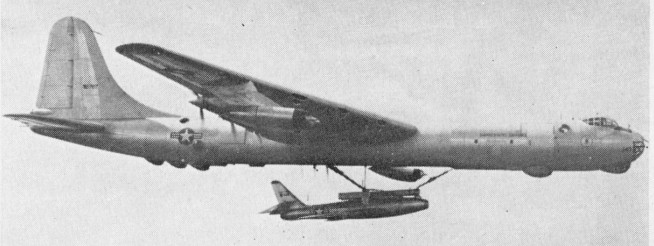
By hitching a Repub¬lic RF 84 Thunderflash to a B 36, the photo-¬reconnaissance jet’s range could be extended from 3220 km (2000 miles) to 19,310 km (12,000 miles).
The parasite’s pilot could transfer to the bomber’s interior, fly in the pressurised cabin until the area to be photographed was approached (because the B-36 had a range of at least 9300 miles / 15,000 km and this could take many hours), then go down to his own cockpit to be released above enemy territory.
SAC had a number of Peacemakers modified to GRB-36 mother aircraft and ordered 25 Republic RF-84K Thunderflash to hitch a ride. During 1955-56 several operational missions were flown from Fairchild and Larson airbases in Washington State.
Some thought was also given to a nuclear bomb equipped Thunderstreak substituting for the Thunderflash, but the arrival of the U-2 and RB-57D ended the project.
GRB-36J
Twenty five RF 84Fs were modified for parasite duty. On a typical mission the mother ship B 36 would depart from Fairchild Air Force Base, Spokane, Washington to be joined in the air by an RF 84K (as the parasite Thunderflashes were designated) from Moses Lake Air Force Base. The fighter would be hoisted into the B 36’s bomb bay.
GRB-36J
In April 1945 the USAF’s predecessor, the USAAF, had issued its specification for a B-35/B-36 replacement with turbine propulsion, and the USAF pushed this programme with considerable vigour. The failing submission to the 1945 requirement was the Convair YB-36G, which was redesignated YB-60 before two prototypes were ordered in March 1951,
Two Convair X-6s were ordered to evaluate the operational practicality of airborne nuclear propulsion systems prior to committing to building a prototype of a dedicated military design. The specific areas to be tested included crew shielding, propulsion, radiobiology, and the effects of radiation on various aircraft systems. In addition to the X-6s, a single NB-36H was ordered to serve as an early flyable testbed. In the NB-36H, the nuclear reactor was functioning but provided no power to the aircraft itself. The X-6s would have been powered by a prototype airborne nuclear propulsion system installed in the aft bomb bays.
In the end, the X-6 program was cancelled before either of the two aircraft were built. The NB-36H was completed, however, making its first flight in September 1955. After conducting tests for approximately two years, the nuclear reactor was removed and the NB-36H was scrapped at Carswell AFB, Texas.
Production of the B-36 continued for almost seven years, the last of 385 examples being delivered to Strategic Air Command on 14 August 1954, and the type was retired finally on 12 February 1959.
B-36 transporting the XB-58 airframe using eight of ten engines (note both of the inboard propellers have been removed for this flight)
Convair easily transported the XB-58 prototype by air from Ft. Worth TX to Wright-Patterson Air Force Base (AFB) in Ohio for testing with the use of a modified Peacemaker bomber.
B-36 and XB-58 airframe mating, note the strut assembly joining the two wings together has been removed from the wing’s inboard engine as well as the prop.
The left and right inboard engines had their propellers removed, along with the bomb bay doors since they did not clear the wings of the XB-58 which was mounted underneath the bomber.
Since the airframe was the subject of testing the XB-58 did not have the engines attached and the vertical fin assembly was left off, as well.
Engines: 6 x P+W R-4360, 2575kW Wingspan: 70.1 m / 229 ft 12 in Length: 49.4 m / 162 ft 1 in Height: 14.3 m / 46 ft 11 in Wing area: 443.3 sq.m / 4771.64 sq ft Max take-off weight: 162162 kg / 357508 lb Empty weight: 72051 kg / 158846 lb Max. speed: 696 km/h / 432 mph Cruise speed: 362 km/h / 225 mph Ceiling: 13700 m / 44950 ft Range w/max.fuel: 16000 km / 9942 miles Armament: 12-16 20mm machine-guns, 32600kg of bombs Crew: 16
Convair B-36D Peacemaker Engines: 6 x 3,500 hp Pratt & Whitney R-4360-41 radials + 4 GE J47-GE-19 turbojet, 5,200 lb. thrust Length: 162.07ft (49.4m) Width: 229.66ft (70.00m) Height: 46.75ft (14.25m) Maximum Speed: 439mph (706kmh; 381kts) Maximum Range: 7,500miles (12,070km) Service Ceiling: 45,197ft (13,776m; 8.6miles) Armament: 12 x 20mm cannons in nose, tail and fuselage barbettes Up to 86,000 lbs of bombs internally. Accommodation: 15 Empty Weight: 171,035lbs (77,580kg) Maximum Take-Off Weight: 418,878lbs (190,000kg)
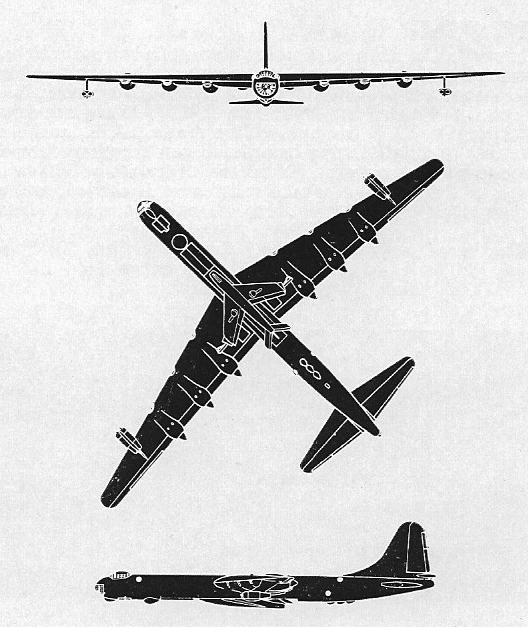
B 36J Peacemaker Engines: 6 x Pratt & Whitney R 4360 53 Wasp Major 28 cylinder radial, 3,800 hp (2834 kW) and 4 x General Electric J47 GE 19 turbojets, 2359 kg (5.200 lb). Max speed: 661 km/h (411 mph) at 11095 m (36,400 ft). Over target height: up to 12160 m (39,900 ft). Range with 4990 kg (11,000 lb) bombload: 10944 km (6,800 miles). Empty weight: 77581 kg (171,035 lb) Maximum take off weight: 185976 kg (410,000 lb). Wing span 70,10 m (230 ft 0 in). Length 49.40 m (162 ft 1 in). Height 14.23 m (46 ft 8 in). Wing area 443.3 sq.m (4,772.0 sq ft). Armament: 16 x 20 mm cannon in 8 turrets Bombload: up to 39010 kg (86, 000 lb).
GRB-36J Engines: 6 x Pratt & Whitney R-4360-53, 3800 hp & 4 x General Electric J47-GE-19, 5200 lb Wingspan: 230 ft Length: 162 ft 1 in Height: 46 ft 9 in Wing area: 4772 sq.ft Empty weight: 145,000 lb Loaded weight: 408,000 lb Max speed: 436 mph Cruise: P&W eng. Only: 290 mph at 40,000 ft Max range: 10,000 mi
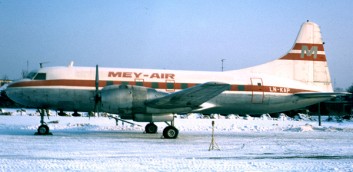
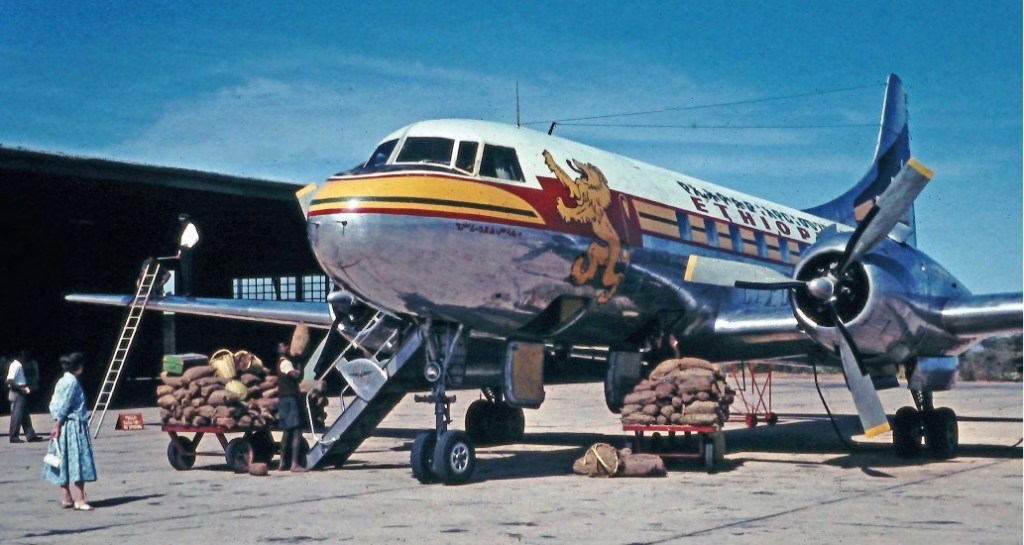
ConvairLiner project started with the Model 110, of which the prototype NX90653 was flown for the first time on 8 July 1946. American Airlines convinced Convair to alter the CV-110 into the larger CV-240. The first post-World War II commercial transport designed by Consolidated Vultee was evolved primarily as a DC-3 replacement.
Accommodation was provided for 2 crew and 40 passengers. The aircraft was powered by two 2400 hp / 1,788kW Pratt & Whitney R-2800-CA18 radial engines.
The prototype, NX90849, first flew at San Diego on 15/16 March 1947 and the first licensed aircraft was delivered to American Airlines on 28 February 1948, who put the type into scheduled service on 1 June 1948.
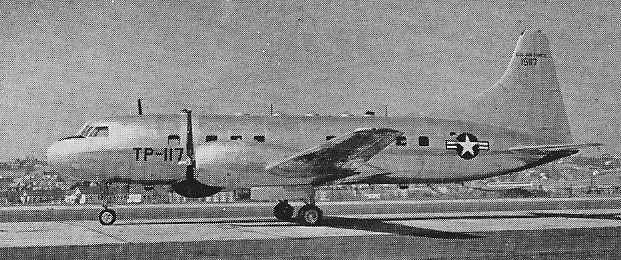
Military versions of the 240 were produced as the T-29A to E aircrew trainers for navigators and bombardiers.
Conversion of the commercial CV 240 for military training duties was commenced in 1948, the first version being the T-29A which first flew on 22 September 1952.
Development of the T-29A with pressurised cabin, increased fuel capacity, etc, resulted in the T-29B which first flew on 30 July 1952.
T-29B
The T-29C had higher powered engines, The T-29D for advanced navigational/bombardment training, and the VT-29E which was a personnel transport variant.
Altogether 176 were built, and the Convair 240 served VARIG for 26 years.
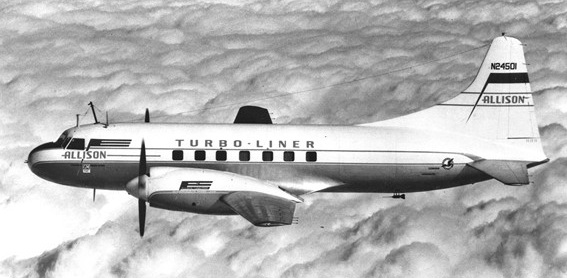
Convair CV-240-21 Turboliner, December 1952 (Courtesy Pat Ford)
The Allison T38 (company Model 501) engines fitted to the Convair CV-240-21 Turboliner were rated to 2,750shp.
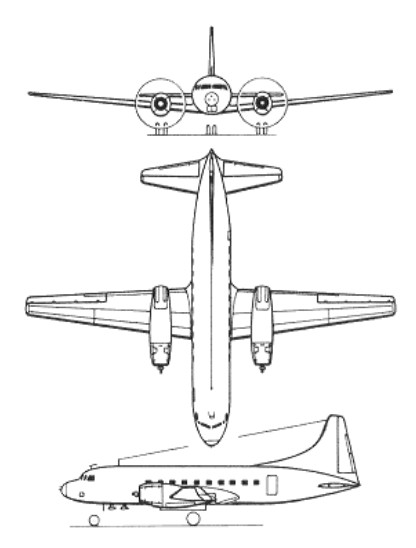
The Convair 340 is a development of the Model 240, having a 4 ft 6 in increase in fuselage length, increased all up weight, and higher powered engines.
Engines: 2 x Pratt & Whitney R-2800-CA18, 2400 hp / 1,788kW Wingspan: 28.0 m / 91 ft 10 in Length: 22.7 m / 74 ft 6 in Height: 8.3 m / 27 ft 3 in Wing area: 75.9 sq.m / 816.98 sq ft Max take-off weight: 18972 kg / 41826 lb Empty weight: 12530 kg / 27624 lb Max. speed: 538 km/h / 334 mph Cruise speed: 480 km/h / 298 mph Ceiling: 9150 m / 30000 ft Range w/max.fuel: 2880 km / 1790 miles Crew: 3-4 Passenger capacity: 40
T-29B Engines: Pratt & Whitney R-2800-97, 2400 hp Wingspan: 91 ft 9 in Length: 74 ft 8 in Height: 27 ft 3 in Wing area: 817 sq.ft Loaded weight: 43,575 lb Max speed: 300 mph Cruise: 230 mph ROC: 1370 fpm Range: 1500 mi


 All Aero