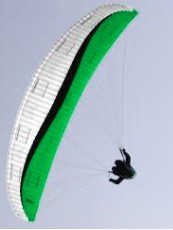
The DHV 2 Maverick is a simple to fly XC class 2 wing with convincing performance data. Professional race risers, four different sail cloths which are selectively used in the canopy according to tension and weight, a mix of five different line diameters in Dynema and Kevalar give the Maverick an edge on comparable class 2-3 wings. Price 2009: US$3,800.00
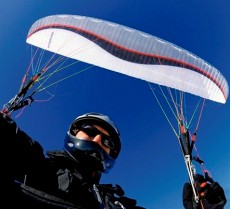
Released in 2006, the Nikita (Acro) was developed for extreme dynamic performance by qualified acro pilots. The wing curvature and special trimming reduce forces on the pilot from SAT and other maneuvers, risers tensioned to prevent twist and diagonal tape and line loops arranged for safe landings in case of line breakage. Factory approval is required before purchasing! For each paraglider model is offered special ICARO motor risers which have been developed for motored flight. ICARO motor risers have many functional details and are an optimal partner for free flight, backpack motor, trike or flyke. Weather installed at ICARO or bought as an optional accessory, ICARO motor risers are for paramotoring and at the same time can also be used for free-flight. The trimmer can be operated easily and provides optimal adaption to the airspeed. A small asymmetrical adjustment to both trimmers balances the torque of the engine. One-sided balancing of the brake is gone. Two attachment loops for main suspension as well as variable fastening points for the brake pulley provide maximum flexibility in all variants of motorised flight. Two pulleys attached at different heights allow the brake line to be adjusted to a suitable position. Price 2009: US$3,300.00
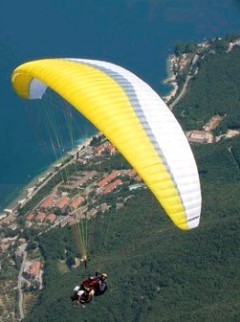
The tandem design for 2007, the Twice was certified DHV 1-2. Suitable for the professional tandem instructor or hobby pilots, the shorter line length and canopy curvature make the Twice light and efficient. For each paraglider model is offered special ICARO motor risers which have been developed for motored flight. ICARO motor risers have many functional details and are an optimal partner for free flight, backpack motor, trike or flyke. Wheather installed at ICARO or bought as an optional accssory, ICARO motor risers are for paramotoring and at the same time can also be used for free-flight. The Twice was designed so that the flight characteristics would remain the same no matter how heavy the load. Fitted with trimmers as a standard feature and comes the providing optimal adaption to the airspeed. A small asymmetrical adjustment to both trimmers balances the torqe of the engine. One-sided balancing of the brake is gone. Two attahment loops for the main suspension as well as variable fastening points for the brake pulley provide maximum flexibilty in all variats of mororized flight. Two pullys attached at diffeent heights allow the brake line to be adjusted to a sutable position. Price 2009: US$3,900.00
ICARO 2000, the first hang-glider factory in Europe, was founded in 1973 by Alfio Caronti & Peter Skaarup.
Alfio received his first glider from Bill Moyes, during a water-ski competition in 1969. He was the first Hang glider pilot in Europe, who took off from a mountain on the 4th November 1971. The glider used by Alfio Caronti was a kingpostless glider with square tubes.
Peter Skaarup was the technician of the factory and together they manufactured hang-gliders under the license of the Australian firm Moyes.
In 1981 Franco Garzia & Gianni Hotz, became the new owners of ICARO 2000 and continued to make Moyes hang-gliders. Their first glider was the Meteor 170.
Since 1983 ICARO has been using only tubes in Perunal (aluminium alloy 7075 for aeronautics) from the Swiss manufacturer Alumenziken.
Until 1991 ICARO sold, in Europe, more then 3,000 gliders (Moyes models like Mega II, Missile, Mars, GT, GTR and XS).
In 1992 Manfred Ruhmer becomes part of the staff and ICARO started to develop original designs with its own sailmakers and workshop with 20 employees and a 1,200+ sq m building. The development of new models was carried out by Manfred Ruhmer, one of the world’s best pilots and Franco Garzia, a former Italian champion. Since this time all ICARO hang glider models are certified by the DHV (Germany).
In 1992 the first ICARO’s original design appeared: the Brazil, followed in 1994 by the Laminar. With this wing ICARO started to reach competition results 1994 European Championship in Laragne (France): Manfred Ruhmer is 2nd 1995 World Championship in Ager (Spain): Manfred Ruhmer is 2nd. In 1995 the first prototype of kingpostless gliders appears.
In 1996 ICARO presented its first prototype of topless glider and with this wing, Manfred reached 2nd place in the European Championship in Hungary.
Since 1998 ICARO has its own landing area (more then 50.000sq m) with Club House, Camping facilities and Store of accessories for Sport Aviation: these facilities are located at Lago Maggiore (northern Italy), facing a mountain ideal for flying.
1998: Via Verdi, I-21038 Sangiano (VA), Italy.
In 1998 ICARO forms an agreement with Felix -A.I.R., by which ICARO will make keels and sails for the Atos (ICARO has made 550 so far) and obtains the option to sell the Atos in certain markets.
ICARO introduces on the paragliders’ scenery the Cyber, a new basic-intermediate wing, with the latest technology and construction methods and highest safety DHV 1. Also in 2000, on October 25th, ICARO reviewed its agreement with Felix; ICARO takes over the worldwide production and distribution of the Atos from the home base in Sangiano. Felix works exclusively on the development of the design.
After having sold more than 400 Atos in two years, a period in which ICARO took an active part in the manufacturing of sails, A-frames and keels, it was decided that henceforth A.I.R. would devote 100% to the development and technical support, whereas ICARO would become in charge of the production and distribution of the Atos.
In September 2001 Christian Ciech starts working for Icaro 2000 in the development team, and after six months comes into the scenery the new Icaro 2000’s rigid wing: the Stratos.
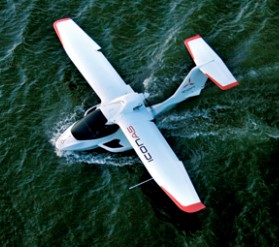
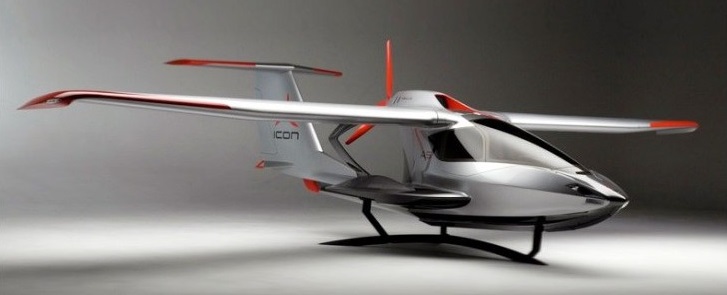
The Icon A5 amphibious LSA was unveiled at a very rock ’n’ roll premiere in Los Angeles in June 2008.
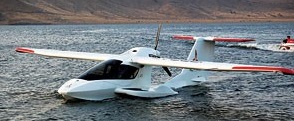
The ICON A5 has two seats and is made mostly of composite materials, with a high wing, T-tail, pusher prop, and tricycle landing gear. It is powered by a Rotax 912 flat-four engine, with hybrid air-water cooling and providing 75 kW (100 HP). All landing gear assemblies have single wheels, the nose gear hinging forward, the main gear retracting into sponsons that also provide flotation stability. Seating is side-by-side, the canopy hinging forward for access. The wings fold back along the rear of the aircraft for ease in handling.
Designed for recreation rather than transport and first flown in July 2008, the A5 is a sport plane available in 2008 for US$139,000.
The A5 received a lot of publicity but no production machine had flown yet.
The long-delayed amphibian could at last be nearing production after wrestling with overweight issues for years. In 2012 the manufacturer awaited FAA’s final decision on whether that agency would allow an additional 250 pounds beyond the LSA amphibious spec of 1,430 pounds or 1,680 pounds MTOW.
Icon’s stated grounds for exception: The extra weight is needed for its spin-resistant wing design. The ruling would only benefit the A5, not any other amphib or float plane.
Engine: Rotax 912, 75 kW Wing span: 10.4m / 34 ft Length: 6.7 m / 22 ft Empty weight: 450 kg / 1,000 lb Max speed: 192 kph Stall: 80 kph
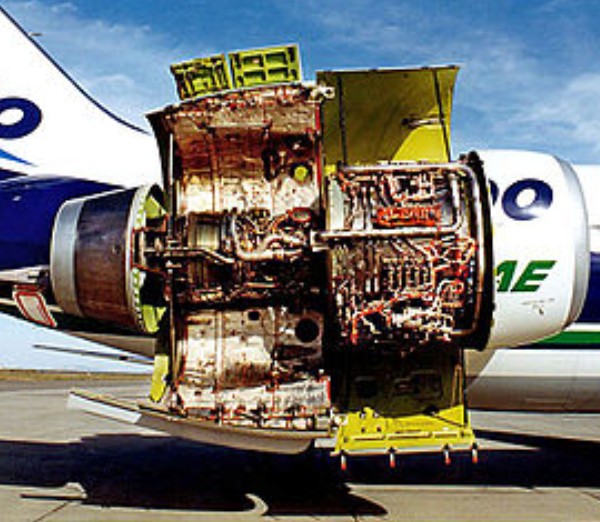
Just a year after IAE was formed, the V2500 two-shaft high-bypass turbofan engine won a position on the Airbus A320 family, formally launching the program. Following a development program, the V2500-A1 engine first entered service with Adria Airways in 1989.
That same year McDonnell Douglas selected the V2500 engine to power the MD-90, providing diversity to the engine program. Delta Air Lines launched this new program with an order for 26 firm aircraft.
Rolls-Royce plc based the HP compressor on a scale-up of the RC34B eight stage research unit used in the RB401-06 Demonstrator Engine, but with a zero-stage added at the front and a tenth stage added to the rear. Pratt & Whitney developed the combustor and the 2-stage air-cooled HP turbine, while the Japanese companies provided the LP compression system. MTU were responsible for the 5-stage LP turbine.
FAA flight certification for the V2500 was granted in 1988.
IAE’s philosophy of continuous improvement was evident from the start, and the first major performance enhancements were introduced into service in 1993 through the V2500-A5 engine. IAE subsequently took the HPT technology developed for the V2500-A5 engine and incorporated it into the V2500-A1 engine in what was termed the “Phoenix Standard” in 1998. This resulted in improved time-on-wing.
The latter part of the 1990s saw IAE and the V2500 engine start to become a dominant force in commercial aviation: (i) the MD-90 entered service; (ii) the first orders were taken from Chinese airlines; (iii) records were broken for deal sizes; and (iv) the first V2500 engine-powered A319 flew in United Airlines’ colors. In addition, the 1,000th V2500 engine was delivered.
The new Millennium saw existing MD-90 operators – China Northern and SAS – select V2500 engine-powered Airbus aircraft for the first time. The engine also became available to power the Airbus Corporate Jetliner (ACJ).
The success story continued throughout the decade as customer numbers approached 200, and a number of record-breaking deals were signed. The 2,000th V2500 engine was delivered in 2002, and the engine program surpassed the milestone of 20 million flying hours.
IAE continued its philosophy of continuous improvement with the introduction of V2500 SelectOne engine in 2005, along with the first comprehensive OEM-managed aftermarket service program in this class. More records were broken as a number of first-run engines remained on wing in excess of 30,000 hours. Following the delivery of the 3,000th V2500 in 2006, orders continued to climb with tremendous success in China with orders from Sichuan Airlines, Hainan Airlines, Shanghai Airlines and Shenzhen Airlines.
The V2500 SelectOne engine gained segment acceptance throughout the decade as customers selected the new engine standard and upgraded their existing fleets with the new retrofit upgrade. The new engine build standard, which debuted with IndiGo in 2008, delivered over 1500 engine units by the end of 2012 and continues to grow. It has a record of exceptional reliability following a flawless entry into service and continued dependable operation. In addition, the V2500 engine became a launch engine for the Airbus A320 Final Assembly Line in Tianjin, China.
An upgrade option for the V2500 SelectOne engine – the V2500 SelectTwo engine was also announced. Meanwhile, the V2500 SelectOne engine reached a major milestone with its 1,000th delivery to IndiGo, and IAE’s order book continued to grow as China Southern became IAE’s largest customer with its order for 65 V2500 SelectOne engines.
In its first military application, IAE was chosen in 2011 by Embraer Defense and Security, in concurrence with the Brazilian Air Force, to provide the powerplant for the country’s new KC-390 multi-role tanker/transport aircraft. The engine will be the V2500-E5 engine.
The 4,000th V2500 engine was delivered to the Brazilian flag carrier TAM and installed on the 4,000th Airbus A320 family aircraft (an A319).
In early 2012, the 5,000th V2500 engine was delivered to SilkAir, and IAE achieved 100 million flying hours.
Variants:
V2500-A1
V2533-A5 A fourth booster stage was introduced into the engine basic configuration to increase core flow. This, together with a fan diameter/airflow increase, helped to increase the thrust to 33,000 lbf (147 kN) thrust, to meet the requirements of the larger Airbus A321-200. A number of derated, Stage 4 noise compliant engines have been produced from the -A5 configuration, including: The 23,500 lbf (105 kN) thrust V2524-A5 for the Airbus A319 The 27,000 lbf (120 kN) thrust V2527-A5 for the Airbus A320 The 28,000 lbf (120 kN) thrust V2528-D5 for the McDonnell Douglas MD-90-30. The 33,000 lbf (150 kN) thrust V2533-A5 for the Airbus A321
V2500SelectOne On October 10, 2005, IAE announced the launch of the V2500SelectOne with a sale to IndiGo Airlines to power 100 A320 series aircraft. The V2500SelectOne is a combination performance improvement package and aftermarket agreement. In February 2009, Pratt & Whitney upgraded the first V2500-A5 to the SelectOne Retrofit standard; the engine was owned by US Airways and had been in use since 1998.
V2500SelectTwo On March 15, 2011, IAE announced an upgrade option of V2500 SelectOne Engines to the SelectTwo Program.
Applications: Airbus A320 family (excluding A318) Embraer KC-390 McDonnell Douglas MD-90
Specifications:
V2500-A1 Thrust: 111 kN Bypass ratio: 5.4 : 1 Compression ratio: 35.8 : 1 Fan diameter: 1.587 m Total length: 3.2 m Weight: 2,327 kg Production start year: 1989 Aircraft type: A320
V2522-A5 Thrust: 97.86 kN Bypass ratio: 4.9 : 1 Compression ratio: 32.8 : 1 Fan diameter: 1.613 m Total length: 3.2 m Weight: 2,359 kg Production start year: 1992 Aircraft type: A319
V2524-A5 Thrust: 106.75 kN Bypass ratio: 4.9 : 1 Compression ratio: 32.8 : 1 Fan diameter: 1.613 m Total length: 3.2 m Weight: 2,359 kg Production start year: 1996 Aircraft type: A319
V2525-D5 Thrust: 111 kN Bypass ratio: 4.8 : 1 Compression ratio: 34.5 : 1 Fan diameter: 1.613 m Total length: 3.2 m Weight: 2,484 kg Production start year: 1995 Aircraft type: MD90
V2527-A5 Thrust: 117.88 kN Bypass ratio: 4.8 : 1 Compression ratio: 32.8 : 1 Fan diameter: 1.613 m Total length: 3.2 m Weight: 2,359 kg Production start year: 1993 Aircraft type: A320
V2528-D5 Thrust: 124 kN Bypass ratio: 4.7 : 1 Compression ratio: 35.2 : 1 Fan diameter: 1.613 m Total length: 3.2 m Weight: 2,484 kg Production start year: 1995 Aircraft type: MD90
V2530-A5 Thrust: 139.67 kN Bypass ratio: 4.6 : 1 Compression ratio: 35.2 : 1 Fan diameter: 1.613 m Total length: 3.2 m Weight: 2,359 kg Production start year: 1994 Aircraft type: A321
V2533-A5 Thrust: 146.80 kN Bypass ratio: 4.5 : 1 Compression ratio: 35.2 : 1 Fan diameter: 1.613 m Total length: 3.2 m Weight: 2,359 kg Production start year: 1996 Aircraft type: A321
IAE International Aero Engines AG is a Zürich-registered joint venture manufacturing company founded in 1983 to develop an engine to address the 150-seat single aisle market.
The original collaboration involved Pratt & Whitney of the United States, Rolls-Royce plc of the United Kingdom, Japanese Aero Engine Corporation of Japan and MTU Aero Engines of Germany. FiatAvio withdrew as a shareholder of the program early on, but the now-renamed Avio S.p.A. remainede as a supplier. The “V” product nomenclature remains as a legacy of the five original shareholders.
The collaboration produced the V2500 – the second most successful commercial jet engine program in production in terms of volume, and the third most successful commercial jet engine program in aviation history.
In October 2011, Rolls-Royce agreed to sell its 32.5% stake in the company to Pratt & Whitney’s parent company, United Technologies (UTC), giving UTC a combined equity ownership share of 49.5% (which is different from UTC’s total program share in the IAE collaboration, which stands at 61%). The transaction was completed on 29 June 2012.
Rolls-Royce remains a major supplier to IAE.
IAE had developed the abortive Superfan for the Airbus A340. IAE’s purpose became the development, production and aftermarket services of the IAE V2500 aero engine family.
By 2012, more than 5,700 engines had been delivered and approximately 1,600 more were on backlog, which is equivalent to nearly five full years production. Over the previous five years, production had doubled with over an engine a day being delivered.
In 2011, the IAE Executive Board of Directors announced the extension of its collaboration agreement to 2045. After receiving regulatory approvals and partner consent, Pratt & Whitney closed on the purchase of Rolls-Royce’s equity and program share in IAE on June 29, 2012. Rolls-Royce were to continue to support IAE as a strategic supplier for the V2500 engine and continue to perform its key responsibilities for IAE, including the manufacture of parts and engines, as well as supply MRO services for IAE’s fleet.
Shareholders in 2012 were: Pratt & Whitney, USA: 25.00% Pratt & Whitney Aero Engines International GmbH, Switzerland: 24.50% MTU Aero Engines, Germany: 25.25% The Japanese Aero Engine Corporation: 25.25%
The Japanese Aero Engine Corporation consisted of: Kawasaki Heavy Industries Ishikawajima-Harima Heavy Industries Mitsubishi Heavy Industries
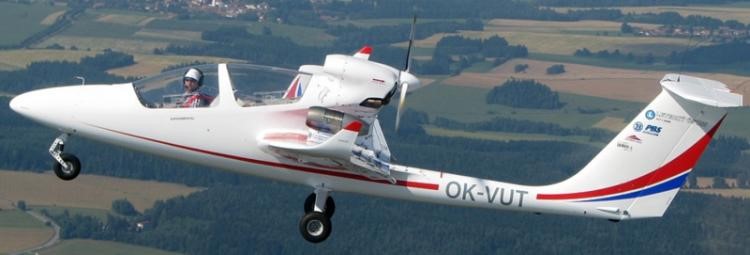
Marabu was completely designed and built by IAE Brno (Czech Republic), under the leadership of Professor Anton Pistek. It is characterized by its Joint Propulsion: Engine 4 cylinder flat Rotax 912 A2 with pusher propeller and turbojet PBS TJ100 M.
It made its first flight on 29 April 2010 at Kunovice (South-East of the Czech Republic) in the hands of test pilot Stanislav Skelnar.
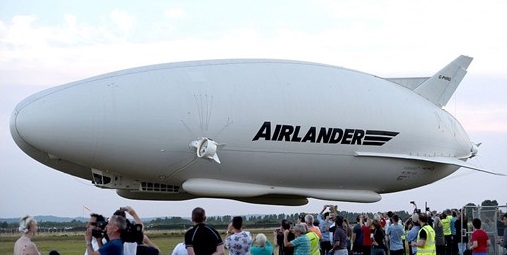
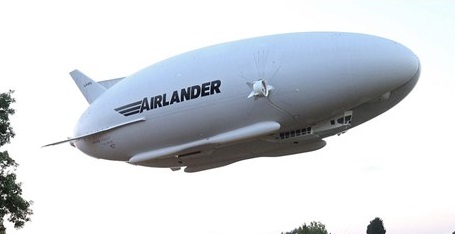
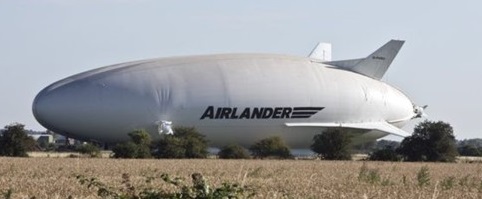
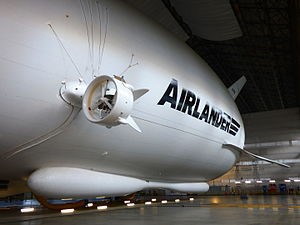
The Hybrid Air Vehicles HAV 304 Airlander 10 is a hybrid airship made by Hybrid Air Vehicles in the UK. It was originally built for the US Army’s Long Endurance Multi-intelligence Vehicle (LEMV) project.
Following the successful demonstration of the HAV-3 small-scale demonstrator, and with Northrop Grumman as the prime bidder, the hybrid airship concept was accepted for the US Long Endurance Multi-intelligence Vehicle (LEMV) project, in preference to the Lockheed Martin P-791 also submitted.
Requirements included the capability to operate at 6 km (20,000 feet) above mean sea level, a 3000 km (2,000 mile) radius of action, and a 21-day on-station availability, provide up to 16 kilowatts of electrical power for payload, be runway independent and carry several different sensors at the same time. According to the U.S. Army, the LEMV was to have been a recoverable and reusable multi-mission platform. It could be forward located to support extended geostationary operations from austere locations and capable of beyond-line-of-sight command and control. Northrop said the LEMV could be used as a cargo aircraft, claiming that it had enough buoyancy to haul seven tons of cargo 2,400 miles at 30 miles per hour.
The HAV 304 was selected by the United States Army for its LEMV programme in which Northrop Grumman was to have been the prime contractor.
The agreement to develop the project was signed on June 14, 2010, between the U.S. Army Space and Missile Defense Command/Army Forces Strategic Command and Northrop Grumman. The agreement also included options for procuring two additional airships.
Northrop Grumman’s subcontractors included: Hybrid Air Vehicles Ltd. in Cranfield, UK (HAV304 platform) Warwick Mills in New Ipswich, USA (fabrics engineering) ILC Dover in Kent County, USA (airship manufacturer and designer) Textron subsidiary AAI Corp. in Hunt Valley, USA (makes the US Army’s OneSystem UAV/surveillance aircraft control & information distribution stations); and SAIC in McLean, USA.
The developmental prototype emerged as the HAV 304, having an internal capacity of 38,000 cubic metres. This compares mid-20th Century airships such as the German Hindenburg-class airships which were 245 m (803 ft 10 in) long.
The airship was a hybrid aircraft and uses aerodynamic lift like a conventional aeroplane to take off before using helium to keep it in the sky once it is airborne. Engines on board are then used to move while it monitors events on the ground. The LEMV’s skin—a blend of Vectran, Kevlar, and Mylar—would have been able to cope with a “reasonable amount of small arms fire.” Northrop estimated that the biggest threat to the craft was weather, where high winds or thunderstorms could buffet the craft.
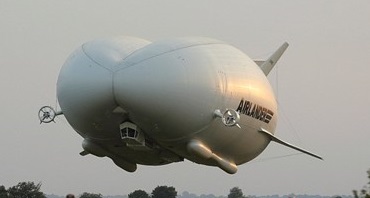
The Airlander, made by British company Hybrid Air Vehicles, has four engines and no internal structure. It maintains its shape thanks to the pressure of the 38,000 cubic meters of helium inside its hull, which is made from ultralight carbon fiber. Together with the aerodynamic shape of its hull, the lighter-than-air helium gas provides most of the lift. The aircraft’s odd shape has led some observers to describe it as a “flying bum.”
The project cost between $154 million and $517 million, dependent on all options. The cost included the design, development, and testing of the airship system within an 18-month time period, followed by transportation to Afghanistan for military assessment.
The timeline for LEMV was an 18-month schedule starting in June 2010 that included vehicle inflation at about month 10. Additional operational characterization would have occurred at Yuma Proving Ground, Arizona, in month 16.
The overall concept struggled with constant time delays and technological challenges. In October 2011 Flight International reported that the LEMV was scheduled to make its first flight in November 2011. According to media reports the LEMV was then set up for its first flight in early June 2012. However, unspecified problems delayed the flight even further. The first flight of the LEMV took place on August 7, 2012 over Joint Base McGuire-Dix-Lakehurst, New Jersey. The flight lasted for 90 minutes and was performed with a crew on board. The first flight primary objective was to perform a safe launch and recovery with a secondary objective to verify the flight control system operation. Additional first flight objectives included airworthiness testing and demonstration, and system level performance verification. All objectives were met during the first flight. That put the combat deployment of the LEMV to Afghanistan in early 2013. However, two months after the test flight, the Army said it had concerns about sending the airship abroad. These included safety, transportation to the theatre of operations, and the timeline of deployment.
The Army was slated to demonstrate the first LEMV in Afghanistan 18 months after June 2010, with proposed plans to build five others following mission completion.
On 7 August 2012 the first test flight of an LEMV was completed at Joint Base McGuire–Dix–Lakehurst, New Jersey. The vehicle tested was one of three planned for the US Army.
The US Army cancelled the LEMV project for cost reasons in February 2013. HAV bought back the airship in September 2013 for $301,000. The cameras, sensors, and communications equipment were removed and the helium was drained before the sale. In 2014—named Airlander—it was reassembled at RAF Cardington in England and re-designated the Airlander 10, to be test-flown in 2016. Hybrid Air Vehicles then managed to raise over 3.4 million pounds ($4.4 million) through two crowd funding campaigns. It also received a grant from the European Union and funding from the U.K. government. The first flight took place on 17 August 2016.
HAV 304 design Length: 91 m (298 ft 7 in) Width: 34 m (111 ft 7 in) Height: 26 m (85 ft 4 in) Envelope: 38,000 cubic metres Engines: four x 350 hp, 4 litre supercharged V8 diesel
Airlander 10 Capacity: 10,000 kg (22,050 lb) Length: 92 m (301 ft 10 in) Wingspan: 43.5 m (142 ft 9 in) Height: 26 m (85 ft 4 in) Volume: 38,000 m3 (1,300,000 cu ft) Gross weight: 20,000 kg (44,092 lb) Powerplant: 4 × 4 litre V8 turbocharged diesel engines, 242 kW (325 hp) each Cruising speed: 148 km/h (92 mph; 80 kn) Endurance: 5 days manned Service ceiling: 6,100 m (20,013 ft) Loiter speed 20 knots (37 km/h)
 All Aero