Kaiser DEKO-9 Magic / Dakomat Deko 9 Magic / Deko 9 Magic

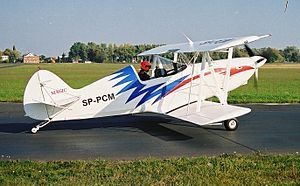
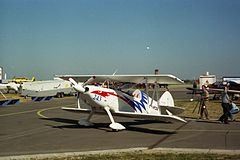
A single-seat aerobatic sports and recreation biplane, the prototype aircraft developed on order from the German Kaiser-Flugzeugbau GmbH. The construction of the prototype, strength tests and flight tests carried out in Military Aviation Plant No. 3 Deblin (later called the Military Aviation Plant No. 1 SA branch) in Dęblinie, Poland. The design work, construction of prototypes and the necessary infrastructure took from 1996 to 1998.

The team headed by Lt.-Col. MSc. Wieslaw Pochylskiego, established a composites laboratory and strength tests, and a thermal tent enabling the study of metal-composite structures at elevated temperatures. Other members included Dr. Eng. Marek Debski and M. Sc. Christopher Kotliński. Builders and MSc. Marian Jakoniuk, MSc. Witold Wiraszka, Eng. Bruno Biernacki and Dr. Eng. Daniel Debski.

Calculations and strength tests were conducted by M.Sc. Vladimir Urbaniak – load, dr. Andrew Szot, MSc. George Mularczyk – static strength tests, Dr. Eng. Wojciech Hajec, MSc. James Kulecki – model airplane spin research, Warsaw University of Technology.

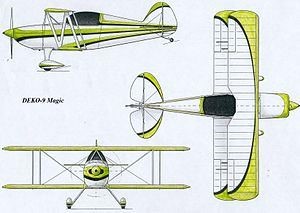
A biplane, the crew seats in tandem with a one-piece canop, and with a fixed main landing gear and tail wheel. The supporting structure of the fuselage is duralumin tube in composite nodes. The wings are double-girder construction with beams made of duralumin tubes and fixed to them duralowej pressed sheet metal ribs. The tail is welded construction made of thin-walled steel pipes. Polish made aircraft are overed with a heat-shrinkable polyester fabric, Dekonit 140 g / m².

First flight of the aircraft on 30 September 2000 and flight tests were performed by test pilot, MSc. , Maciej Aksler. The aircraft was presented at exhibitions air: ILA Berlin 1998 and 2000 and Fredrichshafen AERO 1999 and 2001.

ILA Berlin 2000

The engine of six produced by PZL Rzeszow was the 200 hp PZL Franklin 6A-350C1R , suitable for inverted flight and driving a three-bladed MT-Propeller MTV-9-DC / C188-18a propeller with hydraulically controlled pitch.

Also developed of four-cylinder Franklin 4A-235B4 92 kW (125 hp) powered version with open cockpit.

Engine: PZL Franklin 6A-350C1R, 205 hp (150 kW)
Span: 6.8 m
Length: 6.5 m
Height: 2.2 m
Wing area: 15.4 m²
Empty weight: 500 kg
Useful load: 250 kg
MAUW: 750 kg
Fuel capacity: 100 lt
Max speed: 220 km / h (119 kts IAS)
Cruising speed: 190 km / h (103 kts IAS)
Minimum speed: 90 km / h (49 kts IAS)
Vne: 350 km / h (189 kts IAS)
Rate of climb: 12 m / s (2362 ft / min)
Ceiling: 4000 m (13123 ft)
Range: 700 km (378 nm)
Take-off dist: 120 m (393 ft)
Landing dist: 120 m (393 ft)
Load factor design: + 6 / -3 g
Seats: 2

Deko-9 Magic

Just Aircraft 103

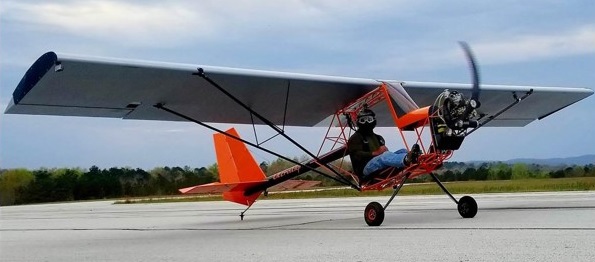
Troy Woodland designed the Just 103 to conform to the FAA Part 103 requirements for ultralight aircraft, including a maximum weight of 254 pounds, a single seat, and a top speed of 63 mph. The new ultralight logged 1.5 hours before heading to the Sun ‘n Fun International Fly-In and Expo. Other than a narrow windscreen, the pilot is very much out in the open air, “which was typical with a lot of earlier Part 103 designs”.

A Polini Thor 250 engine from Italy supplies 37 horsepower at 7,500 rpm, and retails for less than $4,000. Woodland also expected to mount a Rotax 582, which would push the aircraft beyond the ultralight limits and require registration as a light sport or experimental light sport aircraft.

The company was to sell the Just 103 as a kit or ready-to-fly from the factory in Walhalla, South Carolina.

Just Aircraft SuperSTOL

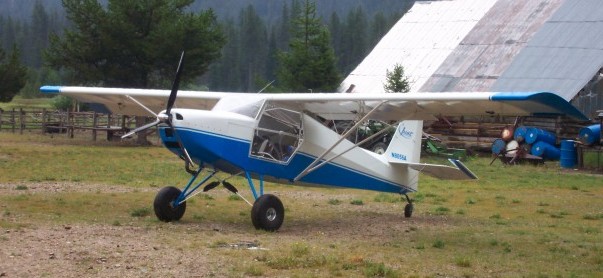
The Just Aircraft SuperSTOL is a classic doped fabric/chrome moly steel frame taildragger with automatically deploying full-span two-segment leading-edge slats, 15-25-40-degree barn door flaps, Rotax 912 power and hydraulic shock-absorbing main gear struts.

The SuperSTOL is based on the Just Highlander. The base price (kit) for the SuperSTOL in 2012 was $36,650 (before engine and avionics), with S-LSA certification underway.

Just Aircraft Highlander

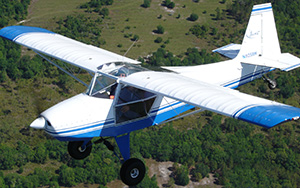
Introduced at Arlington and Oshkosh 2004, Highlander is an upgraded version of the Escapade. Just Aircraft’s new bush plane qualifications are enhanced by a larger balanced elevator and rudder, a larger trim tab, extended (and beefed up) gear legs with larger wheels and brakes, gull wing doors (can be opened in flight), an 8″ tail wheel and VG’s. And, a new three foot longer wing.
The Highlander has the same features as the Escapade, but with all the upgrades to make it a better backcountry aircraft. The Highlander is manufactured with all high quality aircraft materials. It is also manufactured with attach points for floats, lots of cabin area and extra large cargo area.
The Escapade and Highlander share considerable structural elements including the chrome-moly fuselage frame, wing airfoil construction, and engine compartment.
Using the same basic fuselage for both planes means they both have a huge luggage capacity that extends to the tail. The planes can handle a 6’7”+ frame and 300lb+ people. With sliding seats and 44” of elbow room.
Highlander LSA 2010 Kit Price: US$22,250
Both planes can be flown with the doors off or the doors and windows open, although a heater can be installed for frigid conditions.
The planes are available as complete ready to assemble kits which take about 600 – 700 hours to complete. Or you may choose various stages of assembly based upon your time demands and pocket book. Some choose to have the factory finish the wings and cover the fuselage which cuts the build time in half. There is also the option of “Build Assist” where for a monthly fee the owner may assemble the plane in the factory with company experts on hand for assistance. Those desiring a complete build ready to fly option will find this also available.
This would be SLSA certified if desired.
An extended-gear option for the Highlander provides heavy-duty axles to support bush tires: those legs raise the fuselage and widen the track by about 4 inches.
The Highlander is the bush plane model of the Escapade with longer wings, taller-heavier gear, tundra tires and larger tail feathers with balanced elevator and rudder.

The Escapade and Highlander can be installed with any power plants in the weight range of the Rotax 503 up to the Rotax 914 or Jabiru 2200 up to the Jabiru 3300.

Engine: Rotax 912 100 hp
Height: 7’10”
Length: 19′
Cabin Width: 44 in
Wing Span: 31′ 6″
Wing Area: 120.75 sq.ft
Empty Weight: 620 lbs
Gross Weight: 1320
Useable Load: 700
Fuel Capacity: 18 USgal
Flight Load Factor: +4 -2 G
Vne (never exceed speed): 130 mph
Cruise speed @ 75% power: 105 mph
Vso (full flap) at Gross Weight: 23 mph
Vs (clean) at Gross Weight: 27 mph
Take off Distance Ground Roll: 300 ft
Landing Distance Ground Roll: 250 ft

Highlander LSA
Engine: Rotax 912S, 100 hp
Wingspan: 31′ 6″
Length: 19 ft
Wing area: 116.25 sq.ft
Empty weight: 620 lb
MTOW: 1320 lb
Useful load: 700 lbs
Cruise 75%: 105 mph
Stall: 25 mph
Range: 520 sm
ROC: 1500 fpm
Takeoff dist: 100 ft
Landing distance; 75 ft
Seats: 2
Cockpit width: 44 in

Engine: Rotax 912S, 100 hp
Wing Span: 31’6”
Wing area: 120.75 sq.ft.
Mean Cord: 45”
Length: 19’
Height: 7’10”
Length Folded: 20’8”
Width Folded: 7’ 11.5”
Number of Seats: 2
Number of Doors: 2
Landing Gear: 8” Tail Wheel
Gear Width: 76”
Fuel Capacity: 18 or 26 USGallons (24 useable)
VNE: 130 mph
Cruise: 110 mph
Stall With Flaps 40 deg: 27 mph
Stall Clean: 32 mph
Take off Roll: 300 ft
Take off Distance to 50 ft: 800 ft
Ground Roll: 300 ft
Landing Distance from 50 ft: 1000 ft
Climb Rate: 880 fpm
Gross weight: 1320 Lbs
Empty weight: 615 Lbs
Useful Load: 705 Lbs
Load Limit Factors: +4 g’s –2 g’s

Just Aircraft Escapade

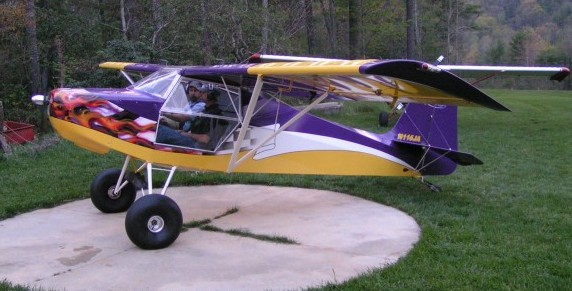
The Escapade has been developed to meet the demand for a two place side-by-side dual control (individual stick controls) aircraft that can be used for training as well as recreation.
The Fuselage, tail and landing gear are manufactured from 4130 Chrome-moly steel.
The original Escapade earned the United Kingdom’s BCAR (British Civil Aviation Requirement) Section S structural – and flight – test standards.

The wings fold in under 2 minutes with no disconnecting of any controls or control surfaces. The Escapade can be configured with tail-wheel or tri-cycle landing gear with the ability to swap from one to the other in about 1 hour.

The Escapade has been through UK Section S static testing certification requirements and flight-testing certification requirements. The Escapade can be installed with any power plants in the weight range of the Jabiru 2200 or Rotax 912/914. Jabiru Pacific can provide from the firewall forward.

The Escapade and Highlander share considerable structural elements including the chrome-moly fuselage frame, wing airfoil construction, and engine compartment.
Using the same basic fuselage for both planes means they both have a huge luggage capacity that extends to the tail. The planes can handle a 6’7”+ frame and 300lb+ people. With sliding seats and 44” of elbow room.
Both planes can be flown with the doors off or the doors and windows open, although a heater can be installed for frigid conditions.
The planes are available as complete ready to assemble kits which take about 600 – 700 hours to complete. Or you may choose various stages of assembly based upon your time demands and pocket book. Some choose to have the factory finish the wings and cover the fuselage which cuts the build time in half. There is also the option of “Build Assist” where for a monthly fee the owner may assemble the plane in the factory with company experts on hand for assistance. Those desiring a complete build ready to fly option will find this also available.
This would be SLSA certified if desired.
Escapade LSA 2010 Kit Price: US$20,250
The Escapade and Highlander can be installed with any power plants in the weight range of the Rotax 503 up to the Rotax 914 or Jabiru 2200 up to the Jabiru 3300.

Variation:
Lanitz Escapade Two

Engine: Rotax 912, 80 hp
Height: 7’2”
Length: 19′
Cabin Width: 44 in
Wing Span: 28′ 6″
Wing Area: 108 sq.ft
Empty Weight: 615 lbs
Gross Weight: 1320
Useable Load: 705
Flight Load Factor: +4 -2 G
Vne (never exceed speed): 130 mph
Cruise speed @ 75% power: 110 mph
Vso (full flap) at Gross Weight: 27 mph
Vs (clean) at Gross Weight: 32 mph
Climb Rate (sea level @ gross): 880 ft/min
Take off Distance Ground Roll: 300 ft
Landing Distance Ground Roll: 300 ft
Fuel Capacity: 18 USgal

Escapade LSA
Engine: Jabiru 2200 85 hp
Wingspan: 28′ 6″
Empty weight: 620 lb
MTOW: 1320 lb
Useful load: 700 lb
Cruise 75%: 110 mph
2010 Kit Price: US$20,250

Engine: Rotax 912S, 100 hp
Wing Span: 28’6”
Wingarea: 108 sq.ft.
Mean Cord: 45”
Length: 19’
Height: 7’2”
Length Folded: 19’2”
Width Folded: 7’ 11.5”
Number of Seats: 2
Number of Doors: 2
Landing Gear: Tricycle or Tail Wheel
Gear Width: 72”
Fuel Capacity: 18 or 26 USGallons (24 useable)
VNE: 130 mph
Cruise: 110 mph
Stall With Flaps 40 deg: 27 mph
Stall Clean: 32 mph
Take off Roll: 300 ft
Take off Distance to 50 ft: 800 ft
Ground Roll: 300 ft
Landing Distance from 50 ft: 1000 ft
Climb Rate: 880 fpm
Gross weight: 1320 lbs
Empty weight: 615 lbs
Useful Load: 705 lbs
Load Limit Factors: +4 g’s –2 g’s

Just Aircraft

Caldwell, Idaho, USA.
Just Aircraft was founded in 2002 when aircraft designer Troy Woodland left his position at Flying K Enterprises, manufacturer of the Sky Raider kit. Troy wanted to design a plane of his own. He met Gary Schmitt at an air show and Gary wanted a plane with many of the features of the new Escapade.With Gary’s backing they collaberated on a design.
The Escapade has a huge luggage compartment, a more roomy cabin , and a simplified wing-folding mechanism that avoids the need to remove control linkages.

Soon after the Escapade came the Highlander, a more rugged plane that was the bush airplane they wanted. The Highlander Debuted at Arlington in 2004, and by 2010 dominated Just’s sales by three-to-one aircraft sold .

In 2004 the company relocated to Walhalla, South Carolina, into a state of the art production facility with its own runway. This was a time of serious growth for Just Aircraft, when materials buying and costs analysis became implemented, when marketing, accounting, and all other true “front office” needs of the growing company were founded.

Over 170 kits had been shipped worldwide: including England, France, Spain, New Zealand, Canada and Equador. Sales are running about 50/50 domestic and export.

In addition to selling kits, Just Aircraft offers customers a build assist program, where they can construct their plane in the factory, or the Company will build 100% of the plane in accordance to the customers specifications.

JPM 01 Médoc / Tanagra

The JPM 01 Médoc is a French amateur-built aircraft that was designed by Jean-Pierre Marie in 1977 and produced by Les Avions Jean-Pierre Marie (JPM) of Le Mesnil-Esnard. The aircraft is supplied as plans for amateur construction, available in 2012 from Les Avions Jean-Pierre Marie (JPM).

The aircraft is named for the French community of Médoc.

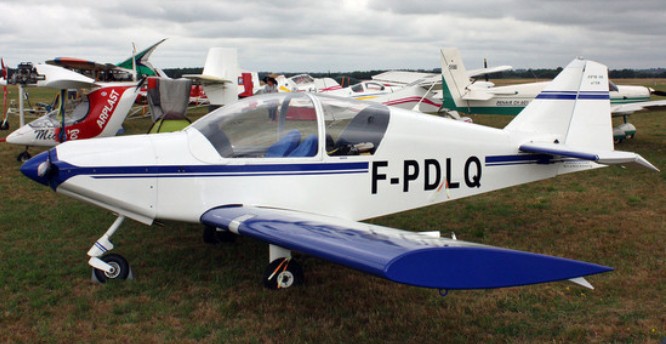
The Médoc features a cantilever low-wing a two-seats-in-side-by-side configuration enclosed cockpit under a bubble canopy, fixed tricycle landing gear and a single engine in tractor configuration.

The aircraft is made from wood with its flying surfaces covered in doped aircraft fabric. Its 7.50 m (24.6 ft) span wing has an area of 9.30 sq.m (100.1 sq ft) and mounts flaps. Standard engines recommended are 60 kW (80 hp)-class Volkswagen air-cooled engines, including the 60 kW (80 hp) Limbach L2000 four-stroke powerplant.

The first example was completed by Pierre-Claude Guillem, and registered F-PGMB. It first flew on September 8, 1987. Originally fitted with a 65 hp JPX 4T-60A engine, it later received an 80 hp Limbach L2000 and the aircraft was winner of the 1988 SFACT Trophy for best multi place design. The JPM-01 built by the designer himself was first flown in August 1993, registered as F-PJPM.

A diesel engine powered version was designated JPM-01 Médoc Provence and the first example was completed by Didier Davenna in 2005. He had it registered as F-PDVN under the designation JPM-01 DDI. By mid-2012 at least fourteen Médocs has been built.

Almost forty years after its introduction the aircraft was redesigned and lightened, gaining slotted flaps to reduce stall speed.

JPM 01 Médoc / JPM-01 Tanagra
Engine: 1 × Limbach L2000, 60 kW (80 hp)
Length: 6 m (19 ft 8 in)
Wingspan: 7.50 m (24 ft 7 in)
Wing area: 9.30 sq.m (100.1 sq ft)
Empty weight: 286 kg (631 lb)
Gross weight: 496 kg (1,093 lb)
Fuel capacity: 60 litres (13 imp gal; 16 US gal)
Maximum speed: 210 km/h (130 mph; 113 kn)
Cruising speed: 175 km/h (109 mph; 94 kn)
Stall speed: 70 km/h (43 mph; 38 kn)
Never exceed speed: 247 km/h (153 mph; 133 kn)
Range: 700 km (435 mi; 378 nmi) with no reserve
Endurance: 4 hours plus 0.5 hour reserve
Service ceiling: 4,100 m (13,451 ft)
g limits: +3.5/–1.5
Rate of climb: 4 m/s (790 ft/min)
Wing loading: 53.3 kg/m2 (10.9 lb/sq ft)
Crew: one
Capacity: one passenger

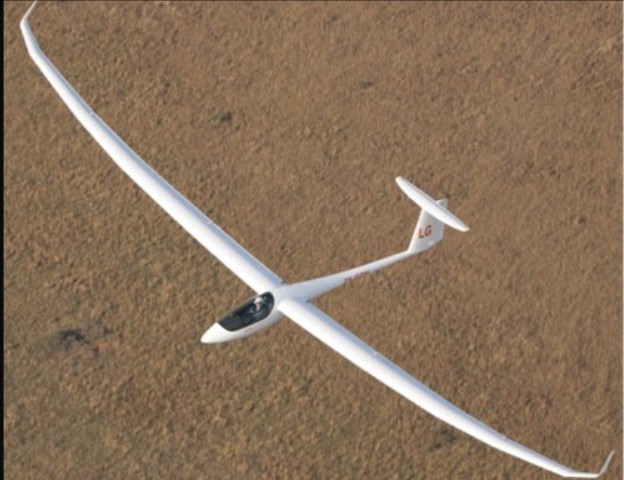
Jonker JS1 Revelation

The JS1 Revelation is a high-performance FAI 18-metre Class sailplane, fully-equipped in its baseline standard. An optional jet sustainer system is available. With the introduction of the JS1C variant, there was also the additional option of 21-metre wingtips for an ‘agile’ Open Class sailplane.

The design process of the JS1 Revelation started with development of the main wing aerofoil. After wind tunnel tests together with new technology and research on techniques that might help climbing performance, then after making hundreds of iterations, they ended up with the T12 aerofoil.

To optimize climbing in turbulent thermals the T12 does not have the typical flat top Cl-Alpha curve at high lift coefficients.

T12 characteristics:
Maximum thickness/chord ratio 12.7%
14% camber changing flap
Low drag with extensive regions of laminar flow
Laminar to turbulent transition on the lower surface occurs at 93% where artificial transition is applied for negative flap settings
Transition on the upper surface occurs at approximately 65% for a 0° flap setting and 2° angle of attack
The top surface is smooth at 13.5° with almost 70% laminar flow

Although aerodynamically optimised, there are structural challenges using such a thin aerofoil. At the time the T12 aerofoil was the thinnest main aerofoil used on modern sailplanes.

The aerodynamic design of the wing root reduces separation problems at the trailing edge and optimised overall drag. Six different aerofoils are used in the wing for maximizing the performance of the glider. All are derived from the main T12 aerofoil, optimised at each spanwise station for the specific chord length and Reynolds number. The wingtip aerofoil is designed with an ample lift reserve to help handling characteristics and avoid any tendency for wing drop.

The optimum wing planform has an elliptical lift distribution for minimum induced drag at low speeds, and a small wing area for reduced profile drag at high speed. The wings of the JS1 Revelation have six tapered polyhedral sections along the wing span, with aerofoils based on the T12 aerofoil optimised at each spanwise position for the specific chord length and Reynolds number. The polyhedral also contributes to the handling qualities.

The winglets for the JS1 Revelation were specifically tailored for the wing shape and tip airfoil. For all operational angles of attack, the load on the tip region was kept within limits of the maximum airfoil lift coefficient, for safe handling characteristics. Due to the polyhedral wing configuration of the JS1 Revelation, the last wing panel is already at an angle of 24 degrees which increase the angle between the winglet and wing. This reduces the detrimental 3D flow effects at the junction corner due to super positioning of adverse pressure gradients which causes separation.

Conventional structures (such as the controls and landing gear) were designed using traditional calculation methods, with hand calculations for simple geometries and laminate analysis for simple composite structures. The more complex structures were designed using FEM analysis techniques.

A combination of glass-fibre, aramid (Kevlar) and carbon-fibre is used in the load bearing structure of the JS1 Revelation. The very thin wing section (12.7%) posed a challenge for the designers, especially in the wing root area where the maximum thickness is only 100mm.

All structural design was according to the certification standards set in CS-22 and with a general safety factor of 1.725.

Standard features include a multi wingspan, including 18m wingtips with provision for 21m wingtips, a nose release hook and provision for a belly hook enclosed by main wheel doors, a fixed pneumatic tail wheel (brass or Vesconite), a multi-probe (pilot, static pressure and Total Energy), and two recessed battery boxes in baggage compartment and battery compartment in vertical stabiliser

The cockpit has a gooseneck dynamic microphone attached to canopy frame, tick mounted PTT switch and twin speakers for radio and navigation computer, a radio antenna in vertical stabiliser and provision for Dolba transponder antenna installation inside vertical stabiliser.

Boundary layer control is with blowholes and soft tripping turbulators. Integrated main water ballast tanks (approximately 2 x 90 litres) are in the main wings with automatic coupling and maintenance-free valves. An integrated non-dumpable C.G. water tank is in the vertical stabiliser (for optimum C.G. when compensating for pilot and equipment)

Triple-panel upper-surface airbrakes are fitted and the retractable undercarriage has elastomeric shock absorbers. Hydraulic disc brake are activated by full aft travel of airbrake handle.

Jonker Sailplanes selected the M&D Flugzeugbau TJ42 jet turbine engine as an option.

Finite Element Modeling (FEM) allows for the whole structure to be represented as a wire frame of cells or elements called “the mesh”. Loads can then be applied to the mesh and the stresses calculated at each point. The result is a colorful representation of the stress condition throughout the structure. This shows exactly where the structure needs strengthening and where weight can be saved. The figure below shows the stress condition in the front and aft fuselage due to a load on the tail, and a high-g pullout maneuver.

In March 2010 the JS1 Revelation gained its official certification by the South African Civil Aviation Authorities (SACAA). With SACAA Type Certification to CS-22 and with an SACAA ICAO- compliant Certificate of Airworthiness the JS1 Revelation should be able to be flown without restriction in any ICAO-signatory country.

However JS recognises that EASA (and its predecessor, JAA, and the German LBA) are widely acknowledged as the experts in glider certification and that it is important to gain EASA Type Certification (TC) or Type Validation (TV) of the JS1 Revelation, both for market confidence and to enable local registration of the JS1 in Europe. Local registration would allow local maintenance procedures to be applied.

JS and SACAA have been in discussion on how to best proceed with EASA TC/TV. A full EASA TC exercise would require repeating all ground and flight tests with EASA witnesses and re-submitting every report and analysis for EASA scrutiny. This would be unnecessarily time-consuming, expensive and inefficient as it would completely ignore everything done for the SACAA Type Certification. This would be inconsistent with the advice provided by EASA to SACAA and JS, namely to gain local South African Type Certification before presenting this to EASA.

An EASA Type Validation exercise allows EASA to take advantage of the tests, reports and analyses already accepted by SACAA – while at the same time reserving the right to require extra information for any areas of special interest or concern. However in order to use a Validation process (rather than a full Certification process) it is necessary to establish a Working Arrangement between SACAA and EASA – simply a legal framework to allow EASA to accept SACAA findings on the basis that SACAA have followed a robust and rigorous process.

For the SACAA, establishing a Working Arrangement with EASA is part of a longer term strategy to advance the worldwide credentials of SACAA as a competent professional airworthiness authority. In December the Director of Civil Aviation, SACAA formally requested discussions with EASA with the aim of setting up a Working Arrangement for EASA Type Validation of the JS1 Revelation.

This was a major step forward for Jonker Sailplanes; to have the direct involvement and support of the SACAA at the highest level for EASA Type Validation.

ICAO Type Certificate Details
Manufacturer: Jonker Sailplanes cc
Type Certificate: J15/12/550
Issued by: South African Civil Aviation Authority
Model: JS1-A “Revelation” JS1-B “Revelation”
JS1-C 18 “Revelation” JS1-C 21 “Revelation”
MCTOW 600 kg (with water ballast) – JS1-A, JS1-B, JS1-C 18
437 kg (without)
720 kg (with water ballast) – JS1-C 21
520 kg (without)
Max. No. of Seats: 1

Type Acceptance Certificate No. 11/21B/25 from the NZ CAA was granted on 21 November 2011 to the Jonker JS1-A and JS1-B based on validation of SACAA Type Certificate J15/12/550.

The Jonker JS1-A and JS1-B are single-seat 18m class sailplanes with winglets, water ballast provisions, full-span flaperons, upper-surface airbrakes, constructed from composite materials. The configuration includes a shoulder wing, T-type empennage and retractable main landing gear. The JS1-B is identical to the JS1-A except for a smaller tailplane and tail surfaces and is the main production model after s/n 004.

The Jonker JS1-A and JS1-B sailplanes are the first indigenous aircraft Type Certificated
by the South African Civil Aviation Authority.

The JS1-C models are identical to the JS1-B except the outer wing is removable, with two different span wing tips available, 18m and 21m. The JS1-C has been the standard production model since s/n

  1. The JS1-C 21 has wing-tip water tanks and an increased maximum weight, but is not eligible for cloud flying or basic aerobatics.

ICAO Type certificate:
SACAA Type Certificate J15/12/550 issued 12 March 2010
SACAA Type Certificate Data Sheet J15/12/550 Issue 4.0 dated 24 May 2013
JS1-A, JS1-B models approved 12 March 2010
JS1-C 18, JS1-C 21 models approved 23 May 2013

Airworthiness Limitations:
The airframe has a specified service life of 12,000 hours, and requires special inspections at set
intervals to reach it.

JS-21 18m
Wingspan: 18m / 59.06 ft
Wing area: 11.20 sq.m / 120.56 sq.ft
Aspect ratio: 28.8
Fuselage length: 7.165m / 23.51 ft
Fuselage height: 1.32m / 4.33 ft
Max weight: 600 kg / 1323 lb
Wing loading (w/70kg pilot): 35.3 kg/sq.m / 7.23 lb/sq.ft
Max wing loading: 53.6 kg/sq.m / 10.98 lb/sq.ft
Best glide ratio: 1-53
Best glide speed at MAUW: 120 kph / 65 kt
Best glide speed at 450 kg: 100 kph / 54 kt
Min sink rate: 0.50 m/s / 100 ft/min
Vne: 290 kph / 157 kt
Rough air speed: 203 kph / 110 kt
Flight loads at Vra: +5.3 / -2.65 G

JS-21 21m
Wingspan: 21.00 m / 68.90 ft
Wing area: 12.27 sq.m / 132.07 sq.ft
Aspect ratio: 35.9
Fuselage length: 7.165m / 23.51 ft
Fuselage height: 1.32m / 4.33 ft
Max weight: 720 kg / 1587 lb
Wing loading (w/70kg pilot): 33.8 kg/sq.m / 6.92 lb/sq.ft
Max wing loading: 58.7 kg/sq.m / 12.02 lb/sq.ft
Best glide ratio: 1-60
Best glide speed at MAUW: 120 kph / 65 kt
Best glide speed at 450 kg: 100 kph / 54 kt
Min sink rate: 0.48 m/s / 95 ft/min
Vne: 270 kph / 146 kt
Rough air speed: 203 kph / 110 kt
Flight loads at Vra: +5.3 / -2.65 G
Jones PJ-1

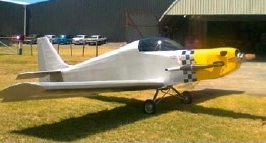
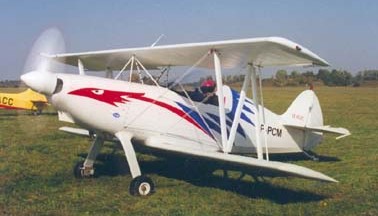
The Jones PJ-1 was started around 2005-6 by Bill Cockram, the plans being loosely based on a two seat Monsoon aircraft with an O-200 engine. As he wanted to use a Rotax engine he set about narrowing the fuselage and designing and building his own wings. Cockram became ill and decided he couldn’t finish the aircraft so he gave what he had built so far to Peter Jones and sold him the Rotax 503.

The aircraft is now a single seat that fits into the ultralight class. It is of all wood construction, fabric covered and uses a LongEze canopy. When weighed, the C of G was too far aft so he extended the front, moving the seat forward.

Jones Sopwith Pup

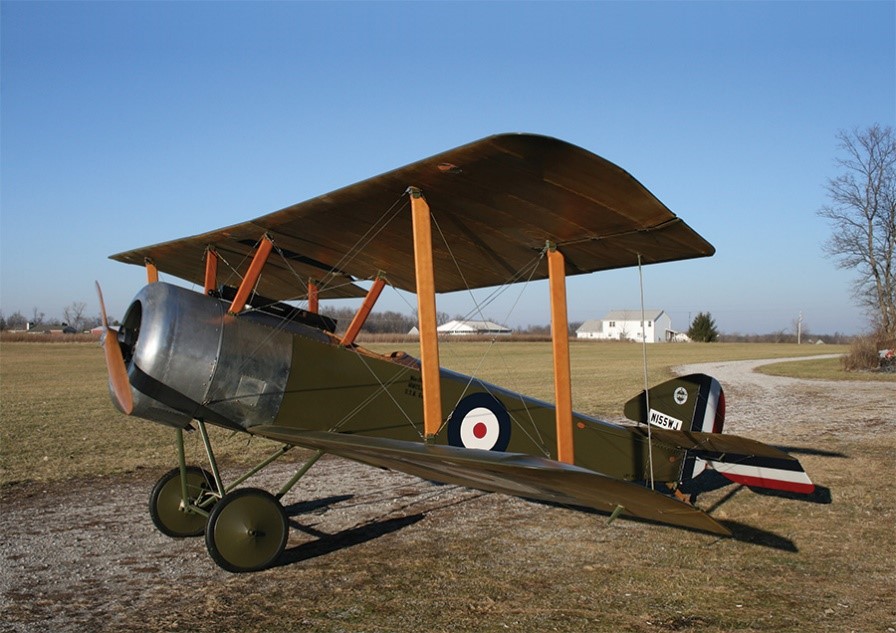
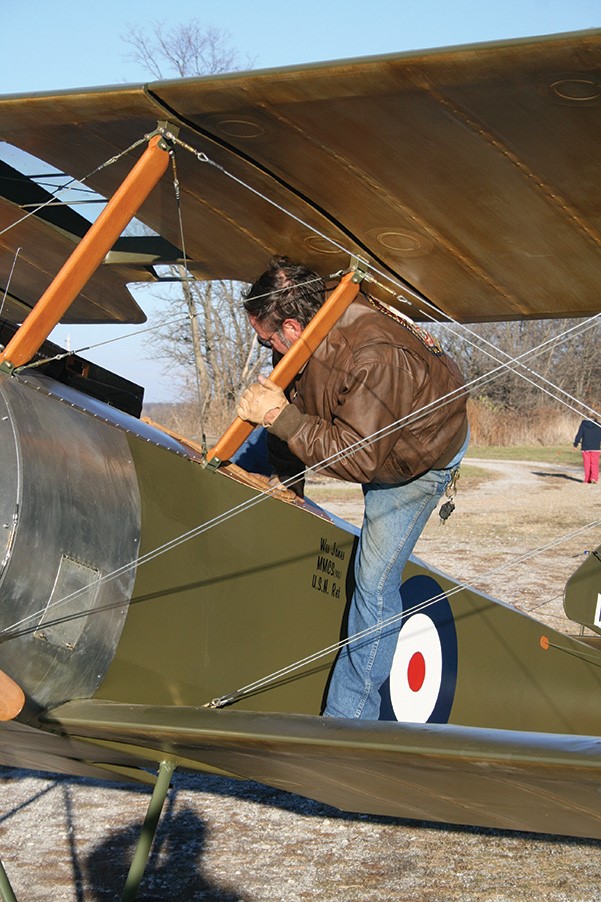
Wes Jones discussed the feasibility of building a full-scale Sopwith Pup with Robert Baslee in 2005. They drew the major components on a dinner napkin later acquiring a set of drawings from Replicraft.

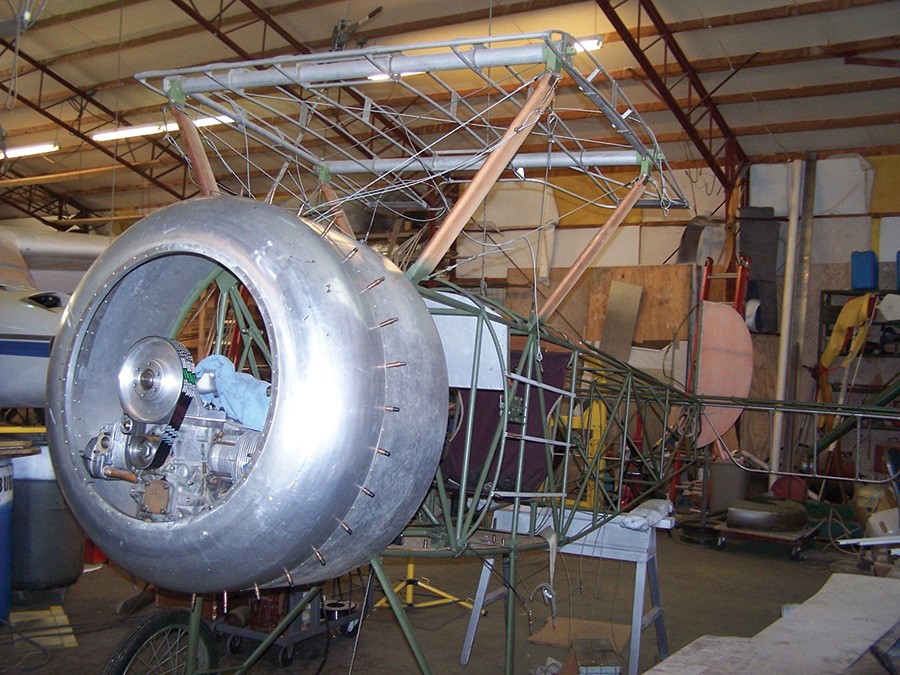
Earnest construction began in December, 2005. The plan was to build a Pup that for all outward appearances would look like an original Pup. There were some mandatory considerations, bank account, settling on a VW engine, instead of a preferred Rotec Radial. The Replicraft plans were used for placement of all uprights and longerons, so the dimensions would match the originals, but the materials are more modern and fit the bank account better.

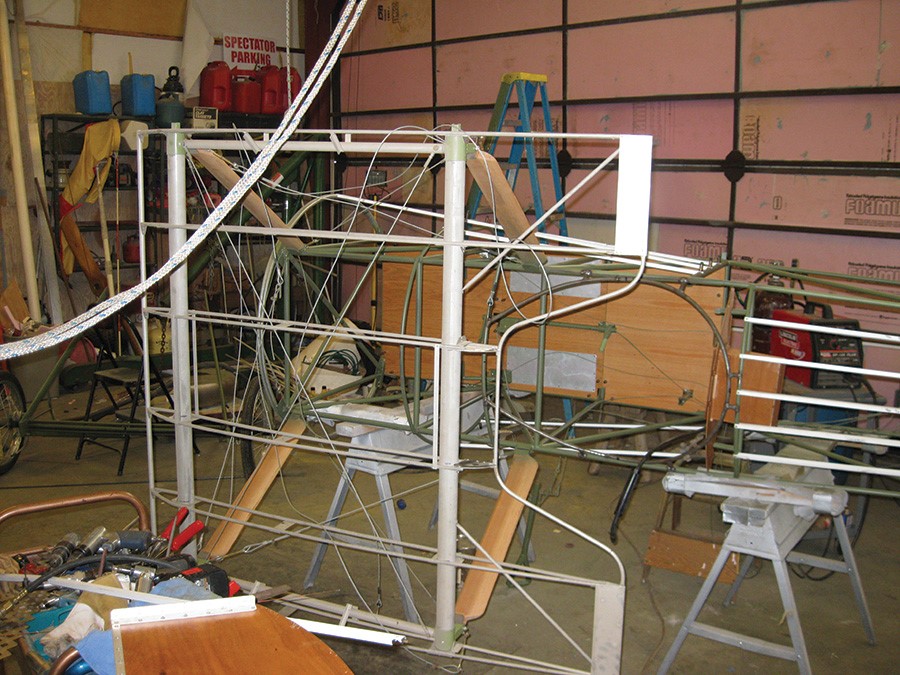
Three-quarter-inch chrome-moly is used for the forward section of the fuse and transitioned to five-eighth-inch aft of the cockpit for the longerons. TIG welding the basic fuse took about a month.

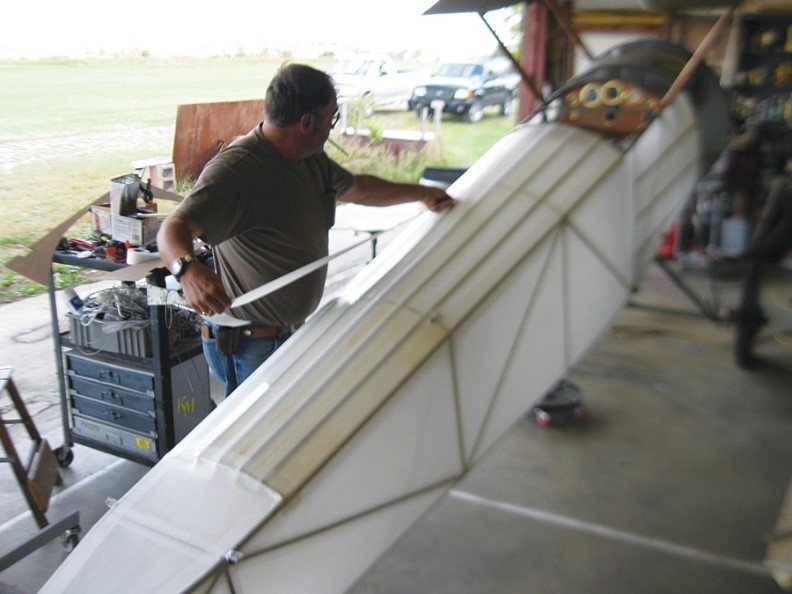
The fuselage and upper wing center section were built of tubular steel and aluminum, respectively.

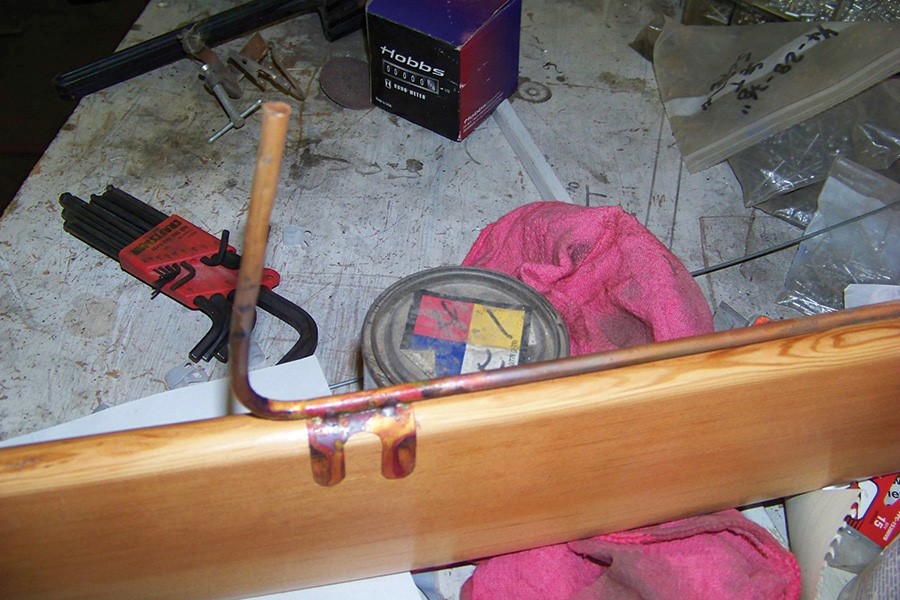
The wing struts and cabanes were fashioned to the original dimensions out of straight-grain Douglas fir to fit welded fittings like Dennis Wiley’s Early Bird Jenny. The landing gear legs were fashioned from streamline tubing to exact specifications from the original 1916 prints.

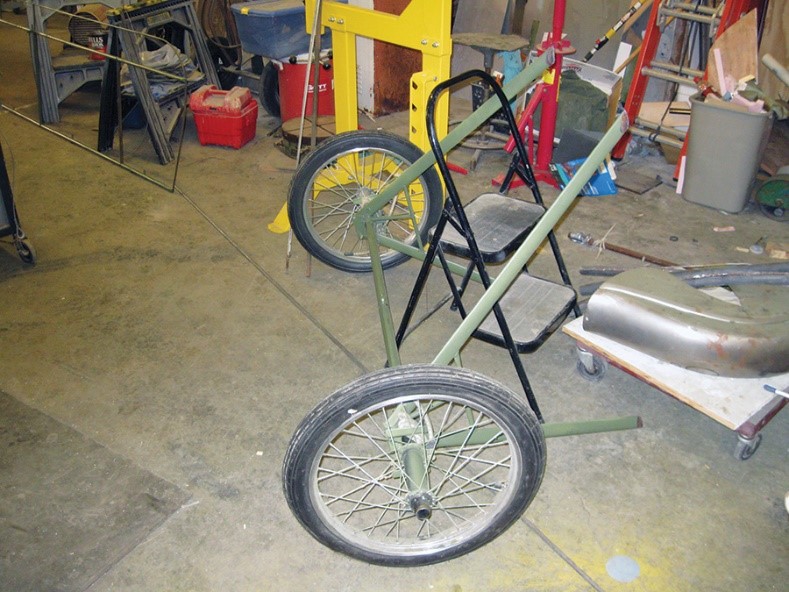
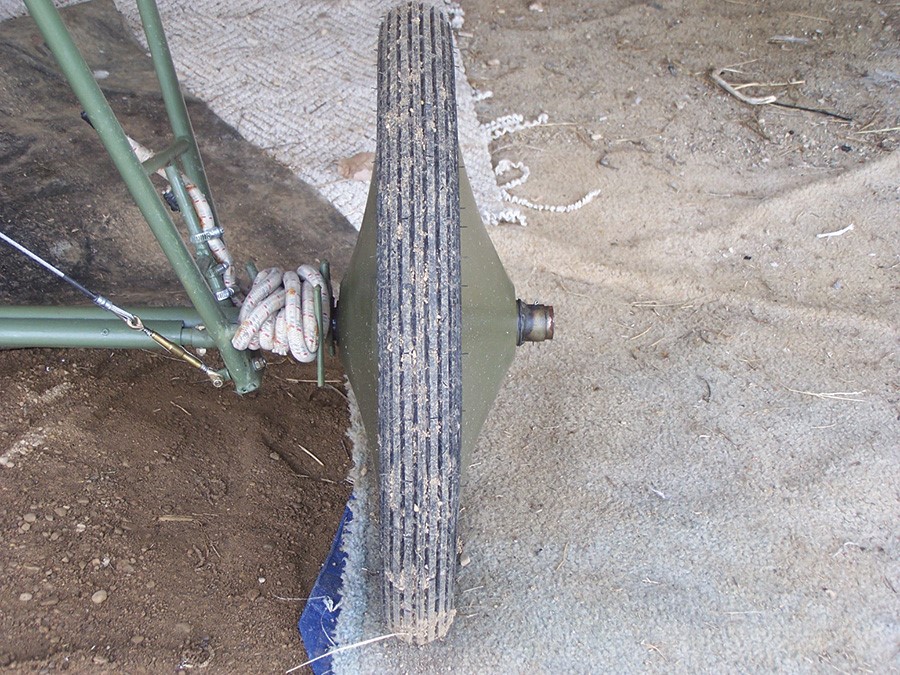
A set of horse racing cart wheels were used for rims and inner spoke attachments, and made a set of hubs on the lathe. The hubs gave 8 inches between the spokes at the axle.

By using longer spokes on the outside and shorter spokes on the inside, it got the dished look of the original wheels.

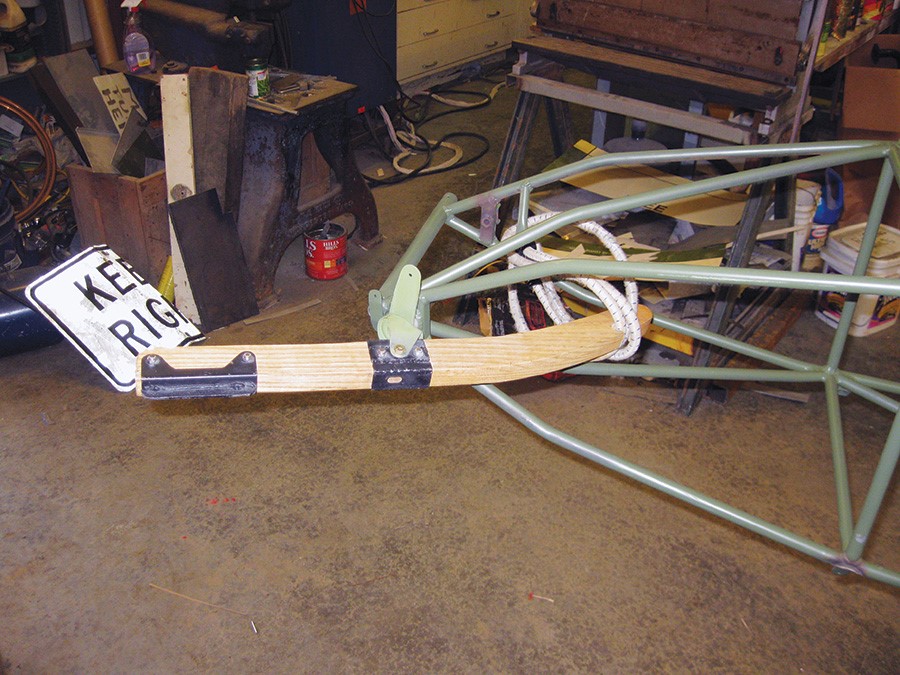
The steerable tailskid was built exactly following the plans of the original, since it was going to be out there for everyone to see. Another reason for sticking with the original skid is that, just like the original, the mains do not have brakes. This helps keep the Pup going straight down a grass field.

The original tailskid worked well until it broke on landing. It was replaced with a piece of wood with conveniently-curved grain.

Wingspars were fashioned from 2-inch .065-wall 6061 tubing. Three-eighth-inch aluminum tubing is used to fashion the ribs la a Graham Lee design. The leading edge uses aluminum sheet metal instead of using nose ribs. Wing-root fittings were copies of the Early Bird Jenny’s root fittings, scaled up for the extra weight. Some expert assistance on rib stitching came from Dallas Shaw, Randy O’Conner and Brad Strohm.

The covering was lightweight Dacron using rhe Stits process from Aircraft Technical Support, since Jim Miller was good friend and neighbour. Since the WW-I originals were just doped on the undersides of the wings and fuse, it was decided to finish those areas using clear Poly-Brush fabric sealer, then adding some tint to the last coat to get an approximate look of old varnish brushed over doped fabric. The markings were done by hand with a brush to approximate what was done in the field back then.

A 2180cc VW engine was built from scratch, using parts obtained from several VW suppliers. It used 94mm cylinders, an 82mm stroker crank, and was set up the compression for 6.67:1 for reliability. Valley Engineering supplied the 2.5:1 propeller speed reduction unit (PSRU), as well as the 96×65-inch prop. Due to some leaning problems with the progressive Weber carb, a single-barrel 34 ICT carb fit the bill better.

A good friend and Dawn Patrol cohort, Rick Bennett, was able to find a correct-size cowling and arrange to have one delivered.

There was some help with the full-scale Vickers machine gun replica on the cowl from Willie Hill, a local expert on getting them to look realistic.

The OK to test-fly it from the local FAA representative, John Walsh, came in October of 2011 and there was only time for six or seven test flights before winter hit hard, so the rest of the time had to be flown off in the spring.

In the air the Pup flies is very stable in normal flight. The four ailerons give a solid feel in roll. Initial timing of the climb rate showed approximately 1200 feet per minute. The climb angle is like a space shuttle launch, although never actually measured.

On takeoff, the tail comes up almost immediately (50 feet) and it gets off the ground in about 150 feet. Stall is around 30 mph and cruise is around 60. The plan to obtain another prop with a 73-inch pitch as soon as funds allow, in order to (hopefully) get the cruise up to around 75-80 mph.

About July, on a normally un-eventful landing, the tailskid wood split at about the halfway mark, leaving no steering and sending the plane into another groundloop. This time, the left upper wing got a slight ding in it due to the hair-raising trip into the woods that immediately followed. Fortunately, two days worth of metal, fabric and painting work sufficed to repair the damage.

A piece of ash with the grain conveniently running along the curve of the new skid replaced it; there have been no problems since.

There has been difficulty keeping the cylinder heads at an acceptable temperature (350 F). Normally it gets about 15 minutes of flight time and temps start to creep up to around 375. Changes with the cooling fins—making extensions to direct the air more smoothly over the heads —and a larger oil cooler with a thermostatically controlled fan may get the temps better.

That old British 10/10 airfoil makes the Pup handle amazingly well.