Kestrel K-350 / JP10 / JP100 / Farnborough Aircraft F1

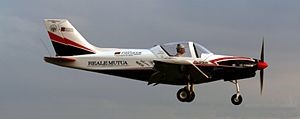
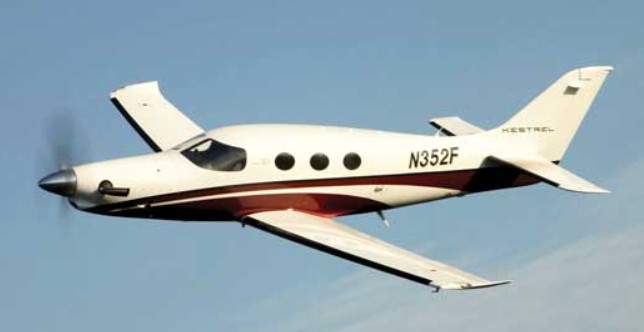
The Kestrel JP10, Kestral K-350, or Kestral is a high-performance single turboprop-engined all-composite six-seat aircraft. Its layout is low-wing with tailplanes mid-set on a single fin. The tricycle undercarriage is fully retractable. Its construction uses composites incorporating carbon fibre. The wing is also of carbon-fibre construction and features a high lift laminar flow design worked out mostly by aerodynamicist Dr. Gordon Robinson.

The cabin features a pressurized area.

Farnborough Aircraft formed a business alliance with Epic Aircraft to develop both companies aircraft and as a result the JP10 appears similar to the Epic LT. The wing is reportedly the same, while the Kestrel’s fuselage is 20 inches longer than the Epic’s.

The company formed in 2002 to build the aircraft was started by Richard Noble who was responsible for the team that first broke the sound barrier on land. Noble envisioned the aircraft’s primary role as being part of the fleet of “air taxis” flying over Europe that provide an alternative to both commercial airlines and chartered corporate jets. Noble named his Farnborough, England based company “Farnborough Aircraft” and the design for the then designated “F1” was detailed.

The name of the company has since been changed to Kestrel Aircraft Company and the aircraft’s designation was changed from “F1” to “JP100” and is now the “JP10”.

A business partnership formed to complete the Kestrel’s development named the Gulf Aircraft Partnership and located in the UAE did not proceed. Alan Klapmeier, co-founder of Cirrus Aircraft Corporation, has joined with Anthony Galley and others in the renamed Kestrel Aircraft Company. A business relationship has been formed with Liberty Aerospace of Melbourne, Florida, United States to provide assistance with Toray carbon fiber components.

Kestrel Aircraft’s Adrian Norris reported that the company was ready to freeze the design and build conformal prototypes in efforts to seek part-23 certification. On 23 July 2010 Kestrel Aircraft announced that they would be relocating to large, relatively newly built hangars at the soon to be closed Brunswick Naval Air Station in Brunswick, Maine. The company was to receive some local financial assistance in exchange for an anticipated eventual creation of some 300 jobs.

The prototype first flew on 29 July 2006. The engine that has been powering the prototype is a Pratt & Whitney PT6-67A turboprop flat rated to 1,000 hp (746 kW). As of April 2010, the prototype, registered N352F, had logged about 260 hours.
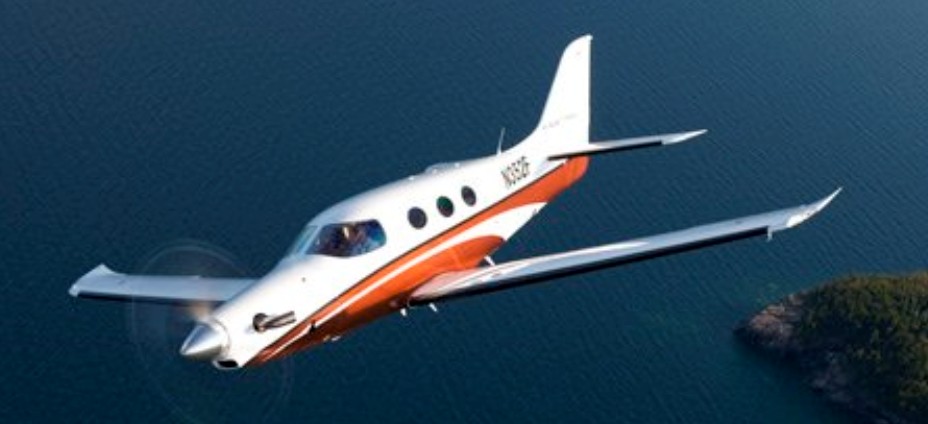
In 2011 the company selected the Honeywell TPE331-14GR engine as first choice for the aircraft, also flat rated to 1,000 hp (746 kW).

On January 17, 2012, it was announced that the aircraft will be produced in Wisconsin due to tax incentives totalling US$50 million.

In July 2013 Kestrel CEO Alan Klapmeier stated that funding delays had slowed progress on the aircraft and that a conforming prototype was now expected to be ready in the summer of 2014, with the first customer delivery forecast for the end of 2015 or early 2016. Certification costs were estimated at US$175M, with US$50M already spent.

By September 2013 employees were reporting that the company was short of money and that salaries and insurance payments were missing or late, and that vendors had not been paid. The company indicated that development had been delayed due to lack of investment and that the first flight of a production aircraft would not occur in 2014.

In early 2014 it was reported that Kestrel Aircraft had fallen months behind on loan payments to the Wisconsin Economic Development Corporation due to financing delays. It was also reported that the delay in financing had impacted hiring, causing the company to reduce its staff in Superior. The WEDC and Kestrel have agreed upon new terms that will defer the payments until November 2014.

Kestrel JP10
Engine: Pratt & Whitney PT6-67A turboprop, 1,000 hp (746 kW)
Wingspan: 44 ft 11 in (13.7 m)
Length: 38 ft 5 in (11.7 m)
Height: 13 ft 0 in (3.96 m)
Empty weight: 5,200 lb (2,359 kg)
Max takeoff weight: 8,500 lb (3,856 kg)
Fuel capacity: 319 US gal (1,208 l)
Maximum cabin altitude: 8,000 feet (2,400 m) at FL 310
Pressurization: 7.5 psi (52 kPa)
Cruise speed: 320 kn (368 mph; 593 km/h)
Stall speed: 53 kn (61 mph; 98 km/h)
Range: 1,300 nmi (1,496 mi; 2,408 km)
Service ceiling: 31,000 ft (9,400 m)
Rate of climb: 2,250 ft/min (11.4 m/s)
Capacity: six standard/seven-eight optional
Crew: 1 or 2
Kenny Jodel D 150X Governor

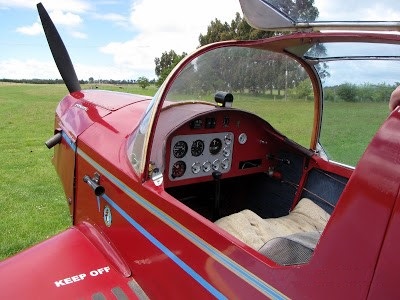
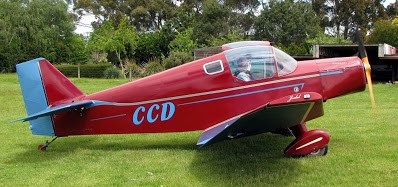
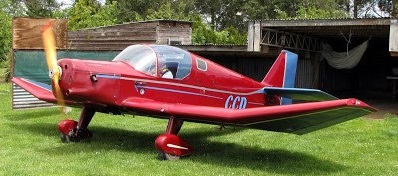
Charlie Kenny of Clydevale near Balclutha, New Zealand, a Jodel enthusiast built a Jodel D 9 ZK-AKR but believed he could build a better Jodel so he designed and built his D 150X Governor ZK-CCD (c/n AACA 360/2).

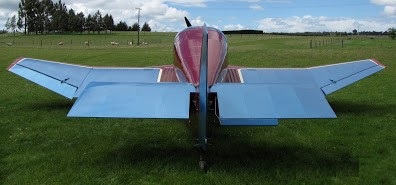
He incorporated what he reckoned were the best bits of all the many Jodel models. Charlie’s D 150X has the rudder from the D 150, the all-flying tailplane from the D 18 (but bigger), the luggage locker from a D 140 and the wing airfoil is that of a D 18 but again applied to a bigger wing. The wing has split flaps that drop down from the trailing edge.

Charlie has also made the fuselage wider than the D 150 at 44 inches while he has moved the seat back 3 inches and sloped the seat to 30 degrees which gives a very roomy cockpit. The windscreen is from a Fletcher FU 24 and it has gull wing doors.

The Jodel is powered by a 1.9 litre Peugeot turbo diesel engine (from a Peugeot 405) that produces around 100 HP. It has a belt reduction drive designed by Wayne Affleck of Invercargill that gives 2400 rpm at the propellor for 3300 rpm engine revs. The engine is water cooled and the radiator in located in the starboard wing root with the battery located in the port wing root. Charlie developed the engine himself but later found out that Jean Delemontez (the del in Jodel) and Jacques Vion had developed their Delvion diesel engine along very similar lines. The diesel engine is very economical using only around 10 litres per hour at cruise.

The dimensions of Charlie’s D 150X Governor are similar to the D 150 Mascaret which has a length of 6.30 metres (20 feet 8 inches), a wingspan of 8.15 metres (26 feet 9 inches) and a wing area of 141 square feet.

It was first registered on 7 November 2011. The first flight was on 2 July 2015. Charlie says his aircraft flies really well and he had flown about 65 hours in, although it hasn’t flown in the last year or so.

Charlie Kenny has designed and built his D 150X entirely by himself in his shed, as well as sorting the entirely clean sheet engine conversion and all its systems.

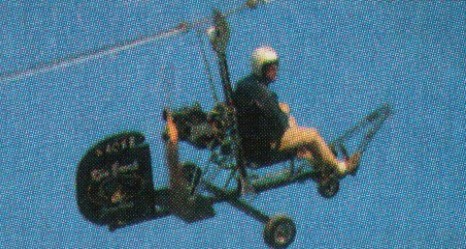
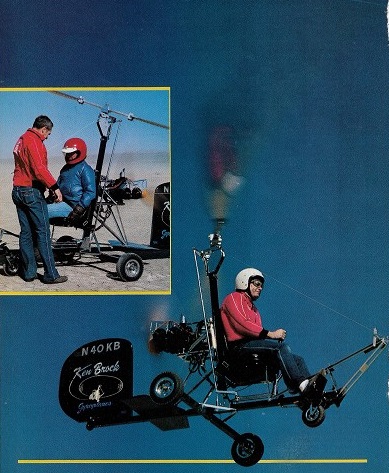
Ken Brock KB-3

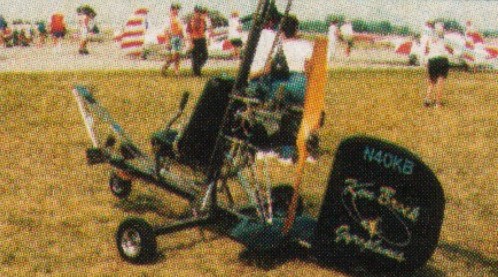
First flown in 1983, the KB-3 conforms to Pt 103 as a homebuilt.
The KB-3 was sold in sub-kits. Price may vary with options, but the average is $12,500 in 2001.

Plans
2001 Plans for the Rotax 582-powered KB-3: $125

Gallery

Engine: 64 hp Rotax 582cc.
Prop: Ground adjustable 60”.
Empty wt. lbs: 250
Max wt. lbs: 600
Rotor blades: 22’ x 7” Brock riveted aluminium, adjustable hub.
Disk area: 380 sq.ft.
Min speed: 18-20 mph.
Cruise: 60 mph.
Top speed: 63 mph.
Range: 100 sm.
Fuel cap: 5 USG.
ROC: 700 fpm.
Service ceiling: 12,000 ft.
Empty wt: 250 lbs.
Useful load: 350 lbs.
Gross wt: 600 lbs.
Width: 5’.
Height: 7’7”.
Length: 11’3”.
Seats: 1.

Engine: Rotax 532
Max speed mph: 63
Cruise mph: 45 Seats: 1

Engine: Rotax 582, 64 hp
Rotor span: 6.70 m
MAUW: 271 kg
Empty weight: 113 kg
Fuel capacity: 34 lt
Max speed: 150 kph
Cruise speed: 115 kph
Minimum speed: 35 kph
Climb rate: 6 m/s
Seats: 1
Fuel consumption: 18 lt/hr
Plan price (1998): $125
Kit price (1998): $11,000

Ken Brock KB-2 Gyroplane

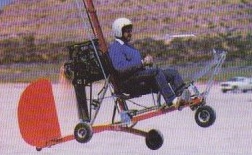
First flown in 1980, the KB-2 Gyroplane has quite a few features that distinguish it from other similar aircraft. These include: an aircraft-type joystick for con¬trol; its fuel tank seat which is molded from polyurethane to save on weight and add to the clean-looking design; its choice of rotor blades and its wheels. Construction has been simplified by packaging into seven separate kits (airframe, landing gear, rotor head, rotor blades, rotor hub, joystick, rudder/horizontal stabilizer and an optional kit for a prefab metal tail). Engine: 72 or 90 hp McCulloch, VW, or similar.

The KB-2 was sold in sub-kits. Price may vary with options, but the average is $12,500 in 2001.

Plans
2001 Plans for the McCulloch-powered KB-2: $125
2001 Plans for the Volkswagon-powered KB-2: $135

Engine: McCulloch, 90 hp.
Rotor blades: 22’ x 7” Brock riveted aluminium, adjustable hub.
Prop: Brock 48” x 18-20” wood fixed pitch.
Speed max: 95 mph.
Cruise: 70 mph.
Range: 150 sm.
ROC: 1200 fpm.
Take-off dist: 200 ft.
Landing dist: 15 ft.
Service ceiling: 12,000 ft.
Fuel cap: 9 USG.
Weight empty: 240 lbs.
Gross: 650 lbs.
Height: 7 ft.
Length: 12 ft.
Disk span: 22 ft.
Disk area: 380 sq.ft.
Seats: 1.
Landing gear: nose wheel.

Keli SkySpark

This aircraft was designed and built by the Italian astronaut Maurizio Keli (Italian: Maurizio Cheli), with the assistance of the Turin Polytechnic Institute, DigiSky and several other companies (Sparco, Sicme Motori). As a prototype, an Alpi Pioneer 300 aircraft was used. June 10, 2009 made the first flight. The main design feature is electric traction. A battery pack weighing more than 70 kg is installed on the machine. The power of this electric motor is 75 kW.

SkySpark June 12, 2009 set a world speed record for this type – 250 kilometers per hour.

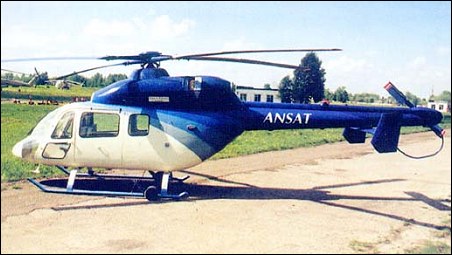
Kazan Ansat

Design began at Kazan in 1993, with design subcontracts to Kazan State Technical University for structural strength and aerodynamic calculations; Aviacon Scientific and Production Centre for rotor; and Aeromekhanica for transmission.

A fuselage mockup was exhibited at the 1995 Paris Air Show, followed by a considerably revised engineering mockup (001) at Paris ’97. By August 1998, now marked ’01’, this had accumulated 10 hours of ground running with engines and rotors, and totalled 800 hours by February 2003.

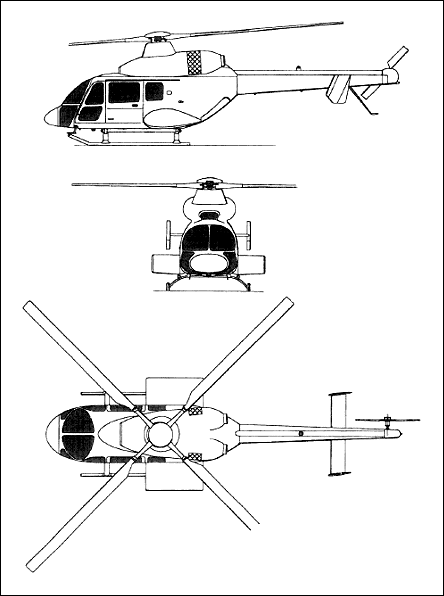
The design features a traditional metal structure and meets FAR Pt 29 Category A and Russian AP-29 requirements. A hingeless main rotor hub with glass fibre torsion bar, has four main blades; two-blade tail rotor. A two-stage, VR-23 main rotor reduction gear in magnesium case ahead of engines has ratio 16.4; rotation speed 365.4 rpm; blade tip speed 220m/s, and transmission rating 769kW. Tail rotor speed 2,000 rpm via single stage conical geabox. Rotor brake. Manual blade folding. Main rotor aerofoil section NACA 23012.

The aluminium alloy fuselage has sparing use of composites, layered glass fibre main rotor blades, window frames and nosecone. The landing gear has twin skids with Kazan transverse shock-absorbers, tail bumper to protect anti-torque rotor, and wheels optional in tricycle configuration, with Yaroslav tyres and Gidroagregat (Balashikha) brakes.
Power is from two P&W Rus XRK206S turboshafts, each rated at 477kW for T-O, 418kW max continuous, in prototypes. Production version with PW207Ks, rated at 470kW for T-O, 410kW max continuous, 529kW for 30 s, 470kW continuous OEI and 491kW 2 minutes OEI. FADEC standard. Fuel capacity 700 litres in either external panniers or underfloor. Optional internal ferry fuel. Alternatively, two Salyut TV-500A turboshafts, each 478kW.
Seating is for up to 11 persons, including one or two pilots, on energy-absorbing seats; or two stretcher patients and three attendants; or internal or externally slung freight. Two forward-hinged doors each side of flight deck; two horizontally split doors each side of cabin, forward; baggage bay behind cabin, with rear-facing door. Baggage door also used for loading stretchers of medical variant. Accommodation ventilated and heated; optional air conditioning.
Avionika FBW controls comprise quadruples electronic system and duplex hydraulic system. Automatic flight control is standard on all piloting functions and optional on navigation functions. Current FBW system to be replaced by KSU-A digital control system. Main transmission drives two alternators (each 200V, 400Hz), two generators (each 27V), two fans and two hydraulic fuel pumps for separate systems. Electrical system 27V, with battery; optional AC system, with second battery. Electric de-icing optional.
First flight was scheduled for late 1997, but initial designated flight trials aircraft (02) exhibited at Farnborough in September 1998, still unflown. First flight (02) was 12 minute hover on 17 August 1999, with an initial forward flight on 6 October 1999. Trials halted in November 1999, after 4 hours, due to gearbox problems, but resumed in the second quarter of 2000 with a strengthened and redesigned main transmission, scarfed engine exhausts and new identity ‘902’. Total 120 hours up to February 2003.

The third (second flying) prototype (03) was to have joined the programme in late 1999, but was not completed until August 2001. First flown 27 December 2001, this is to preproduction standard with small, detachable, pannier tanks, increased fin area, PW207 engines, additional side window and flatter windscreen combined with revised nose shape; will add 400 hours to trials programme. Certification flight resting began in October 2002, for completion before end of 2003; by early 2003 had been renumbered ‘904’.

On 14 September 2001, Ansat declared winner of competition to supply 100 training helicopters to Russian armed forces by 2015.

Aircraft No.5 was to Ansat-U standard, including dual controls and wheel landing gear. Optimised for training (uchebni).

Russian Federal Border Service (Federalnaya Pogranichnaya Sluzhba) requirement for 100 notified in 1997. Total 12 civil sales reported by late 2002, including one for export.
The price was US$2.0 million for utility version (2003). Kazan’s development expenditure had reached Rb200 million by mid-2000.

Ansat
Engine: 2 x Klimov / Pratt & Whitney Canada PW 206 C, 631 shp
Main rotor diameter: 11.5m
Fuselage Length: 37.861 ft / 11.54 m
Length with rotors turning: 13.77m
Height: 11.286 ft / 3.44 m
Rotor diameter: 37.73 ft / 11.5 m
Max take off weight: 7276.5 lb / 3300.0 kg
Cruising speed: 129 kts / 238 km/h
Max speed: 280km/h
Economic cruising speed: 140km/h
Service ceiling: 19685 ft / 6000 m
Hovering ceiling, OGE: 1800-2700m
Maximum range: 335 nm / 620 km
Range: 281 nm / 520 km
Endurance: 3 h
Crew: 1
Payload: 8 pax / 1300 kg int. max. / 1650 kg ext. max.

Kazan Aktay / White Colt

Work beginning in 1996, the project was revealed at the Moscow Air Show, on 19 August 1997, with display of a mockup. A second engineering mockup was built in 1998. Kazan decided in mid-2001 to begin building a prototype to fly in 2003.

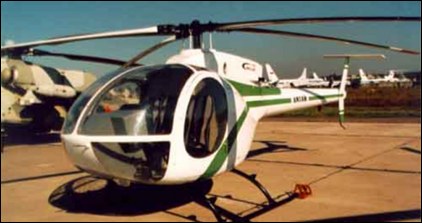
Intended for light transport, patrol, medical evacuation and training, certification was to be to FAR Pt 27. A conventional pod and boom configuration with T tail, semi-articulated three-blade main rotor, tapered blades on production version. The max (emergency) rotation speed is 2,586 rpm. A rotor brake is standard but no provision for folding. A Krasnyy Oktyabr VR-10 main gearbox, rated for 216kW, receives an engine input of 6,000 rpm. A XP-10 gearbox is fitted for the two-blade tail rotor.
Extensive use of composites is made throughout, including main rotor blades.
The landing gear is a conventional, non-retractable skids on arched support tubes, with spring shock absorbtion.
Power is by one 201kW VAZ-4265 rotary engine mounted above the cabin and behind the gearbox and operating on 92/93 grade petrol. Rpm control is manual. Fuel capacity is 300 litres. A refuelling point is on the left side. Oil capacity 20 litres.

The pilot and two passengers, all side by side, in individual seats, have a forward-hinged door each side. Twin clamshell doors are at the rear of the pod, below the tailboom, provideding access to the flat freight floor. One casualty stretcher can be loaded through rear doors when a passenger seat is removed. Alternative access via door on starboard side. Optional, rear-facing seat in luggage bay. Optional heating and air conditioning.
The electrical system with accumulator and M-16 generator has a max rating of 16kW. Anti-icing is fitted for the main rotor blades.

Engine: 1 x 201kW VAZ-4265 rotary
Max take-off weight: 1050kg
Payload: 300kg
Empty weight: 2402kg
Max speed: 190km/h
Cruising speed: 155km/h
Hovering ceiling, OGE: 1300m
Service ceiling: 4700m
Range with 300kg payload: 100km
Range with 190kg payload: 600km
Max endurance: 6h
Crew: 1
Passengers: 2