Yvon Perret EViva

The Yuneec EViva was originally designed by Martin Wezel in conjunction with the Czech company Composit and initially intended to be powered by a 50 hp (37 kW) Rotax 503 two-stroke or 60 hp (45 kW) HKS 700E four-stroke powerplant.

The aircraft was designed to comply with the Fédération Aéronautique Internationale microlight rules. It features a cantilever wing, a T-tail, a two-seats-in-side-by-side configuration enclosed cockpit under a bubble canopy, retractable monowheel gear with wing tip and tail casters, and a single electric motor in tractor configuration driving a folding propeller.

The design was purchased by Yuneec, development shifted to China and the aircraft was adapted for electric power.

The aircraft is made from composites. Its 17 m (55.8 ft) span wing has an area of 14.2 m2 (153 sq ft) and upper wing telescopic air brakes as well as flaps. The wing is derived from the Wezel Apis 2 wing. The standard engine fitted is the 40 kW (54 hp) Yuneec Power Drive 40 electric motor, controlled by a Yuneec Power Block 40 400 Amp power controller and powered by two Kokam Lithium polymer battery packs of 31 Ampere-hours (Ah) each (62 Ah total). The engine weighs 23 kg (51 lb), the controller 7 kg (15 lb) and the batteries weigh 67 kg (148 lb) in total. The propeller folds aft into the engine cooling vents when not in use and deploys automatically on engine start. The batteries are charged by a Yuneec E-Charger that can run on 110-240 volts and charge in 3–4 hours.

First flown in 2012, the projected price in 2011 was €91,000.

Powerplant: 1 × Yuneec Power Drive 40 electric motor, 40 kW (54 hp)
Battery packs: two Kokam Lithium polymer packs of 31 Ah each (62 Ah total)
Propeller: 2-bladed folding carbon fibre
Prop diameter: 1.60 m (5 ft 3 in)
Wingspan: 17 m (55 ft 9 in) / 11.6 m with wing tips removed
Wing area: 14.2 m2 (153 sq ft)
Length: 6.9 m (22 ft 8 in)
Height: 2.65 m (8 ft 8 in)
Empty weight: 225 kg (496 lb)
Gross weight: 472.5 kg (1,042 lb)
Maximum speed: 180 km/h (112 mph; 97 kn)
Cruise speed: 160 km/h (99 mph; 86 kn)
Stall speed: 65 km/h (40 mph; 35 kn) flaps down
Never exceed speed: 230 km/h (143 mph; 124 kn)
Endurance: 1.3 hours on batteries
Maximum glide ratio: 38:1
Rate of sink: 0.65 m/s (128 ft/min) at 85 km/h (53 mph)
Wing loading: 33.3 kg/m2 (6.8 lb/sq ft)
Crew: one
Capacity: one passenger

Yuneec E-430 / GreenWing International GW430

The Yuneec International E430 is a Chinese two-seat electric aircraft designed for commercial production by electric model aircraft manufacturer Yuneec International.

The E430 is a two-seat, V tailed, composite aircraft with a high-aspect ratio wing. Take-off speed is 40 mph, cruise speed is 60 mph, and max speed is 95 mph.

The company claims that the battery packs have an expected lifespan of 1500 hours and cost US$7000 each, with the aircraft carrying 3-5 battery packs, giving two to two and half hours endurance. The batteries can be recharged in 3–4 hours from a 220v outlet.

The aircraft was being developed as a kit aircraft for the US market. The development of the E430 was being funded entirely by Yuneec CEO Tian Yu.

The aircraft was first flown on 12 June 2009 from the Yuneec factory near Shanghai, China, and then shipped for further testing to Camarillo, California. On 14 July 2009 the prototype aircraft was registered in the USA as N386CX and on 18 July 2009 it was given a Certificate of Airworthiness by the Federal Aviation Administration and further test flights were carried out, totalling 22 hours. The prototype E430 was then shipped by truck to Wisconsin and displayed at EAA AirVenture Oshkosh in July 2009. It was also on display at that venue in summer of 2010.

In July 2009 the company estimated that the price for a commercially available light sport aircraft production version of the E430 would be US$89,000.

At AirVenture 2010 the company announced that it would start accepting orders for the aircraft after the show. At that date the aircraft was advertised as having an endurance of 2.25 to 2.5 hours with a useful load of 390 lb (177 kg). The E430 was named the winner of the Lindberg prize for electric aircraft at AirVenture in 2010. The Lindbergh Electric Aircraft Prize (LEAP) was awarded by Erik Lindbergh, the grandson of Charles A. Lindbergh and Anne Morrow Lindbergh. In the same year it was named Brit Insurance Design of the Year in the transport category. Deliveries were initially scheduled for late 2011, but by the end of 2012 there was no indication that more than prototypes had been completed.

Yuneec International, created GreenWing International and in June 2013 it was announced that their GW280 (eSypder) and GW430 (e430) airplanes will be produced, marketed and supported by GreenWing International, however that company went out of business in about 2014.

By December 2012 a total of two examples had been registered in the United States with the Federal Aviation Administration. The first one was the initial prototype shipped to the US, registered in the Experimental – Exhibition category on 14 July 2009, although its registration expired on 31 March 2012. The second was registered in the Experimental – Research and Development category on 26 January 2011 to Flying Tian of Monterey Park, California.

E430
Engine: 1 × Yuneec Power Drive 40, 40 kW (54 hp)
Batteries: Yuneec OEM Lithium Polymer, 13 kg (28.6 lbs), 66.6V (30 Ah) each
Propeller: 2-bladed fixed pitch
Length: 6.98 m (22 ft 11 in)
Wingspan: 13.8 m (45 ft 3 in)
Wing area: 11.37 sq.m (122.4 sq ft)
Empty weight: 250 kg (551 lb) with batteries
Gross weight: 470 kg (1,036 lb)
Maximum speed: 150 km/h (93 mph; 81 kn)
Cruising speed: 90 km/h (56 mph; 49 kn)
Stall speed: 70 km/h (43 mph; 38 kn)
Range: 227 km (141 mi; 123 nmi)
Maximum glide ratio: 25:1
Rate of climb: 3.5 m/s (690 ft/min)
Wing loading: 41.3 kg/sq.m (8.5 lb/sq ft)
Seats: 2

Yuneec eSpyder / GreenWing International GW280

The Flightstar is a large family of single and two-seat, high wing, single engined kit aircraft that was produced by Flightstar Sportplanes of South Woodstock, Connecticut. In 2009 the rights, tooling and parts inventory were sold to Yuneec International of China when Flightstar Sportplanes’ business was wound up.

In April 2014 Yuneec International of China debuted its eSpyder electric at the AERO event in Germany. The eSpyder is a reworked Flightstar ultralight from the 1980s. Flight Design USA’s Tom Peghiny, producer of the Flightstar for many years, sold the design to Yuneec but continued helping with development. The eSpyder, has completed Germany’s DULV aviation standard.

In July 2009 a new single seat model was exhibited at EAA AirVenture Oshkosh. The aircraft is intended to be developed into a commercially available kit and forecast to be available for under US$25,000.

The e-Spyder is an electric-powered and beefing up (enlarging and strengthening) version of the Flightstar Spyder. The aircraft replaces the Spyder’s two-stroke engine with a Yuneec Power Drive 20 20 kW / 27 hp electric motor and two 28 lb (13 kg) Lithium polymer battery packs which provide a 40-minute endurance.

e-Spyder

The E-Spyder, a single seat electric powered aircraft featuring the PowerDrive 24 propulsion system integrating the Motor, Motor Controller, 75 Volt Battery, and Charger, received the world’s first type certification for an electric aircraft from Deutschen Ultraleichtflugverbandes (DULV) E.V in 2013.

Yuneec International created GreenWing International to further develop and market their GW280 (eSypder) and GW430 (e430) airplanes. GreenWing International went out of business in about 2014.

GreenWing International had announced the release of its first 50 eSpyder single-seat electric planes, which were to be sold as build-it-yourself kits for for under US$40,000. The company was to ship 25 eSpyders in the United States at a cost of US$39,990. Another 25 were to be sold in Europe for €34,990 each.

Power: PowerDrive 24, 24 kW / 32 hp
Battery: 75 Volt, 13-kWh lithium
Wingspan: 10.1 m / 33.1 ft
Length: 5.9 m / 19.4 ft
Height: 2.4 m / 7.9 ft
Empty weight: 186 kg / 410 lb
Max cruise: 68 mph / 109 km/h
Economy cruise: 38 mph / 61 km/h
Standard flight time: 60 – 90 min
Battery recharging: 2 – 3 hr

Yuneec Power Drive 40

The Yuneec Power Drive 40 is a Chinese electric motor for powering electric aircraft and motorgliders, designed and produced by Yuneec International of Kunshan, Jiangsu.

The Power Drive 40 is part of a family of scalable electric motor designs produced by Yuneec. The family of engines is designed to use the company’s own power controller, Lithium polymer battery pack and charger, as an integrated package of components. This ensures that all components are compatible and also removes the need for aircraft builders to separately source components.

The Power Drive 40 is a brushless 133 volt design producing 40 kW (54 hp), with an outrunner. The low working rpm of the engine means that it can turn a propeller at efficient speeds without the need for a reduction drive.

Applications:
Yuneec E430
Yuneec EViva

Specifications:
Power Drive 40
Engine type: Brushless electric aircraft engine
Length: 163 mm (6.4 in)
Width: 240 mm (9.4 in)
Height: 240 mm (9.4 in)
Weight: 19 kg (42 lb)
Coil type: Outrunner
Bearings: 2
Reduction drive: none
Cooling: air
Voltage: 133 nominal
Current drain, maximum: 285 A
Current drain, cruise: 180 A
Power: 40 kW (54 hp) at 2400 rpm
Power to weight: 2.1 kW/kg

Yuneec Power Drive 10

The Yuneec Power Drive 10 is a Chinese electric motor for powering electric aircraft, designed and produced by Yuneec International of Kunshan, Jiangsu. Major applications are paramotors.

The Power Drive 10 is part of a family of scalable electric motor designs produced by Yuneec. The Power Drive 10+ produces the same power but at a reduced rpm.

The family of engines is designed to use the company’s own power controller, Lithium polymer battery pack and charger, as an integrated package of components. This ensures that all components are compatible and also removes the need for aircraft builders to separately source components.

The Power Drive 10 is a brushless 67 volt design producing 10 kW (13 hp), with an outrunner. The low working rpm of the engine means that it can turn a propeller at efficient speeds without the need for a reduction drive.

Variants:

Power Drive 10
Model that produces 10 kW (13 hp) at 2400 rpm, with a weight of 4.5 kg (9.9 lb).

Power Drive 10+
Model that produces 10 kW (13 hp) at 2000 rpm, with a weight of 6.0 kg (13.2 lb).

Applications:
Yuneec International EPac paramotor
Yuneec International ETrike ultralight trike

Specifications:
Power Drive 10
Engine type: Brushless electric aircraft engine
Length: 114 mm (4.5 in)
Width: 160 mm (6.3 in)
Height: 160 mm (6.3 in)
Weight: 4.5 kg (9.9 lb)
Coil type: Outrunner
Bearings: 3
Reduction drive: none
Cooling: air
Voltage: 67 nominal
Current drain, maximum: 180 A
Current drain, cruise: 55A
Power: 10 kW (13 hp) at 2400 rpm
Power to weight: 2.2 kW/kg

Yuneec International

Founded in Hong Kong in 1999, Yuneec International Co. Ltd. became a leader in electric aviation.

With hundreds of patents filed, Yuneec’s core technologies power its manned aircraft as well as its drones and its line of radio controlled aircraft for the hobby market.

The company was constructing a 260,000 square foot (25,000 sq m) factory to produce the E430 aircraft in Shanghai that was expected to open in October 2009.

In 2009 the rights, tooling and parts inventory of Flightstar Sportplanes of South Woodstock, Connecticut, were sold to Yuneec International of China when Flightstar Sportplanes’ business was wound up.

XtremeAir XA 42 / Sbach 342

The XtremeAir Sbach 342 is a German high performance two-seat aerobatic and touring monoplane designed by Philipp Steinbach with Albert Mylius and built by XtremeAir GmbH of Hecklingen.
The Sbach 342 (a marketing name for the XA42) is a composite structure low-wing monoplane with a fixed conventional landing gear with a tailwheel. It is powered by a 315 hp (235 kW) Lycoming AEIO-580-B1A piston engine driving a three-bladed propeller. It is the tandem version of the single-seater XA 41 (XtremeAir Sbach 300) which was designed by the same team in Speyer in 2004. The XA42 received a type certificate from the European Aviation Safety Agency in March 2011. On 5 November 2012 it received its type certification through the FAA.
At least 37 have been produced.

Engine: 1 × Lycoming AEIO-580-B1A, 245 kW (315 hp)
Length: 6.67 m (21 ft 11 in)
Wingspan: 7.5 m (24 ft 7 in)
Height: 2.54 m (8 ft 4 in)
Overall height, ground attitude: 2.3 m / 7.5 ft
Wing area: 11.25 sq.m (121 sq.ft)
Aspect ratio: 5
Stabilizer / Elevator span: 3.20 m / 10.5 ft
Stabilizer / Elevator area: 2.98 sq.m / 32.1 sq.ft
Empty weight: 610 kg / 1344 lb
Max. Take off weight Aerobatic: 850 kg / 1875 lbs
Max. Take off weight Utility: 999 kg / 2200 lbs
Wing loading Aerobatic: 75.5 kg/sq.m / 15.4 lb/sq.ft
Wing loading Utility: 84.4 kg/sq.m / 17.3 lb/sq.ft
Maximum speed @ 3000 ft: 416 km/h (256 mph)
Cruise 75%: 185 kts
Stall speed: 53 kts
Rate of climb: 3200 ft/min
Service ceiling: 4572 m (15000 ft)
Range @ 75% 205kts TAS @ 10,000ft: 800 nm
VA: 174 kts / 322 km/h
VC: 185 kts / 345 km/h
VNE: 225 kts / 416 km/h
Load Factor Aerobatic flight: +/-10G
Load Factor Utility: +4,4G / -2G
Roll rate: 450°/sec
Take off over 50 ft obstacle: 260 m / 853 ft
Landing over 50 ft obstacle: 400 m / 1312 ft
Seats: 2

XtremeAir XA41 / Sbach 300

The XtremeAir Sbach 300 is a German aerobatic aircraft, designed by Philippe Steinbach and produced by XtremeAir, of Cochstedt. The aircraft was supplied in 2012 as a complete ready-to-fly-aircraft. The aircraft bears the company designation XA41, but is marketed under the name Sbach 300.
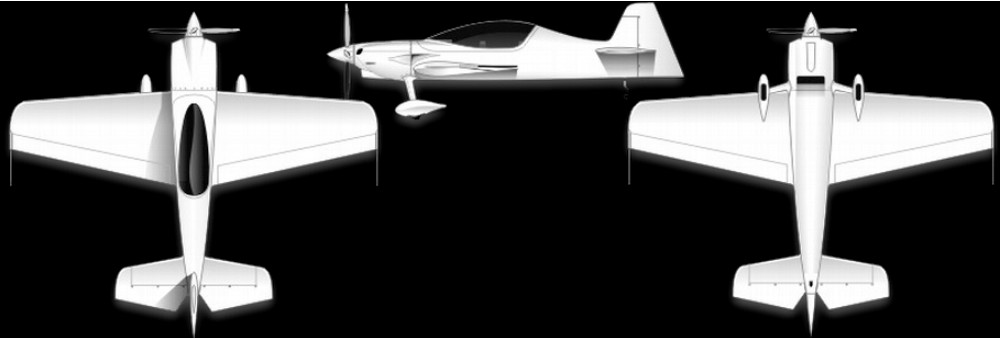
The Sbach 300 is an all-composite design, predominately constructed of carbon fibre. It features a cantilever low-wing, a single-seat enclosed cockpit under a bubble canopy, fixed conventional landing gear and a single engine in tractor configuration.
The aircraft’s wing mounts full-span ailerons with spades to lighten control forces, which give a roll rate of 450° per second. The standard engine employed is the 324 hp (242 kW) Lycoming IO-580 four-stroke powerplant.

The Sbach 300 was flown to a German national aerobatic championship in the unlimited class.
The 300 was later developed into a two-seat version, the XtremeAir Sbach 342, which was introduced in 2007.

XtremeAir XA-41 (Sbach 300)
Engine: 1 × Lycoming IO-580 B1A, 242 kW (324 hp)
Propeller: 3-bladed constant speed
Length: 6.30 m (20 ft 8 in)
Wingspan: 7.50 m (24 ft 7 in)
Height: 2.3 m (7 ft 7 in) in three-point attitude
Wing area: 11.25 sq.m (121.1 sq ft)
Aspect ratio: 5:1
Stabilizer / Elevator span: 3.20 m / 10.5 ft
Stabilizer / Elevator area: 2.98 sq.m / 32.1 sq.ft
Empty weight: 570 kg (1,257 lb)
Gross weight: 850 kg (1,874 lb) for aerobatics
Gross weight: 999 kg (2,200 lb) for non-aerobatic flight
Fuel capacity: 245 litres (54 imp gal; 65 US gal)
Maximum speed: 389 km/h; 242 mph (210 kt) @ 3000 ft
Cruising speed 75%: 345 km/h (214 mph; 186 kn)
Stall speed: 94 km/h (58 mph; 51 kt)
Never exceed speed: 417 km/h; 259 mph (225 kn)
VA: 174 kts / 322 km/h
VC: 185 kts / 345 km/h
Range 75% pwr: 1,482 km; 921 mi (800 nmi)
Load Factors Aerobatic: +/-10G
Load Factors Utility: +4,4G / -2G
Rate of climb: 3500 ft/min
Roll rate: 450°/second
Wing loading Aerobatic: 57,8 kg/sq.m / 11.8 lb/sq.ft
Wing loading Utility: 66,7 kg/sq.m / 13.7 lb/sq.ft
Take off over 50 ft obstacle: 230 m / 750 ft
Landing over 50 ft obstacle: 380 m / 1250 ft
Crew: one