Little Wing Autogyros Two Place

Trans-continental record holder.
Info package: $5 Video: $10 Postage $2.00
Pre-Welded Airframe: $3,500 Plans: $175 in 2009

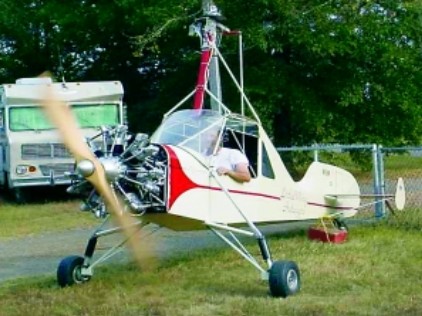
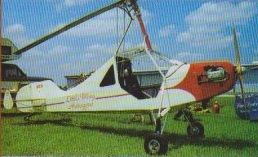
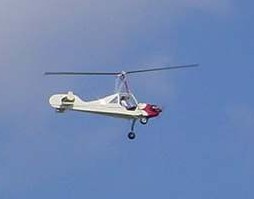
Two-seat enclosed tractor autogyro
Engines: Hirth F-30 110 hp; Rotax; 912S-100 hp, 914-115 hp; Rotec Radial 110hp
Propeller: Warp Drive, Prince, Sterba 76″
Rotor Blades: 27′-29′ Dragon Wings
Specifications:
Min Speed 20 mph
Cruise 70 mph
Top Speed 90 mph
Empty Weight 450-600 lbs
Useful Load 500 lbs
Gross Weight 1,100 lbs
Width 7′
Height 9′
Length 16′ – LW-5, 18′ – LW-4
Seating is tandem (solo from rear).

Main Rotor: 23 to 27 feet
Blade Chord: 7 inches
Length Overall: (rotor turning) 23-27 feet
Length of Aircraft without Rotor installed: 18 feet (16 feet, short-versions)
Wheel Track: 7 feet
Wheel Base: 13 feet – (11.5 feet, short-versions)
Landing Gear: Conventional (tailgear)
Overall Height: 8.5 feet
Cabin Width: 26 inches
Cabin Height: 42 inches
Cabin Length: 75 inches (2-place)
Baggage: Small shelf aft seat(s) 10 lbs. max.
Rotor Disc Area: 415 Sq. feet (23 ft.) / 573 Sq. feet (27 ft.)
Disc Loading (@ gross wt.): 1.9 lb./sq.ft., 2-place (27 ft.)
Tailplane Area:
Vertical Fin: 4.52 Sq. feet
Tip Shields: (2) 1.59 Sq. feet each
Rudder: 3.3 Sq. feet
Rotor/horizontal tail volume ratio: 22% for long frame / 14.9% for short frame.
Empty Weight: 451 lbs. w/ Hirth F-30 (two-stroke powered) / 520 lbs. w/ Rotax 914 (four-stroke powered)
Gross Weight: 1100 lbs.
Fuel Capacity: 13.5 US gal.
Cruise Speed: 65 – 75 mph
Minimum Speed: 15 – 20 mph
Landing Speed: 10 – 15 mph
Takeoff distance: 100-750 ft
Landing Roll: 0-25 ft.
Two-Place seating: Tandem, solo from rear seat w/ fully dual controls.
Construction: Welded SAE 4130 steel tubing, Dacron fabric covering.

Little Wing Autogyros LW-5

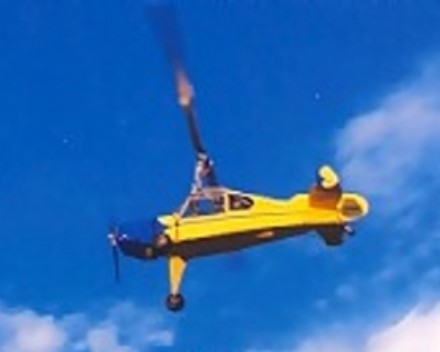
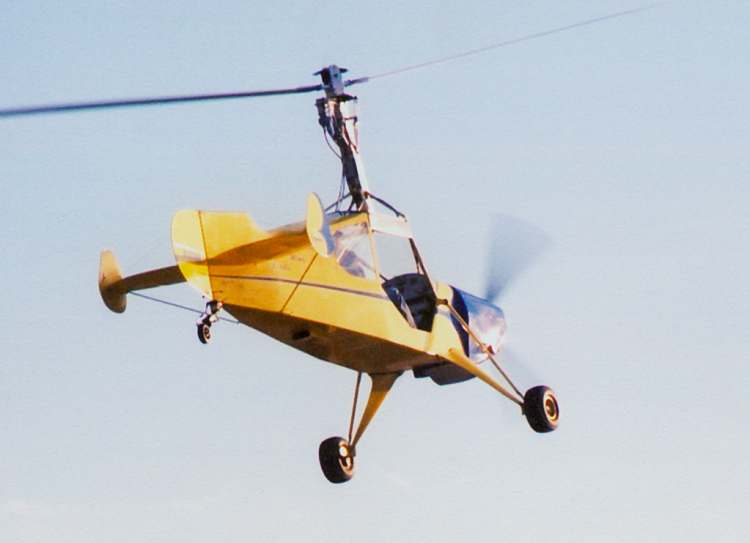
After the LW-3, the next logical step was to develop a two-place version. The prototype, based on the LW-2 and LW-3 single-place models, is a shortened version of all models. The original fuselage was designed for using an elevator for longitudinal control and, therefore, was built longer to provide ample control power at all flight speeds. With the direct (full tilting head) control, the full length fuselage isn’t required and the shorter version will be much less likely to receive damage to the tail from a rotor blade during ground operation. The horizontal tail area has been increased accordingly. Plans were available for this version. The prototype two-place, short-version, has been test flown and should be in a cosmetically completed state by early fall, 2000. It features a Rotax 914 turbo-charged engine of 115 hp. It is very smooth and very quiet.

Main Rotor: 23 to 27 feet
Blade Chord: 7 inches
Length Overall: (rotor turning) 23-27 feet
Length of Aircraft without Rotor installed: 18 feet (16 feet, short-versions)
Wheel Track: 7 feet
Wheel Base: 13 feet – (11.5 feet, short-versions)
Landing Gear: Conventional (tailgear)
Overall Height: 8.5 feet
Cabin Width: 26 inches
Cabin Height: 42 inches
Cabin Length: 75 inches (2-place)
Baggage: Small shelf aft seat(s) 10 lbs. max.
Rotor Disc Area: 415 Sq. feet (23 ft.) / 573 Sq. feet (27 ft.)
Disc Loading (@ gross wt.): 1.9 lb./sq.ft., 2-place (27 ft.)
Tailplane Area:
Vertical Fin: 4.52 Sq. feet
Tip Shields: (2) 1.59 Sq. feet each
Rudder: 3.3 Sq. feet
Rotor/horizontal tail volume ratio: 22% for long frame / 14.9% for short frame.
Empty Weight: (Two-Place) 451 lbs. w/ Hirth F-30 (two-stroke powered) / 520 lbs. w/ Rotax 914 (four-stroke powered)
Gross Weight: 1100 lbs. 2-Place.
Fuel Capacity: 13.5 US gal. (2-place)
Cruise Speed: 65 – 75 mph
Minimum Speed: 15 – 20 mph
Landing Speed: 10 – 15 mph
Takeoff distance: 100-750 ft
Landing Roll: 0-25 ft.
Rate of Climb: Varies with powerplant, density altitude and weight.
Two-Place seating: Tandem, solo from rear seat w/ fully dual controls.
Construction: Welded SAE 4130 steel tubing, Dacron fabric covering.

Little Wing Autogyros LW-3

The LW-2 craft was so stable that Herron was prepared to compare it to a similar machine with a fully tilting head. Thus, LW-3 was born.
This craft was built with some other changes implemented besides the control method. A shock absorbing, outrigger landing gear, and a 2180cc Volkswagen conversion, with dual ignition. This had a rotor brake and a simple electric prerotator, the centrifugal flyweights and also a control stick lock to hold the stick full forward any time the craft was operated on the ground prior to take-off and after landing. This precluded the rotor contacting the tail prior to the blades reaching stable speed prior to take-off and as the rotor slowed after landing.
This aircraft flew exceptionally well from the very beginning. Any fears of it being anything less than completely stable were quickly squelched. It used the same horizontal stabilizer as LW-2 but omitted the elevator. After about 20 hours of flight, a special damper system was designed for the rotor pylon. This diminished the two-per-rev vibrations typically felt in two-biaded rotor systems.

Single-seat enclosed tractor autogyro.
Practically any popular engine package can be mounted to these airframes. These aircraft feature engine thrust lines below aircraft CG…No PPO problem. 100% 4130 chromoly steel construction.
Pre-welded fuselage: $3,500, Plans: $175 in 2009.

Engines: Hirth 65-120 hp; 70 hp T.E.C. 2180 cc;
Rotax 582, 912, 914, Rotec Radial 110 hp
Propeller: Warp Drive up to 72″, Prince or Sterba 74″-76″
Rotor Blades: 25′ Dragon Wings
Specifications:
Min Speed 15-20 mph
Cruise 60-70 mph
Top Speed 100 mph
Empty Weight 350 lbs, 2-stroke
575 lbs, Radial
Useful Load 300 lbs
Gross Weight 700-900 lbs
Width 7′
Height 8’6″
Length 16′ – LW-3S, 18′ – LW-3

Main Rotor: 23 to 27 feet
Blade Chord: 7 inches
Length Overall: (rotor turning) 23-27 feet
Length of Aircraft without Rotor installed: 18 feet (16 feet, short-versions)
Wheel Track: 7 feet
Wheel Base: 13 feet – (11.5 feet, short-versions)
Landing Gear: Conventional (tailgear)
Overall Height: 8.5 feet
Cabin Width: 26 inches
Cabin Height: 42 inches
Cabin Length:
Approx. 49 inches (single)
Baggage: Small shelf aft seat(s) 10 lbs. max.
Rotor Disc Area: 415 Sq. feet (23 ft.) / 573 Sq. feet (27 ft.)
Disc Loading (@ gross wt.): 1.8 lb./sq. ft. single-place (23 ft.)
Tailplane Area:
Vertical Fin: 4.52 Sq. feet
Tip Shields: (2) 1.59 Sq. feet each
Rudder: 3.3 Sq. feet
Horizontal Stabilizer: 8.8 Sq. feet LW-3 series (8 Sq. feet for elevator models)
Control Method: Conventional rudder, fully-tilting head
Rotor/horizontal tail volume ratio: 22% for long frame / 14.9% for short frame.
Empty Weight: 351 lbs. w/Rotax 582-618, 2Si 540-L(two-stroke powered) / 452 lbs. w/ 2180 VW (four-stroke powered)
Gross Weight: 750 lbs. Single-Place
Fuel Capacity: 8.5 US gal. (single-place)
Cruise Speed: 65 – 75 mph
Minimum Speed: 15 – 20 mph
Landing Speed: 10 – 15 mph
Takeoff distance: 100-750 ft
Landing Roll: 0-25 ft.
Rate of Climb: Varies with powerplant, density altitude and weight.
Construction: Welded SAE 4130 steel tubing, Dacron fabric covering.

Little Wing Autogyros Inc

1995-2009: 746 Highway 89 N, Mayflower, AR 72106, USA.

Ron Herron of Little Wing Autogyros Inc began involvement with gyros by building a Bensen B-8M in 1975. Became a little concerned about the continued problem of “Pushovers”, he sold the gyro and began to research the history of the Autogiro and found the original Autogiros flew for 10 years before anyone was ever killed in one.
Cierva had patented the concept of aligning the propeller thrustline with CG (For increased longitudinal stability) very early in the Autogiro’s development. The missing ingredient in the Bensen type gyro was the horizontal tail. The Autogiros of old had huge horizontal tails and tractor mounted propellers which were located in the center of aircraft drag and center of gravity. These aircraft were forgiving and pitch-stable. Herron “copied” Don Juan de la Cierva Codorniu…..the father of practical rotorcraft.
The first 2 prototypes utilized elevators for longitudinal (pitch) control. On these craft he locked the rotorhead in the fore-aft position and designed a means of trimming it for fine adjustments. Side-ways tilting of the head was used for lateral control. The first of these prototypes was the LW-1, built it from a wrecked Piper airplane fuselage. The rotor pylon was attached to the fuselage through four large isolation dampers, and a wide outrigger type landing gear with oleo struts. This aircraft was powered by a Continental 0-200 engine of 100 horsepower. Lateral control was accomplished by using push-pull cables directly connected to the control torque tube. Centrifugal flyweights were developed for the rotorhead to prevent the two-bladed rotor from flapping into the tail at low rotor speeds, and an automotive starter for a prerotator to start the blades.

LISA Airplanes Akoya

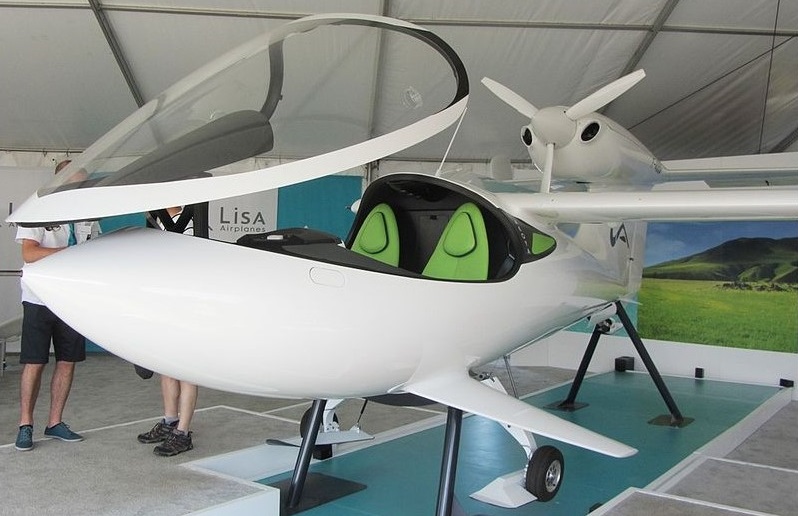
The LISA Akoya (Akoya is a species of pearl oyster) is a light aircraft designed to operate from land, water or snow without adaptation and incorporating a wing of variable area.

First flying on 22 August 2007 the LISA Akoya is a French single-engine light aircraft, seating two in side-by-side configuration. It is an amphibious aircraft capable of alighting on land, water or snow without adaptation. It has a high-aspect-ratio electrically-folding wing, with trailing edge extensions rather than flaps, and a rear-mounted tractor configuration engine.

Some other features are unusual: it has a wing which folds for transportation by horizontal rotation through almost 90° and a single engine mounted high on the fin in tractor configuration. It is built entirely from carbon-fiber-reinforced polymer composites.

The cantilever wings of the Akoya have an aspect ratio of about 18:1, they have constant chord apart from the angled tips. Instead of conventional hinged flaps, the inner 2⁄3 of the trailing edge can be extended rearwards, exposing new fabric surface stored within the wing in roller blind fashion. Fully extended for landing and half extended for take-off, these surfaces provide a large increase in wing area. Conventional ailerons are fitted outboard. High mounted, the wings attach at a rotatable fairing on the highest point of the fuselage, allowing the rotation for storage.

The fin and rudder together form a swept, short and parallel chord surface which carries at its top both the tailplane in T-tail configuration and the engine. The tailplane, like the wing, is of high aspect ratio and has full span elevators. The engine is a 73.5 kW (98.6 hp) Rotax 912 ULS flat four, driving a three bladed tractor propeller.

The Akoya’s fuselage is pointed at the nose and almost circular at its greatest diameter. In elevation it has a curved underside and, above, the large one piece canopy over the side-by-side, dual control cabin forms an unbroken line with the fuselage. There is an electrically operated retractable undercarriage of the taildragger variety, with the main gear legs rotating backward and inwards into the fuselage, and the tailwheel arm rotating forward. All wheels have hydraulic brakes. Operation from water, without a planing bottom or floats, is performed undercarriage up on the round fuselage underside with the aid of a pair of fixed hydrofoils, called shark-fins, sharply tapered planes set at about 50° to the vertical just outboard of the mainwheels. Small tip floats are an option for better lateral stability on water. The Akoya, it is claimed by the manufacturer, can also land on snow, though skis are an option.

A full-size mock-up appeared at the Friedrichshafen Aero ’07 show in April 2007, and the prototype flew in August 2007 at Chambery. By May 2009 F-WURE had flown 150 hours and 50 orders placed. Production was initially expected by mid-2011.

In March 2012 the company was pursuing light-sport aircraft approval of the design to facilitate sales in the United States.

In July 2012 the prototype had flown its first passenger and has been exhibited at AirVenture 2012. LSA approval and the start of production was still pending. Also in July 2012, the company was placed in receivership for financial restructuring after existing investors were not forthcoming with additional funds.

By February 2013 a 75% controlling interest in the company had been purchased by the Heima Mining Company of China for US$20 million. The Heima Mining Company was to name its own chairman of LISA and planed to open two new production lines in France. The Chinese investment permitted finalizing the Akoya’s design for production.

In late 2014 the aircraft was priced “all inclusive” at 300,000 Euros. In July 2015 information about the aircraft was shown at AirVenture, and the price was indicated as US$330,000, and the company claimed about 100 orders.

In March 2017 it was announced that an updated second-prototype would fly in April 2017, it included a new retractable landing gear that would enable the aircraft to operate on water, land and snow.

The second prototype, Pre-Series 1, first flew in August 2017 and features revised fuselage fins, that are horizontal, instead of canted downwards. This change enabled shortening the main landing gear legs to improve cockpit visibility when taxiing.

Akoya
Engine: 1 × Rotax 912 ULS with 1:2.34 reduction gear, 73.5 kW (98.6 hp)
Propeller: 3-bladed
Wingspan: 11.00 m (36 ft 1 in)
Wing area: 6.70 sq.m (72.1 sq ft)
Length: 6.90 m (22 ft 8 in)
Height: 2.35 m (7 ft 9 in) including propeller
Empty weight: 400 kg (882 lb)
Max takeoff weight: 650 kg (1,433 lb)
Fuel capacity / normal: 70 l (18 US gal; 15 imp gal)
Fuel capacity / optional: 110 l (29 US gal; 24 imp gal)
Cruise speed: 210 km/h (130 mph, 110 kn) economical
Stall speed: 64 km/h (40 mph, 35 kn) flaps down
Never exceed speed: 290 km/h (180 mph, 160 kn)
Range: 1,250 km (780 mi, 670 nmi) at economical cruising speed without optional tank
Rate of climb: 5.2 m/s (1,020 ft/min) maximum
Seats: 2
Avionics: VHF, intercom, transponder. Two screen EFIS with emergency backup instruments
Lindstrand Balloons

Lindstrand Balloons is a manufacturer of hot air balloons and other aerostats. The company was started by Swedish-born pilot and aeronautical designer Per Lindstrand in Oswestry, England, after he left Thunder & Colt in 1978. Lindstrand Balloons is known for its leading-edge engineering, which includes sophisticated testing and production facilities.

Of note, Lindstrand Balloons designed and built all of the hot air balloons flown by Per Lindstrand and Richard Branson on their record breaking flights first across the Atlantic Ocean in 1987 and then the Pacific Ocean in 1990. Lindstrand’s then designed and built three Rozière balloons that Per Lindstrand and Branson (and others, including aeronautical engineer Alex Ritchie, and adventurer, Steve Fossett) used in their unsuccessful attempts to circumnavigate the Earth by balloon. Per Lindstrand played an instrumental role in making these flights possible, and was pilot for all of them.

In the late-1990s, Cameron Balloons and its owner Don Cameron acquired two-thirds ownership of Lindstrand Balloons. Cameron bought the majority stake in Lindstrand Balloons from Rory McCarthy, a British industrialist associated with Richard Branson, who had invested in Lindstrand to support Branson’s series of record-setting balloon flights. The remaining third of the company is owned by its founder Per Lindstrand.

Despite Cameron’s ownership, Lindstrand Balloons continues to operate as an independent company with separate management and its own distinct designs and products. Per Lindstrand also independently operates a separate company, Lindstrand Technologies, which designs and builds gas balloons, innovative buildings, specialized aerospace equipment (including an advanced parachute for the Beagle 2 Mars-lander) and inflatable structures including aircraft hangars, plugs for fire-containment for road tunnels and flood prevention systems.

In 2011 Lindstrand Hot Air Balloons Ltd, based in Oswestry, Shropshire in the UK, had been building lighter-than-air craft on the same site for over 25 years and had its designs certified in 48 countries.

Lindstrand Balloons design special shaped envelopes. Once approved, computer aided technology turns the visual into a full working drawing which manufacture uses. All these envelopes are fully EASA approved.

Limbach Flugmotoren

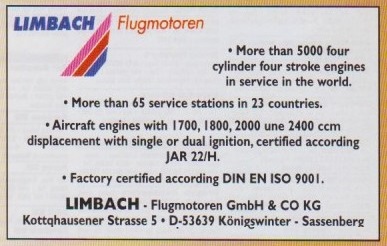
Limbach Flugmotoren (Limbach Flightmotors) is a German company that produces aircraft engines. The company is named after Peter Limbach who expanded his father’s engine repair business in the 1970s in Königswinter.

1998

By May 2006, Limbach had produced more than 6000 engines for light aircraft, ultralight aircraft and airships. Many Limbach engines are based on the Volkswagen flat-4 boxer unit with displacement of up to 2.4 litres, and up to 160 BHP in the turbocharged model.

In a letter dated 25th August 2011, the company announced that it would be closing by late 2011, saying “Years of ever increasing regulations and requirements have been choking us. Our efforts to operate in that environment were not successful because we cannot provide the necessary resources. Additionally there are government activities that hinder our current business and we cannot make plans for the future.”

In late 2012 it was announced that the Limbach assets had been sold to Mr. Chen Shuide.

1998-2012: Kotthausener Str. 5, Konigswinter, Germany, D-53639

Limbach produce 2-stroke and 4-stroke engines from 15 to 125 kW for paragliders to cruising aircraft.

The engines have electronic engine management with electronic fuel injection, no mixture control, no choke, and no carburettor preheating. With an electrically adjustable propeller, you only need to preselect the speed and accelerate.

Lilium Jet

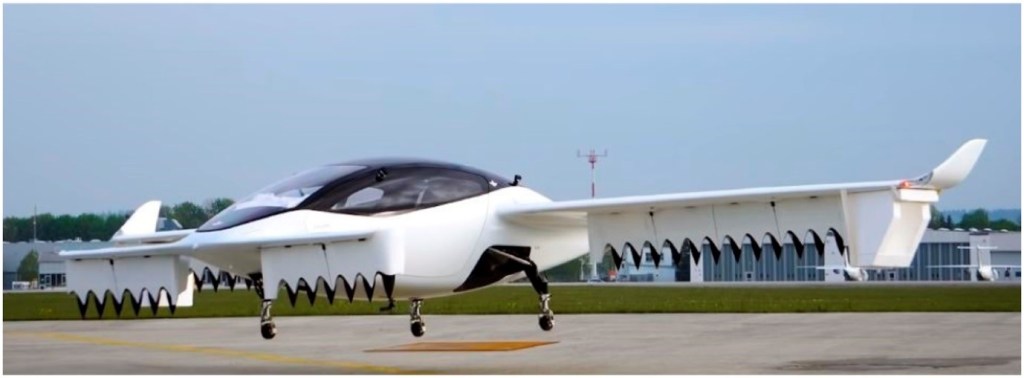
On 4 May 2019, Lilium flew its first flight of an untethered and unmanned five seat Lilium Jet at the Special Airport Oberpfaffenhofen in Munich, Germany. The full-scale prototype was powered by 36 electric ducted fans in configuration inspired by the Eagle prototype aircraft. After the first flight, which consisted primarily of hover, the Lilium Jet has expanded its flight envelope to include conversion to forward flight using the wing for lift, and several safety tests.

Lilienthal Bekas X-32 / X-34 / Jordan Aerospace Industries / JAI RumBird X-32 / GulfBird X-34

The Lilienthal Bekas (Lilienthal Snipe in English, Лиленталь Х-32 Беҝас in Russian) is a 2/3 seat, high wing single engine pusher ultralight from Ukraine.

The Lilienthal Bekas is a pod and boom, multi-purpose, pusher configuration ultralight with a high wing and low-set boom carrying a T-tail. The well glazed pod seats two in tandem and carries the constant chord wing at its top. The wing is braced to the lower fuselage by two pairs of cross braced struts and is fitted with flaps, which have a maximum deflection of 40°. A fixed, tricycle undercarriage with a castoring nosewheel is mounted on the pod.
The engine is mounted at the rear top of the pod, behind the cabin; types in the 60-100 hp (45-75 kW) range may be fitted, most commonly Rotax two or four cylinder models such as the Rotax 582 or 912UL and 912ULS. The engine is cowled on some aircraft but not all. Much of the slim boom is occupied by a broad chord fin with a straight swept leading edge. On some aircraft it is extended forwards with a fillet. The rudder hinge, also slightly swept, is at the end of the boom. The tailplane is of constant chord and braced to the end of the boom by a strut on each side.
The X-32 Bekas first flew in March 1993 and received its Ukrainian certification in 1995. The Rotax 582 and 912 variants were certified in 2003 and 2005 respectively. The aircraft has JAR-VLA certification.

Lilienthal Bekas X-32 RA-2096G MSN: 03180 Russia – May 30, 2020

Between 2003 and 2006, the X-32 and X-34 were marketed by JAI (Jordan Aerospace Industries) as the RumBird X-32 and GulfBird X-34. By 2009, more than 400 X-32s had been sold.

Variants:

X-32AT Bekas
Sports version, certified for limited aerobatics.

X-32UT Bekas
Dual control trainer version.

X-32CK Bekas
Agricultural version, which may be fitted with spraybars fed from tank replacing rear seat.

X-32A Bekas
Ski undercarriage.

X-32H Bekas
Float undercarriage.

X-34 Bekas
Widened cabin for three, with the two passengers side-by-side on a rear bench seat; 500 mm greater span and either Rotax 912S or Rotax 914 engine.

Specifications:

X-32
Engine: 1 × Rotax 912, 60 kW (80 hp)
Propeller: 3-bladed VPSH 2 Donchak variable pitch pusher
Length: 6.55 m (21 ft 6 in)
Wingspan: 9.00 m (29 ft 6 in)
Height: 2.00 m (6 ft 7 in)
Wing area: 12.33 m2 (132.7 sq ft)
Airfoil: NACA 4412
Empty weight: 300 kg (661 lb)
Max takeoff weight: 495 kg (1,091 lb)
Cruising speed: 120 km/h (75 mph; 65 kn)
Stall speed: 55 km/h (34 mph; 30 kn) power off, flaps down
Never exceed speed: 158 km/h (98 mph; 85 kn)
Endurance: 3 hrs 20 min on normal fuel load
g limits: +3.8/-1.9
Rate of climb: 5.0 m/s (980 ft/min)
Crew: one
Capacity: one passenger