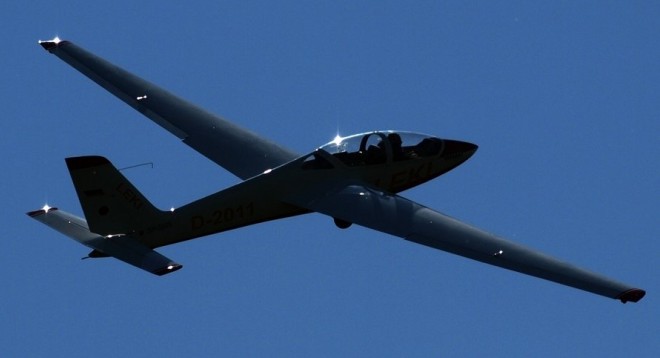
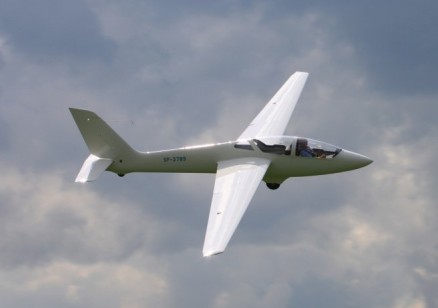
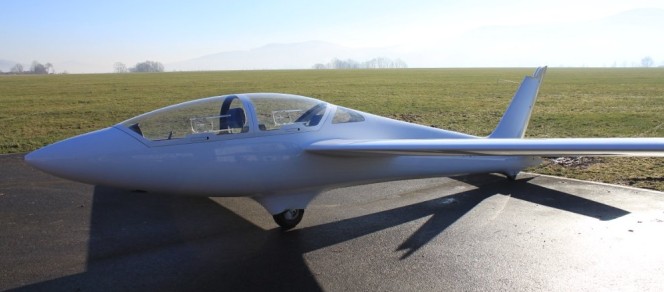
The two-seater MDM-1 FOX glider has been developed on base of design experience acquired during work with KOBUZ, JANTAR and SWIFT S-1 gliders by the team of Edward Marganski M.Sc. (Eng.). Designed by E.Marganski, K. Kapinos, H. Gielbaza, and B Adamski, work started in November 1992 and the first prototype was flown on 9th July 1993.
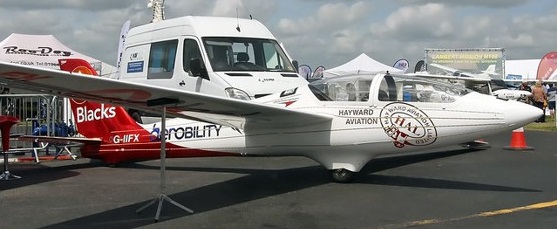
Marganski MDM-1 Fox G-IIFX
Capable of arotowing and winch-launching, the Fox is optimized for aerobatic training with erect and inverted clearance to +9/- 6 g solo, and +7/-5 g with two people. The landing gear is fixed, and approach control is assisted by Schempp-Hirth airbrakes.
Almost immediately after the 1-st presentation at World Glider Aerobatic Championships, Venlo Netherlands 1993 the Fox model has gained a status of monotype at every serious international championships in glider aerobatic.
Certification is EASA TYPE CERTIFICATE No A.039.
The MDM-1 Fox P is a version with redesigned exchangeable wing tips. Depending on the mounted wing tip, the glider can be used in one of two versions:
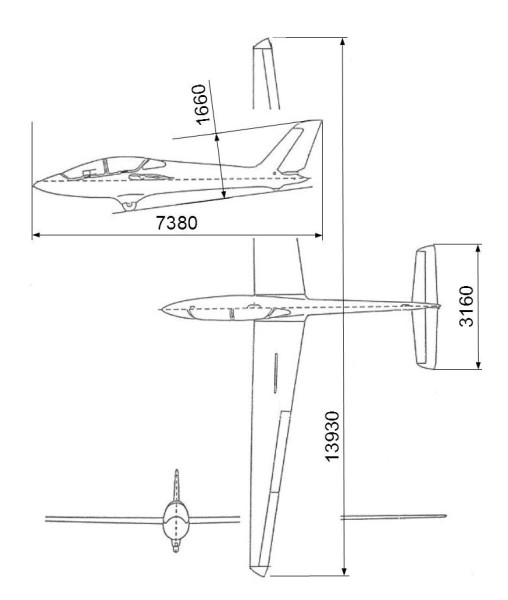
Aerobatic – without wing-tips, wing span of 14,00 m.
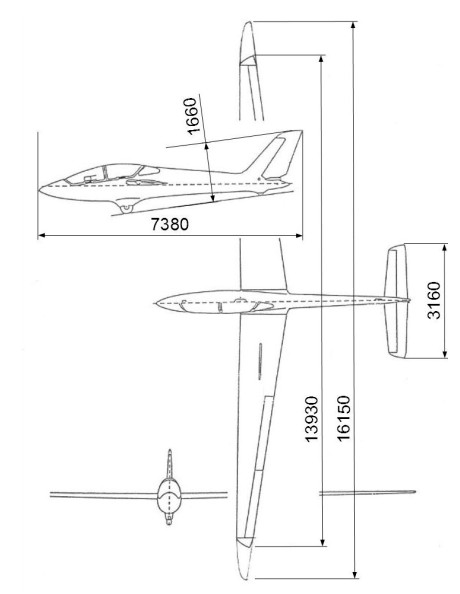
Utility – with wing-tips extending wing span to 16,15 m. Glider in this version can perform only basic aerobatic manoeuvres. Wing-tips with elliptical sweep and dihedral lift based on an arc.
The base price in 2011: 91 850 € TTC EXW (76 800 € HT EXW) As at November 2013 the prices were: MDM-1 Fox glider in basic version: 75 000,00 € MDM-1P Fox glider in aerobatic / utility version: 76 500,00 €
MDM-1 Fox Wing span: 14 m / 45.9 ft Wing area: 12.34 sq.m / 132.8 sq.ft Length: 7,38 m Height: 2,25 m Empty Weight: 345kg / 761lb Payload: 180kg / 396 lb Aspect ratio: 15.88 Gross Weight: 525 kg / 1157 lb Wing Load: 42.54 kg/sq.m / 8.71 lb/sq.ft MinSink: 0.8 m/s / 2.62 fps / 1.55 kt Vne (max never exceeded speed): 285 km/h / 152kts Airfoil: NACA 64(1)412 Structure: GFRP/CFRP Max G-Force: +9 / -6 G Seats: 2
MDM-1 Fox P Aerobatic Wing span: 14,00 m / 45,9 ft Length: 7,38 m / 24,2 ft Height: 2,25 m / 7,4 ft Wings area: 12,34 sq.m / 132,8 sqft Vne(max never exceeded speed): 282 km/h / 152kts Max take-off weight: 530 kg / 1168,0 lb Max empty weight: 350 kg / 772,0 lb Max G-Force (1 person crew): +9 / -6 G Max G-Force (2 person crew): +7 / -5 G
MDM-1 Fox P Utility Wing span: 16,15 m / 53,0 ft Length: 7,38 m / 24,2 ft Height: 2,25 m / 7,4 ft Wings area: 13,09 sq.m / 141,0 sqft Vne(max never exceeded speed): 282 km/h / 152kts Max take-off weight: 535 kg / 1179,0 lb Max empty weight: 355,0 kg / 783,0 lb Max G-Force (1 person crew): +5,3 / -2,65 G Max G-Force (2 person crew): +5,3 / -2,65 G
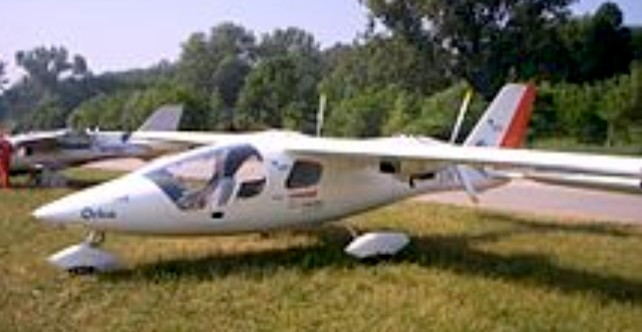
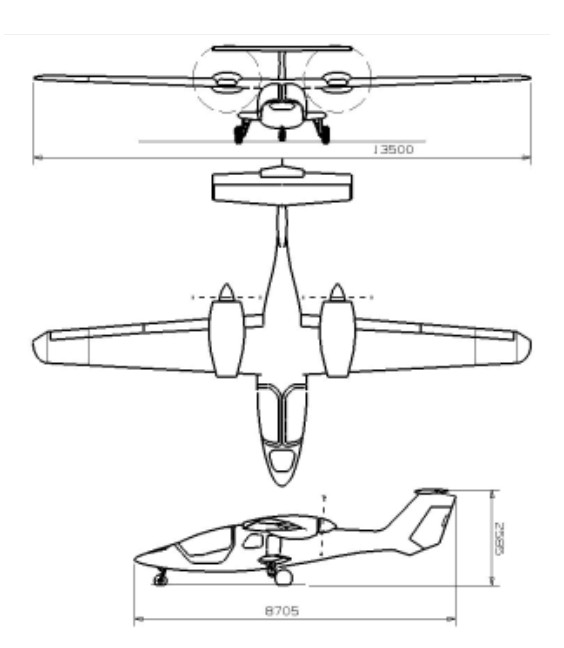
The EM-11 was designed by Edward Margański of Margański & Mysłowski Zakłady Lotnicze (Margański & Mysłowski Aviation Works). Work on this low cost, light utility aircraft, of unorthodox configuration, with slim glider-like fuselage and two pusher engines, started in 2001. The plane was constructed of composite materials with a car-like 4-seat cabin placed low to the ground. Room for cargo was created aft of the rear seats.
A four seater twin-engine aircraft with retractable landing gear, high-wing configuration, the shell structure is all-composite with honeycomb filler. Wings have foldable tips for easier hangaring. Two fuel tanks of 200 litres capacity each are installed in wings. Fuselage has upwards-opening door in the front part and cargo hatch in the central part. Passenger cabin has four separate seats, of which the front ones are reclining and sliding. The seats have 3-point inertial safety belts. Tail plane is in T type. Electrical trimming tabs are mounted on both planes. Flight control systems are controlled by a rigid push-rod transmission system, the rudder is controlled with use of a line. The aircraft is propelled by two counter-rotating engines LYCOMING IO-320 / LIO-320 of 160 hp each at 2,700 RPM. 3-blade constant-speed type MT-Propeller propellers are fitted. Hydraulically retracted landing gear is mounted on fuselage and has gas shock absorbers with hydraulic damping.
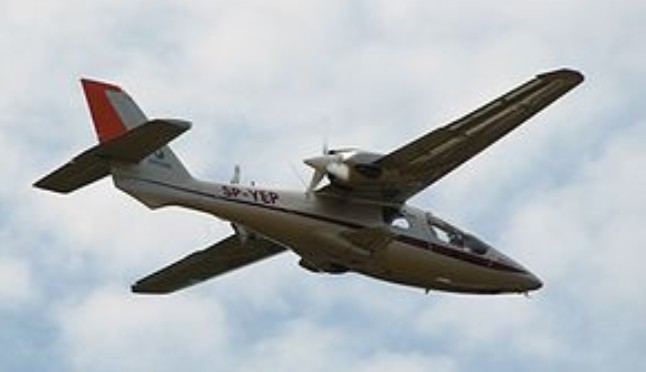
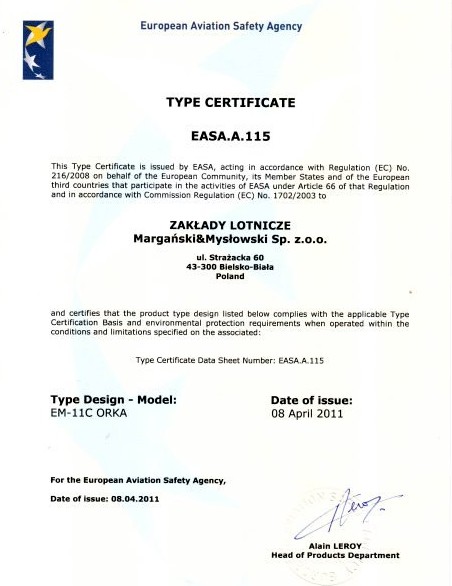
The first prototype EM-11, registered SP-YEN, first flew on August 8, 2003. It has a fixed tricycle landing gear and Rotax 912 (100 hp) engines. The second prototype, registered SP-YEP, being a pattern for serial production variant EM-11C, flew 20 October 2005 with Lycoming IO-320 engines and retractable landing gear. In April 2011 EM-11C Orka was EASA certified and in production. Prior to certification, the prototypes and three further aircraft had been built.
EM-11C Orka (SP-YEP)
Several variants were planned including, a patrol aircraft with an FLIR head, an air ambulance, a cargo plane, and an amphibious version.
Margański & Mysłowski ZAKŁADY LOTNICZE dates back to 1986, when Edward Margański, an engineer, established “Aircraft Repair and Equipment Production Plant”. Initially, the company dealt with the inspection and repair of wooden gliders.
In 1990 company’s activity has been extended to glider constructions designing. Within 26 months SWIFT glider has been designed, flight tests have been performed and Type Certificate was obtained.
The successes of the SWIFT led to an order from MDM Ltd. to design an aerobatic two-seater glider. The company has developed MDM-1 Fox glider, which has gained many world’s and European aerobatics championships awards. On 27th July 1994, a Type Certificate was issued.
In 1999, on the basis of previous experience and preliminary preparations carried out in advance, the company began work on a prototype of the Iskra II jet training aircraft, with an engine thrust of 1,300 – 1,500 kg. The airplane was renamed the ‘Bielik’ and underwent test flights in 2003.
In 2001, work commenced on the development of a new aircraft structure; an executive aircraft, the EM-11 Orka, test flights for which took place in 2003. ORKA is a four seater twin-engine aircraft with retractable landing gear, high-wing configuration with push-type propellers and comfortable passenger cabin. On 8th April 2011 EM-11C Orka has achieved EASA Type Certificate.
Concurrent with aircraft production, the company has participated in a number of projects in other areas. – production tools and the first specimens of a 44 m diameter rotor blade made of glass-fibre-reinforced composite for a wind power plant generating 1000 kW of energy. In 2002, an order from ENECO for a prototype rotor for a wind power plant with a 1.2 MW output was built. In cooperation with ROTHENSEER ROTORBLATTFERTIGUNG GmbH, the company has made supporting elements for the construction of wind power plant rotor blades.
In 2010 production of MDM-1 Fox glider series was started again.
Since October 2011 the company has been transformed from limited company to joint-stock company and has been renamed to Zakłady Lotnicze Margański&Mysłowski S.A.
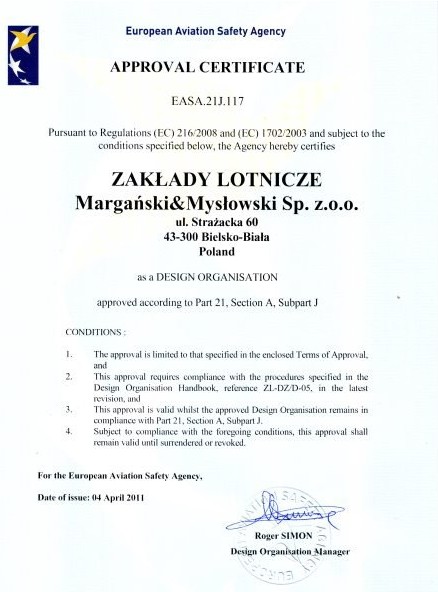
Certificates: Production Organization Approval (POA) no PL.21G.0012 Design Organization Approval (DOA) no EASA.21J.117
M&D Flugzeugbau are a German company based in Friedeburg, Lower Saxony in north-western Germany. M&D Flugzeugbau manufacture the Samburo motorglider and also provide maintenance services for other light aircraft.
In 2007 M&D identified the potential benefits of installing a small jet turbine sustainer in gliders but considered the range of jet turbines available for model aircraft had limitations. Such engines had not been designed from the outset to consider certification or in-flight starting. M&D decided that rather than convert a model aircraft jet turbine into a glider sustainer, it would be better to develop and certificate a new engine.
The key features of the TJ42 engine are: Single spool jet turbine Two stage axial-centrifugal stator-less compressor with a compression ratio of 1:3.8 Cannular combustor with multiple fuel injectors and combustion zones contained within a single annulus casing Glow-plug ignition system (used in start-up sequence only, ignites top combustion zone only) Single stage axial turbine with stators Convergent nozzle Front-mounted, direct drive electric starter motor for initial spool up
The maximum thrust is nominally 42 kgf at 100,000 rpm with an estimated fuel consumption of 66.4kg/hr at full thrust. At the idle speed of 30,000 rpm the thrust is less than 2 kgf. The weight is 3.3kg and overall dimensions 400 mm long and 150 mm diameter.
The TJ42 has a kerosene start-up (as opposed to gas start engines) which eliminates the need for separate gas canisters and long complex start-up procedures.
The start-up sequence is: Glow-plug heats up for 10 seconds Electric starter motor spools up engine to 8,000 rpm Starter fuel solenoid pulses with fuel being injected into the top combustion zone only Fuel ignited in top combustion zone by glow-plug Engine spools up to 15,000 rpm Normal fuel solenoid pulses with fuel being injected into all combustion zones (starter fuel solenoid closes) Engine spools up to idle speed of 30,000 rpm Fuel rate controlled by throttle, and matched to density altitude and rpm by ECU
The shut-down sequence is: Fuel cut off and combustion ceases With no fuel, the engine speed decreases and EGT decreases
The ECU senses EGT and rpm, and if the engine speed is too low to promote rapid cooling, the electric starter motor runs an automatic cooling cycle (spooling the engine up to 3,000 rpm, then switching off)
Once the EGT has dropped below 50°C the ECU signals that the engine can be retracted
The engine and pylon are enclosed by cowlings manufactured from fiberglass and aluminum (or possibly stainless steel subject to clarification of certification requirements).
The MD-TJ42 is certified for installation on self-sustaining sailplanes only, i.e. it is not intended for take-off operation, EASA Type Certificate EASA.E.099. The first type certificated application was on the Jonker Sailplanes JS-1 Series.
Because of the use of these engines in sailplanes, there are several assumptions to simplify the requirements for certification. These assumptions are:
the engines will be used for self-sustaining sailplanes only, not intended for take off;
no bleed air, no reverse functions;
no flight in icing or hail conditions;
no aerobatic operation;
the turbine engine is not used to drive accessories that are essential for any other means than the turbine itself;
the strike and ingestion of foreign matter can be treated as extremely remote, because the engine is started and shutdown in f1ight. Ground operation will only take place for maintenance purposes.
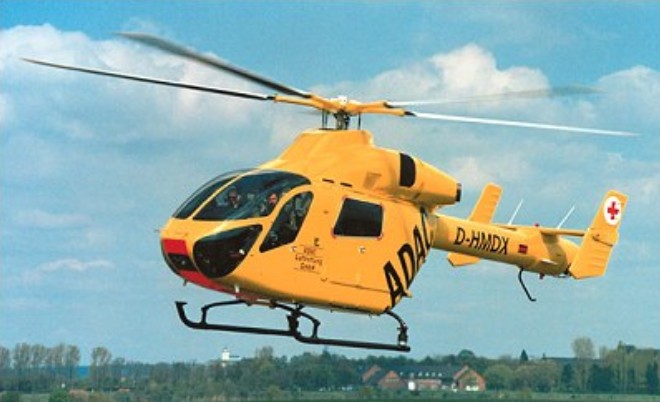
The genesis of the Explorer dates to 1986, when company engineers hit upon the idea of using the latest technology, such as an all-composite main rotor and MDHS’ own no-tail-rotor (NOTAR) anti-torque system, as a basis for a new eight-seater design which would give excellent performance at affordable cost. The MD Explorer is the first commercial helicopter totally designed using computer-aided design techniques and only after a detailed market survey of over 177 operators asking them what they wanted from a new utility helicopter in terms of flight performance and general layout in a 1800 to 3600kg helicopter.
MDHS decided to go ahead with design work in January 1989 with a senior advisory council formed from risk-sharing partners in the $200 million programme. The Explorer is created using computer-aided design (CAD) techniques. The Explorer is the first helicopter to have a major portion of its primary structure constructed from composites. This is most evident in the fuselage, which is manufactured by Hawker de Havilland in Australia. Skins, floors, mb/keel beam and aft-fuselage assemblies are made from a pre-impregnated carbon-fibre composite with a toughened epoxy resin system produced by Hexel. Hawker de Havilland refined manufacturing techniques after the first three fuselage units and standardised on a final design which is around 10% lighter than the development fuselages, weighing in at just 260kg. Metallic parts consist of the titanium roof which provides protection from fire in the engine area, the main frames, fittings and forward-cockpit structure. Two aluminium plough beams form the primary structural support for the nose and provide enhanced crash-protection. In the event of a forward impact with the ground, the beams are designed to keep the nose of the helicopter from tipping down. In the passenger configuration, the Explorer’s 1.44m-wide cabin provides enough space for two rows of three 480mm seats , with a seventh passenger seated in the co-pilots position. Without seats, the helicopter has a completely flat floor which is accessible via a rear-access door and large sliding doors on either side of the cabin. The tailboom and empennage are all-composite primary structures made by MDHS using the same carbon composite and toughened resin as the fuselage. Like the fuselage, the early tailboom design was altered slightly for the final-production configuration to give a 25% weight saving. As the tailboom is hollow to accommodate the NOTAR system, it has aerodynamic surfaces on the inside, as well as the outside. Slots run the length of the right-hand side of the boom to allow air to escape and create the Coanda effect at the heart of the NOTAR principle.
Initially known as MDX, then MD 900 (proposed MD 901 with Turbomeca engines was not pursued. Hawker de Havilland of Australia designed and manufactures airframe; Canadian Marconi tested initial version of integrated instrumentation display system (IIDS) early 1992; Kawasaki completed 50 hour test of transmission early 1992. Other partners include Aim Aviation (interior), IAI (cowling and seats) and Lucas Aerospace (actuators).
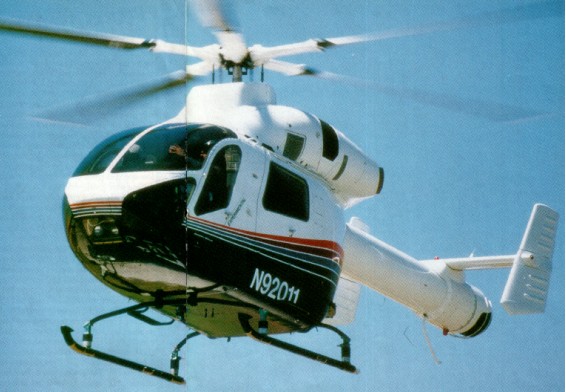
Ten prototypes and trials aircraft, of which seven (Nos. 1, 3-7 and 9) for static tests, were built. The first flight (No.2/N900MD) was on 18 December 1992 at Mesa, Arizona, followed by No.8/N900MH 17 September 1993 and No.10/N9208V 16 December 1993; first production/demonstrator Explorer (No.11/N92011) flown 3 August 1994.
FAA certification 2 December 1994; first delivery 16 December 1994; JAA certification July 1996; FAA certification for single-pilot IFR operation achieved January 1997. Type certificate transferred to MDHI on 18 February 1999.
This new technology helicopter received type certification on 21 December 1994 from the FAA which was only 23 months after first flight. This was one of the shortest certification periods ever recorded for a new helicopter and was also the first new design passenger and utility rotorcraft certified by the FAA in more than ten years.
FAA certification of uprated PW207E engine achieved in July 2000, providing 11% more power for take-off and 610m increase in hovering capability OEI in hot-and-high conditions; first delivery of PW207E-engined Explorer to Police Aviation Services, UK, 27 September 2000. “100th production” Explorer (actually 89th overall, including prototypes) delivered 1 March 2002 to Tomen Aerospace Corporation of Japan for ENG operations by Aero Asahi of Hiroshima. Total fleet time stood at more than 120,000 hours by December 2002.
MDHS begun delivery of the Explorer with a target direct-operating cost of $389/h and a base price of $3.16 million at 1995 exchange rates.
The Explorer has been built largely from composite materials and is powered by twin Pratt & Whitney Canada PW 206A turboshafts and has a maximum gross weight of 2950kg. It can lift 1150kg internally, or 1350kg externally and weighs only 1350kg empty. The helicopter incorporates a range of new technologies to improve safety and performance and reduce operating costs. These include the NOTAR yaw control system, composite, bearingless main rotor with five blades. Digital avionics including FADEC, diagnostics and an Integrated Instrument Display System. The liquid crystal Integrated Instrument Display System (IIDS) replaces traditional cockpit instruments by presenting aircraft operating information in a digital format and icon symbology on two six-inch screens. The system also records operating data for on-board health and usage monitoring, providing technicians with accurate information for performing maintenance functions.
The NOTAR anti-torque system features all-composites five-blade rotor of tapered thickness with parabolic swept outer tip with bearingless flexbeam retention and pitch case; tuned fixed rotor mast and mounting truss for vibration reduction; replaceable rotor tips; maximum rotor speed 392 rpm; modified A-frame construction from rotor mounting to landing skids protects passenger cabin; energy-absorbing seats absorb 20 g vertically and 16 g fore and aft; onboard health monitoring, exceedance recording and blade track/balance.
Mechanical engine control from collective pitch lever is back-up for electronic FADEC. Automatic stabilisation and autopilot available for IFR operation. The transmission overhaul life 5,000 hours; glass fibre blades have titanium leading-edge abrasion strip and are attached to bearingless hub by carbon fibre encased glass fibre flexbeams; rotor blades and hub on condition.
The baseline MD 900 is powered by two Pratt & Whitney Canada PW206E turboshafts with FADEC, each rated at 463kW for 5 minutes for T-O, 489kW for 2.5 minutes OEI and 410kW maximum continuous. Transmission rating 820kW for T-O, 746kW maximum continuous, 507kW for 2.5 minutes OEI and 462kW maximum continuous OEI.
Fuel contained in single tank under passenger cabin, capacity 564 litres, of which 553 litres are usable. Single-point refuelling; self-sealing fuel lines.
Accomodation is for two pilots or pilot/passenger in front on energy-absorbing adjustable crew seats with five-point shoulder harnesses/seat belts; six passengers in club-type energy-absorbing seating with three-point restraints; rear baggage compartment accessible through rear door; cabin can accept long loads reaching from flight deck to rear door; hinged, jettisonable door to cockpit on each side; sliding door to cabin on each side.
Hydraulic system, operating pressure 34.475 bar.
With 14 feet of flat floor space in the rear cabin, the Explorer is expected to undertake a multitude of civil missions from general utility to offshore transportation, corporate flight, tourist flights and air medical services. In the EMS configuration the Explorer can accommodate two patients, two attendants and life support equipment in addition to the flight crew.
The 100th Explorer registered in 2002 (to become seventh for Netherlands police); total of 108 manufactured by December 2002; first delivery 16 December 1994 to Petroleum Helicopters Inc (PHI) which ordered five; second delivery (N901CF) December 1994 to Rocky Mountain Helicopters for EMS duties with affiliate Care Flight unit of Regional Emergency Medical Services Authority (REMSA) in Reno, Nevada. Total of two delivered in 1994, 12 in 1995, 15 in 1996, one in 1997, four in 1998, 11 in 1999, 16 in 2000, 20 in 2001 and four in 2002; initial (MD 900) series comprised 40 aircraft including three flying prototypes; FW207E engine from 64th production (67th overall) aircraft.
MD Enhanced Explorer: Improved version, announced September 1996; originally MD 902, but now known as “902 Configuration”. Main features include Pratt & Whitney Canada PW206E engines with increased OEI ratings; transmission approved for dry running for 30 minutes at 50% power; improved engine air inlets, NOTAR inlet design and engine fire suppression system, and more powerful stabiliser control system, resulting in 7% increase in range. 4% increase in endurance and 113kg increase in payload over Explorer. First flight (N9224U; c/n 900-0051, 41st Explorer) 5 September 1997, FAA certification to Category A performance standards (including continued take-off with one failed engine) and single-pilot IFR operation achieved 11 February 1998; JAA certification for Category A performance achieved July 1998. Retrofit kits to convert Explorers to Category A standard. First Enhanced Explorer delivery in May 1998 to Tomen Aerospace of Japan. PW206E replaced by PW207E from late 2000, beginning at c/n 900-0077, allowing further MTOW increase to 2,948kg.
MH-90 Enforcer: Beginning March 1999, under a programme code-named Operation New Frontier, the US Coast Guard used two leased MD 900 Explorers for shipboard anti-drug smuggling operations. Armed with a pintle-mounted M240 7.62mm minigun at the door station. In September 1999 the MD900s were exchanged for two leased MD 902 Enhanced Explorers. These subsequently replaced by Agusta A 109s. Six delivered to Mexican Navy at Acapulco (two each respectively in May and December 1999 and April 2000) for anti-drug operations, equipped with 12.7mm General Dynamics GAU-19/A Gatling guns, and 70mm rocket pods; further four in process of delivery. Weapons qualification trials were completed at Fort Bliss, Texas in November 2000.
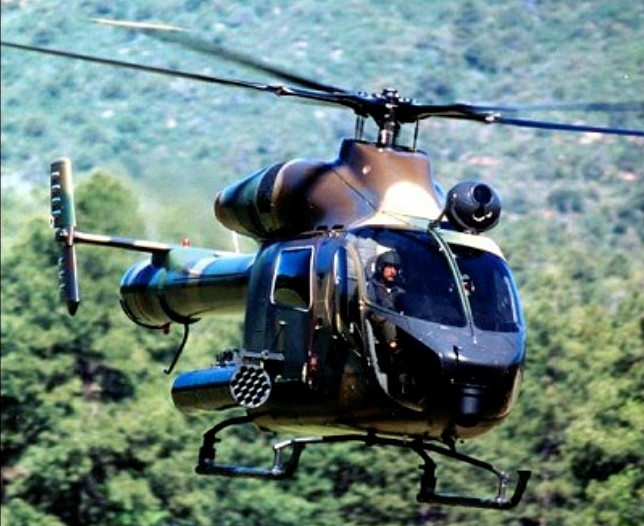
Combat Explorer: Displayed at Paris Air Show, June 1995; demonstrator N9015P (No.15), an MD 900 variant. Can be configured for utility, medevac or combat missions; armament and mission equipment may include seven- or 19-tube 70mm rocket pods, 12.7mm machine gun pods, chin-mounted FLIR night pilotage system and roof-mounted NightHawk surveillance and targeting systems. Combat weight 3,130kg; two P&WC PW206A engines. No customers announced by January 2000, but N9015P became one of initial two MH-90s (with third prototype, N9208V).
February 19, 1999: Boeing sold MD commercial line to RDM The dutch company bought the ex Mc Donnell Douglas models MD 500E and MD 530F single-engine helicopters with conventional tail rotors, the MD 520N and MD 600N single-engine NOTAR helicopters and the MD Explorer series of twin-engine, eight-place helicopters.
Costs: US$2.285 million (2002); direct operating cost US$408.11 (2002) per hour.
McDonnell Douglas MD 902 Explorer Engine: 2 x Pratt & Whitney Canada PW206E, 630 shp Length: 32.316 ft / 9.85 m Height: 12.008 ft / 3.66 m Rotor diameter: 33.825 ft / 10.31 m Wing area: 3939.624 sqft / 366.0 sq.m Max take off weight: 6504.8 lb / 2950.0 kg Weight empty: 3214.9 lb / 1458.0 kg Max. speed: 160 kts / 296 km/h Cruising speed: 140 kts / 259 km/h Initial climb rate: 2795.28 ft/min / 14.2 m/s Service ceiling: 18497 ft / / 5638 m Wing load: 1.64 lb/sq.ft / 8.0 kg/sq.m Range: 313 nm / 580 km Crew: 2 Payload: 8pax
MD Explorer Engine: 2 x Turbomeca Arrius 2C Instant pwr (Turbomeca engine): 480 kW. Rotor dia: 10.3 m MTOW: 2700 kg Useful load: 1165 kg Max cruise: 150 kts Max range: 600 km Seats: 8
MD Explorer Engine: 2 x P&WC PW206A Gross wt: 2,722kg Empty operating wt: 1,481kg Useful load: 1,163kg Fuel capacity wt (600litres): 438/472kg Main rotor dia: 10.34m Length: 9.86m Height: 3.66m Skid width: 2.23m Passengers: 7. Crew: 1 Max cruise speed @ ISA 38oC: 135kt (@sea level ISA: 139kt) Max range: 530km Max endurance: 3.5hr Hover Out of ground effect @ ISA: 3,353m (@lSA+20o: 2,073m) Hover in ground effect @ ISA 3901m (@lSA+20o: 2,621m) Climb rate: 14.2m/s Ceiling: 20,000ft
MD 900 Explorer Engines: 2 x Pratt & Whitney PW 206B turboshaft, 469kW Rotor diameter: 10.31m Length with rotors turning: 11.83m Fuselage length: 9.85m Height: 3.66m Fuselage width: 1.63m Max take-off weight: 3057kg Empty weight: 1481kg Max speed: 278km/h Cruising speed: 250km/h Rate of climb: 14.2m/s Hovering ceiling: 3840m Service ceiling: 6100m Range: 530-600km Payload: 1360kg Crew: 1-2 Passengers: 6
On 8 November 1994, McDonnell Douglas announced their plans to develop an eight-place version of their popular MD520N helicopter. They surprised the world’s press in January 1995 when they flew their new helicopter to Heli-Expo 95 in Las Vegas, Nevada. The prototype, then known as MD 630N (N630N, converted from MD 530F demonstrator), first flew 22 November 1994, 138 days after project approval. After their public debut at Heli-Expo the first year’s production was sold out on the first day.
Production go-head was given on 28 March 1995, at which time designation changed to MD 600N; and a prototype was first flown with production standard engine and rotor system on 6 November 1995.
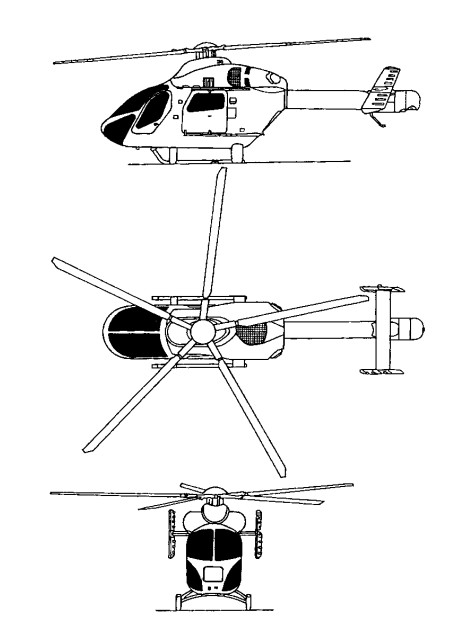
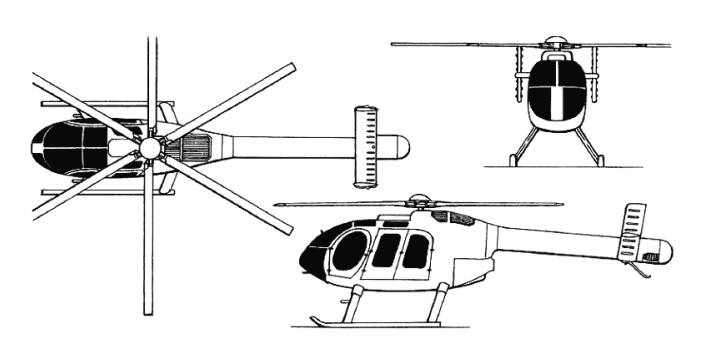
The 600N has a 33in lengthened fuselage centre section with double, centre opening doors, which gives access to a six-foot long flat floor with seating for five passengers in this rear cabin and three across the front seats. The complete fuselage of these helicopters are built under contract by helicopter manufacturer Kaman Aerospace. The six bladed fully articulated main rotor system shares many components with the MD500 series machines, and power comes from an 800-shp Rolls-Royce Allison 250-C47M turboshaft engine, which is derated to 600 shp for take-off and 530 shp for maximum continuous. The engine is equipped with FADEC as well as a manual backup hydro-pneumatic fuel system.
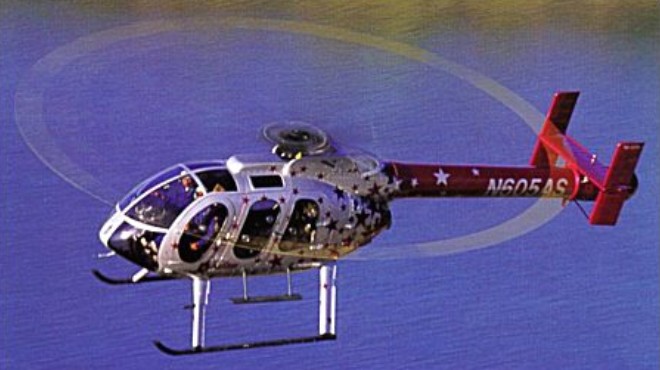
Production prototype (N600RN) first flown 15 December 1995, and became certification test vehicle leading to FAR Pt 27 certification, but was destroyed in ground fire 28 May 1996, following emergency landing after rotor/tailboom strike during abrupt control reversal tests. This resulted in changes to tailboom/rotor clearance; third prototype (N605AS) flown 9 August 1996; further accidents to N630N on 4 and 21 November 1996 and on 18 January 1997, all during autorotational descents, culminated in total loss and delayed certification and first delivery, originally scheduled for 18 December 1996, to 15 May and 6 June 1997, respectively. MD 600N certified on MD500 certificate. The FAA Certification was received on 15 May 1997. The first delivery was on 6 June 1997, N605AS, to AirStar Helicopters.
The 630N features a stretched MD 520N airframe (less than 1% new parts) by means of 0.76m plug aft of cockpit/cabin bulkhead and 0.71m plug in tailboom, combined with more powerful engine, uprated transmission and six-blade main rotor. Cabin has flat floor to assist cargo handling, and will feature quick-change interior configurations to suit multiple-use operators. Intended for civil, utility, offshore, executive transport, medevac, aerial news gathering, touring, law enforcement and other noise-sensitive operations; also adaptable for armed scout, utility and other military missions.
Powered by one 603kW Rolls-Royce 250-C47M turboshaft, derated to 447kW for T-O (5 minutes) and 395kW maximum continuous, with FADEC. Transmission manufactured from WE43A magnesium alloy for lower weight, greater strength and enhanced corrosion resistance, rating 447kW. Fuel contained in two crashworthy bladder tanks in lower fuselage, total capacity 440 litres, of which 434 litres are usable.
The electrical system comprises 28V 200Ah starter-generator and 28V 17Ah Ni/Cd battery. 24V auxiliary power receptacle inside starboard cockpit door standard.
In July 1998, Boeing completed a year-long envelope expansion programme for the MD 600N leading to FAA approval for operation at a density altitude of 2,135m at a T-O weight of 1,746kg and at a density altitude of 1,220m at a T-O weight of 1,860kg. Other performance enhancements approved by the FAA included provision for doors-off operation at speeds up to 213km/h, operation at temperatures -40°C/52°C, lifting up to 968kg on the external cargo hook, making slope landings up to 10° in any direction, operation with emergency floats and for installation of a movable landing light and additional wire strike protection on the fuselage. The MD 600N also completed HIRF trials at NAS Patuxent River, Maryland. Yaw-stability augmentation system (Y-SAS) was under development during 2000, aimed at reducing pilot workload during extended flights and in turbulent conditions.
Total of 68 registered by May 2003. Launch customer AirStar Helicopter of Arizona (two, of which first delivered 6 June 1997); Saab Helikopter AB of Sweden and Rotair Limited of Hong Kong ordered one each in June 1995; other customers include Guangdong General Aviation Company (GGAC) of the People’s Republic of China, which took delivery of one MD 600N in November 2000, during Airshow China 2000 in Zhuhai, Los Angeles County Sheriff’s Department Aero Bureau (three), Orange County, California, Sheriff’s Department, Indianapolis, Indiana. Police Department (one), Presta Services of France (one), Turkish National Police, which ordered 10 in December 2000 for delivery during 2002 (subsequently postponed to 2003), UND (University of North Dakota) Aerospace (one), West Virginia State Police (one) and the US Border Patrol (45, of which 11 delivered by end of 1998. when procurement halted pending evaluation of UAVs for border patrol role). Deliveries totalled 15 in 1997, 21 in 1998, six in 1999, seven in 2000, two in 2001 and two in 2002.
Costs: US$1.315 million (2002).
February 19, 1999 : Boeing sold MD commercial line to RDM The dutch company bought the ex Mc Donnell Douglas models MD 500E and MD 530F single-engine helicopters with conventional tail rotors, the MD 520N and MD 600N single-engine NOTAR helicopters and the MD Explorer series of twin-engine, eight-place helicopters.
In September 1968, the USAF issued a request for proposals for a new FX fighter. The Air Force wanted a single air superiority fighter able to defeat the Mach 3 MiG 25 Foxbat, the MiG 21 Fishbed, and the MiG 23 Flogger. McDonnell was short listed and in late 1969 was selected to develop and produce the F-15 under the direction of Air Force Systems Command, full scale development being authorised in January 1970.
In February 1970, the Pratt & Whitney F100 turbofan was selected for development and a few months later the Hughes APG-63 radar was chosen for the F-15.
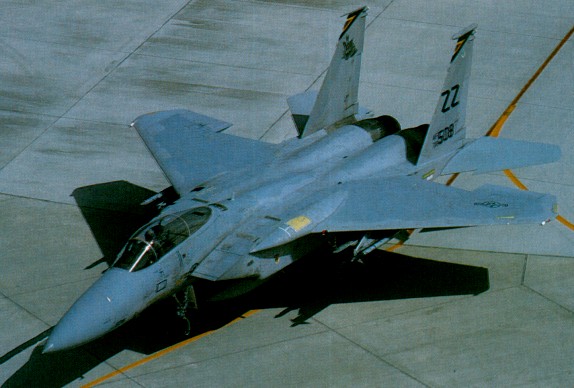
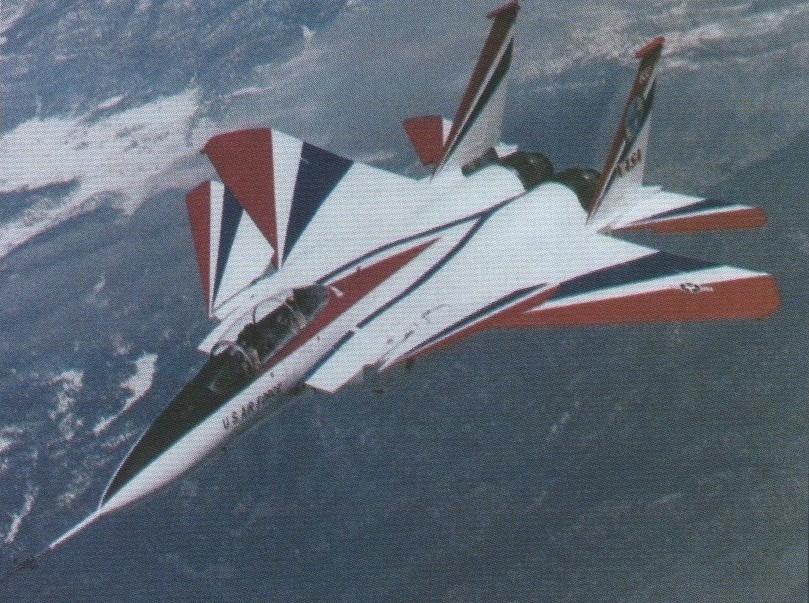
The initial contract called for 18 single-seat F-15As and two TF-15 trainers (re-designated F-15B in December 1977). The first F-15A was rolled out in June 1972, and made its maiden flight on 27 July 1972, to be joined by the first two-seater on 7 July 1973. Most of the major test hurdles had been successfully negotiated by late 1974, clearing the way for the Eagle to join TAC’s inventory.
The F-15 was the first USAF fighter to be developed under the DoD “Fly-Before-Buy” concept, but funding for long-lead items for the first wing of aircraft was released late in 1972, followed by full production funding in early 1973. The second wing was ordered late 1974. The first production aircraft was flown on 25 September 1974.
On 14 November 1974 President Gerald Ford formally accepted the first aircraft (actually a two-seat TF-15A designated F-15B) to be handed over to TAC at Luke AFB, Arizona. Initial operational capability was declared in July 1975, with delivery of the 24th aircraft, and the first wing was completely equipped by the end of 1976. From the outset the USAF planned a force of 729 production aircraft, of which 589 had been delivered by 1 May 1981.
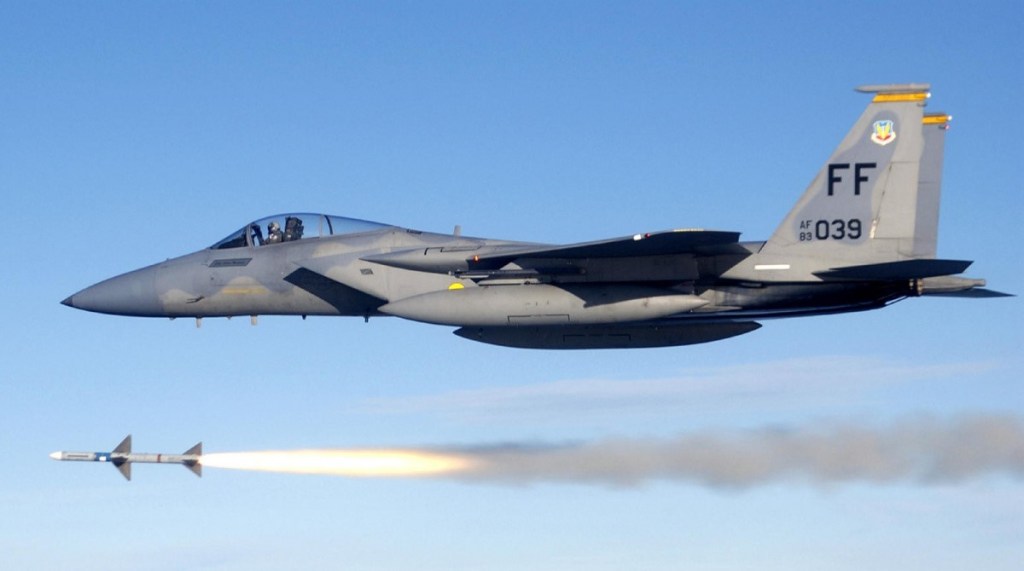
The first two models to enter service were the F-15A single-seater and TF-15A (later F-15B) combat-capable tandem two-seater. Both variants had the APG-63 radar and 10855kg Pratt & Whitney F100-P-100 afterburning turbofans, with AIM-7 Sparrow air-to-air missiles along the bottom of its large inlet ducts and 20mm cannon mounted in the right inboard wing. The two-seat F-15B combat trainer which first flew on 7 July 1973 is about 360kg heavier than the F-15A fighter, but retains most of its combat capability. The Eagle is equipped with Hughes APG-63 pulse-Doppler radar with computerised data-processing and the F-15 pioneered the HOTAS (hands on throttle and stick) concept.
The 1st Tactical Fighter Wing at Langley AFB, Virginia, was the first USAF recipient of the F-15A, while the first operational aircraft in Europe were assigned to the 36th TFW at Bitburg AB, West Germany.
The production totalled 366 and 58 respectively for the US Air Force plus 19 and two respectively for the Israeli Air Force.
Israel, the first export country, ordered 40 F-15 under the ‘Peace Fox’ program. Delivery started in 1976 on an initial batch of 25 aircraft. At least one Syrian MiG-23 has been shot down in clashes with Israeli F-15s over Lebanon.
Japan’s programme to acquire the F-15 began in 1975. The first of the two single-seat F-15Js produced by the parent company was accepted on 29 July 1980, with the second following on 29 July, and after 39 test flights with ASDF pilots, were ferried to Japan landing at Kadena Air Base on 1 March 1981. Essentially similar to the USAF’s F-15C, the F-15J differs in having various avionics changes, the Tactical Electronic Warfare System – the TEWS pod being omitted from the tip of the port fin.
Continuing procurement of the F-15A variant enabled two more TAG wings and one more USAFE squadron to be equipped between 1977-9, production thereafter switching to the F-15C and the basically similar two-seat F-15D.
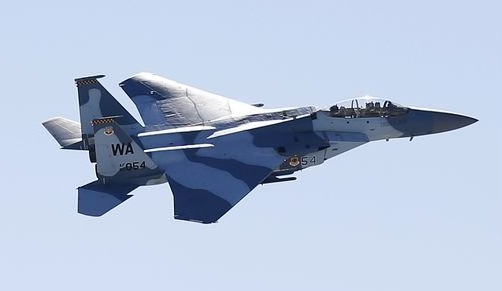
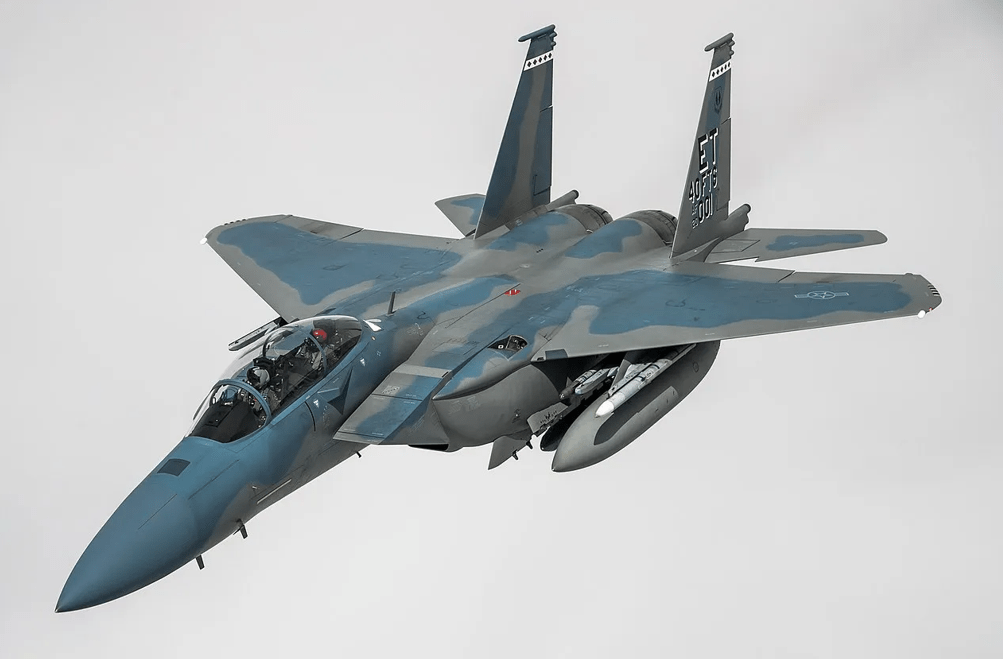
In June 1979 deliveries of the improved and more advanced F-15C single-seat (flown for the first time on 27 February 1979) and F-15D two-seat models began. Equipped with AGP-70 radar (with a programmable digital signal processor, synthetic-aperture ground mapping and track-while-scan air-to-air capability), an uprated powerplant, and provision for low-drag conformal packs carrying fuel and fitted with tangential attachments for weapons. The two variant were built for the USAF, Israel and Saudi Arabia and are still operated today. These variants were also built under licence in Japan by Mitsubishi and designated F-15J.
F-15D
In addition, it is also compatible with the company-developed FAST (Fuel And Sensor Tactical) packs, whereby conformal fuel tanks and/or sensor packages can be attached to the outside of each air inlet. Extra fuel tanks conform to the sides of the fuselage and hold an additional 10,000 lb / 4536 kg of fuel to supplement the 11,600 lb / 5260 kg of internal fuel, or a variety of sensors (such as reconnaissance cameras, infra-red equipment, radar warning receivers, laser designators and low-light-level television cameras to be carried. Thus, overall capability the Eagle has been significantly enhanced. Operational deployment of the F-15C and F-15D began in 1979. The 18th TFW at Yridena, Okinawa, was the first unit to receive this version, re-equipment of this Wing’s three squadrons being effected between September 1979 and April 1980. Subsequent deliveries were made to existing Eagle units, most of which were progressively re-equipped during the early 1980s.
The first single-seat air superiority F-15C incorporating MSIP enhancements was rolled out in June 1985.
Renowned as an extremely capable interceptor, the F-15D Eagle was modified in 1980 to perform in the all-weather interdictor role whilst still retaining the ability to operate as an air superiority aircraft. This private venture, first known as the Strike Eagle, first flown on 8 July 1980, was redesignated McDonnell Douglas F-15E Enhanced Eagle when the USAF expressed interest in the concept and conducted an evaluation between November 1982 and April 1983. Together with the delta-winged General Dynamics F-16E, the Enhanced Eagle was competing for selection in the USAF’s Derivative Fighter Program as a supplement and eventual replacement for the General Dynamics F-111.
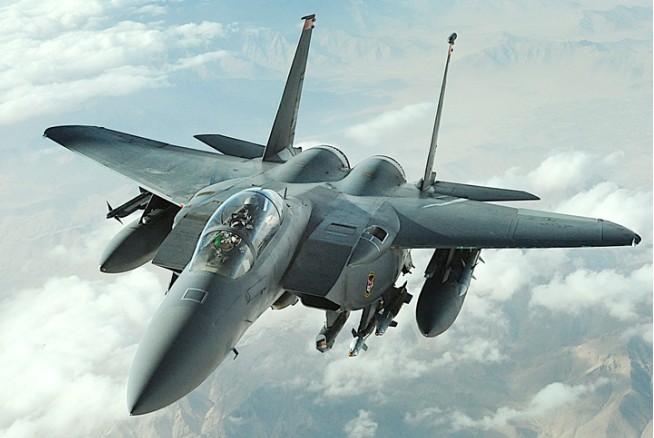
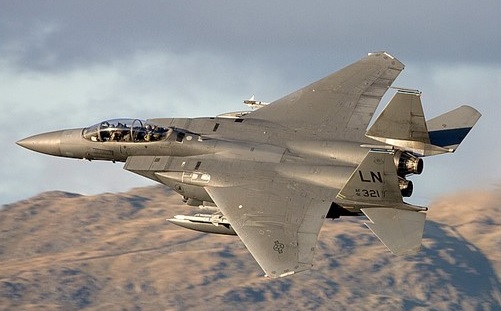
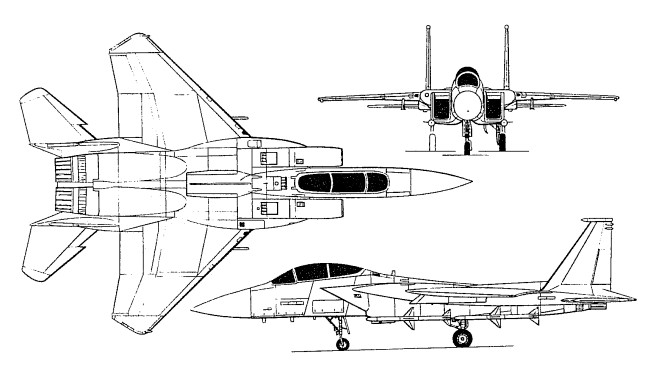
The dual-role F-15E Strike Eagle is basically a converted F-15B/D trainer for the ground-attack role. It has a total of 18 external hardpoints.
On 11 December 1986 the F-15E made its first flight and the US Air Force announced that it was to order 392 examples though this requirement was later reduced to 200 and deliveries began in 1988, initially to the 405th TTW for training and then the 4th TFW for operations, replacing the F-4E. The rear cockpit of the prototype (a converted F-15B trainer) has been fitted with four multi-purpose cathode ray tubes (CRTs) for information display to the systems operator and three more CRTs are to be installed for the pilot in production versions. Beneath the nose-cone, high resolution radar provides long-range ground-mapping of remarkable clarity, whilst forward looking infra-red (FLIR) gives close range images of similar quality. In combination, these systems allow rapid target identification in all weathers and ensure accurate weapon delivery. Ordnance carriage has been improved by addition of bomb attachment points on the ‘conformal’ wing-root fuel and sensor packs, resulting in less drag and freeing wing pylons for additional fuel tanks. Called Tangential Carriage, the modification extends the Eagle’s endurance by 40 per cent in some cases. During proving trials, the F-15E demonstrated an ability to take off at a weight of 34020 kg (75,0001b), some 3175kg (7,0001b) above the previous maximum.
McDonnell Douglas F-15E Strike Eagle
The type has an advanced nav/attack system with APG-70 main radar as well as several radar and infra-red navigation and targeting options displayed to the rear seat, leaving the pilot free to concentrate on tactical flying using his head-up display. Equipment installed in the F-15E includes the LANTIRN night nay/attack pod system, FLIR sensors, threat-warning displays, digital map displays, APG-70 radar, a wide-angle HUD an improved mission computer and provision for AIM-120 AMRAAM missiles and the integral M61 Vulcan cannon.
F-15E Strike Eagle
21 Strike Eagles were exported to Israel designated F-15I. The Israeli Defence Force/Air Force aircraft have been involved in several dogfights with Syrian MiG-21s and MiG-23s and are officially confirmed as having shot down at least one MiG-25. On 7 June 1981, Israeli F-15s escorted F-16s making the strike against Iraq’s Osirak nuclear powerplant, covering a radius of 966km.
On the 1st of November 1968, Japan signed a letter of agreement with Mc Donnell Douglas and it was also announced that it would become one of the few countries worldwide that was going to license-produce this aircraft. Over the following years, the Nihon Koku Jietai (Japan Air Self-Defence Force) received a total of 154 F-4EJ and RF-4Es. The F-4EJs (the export version for Japan) were mostly similar to the F-4Es, although the Japanese aircraft had their in-flight refuelling and ground-attack capabilities removed to align with Japan’s defensive posture, the F-4EJs were delivered without the AN/AJB-7 bombing computer system.
The first two F-4EJs (JASDF serials 17-8301 and 17-8302) were built by McDonnell Douglas in St Louis and first flew on January 14, 1971. The next 11 F-4EJs (JASDF serials 27-8303/8307, 37-8307/8310, and 47-8311/8313) were built by McDonnell Douglas in kit form and were assembled in Japan by Mitsubishi Heavy Industries, Ltd. The first Japanese-assembled aircraft (27-8303) flew on May 12, 1972. Seven more F-15Js single-seat version based on F-15C were to be assembled by August 1982, leading to manufacture by Mitsubishi against contracts placed for a total of 45 F-15Js and 12 two-seat F-15DJs (including two aircraft assembled in the USA by McDonnell Douglas). Funding of 43 more F-15Js in the FY82 budget brought total procurements to 100. Subsequently, Mitsubishi built all the rest 127 F-4EJ during the following nine years. The last example was delivered to the JASDF on May 20, 1981.
Mitsibishi produced 213 McDonnell Douglas F- 15J/DJ fighters for the JASDF by 1998.
Japan also acquired 14 RF-4Es built by McDonnell Douglas to serve in the reconnaissance role. These RF-4Es were delivered between November 1974 and June 1975. They were virtually identical to the USAF RF-4C, with the only differences being the deletion of certain equipment such as the radar homing and the warning suite which had not been released for export to Japan.
The F-4EJs entered service with the JASDF in August 1972 with a total of six squadrons operating the aircraft: the 301st, 302nd, 303rd, 304th, 305th and 306th squadrons. The RF-4Es equipped the 501st that had previously operated one of the less-well-known Sabre models, the RF-86F.
Korea ordered the Boeing F-15K to replace its F-4 Phantom II fleet. The F-15K is more advanced than the original F-15E, it has better radar and improved systems and a helmet-mounted cueing system.
Saudi Arabia ordered the F-15 variant and took delivery of 72 downgraded F-15Es, redesignated F-15S.
The F-15 Eagle has a perfect combat record of 101 victories and zero defeats. F-15s downed four Mig-29 fighters during the Balkan conflict and 33 of the 35 fixed-wing aircraft Iraq lost in air combat during Operation Desert Storm.
Singapore ordered the F-15SG (previously known as F-15T), another customized advanced derivative of the F-15E Strike Eagle, to replace the A-4 Skyhawk in the ground-attack role.
The McDonnell Douglas F-15S/MTD, AF71290, is the prototype F-15B modified under a $US117.8 million programme for the US Air Force Wright Aeronautical Laboratories to investigate short take-off and landing using vectored thrust jet nozzles and canards mounted on the engine intakes. The aircraft’s first flight was made on 7 September 1988 and after the fitment of the thrust vectoring reversing nozzles on the jet pipes these were flown for the first time on 10 May 1989. The aircraft was involved in a 13 month, 100 flight test schedule at Edwards. The aircraft’s controllable canard foreplanes are adapted tailplanes from the F/A-18 Hornet and can operate independently of each other for pitch and roll manoeuvres having a 20 degree dihedral.
The US signed a US$29.4 billion deal to sell 84 new F-15 fighter jets to Saudi Arabia in December 2011. The sale includes the 84 advanced Boeing F-15SA fighters with Raytheon Co radar equipment and digital. electronic warfare systems. Also included are upgrades that wilI bring Saudi Arabia’s 70 older F-15s up to the new standard, as well as HARM, AGM-88 AntiRadiation Missfies; Laser JDAM and Enhanced Paveway munitions and related equipment and services. The first new F-15s’ were expected to be delivered to Saudi, Arabia in early 2015.
By 1990, since the development two-seat Strike Eagle was displayed in 1984, this all-weather interdictor/strike aircraft has entered service with the USAF’s 4th TFW and production of 200 was underway. Powered by 23,800 lb st (10 800 kgp) P& W F100-PW-220s, the F-15E The F-15E has a range of 2,400 nm (4,445 km).
The Boeing F-15EX Eagle II represents the ultimate evolution of the F-15, thoroughly modernised to remain relevant against emerging threats.
The F-15EX incorporates 21st-century technology, including an APG-82 AESA radar, advanced cockpit displays, digital fly-by-wire controls, and the Eagle Passive Active Warning Survivability System (EPAWSS), a sophisticated electronic warfare suite that drastically improves survivability against modern air defence systems.
Powered by twin Pratt & Whitney F100-PW-229 engines, each producing 29,000 pounds of thrust, the F-15EX reaches Mach 2.5 (approximately 3,100 km/h).
It can carry up to 22 air-to-air missiles or a mix of air-to-ground ordnance. The US Air Force planned to acquire 144 F-15EX aircraft at $87 million each to replace aging F-15C/D models.
F-15EX_Eagle_II
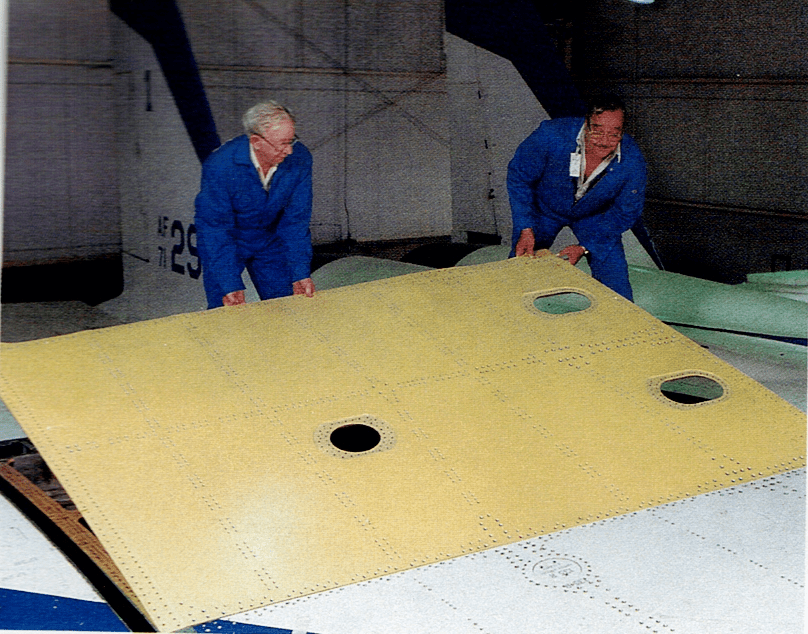
F-15 wing skin panel of aluminium-lithium alloy – lighter than conventional aluminium alloys
F-15A Engines: 2 x Pratt & Whitney F-100-PW-100, 29,000 lb. Wing span: 42 ft 9.75 in (13.05 m) Length: 63 ft 9.75 in (19.45m) Height: 18 ft 7.25 in (5.67m). Wing area: 56.5 sq.m / 608.16 sq ft Take-off weight: 18145-25000 kg / 40003 – 55116 lb Empty weight: 12245 kg / 26996 lb Max. speed: 2655 km/h / 1650 mph Ceiling: 20400 m / 66950 ft Range w/max.fuel: 8000 km / 4971 miles Range w/max.payload: 4500 km / 2796 miles Seats: 1 Internal fuel: 5278 kg (11,635 lb) Armament: 1 x 20mm Vulcan, 6800kg ordnance
F-I5B / TF-15A Engines: 2 x Pratt & Whitney, 29,000 lb. Wing span: 42 ft 9.75 in (13.05 m) Length: 63 ft 9.75 in (19.45m) Height: 18 ft 7.25 in (5.67m). Seats: 2 Weight: F-15A + approximately 363 kg (800 lb)
F-l5C Engine: 2 x P&W F100-220, 105.73 kN (23,770 lb st) Installed thrust (dry/reheat): 134 / 211 kN Span: 13.05 m (42ft 9.75in) Length: 19.43 m (63 ft 9in) Height: 5.63m (18ft 5.5in) Wing area: 56.48 sq.m (608 sq.ft) Wheel base: 5.42m (17ft 9.5in) Wheel tract: 2.75m (9ft .025in) Empty wt: 12,247 kg (27,000 lb) Take-off weight (clean): 20,244 kg (44,630 lb) MTOW: 30,845 kg (68,000 lb) Internal fuel: 6,103 kg (13,455 lb) Conformal fuel tank capacity: 4536 kg (10,000 lb) Max speed: 2.5+ Mach Time to height: 1 min / 12,200 m Service ceiling: 18,300 m TO run: 274 m Ldg run: 840 m Fuel internal (external): 6100 kg (9820 kg) Air refuel: Yes Combat radius: 1062 nm. Seats: 1 Hardpoints: 9 Armament: one 20mm M61A1 Vulcan six-barrel cannon with 940 rounds; 10,705 kg (23,600 lb) disposable stores
F-15D MTOW: 68,000 lb Fuel internal: 6100 kg Fuel external: 9820 kg Seats: 2
F-15E Powerplant: two 10855-kg (23,930-lb) thrust Pratt & Whitney F100-PW-100 afterburning turbofans. Span 13,05 m (42 ft 9¾ in) Length 19.43 m (63 ft 9 in) Height 5.63 m (18 ft 5½ in) Wing area 56.5 sq.m (608 sq ft). Maximum speed Mach 2.5 + at altitude Maximum speed 1481 km/h (920 mph) at sea level Ceiling 20000 m (65,610 ft) Endurance 5 hours 15 min Armament: one M61A1 Vulcan 20-mm gun (with 940 rounds) External load: 24,000 lb / 10,885 kg Hardpoints: 3 fuselage / 6 fuel pack Seats: 2
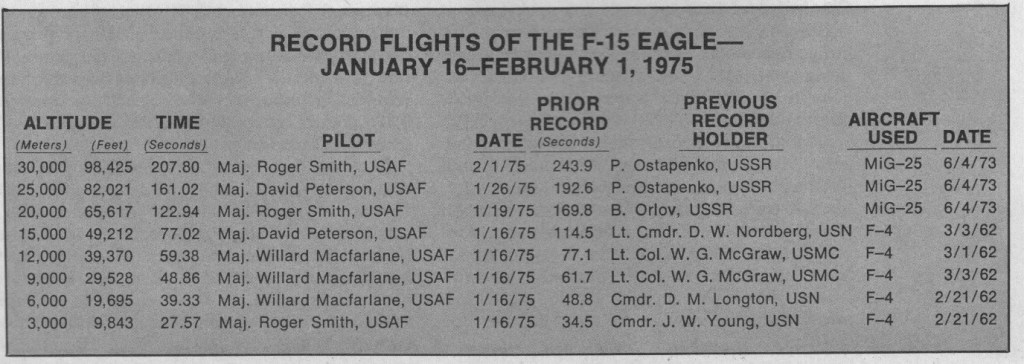
F-15E Eagle Engines: two 23,450-lb (10,637-kg) reheated thrust Pratt & Whitney F100-P-220 turbofans. Maximum speed 1,650+ mph (2,655+ km/h) or Mach 2.5+ at 36,000 ft (10,975 m) Climb to 39,370 ft (12,000 m): 1 minute 0 seconds Service ceiling 60,000 ft (18,290 m) Radius 1,150+ miles (1,851+ km) Empty weight 31,700 lb (14,379 kg) Maximum take-off 81,000 lb (36,742 kg) Wing span 42 ft 9.75 in (13.05 m) Length 63 ft 9 in (19.43 m) Height 18 ft 5.5 in (5.63 m) Wing area 608.0 sq ft (56.48 sq.m) Armament: one 20-mm multi-barrel cannon, up to 24,250 lb (11,000 kg) disposable stores.
F-15E Powerplant: two 129.45 kN (29,100 lb st) Pratt & Whitney F100-PW-229 turbofans Length 19.43m (63 ft 9 in) Height 5.63m (18 ft 6 in) Wing span (over tip launchers) 13.05m (42ft 10 in) Take-off weight (‘clean’) 14.515 kg (32,000 lb) Max Take-Off Weight 36.741 kg (81,000 lb) Wing loading: 133.25 lb/sq.ft / 650.0 kg/sq.m Max level speed at high altitude (‘clean’) 2,655+ km/h (1,650+ mph) Service ceiling: 60039 ft / 18300 m Max rate of climb at sea level 15,240+ m (50,000+ ft)/min Range int. fuel: 686 nm / 1270 km Max range 4,455 km (2,762 miles) Armament: one 20mm M61A1 Vulcan six-barrel cannon with 512 rounds; 11.000 kg (24,250 lb) ordnance Hardpoints: 18 Crew: 2
Three flight test models were built, and the aircraft became operational in 1994.
By October 2002 C-17s were being delivered at a rate of 15 per year, with a planned run of 180 aircraft. The C-17 Globemaster is a four-engine transport aircraft fitted with the reversible-thrust F117-PW-100 by Pratt & Whitney, with each of 40,000 pounds of thrust. This powerplant represents the military version of the commercial Pratt & Whitney PW2040 as found on the 757 airliner. The aircraft is designed for operations utilizing shortened runaways.
The C-17 Globemaster III is crewed by a pilot, copilot and a loadmaster. At rear of the aircraft, the C-17 features a large access ramp. The aft-loading ramp allows for transportation and delivery of varying types of cargo including over 100 fully-armed troops and paratroopers, 36 medical litters and nearly 171,000 pounds of cargo. The cargo hold is able to carry most all of the military’s air-portable weapon and vehicle systems. With in-flight refueling, the C-17 has a global reach.
Unit Cost: $237 million (2007)
The Boeing-produced C-17 Globemaster III represents one of the latest additions to the United States Air Force mobile airlift fleet. By 1998, over 140 Globemaster III’s were in active or reserve service with the USAF, Air National Guard and the Air Force Reserve.
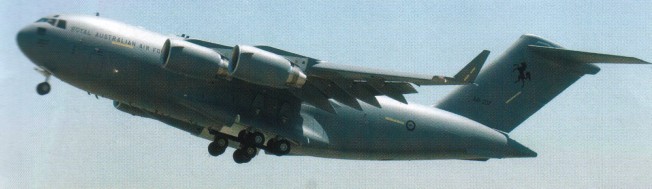
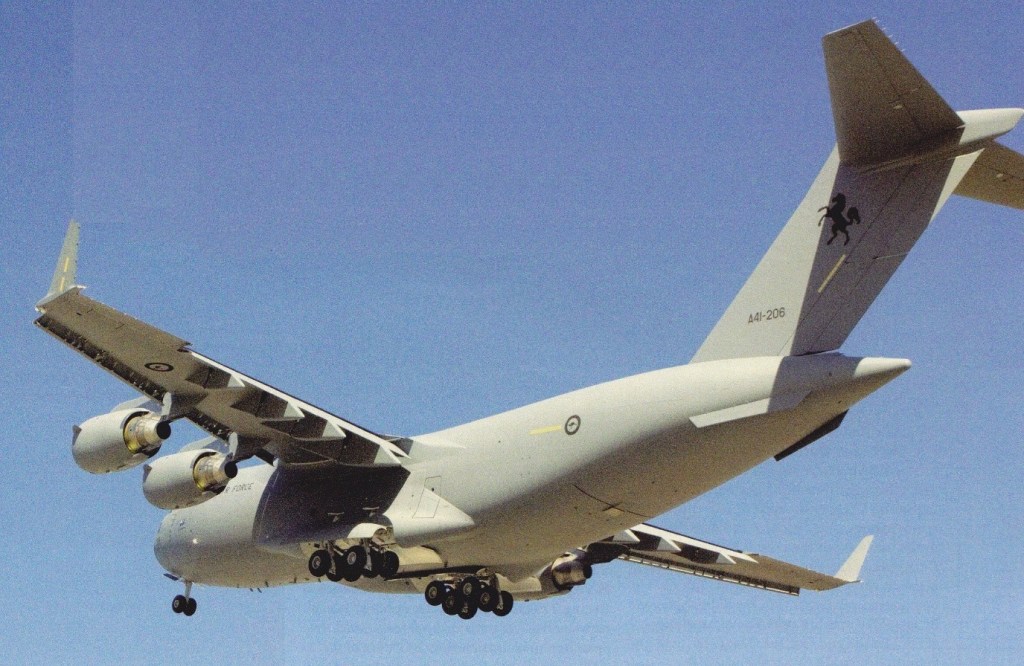
The first Boeing C-17 Globemaster III for the RAAF, A41-206, first flew at Long Beach on 8 November 2006. The Royal Australian Air Force had four C-17 Globemaster heavy transport aircraft.
RAAF A41-206
The first, A41-206, arrived in Australia on 2 December 2006. The RAAF’s second C-17 was handed over at Long Beach on 11 May 2007 and flown to Australia a few days later.





 All Aero