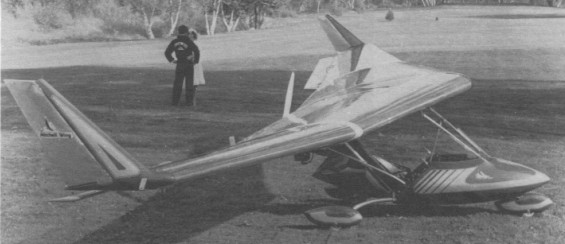
Single seat single engined high wing monoplane with conventional three axis control. Wing has swept back leading and trailing edges, and tapering chord; no tail. Pitch/roll control by stabilators; yaw control by tip rudders; control inputs through stick for pitch/roll and pedals for yaw. Cantilever wing; wing profile; double surface. Undercarriage has three wheels in tricycle formation. Push right go right nosewheel steering connected to yaw control. Aluminium tube framework, with pod. Engine mounted below wing driving pusher propeller.
Shown in December 1982, the A 10 Silver Eagle is an updated version of the B 10 Mitchell Wing, not only as regards detail improvements, but in the technology and type of manufacture. Don Mitchell has abandoned the overhead stick, which comes down from the high wing on the B 10, to replace it with a conventional stick between the pilot’s knees. Materials (wood and fabric) used for the B 10 wing have been superseded by aluminium and a foam developed by NASA called honeyfoam and designated SR 502B, the final B indicating the use of boron.
The A 10 Silver Eagle was sold ready to fly and includes a fairing for the cockpit, wheel fairings on the main wheels, an upholstered seat with shoulder harness and an instrument panel. The price in April 1983 was $5995.
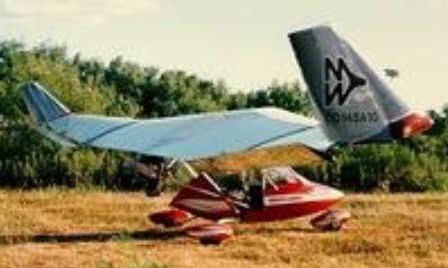
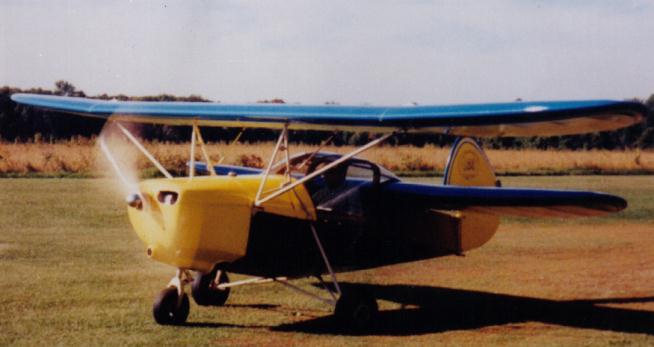
Mitchell Wing A-10
Ameriplanes Inc sold the Mitchell Wing A-10 described as a unique, ultralight motorglder for intermediate and advanced pilots based on Don Mitchell’s Mitchell Wing B-10 hang glider. It is a flying wing design from aluminium. It utilzes a Rotax 277/28 hp engine and was available in kit form for $9400 (does not include engine). Price completed in 2009: 11700 USD
The A-10 was available with a 2SI, A-20 engine and when equiped with same it comes in at 254lbs (the 103 UL limit). Other engines, like the Zenoah G25B-1 were also available.
The Higher Planes A-10 is stressed to +6 and –5.5 G, and the wings fold for transport. The kit price in 1997, without engine, was US$7900.
Engine: Rotax 277, 26 hp Speed max: 70 mph Cruise: 55 mph Range: 200 sm Stall: 28 mph ROC: 800 fpm Take-off dist: 200 ft Landing dist: 200 ft Service ceiling: 12,000 ft Fuel cap: 2.5 USG Weight empty: 280 lbs Gross: 553 lbs Height: 7.33 ft Length: 9.33 ft Wing span: 34.33 ft Wing area: 134 sq.ft Seats: 1 Landing gear: nose wheel
A-10 Silver Eagle Engine: Zenoah G2SB 1, 20 hp at 6500 rpm Toothed belt reduction Max static thrust 165 lb, 75 kg Power per unit area 0.14 hp/sq.ft, 1.58 hp/sq.m Fuel capacity 3.0 US gal, 2.5 Imp gal, 11.4 litre Length overall 8.0ft, 2.43m Height overall 5.6 ft, 1.67m Wing span 34.4ft, 10.46m Chord at root 6.0ft, 1.83m Chord at tip 2.0ft, 0.61m Dihedral 6 deg at tip Sweepback 12 deg Total wing area 136 sq.ft, 12.6sq.m Wing aspect ratio 8.6/1 Nosewheel diameter overall 10 inch, 25 cm Main wheels diameter overall 10 inch, 25 cm Empty weight 250 lb, 113kg Max take off weight 553 lb, 251 kg Payload 303 lb, 138 kg Max wing loading 4.06 lb/sq.ft, 19.8 kg/sq.m Max power loading 27.6 lb/hp, 12.5 kg/hp Load factors +6.0, 6.0 design Max level speed 63 mph, 101 kph Max cruising speed 58 mph, 93 kph Stalling speed 26 mph, 42 kph Max climb rate at sea level 650 ft/min, 3.3 m/s Best glide ratio with power off 18/1 Take off distance 200ft, 60m Landing dis¬tance 200 ft, 60 m
Made plans and some components available for the construction of the Celerity two-seat monoplane, originally designed by Larry Burton and first flown in 1985.
1996: 3936 Austin St, Klamath Falls, OR 97603, USA. 2009: Mirage Aircraft, Inc, 8702 N Silver Moon Way, Tucson, AZ 85743, USA
Codenamed ‘Hermit’ by NATO, the Mi-34 is a two/four-seat light helicopter powered by a piston engine. The first of two prototypes flew for the first time in 1986, and the type was revealed to the West for the first time at the Paris air show in June 1987. First flown on 17 November 1986, two prototypes and a structure test airframe were completed by mid-1987.
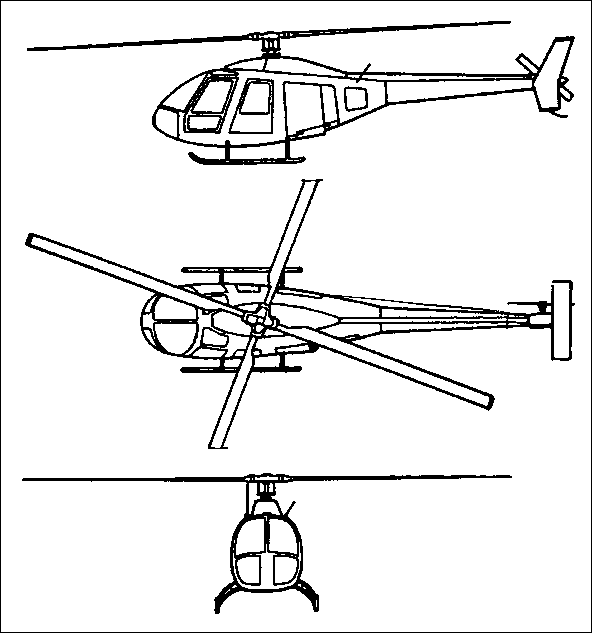
An acrobatic helicopter, it was the first helicopter built in former USSR to perform normal loop and roll. Intended initially for training and international competition flying, it has a conventional pod and boom configuration, powered is from a 325 h.p. Vedeneyev M-14-V26 engine.
Aerobatic capabilities include backwards flight at 130km/h and rotation about main rotor axis at 120 degrees/s. The flying controls are manual, with no hydraulic boost. The semi-articulated four-blade main rotor with flapping and cyclic pitch hinges, has natural flexing in the lead/lag plane. Blades are of GFRP with CFRP reinforcement, attached by flexible steel straps to the head. The two-blade tail rotor is of similar composites construction, on the starboard side. The riveted light alloy fuselage has a sweptback tailfin with small unswept T tailplane.
Landing gear is conventional fixed skids on arched support tubes and a small tailskid protects the tail rotor. One 239kW VOKBM M-14V-26V nine-cylinder radial air-cooled engine is mounted sideways in the centre of the fuselage. Fuel capacity is 176 litres in a system for inverted flight.
The normally one or two pilots, side by side, are in an enclosed cabin, with optional dual controls. The rear of the cabin contains a low bench seat, available for two passengers and offering a flat floor for cargo carrying. There is a forward-hinged door on each side of flight deck and on each side of rear cabin.
The primary electric power is provided by 27V 3kW engine-driven generator. A secondary power supplys 115V AC, 400 Hz, single-phase and 36V AC, 400 Hz, three-phase; 27V 17Ah battery.
The Mi-34S/34C completion was at Moscow plant of LVM, but subsequently reverted to Arsenyev.
Planned completion of 30 in 1994-95 was hampered by a lack of funding, with five delivered in 1995, and one in the first half of 1996.
Trials in 1999 by a civil pilot training school at Omsk showed Mi-34 to be 2.8 times cheaper and more effective to operate than current fleet and the school was to acquire three Mi-34Cs and obtain up to 10 more in long term. In 2001, an upgraded variant was proposed with M-14 engine rated at 272kW, IFR instrumentation and auxiliary fuel tank. An agricultural variant was planned for debut in 2003.
The Mi-34S is the basic version, marketed in Russia as the Mi-34, and certified by the Interstate Aviation Committee Aviation Register (initially at 1,350kg max take-off weight), with helicopter, engine and noise type certificates, meets FAR Pt 27 requirements. (Note that until 1999, all marketing literature for this version used the hybrid Roman/Cyrillic ‘Mi-34C’ to indicate certified status.)
Total of 23 sold and 18 delivered by mid-2002, compared with estimated 425 called for in Russia’s 1992-2000 civil aviation development plan. Had increased to 21 deliveries (from Arsenyev) by March 2003. First three for Mayor’s office, Moscow. Others used by Bashkir Airlines and Mi-Avia for patrol and training. One operated by Bosniac and Croat Federation Air Force. Three delivered to Nigerian Air Force in 2001, along with six Mi-35s; these were from first batch of six Mi-34s built at Arsenyev, after pause of several years; further five delivered to Nigeria by end of 2002. LVM reportedly ordered 20 Mi-34s for construction at Arsenyev in 2001, but only delivery in that year apart from Nigerians was one to Sibneft. In June 2002, Russian sources reported foreign (assumed Nigerian) negotiations for “several dozen” Mi-34s although only known 2003 production commitment is follow-on batch of four for Nigeria and five for Omsk Civil Aviation Flying and Technical College by end of 2005.
Costs: US$400,000, fully equipped (2003).
A twin-engine version is built by the VAZ motor car works at Tolyatti. The Mi-34VAZ features a totally new rotor head made from carbon fibre.
A development was under way to re-engine the Mi-34 with two 164kW VAZ-430 rotary engines normally used to power VAZ cars, and which run on Mogas. First flight of the prototype, designated Mi-34V, was scheduled for 1993.
The Mi-34P (patrulnyi: patrol) is a version of the Mi-34S, equipped for police duties. Renewed interest in 2001 from Gazprom for pipeline patrol.
Mi-34 Engine: 1 x VMKB M-14V-26 Instant pwr: 243 kW Main rotor diameter: 10.0m Tail rotor diameter: 1.48m Overall length, rotors turning: 11.415m Fuselage length: 8.71m Max width: 1.42m Overall height: 2.75m Normal take-off weight: 1280kg Max take-off weight: 1450kg Empty weight: 950kg Max level speed: 210km/h Max cruising speed: 170km/h Service ceiling: 4000m Hovering ceiling, OGE: 900m Range with max fuel at 500m: 356km Crew: ½ Pax: 2 Seats: 4
Mi-34VAZ Engine: 2 x VAZ-430 rotary Instant pwr: 170 kW Rotor dia: 10 m MTOW: 1960 kg Useful load: 550 kg Max cruise: 110 kts Max range: 600 km Crew: 1-2 Pax: 2 Seats: 4
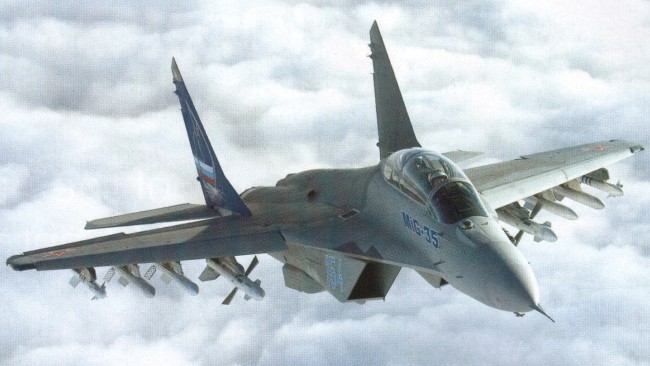
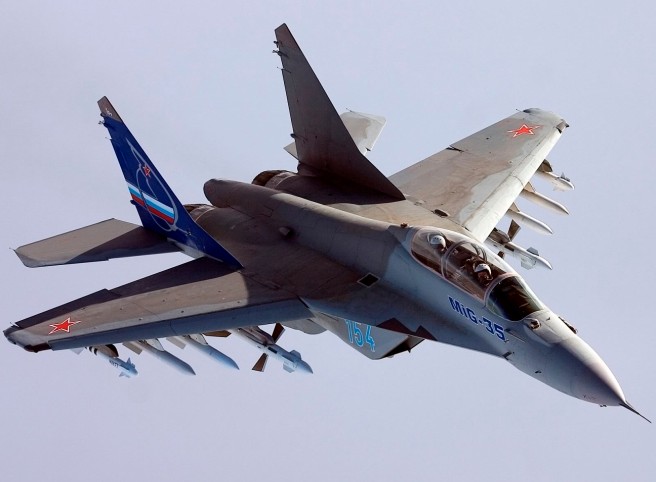
The Mikoyan MiG-35 (Russian: Микоян МиГ-35; NATO reporting name: Fulcrum-F) is a Russian multirole fighter that is designed by Mikoyan, a division of the United Aircraft Corporation (UAC). Marketed as a 4++ generation jet fighter, it is a further development of the MiG-29M/M2 and MiG-29K/KUB fighters.
The MiG-35 is powered by two FADEC RD-33MK Morskaya Osa (Russian: Морская Оса, literally: “Sea Wasp” or Chironex fleckeri) turbofans. The RD-33MK a highly improved variant of the Klimov RD-33 turbofan and was intended to power the MiG-29K and MiG-29KUB. It has 7% more power compared to the baseline model due to the use of modern materials in the cooled blades, providing a higher thrust of 9,000 kgf. In response to earlier criticism, the new engines are smokeless and include systems that reduce infrared and optical visibility. The engines may be fitted with thrust vectoring nozzles, which would result in an increase in combat efficiency by 12% to 15%, according to manufacturer claims.
The RD-33OVT engine variant comes with thrust vectoring nozzles, and can direct thrust in two axis.
The MiG-35 has a glass cockpit equipped with night-vision goggles, an additional display for the optical locator system, and a 3-equal-size color LCD multi-function display. The second-seat version of the MiG-35, the MiG-35D, has 4 LCD displays in its rear cockpit. The MiG-35D uses a tandem cockpit while single-seat versions of the MiG-35 uses the rear cockpit to store extra fuel, while retaining a two-seat canopy.
The MiG-35 is to be equipped with the new Phazotron Zhuk-A/AE active electronically scanned array (AESA) radar, the first radar of this kind installed on a Russian fighter aircraft. The Phazotron Zhuk-A/AE AESA radar offers a wider range of operating frequencies, providing better resistance to electronic countermeasures (ECMs), extended detection range and more air and ground targets detected. The FGA-35 radar type, featured 688 mm antenna and 1016 T/R modules (originally planned 1064) with initial stage performance of a 200 km detection range for 3m2 RCS target. Later detection range was raised up to 250 km. It can track up to 30 targets at any time, engaging up to 6 air targets at once, or 4 ground targets at once.
For detection of targets in the infrared spectrum, the MiG-35 is equipped with the OLS-UEM (13SM-1) electro-optical targeting station with lookdown capability against ground, sea and air targets. Its forward-looking infrared (FLIR) sensor is capable to detect airborne threats up to 55 km and provides coverage in azimuth of +/- 90-degree and +60-degree to −15-degree in elevation. There is also the OLS-K/OLS-KE podded electro-optical targeting system mounted under the right engine nacelle. It is designed to search, detect and track ground and sea targets. The system consists of infrared sensor and TV camera and is capable to detect ground targets up to 20 km and sea targets up to 40 km.
To protect the aircraft against current and future surface-to-air (SAM) missiles, the MSP-418KE compact active jammer pod can be mounted on any of the aircraft nine hardpoints.
The first prototype was a modification of the aircraft that previously served as a MiG-29M2 model demonstrator.
The single-seat version is designated MiG-35S and the two-seat version MiG-35UB. The fighter has vastly improved avionics and weapon systems, notably new precision-guided targeting capability and the uniquely designed optical locator system, which relieves the aircraft from relying on ground-controlled interception systems and enables it to conduct independent multirole missions. There is also an option for AESA radar.
First flying on 7 February 2007, Russia unveiled the MiG-35 at the 2007 Aero India air show in Bangalore, amid Moscow’s keenness to sell these planes to India. The MiG-35 was ousted from the contest in April 2011.
In May 2013, it was reported that Russia intended to order 37 aircraft. However, in August 2013, the Russian Defense Ministry reported that the purchase worth 37 billion rubles ($1.1 billion) will be delayed until 2016 due to the spending cuts in the state arms program for 2014–2016. The state tests of the MiG-35 was to begin in 2017 with completion in mid-2018 after the serial production of the aircraft would started.
During 2016, first two pre-production aircraft were in active phase of construction at the Production Center No.1 in Lukhovitsy. Both aircraft were delivered at the end of the year.
In July 2017, during the MAKS 2017 International Aviation and Space Salon, the Russian Defence Ministry agreed it will buy 24 MiG-35s as a part of the new state armament program for 2018–2027, although 37 aircraft were previously planned. Six out of the 24 MiG-35s will replace the aging MiG-29s of the Russian aerobatic team Swifts.
On 22 August 2018, during the International Military-Technical Forum «ARMY-2018», the first contract for six MiG-35s was signed.
By April 2010, pictures and additional information surfaced of two new MiG-35 demonstrators, the single-seat MiG-35 “961” and the two-seat MiG-35D “967”. According to Russian media, they first flew in autumn of 2009, and subsequently took part in MMRCA trials in India in October 2009. Both have a very high commonality with the previous MiG-29K/KUB airframes, an immediate visible difference being the braking parachute installed in place of the hook, present on the naval aircraft. Subsequently, the MiG-35D “967” appears to have been equipped with a similar AESA radar as fitted to the older MiG-35 demonstrator “154”, identifiable by the dark grey short nose radome.
On 6 September 2016, according to the general designer of the United Aircraft Corporation Sergei Korotkov, first MiG-35s were to be delivered in November 2016 to the Russian Air Force for flight testing to confirm the technical characteristics of the aircraft. First of the two aircraft, single-seat MiG-35 “702” made its first flight on 24 November 2016, followed by double-seater MiG-35UB “712” in December 2016.
On 28 January 2017, MiG officially demonstrated one of the two pre-production aircraft, MiG-35UB “712”, to the Russian government, followed by subsequent demonstration for export customers on the next day. The newly presented MiG-35 showed to be a bit different with the one unveiled in 2007, the aircraft allegedly lacked the AESA radar as well as thrust vectoring control, supposedly to keep procurement cost low to attract foreign customer.
In February 2017, it was announced a contract was signed to build another two aircraft that would join the testing.
In February 2018, MiG Aircraft Corporation announced that it had completed factory trials of the MiG-35, the certificate of the trials completion having been signed in December 2017. In May 2018, head of the United Aircraft Corporation Yuri Slyusar reported, state trials of the MiG-35 had begun. In April 2019, another MiG-35UB “11”, first took off to join the testing. This is first of the two additional pre-production aircraft for which contract was signed in February 2017.
On 17 June 2019, Russian Aerospace Forces has received first two serial MiG-35S fighters, marking the introduction of the variant into service.
The MiG-35/MiG-35D incorporate advancements of the MiG-29K/KUB and MiG-29M/M2 fighters in combat efficiency enhancement, universality and operational characteristics improvement. The main features of the new design are the fifth-generation information-sighting systems, compatibility with Russian and foreign weapons applications and an integrated variety of defensive systems to increase combat survivability. The new overall design overtakes the design concepts of the baseline model and enables the new aircraft to conduct full-scale multirole missions as their western counterparts.
New avionics includes the Phazotron Zhuk-AE active electronically scanned array (AESA) radar, the RD-33MK engines and the newly designed optical locator system, OLS-35. The number of weapon stations has increased to 10, flight range has increased by 50%, and radar visibility has been reduced.
The final configuration of the MiG-35’s onboard equipment has been left open intentionally using the MIL-STD-1553 bus. Weight load 7 tons (twice the weight load of the MiG-29).
United Aircraft Corporation subsidiary Russian Aircraft Corporation (RAC) MiG developed an export-oriented variant of its Mikoyan-Gurevich MiG-35 multirole combat aircraft (MCA), which was unveiled at the MAKS 2019 aerospace show held in Zhukovskiy close to Moscow from 27 August to 1 September.
The MiG-35 export version is a 4++ generation MCA “made using some fifth-generation aircraft technologies”. The platform has been fitted with a nose-mounted radar with an active electronically scanned array (AESA), as well as an electro-optical search-and-track system installed under the fuselage for employment against land targets.
The upgraded MiG-35 has a maximum take-off weight of 24,500 kg and is powered by two 9,000 hp RD-33MK afterburning jet engines, producing a top speed of 2,100 km/h and a service ceiling of 16,000 m. “The platform also features a modular design, allowing integration of new electronic subsystems, including of foreign origin,”. Installation of a PAZ-MK refueling pod allows the platform to be employed as a tactical aerial tanker.
The MiG-35 export version has received a Russian-designed helmet-mounted target designation system and head-up display. Its armament suite comprises RVV-AE air-to-air, Kh-35UE anti-ship, and Kh-38MLE air-to-surface missiles, KAB-500 guided bombs, and various free-fall bombs.
According to the General Director of Mikoyan, Ilya Tarasenko, a carrier-based version of the MiG-35 was under development. The Radioelectronic Technologies Concern (KRET) has already adapted a new landing system to the BINS-SP-2 deck for the MiG-35.
MiG-35 Single-seat variant Engines: 2 × Klimov RD-33MK afterburning turbofan engines, 53 kN (12,000 lbf) thrust each dry, 88.3 kN (19,900 lbf) with afterburner Wingspan: 12 m (39 ft 4 in) Length: 17.3 m (56 ft 9 in) Height: 4.73 m (15 ft 6 in) Wing area: 38 m2 (410 sq ft) Empty weight: 11,000 kg (24,251 lb) Gross weight: 17,500 kg (38,581 lb) Max takeoff weight: 29,700 kg (65,477 lb) Maximum speed at altitude: 2,400 km/h (1,500 mph, 1,300 kn) Maximum speed at sea level: 1,450 km/h (900 mph; 780 kn) / M1.7 Maximum speed: Mach 2.2 Range: 2,400 km (1,500 mi, 1,300 nmi) Combat range: 1,000 km (620 mi, 540 nmi) Ferry range 3 external fuel tanks: 3,100 km (1,900 mi, 1,700 nmi) Ferry range with aerial refuelling: 6,000 km (3,700 mi; 3,200 nmi) Service ceiling: 19,000 m (62,000 ft) g limits: +10 Armament: 1 × 30 mm Gryazev-Shipunov GSh-30-1 autocannon with 150 rounds Hardpoints: 9 with up to 6,500 kg Crew: 1
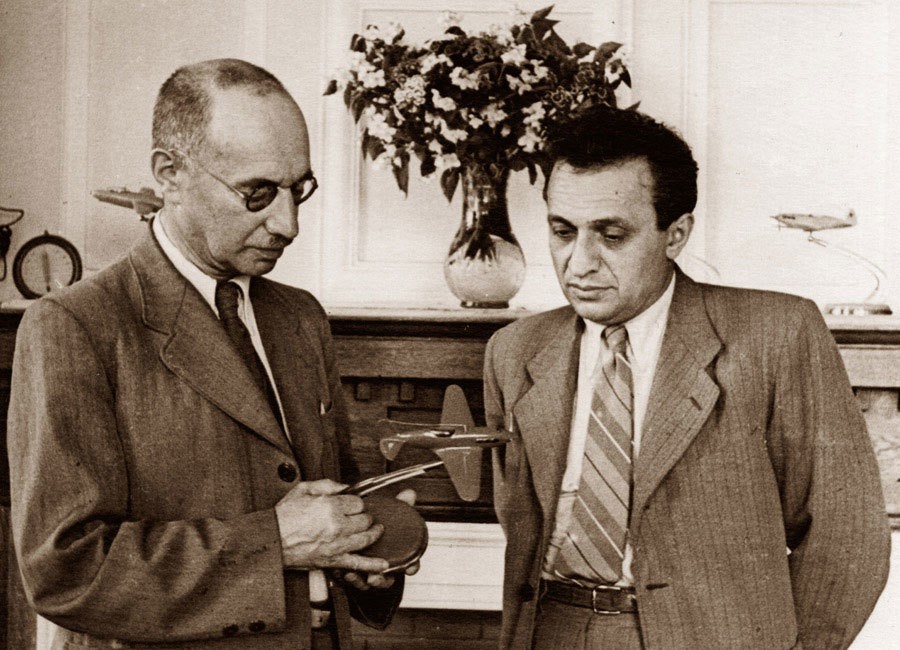
Mikhail Iosifovich Gurevich and Artem Ivanovich Mikoyan with a model of the MiG-3 fighter
A. Mikoyan and G. Gurevich design bureau established December 1939; still operating in 1990 as MAPO “MiG” as part of MIG “MAPO-M” organization, although Gurevich retired in early 1960s and Mikoyan died December 9,1970.
MiG-1 fighters with AM-35 engine produced 1940-1941; developed MiG-3 produced until 1942. First jet aircraft built in quantity was MiG-9 with twin RD-20 (BMW 003A) engines, flown 24 April 1946. Swept-wing MiG-15 with Russian copy of Rolls-Royce Nene introduced 1947, built under license in Czechoslovakia and Poland. Followed by approximately 9,000 of derived MiG-17, with redesigned wing, manufactured 1950-1957. Twin Mikulin AM-5-powered MiG-19 flown September 1953, built under license in Czechoslovakia, Poland, and China. Superseded by delta-winged MiG-21, in service in the USSR from 1959 and, when built in India, was first Russian aircraft manufactured in non-communist country.
Col-Gen Mikoyan died in 1970.
As ANPK “MiG” named after A.I. Mikoyan Aviation Scientific- Production Complex, produced MiG-23 (4,278 constructed 1969-1985; also built in India) and MiG-27 (over 900 between 1973 and 1983) related variable-geometry fighter and ground-attack aircraft, MiG-25 Mach 2.8+ reconnaissance aircraft and interceptor (some 1,200 built up to 1985), and MiG-31 long-range interceptor (about 400, operational from 1983).
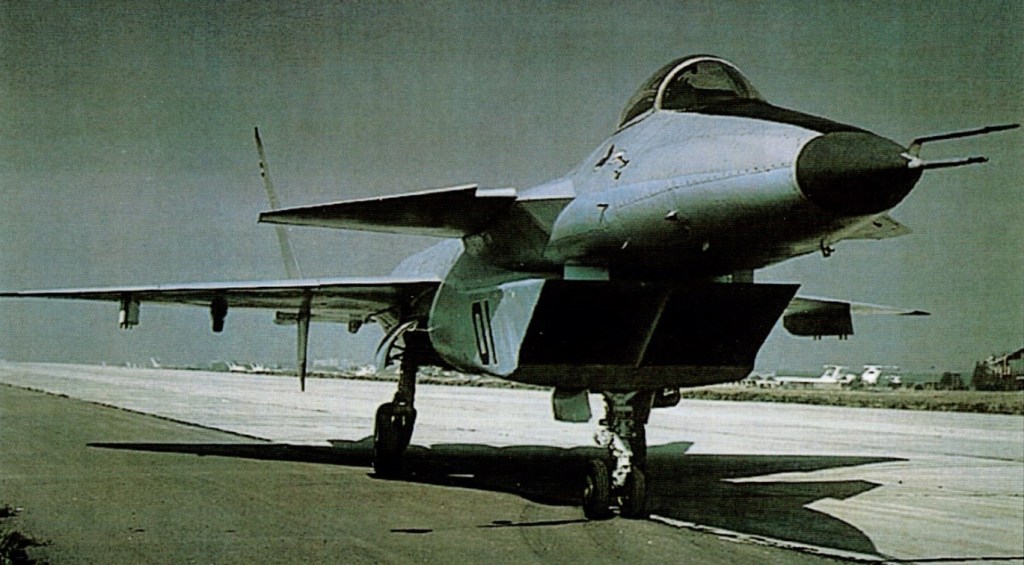
MAPO ‘MiG’ produced MiG-21 upgrade as MiG-21 -93, MiG-29 Fulcrum lightweight close-air-combat fighter (first flown October 1977 and over 1,500 built, serving since 1983), improved MiG-29M (first flown April 1986) and MiG-33 export version, MiG-29K shipborne fighter prototype (first flown July 1988, first landing on aircraft carrier Admiral KuznetsovNovember 1989, and development restarted in 1996 after earlier program halt), MiG-35 multirole fighter (first flight 1999?), MiG 1-44 uniquely configured newgeneration combat aircraft (first seen February 1999), and MiG-AT/UTS/AC series of advanced and combat trainers. MiG-301/321 are reported hypersonic reconnaissance aircraft, thought to be under development. Also developing MiG-110 light multipurpose transport and MiG-115 and MiG-125 transports.
Migavia – the first national aircraft manufacturer in Russia aircraft corporations. RAC “MiG” is integrated company in which all technologies of design, production and improvement of aircraft are collected together in one legal frame. Corporation Migavia holds the shares of other corporations which are included into the complex of firms developing and producing the aircraft engines.
Mignet Do Brasil was formed early 1950s to build Mignet H.M.310 Estafette two-seat modernised version of the designer’s earlier Pou-du- Ciel light aircraft. A new development flown 1951 with Continental A90 engine.
The HM 360 is a single seater with very detailed plans in French, and English translation manuals supplied. The HM 380 is a two seater side-by-side, with a wood fuselage. It is supplemental to the HM 360 set, redrawn in English, with added detail.
Options include Cosandey flap, ailerons, swept fin & rudder, tricycle gear and HIPEC® covering.
The HM380L is a set of plans in English for a steel tube fuselage version of the 380. Instructions are on plans. Flap plans included (Cosandey flap not required). Set is very complete showing engine installation, fuel system, wiring diagram, exhausts, engine mount, full size wing ribs, tailwheel, main undercarriage (Wittman type), etc. Hardware is AN standard. Materials are SAE and US standard. The Ladybug 380L ia a 2 seat side by side tandem wing aircraft that is great for training and familiarization for these type of aircraft.
The two seaters are flown from the front.
A considerably modified version of the two-seat HM.380 was developed by Mr Lederlin in France as the Lederlin HM.380L Ladybug. The prototype of this version on 14 September 1965, powered by a Continental C90.
Prototype Lederlin HM.380L Ladybug, Old Warden 1973.
Falconar Mignet HM 360 plans cost US$150 in 2010, with the 380 supplemental plans and additional US$50. Falconar 380L Ladybug plans sold for US$175 in 2010.
On June 30, 2019, Falconar Avia Inc closed for business and assets dissolved. The Master Sets (Original Drawings, Plans, Info Kits, Documentation) were available for sale and full transfer of rights included the MIGNET HM 360, HM 380, and 380 L for $2500 USD.
Mignet HM 360 Engine: 60 hp Continental or similar Cruise speed: 80mph Empty weight: 390 lbs Wing Span: 21 feet Gross weight: 700 lbs Wing span folded: 8 feet
HM 360 Engine: Continental, 65 hp. HP range: 65-100. Length: 13 ft. Wing span: 21 ft. Wing area: 138 sq.ft. Weight empty: 390 lbs. Gross: 700 lbs. Fuel cap: 14 USG. Cruise: 95 mph. Range: 330 sm. Stall: 28 mph. ROC: 1500 fpm. Take-off dist: 130 ft. Landing dist: 130 ft. Seats: 1. Landing gear: nose or tail wheel.
HM360 Engine: Continental C-65, 65 hp HP range: 65-100 Height: 6 ft Length: 13 ft Wing span: 21 ft Wing area: 138 sq.ft Empty weight: 390 lb Gross weight: 700 lb Fuel capacity: 14 USG Top speed: 124 mph Cruise: 95 mph Stall: 28 mph Range: 330 sm Rate of climb: 1000 fpm Takeoff dist: 130 ft Landing dist: 130 ft Seats: 1-2 Landing gear: nose or tail
Mignet HM 360 Engine: 100 hp Continental or similar Cruise speed: 100 mph Empty weight: 390 lbs Wing Span: 21 feet Gross weight: 700 lbs Wing span folded: 8 feet
Mignet HM 380 Engine: 60 hp Continental or similar Cruise speed: 80mph Empty weight: 580 lbs Wing Span: 27 feet Gross weight: 1100 lbs Wing span folded: 10 feet
HM380 Engine: Continental C-65, 65 hp HP range: 65-100 Height: 6 ft Length: 13 ft Wing span: 21 ft Wing area: 138 sq.ft Empty weight: 390 lb Gross weight: 700 lb Fuel capacity: 14 USG Top speed: 124 mph Cruise: 95 mph Stall: 28 mph Range: 330 sm Rate of climb: 1000 fpm Takeoff dist: 130 ft Landing dist: 130 ft Seats: 1-2 Landing gear: nose or tail
HM 380 Engine: Continental C-90, 90hp.
Mignet HM 380 Engine: 100 hp Continental or similar Cruise speed: 100 mph Empty weight: 580 lbs Wing Span: 27 feet Gross weight: 1100 lbs Wing span folded: 10 feet
Development has continued since World War 2, the basic post war single seat version being the HM-290 with a 25 hp Poinsard engine.
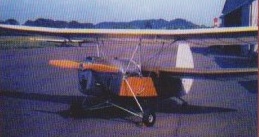
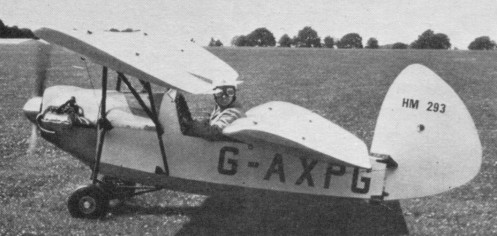
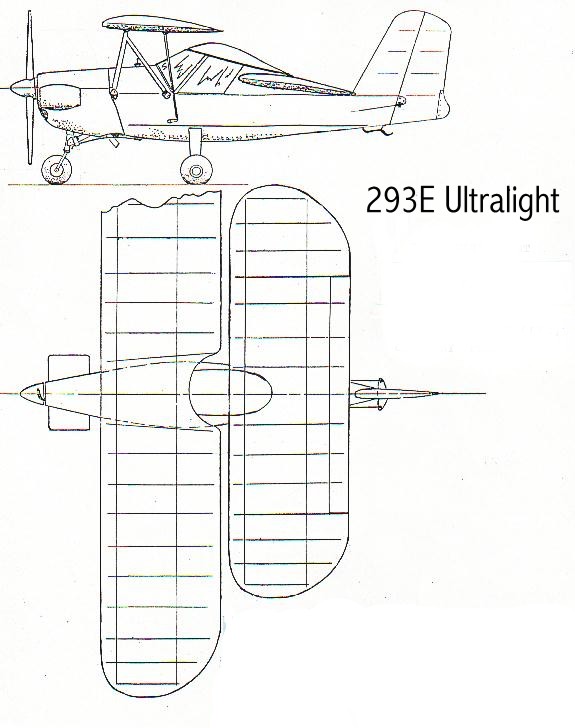
The HM 290 Series included: F293E ultralight model- for medium size pilot F295E ultralight model- for medium size pilot (with simplifications) HM290 amateur built model – for small pilot HM293 amateur built model – for medium size pilot
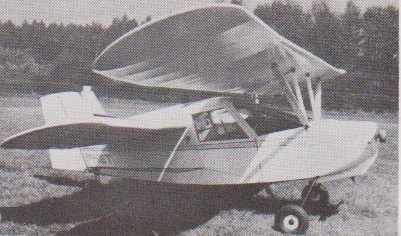
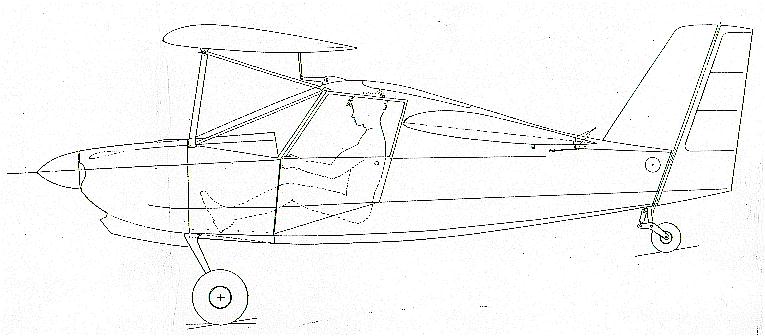
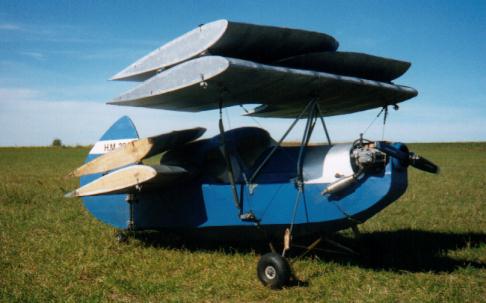
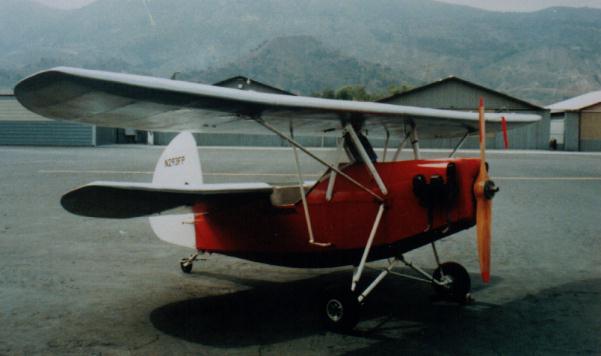
HM293
These tandem wing aircraft feature a large speed range, stall resistant, and spin proof. Both wings lift and being small size, minimal space is needed to build. Landing gear arrangement: tail dragger or tri-gear. Options include swept fin and rudder.
Falconar devised design changes for easier construction, modern materials, Delrin bearings, tri-gear and HIPEC® covering.
Rodolphe Grunberg has redrawn the 1940s HM.293 plans, updated them for 1990s materials, and fitted new light weight engines. Over 40 Grunberg HM.293s were reported either flying or close to completition in France in 1998.
Rodolphe Grunberg HM 293
In 2010 Falconar MIGNET “Flying Flea” plans cost: HM290E, HM293E, HM290, HM293 cost US$65. Falconar Avia produced kits as an LSA.
HM 293
On June 30, 2019, Falconar Avia Inc closed for business and assets dissolved. The Master Sets (Original Drawings, Plans, Info Kits, Documentation) were available for sale and full transfer of rights included the MIGNET “Flying Flea” HM 290/293, 290/293 E, F295 E, and 295 F for $4500 USD.
“Flying Flea” HM 290E/293E ULTRA LIGHT Engine: 25/30 hp Hirth or Rotax Cruise speed: 60 mph Length: 13 ft Empty weight: 246 lb Gross weight: 476 lb Wing span: 20 ft
HM290/HM293 amateur built Engine: 50/60 hp Little Demon (VW) or similar Cruise speed: 90 mph Length: 12-13 ft Empty weight: 360 lb Gross weight: 580 lb Wing span: 18-20 ft
HM290/293 Engine: VW, 60 hp HP range: 50-60 Height: 5.5 ft Length: 13 ft Wing span: 20 ft Wing area: 113 sq.ft Cruise: 90 mph Stall: 28 mph Range: 300 sm Rate of climb: 800 fpm Takeoff dist: 150 ft Landing dist: 150 ft Fuel capacity: 10 USG Empty weight: 350 lb Gross weight: 600 lb Seats: 1 Landing gear: nose or tail
HM 293 Engine: VW, 60 hp Speed max: 110 mph Cruise: 90 mph Range: 300 sm Stall: 28 mph ROC: 1400 fpm Take-off dist: 150 ft Landing dist: 150 ft Fuel cap: 10 USG Weight empty: 350 lbs Gross: 600 lbs Height: 5.5 ft Length: 13 ft Wing span: 20 ft Wing area: 113 sq.ft Seats: 1 Landing gear: nose or tail wheel.
Falconar Avia 290E/293E Engine: Kawasaki, 30 hp HP range: 25-35 Length: 13 ft Wing span: 20 ft Wing area: 117 sq.ft Empty weight: 246 lb Gross weight: 476 lb Fuel capacity: 5 USG Cruise: 55 mph Stall: 28 mph Range: 290 sm Rate of climb: 500 fpm Takeoff dist: 180 ft Landing dist: 150 ft Cockpit width: 23 in Landing gear: nose or tail
Rodolphe Grunberg HM 293 Engine: 30-40 hp Wing span: 6.10 m Wing area: 12 sq.m MAUW: 250 kg Empty weight: 117 kg Fuel capacity: 30 lt Max speed: 130 kph Cruise speed: 90 kph Minimum speed: 30 kph Seats: 1 Plan price (1998): 295 Fnc
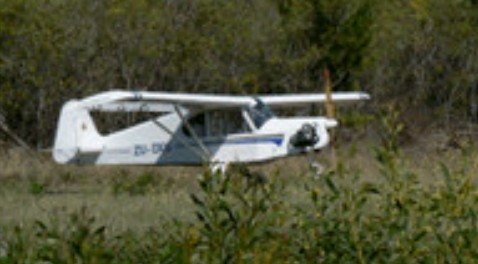
The Cubby is 75% of the original J-3 Piper cub. With modern materials and technology the performance has been improved, and the Cubby uses automotive fuel as opposed to AVGAS.
The Cubby can be registered as a three axis micro-light or a non type certified light aircraft. The Cubby was available in tri-gear or tail dragger. The 2009 Price was dependable on the choice of engine. The option to have the Cubby interchangeable between tri-gear and tail dragger was also available on request as an option.
The factory is up to CAA standards. All upgrade and changes requested by CAA has been done and communicated to all Cubby owners. All correspondence of changes and upgrades are posted to Cubby owners with a newsletter.
Tri-Cubby
There were 26 flying in South Africa and 3 on order. The Cubby was available in kit form, fast built and basic kit, or as ready to fly or fully built but without engine, radio and instruments.
Cubby Stall: 40 kt / 46 mph / 74 kmh Cruise: 74 kt / 85 mph / 137 kmh VNE: 113 kt / 130 mph / 209 kmh Empty Weight: 260 kg / 573 lbs MTOW Weight: 500 kg / 1102 lbs Climb Ratio: 1200 ft/min / 6 m/s Take-off distance (50ft obstacle): 660 ft / 200 m Landing distance (50ft obstacle): 820 ft / 250 m
Tri-cubby Stall: 45 kt / 52 mph / 83 kmh Cruise: 100 kt / 115 mph / 185 kmh VNE: 130 kt / 150 mph / 241 kmh Empty Weight: 260 kg / 573 lbs MTOW Weight: 500 kg / 1102 lbs Climb Ratio: 1200 ft/min / 6 m/s Glide Ratio: 10:1 Take-off distance (50ft obstacle): 330 ft / 100 m Landing distance (50ft obstacle): 490 ft / 150 m
Turbomeca was founded August 29, 1938 by Joseph Szydlowski and André Planiol following their patent of a supercharger in 1937. Hispano-Suiza ordered a demonstrator to equip its 12 Y engine, used among others on the MS 405 C1.
Turbomeca changed rapidly from an artisanal production to an industrial one benefiting from the politics of re-armament. This is shown by the production figures of the following three years: 18 compressor in 1938, 300 in 1939 and 1200 in 1940. Although the factory at Mézières-sur-Seine was only really operational in June 1940, the government advised the move to the south of France due to the German advance. During the same month, Turbomeca had relocated in newly requisitioned workshop in Saint-Pé-de-Bigorre near the Hispano-Suiza engine factory in Tarbes. The buildings were found to be too small and in 1941 a place is bought in Bordes near Pau. Between the autumn of 1941 and June 1942 Turbomeca moved. In November 1942, Szydlowski fled to Switzerland. Between October 1942 and 1944, the production stale and the workforce went from about 300 to about 50.
From 1950, Turbomeca produced the tiny centrifugal flow Palas turbojet, producing 1.6 kN (353 lbf). The Palas was also produced by Blackburn and General Aircraft in the UK and Continental in the USA. From 1957, it manufactured the Bastan turboprop for the Aérospatiale N 262 airliner. Blackburn had a licence for producing other Turbomeca designs.
Rolls-Royce Turbomeca Limited was established in 1968 to develop the Adour jet engine for the Anglo-French SEPECAT Jaguar. The company went on to develop the RTM322 turboshaft, which powers Westland WAH-64, and some models of the AgustaWestland EH101 and NHI NH90.
In 2001 Turbomeca and Rolls-Royce won a $1 billion USD contract to equip 399 German, French and Dutch NH90 helicopters with their RTM322 engines.
SNECMA Group acquired the company in September 2001.
Headquarters: Bordes, France Revenue (2006): € 870 million Employees (2006): 5,178
As of 2012, Turbomeca turbines power civil, parapublic and defence helicopters for all the leading helicopter manufacturers (mainly Eurocopter, but also AgustaWestland, Sikorsky, NHI, Kamov, HAL).
Engines of Microturbo:
Palas SG 18 TRS 18 TRS 25 TRI 40 TRI 60 TRI 80 J403 Cougar Eclair Eclair II Lynx


 All Aero