New Zealander Garry Morgan formed Morgan Aero Works in Australia in 2002, having come from a background of model aircraft building. His first design was the Cheetah and this was further developed into the Cheetah Sierra 100. Further designs followed including the single seat Diamond, the two seater Cheetah Sierra 200 and the Joey Mk II, and the 4 seater Cougar.
Garry Morgan sold Morgan Aero Works in 2016 to Wedgetail Aircraft Pty Ltd which was formed by Ray Tolhurst and which is based at Camden Airport in NSW. Wedgetail Aircraft offer the Cheetah Sierra 200 and the Cougar, as well as the single seat Vampire.
On October 20, 2017, Tom Morgan of Bristol, England reached heights of 8,000 ft (2,438m) using 100 color helium balloons and has flown 25 km (15.5 miles) over South Africa.
Mooney Aircraft formed July 1946 at Wichita, Kansas, USA. Moved to Texas in 1953. M-20 four-seat version first flown August 10,1953. Merged with Alon Inc. in October 1967. A variety of problems had run the company mil¬lions of dollars into debt, and in 1969, it was taken over by American Electronic Laboratories. Became Aerostar Aircraft Corporation on July 1,1970, renamed Mooney Aircraft Corporation October 1973. Then Butler Aviation International bought the operation, thinking to combine the three most popular Mooneys the Ranger, Chaparral and Executive with the twin engine Aerostar line, the product of still another company that had been taken over by Butler. Mooney might finally have come to an end in 1971 when Mooney quietly closed the doors and shut down production. The company and its airplane lay dormant for a full three years before Republic Steel, in an unexpected diversification, acquired all rights to the Mooney line in October 1973 and resumed production at the old facility in Kerrville, Texas. In 1976, Republic continued to produce the Ranger, Chaparral and Executive. 1979: Mooney Aircraft Corporation, Subsidiary of Republic Steel, Kerrville, Texas 78028, USA. Mooney’s 10,000th aircraft built 1994. In 2001 the Mooney Aircraft Corp filed for bankruptcy, but in 2002 Advanced Aerodynamics & Structures took over the Mooney Aircraft Corporation. Mooney Mite Aircraft Corp., Box 3999, Charlottesville, VA 22903, USA
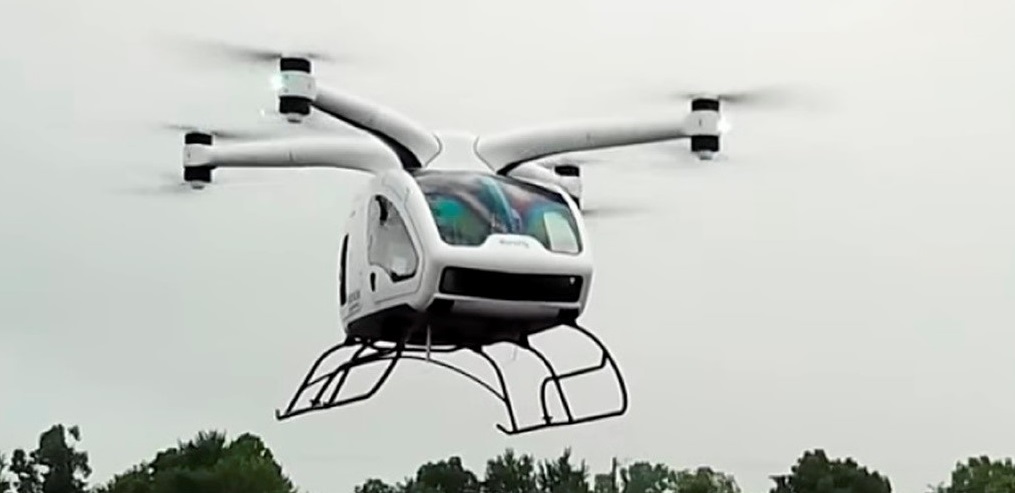
On 30 April 2018 the Moog Surefly flew its first flight. The configuration of the Surefly is four arms with the counterrotating propellers are mounted above the aircraft instead of close to the ground.
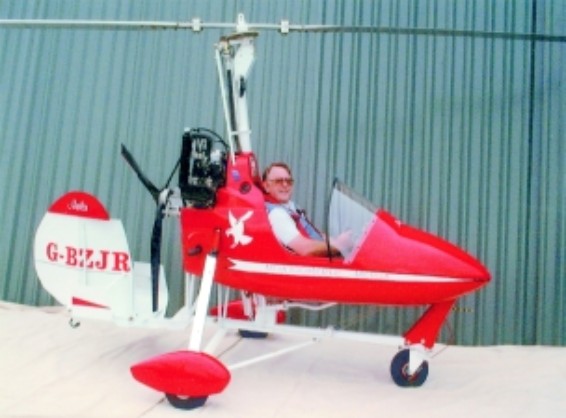
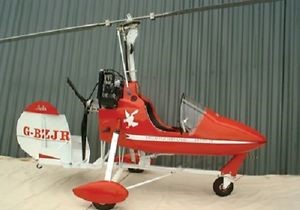
Bensen’s Gyrocopter is the design-ancestor to the Merlin’s bolted 2×2 aluminum tube frame and streamlining is the modern Merlin’s anthem. Two fuel tanks are foamed in place behind the pilot and together hold 11 US gal. Partially enclosed, it has capacity for one. Sprung main wheel suspension struts w/intergral gas shock absorbers.
2001 Kit price without engine, rotors, propeller or instruments: approximately $5338.98 (U.S. dollars). Kits were supplied to the US market less rotors, gimbal head, engine, propeller and instruments.
Jim Montgomery’s design was produced by Layzell Gyroplanes of Quedgeley, Gloucester. The aircraft was supplied as a kit for amateur construction. After taking over Montgomery’s design, company owner Gary Layzell expressed an interest in further developing the Merlin, but initially produced it unchanged.
The aircraft fuselage is made from bolted-together square aluminum tubing. Its 7.01 m (23.0 ft) diameter Rotor Flight Dynamics rotor has a chord of 18 cm (7.1 in).
The type remained in production by Layzell through 2011, although by July 2012 the company website had been removed from the internet. The unit cost in 2011 was £12,761.
By January 2013, 28 examples had been registered in the United Kingdom with the CAA as Montgomerie-Bensen B8MR.
Sonex, Ltd. is a kit manufacturer in Oshkosh, Wisconsin. Their original design, the all-metal, two-seat Sonex single engine monoplane morphed into the V-tailed Waiex. Add a 45′ wingspan to that airplane, and a motorglider, the Xenos, is born. The company boasts the talents of John Monnett, creator of the Monerai sailplane and the Moni motorglider.
Designed by John Monnett as a simple airframe and power plant to create a fun VFR machine. A basic and economical all metal, two place monoplane with a hp range of 80-120. With all the metal except the main spar, pop-riveted, options include nose or tail wheel.
Designed to meet the needs of the European and Domestic sport aircraft markets, it can incorporate various light weight engines of 80 to 120 hp (engine package weight of less than 200 lbs.), and is perfectly suited to the new US Sport Pilot/LSA regulations. The three recommended powerplants include the 2180cc Volkswagon, 2200 Jabiru, and 3300 Jabiru.
Performance is achieved through its clean aerodynamic shape and simple, light weight construction. The Sonex plans contain many options, including a tailwheel or tricycle landing gear along with a center or dual stick. Motor mount drawings are supplied for all three recommended powerplants.
The Sonex features easily removable wings for transport and storage.
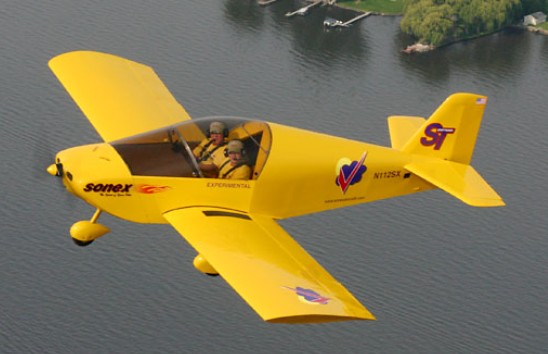
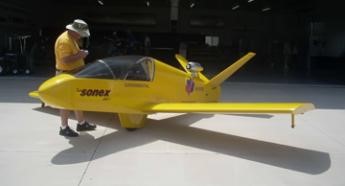
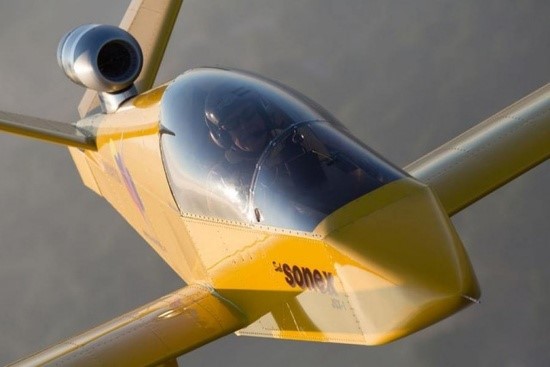
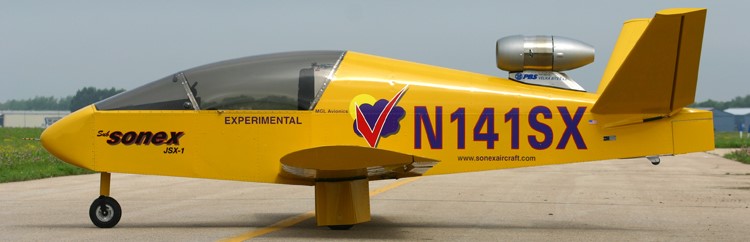
The SubSonex jet aircraft prototype, JSX-1, made its first flight on August 10, 2011 at Wittman Airport in Oshkosh, Wisconsin. Piloted by Bob Carlton, the flight lasted approximately 14 minutes and focused on low-end speed, including stalls and low approaches in the landing configuration. The engine selected for the SubSonex is the Czech-built PBS TJ-100 turbojet.
Through the course of a series of high-speed taxi tests, Sonex design team has identified some issues with controllability of the aircraft in the transition phase approaching takeoff speeds, and has decided to enter a thorough design review process aimed at making the aircraft easier to handle for the average recreational pilot.
The Subsonex originally sported a tandem landing gear with outrigger gear on each wing tip. Due to the increased power offered by the new PBS TJ-100 engine selected for the SubSonex, it was determined that a tricycle gear configuration would be needed to increase yaw stability on the ground in the transition phase approaching takeoff speeds.
SubSonex personal Jet aircraft
During Air Venture 2010, it was presented with the new fixed tricycle landing gear and the PBS TJ-100 turboJet engine.
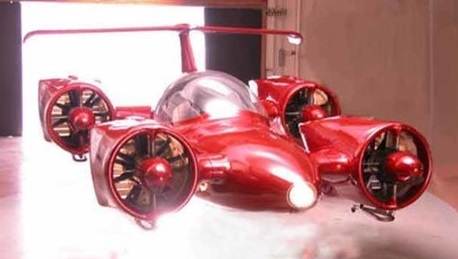
The Moller M400 Skycar is a flying car that promised to let you take off from your backyard and fly to your destination at 350 mph. Paul Moller won’t give up on his 50-year, $150 million quest to make his vision for a flying car a reality.
The M400 Skycar was developed over many years and first flown in 2001 at the company’s shareholder meeting. It has since flown (under a restricted environment) many times. This vehicle was featured on the covers of Popular Science, Popular Mechanics, and the topic of countless news articles and broadcasts including 60 Minutes, ABC, Bloomberg, CNN, and Discovery Channel.
In July 2017, Moller International listed the 2001 M400 prototype on eBay at the starting bid of $1 million. The more impatient bidder could have used the Buy It Now option for $5 million. The listing attracted no bidders. The M400 was relisted, this time with an opening bid of $250,000.
A collector who buys the M400 will receive it in its original 2001 flight form and condition, complete with eight Rotapower engines that produced over 720 hp allowing the M400 Skycar to take off and land vertically. It should be noted, however, in this original form, it does not have FAA approval and a condition of this offer is that it cannot be flown. Nonetheless, this vehicle can be the centerpiece of any car or aircraft collection in a public or private museum.
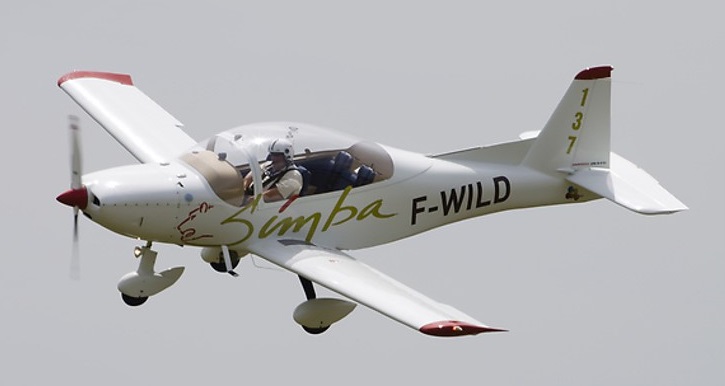
Designed by Philippe Moniot, the 2009 APM 40 Simba: prototype was built by Rex Composites. It is a derivative of the 2-seater APM 20 Lionceau and 3-seater APM 30 Lion.
The Issoire APM 40 Simba is a four-seat light aircraft manufactured by Issoire Aviation. It is entirely built from carbon-fiber-reinforced polymers. The aircraft’s first flight was on 19 May 2009, and it made its public debut at the Paris Air Show in June 2009.
The 2017 APM 41 Simba is the APM 40 re-powered with a 140 hp Rotax 915iS.
The APM 50 Nala is an aerobatic derivative of the APM 41.
The APM 51 Cheelaar is a multi-purpose APM 41 derivative intended for surveillance, training, etc.
APM 40 Engine: Teledyne Continental Motors IO-240F, 93 kW (125 hp) Wingspan: 8.66 m (28 ft 5 in) Length: 7.7 m (25 ft 3 in) Empty weight: 490 kg (1,080 lb) Max takeoff weight: 1,000 kg (2,205 lb) Cruise speed: 220 km/h (140 mph, 120 kn) Range: 700 km (430 mi, 380 nmi) Crew: 1 Capacity: 3 passengers
APM 41 Simba Engine: Rotax 915iS, 140 hp Wingspan: 8.66 m (28 ft 5 in)
JA21MJ Mitsubishi MRJ-90 at Nagoya Komaki on 15th September 2016
In 2003 the Japanese government started a five-year, ¥50 billion ($420 million) research program to study an indigenous regional jet for 30 to 90 passengers, led by Mitsubishi Heavy Industries (MHI). In 2004 MHI was focused on a 2m high by 2.8m-wide, four-seat abreast cabin, seating 30 to 50 passengers, and was hoping to fly a prototype in 2007 and deliver the first aircraft in 2010. In 2005 it switched to a larger 70-90 seat category. The Mitsubishi Regional Jet (Japanese: 三菱リージョナルジェット), or MRJ for short, is a twin-engine regional jet aircraft seating 70–90 passengers manufactured by Mitsubishi Aircraft Corporation, a partnership between majority owner Mitsubishi Heavy Industries and minority owner Toyota Motor Corporation with design assistance from Toyota affiliate Subaru Corporation, itself already an aerospace manufacturer.
MHI launched its concept at the 47th Paris Air Show in June 2007, showing a full-scale cabin mock-up and aiming to be the first regional jet all-composite airframe, with certification targeted for 2012. Mitsubishi formally offered the MRJ to airlines in October 2007 after being the first airframer to select the Pratt & Whitney PW1000G geared turbofan offering a 12% reduction in thrust specific fuel consumption, rated at 15,000 lbf (67 kN) thrust on the 70- to 80-seat MRJ70 and 17,000 lb thrust (75.7 kN) on the 86- to 96-seat MRJ90, projecting a ¥150 billion ($1275 million) development cost.
MHI officially launched the Mitsubishi Regional Jet Program on March 28, 2008 with an order for 25 aircraft (15 firm, 10 optional) from All Nippon Airways, targeting a 2013 introduction. Flight testing was scheduled for late 2011 and the $1.9-billion programme necessitates 300-400 sales to recoup its cost.
In September 2009 Mitsubishi unveiled extensive design changes, using aluminium instead of carbon fibre composites for the aircraft’s wings and wingbox; the remaining composite parts will make up 10-15% of the airframe: the empennage, horizontal tail and vertical tail. The cabin height is increased by 1.5 in (4 cm) to 80.5 in (204 cm) and the fuselage height is increased to 116.5 in (296 cm), giving a rounder cabin, wider and higher than its competition. The program was delayed six months with final design frozen in mid-2010, first flight delayed to the second quarter of 2012 and deliveries to early 2014.
As the MRJ90 MTOW of 39.6 t is above the US regional carriers scope clause of 39 t, SkyWest and Trans States Holdings could convert their MRJ90 orders for 100 and 50, respectively, to the 1.4 m shorter MRJ70: 67% of the 223 firm MRJ90 orders. But the MRJ70 seats only 69 in two classes and attain the 76 seats scope close limit only in all-economy: Mitsubishi wants to increase seating within its fuselage to compete with the currently compliant Embraer E-175 and Bombardier CRJ900.
On 15 September 2010, the Mitsubishi Aircraft Corporation announced that it had entered the production drawing phase and was proceeding with the manufacturing process. Assembly of the first aircraft began in April 2011 with construction of the emergency escape for the cockpit.
In early 2013, Pratt & Whitney delayed the PW1200G certification to the “latter half” of 2014, after the MRJ first flight scheduled for late 2013. On 22 August 2013, Mitsubishi announced a third delay to the program, and that the first flight would take place in the second quarter of 2015 instead of end-2013, while the first delivery to launch customer ANA would take place in the second quarter of 2017 instead of 2015, due to parts delivery problems including Pratt & Whitney engines. On 7 September 2013 were exhibited a prototype of the left wing and four aluminium sections: forward fuselage, front mid fuselage, aft mid fuselage and aft fuselage, to be assembled in October 2013. Mitsubishi has hired foreign experts to help with relations with suppliers, ground tests, flight tests, and certification.
Pictures of the first fully assembled MRJ90 were available on 26 June 2014. An official rollout occurred on 18 October 2014.
The maiden flight of the MRJ90 took place on 11 November 2015. On 24 December 2015, Mitsubishi announced a one-year delay for the first delivery of the MRJ, to mid-2018. The delay was attributed to insufficient wing strength and the redesign of the landing gear for better safety. Much of the flight testing for the MRJ90 will take place in Moses Lake, Washington, due to the crowded airspace in Japan causing scheduling difficulties. Static strength test were completed on November 1, 2016 and confirmed that the airframe could withstand 1.5 times the maximum load.
In January 2017, a further two-year delay was announced, pushing the expected first delivery to mid-2020. This resulted from moving the avionics bay and wiring looms and in March 2017 the flight certification program was extended from 2500 to 3000 flying hours. The development cost ballooned to 350 billion yen (US$3.17 billion) and the project might never able to fully recover its costs. Mitsubishi originally planned to use five flight test aircraft and two ground test aircraft.
In June 2017, 940 hours of flight tests have been done and the four prototypes have an above 98% availability. On 21 August, FTA-2 experienced a flameout 170 km (92 nmi) west of Portland International where it landed, partial damage was confirmed in the PW1200G and the test fleet was grounded until the cause is known. Flight testing resumed on 6 September.
By December 2017, the MRJ test campaign was half done with 1,500 flight hours and less than 1% cancelled due to technical issues.
In January 2018, the avionics bay rearrangement and rerouted wiring were almost complete to be adequate for extreme events such as bomb explosions or water ingress underfloor. Upgrades and ground tests were performed on four flight test aircraft from February to March 2018 at Moses Lake, preceding flight testing for natural icing, avionics and autopilot, performance, stability and control.
In April 2018, the test fleet had logged 1,900 flight hours as Mitsubishi plans displaying it at the July 2018 Farnborough air show. In May 2018, the flight-test fleet is attaining 2,000 hours and as most of the flight envelope is explored.
On 26 April 2017, the fifth MRJ was complete in ANA livery, lacking only engines and nose cone, aircraft number six and seven had their fuselage and wings joined without the tails and the eighth, the first MRJ70, was at the assembly line start; Mitsubishi could manufacture 12 aircraft concurrently: in station one are joined fuselage sections, in station two the landing gear, wings and horizontal stabilisers are attached, in section three the major components are assembled, in outfitting takes place in section four and ground tests in station five, then the completed aircraft moves to painting.
All Nippon Airways was the first customer, with an order for 15 MRJ 90s and an option for 10 more. In March 2008, and again in October 2008, Sankei Shimbun and Fuji Sankei Business I reported that the government of Japan would buy ten MRJs to serve as short-haul and small-field VIP transports, supplementing the existing Japanese Air Force One Boeing 747 aircraft.
At the July 2012 Farnborough Airshow, SkyWest agreed to buy 100 MRJ90s, to be delivered between 2017 and 2020. The deal is worth $4.2bn at list prices. During the 2013 Regional Airlines Association conference, held in Montreal, Quebec, Canada, Mitsubishi announced that ANI Group Holdings, which firmed a MoU for 5 MRJ aircraft in June 2011, cancelled the deal, without giving further details.
The MRJ future was fragile after six years of delays, with 70% of the backlog shared by two US regional carriers bounded by scope clauses: the MRJ90 is too heavy and the smaller MRJ70 accommodates seven seats less than the 76 permitted.
MRJ70 Engines: 2 x Pratt & Whitney PW1215G, 69.3 kN (15,600 lbf) Fan diameter: 56 in (142 cm) Wing span: 29.2m / 95 ft 10in Length: 33.4m / 109 ft 8in Tail height: 10.4m / 34 ft 2in Max takeoff weight: 40,200 kg (88,626 lb) Max landing weight: 36,200 kg (79,807 lb) Max zero fuel weight: 34,000 kg (74,957 lb) Typical cruise speed: Mach 0.78 (447 kn; 829 km/h) Range: 3,740 km (2,020 nmi) Operating ceiling: 11,900 m (39,000 ft) Takeoff field length (MTOW, SL, ISA): 1,720 m (5,650 ft) Landing field length (MLW, Dry): 1,430 m (4,700 ft) Passengers: 69 to 80 Seat pitch: 74–79 cm (29–31 in) – 91 cm (36 in) Cabin Height: 2.03 m / 6 ft 8in Cabin Width: 2.76 m / 9 ft 1in Cabin length: 33.4m / 109 ft 8in
MRJ90 Engines: 2 x Pratt & Whitney PW1217G, 78.2 kN (17,600 lbf) Fan diameter: 56 in (142 cm) Wing span: 29.2m / 95 ft 10in Length: 35.8m / 117 ft 5in Tail height: 10.4m / 34 ft 2in Max takeoff weight: 42,800 kg (94,358 lb) Max landing weight: 38,000 kg (83,776 lb) Max zero fuel weight: 36,150 kg (79,697 lb) Operating empty weight: 26,000 kg (57,320 lb) Fuel Capacity: 12,100 L (3,200 US gal) Typical cruise speed: Mach 0.78 (447 kn; 829 km/h) Range: 3,770 km (2,040 nmi) Operating ceiling: 11,900 m (39,000 ft) Takeoff field length (MTOW, SL, ISA): 1,740 m (5,710 ft) Landing field length (MLW, Dry): 1,480 m (4,860 ft) Passengers: 81 to 92 Seat pitch: 74–79 cm (29–31 in) – 91 cm (36 in) Cabin Height: 2.03 m / 6 ft 8in Cabin Width: 2.76 m / 9 ft 1in



 All Aero