2009: Nexaer, 7890 Cessna Drive, Meadow Lake Airport, Peyton, CO 80831, USA.
Built the LS1 LSA.
2009: Nexaer, 7890 Cessna Drive, Meadow Lake Airport, Peyton, CO 80831, USA.
Built the LS1 LSA.
Stoddard Hamilton closed its doors in 2000 after more than 20 years in business. Both aircraft types were split from the Stoddard Hamilton camp when the clo¬sure occurred. New owner Thomas Walthem was committed to getting all three kits back into production. He initially purchased the Glasair side of the business but after find¬ing the overheads of the line were not self supporting approached Arlington Air-craft Development Inc (AADI) to purchase the GlaStar line. As a single entity, the Glasair and Glastar kit aircraft under the banner of New Glasair/GlaStar.
2009: Glasair Aviation LLC, 18810 59th Ave NE Arlington, WA 98223
Mr. Wathen, who sits on the President’s Counsel of the EAA and owns historic Flabob Airport in Riverside, California, selected Mikael Via to be President and Chief Operating Officer (COO) of the new companies. According to Mr. Wathen, Via is to be responsible for daily operations of Glasair Aviation and will help Wathen determine the long-term direction and growth of the company. Via, is a private pilot and builder/owner of a Glasair Super II RG.
More than 3,000 kits were in the field and some 1,700 aircraft flying in countries around the world by 2008.
In July 2012 the company was sold to the Jilin Hanxing Group of China, who formed a new company Glasair Aircraft USA, LLC. Jilin Hanxing Group indicated that they intend to certify the Glastar design and otherwise retain production in Arlington, Washington. TieJi Fang, chairman of the Jilin Hanxing Group, said that he envisions the company producing trainers for flight schools and eventually personal aircraft for the Chinese market. He stated that purchasing Glasair was “the first step in a very long journey”.

Russian registered RA-0565G is an approximately 75% scale Ju-87B-2 owned by Vladimir Nessunov and first flown on June 20, 2000.
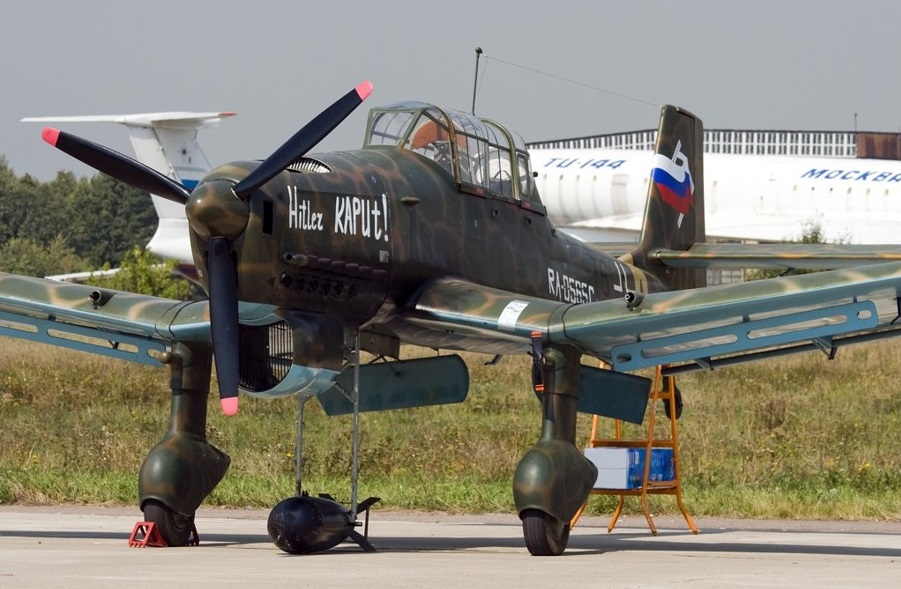
This machine is apparently stationed at the Kubinka test base and is flown by the Kublinka Aeroclub there.
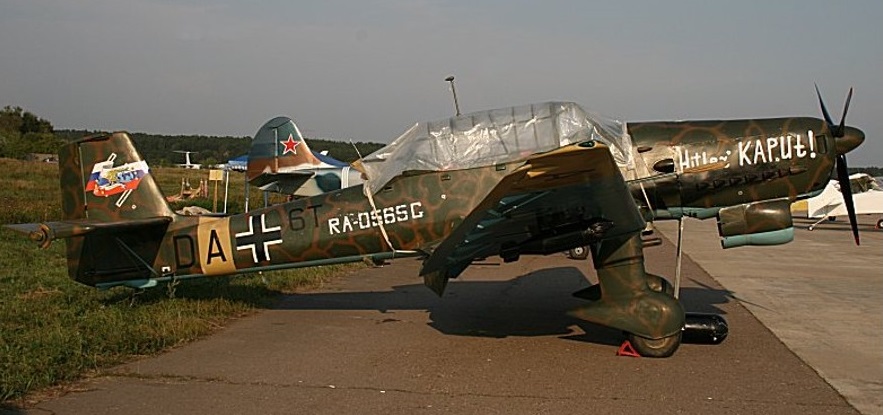
Engine: 210Hp Walter (LOM) M337.
Wingspan: 14.94 m
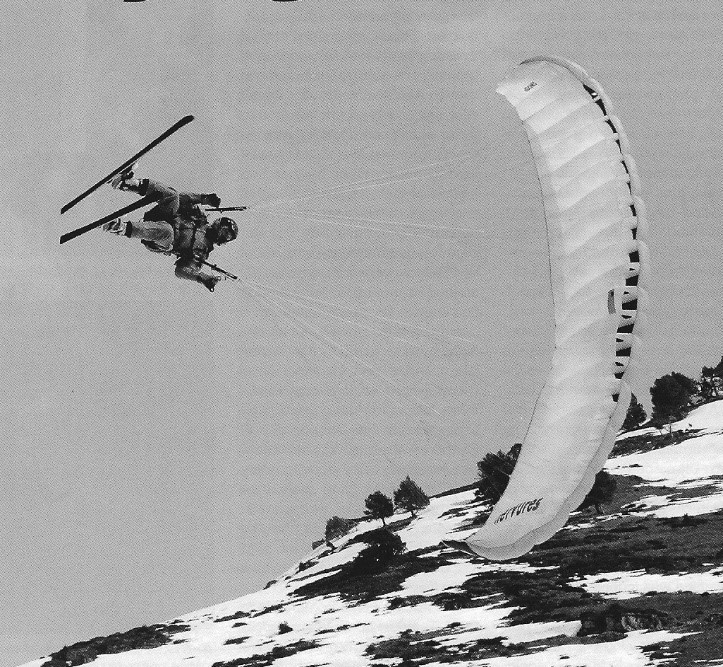
The Nervures Swoop 14 and 16 mini wing were created in 2006 in collaboration with Val Montant.
The Swoop 2 16 is described as ultra versatile, for speedflying on site and hiking or paraclimbing version, it is ideal for an introduction to mini-wings with take off near a paraglider, a very healthy behavior, able to climb thermal and land comfortably.
The aspect ratio has also been specially designed for this surface to facilitate take off and provide dynamic flight behavior. Recommended to max inflight weight 100kg.
The Swoop 2 14 is a mini wing for experienced pilots for speedflying and paraclimbing. The aspect ratio has been specially designed for this surface, the short suspentage cone facilitates placement on the ground as well as elevation of the wing. In expé Version (1.9kg) it is suitable for short & difficult takeoffs, solid in turbulent conditions even in trimout position.
The Swoop 2 10 is for expert only, extreme speed flying or speed riding new sensations; compared to other mini wings of same surface glide ratio is widely superior, more efficient brake response and lower roll movement.
Swoop 14
Surface: 14.2 m²
Projected area: 13.1 m²
Flat wingspan: 7.4 m
Projected wingspan: 6.3 m
Flat aspect: 4
Projected aspect: 3.17
Total flying weight: 95 – 120 kg
Number of cells: 30
Length: 1.50 m
Height: 4.3 m
Standard weight: 1.7 kg
EN 926-1
Swoop 16
Surface: 15.6 m²
Projected area: 14.4 m²
Flat wingspan: 8 m
Projected wingspan: 6.8 m
Flat aspect: 4
Projected aspect: 3.17
Total flying weight: 120 kg
Number of cells: 30
Length: 1.62 m
Height: 4.5 m
Standard weight: 1.8 kg
EN 926-1
Swoop 19
Surface: 19.13 m²
Projected area: 15.3 m²
Flat wingspan: 8.6 m
Projected wingspan: 7 m
Flat aspect: 4
Projected aspect: 3.17
Total flying weight: 120 kg
Number of cells: 30
Length: 1.79 m
Height: 4.9 m
Standard weight: 1.9 kg
EN 926-1
With a family background in aviation (Meyers Aircraft), Lance Niebauer, a Californian graphics artist, sold his family home and chattels in order to pursue the dream of producing the perfect kitset aircraft, founding the company in 1984. The original Lancair 200 composites monoplane, designed by Lance Niebaur, first flew in 1984.
The first model Lancair 200 was developed in 1984 and today, that prototype resides in the Experimental Aircraft Association (EAA) Museum in Oshkosh, WI.
1988:
Neico Aviation Inc
403 S. Ojai St
Santa Paula
California 93060
USA
From the subsequent Lancair 320 evolved the Lancair 320 Mk II two-seat monoplane that was available in kit form. In July of 1999 The Legacy 2000 was introduced as the successor to the Lancair 320/360. The Legacy provides additional passenger and luggage space as well as increased performance over the previous Lancair 360. Using a 310 hp Continental IO-550-N, the Legacy achieves cruise speeds in excess of 276 mph at 8000 ft.
In Sept of 2001 Lancair International flew their turbine engine powered Lancair IV-P. The Lancair Sentry is a Walter turbine powered Lancair IV is a military-style tandem seat aircraft with left-side throttle controls, and a rear hinge canopy. “The airplane performs very similar to the existing Propjet model, achieving a cruise speed of almost 400 mph! ”Not only does this new Lancair kit yield blood-boiling speeds similar to the IV-P Propjet model, it also offers increased yaw stability and excellent visibility out of a newly designed rear hinge canopy.
There are kits for the four-seat Lancair IV, IVP with pressurized cabin and Tigress as a two-seat variant of IV. Four-seat Lancair Super ES has also given rise to the Columbia 300 for certification, the latter being a joint venture program with a Malaysian organization.
1995: Marketed by Lancair International from 2244 Airport Way, Redmond, OR 97756, USA. Lancair International Inc. manufactures advanced composite structures at its Redmond, Oregon facility.
In February 2003, founder and president, Lance Neibauer announced the sale of his kit company to Joseph C. Bartels, a previous Lancair IV-P customer. Joseph C. Bartels, an attorney from New Orleans, first became involved with Lancair in December 1992 when he took delivery of a Lancair IV-P kit. Since then he and a partner formed Aero Cool, LLC, a company that provides air-conditioning units for the Lancair IV’s, now sold exclusively through Kit Components Inc., a division of Lancair International Inc. Joe holds a private pilot certificate with instrument rating as well as an A & P rating.
2009: Lancair International, 2244 Airport Way, Redmond, OR 97756, USA.
Lancair, in 2009, had a market segment that outsold the production market fleet by more than 3 to 1.
The Lancair family of aircraft covers the range of private pilot aircraft from the solid two-seat aerobatic Lancair Legacy, the economical two-seat Legacy fixed-gear to the four-seat, fixed-gear Lancair ES, the 330 mph Lancair IV speedster to the fourth-ever pressurized piston single in the history of aviation, the Lancair IV-P. In 2000 Lancair was proud to announce a turbine engine option to the Lancair IV-P. This high-powered turbine will propel the Lancair IV-P to incredible speeds of up to 370 mph.
The cockpit offers great visibility and the aircraft is constructed entirely of metal. The aircraft engine is a very sturdy and reliable Rotax 912 ULS so you can travel at a cruising speed of 125 mph (201 km / h) with a fuel consumption of around 17 liters / h.
Price 2009: 61900 EURO
Stall: 30 kt / 34 mph / 55 kmh
Cruise: 109 kt / 125 mph / 201 kmh
VNE: 131 kt / 151 mph / 243 kmh
Climb Ratio: 1200 ft/min / 6 m/s
Take-off distance (50ft obstacle): 360 ft / 110 m
Landing distance (50ft obstacle): 400 ft / 122 m
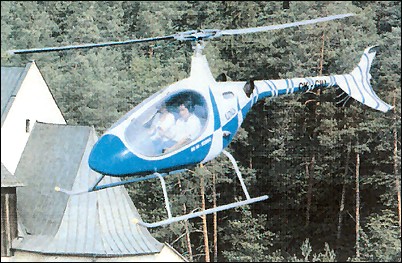
Design work of the (formerly Unis, Obchodni Spol, Sro) Bongo began in 1992 followed by model tests in 1993 with construction of a technology demonstrator started in 1996.
A public debut was at Ârno International Machinery Fair 1997 (then called TINTS NA40 and with two-blade main rotor) by the first prototype, OK-CIU. The prototype began 70 hours of tethered hover flights in March 1998, and two further prototypes were completed by mid-1998.
NA Design planed Normal category certification to FAR Pts 27, 33, 34 and 36 by late 2003, subject to finding joint venture Western partner to share certification, manufacturing and marketing costs. In 2002 financial support of US$2.5 million was still being solicited. The project was put on hold in late 2002 while finance was sought but, despite this, a new version, the four-seat NA50, was announced in late 2002.
Nothing further had been heard by early 2003.
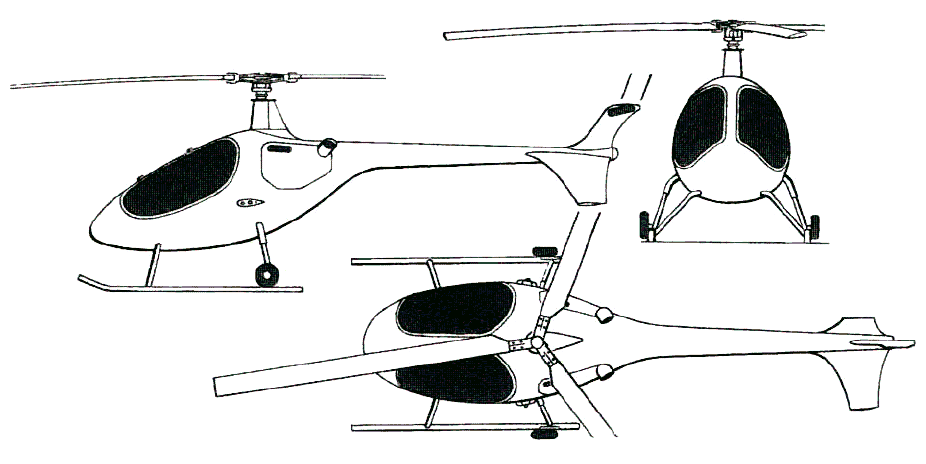
The NA Design NA 40 Bongo two-seat ultralight helicopter features a three-blade teetering rotor and pod and boom fuselage with an inverted Y-tail unit. A Cocomo patented anti-torque system eliminates the need for a tail rotor, reducing transmission complexity and operating noise level.
Flying controls were conventional cyclic and collective, with a ducted air anti-torque system. The structure is mainly composites, including the rotor blades. Some aluminium is in the fuselage, otherwise it is a double-curvature monocoque sandwich, with a laminated, vacuum-formed elastomeric rotor head. The landing gear is a tubular twin-skid gear with ground handling wheels. Inflatable permanent or emergency floats are optional.
Power is from two 86kW Prvni Brnenska Strojina PBS Velka Bites ÒÅ 50Â turboshafts, with FADEC and dual ignition. The engines are mounted side by side behind the cockpit with transmission via a combining gearbox. A single self-sealing fuel tank is beneath the engines, with a capacity of 210 litres.
A baggage space is aft of the two seats and gull-wing window/doors are on each side, hinged on the centreline and opening upward. A dual 27V DC electrical systems and external power receptacle are provided.
NA40 Bongo
Rotor diameter: 7.48m
Fuselage length: 6.15m
Height to top of rotor head: 2.35m
Empty weight, equipped: 480kg
Max load on external sling: 250kg
Max take-off weight: 950kg
Never-exceed speed: 280km/h
Max cruising speed: 250km/h
Econ cruising speed: 230km/h
Hovering ceiling IGE: 4,000m
Max range: 500km
NA Design was created in third quarter of 1999, in co-operation with Moravan Aeroplanes Inc.
LSA helicopter builder
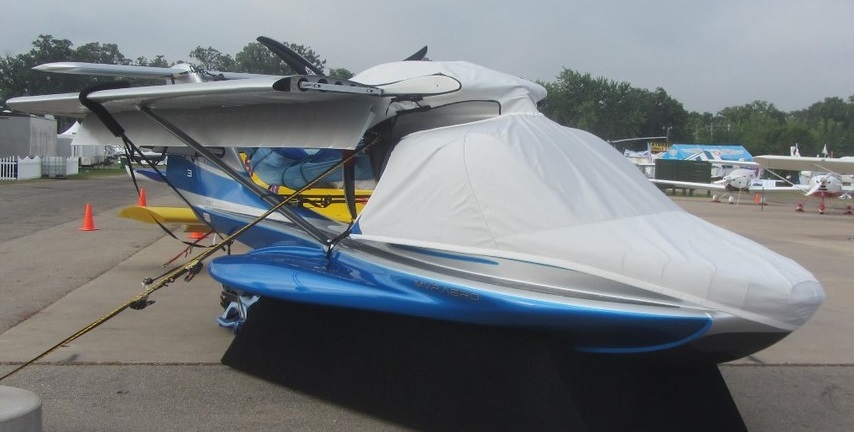
Designed by Mike Van Staagen, the MVP Model 3 is a prototype American “triphibian” light-sport aircraft, displayed in mockup form in 2014. The aircraft is under development by MVP.Aero Inc. of Delaware.
The MVP Model 3 is designed to operate on land, water, snow and ice. The floor panels can be rearranged to accommodate fishing or camping. The design will be marketed in several versions, including the E-AB, E-LSA, and S-LSA. The aircraft is a two-seats in side-by-side configuration with a pusher propeller and folding wings, which are constructed with carbon-fiber composite spars and covered with fabric. The balance of the airframe is constructed from a combination of carbon fiber and fiberglass. Electric thrusters help the aircraft manoeuvre in the water.
The design allows the canopy to be raised on a four bar system to sit above the engine cowling. This leaves the cockpit area open for fishing from and can also allow mounting of a tent for camping, with the floor panels inserted. With the canopy fully open the engine can still be run for water maneuvering.
The unit cost was US $169,000 as an Experimental and $189,000 as S-LSA.
Variants:
Model 3 E-AB
Model 3 E-LSA
Model 3 S-LSA
MVP Model 3
Engine: 1 × Rotax 914, 115 hp (86 kW)
Wingspan: 36 ft 0 in (10.97 m)
Length: 23 ft 9 in (7.24 m)
Length wings folded: 8.1 m (26 ft 7 in)
Width: 8 ft 0 in (2.44 m) wings folded
Fuel capacity: 26 US gal (22 imp gal; 98 l)
Cruise speed: 104 kn (120 mph, 193 km/h) at sea level
Stall speed: 41 kn (47 mph, 76 km/h) with full flaps
Rate of climb: 1,000 ft/min (5.1 m/s) at sea level
Wing loading: 11 lb/sq ft (54 kg/sq.m)
Crew: one
Capacity: one passenger
MVP.Aero Inc has its design and engineering team in Duluth, Minnesota, with management and administration based in Minneapolis. In January 2016 it was announced that the Model 3 will be built in Brunswick, Maine.
The Model 3’s lead designer, Mike Van Staagen, is a former Cirrus Aircraft engineer who played a key role in the design and development of the Cirrus Vision SF50 personal jet, as well as the Cirrus SR20 and SR22 composite light aircraft.
 All Aero