This light paramotor is suitable for pilots weighing between 45 and 80 kg. The paramotor is equipped with very light drive rocket unit. The centrifugal clutch and electrical starter enable maximum ease of manipulation on the ground and take off. The tuned exhaust together with wooden or composite propeller ensures sufficient performance for fast take off and safe climb. The paramotor features a four-parts folding frame and AustriAlpine Powerfly carbines. Price per Unit (piece) 2009: $6,316.00
Engine: Raket 120 Power: 13.5 PS (9,000 rpm) Ignition: Contactless Carburettor: Diaphragm WALBRO Reduction: Belting 1:3 Exhaust: Radne Propeller: Wooden, two blade (115, 125 cm) Starting Gear: Electrical Fuel Tank: 10 litres, integrated Body • Frame: Self-supporting, laminated shell, orange colour • Aluminium, four-parts, foldable Harness: Anatomic construction, silencing of the remaining vibrations, straps AustriAlpin Cobra, front reserve container – removable Accessories: Maintenance free battery NiCd charged during the flight, socket 16.8 VDC, fuel gauge Equipment: Padded bag for engine complete with wheels, frame and propeller packs Weight: 18 kg Recommended Pilot Weight: 40–70 kg Minimum Static Thrust: 52/50 kP (according to the propeller size 125/115 cm) Average fuel consumption: 3 litres per hour
The Rodeo paramotor received DULV certification in 2005 The Simonini tuning engine has a tuned exhaust and is fitted with the PULSE composite two-blade propeller. AustriAlpine Powerfly carbines are used throughout. Price 2009: $7,845.00 Also marketed by Parajet 4 Fun at US$3,845 in 2010.
Engine: Simonini MINI 2 Plus, NIRVANA Tunning Power: 27 PS (6,800 rpm) Ignition: NIRVANA CIR (electronic with pre-ignition and battery charging regulation) Carburettor: Diaphragm WALBRO WB37 Reduction: Belting 1:2.4 NIRVANA Exhaust: Tuned NIRVANA Propeller: Carbon two-blade foldable PULSE 2R2 (115, 125 cm) Starting Gear: Manual and electrical Fuel Tank: 10 litres, integrated Body • Frame: Self-supporting, laminated shell, orange colour • Aluminium, four-parts, foldable Harness: Anatomic construction, silencing of the remaining vibrations, straps AustriAlpin Cobra, front reserve container – removable, foldaway spacers Accessories: Maintenance free battery NiCd charged during the flight, socket 16.8 VDC, fuel gauge Equipment: Padded bag for engine complete with wheels, frame and propeller packs Weight: 25 kg Recommended Pilot Weight: 80–160 kg (single or tandem) Minimum Static Thrust: 70/65 kP (according to the propeller size 125/115 cm) Average fuel consumption: 3–3.5 litres per hour
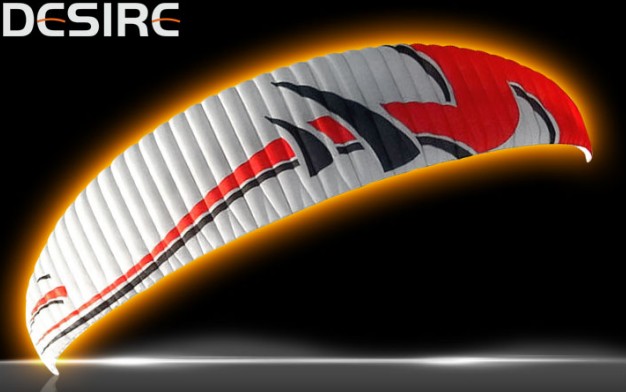
Nirvana introduced the new PPG wings, Alix and Desire in 2005 The Desire is a standard category glider which was primarily developed for motor flying.
DESIRE S Area – Flat: 26 sq.m Area – Projected: 21.1 sq.m Span – Flat: 11.36 m Span – Projected: 9.2 m Number of Cells: 46 Flat Aspect Ratio: 5 Minimum Speed: 25 km/h Maximum Speed – Trim: 43 km/h Maximum Speed: 55 km/h Glider Weight: 5.5 kg Pilot Weight Range: 65–85 kg Weight Range PPG/MPG: 65–110 kg Category: Standard Certification: AFNOR Material – Canopy: Skytex E77 Material – Main Susp. Lines: EDELRID KEVLAR 1.5 – 1.8 – 2.1 mm Material – Suspension Lines: COUSIN DYNEEMA 1.1 mm
DESIRE M Area – Flat: 28 sq.m Area – Projected: 23.8 sq.m Span – Flat: 11.84 m Span – Projected: 9.7 m Number of Cells: 46 Flat Aspect Ratio: 5 Minimum Speed: 25 km/h Maximum Speed – Trim: 43 km/h Maximum Speed: 55 km/h Glider Weight: 5.9 kg Pilot Weight Range: 85–110 kg Weight Range PPG/MPG: 85–143 kg Category: Standard Certification: AFNOR Material – Canopy: Skytex E77 Material – Main Susp. Lines: EDELRID KEVLAR 1.5 – 1.8 – 2.1 mm Material – Suspension Lines: COUSIN DYNEEMA 1.1 mm
DESIRE L Area – Flat: 30 sq.m Area – Projected: 25.5 sq.m Span – Flat: 12.20 m Span – Projected: 10.2 m Number of Cells: 46 Flat Aspect Ratio: 5 Minimum Speed: 25 km/h Maximum Speed – Trim: 43 km/h Maximum Speed: 55 km/h Glider Weight: 6.3 kg Pilot Weight Range: 100–130 kg Weight Range PPG/MPG: 100–170 kg Category: Standard Material – Canopy: Skytex E77 Material – Main Susp. Lines: EDELRID KEVLAR 1.5 – 1.8 – 2.1 mm Material – Suspension Lines: COUSIN DYNEEMA 1.1 mm
Nirvana Systems sro is a producer of motor paragliding equipment. The first flights on the modified Parafoil began in 1987; take off using the tow rope behind the car. 1988 saw the beginning of parachute production – BIG type, and the discovery that flying from the hills is possible. The first paramotor production began in 1989– the paramotor was not finished. Sale and service of Edel parachutes began in 1992, later also the Wings.
In 1993 the Trike was completed with a Jawa 350 engine and later the Trabant. This was first flown in 1994. In 1995 the first own paramotor was completed with a Konig triple cylinder engine. A light paramotor with a Hirth engine was completed in 1996.
1999 saw the foundation of the company – Nirvana paragliding – for the production of paramotors. 2000 brought the serial production of the Nirvana Electric model. First racing season – Czech Republic Championship.
Nirvana introduced the new PPG wings, Alix and Desire in 2005 and the Rodeo paramotor received DULV certification.
The new Flystyle collection was introduced in 2006.
Official entered the USA PPG market in 2009, WAG qualification, and official introduction of the Instinct to the domestic, German and UAE market.
The Nieuport 23C-1 replica built by Nieuport Memorial Flyers made a successful maiden flight in Grenchen, Switzerland, on 21 September 2020. The aircraft, registered HB-RNA, was flown by Isidor von Arx. It is powered by the rotary engine of a Thulin A (Swedish license-built Blériot XI).
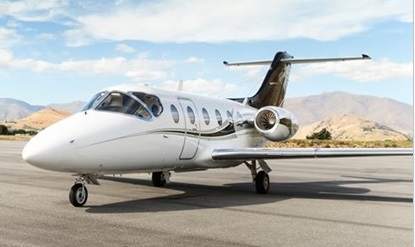
Nextant Aerospace selected the Beechjet 400/Hawker 400XP for remanufacturing as the Nextant 400XTi. The hundreds of millions of dollars needed to develop a new jet was a huge barrier, yet a well designed and -built jet has a long service life and could be an ideal platform on which to add new avionics and engine technology as well as aerodynamic tweaking using modern tools such as computational fluid dynamics.
The 400XTi is essentially a Beechjet 400/Hawker 400A/XP with new Fadec-controlled 3,050-pound-thrust Williams International FJ44-3AP engines replacing the original 2,965-pound Pratt & Whitney Canada JT15D-5Rs, aerodynamic improvements to the nacelles and pylons, a new Rockwell Collins Pro Line 21 flight deck, fresh interior and other enhancements. The jets undergo 60 engineering changes, replacement of more than 40 time-controlled components, compliance with A-, B-, C- and D-check inspections as well as compliance with all FAA airworthiness directives and applicable manufacturer service bulletins during a 6,000-man-hour renewal/overhaul process. The resulting remanufactured 400XTi carries a two-year tip-to-tail warranty (three for the engines), which can be extended to five years as an option.
The first remanufactured version was the 400XT, but in 2014 Nextant introduced the 400XTi, with an improved and more spacious composite cabin shell that takes full advantage of unused space in the fuselage, a new noise insulation package, Nextant-designed winglets, Luma Technologies LED warning panels and a Mid-Continent Instruments LCD standby attitude module and True Blue Power MD835 lithium-ion backup battery units. The MD835s eliminate a 90-day inspection interval for the jet’s original lead-acid backup batteries.
By 2015, Nextant had converted more than 40 Beechjet/Hawker 400s and delivered them to owners in eight countries since certification of the upgrades in 2011. Flight Options has ordered forty 400XTi conversions, and charter provider Travel Management Company was upgrading its entire fleet of 50 Beechjet/Hawker 400s. Nextant’s backlog represents a quarter of the available fleet of about 600 jets. There were also another 180 Air Force T-1A Jayhawks (Beechjet 400s) that could be converted, if the Air Force were to select the 400XTi upgrade instead of buying a new jet for its Air Education and Training Command bases.
The Nextant 400XTi sold for $5.15 million (2015). The airframe was valued at $995,000, so that would be deducted from the price if an owner brought a Beechjet/Hawker 400 for conversion. The performance improvements include a 50-percent range extension, 30 percent lower operating costs and 20 to 25 percent less fuel burn.
The Nextant 400XTi has the 3,502-pound Williams International FJ44-3APs (flat-rated to 3,050 pounds at ISA +7 deg C) engines. The jet itself can’t fly faster than its limiting Mach .785 Mmo. The new nacelles housing the Williams engines and the larger pylons are the fruit of computational fluid dynamics analysis that showed excessive drag due to a supersonic shockwave in the area between the nacelles and the fuselage. The pylons now have twice the surface area, and the redesign eliminated the drag problem. Noise compliance exceeds Stage IV requirements.
To help improve maintenance access to the nose gear and other areas, Nextant added access panels so mechanics don’t need to remove dozens of fasteners for routine maintenance tasks. Further adding to future reliability is a completely new primary wiring harness, built by Nextant technicians on the company’s own looms. The new wiring meets the latest FAA electrical wiring interconnection system regulations.
The new composite cabin shell by Jeff Bonner R&D takes advantage of space within the fuselage structure that the existing interior didn’t use, and it adds three inches of width and 2.5 inches of height. N2Aero insulation reduces cabin noise by nine decibels, to 66 dB.
Three interior layouts were available, and a typical choice is the forward divan opposite the galley, then a four-club configuration, with seats for up to eight passengers (including the belted lavatory). Also offering eight seats is the four-club layout with two forward-facing seats aft and one seat up forward opposite the galley. This layout provides less legroom in the club seating area, however. A six-seat interior puts the galley on the right side of the cabin and includes the spacious four-club seating area, one seat opposite the galley and forward of the cabin door, plus the lavatory seat. Passenger seats were redesigned by Nextant engineers and are mechanically rebuilt and recovered. The two aft-facing seats in the club-seating area fold flat, and the divan can be extended outward to provide a larger sleeping surface.
The updated interior is fitted with a Rockwell Collins Venue cabin management system (CMS) with Airshow moving map, Apple iOS device control of the CMS, LED lighting and a new galley with a Nespresso machine and a new work surface. Optional features include Aircell Gogo Business Aviation Axxess (air-to-ground telecom and SwiftBroadband satcom) and 110-/220-volt power outlets. The lavatory bulkhead is moved six inches forward, and this helps provide more interior space for luggage (an additional 20 cu ft), as one of the Beechjet’s Achilles heels is the small 26-cu-ft external baggage capacity.
On the outside, the most prominent change is the new winglets with embedded LED lights. Most of the upgraded jets were equipped with aluminum winglets, but soon, if not already, the 400XTi will have new carbon-fiber winglets that are raked back farther and shave 24 pounds off the empty weight. The new winglets bolt onto the existing structure and will be provided as a kit to owners with the old winglets.
The heavy remanufacturing and maintenance tasks take about eight to 10 weeks, during which the Beechjet/Hawker 400 is completely stripped down. All life-limited components are replaced, landing gear is overhauled, the entire structure is inspected and any repairs are completed. Typically, the horizontal stabilizer has cracked ribs, induced by an oscillation caused by the thrust reversers. Nextant technicians install thicker ribs in a special jig built in-house. The engine mount beam that runs across the aft fuselage is another weak area, and Nextant engineers redesigned the beam with added doublers to make it stronger but maintain the same geometry so that it would meet the latest regulatory stress load requirements without requiring modification of the adjacent structure. Nextant also replaces the engine mount with a much stronger one-piece milled unit made of stainless steel alloy.
For pilots, the biggest visible change is the flight deck, where the old CRT-based Rockwell Collins Pro Line 4 avionics are replaced with a Pro Line 21 suite. The base system in the 400XTi includes two PFDs and two MFDs in portrait orientation, which provides one PFD and one MFD for each pilot to control. Dual Collins FMS 6100s are mounted on the angled portion of the console between the seats. All other avionics are new, including dual solid-state AHRS, autopilot, Waas LPV GPS 4000S, com and nav, ADF, DME, transponders, radar altimeter, weather radar, Taws, Tcas II, DBU 5010E database loader, 406-MHz ELT and the Mid-Continent standby attitude module. The eyebrow warning lights now use LEDs instead of incandescent bulbs. Engine instruments are all hosted on the Rockwell Collins MFDs, and if an MFD fails the engine indications migrate to the respective PFD.
After the major maintenance and modification phase, including avionics upgrades, the jet is moved outside for engine runs and flight-testing, then the exterior is painted and the interior installed. The final flight-test takes place about 16 to 17 weeks after the jet rolls into the Nextant facility. One way to spot a Nextant modified Beechjet/Hawker 400 is the new supplemental data plate mounted next to the old one on the aft fuselage.
Nextant 400XT
The 400XT made its first test flight in March 2010. Receipt of final certification from the Federal Aviation Administration (FAA) was announced in October 2011. Deliveries of the Nextant 400XT began that same month, with initial deliveries of a 40-aircraft, $150 million order to private aviation company Flight Options LLC.
The 400XTi, at a takeoff weight of 13,800 pounds, 2,500 below the 16,300-pound mtow, will climb to 40,000 feet in 15 minutes. Climbing at more than 2,000 fpm at 30,000 feet. Takeoff field length, about ISA+15 on the ground, is about 3,100 feet.
At FL410 power for long-range cruise, Mach .70 and 392 ktas, burns 730 pph total. Pushing up the power to maximum continuous thrust raised the fuel flow to 1,040 pph, but in those conditions the airspeed would exceed the Mmo, so normal cruise is Mach .73 and 447 ktas, which brings the fuel flow down to about 1,000 pph.
The 400XTi can fly about five hours after reaching FL400 to FL410 at long-range cruise speed. The performance numbers in the flight manual supplement show that at a weight of 14,000 pounds, a climb to FL410 on an ISA day would consume 458 pounds of fuel. Climbing to FL450 in the same conditions should take 23 minutes and 578 pounds of fuel.
The stock Hawker 400XP can fly 1,464 nm with two pilots and four passengers (NBAA IFR reserves, 100-nm alternate). Under the same conditions, the 400XTi can fly more than 2,000 nm. Fuel capacity is 4,912 pounds. Typical BOW for a 400XTi is between 10,750 and 10,850 pounds, Marker said, depending on the options and interior configuration. These numbers are lower than the typical 10,985-pound BOW of a Hawker 400XP.
Cleveland-based Nextant was founded in 2007 by aviation entrepreneur Kenneth C. “Kenn” Ricci, who serves as the company’s chief executive officer. Ricci also is a principal of Directional Aviation Capital, a private investment firm which is solely focused on aviation investments. Ricci also serves as chairman of Flight Options, LLC, the second-largest private aviation company in the U.S. Nextant sister company Flight Options has many years experience operating the Beechjet/Hawker 400.
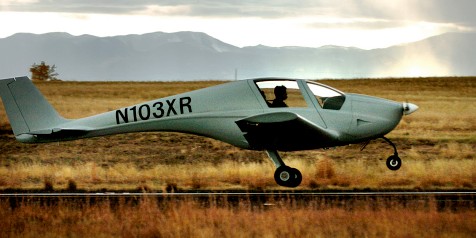
The Nexaer LS1, a 2-seat composite airplane that meets Light Sport Aircraft classifications and is being promoted and marketed by Sportplanes.com. The LS1, manufactured by Nexaer in Colorado Springs, Colorado, fetures a 54” wide cockpit, a cruise speed of 120 knots and a useful load in excess of 600 lbs. The prototype of the LS1 was unveiled at AirVenture 2005. With a moulded carbon fiber composite structure, the Nexaer LS1 features a 4-point harness, and an all-plane parachute.
Standard features include: No-flap Tricycle landing gear for easy ground handling Molded Kevlar® fuel tank (single center-mounted tank) 21-inch-wide seating with slide and tilt adjustment Cabin heat and vent Rear baggage compartment for standard cargo Sporting goods cargo area for skiis, fishing poles, hunting gear, and golf clubs Passenger-side glove compartment with flip-down tray and 12V power outlet
Standard Edition (SE) Jabaru 2200 engine (80 hp) Standard mechanical flight instruments (6-pack) Standard analog engine gauges Garmin SL-40 comm radio Garmin GTX327 digital transponder Single pilot-side yoke and pedals Landing light Navigation lights and strobes
Trainer Edition (TE) Jabaru 2200 engine (80 hp) Standard mechanical flight instruments (6-pack) Standard analog engine gauges Garmin SL-30 nav/comm radio Garmin GTX327 digital transponder Dual flight controls Landing light Navigation lights and strobes All-plane parachute
Luxury Edition (LE) Jabaru 3300 engine (120 hp) Dual electronic flight instrumentation system (EFIS) Dual GPS Electronic engine monitor with matching LCD display Garmin SL-40 comm radio Garmin GTX330 digital transponder PSEngineering PCD7100-I stereo intercom with CD/MP3 2-axis digital autopilot Single pilot-side flight controls Landing light Navigation lights and strobes All-plane parachute Keychain remote door unlock and open
Length: 23.25 ft. Height: 7 ft. 10 in. Wing span: 29.5 ft. Wing Area: 124 sq. ft. Cabin Width: 54 in. Seat width: 21 in. Max Gross Weight: 1320 lbs. Empty Weight: 750 lbs. Fuel Capacity: 27 USgal. (162 lbs.) Useful Load: 570 lbs. Design load factor: +4.5/-2.0 g Power: 80 – 120 hp Stall speed: 44 knots (51 mph) Max speed in level flight: 120 knots (138 mph) Maneuvering speed (VA): 105 knots (121 mph) Never-exceed speed (VNE): 160 knots (184 mph) Max rate of climb (sea level): 1500 ft./min Max rate of climb (10,000 ft.): 700 ft./min Service ceiling: TBD Take-off distance (sea level): 350 ft Take-off distance (10,000 ft): 750 ft Endurance: 4 hours (with 30 minute reserve) Range: 550 miles (ave.)




 All Aero