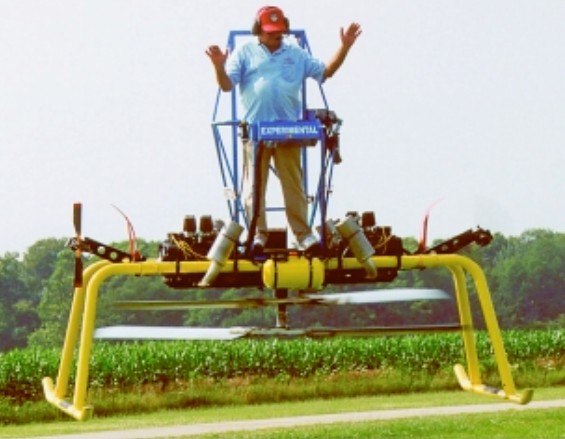
PAM 100B Single place, stand-on Individual Lifting Vehicle (ILV) with two composite 24″ diameter props for directional control. Simple tubular helicopter-type high strength airframe made of aircraft grade aluminum. Controls consist of a throttle and a fly-by-wire joy stick for directional control. There is no collective control. Kit price of $50,500 includes everything but shipping in 2009. Plans were also available.
Engines: (2) Hirth F-30 100 hp Rotor Blades: Four extruded aluminum Blade diameter: 9.17 ft Chord: 8″ chord
Min Speed Hover Cruise 45 mph Top Speed 60 mph Empty Weight 640 lbs Useful Load 360 lbs Gross Weight 1,000 lbs Skid Width 10 ft Height 9 ft Length 8 ft
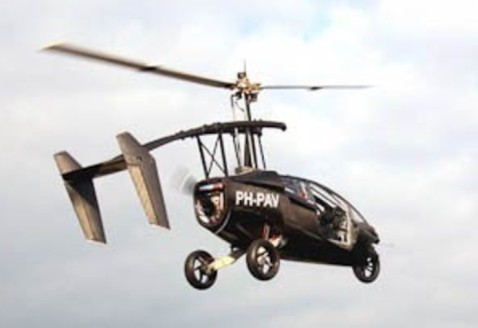
The PAL-V (Personal Air and Land Vehicle) in flight is an autogyro or gyrocopter designed by C. Klok (exterior design), with a pusher propeller at the rear of the fuselage providing forward thrust and a free-spinning rotor providing lift. Directional stability is provided by twin boom-mounted tailfins. It has a tricycle undercarriage with relatively large wheels.
On the ground, the propeller and rotor are stopped and power is diverted to the wheels, allowing it to travel as a three-wheeled car. Unusually, it leans into turns like a motorcycle, a solution pioneered by the Carver vehicle, also produced by a Dutch company. However, the PAL-V does not tilt as a Carver but like the BMW “Simple Concept” from 2009. The PAL-V ONE transforms into a gyrocopter within minutes as its rotor unfolds and its tail extends. Converting the PAL-V ONE from airplane to automobile takes about 10 minutes. The propeller folds itself automatically into the driving position. Pushing a button then lowers the rotor mast into the horizontal position. The same motion lowers the tail. The outer blades are folded over the inner blades via hinge mechanisms. And then driver/pilot has to push the tail into its driving position and secure the rotor blades.
The PAL-V One has two seats and a 160 kW flight certified gasoline engine, giving it a top speed of 180 km/h (112 mph) on land and in air, and a Maximum Takeoff Weight of 910 kg.
A prototype model was first test flown in March 2012 and the company was seeking funds to develop the type for production. Estimated unit price is around $300,000 in 2014.
Engine: 160 kW Dimensions Road (LxWxH): 4.0 x 1.6 x 1.6 m Empty weight: 1,499 lb (680 kg) Gross weight: 2,006 lb (910 kg) Maximum speed: 97 kn (112 mph; 180 km/h) Minimum control speed: 27 kn (31 mph; 50 km/h) Range inflight: 220-315 mile Range on land: 750 mile Takeoff dist: 165m (540 ft) Landing roll: 30 m (100 ft) Capacity: 2
PAL-V Europe NV started in 2001 to design a roadable aircraft. It evaluated many potential technologies and created numerous concepts in cooperation with research institutes and universities. The most important breakthrough was the maturing of the DVC tilting technology in 2005. This brought into reach the design of a real flying car instead of a roadable aircraft. This technology allowed for safe driving without compromises while having a high centre of gravity and a narrow aerodynamic shape necessary for flying. A “flying car” concept.
Having designed and patented their findings and concepts, PAL-V Europe NV hired a team of engineers with automotive, aviation and motorcycle backgrounds and started the engineering of its proof-of-concept prototypes. Partners were selected and contracted for several system elements. This led to the first flight of PAL-V’s proof-of-concept prototype in 2012.
Since then the company entered the next phase of development, engineering the first commercial version, optimizing the design, and starting up production. This was to result in the market launch of the first model: the PAL-V ONE.
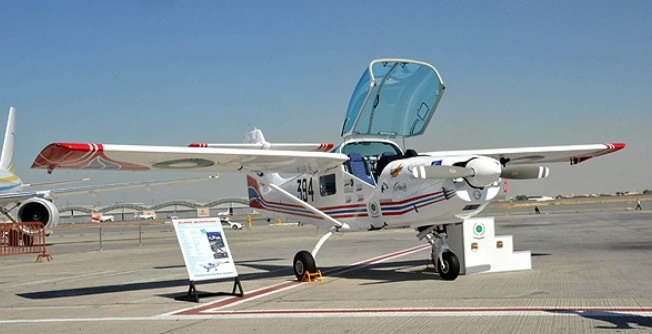
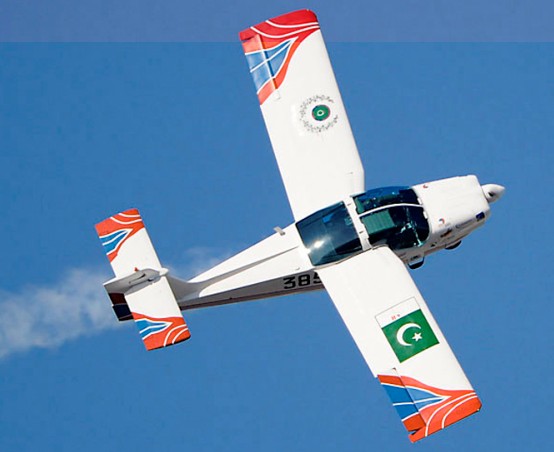
The MFI-395 Super Mushshak is a military trainer / light attack aircraft designed and manufactured by the Pakistan Aeronautical Complex (PAC) for the Pakistan Air Force (PAF) and the Royal Saudi Air Force (RSAF).
The development of the MFI-395 started in 1995. The aircraft was built by upgrading the MFI-17 with an advanced 260hp engine, electrical instruments, dual flight control systems and a Bendix RSA fuel injection system. PAC rolled out the improved version, the MFI-395 Super Mushshak aircraft in 1995.
The MFI-395 features a high wing monoplane design. It boasts two integral fuel tanks which carry 47 gallons of fuel. The large baggage compartment located aft of the cockpit can be easily accessed through a door on the rear side of the fuselage.
The Super Mushshak is equipped with a blind screen, which allows the aircraft to carry out instrument flying missions.
The spacious glass cockpit of the MFI-395 accommodates two flight crew members, a student pilot and a flight instructor. It is integrated with two ejection seats adjacent to each other, with an option for third seat at the rear side. It is enclosed by an oval shaped glass canopy which opens upwards to meliorate the visibility.
The cockpit is equipped with two multifunctional displays to exhibit data related to navigation, flight instrumentation, fuel and the engine. It is also equipped with an Enviro R-134 air conditioning system to sustain constant temperature.
The avionics suite incorporated in the MFI-395 includes instrument flight rules (IFR) capable electronic flight instrumentation system (EFIS), a global positioning system, instrument landing system, voice over recorder, UHF radio, automatic direction finder, distance measuring equipment and information friend or foe transponder.
The MFI-395 is fitted with six hardpoints under the wing pylons. The inner two stressed hardpoints can carry up to 150kg each. The remaining four carry rockets, gunpods and Bofor Bantam anti-tank missiles.
The MFI-395 was designed to provide primary flight training to the pilots of the PAF Academy situated at Risalpur. It was designed to suit both military and civilian missions. The aircraft’s design is compliant with the US FAR 23 certification standards in aerobatics and utility classes.
The tricycle type undercarriage allows the aircraft to operate from unprepared airstrips and rough airfields.
The maiden flight of the Super Mushshak took place in August 1996. The production aircraft was rolled out in November 2000. It entered service in May 2001 and was certified by the Pakistan Civil Aviation Authority in 2002.
It was displayed at the Dubai Air Show held in November 2011.
Approximately 300 MFI-395s were operational at the academies of the Pakistan Armed Forces.
Customer orders for the MFI-395 included: PAF (50), RSAF (20) and Royal Air Force of Oman (five). The PAF received its first Super Mushshak in May 2001. Deliveries to the Royal Air Force of Oman were concluded in 2004.
Pakistan signed an agreement with Iraq for the supply of trainer aircraft to Iraqi Air Force, in what is billed as “major milestone” in the export of aviation products from the country.
The contract of sales of Super Mushshak Aircraft to Iraq was signed by General Anwer Hamad Ameen Ahmed, Commander Iraqi Air Force and Air Marshal Sohail Gul Khan, Chairman of the Pakistan Aeronautical Complex (PAC) Kamra.
In total two agreements were signed including the one for sale of the trainer aircraft. According to the first agreement Pakistan Air Force will provide Training, to Iraq Air Defence Force personnel, in all sphere of Modern Air Force concept pertaining to different field special Air Defence, and Air Crew.
The Pagotto Brako is an Italian ultralight trike, designed by Enio Pagotto and produced by Carpenterie Pagotto of Pianzano.
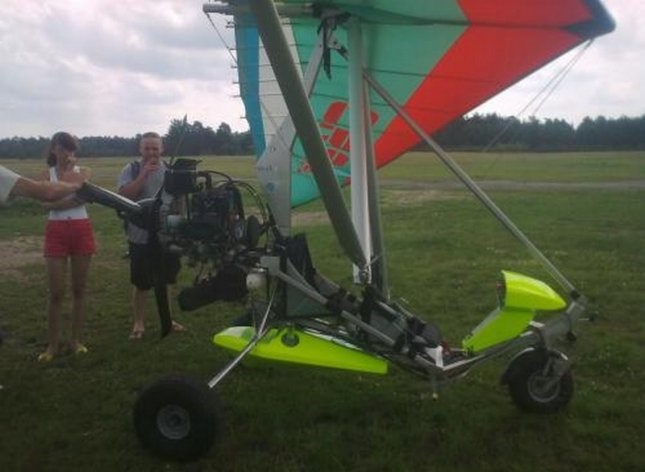
The aircraft was designed to comply with the Fédération Aéronautique Internationale microlight category, including the category’s maximum gross weight of 450 kg (992 lb). The aircraft has a maximum gross weight of 450 kg (992 lb). It features a cable-braced hang glider-style high wing, weight-shift controls, a two-seats-in-tandem open cockpit without a cockpit fairing, tricycle landing gear with wheel pants and a single engine in pusher configuration.
The aircraft is made from welded stainless steel tubing, with its single or double surface wing covered in Dacron sailcloth. The Brako is factory supplied only with Grif wings. With the Trainer wing it has a wingspan of 10.35 m (34.0 ft). The wing is supported by a single tube-type kingpost and uses an “A” frame weight-shift control bar. The powerplant is a twin-cylinder, air-cooled, two-stroke, dual-ignition 50 hp (37 kW) Rotax 503 engine, with a reconditioned four-cylinder, air- and liquid-cooled, four-stroke, dual-ignition 80 hp (60 kW) Rotax 912UL engine optional.
With the Rotax 503 engine and Grif Trainer wing the aircraft has an empty weight of 158 kg (348 lb) and a gross weight of 450 kg (992 lb), giving a useful load of 292 kg (644 lb). With full fuel of 42 litres (9.2 imp gal; 11 US gal) the payload is 261 kg (575 lb).
A number of different wings can be fitted to the basic carriage, including the beginner Grif Trainer, intermediate Grif Spyder and the higher performance Grif Corsair with wing areas of 12.8 sq.m (138 sq ft) and 13.7 sq.m (147 sq ft).
The aircraft was in production in 2013 and was supplied as a complete ready-to-fly-aircraft.
Brako / Grif Trainer wing Engine: 1 × Rotax 503, 37 kW (50 hp) Propeller: three-bladed composite Wingspan: 10.35 m (33 ft 11 in) Wing area: 16.0 m2 (172 sq ft) Empty weight: 158 kg (348 lb) Gross weight: 450 kg (992 lb) Fuel capacity: 42 litres (9.2 imp gal; 11 US gal) Maximum speed: 100 km/h (62 mph, 54 kn) Cruise speed: 75 km/h (47 mph, 40 kn) Stall speed: 45 km/h (28 mph, 24 kn) Rate of climb: 2.8 m/s (550 ft/min) Wing loading: 28.1 kg/m2 (5.8 lb/sq ft) Crew: one Capacity: one passenger
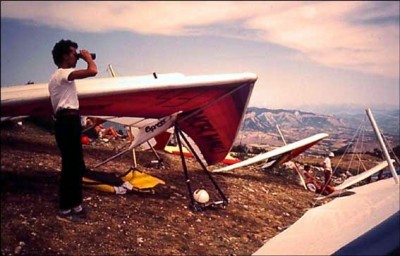
Appearing for the first time at the Coupe du Mont Faucon 1984 were the first models of Express.
Since the Coupe du Mont Faucon where the Express appeared much faster than its competitors, André Chairou has “civilized” his prototype. The profile in the central part was thickened to improve the characteristics at low speed. The trailing edge of the extrados like that of the intrados were no longer scalloped but rectilinear and reinforced by a strip. To increase the roll rate, the surface of the marginal edges had been decreased.
The 28 pounds of the Express was further diminished by the use of a transversal in 62 * 0.9 which no longer required sleeve. When lifting the unit the core lugs will easily skew and bend the cables. 8 slats on the extrados, 5 in the intrados. The fiberglass sticks which form the marginal edges are very easy to assemble. The leading edge is not mylarized. The sail is bathbridge 4.2.
For reasons of stability, the intrados is connected to the extrados by a system of adjustable velcros. On the Express, by inflating the extrados to 80% moves the center of thrust towards the rear. This reduces the recall to neutral. The binding extrados intrados fights against this effect. Care must therefore be taken to ensure that the connecting hooks are always secured and their length is symmetrical for each wing. Those relieving the last lath of intrados to the extrados have an influence on the stability spiral. Too tense, they diminish it, too much, they increase it.
The stall is rarely symmetrical and is often followed by a quarter turn during recovery. This characteristic is found at landing. If the rounding is negotiated at the right time, no problem but if it is made too high, one wing or the other will collapse first. These characteristics almost disappear with a “soft” setting.
The Express “Dacron” was made in France by Pacific Wings.
Express 148 Wing area: 14.8 m² Wing span: 10.8 m Aspect ratio: 7.9 Hang glider weight: 27 kg Number of battens: 26 Nose angle: 130° Price 2007: 13500F
Express 158 Wing area: 15.8 m² Wing span: 10.8 m Aspect ratio: 7.4 Hang glider weight: 28 kg Number of battens: 26 Nose angle: 130° Price 2007: 13700F
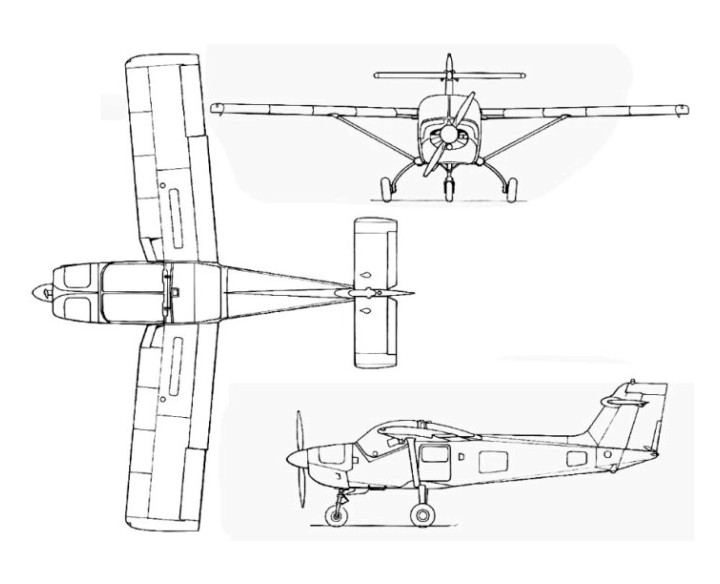
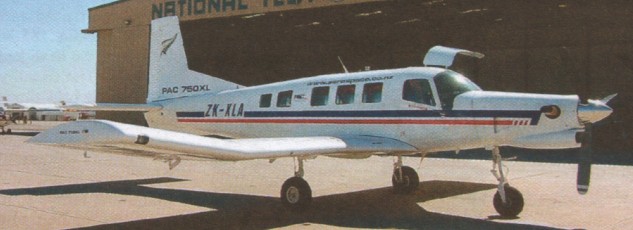
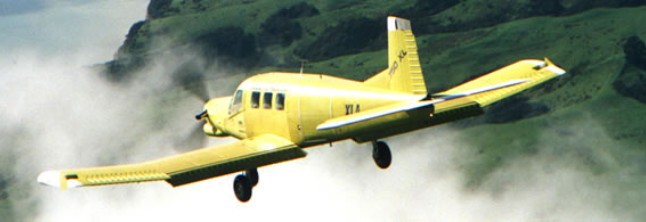
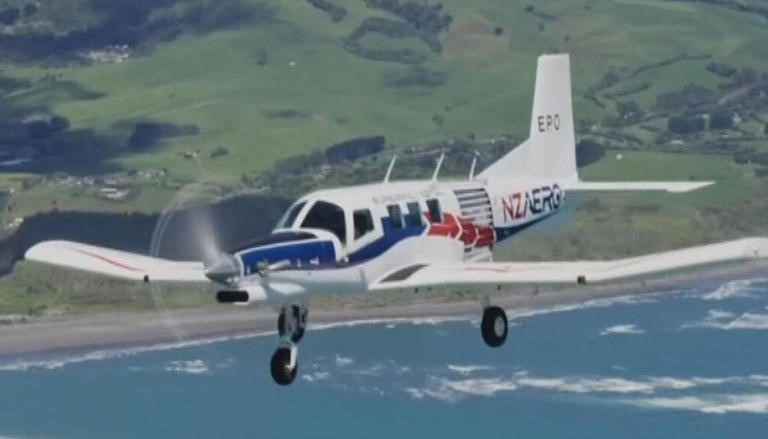
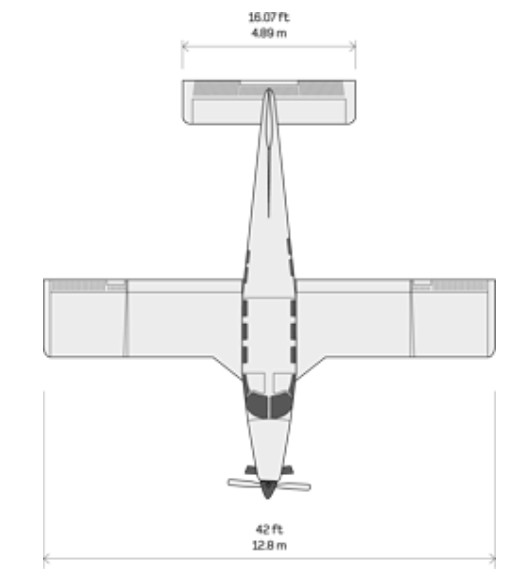
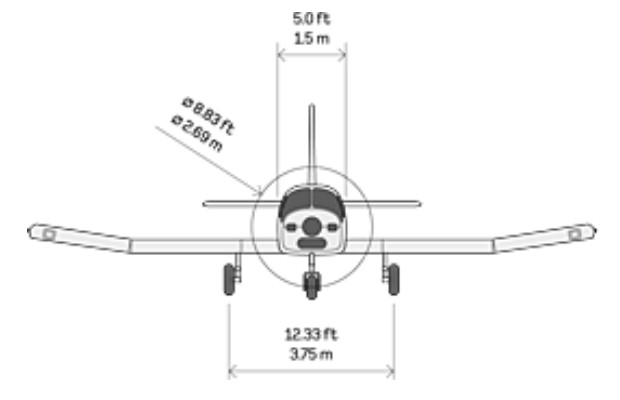
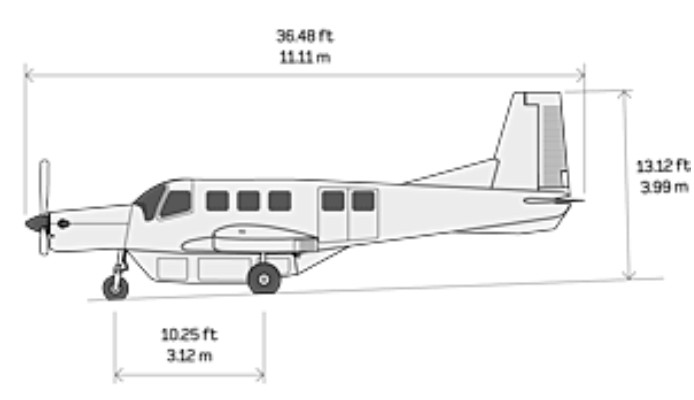
In 1999, representatives of the US skydiving market approached Pacific Aerospace wanting an enlarged version of the Cresco aircraft. This aircraft stemmed from a remark that it was a pity that the Cresco couldn’t be used for sky-diving. With the Cresco as a starting point the 750 XL resulted. After the development programme, little of the original Cresco remained. Wings, ailerons, flaps, fuel system, etc. have been either replaced or modified. First flown on 5 September 2001, the ten seater utility received New Zealand type certification (NZ TC A-14) on 23 July 2003.
On March 10th, 2004, the US Federal Aviation Administration certified the PAC 750XL (since renamed the P-750 XSTOL) under the very latest revisions of Part 23. Taking the aircraft from initial drawings to FAA certification took about 52 months. The P-750 is Single Pilot IFR Certified (FAA) and in 2012 gained certification against ICAO Annex 6 for Single Engine IFR Passenger Transport Operations.
While initially developed for the skydiving market, the attributes of the P-750 XSTOL also made it ideal for other market segments for which it is in wide use around the world particularly freight, passenger and aerial survey work.
The P-750 XSTOL can take off and landing in less than 800 ft (244m), even when it is hot and high. Operate off semi-prepared airstrips in all types of terrain. Carry a load of more than 4,000 lb even in hot and high conditions. The rugged construction has a low 150-hour airframe/engine inspection interval and 39,000 hours before any scheduled airframe maintenance requirement.
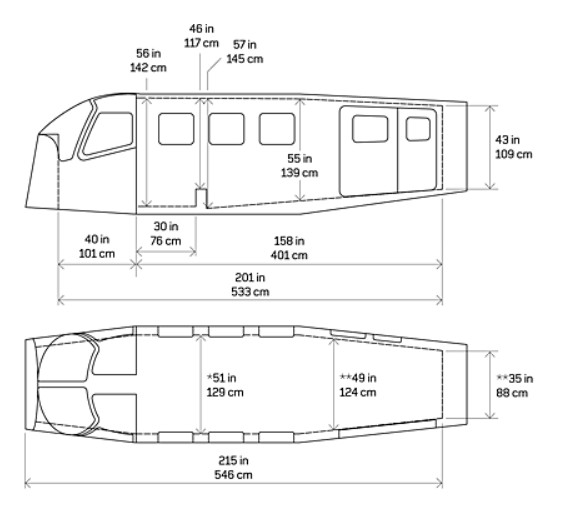
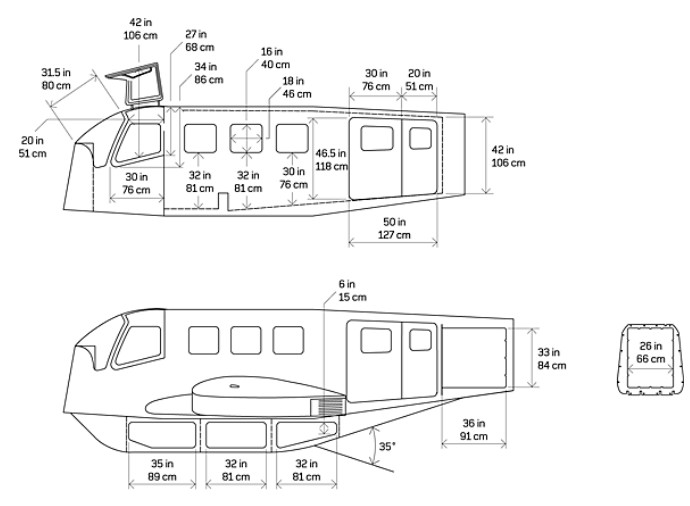
The P-750 XSTOL Utility has a 240 cu ft cabin complemented by an optional 70 cu ft cargo pod and 18 cu ft rear storage compartment. It has the ability to carry passengers on one leg then in 30 minutes have the seats removed and stored in the rear compartment making the full cabin and cargo pod available for carrying freight on the return leg. The large single compartment cargo pod with 1,000 lb (454 kg) capacity has no impact on aircraft cruise speed and loading access is via three side doors and one large rear ramp.
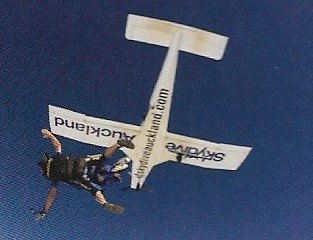
For skydiving the P-750 XSTOL has the ability to climb rapidly to jump height (e.g. sea level to 12,000 ft in ten minutes) and then be back at the air strip ready for another load before the jumpers land, enabling the aircraft to average four loads per hour. Able to carry seventeen skydivers or six tandem teams, the wide centre of gravity range making it a very stable jump platform. Able to carry 17 skydivers to altitude and return to the point of departure in approximately 15 to 16 minutes. The climb and descent profile is about half the horizontal airspace of most other jump planes, assisting operation in noise-sensitive areas. Factory installed skydiving modification that can be operated by the pilot ensuring no open-door speed restrictions on descent.
For aerial survey factory-approved modifications support easy installation of camera holes in the floor of the aircraft and side wall mounted track for the attachment of equipment. The P-750 XSTOL is an electrically quiet aircraft with minimal electro-magnetic interference (EMI) and all major control systems mechanical rather than electric. The aircraft structure serves as an effective faraday cage blocking out external static electric fields and can be readily customer-modified for geophysical survey work.
For Crop Dusting, Spraying or Fire Fighting the P-750 XSTOL Agriculture is able to carry a 4,888lb (2,272 kg) hopper load. Operators commonly complete up to 17 cycles (load, take-off, dispense, land) per hour. The hopper can be removed without affecting the airframe, allowing versatility in the roles of the aircraft. The aircraft can be converted to another factory-approved configuration maximising its useful life and resale value.
In the late 1950s several FU-24 operators; James Aviation, Thames Aerial Topdressing and Robertson’s Air Services, formed Air Parts (NZ) Ltd at Hamilton Airport to provide aftermarket sales and service to FU-24 operators. Also in the mid 1950s Aero Engine Services Ltd (AESL) was formed to provide Engine and component overhaul facilities in support of the FU-24 program.
These businesses continued on until the 1960s when things began to change for the both of them. In 1965 Air Parts (NZ) Ltd secured the manufacturing rights to the Fletcher FU-24 and began producing detail parts and FU-24 aircraft locally. In 1967 AESL secured the manufacturing rights to the Victa Airtourer and also began detail and Aircraft production locally. Both companies then enjoyed some years of expansion and development.
AESL provided the catalyst for the next change. In the early 1970s it had developed the CT-4 Airtrainer out of the prototype Victa Aircruiser and successfully secured contracts to supply the Airtrainer to the RAAF and RTAF. As a result of this, there were moves to get the New Zealand Government involved and merge Air Parts (NZ) Ltd and AESL into a new strong entity.
New Zealand Aerospace Industries Ltd (NZASIL) was born in 1973 with a 50% Government shareholding, (25% Air New Zealand and 25% National Airways Corporation), with the other 50% shareholding remaining with the previous companies shareholders such as James Aviation.
NZASIL started off well and successfully marketed both lines of Aircraft all around the world. Peak production was reached in 1975 with the delivery of 36 CT-4 Airtrainers and 14 FU-24s a total of 50 aircraft for the year.
Things quietened down several years later when CT-4 production slowed and all that remained was short run FU-24 production.
NZ Aerospace Industries went into receivership early 1982. The company was half-owned by the government (through Air New Zealand), and was producing the Fletcher and Cresco at the time of collapse. Production of the CT-4 Airtrainer had already ended, although the design and jigs may be one of the assets. The fourth Cresco was nearing completion when receivership was announced.
In July 1982 Pacific Aerospace Corporation, (PAC), was formed to carry on the manufacturing activities of NZASIL. A couple of years later the maintenance side of James Aviation was absorbed into the PAC structure.
By the late 1980s PAC had been purchased by Aerospace Technologies of Australia (ASTA). ASTA’s main interest was for PAC to produce detail parts for its commercial Airliner contracts with Boeing and Airbus. Production of PAC aircraft was secondary. In 1995 ASTA sold PAC to the Hamilton based and owned Aeromotive Group.
Under Aeromotive ownership PAC began its renaissance producing aircraft on a regular basis again. In late 1995 Cresco topdressing aircraft started regularly moving down the production line again , in 1998 the CT-4E was put into production and in 2000 the development of a brand new aircraft, the P-750 XSTOL, commenced.
In November 2006, a New Zealand consortium of aviation related professionals saw great potential in the company, in particular its P-750 XSTOL aircraft, and purchased the assets of the company. Pacific Aerospace Corporation became Pacific Aerospace Limited.
In July 2007 Pacific Aerospace celebrated the production of its 600th aircraft, spanning back to the 1950’s when the first Fletchers were produced. Since January 2007 Pacific Aerospace has lifted production of the XSTOL by 42%. New markets include India, Nepal, Latin America, China and Russia.
New Zealand aircraft manufacturer Pacific Aerospace Limited (PAL) acquired the ownership and manufacturing rights of the E-350 Expedition from Found Aircraft after it went into receivership in 2013. PAL launched a joint venture company, Beijing Pan-Pacific Aerospace Technology (BPAT), in Changzhou, China, which was to manufacture the P-750 SETP and, in the future, the E-350.
 All Aero