“Doc” Bailey of Renegade Light Sport Aircraft was at Sun and Fun 2013. He had just completed the move from Missouri to his new 71,000 ft.² facility in Fort Pierce, Florida.
2000->
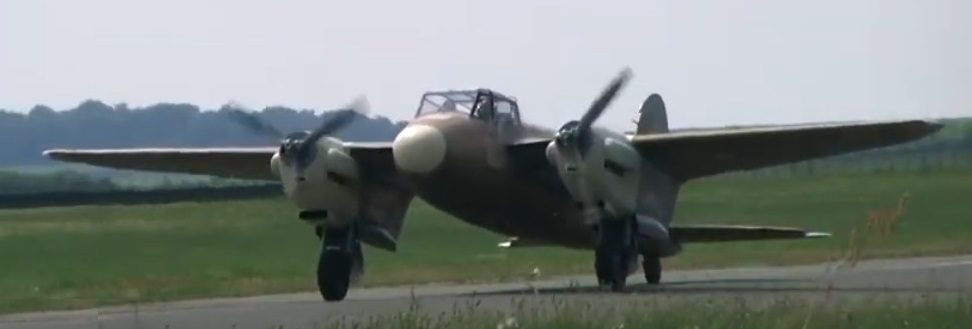
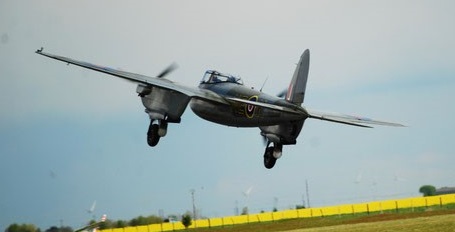
Reconstruction Répliques Avions Anciens Mosquito .75
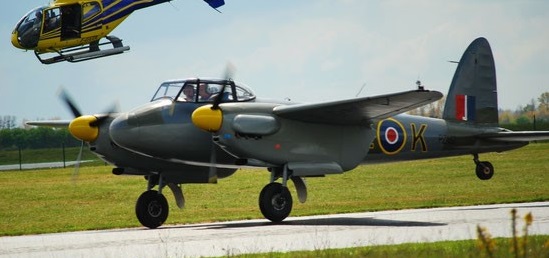
The French association Reconstruction Répliques Avions Anciens began work on 3/4-scale de Havilland Mosquito replica the replica in 1995 and required over 30,000 hours of work before it was ready for the first test at the Fontenay-le-Comte airfield.
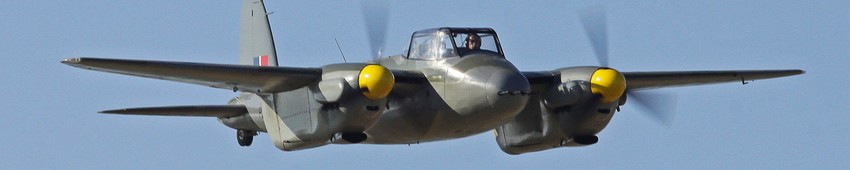
The first engine test was carried out earlier this year and were then followed by high-speed ground tests. The first flight took place on April 23, 2011.
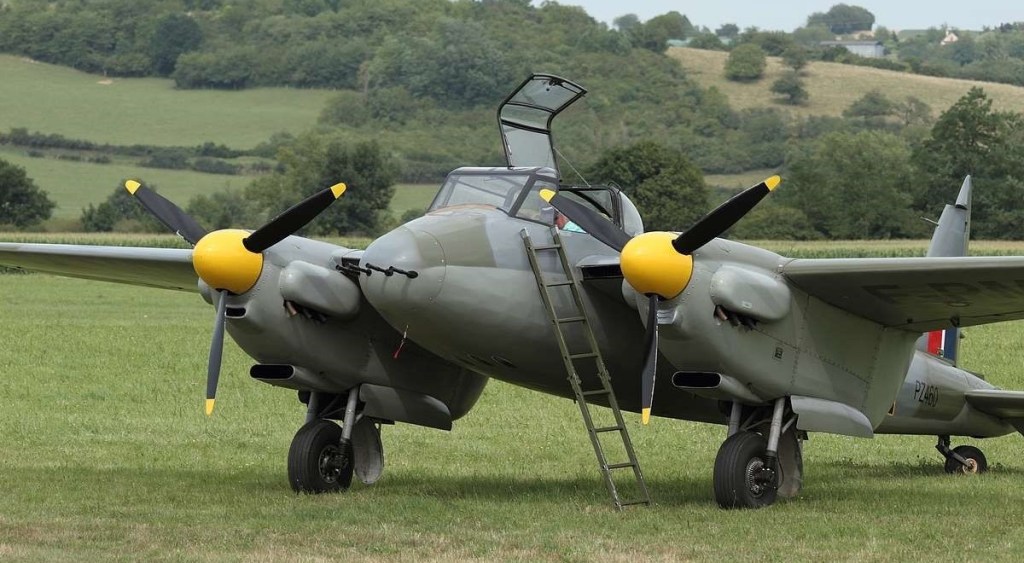
This replica of a British WWII bomber overturned on 6 August 2015 after touching the ground in Fontenay-le-Comte. The pilot is seriously injured.
Thursday evening, at 8:45 p.m., the plane approached an airstrip at the aerodrome of Fontenay-le-Comte, in the south-Vendée. This three-quarter-length replica of a Mosquito, a British WWII bomber, returns to its “base” after a commemoration, in Jonzac, in Charente-Maritime. On board: Hervé Thebaud, the pilot, an instructor from Île d’Yeu; and Jean-Paul Bichon, the co-pilot, a resident of Luçon, both in their sixties.
According to several witnesses, the landing “is going well”. Shortly after touching the ground, “a hundred meters from cutting the throttle”, during the “taxiing” phase, the aircraft got slightly askew. At this precise moment, it tilts forward, “like a wooden horse”, and completely overturns, until the fin hits the ground. He ends his race on his back.
An aerodrome mechanic is already running towards the aircraft. Seeing the aircraft’s turn signals still on, he said to himself that it was absolutely necessary to “cut the battery to prevent it from causing a fire” with the fuel escaping from the tank. It then contains “at least 400 liters of gasoline”.
When the mechanic arrives in front of the machine, the pilot and the co-pilot are aware and can press the button. The co-pilot is the first to exit, with the help of the mechanic who broke the window. The pilot was extricated after an hour by the firefighters, “quickly on the spot”. Seriously injured, he will later be directed to Nantes. Its vital prognosis is not engaged.
On the aerodrome, around thirty firefighters cover the aircraft with a carpet of foam. The last left at 12:30 am Several people, including the co-pilot who returned from the emergency room, then got busy to get the Mosquito out of the airstrip. It is when trying to turn it over with a crane that the tail, which was already hanging on by a thread, becomes detached. The plane had required 17 years of work. According to a member of the Luçonnaise association which built it (Replicas and reconstruction of old planes), it will be “difficult to repair”.
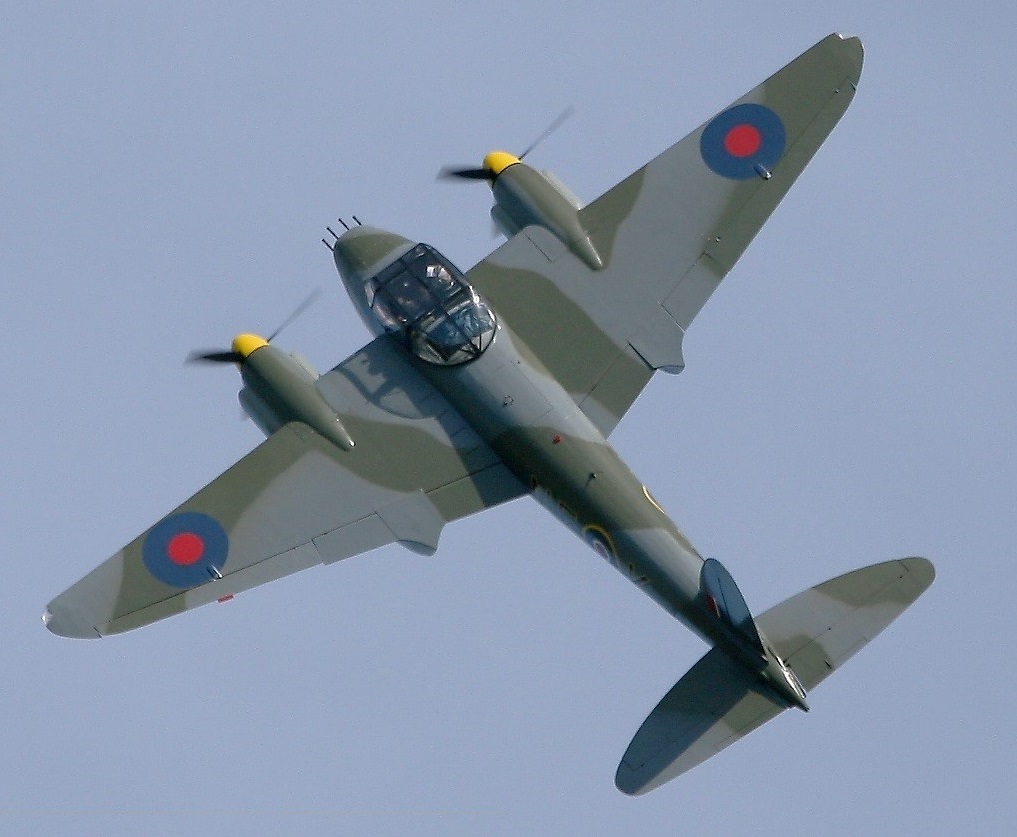
Ironically, the Mosquito had, the same day, flew over Jonzac in homage to the crew of an Allied bomber that crashed there on August 6, 1944.
Wingspan: 12.04 m
Length: 9.30 m
Height: 2.45 to 2.53 m
Reberry 3M1C1R
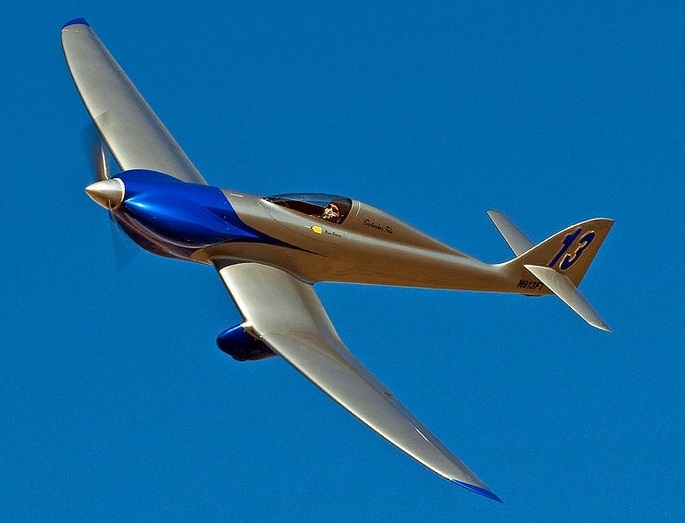
Brian Reberry built the Model 3M1C1R “September Fate”, race #13, in 2011.
Serial Number 013 and registered N013, “September Fate” has been clocked at 238.824 mph.
In 2015 the 3M1C1R was registered to Hot Stuff Air Racing LLC of Kissimmee, Florida, United States.
Engine: Continental O-200-D
Reality Easy Raider
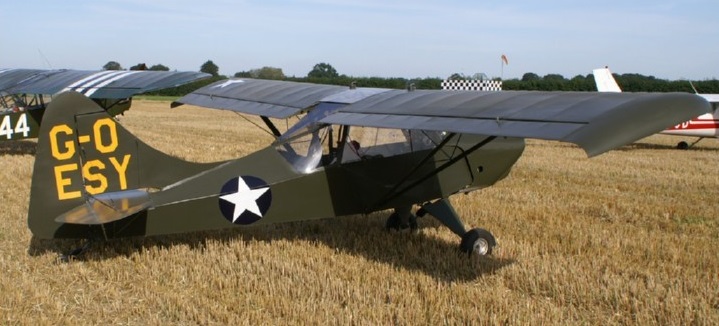
The Reality Easy Raider is a development of the Flying K (later Sky Raider LLC) Sky Raider II, incorporating over 100 modifications.
Featuring a high wing with two tubular main, and two secondary bracing struts to each wing. Tailplane braced with twin wires above and twin rods below. Large fin fillet, compared with Sky Raider, enables sideslipping with cockpit doors in place. Wings fold for storage. Quoted build time 350 hours.
Flying controls are conventional and manual. Frise ailerons, cable actuated. Flight-adjustable tab in port tailplane. Horn-balanced tail surfaces. Slotted flaps, deflections 0, 15, 30 and 40°.
Fabric-covered 4130 chromoloy steel tube fuselage with composites engine cowling. Wing built on large diameter metal tube leading-edge/spar with wooden ribs, fabric covering and composites downturned wingtips.
The landing gear is tailwheel type; fixed. Rubber-in-tension shock-absorbers. Mainwheels 8.00-6 (4 ply); Matco steerable tailwheel. Optional floats or amphibious floats.
Two fuel tanks are fitted in the wings, total capacity 37.9 litres (10.0 US gallons; 8.3 Imp gallons) standard; 72 litres (19.0 US gallons; 15.8 Imp gallons) optional.
A tandem-seat ultralight kitbuilt, the prototype G-SRII (Rotax 503 engine) flew in 2001, and conforms to BCAR Section S. Kit fabrication is by Just Aircraft of USA, with which Reality holds joint design rights.
The Easy Raider 503 initial version has one 37.0 kW (49.6 hp) Rotax 503 DCDI-2V two-stroke engine driving a Powerfin FL370T three-blade, ground-adjustable pitch, composites propeller.
The Easy Raider J2.2 has one 59.7 kW (80 hp) Jabiru 2200 engine driving a two-blade Powerfin ground-adjustable pitch or two-blade Newton wooden propeller. The prototype G-OESY (c/n 0002) was built late in 2001.
The Easy Raider R100 with a BMW R100 four-stroke motorcycle engine driving a Powerfin two-blade, ground-adjustable pitch propeller, prototype G-SLIP (c/n 0004) was under construction in 2002.
Five were flying and five more under construction by July 2003.
Kit £9,898 excluding engine; or £12,563 (Rotax), £14,500 approx (BMW) or £16,298 (Jabiru), including engine, cowlings and propeller, excluding tax (2003).
Raytheon T-6 Texan II / AT-6 Wolverine
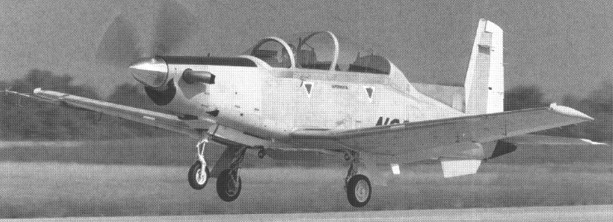
Raytheon Aircraft won a USAF and USN Joint Primary Aircraft Training System competition with the Beech Mk.II trainer, derived from the Pilatus PC-9.
Raytheon’s contract with the U.S. joint armed services to provide up to 700 T-6ATexan II JPATS trainers through the year 2014 continued to pay dividends for the Wichita based airframer. The Air Force and Navy exercised an option for 22 additional Texan IIs, an order valued at almost $65 million.
The first production T-6A Texan II flew on 15 July 1998.
Apart from the JPATS program, Raytheon has orders for 138 T 6As, including a 45 airplane deal with the Greek Air Force.
The first production Beechcraft AT-6 light attack aircraft made a ceremonial first flight on 20 August 2013 at Wichita, Kansas. The single-engined 1,600shp (1,190kW) Pratt & Whitney PT6 turboprop aeroplane took to the air at about 10:30 local time with test pilot Lionel Alford at the controls.
The aircraft was loaded with a pair of 66 gal (250 litres) drop tanks, two inert GBU-58 laser-guided bombs and two LAU-131 seven-shot rocket launchers. The AT-6 was also carrying a L-3 Wescam Mx-15Di electro-optical infrared camera. Although a production aircraft, it is a company-owned asset. Beechcraft has not secured an order for the type. When asked why the company would fly the first flight with such a heavy load, Derek Hess, the company’s senior vice-president for business development, says: “Because it’s so easy.”
The aircraft had demonstrated air-to-air gunnery with .50 caliber machine guns and the potential exists to employ Raytheon AIM-9 Sidewinders to counter certain aerial threats.
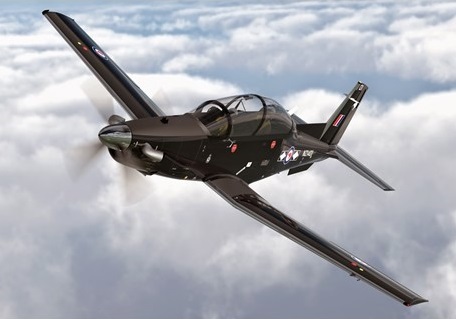
The AT-6TH Wolverine attack variant is derived from the T-6C Texan trainer and is designed to carry out close air support and surveillance missions. The AT-6 has an L3 Wescam MX-15D multi-sensor package that includes colour and IR cameras, laser designator, laser illuminator, and laser rangefinder.
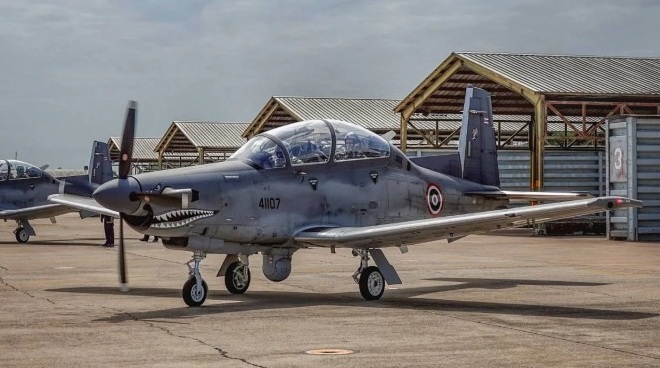
The Royal Thai Air Force (RTAF) received eight AT-6TH Wolverine light attack aircraft in 2025 acquired from the United States as part of its ongoing fleet modernization program.
Assigned to Squadron 411, part of Wing 41 based in Chiang Mai, the AT-6TH Wolverine, manufactured by U.S. company Textron Aviation, is designed for close air support, armed surveillance, and tactical training missions.
T-6A Texan II
Engine: Pratt & Whitney Canada PT6A-68, 1100 hp
Length: 33.268 ft / 10.14 m
Height: 10.696 ft / 3.26 m
Wingspan: 33.301 ft / 10.15 m
Wing area: 175.346 sq.ft / 16.29 sq.m
Max take off weight: 6299.7 lb / 2857.0 kg
Weight empty: 4601.8 lb / 2087.0 kg
Max. speed: 310 kt / 575 km/h
Cruising speed: 230 kt / 426 km/h
Initial climb rate: 3996.06 ft/min / 20.30 m/s
Service ceiling: 35007 ft / 10670 m
Wing loading: 35.88 lb/sq.ft / 175.0 kg/sq.m
Range: 850 nm / 1574 km
Endurance: 3 h
Crew: 2
Raytheon Hawker Horizon

Raytheon’s biggest Hawker design (30% larger than the 800XP) originated at roughly the same time as the initial work began on the Premier I. The Horizon would be an effort to blend high technology with earlier Hawker flight characteristics.
First flown on 11 August 2001, the Horizon retains its DH125 pedigree but is an all-new aircraft with a thinwall composite fuselage offering some 20% more cabin space for the equivalent weight of a conventional structure. The Horizon complements the upgraded 800XP and the entry-level Premier 1.
The design received FAA certification in 2004. On the flight deck is a Primus Epic flight control system and flight management system. The navigation comes from a dual VHF omni-directional radio navigation system, dual distance measuring equipment, dual inertial navigation system and a dual global positioning system. Preliminary performance specifications for the 37,500-pound-MTOW, P&WC PW308A-powered twinjet include a 470-knot high-cruise speed, 3,366 nm NBAA IFR range (two crew and six passengers), and a 5,088 ft balanced field length.
More than 320 were ordered.
Engines two 6,900-lb Pratt & Whitney PW308A turbofans
Gross wt. 37,700 lb
Empty wt. 21,555 lb
Fuel capacity 2,134 lb
Max cruise 470 kts
Long range cruise 430 kt
Range 2,763-3,477 nm
Ceiling 45,000 ft
Takeoff distance 5,088 ft
Landing distance 2,907 ft
Seats 8-14
Raytheon
Raytheon Aircraft Company
In 1993 British Aerospace sold its corporate jets business (builders of the BAe 125-800 and -1000) to Raytheon.
Founded in 1994 as a division of Raytheon International Inc, bringing together the activities of the Beech Aircraft Corporation and Raytheon Corporate Jets, the latter having been British Aerospace Corporate Jets, producing Hawker bizjets, before the August 1993 acquisition.
Continued to market a range of Beech lightplanes (including Bonanza A36 and B36TC, Baron 58, King Air C90, and Super King Air B200 and 350), Beechjet 400A business aircraft and the 1900 Airliner (current 1900D Airliner version first flown March 1990)
Also continued to market the Hawker 800XP corporate jet (Hawker 1000 production ended in 1998), while its latest bizjetto fly is the Premier I (December 1998), and the Hawker Horizon will follow in 1999.
Also manufactures a variant of the Swiss Pilatus PC-9 as the Beech PC-9 Mk II, which is being produced for the USAF and U.S. Navy as the T-6A Texan II primary undergraduate flight trainer and undergraduate navigator trainer. Other activities include the production of missile targets.
Raven 2XS
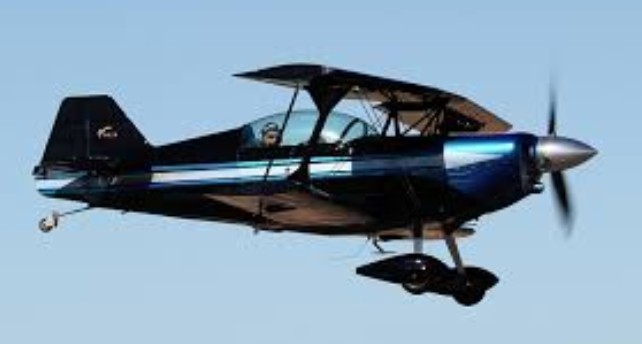
Introduced in 2009, the Raven 2XS (English: To Excess) is a Canadian aerobatic amateur-built biplane, designed and produced by Raven Aircraft of Surrey, British Columbia. The aircraft is supplied as a kit or as plans for amateur construction.
Developed from the Pitts Special, the 2XS features a strut-braced biplane layout, a two-seats-in-tandem enclosed cockpit under a bubble canopy, fixed conventional landing gear and a single engine in tractor configuration. The cockpit is 24 in (61 cm) wide.
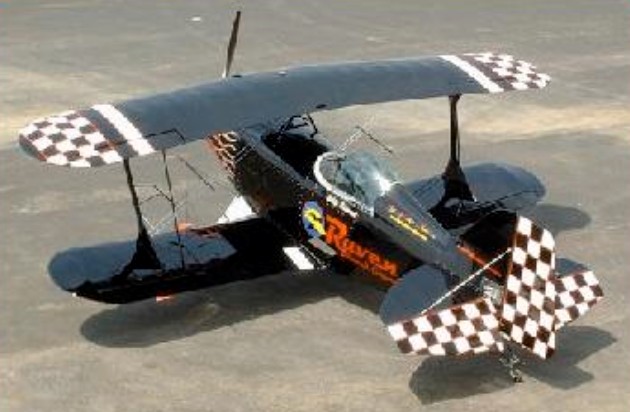
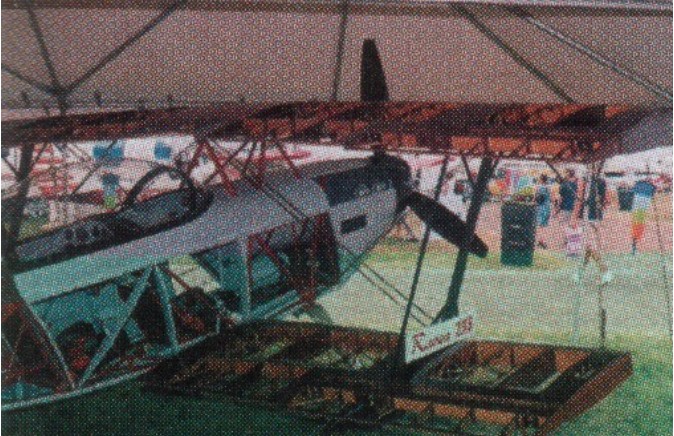
The aircraft is made from mixed construction, using welded steel tubing, aluminum and wood, with its flying surfaces covered in doped aircraft fabric. Construction time from the supplied kit is estimated as 2000 hours.
By November 2012 one example had been registered in the United States with the Federal Aviation Administration, but none in its home country with Transport Canada. Unit cost: US$24,000 (kit only, less engine, instruments, 2011)
Engine: 1 × Lycoming IO-540, 280 hp (210 kW)
HP range: 260-400
Propellers: 3-bladed composite
Length: 19 ft 4 in (5.89 m)
Wingspan: 19 ft 2 in (5.84 m)
Height: 6 ft 6 in (1.98 m)
Wing area: 119.4 sq ft (11.09 m2)
Empty weight: 1,180 lb (535 kg)
Gross weight: 1,780 lb (807 kg)
Fuel capacity: 37 U.S. gallons (140 L; 31 imp gal)
Maximum speed: 200 mph (322 km/h; 174 kn)
Cruise speed: 188 mph (163 kn; 303 km/h)
Stall speed: 60 mph (52 kn; 97 km/h)
Range: 450 mi (391 nmi; 724 km)
Rate of climb: 3,300 ft/min (17 m/s)
Wing loading: 14.9 lb/sq ft (73 kg/m2)
Roll rate: 330 degrees/second.
Takeoff dist: 530 ft
Landing dist: 750 ft
Seats: 2 tandem
Cockpit width: 24 in
Landing gear: tailwheel
Raven Aircraft Corp
2011:
Raven Aircraft Corporation
Unit #6 12312 82a Ave
Surrey, BC V3W 0T7
Ravin Aircraft Ravin 500
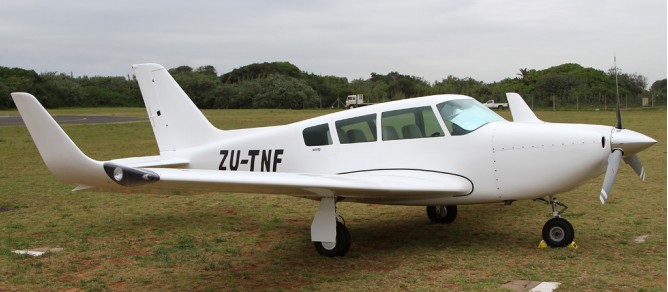
This composite aircraft, based on the concept of the Piper Comanche was designed and developed by SA Ravin in 2 years and 5 months. The Ravin 500 made it’s first flight on 15 September 2002.
An all Composite kit aircraft for amateur construction by SA Ravin Aircraft of Pretoria, South Africa.
An NACA 64-series profile (modified) was used, brought into the shape by Francois Jordaan. The standard handshake overlap main spar design is used to join the two spars in the fuselage.
A Hartzell 3 Bladed Scimitar Pulse Prop was used from the beginning. It uses a 12 liter plenim box in conjunction with the air filter.
The fuselage mold is split vertically with port and starboard halves. There are cross braces below the cockpit floor and one bulkhead visible in the rear fuselage.
Wings are also two-piece, incorporating mainspars and rear subspars. The carbon mainspars overlap and join within the fuselage. Horizontal tailplane was one-piece, glass with carbon elevator.
The fuselage, wings, tailplane and other components appear to have been molded with an inscribed grid covering the exterior surfaces as an aid to alignment and windshield, window cutouts.

Ravin 500
Type: 4-Seat cruiser, conventional
Engine: Lycoming IO540 (194kW, 260h)
Wing span: 10,40m (34ft 2 in)
Wing Area: 14,6 sq m (157 sq ft)
Empty Weight: 975 kg – 1040 kg
Max take-off Weight: 1620 kg (3564 lb)
Aircraft Length: 7,42 m (24 ft 4 ins)
Fuel Capacity: 160 US gal integral wing tanks
Max power loading: 8.35 kg/sq m (22.7 lb/hp)
Max wing loading: 111 kg/sq m (22.7 lb/sq ft)
Max level speed (sea level ISA): 210 kts (242 mph) IAS
Cruise speed (75% power): 185 kts (213 mph) IAS
Optimum cruise (75%@ 6500 ft): 196 kts (226 mph) TAS
Stall speed clean @ max weight: 64 kts IAS (75 mph) IAS
Stall speed with flaps, gear down: 56 kts IAS (64 mph) IAS
Fuel consumption @ 75% power: 14.1 US gal/hr
Range with 10% fuel reserve: 2000 naut miles (2300 stat miles)
 All Aero