2001: Fort Wayne, Indiana, USA.
2009: Rotor Hawk Industries, Inc.
11114 Maples Rd.
Ft. Wayne, IN 46816, USA
Gyrocopter builder
2001: Fort Wayne, Indiana, USA.
2009: Rotor Hawk Industries, Inc.
11114 Maples Rd.
Ft. Wayne, IN 46816, USA
Gyrocopter builder
1998-2009: Rotor Flight Dynamics, Inc.
19242 Grange Hall Loop
Wimauma, FL 33598, USA
Gyrocopter builder
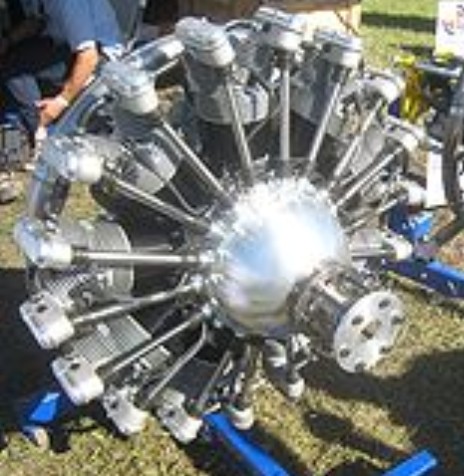
The Rotec R3600 is a nine-cylinder radial engine built by Rotec Engineering PTY LTD in Australia. Initially released in 2005, it was a followup of the 7-cylinder Rotec R2800 released five years earlier. Both this engine and its smaller cousin have been frequently used as both replacement engines for vintage World War 1 aircraft, and replica aircraft from the same vintage. Some notable aircraft this engine has been used in are the Fokker Triplane, Sopwith Camel and the Nieuport 17.
Note that these engines are not limited to only aircraft applications, JRL Cycles has converted an R3600 for use in a motorcycle.
Applications:
Airdrome Sopwith Camel
Criquet Storch
Specifications:
Rotec R3600
Type: 9-cylinder Air-cooled single row radial engine
Bore: 3.149 in (80 mm)
Stroke: 3.149 in (80 mm)
Displacement: 220.9 cu.in (3,619 cc)
Diameter: 33.47 in (850 mm)
Dry weight: 275 lb (125 kg) (dry)
Valvetrain: Poppet Valve (pushrod activated), two per cylinder.
Supercharger: None
Turbocharger: None
Fuel system: Carburetion
Fuel type: 100LL Avgas
Oil system: Dry Sump
Cooling system: Air Cooled
Power output: 150 hp (111.85 kW, 152 PS) at 3,600 RPM Geared
Specific power: 0.68 hp/cu.in (31.06 kW/L)
Fuel consumption: 7.1 US Gal/hr (5.93 Imp Gal/hr, 27 Liters/hr) at 75% throttle
Power-to-weight ratio: 0.54 hp/lb (0.89 kW/kg)
The origins of Rotary Air Force South Africa date back to 1943 when Bernard J. Haseloh hovered his first experimental helicopter at his shop in Ponoka, Alberta, Canada.
Mr. Haseloh was discouraged from building and testing amateur/experimental built helicopters, by the Government who felt that the technology for the power driven rotor system was too complex for the private individual.
To further complicate matters, at that time the Government had no regulations in place for amateur/experimental built helicopters. Therefore, his keen interest in Rotary Winged Aircraft turned toward the development of gyroplanes, the first of which was successfully completed in 1954
Over 30 years, Bernard Haseloh has developed and implemented numerous design and structural innovations for gyroplanes.
Mr. Haseloh has logged more than 2000 hours of flying time on his experimental “HASELOH” designed machines and has spent over 10,000 hours in the development of prototype gyroplanes of “ THE TYPE “ manufactured and sold by Rotary Air Force South Africa.
Bernard Haseloh holds the first Gyro Pilot’s License issued in Canada and is widely recognized as a pioneer in the gyroplane industry. Mr. Haseloh is highly regarded by Federal Aviation Regulators having for many years served as the designated gyroplane instructor for Alberta, Canada.
Bernard Haseloh served as a key technical advisor to the development, testing & design of the
RAF 2000
1987 the Group forms Rotary Air Force Marketing Inc, First aircraft to go into production is the RAF 1000,
recognizing the need for proper flight instruction and to meet the demand for a two place gyroplane the
Rotary Air Force team introduces the Two place Gyroplane in 1989.
Incorporated in 1987, Rotary Air Force employed 16 people in 2001.
1995-7: Box 1236, Kindersley, Saskatchewan S0L 1S0 Canada.
In May 2001, RAF announced that it would be expanding its activities into commercial applications, including agricultural spraying and paramilitary functions.
As of April 2, 2007, Rotary Air Force Marketing Inc. closes doors.
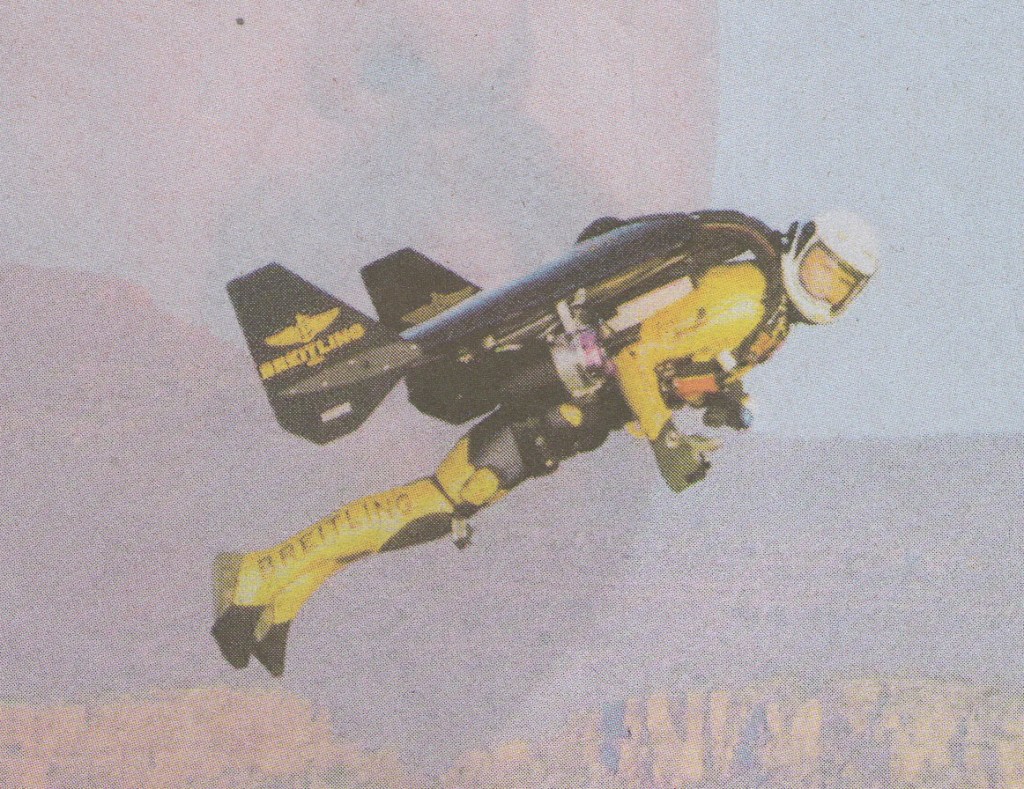
In 1993 Rossy began skysurfing and diving with wingsuits. In 1999 experimented with inflatable wings.
In 2003 Rossy straps jet engines to wings but fails to fly.
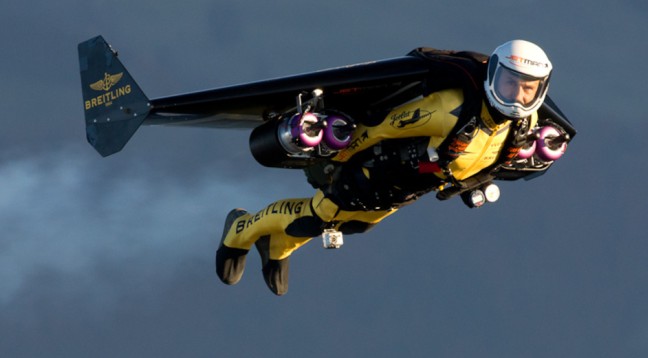
In 2006 was the first (unpowered) flight with two engines on fixed wings. In November 2006 was the first successful flight, of 6 minutes with four engines.
In November 2010 Rossy performs aerial loops on a newly developed model.
20 May 2011 – Rossy flew across the Grand Canyon.

David Rose built the overpowered RP-4 for speed. The experimental counter-rotating propellers, inspired by a NASA project, run at 4800 rpm. Rose can connect both propellers directly to their engines without heavy reduction gearing. The props can change pitch for maximum efficiency at any speed. “It’s a drag-racer frame with skin on it to keep the wind out,” says Jerry Baer, a former pilot who helped Rose build RP-4.
Intended to compete in the Unlimited Class at the Reno Air Races, work began on the David Rose RP-4 project in 2005. Designed by Mr. Rose and built primarily be Eric Hereth, both of San Diego, at slightly over 4,600 pounds, 100 more than the minimum allowable, it was estimated that the racer would tour the course at upwards of 600 miles per hour, at least 100 mph faster than the then record holder.
Power is provided by two 600 cubic inch displacement V-8 engines designed originally for drag racing and, in that configuration, each is capable of producing as much as 2,500 horsepower (hp). Detuned to approximately 1200 hp. each, the engines were expected to withstand the rigors of running at full throttle for eight minutes, the time required to complete each heat at Stead Field in Reno.

The engines are mounted in tandem, each with its own independent systems, and each driving its own propeller. The engines are pressure-fed by two Pro-Charger F3-R centrifugal type superchargers with refrigerated intercoolers. The induction system is custom made from the 6” diameter throttle plate, to the attachment at the cylinder heads. The fuel is delivered by an electronic fuel injection system, also custom made for this application. Two-inch diameter stainless steel headers converge into collectors at the bottom of the fuselage exiting rearward and providing additional thrust in the process.
The contra-rotating propellers are reflective of those used in a ducted-fan experiment in the 1960s. Very efficient, but noisy, they split the job of delivering thrust and also cancel the negative torque reactions resulting from the P-factor, making such a high-power aircraft of small dimensions much more easily controlled.
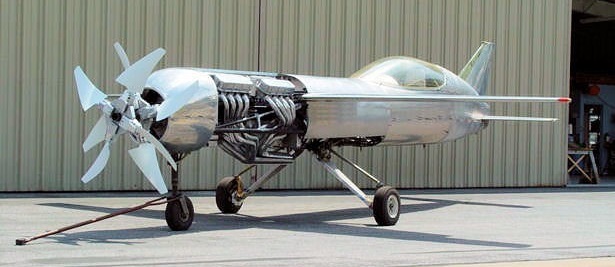
The racer employs a unique engine cooling system. To eliminate any unnecessary parasitic drag on the fuselage, all scoops typically found in this type application are absent. Water from the engine cooling jackets is directed through the wings in parallel tubing, while the wings themselves are filled with water. Heat is transferred from the tubing into the water and heat from the water is transferred overboard through the wing skins. The wing will hold about 50 gallons of water adding about 400 pounds to the weight of the aircraft, which will help it reach the unlimited class weight limit.
All custom crafted by Eric Hereth, the fuselage is 31 inches in diameter with the canopy protruding 12 inches above its top line. It is constructed of welded chromoly tubing, stressed for over 10 g’s and covered in aluminum sheeting. Spinner to tail the aircraft measures 28 feet, with a wingspan of 20 feet and a cord length of four feet at the root. Wing area is 58 square feet, resulting in a wing loading of nearly 100 pounds per square foot.
A change in the rules instituted by the Reno Air Racing Association (RARA) prevented the racer from completing in the unlimited category, and as a result, work on the nearly completed aircraft was halted in 2012.
David Rose has more than 2,500 flight hours in his logbook. He first honed his skills in the U.S. Air Force in Vietnam, flying B-52s and the F-104 Star Fighter. After the military, he joined American Airlines as an ATP, flying 757s, 767s and MD-11s. David is also an avid air racer—he’s won four Reno Gold championships.
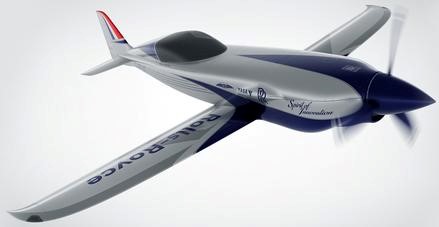
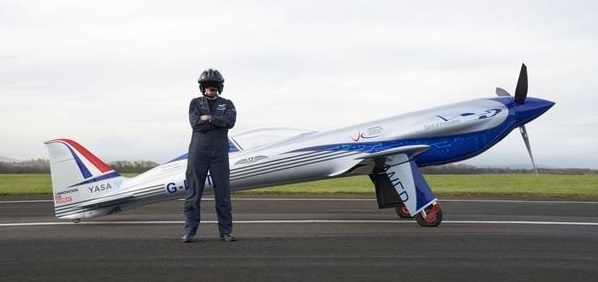
Rolls-Royce developed the ACCEL (Accelerating the Electrification of Flight) as an electric aircraft demonstrator racing aircraft to gain the all-electric air speed record, targeting over 480 km/h (260 kn). The existing electric aircraft record at that time was 182 kn (337 km/h), set in 2017 by a Siemens powered Extra 330.
Designed at Gloucestershire Airport, the project is partly funded by the UK government and involves partners such as electric motor and controller manufacturer YASA Limited and aviation start-up Electroflight.
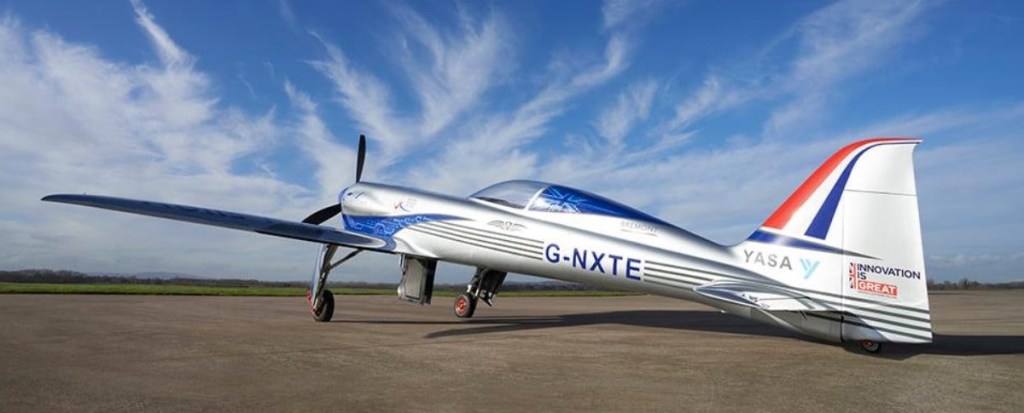
The team aimed to reach the 1931 Schneider Trophy speed, which was won by a R-R-powered Supermarine S.6B, reaching 298 kn (552 km/h).
On 15 September 2021, Rolls-Royce announced the aircraft, named “Spirit of Innovation”, had successfully completed its first flight, flying from MoD Boscombe Down for fifteen minutes.
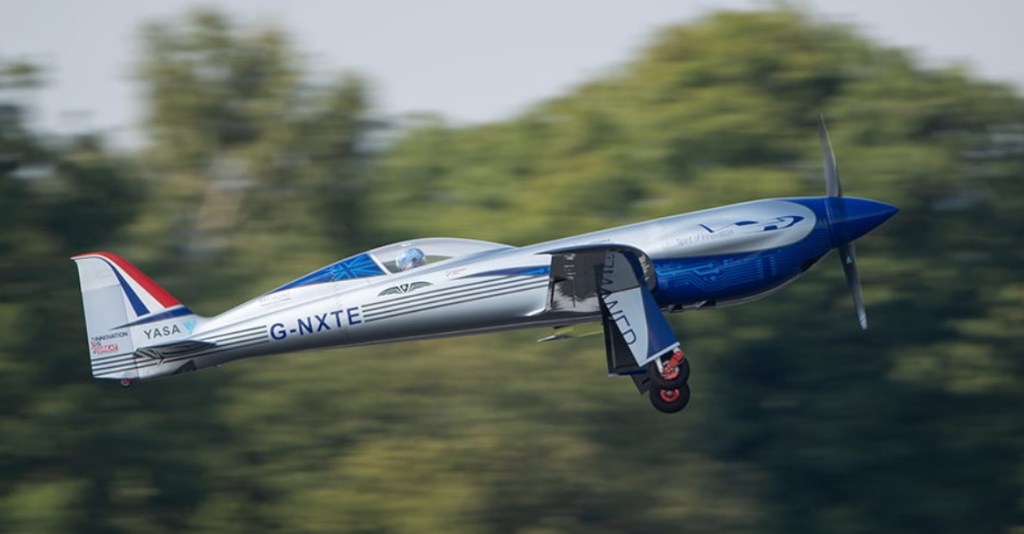
The 24 ft (7.3 m) span aircraft is powered by three high power density electric motors driving a single three-blade propeller spinning at 2,400 RPM, designed and manufactured by YASA, running at 750 volts and delivering over 400 kW (536 hp) combined from its 6,480-cell battery pack with cork insulation. Its cooled battery pack should have the highest energy density for an aircraft and should allow a 320 km; 170 nmi range.
It is derived from the carbonfibre Sharp Nemesis NXT racer, cruising at 282 kn (522 km/h) with a 350hp (260kW) piston engine, but reaching 355 kn (657 km/h) with a highly tuned engine. Battery power output will be 500 hp (373 kW) continuous, reaching 750kW (1,006hp) at maximum power. The battery, motors and control equipment weigh the same as the regular engine and fuel tank while the NXT has a maximum take-off weight of 1,200kg (2,645lb). Its 216 KWh battery pack weighs 1350 kg.
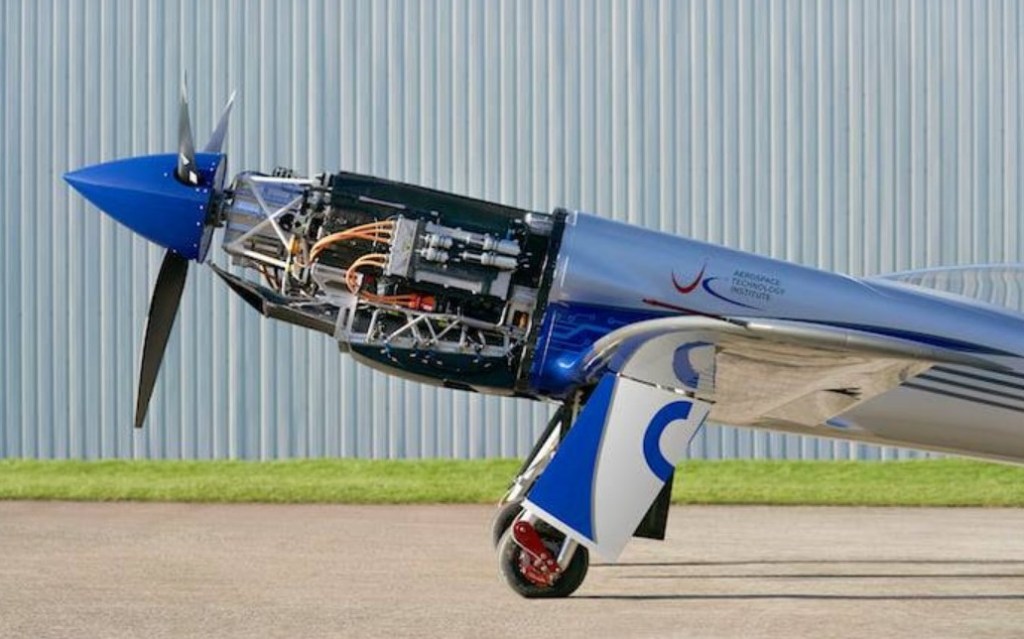
Rolls-Royce said that its all-electric Spirit of Innovation aircraft has set three new world speed records, making it the world’s fastest all-electric aircraft. The company has submitted data to the Fédération Aéronautique Internationale (FAI)— the World Air Sports Federation which controls and certifies world aeronautical and astronautical records—that at 15:45 (GMT) on 16 November 2021, the aircraft reached a top speed of 555.9 km/h (345.4 mph) over 3 kilometers, smashing the existing record by 213.04 km/h (132mph).
In further runs at the UK Ministry of Defense’s Boscombe Down experimental aircraft testing site, the aircraft achieved 532.1km/h (330 mph) over 15 kilometers—292.8km/h (182mph) faster than the previous record—and broke the fastest time to climb to 3000 meters by 60 seconds with a time of 202 seconds. It subsequently reached a top speed of 623 km/h (336 kn), 555 km/h (300 kn) over 3 km (1.6 nmi), 532 km/h (287 kn) over 15 km (8.1 nmi), and was able to climb to 3,000 m (9,840 ft) in 3min 22s. The speeds achieved were accepted as world records for electric aircraft by the Fédération Aéronautique Internationale in January 2022.
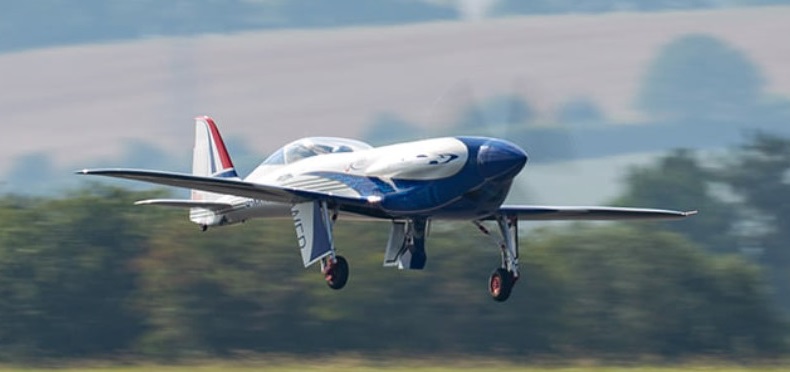
During its record-breaking runs, the aircraft clocked up a maximum speed of 623 km/h (387.4 mph)—making the Spirit of Innovation the world’s fastest all-electric vehicle.
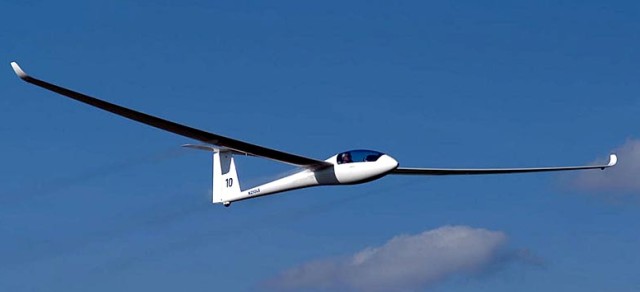
The end of 2005 concluded a series of workshops around key ideas for the new LS10. One key principle was not to “DG-ize” the LS10 but rather maintain the typical LS characteristics.
The LS 10 will differ from the existing model by all LS10 gliders being engine-ready. To simplify production all LS10 gliders will have the engine box built into the fuselage. All LS10 ordered in the glider-only version will offer the option of retrofitting a sustainer engine later.
The typical LS toe brake actuation will be replaced by a drum break actuated by the dive brake lever (in its fully deployed position). The “Haenle” guides for the ailerons remain.
There are no changes to the LS-type elevator assembly, but the outer wing panels trade-in the old threaded bolt for a spring loaded locking pin for easier assembly.
The skids on the wingtips remain (no wheels) as there will be no self-launching version.
All versions of the LS10 feature 4 wing panels, i.e. each wing will be partitioned into two panels for all versions and configurations of the LS10. This design ensures easier assembly and allows for the use of a shorter trailer. As for the location of the paring between inner and outer panels, the further out toward the wing tip the designer places the divide, the easier the assembly and the cheaper and lighter the required connection for the wing spar. In the limit of parting at y=7.25m however, the resulting wing tips of 0.25m for the 15m wing plan form lead to sub-optimal performance characteristics. If the divide is moved too far toward the wing root, the outer panels become so heavy that they cannot be handled by one person. In addition, this also raises the total weight of the wing substantially, which in turn leads to a more expensive overall wing design. The best compromise is for the parting to be at y=7m. This results in 2m outer panels for the 18m version, a size that can still be handled effectively by one person. Combing the resulting 0.5m wingtips for the 15m version with “high” winglets leads to an aerodynamically optimal plan form for this version as well.
The 18m wing plan form will feature the well-known LS curved winglets.
All LS10 gliders are designed to accommodate a bug wiper system. Integrating this option into the design of the LS10 allows for the installation of a lower drag bug wiper system.
Meanwhile the second LS10 was construction at the Bruchsal facility according to the original Rolladen-Schleicher design. This aircrafts construction was begun by Rolladen-Schneider and was suffering from delays due to the well-known legal problems. The test pilot was Micro Scholz.
Its design is still identical to the “original”, as is production no. 1. The design of number 3 is currently being completed. It will include a number of improvements and will serve as the basis for serial production.
In parallel with the flight tests staff worked on detailed solutions and modifications. The extensive testing of the two prototypes resulted in new fairings at the lower part of the vertical fin, but the biggest changes took place in the cockpit e.g. the position of the rudder pedal cavity foot tub was changed. Now there will be room for big feet. To further improve the view out of the cockpit the instrument panel could be further lowered – without loosing space for the instrumentation, and a Piggott-Hook was installed.
The operating forces of the water ballast system were reduced. The shape of the opening levers was optimised. The flap lever the changes in flap setting works more precisely and pilot-friendly – the handle is coated with fine leather. The decompression lever for starting the engine was moved and now is very well accessible. The position of the trim knob was optimized ergonomically and functions much better. The rudder pedal handle now retracts in the seat pan after use in the LS10.
A very tall pilots will fit in the LS10 by using an optional separate headrest which can be installed instead of the back support. The change can be done in a minute.
Span: 15 m
Area: 10.4 sq.m
Aspect ratio: 21.7
Airfoil: Lemke
Empty Weight: 250 kg
Gross Weight: 525 kg
Wing Load: 50.5 kg/sq.m
Seats: 1
 All Aero