Rutan SpaceShipOne

Burt Rutan leads one of 27 teams from seven countries competing for the US$10 million (NZ$16 million) X Prize, to be given to the first private entrepreneur who can put three people into sub-orbital space and do it again with the same equipment within two weeks by the end of 2004.

The team is funded by Microsoft co founder Paul Allen.

SpaceShipOne will piggyback aboard a mother aircraft known as the White Knight, to an altitude of 48,000 feet (14,600 metres). On release, SpaceShipOne’s 18,000 lb thrust rocket engine burns for 80 seconds, accelerating the aircraft at three times the force of gravity to reach Mach 3.2 (3860kph) by the time the engine burns out at 160,000 ft (48,700m). Coasting the rest of the way, losing power and slowing down. At 200,000ft, the pilot and passengers in the future experience weightlessness, which lasts three to four minutes as the spacecraft attains its maximum altitude of 340,000ft, virtually stops, then falls back to 200,000ft (60,000m), when it begins to feel the atmosphere once again. The key is to decelerate gently in the upper atmosphere by controlling the angle during descent and maximising drag, making for a much safer and more comfortable ride.

SpaceShipOne, the rocket plane funded by Microsoft cofounder Paul G Allen, appeared to top its required altitude within minutes of firing its rockets in 2004. The plane took, off from a desert runway slung to the belly of a carrier plane with a test pilot at the controls. It was released at about 13,800m and fired its rockets to climb to an altitude of 100km.
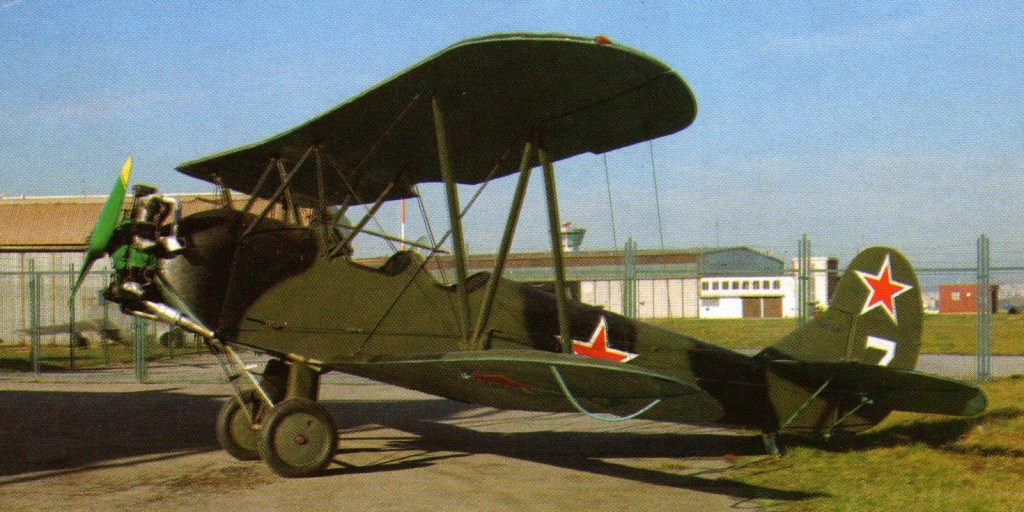
Rusavia Polikarpov U-2

During the first flights in 2004, the Shvetsov M-11FR radial was damaged and needed to be overhauled. Albatros Aviation Services carried out the recent engine rebuild, using many hard-to-find original parts.

Slovak Republic-based Polikarpov U-2 replica ‘White 7’ (OM-LML) took to the air again after the engine overhaul on October 11, 2007. This machine was built by Rusavia in Moscow and was gifted to the Museum of Aviation collection at Kosice by Russia in August 2004.

Ruixiang / Liaoning Ruixiang RX1E

RX1E

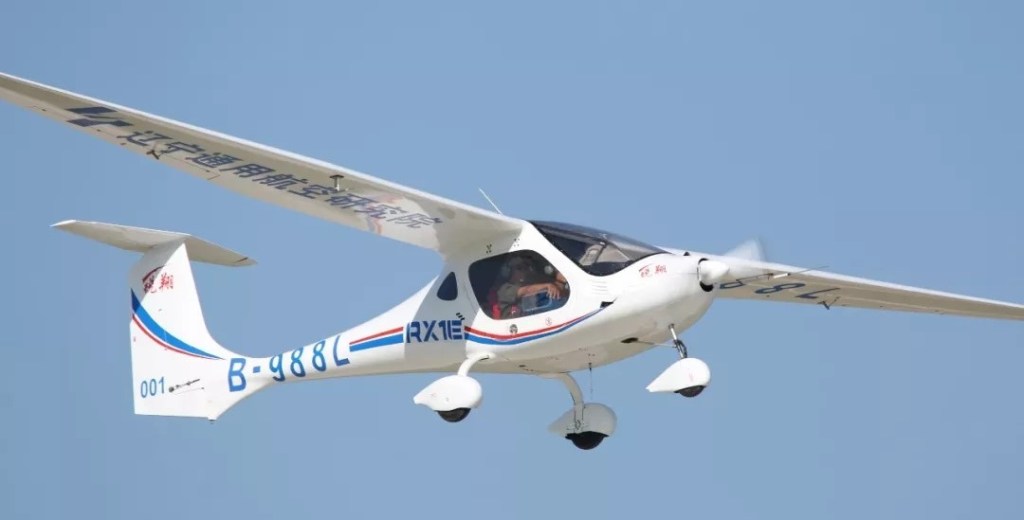
The RX1E aircraft is China’s first two-seater general aircraft developed by Liaoning Ruixiang General Aircraft Manufacture Co. Ltc. The aircraft used pure lithium batteries and permanent magnet motor to drive the propeller.

The whole machine structure made of composite material. The side-by-side two-seater aircraft belonged to the category of light sport aircraft, and debuted at the 2012 Zhuhai airshow. The cabin opens on both sides to facilitate boarding passengers.

The RX1E aircraft is equipped with mechanical flight instruments and electronic digital display power meters.

On November 1, 2017, at Fakucaihu Airport in Shenyang, the first flight of the Ruixiang Extended Range Electric Aircraft (RX1E-A) was successful. On October 19, 2018, RX1E-A aircraft has obtained the Model Design Certificate (TC) issued by China Civil Aviation Administration.

RX1E-A

RX1E
Engine: A37K154, 30KW
Propeller: LGAA
Wingspan: 14.5m
Wing area: 12 sq.m
Length: 6.61 m
Maximum take-off weight: 500 kg
Maximum load: 162 kg
Maximum speed: 150 kph
Cruising speed: 120 kph
Ceiling: 3000 m
Endurance: 1 hr
Load factor: +4g/-2g
Seats: 2

RX1E-A
MTOW: 600 m
Maximum Landing Weight: 600 kg
Payload: 160 kg
Max Level Speed: 160km/h
Stall Speed: 82km/h
Cruising Speed: 110km/h
Load factor: +4g/-2g
Service Ceiling: 3000 m
Endurance: 90 min
Range: 180 km
Takeoff run: 330 m
Landing Run: 380 m

Rousson Zeppy

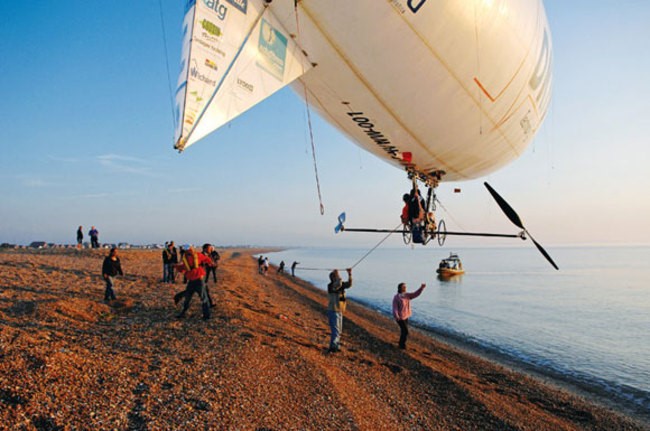
Rousson’s blimp, a crank-driven zeppelin known as Zeppy, is 16-meters-long with a 5-meter diameter, and a maximum speed of 20 kph. The craft’s forward momentum and steering come from a pair of 10-foot movable propellers turned by a recumbent bike hanging from the ship’s belly and pedalled.

Rousson, a 39-year-old Frenchman, attempted to cross The English Channel in a pedal-powered airship on 28 September 2008. He was forced to deflate his blimp and continue to France in a boat after a shift in winds made it impossible for him to progress, no matter how hard he pedalled.

“We were about three-quarters of the way across but the wind was flowing in the wrong direction for me to make it across,” he said. “I’m not disappointed. I feel happy because it had nothing to do with any technical failure, it was purely the wind that got in the way of this achievement.”

The failure is strike two for Rousson, whose June attempt to cross the Channel was also foiled by winds. This time around, he waited more than a week for the right conditions, but was doomed by a light breeze that picked up while he was in flight. “What feels breathlessly still to most people feels like a storm when you’re trying to fly a pedal-powered airship,” he says.

Rousson’s singular focus on flight also seems to be taking over his life. “All of my money has gone into this,” he says. I’m in quite a bit of debt.” He was also dumped by his girlfriend; presumably he loves his blimp more than he loves her.

Rotron

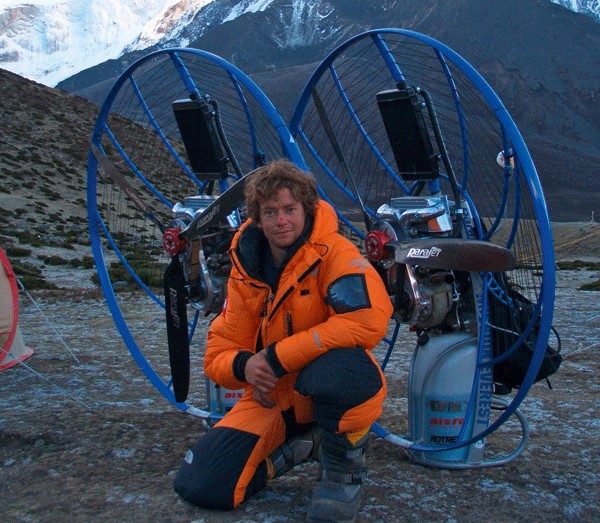
In early 2007 Rotron founder and chief technology officer, Gilo Cardozo, pursued a childhood dream: to fly a paramotor 30,000ft over the summit of Everest.

Having teamed up with friend and TV personality Bear Grylls, Cardozo had just seven months to build two paramotors. The most powerful paramotor engine available was barely producing 30hp and was far too heavy to launch at the desired altitude. So, he also set about building a four-stroke rotary engine that was more compact and 50 per cent lighter than a piston engine equivalent.

The basis of the Everest engine was a 294cc single rotor engine producing 40hp as a standard normally aspirated engine.

The engine included a miniature centrifugal supercharger fitted with a miniature intercooler to ensure the air was as cold and dense as possible when entering the combustion chamber. The supercharger was modified to be spun at up to 200,000rpm in order to simulate sea level atmospheric pressure of 1 bar at 30,000ft.

To eliminate the problem of icing, the supercharger was placed before the fuel delivery system. The heated and supercharged air was then sent through an intercooler before passing the injector at an average of 25 degrees Celsius.

After four months of design, development, testing and manufacturing, the engine was finally ready. With just two days before departure, the second engine was completed.

On 14 May 2007 the two pilots took off and in a flight that lasted four hours they achieved a paramotoring world record of 29,494 feet.

On completion of the expedition and building on its success, Cardozo continued to develop his rotary engine and looked for a commercial platform for the technology. Rotron Power was born.

RotorWay International A600 Talon

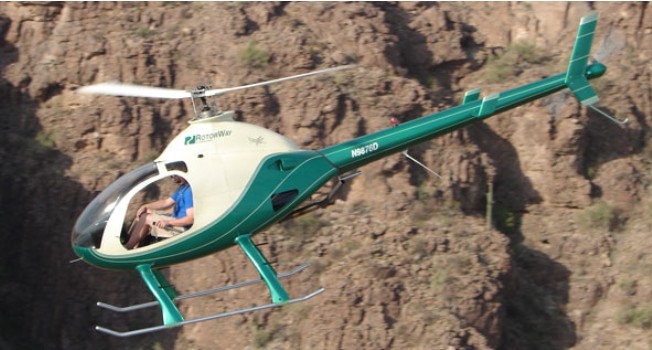
The A600 Talon is a top-to-bottom redesign, incorporating many customer-initiated requests, advanced electronics, engineering, and convenience items. The cockpit is now all-glass, using the MGL Avionics system. The completely redesigned and tuned FADEC system now has a secondary FADEC as a clone of the primary. Any failure of the primary unit will be imperceptible to the engine informing the pilot on the MGL display. The 162’s primary drive chain is replaced by a heavy-duty cog belt for ease of maintenance and longevity.

The useful load is 535 pounds, including a 100-pound luggage compartment. Economy cruise is a practical 90mph and fast long-distance cruise has already been demonstrated at 100 plus, with the doors off! The landing gear is 10 inches wider, 10 inches longer, and 7” higher than its smaller predecessor the Exec 162. This enables improvements in strength and stability, while offering greater accessibility underneath for the optional accessory luggage pod.

Process controls and designs with the new Talon’s manufacture at Rotorway’s new factory, are specifically aimed at the company’s plan to develop and deliver a certified helicopter. The A600 Talon is to be built in the new facility, on the new line, under the new processes that are being set up and proven to enable the certified machine to follow as early as 2011 in the United States. These new processes, materials, and documentation on the experimental, owner-built A600 Talon are designed to mesh into the processes and controls to be used on the future certified machine. The result is that the Talon will be built to type certified standards, of certified materials. First customer deliveries are set for October 2007.

Engine Standard: RI 600N, 147 hp
Engine Supercharged: RI 600S, 167 hp
Gross weight: 1500 lbs
Empty weight: 965 lbs
Fuel cap: 17 USG
Service ceiling: 10,000 ft
HIGE: 6000/7500ft(Supercharged)
Normal cruise: 115 mph
HOGE: 4000/6000ft(Supercharged)
Max IAS SL: 115 mph
Main rotor dia: 25 ft
Tail rotor dia: 50.25 in
Fuselage Length: 22 ft
Overall length: 29.5 ft
Cabin width: 44 in
Skid width: 72 in
Height: 103 in
Seats: 2

Rotorvox C2A

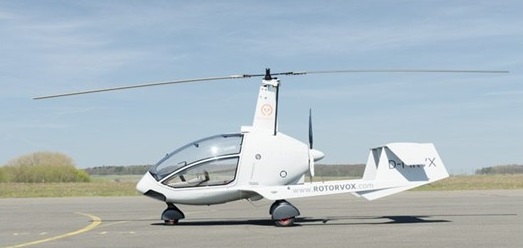
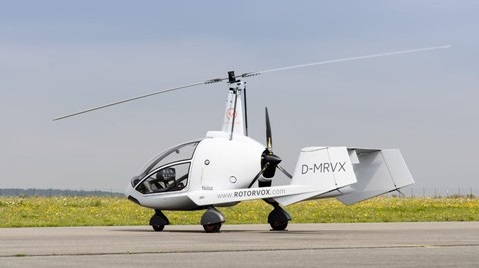
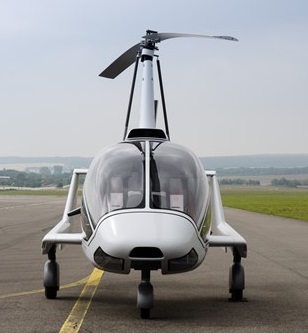
The Rotorvox C2A is a two-seat autogyro developed in Germany.

Structurally, the C2A is largely carbon-fibre monocoque. The fuselage pod contains a protective cell for the side-by-side seating behind a large, forward hinged, three piece canopy. A faired pylon, mounted immediately behind the cell supports a two blade aluminium rotor and behind it a 73 kW (98 hp) Rotax 914 liquid-cooled flat-four engine drives a pusher three blade propeller. The rotor is pre-rotated hydraulically.

Flat-sided tail booms are held away from the fuselage on short stubs and each mounts a straight-tapered fin and rudder, their tips linked by the tailplane. There are shallow, long ventral fins. The C2A has a short-legged, wide track tricycle undercarriage with its mainwheels near to the forward end of the booms and a nosewheel under the forward fuselage.

First flown around 2009, at least two prototypes were flown over five years of development before C2A deliveries began in October 2014.

Engine: 1 × Rotax 914, 73 kW (98 hp) continuous
Main rotor diameter: 8.40 m (27 ft 7 in)
Blades: two aluminium, airfoil NACA 8H12
Length: 5.50 m (18 ft 1 in) fuselage; including rotors 8.40 m (27 ft 7 in)
Width: 2.21 m (7 ft 3 in) fuselage
Height: 2.85 m (9 ft 4 in)
Max takeoff weight: 560 kg (1,235 lb)
Fuel capacity: 90 l (20 imp gal; 24 US gal)
Propellers: 3-bladed Duc, 1.75 m (5 ft 9 in) diameter
Cruise speed: 145 km/h (90 mph; 78 kn)
Never exceed speed: 164 km/h (102 mph; 89 kn)
Range: 600 km (373 mi; 324 nmi)
Endurance: maximum 6 hr
Crew: Two

Rotor Hawk Sparrow

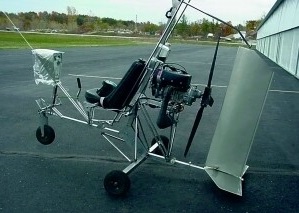
Correspondingly named, the Sparrow is the drop keel ultralight cousin of the Falcon. Its bolt-together aluminum frame carries a useful load of up to 240 pounds, depending on the engine (choice of Rotax 447 or 503, or Hirth 2704 or 2706). Cruising airspeed is 63 mph.

Bolt-together all-aluminum frame. Components done on CNC. Contains all fasteners, cables, wheels,
engine mount, rotor head, pod, tall tail and horizontal stabilizer, and joystick.

Kit for the Sparrow:
(Without engine, seat tank, propeller, rotors and instruments) 2001: $3795. Plans for the Sparrow 2001: $175

Engines: Rotax 447, 503; Hirth 2704
Propeller: 2 or 3-blade Warp Drive
Rotor Blades: Rotor Hawk 23 or 24 rotor disk
Width 64″
Height 84″
Length 9′
Min Speed 15-20 mph
Cruise 63 mph
Empty Weight 254 lbs
Useful Load up to 240 lbs
(depending on engine)

Rotor Hawk Falcon

Falcon

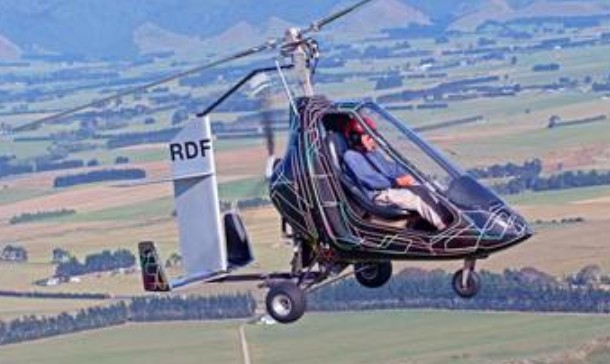
Both Falcon and Falcon II are accommodating to most aircraft engines, including Subaru, Rotax and Hirth, and both cruise at 60 to 70 mph with a top speed of 95 mph. But two passengers can ride side-by-side in the Falcon II while the Falcon only has room for one. Both are available with or without enclosure.

Falcon kit (without engine, propeller, rotor blades, instrument and seat tank) 2001: $3995
Falcon II kit (without engine) 2002: $11,950, but may cost less, depending on option choices.

The airframe is aluminium bolted together. Engine options include 70 hp Subaru, Rotax or VW. Rotor blades: 22-28’, 8 1/8” aluminium bonded and riveted.

Complete kit available as well as individual components and modification kits for upgrading Bensen-type machines to the Falcon configuration. Features main gear suspension using standard 2 x 2 Bensen axle tube. Full enclosure available. Kit contains everything less engine, prop, rotor blades, instruments and seat tank. Info pack: $3.00 Kit: $3,995 in 2009.

Engines: Subaru, Rotax, VW, or Hirth
Rotor Blades: RotorHawk 26′ diameter,8-1/8″ chord aluminum bonded and riveted.
Min Speed 20 mph
Cruise 60-70 mph
Top Speed 95 mph
Empty Weight 475 lbs
Useful Load 300 lbs
Gross Weight 775 lbs
Width 6’8″
Height 8’2″
Length 9′
Seats 2