Sandlin Pig

The Pig, September 2008

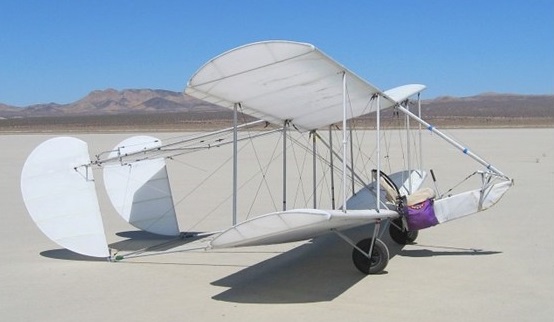
The Pig (Primary Instruction Glider) is an airchair, ultralight biplane sailplane with a two axis control system (rudders & elevator, but no ailerons). A center stick & rudder pedals provide a traditional control system.

The Basic Ultralight Gliders are best characterized by their light wing loading, which is about the same as that of a hang glider (around 1.7 lb. of gross weight for every square foot of wing area). Light wing loading results in slow flight, which is safe, comfortable, and allows soaring in small thermals (because of the ability to turn tightly).

The Pig features:
low wing loading for forgiving flight characteristics and rolling launches (1.5 lb/sqft.)
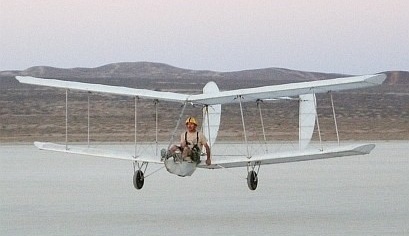
open air pilot seating (allows hand thrown emergency parachute)
center of lift landing gear (allows simple balance check for proper center of mass)
car top transport (major sections separate, wings and tail fold up)
one person assembly (37 minute setup for me in my backyard)
light weight airframe (about 148 lbs. with parachute)
nose skid for quick stops, nose down or tail down attitude for take off or landing

The Pig features simple construction from readily available materials, no molds, no welding, no special machining, no spray rig, no sail making, no sheet metal, etc. The airframe is made of bolted aluminum tubing with braided steel cables, covered with a light grade of conventional aircraft fabric (polyester fabric is cemented on, heat shrunk, then adhesive sealant is applied by brush).

All secondary structures (small ribs) are composites of foam, carbon rod, & fiberglass tape.

Low time pilots should use a glider that is easy to fly, forgiving, and robust, and which has good crash protection for the pilot. Controls and airframe must look and feel good, to engender the confidence that will reduce pilot stress and allow effective learning. The mechanics of launching and landing should be simple and non-athletic. Things should be happening slowly so the student has time to see mistakes and react to them. The Pig is a version of this slow/simple/safe aircraft.

The Pig has two wheels (40 cm. diam. standard kite buggy type), 8 feet apart, rudder turn control, no ailerons (stick moves fore and aft only). 6 degree wing dihedral angle for yaw/roll coupling, and Box kite structure for torsional rigidity.

The wing airfoil is a simple utility type that Sandlin made up (Pigfoil 3012, 12% thick at 30% chord) with a completely flat bottom. This airfoil is similar to that of some radio controlled trainer gliders, and much like a Piper Cub. This is for good low speed flying characteristics and easy construction. This airfoil can also provide a strong and stiff trailing edge which will tolerate rough assembly on irregular terrain (the wing section is assembled with the trailing edge on the ground).
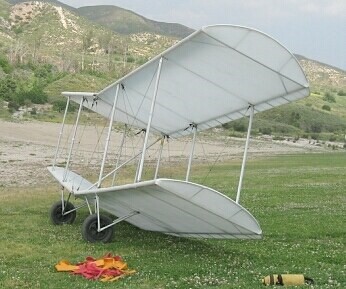
Folding wing design provides a large area wing in a small, light package, allowing transport & assembly by one person.

The eight main wing struts are mounted on swiveling eye bolts, so that during disassembly the struts can be detached at one end and rotated ninety degrees on the other. This allows each upper wing half to be lowered onto the lower wing half, making a compact stack for car top transport. A Pig can be strapped down onto an ordinary hang glider rack, with no special saddles or pads.

Room has been allowed behind the the pilot for installation of a small motor and pusher propeller at about the trailing edge of the wings. The engine frame might replace the two centerline struts, and there are other hard points nearby if required. The prop wash can exit through the box tail without hitting any control surface, avoiding a common source of vibration and drag. Adding a motor to the Pig would create a “motor floater”, a self launching airchair which could play the game of minimal power flight to the nearest thermal.

The two axis control system has proven to be adequate, simple to use, and fun for recreational flying. Launches have been made by line towing and by rolling off open hillsides.

The release handle fot the tow hook is in the middle of the nose tube.

Flying the Pig is simple, a two axis system like a hang glider, “fast-slow, right-left”, not requiring any coordination between the yaw and roll axes as does the three axis system. There is no yaw string, and the general instruction is: “nose level, turn with your feet”.
The initial use of the rudder induces a skid, quickly followed by banking of the wing. Generally, the control feel is quick and stable, and the controls function just as well as on any of the three axis airchairs. There are special two axis procedures, such as keeping the nose low while ground rolling in a cross wind, so the weight of the glider on the wheels will keep the wings level.

Its first high flight was made in September, 2008.
Nothing is for sale and there are no commercial intentions. The Pig1 technical drawings are available for on line viewing or download, Basic Ultralight Glider homepage, “Pig Drawings”. There are 81 drawings available in three different file formats.

Gallery

Wingspan: 26 ft
Empty weight, with parachute: 147.5 lb
Gross weight: 308 lb
Wing area: 194 sq.ft
Wing loading: 1.6 lb/sq.ft


Sandlin, Mike

Mike Sandlin designed and built what he calls “airchair” basic ultralight gliders. The Pig1, Goats1 & 4, and Bug4, are home built, basic ultralight gliders. Technically these aircraft are ultralight sailplanes, but they are best described as “airchairs”, which are simple, slow flying gliders with the pilot sitting out in the open air rather than inside a fuselage.

The airchair dersigns are intended to provide open air soaring, forgiving flight characteristics, convenient transport, simple “garage technology” construction, and a high level of crash safety. In the United States, all unpowered ultralights, including paragliders, hang gliders, and airchairs are regulated under FAR Part 103, which allows gliders to be built and flown with no direct official oversight as long as they weigh less than 155 lbs.

The complete descriptive drawings of the Pig1, Goat4, Bug4, and some of their predecessors are free and available for downloading in CAD format. In addition, the the Goat4 drawings can be viewed on his Web. His activities are noncommercial and all of the materials on his website are available for whatever purposes the user may consider worthwhile.

Safran ENGINeUS

Safran’s ENGINeUS smart electric motor, the ENGINeUS 100, has been in the works over at French aerospace company Safran since 2021. It should serve the needs of aircraft ranging from personal transporters to medium-sized commercial planes, either by completely electrifying their powertrains, or by becoming part of some sort of hybrid system.

The ENGINeUS 100 comes with built-in power and control electronics, thus making it suitable for use in passengers aircraft that can carry as many as four people, or even in larger one that can fly 19 people on a regional trip.

The air-cooled motor, light and compact as to be easily integrated into existing designs, can generate a maximum power of 168 hp. That number translates into a weight-to-power ratio of 5 kW/kg.

Safran wasn’t the only one involved in this. The EASA got into the testing of the engine as well (over 1,500 hours of certification tests were performed, but also 100 hours of actual flight), because it too had to learn what airworthiness rules the tech must follow for it to be certified.

Now that it got the certification it was after, Safran announced that it will start producing the ENGINeUS 100 in 2026. Two facilities, one in Niort, France, and the other in Pitstone, UK, will be tasked with making the motors, and they should roll out a combined 1,000 electric motors each year.

It’s not exactly clear when the first aircraft powered by the ENGINeUS will take to the sky or what plane that will be.

Sabre Aircraft Aeros 503

Circa 2008

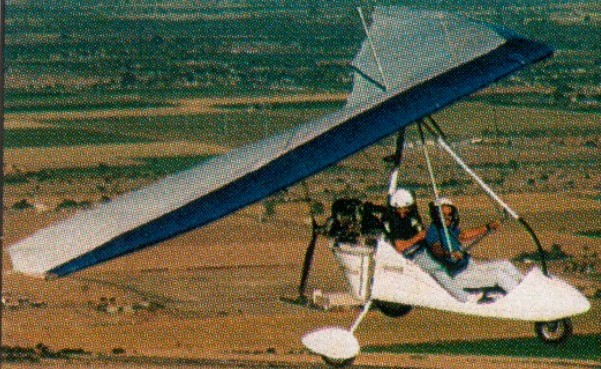
Manufactured in the US, kits included the engine and propeller. Using as standard the Aeros Stranger wing, other options were available.

Engine: Rotax 503, 48 hp
hp range: 41-65
Height: 12 ft
Length: 13 ft
Wing span: 33 ft
Wing area: 160 sq.ft
Empty weight: 235 lb
Gross weight: 885 lb
Fuel capacity: 5-10 USG
Max speed: 69 mph
Cruise: 60 mph
Range: 250 sm
Rate of climb: 1000 fpm
Takeoff dist: 100 ft
Landing dist: 75 ft
Service ceiling: 15,000 ft
Seats: 2

SAAB

Svenska Aero
AB Svenska Järnvägsverkstäderna (ASJA)
Svenska Aeroplan Aktiebogalet (SAAB)

Svenska Aero, as a subsidiary of Heinkel, was taken over by AB Svenska Järnvägsverkstäderna (ASJA) in 1932.

The Bofors Company at Trollhattan formed in 1937 Svenska Aeroplan Aktiebogalet (SAAB). Following its merger in 1939 with the AB Svenska Jarnvagsverkstadernas Aeroplanavdelning (AJSA). In 1939 amalgamated with Aircraft Division of Svenska Jarnvagsverkstaderna and moved main establishment to Linkoping. From 1950 acquired other important facilities, including underground factory at Linkoping.

Built 82 Tiger Moth, 43 Hawker Hart, 11 NA-16-4M, FW-44, and Northrop 8A-5 under licence.

In 1945, in the hope of a lasting peace, the Company decided to scale down its production of military aircraft and to develop its civilian operations – a change in policy signified by the ap¬pearance of the Saab 90 Scandia airliner and the Saab 92 car.

Name changed to Saab Aktiebolag May 1965; Malmo Flygindustri became a subsidiary in 1967; in 1968 merged with Scania-Vabis group to became Saab-Scania. Current name Saab Group, comprising five main divisions: Saab AB, Saab Dynamics AB for guided weapons and electronics, Saab Training Systems AB, Saab Aircraft AB for marketing and supporting commercial aircraft, and Saab Combitech AB. Saab AB parent division established January 1997 to combine activities of previous Saab Military Aircraft, Saab Aircraft and Saab Service Partner, and develops and manufactures military and commercial aircraft within business units known as Gripen, General Military Aircraft, Future Products and Technology, Operations Commercial Aircraft, and Collaborative Programs.

First airplanes were license-built Junkers Ju 86K twin-engined bombers, Northrop-Douglas dive-bombers (Douglas 8A-1, similar to the US Army Air Corps’ A-17) and North American NA-16 trainers. First own-design production aircraft was Saab 17 dive-bomber of 1940, used widely and 60 delivered to Ethiopia from 1947. Saab 18 was twin-engined bomber of 1942, some late examples of which had ejection seats. Saab 21A of 1943 was piston-engined single-seat fighter, and 21-R was jet development of the same aircraft. Saab 29 was the so-called “flying barrel” swept-wing jet fighter, in production until 1956, while Saab 32 Lansen of 1952 was swept-wing fighter/attack/reconnaissance two-seater. Saab 35 Draken “double-delta” fighter appeared in 1955, and a squadron remained active as interceptors until 1999. Saab 105 of 1963, a twin-jet light side-by-side two-seater armed multipurpose aircraft, still in use as a trainer in 1999; Swedish Air Force aircraft have just undergone an upgrade with new engines and thus redesignated Sk 60W. Saab 37 Viggen multirole combat aircraft, first flown February 1967, has foreplane and delta wings, and with its STOL capability remains a very potent weapon system. Produced for service between 1971 and 1990, it has been continuously upgraded; redelivered in latest upgraded form 1998 for continued service in JA 37 interceptor and AJS 37 attack/interceptor/maritime-reconnaissance variants. Latest combat aircraft is Saab AB Gripen JAS 39 Gripen, first flown December 1988 and taken into Swedish Air Force service from 1996. Grippen is the world’s first combat aircraft of the new-generation type and the first to combine the roles of interceptor, attack, and reconnaissance in a single aircraft (all as primary roles) by the adoption of push-button control to select the required function in the computer programs of the totally integrated avionics suite.

Civil types have included Saab 90 Scandia twin-engined 32-passenger transport (first flown November 1946); Saab 91 Safir all-metal 3/4-seater (first flown November 1945); two/three-seat high-wing Safari (first flown in July 1969) and its military Supporter development (first flown 1972). In production until 1999 has been the Saab 340 turboprop regional transport (first flown January 1983, and finally produced in 340B and BPIus variants with accommodation for up to 37 passengers) and the Saab 2000 50/58-seat turboprop regional airliner (first flown March 1992). Saab has also developed an airborne early warning and control variant of the 340B airliner as the S100B Argus (first flight of AEW&C prototype with overfuselage radar July 1994), plus a search-and-rescue variant for the Japanese Maritime Safety Agency as the SAR-200 (delivered 1997).

Rutan SkiGull

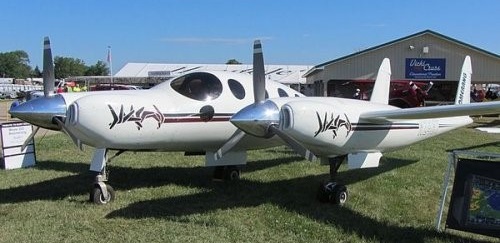
Burt Rutan has designed and buil the SkiGull, his own light aircraft concept. The SkiGull is a small amphibious aircraft that fits in a single-car garage, after having folded its wings. The plane has a single engine located directly above the cockpit that is itself suspended from the wings in a gondola-like cabin.

The SkiGull has a retractable, flexible ski system. The skis provide five times the shock absorption deflection of a typical land plane, making it possible for the SkiGull to operate in considerably rougher environments than most other seaplanes. This includes the ability to perform water landings on beach waves and ocean crests.

Small wheels protrude from the bottom of the skis, making it possible to land on surfaces such as snow or grass.

According to Rutan, the SkiGull’s all-composite structure means he can avoid conventional structural design and fabrication methods. No specific details have been made available yet, he does give a hint: “For now all I can say is that its structure is more like nature than conventional.”

“It will be the last time I design and build an airplane, since I want to enjoy this one for myself,” said the 72-year-old Rutan.

Rutan SpaceShipTwo

The six passenger SpaceShipTwo is carried aloft by WhiteKnightTwo.

Virgin Galactic’s SpaceShipTwo made its second successful powered flight on 5 September 2013 from Mojave Air and Space Port in California.

SpaceShipTwo, funded by billionaire Richard Branson, was carried to an altitude of 42,000 feet attached to the “mothership” and then climbed to 69,000 feet under its own power before descending back to Mojave.

“In addition to achieving the highest altitude and greatest speed to date, the test flight demonstrated the vehicle’s full technical mission profile in a single flight for the first time … All of the test objectives were successfully completed,” the company said.