Scaled Composites 351 Stratolaunch / Stratolaunch Stratolaunch

Allen first announced the Stratolaunch in 2011. Being the largest aeroplane in the world, it’s intended to fly into low Earth orbit and launch an Orbital ATK’s Pegasus XL rocket into space. The rocket is designed to carry small satellites that weigh up to 454kg into orbit. Once the Stratolaunch hits an altitude of 10,668m, the rocket that’s tethered to its belly will finish out the journey. If Allen’s full ambitions are realised, the company will be able to send crewed missions into space at a lower price than Russia is charging NASA.

Stratolaunch is designed to carry up to three Pegasus XL air launch vehicles, each capable of hauling a 1,000-pound satellite into low Earth orbit. The company says it’s looking into medium and large, solid and liquid fueled launch vehicles, which would boost the size of satellites they could carry.

Test flights were supposed to begin in 2016, but that deadline came and went. Aerospace engineer Burt Rutan and his team were at work on the massive aeroplane all this time.

This is a first-of-its-kind aircraft, so the aircraft was to start testing at the Mojave Air and Space Port with plans for a launch demonstration in 2019. The plane is the largest in the world based on wingspan, measuring 385 feet.

The Scaled Composites Model 351 Stratolaunch is an aircraft built for Stratolaunch Systems by Scaled Composites to carry air-launch-to-orbit rockets. In early 2011, Dynetics began studying the project and had approximately 40 employees working on it at the December 2011 public announcement.

In May 2012, its specially constructed hangar was being built at the Mojave Air and Space Port in Mojave, California. In October 2012, the first of two manufacturing buildings, a 88,000 sq ft (8,200 m2) facility for construction of the composite sections of the wing and fuselage, was opened for production.

By June 2016 Scaled Composites had 300 people working on the project. By May 1, 2017, Stratolaunch had already spent hundreds of millions of dollars on the project. On May 31, 2017, the aircraft was rolled out for fueling tests, and to be prepared for ground testing, engine runs, taxi tests, and ultimately first flight.

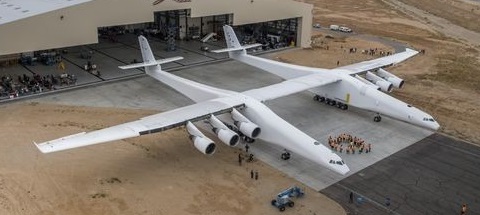
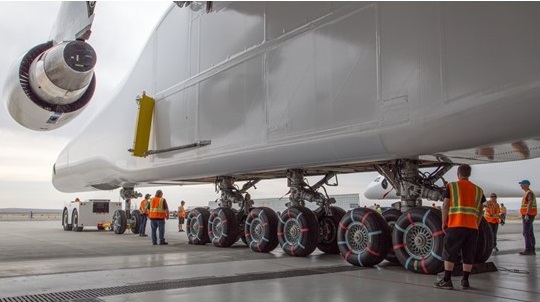
Stratolaunch has a twin-fuselage configuration, each 238 ft (73 m) long and supported by 12 main landing gear wheels and two nose gear wheels, for a total of 28 wheels. Each fuselage has its own empennage and the twin fuselages are 95 feet apart.

The pilot, co-pilot and flight engineer are accommodated in the right fuselage cockpit. The flight data systems are in the left fuselage. The unpressurized left fuselage cockpit is unmanned with storage space for up to 2,500lb of mission specific support equipment. Both fuselage cockpits are pressurized and separated by a composite pressure bulkhead from the remainder of the unpressurized vehicle.

At 385 ft (117 m), it is the largest plane by wingspan, surpassing the Hughes H-4 Hercules flying boat of 321 feet (98 m). The main center section is made up of four primary composite spars supported by four secondary spars. The center section of the high-mounted, high aspect ratio wing is fitted with a Mating and Integration System (MIS), developed by Dynetics and capable of handling a 490,000 lb (220 t) load. The wing houses six main and two auxiliary fuel tanks, with the main tanks located inboard adjacent to an engine. The auxiliary tanks are located in the inboard wing where the load-carrying structure joins the fuselage.

Stratolaunch is powered by six Pratt & Whitney PW4056 engines positioned on pylons outboard of each fuselage, providing 56,750 lbf (252.4 kN) of thrust per engine. Many of the aircraft systems have been adopted from the Boeing 747-400, including the engines, avionics, flight deck, landing gear and other systems, reducing development costs.

The flight controls include 12 cable-driven ailerons powered by hydraulic actuators, split rudders, and horizontal stabilizers on twin tail units. The wing has 14 electrically signaled, hydraulically actuated trailing-edge split flaps that also act as speed brakes. The hydraulic system and actuators, electrical system, avionics, pilot controls, and flight deck are from donor B747-400s. Approximately 250,000 lb of the aircraft’s takeoff weight of 1,300,000 lb is from B747-400 components. Much of the design is based on the Boeing 747-400, replicating much of the avionics, engineering, power plants, and more to reduce the $400 million cost of the project.

Within Scaled Composites, its model number is M351. It is nicknamed “Roc” after Sinbad’s Roc, the mythical bird so big it could carry an elephant.
Initially, flights will be under an experimental certification from the FAA.
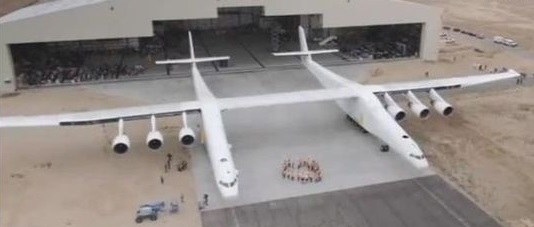
The Stratolaunch has a wingspan of 117m, it uses six 747 jet engines, sits on 28 wheels, can carry 113,400kg of fuel, and weighs 226,800kg without fuel. In order to take off, it needs about 3660m of runway.
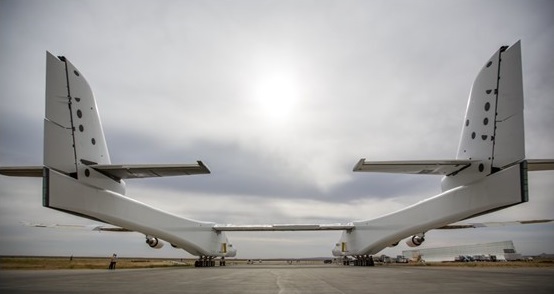
The Stratolaunch is intended to carry a 550,000-pound (250 t) payload and has a 1,300,000-pound (590 t) maximum takeoff weight.

In December 2017, registration N351SL first low-speed taxi test took it to 25 knots (46 km/h) on the runway powered by its six turbofans to test its steering, braking, and telemetry. Higher-speed taxi tests began in 2018, reaching 40 knots (74 km/h) in February, and 78 kn (140 km/h) in October. On January 9, 2019, Stratolaunch completed a 110 knot (219 km/h) taxi test, and released a photograph of the nose landing gear lifted off the ground during the test.

In January 2019, three months after the death of Stratolaunch founder and Microsoft co-founder Paul Allen, Stratolaunch abandoned the development of its PGA rocket engines and dedicated launchers. Stratolaunch was then reported to be aiming for a first flight within a few weeks and a first launch from the carrier in 2020.

The aircraft first flew on April 13, 2019 at 06:58, at the Mojave Air and Space Port, reaching 17,000 ft (5,200 m) and 165 kn (305 km/h) in a 2 h 29 min flight. Tests included various flight control manoeuvres to calibrate speed and evaluate flight-control systems, including roll doublets, yawing manoeuvres, pushovers and pull-ups, and steady heading sideslips. Test crew Evan Thomas and Chris Guarente also flew simulated landing approach exercises at an altitude of 15,000ft.

The company ceased operations the next month, and placed all company assets, including the aircraft, for sale for US$400 million by June 2019. Cerberus Capital Management acquired Stratolaunch Systems including the Stratolaunch aircraft in October 2019. Stratolaunch announced in December 2019 that it would now be focusing on offering high-speed flight test services.

So far, only one flight has been carried out.

Model 351 Stratolaunch
Powerplant: 6 × Pratt & Whitney PW4056 turbofan, 56,750 lbf (252.4 kN) thrust each
Wingspan: 385 ft (117 m)
Length: 238 ft (73 m)
Height: 50 ft (15 m)
Empty weight: 500,000 lb (226,796 kg)
Gross weight: 750,000 lb (340,194 kg) with no external payload
Max takeoff weight: 1,300,000 lb (589,670 kg)
External payload: 550,000 lb (250,000 kg)
Maximum speed: 460 kn (530 mph, 850 km/h)
Range: 1,000 nmi (1,200 mi, 1,900 km) radius
Ferry range: 2,500 nmi (2,900 mi, 4,600 km)

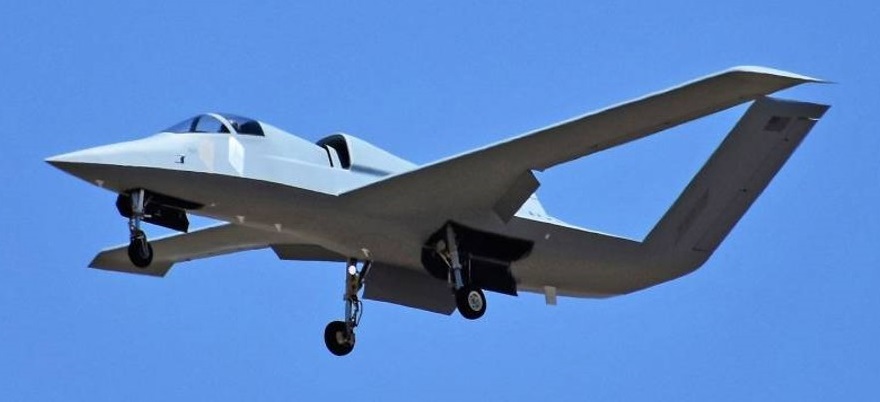
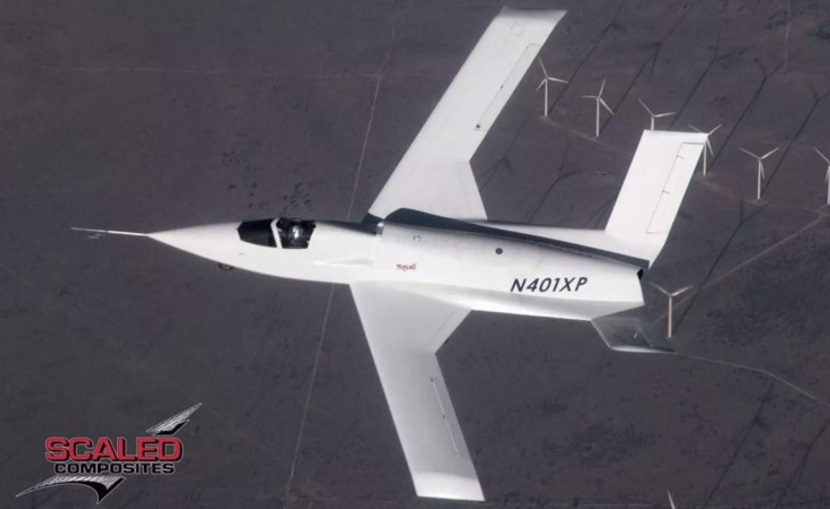
Scaled Composites 401 Son of Ares

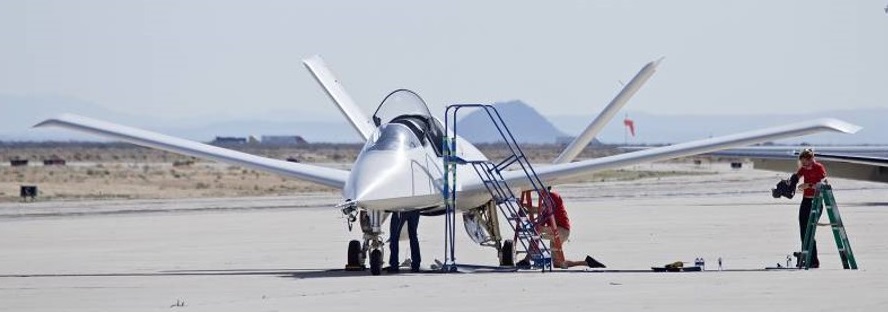
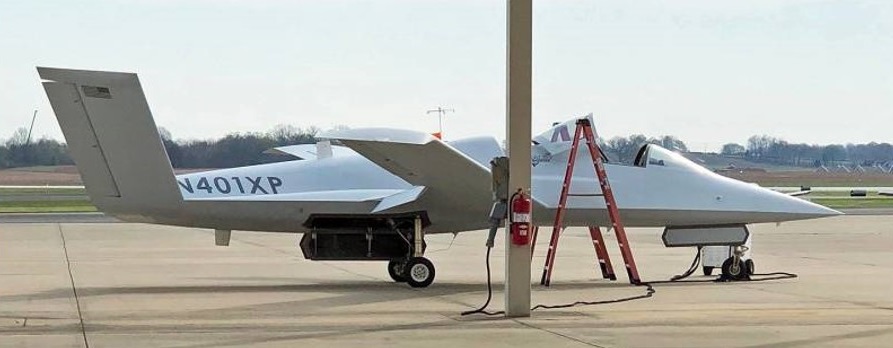
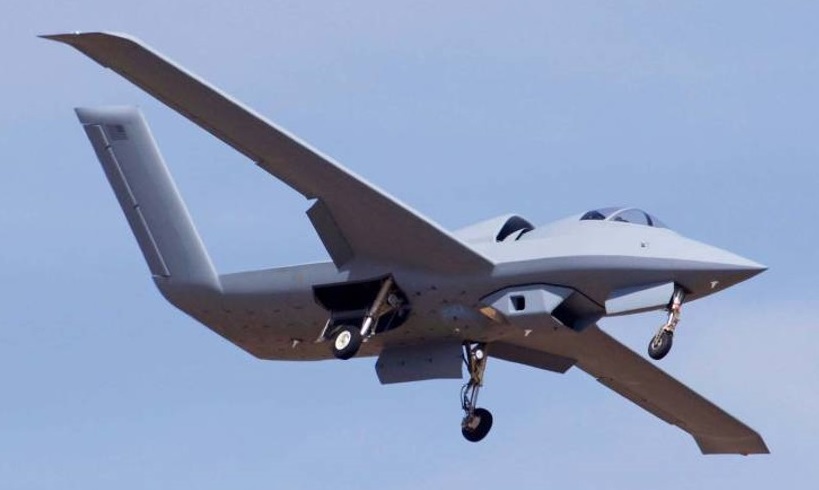
The Scaled Composites 401 Son of Ares single-seat aircraft empty mass is 1814 kilograms and the maximum take-off weight is 3629 kilograms. The wingspan and length are 11 meters. The power plant is a Pratt & Whitney JTD-15D-5D bypass turbojet engine with a maximum thrust of 1381 kilograms. The Model 401 is slow-moving: Mach 0,6 at an altitude of over 9 kilometers. In cruise mode, the Son of Ares can stay in the air for about 3 hours.

The plane took off for the first time on October 11, 2017.

The aircraft only occasionally appeared in the skies over the Mojave Desert in California. Son of Ares does not have installed weapon and even a place for it is not provided.

A couple of prototypes built by 2017 were named “Deimos” and “Phobos” (tail numbers: N401XD Deimos and N401XP Phobos). According to mythology, Deimos with Phobos were the sons of the god Ares. There is speculation that option D is a drone with an opaque dome instead of the cockpit.

On the second flight model of the Model 401, a matte gray finish could be seen. Given the prevalence and development of infrared guidance systems that can partially devalue stealth technology, it can be assumed that Scaled Composites were testing a new cloaking system.

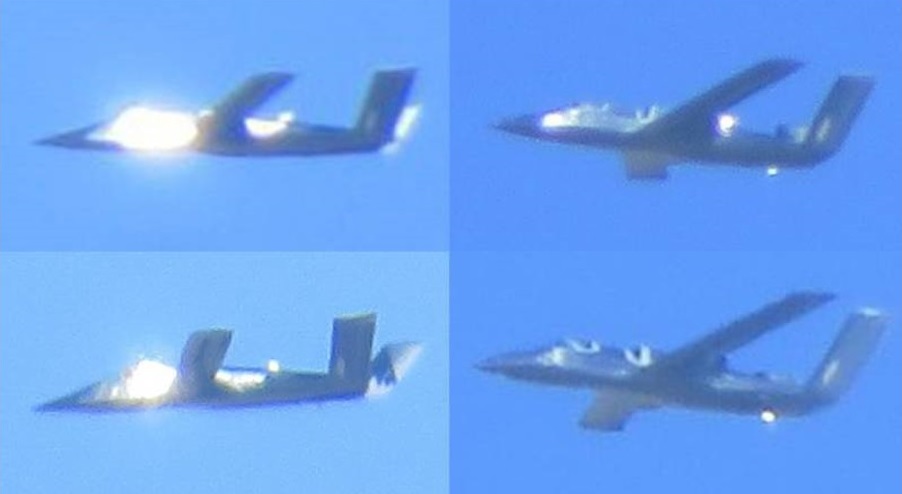
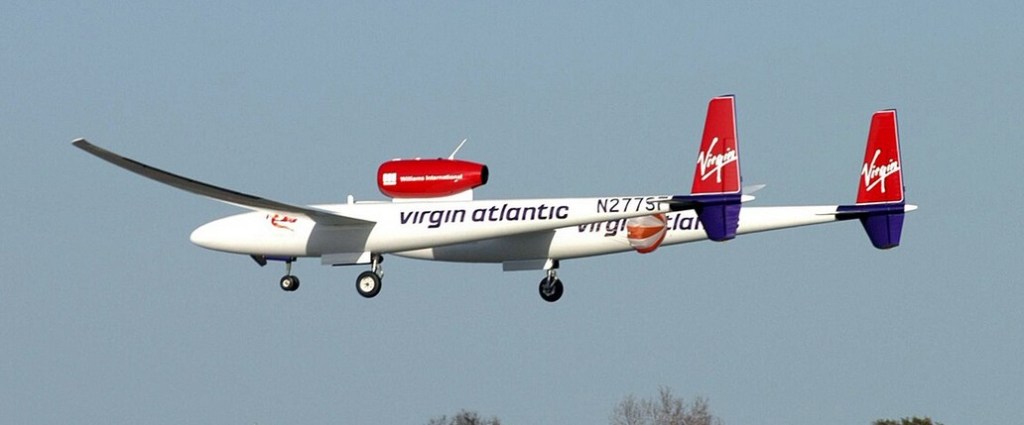
The first time the Model 401 seriously attracted attention was in the middle of 2020, when it took to the air, completely covered with mirror film. The flight of the mirror plane over the China Lake airbase was accompanied by the Proteus aircraft. The Proteus was carrying a container under the fuselage with signs of optical systems. The logic of those observing this couple was very simple: the specular coating of the experimental Son of Ares is necessary to reflect the rays, and they are clearly not solar. The working hypothesis was testing a secret coating designed to reflect combat lasers. Proteus in this story acts as the carrier of the container with laser weapons. Of course, the power of the emitter was artificially lowered: after all, a manned aircraft acted as a training target.

The use of a similar gray coating on aircraft is to scatter laser beams of guidance and destruction systems. On some flights of the mirrored and matt Model 401 aircraft, an F-15D Eagle acted as an escort. And under its fuselage was also seen a container with optical equipment. All indications are that the Son of Ares program is being considered by the military as a testing ground for technological innovations for the Air Force and Navy.

Son of Ares N401XP at the end of October 2020 had a mysterious hardware unit under the cockpit. The flights took place in the Mojave Desert and were accompanied by a completely traditional training T-39 Sabreliner. No specific equipment was seen on the escort plane. In this case, the Model 401 acted as a carrier of laser weapons, in flights they worked out the tactics of its use. The characteristic shape of the block probably indicates the need to cool the equipment hidden inside.

An unknown container under the fuselage of the Son of Ares believed to be a solid-state combat laser.

The uniqueness of the Model 401 program lies in its ambiguous secrecy. On the one hand, on the official website of Scaled Composites there is not a word about the experimental aircraft, and on the other hand, the aircraft is photographed by everyone who is not lazy. The reason for the creation of such an expensive aircraft with a carbon fiber fuselage, assembled according to the precepts of the Stealth technology, is not fully understood. It is too expensive to develop such an aircraft solely as a platform for testing new technologies – after all, you can use a lot of other aircraft. The double nature of the use of the experimental aircraft cannot be disregarded. Such “secret” PR can serve to attract the attention of potential investors to the Model 401 civilian use program.

Scaled Composites 311 Global Flyer

Test flying began in 2004 in the US on an aircraft designed to fly around the world by a single pilot and without refuelling. Known as the Global Flyer, or Scaled Composites Model 311, it made the first of several flights which tested its controls and systems, including its “drag chutes” used during descent and landing.

The GlobalFlyer is a single seat, turbofan powered airplane designed to fly around the world nonstop, unrefueled. It achieved this milestone for the first time on March 03, 2005 after 67 hours and one minute of flying time. With that, Pilot Steve Fossett set the record for fastest time around the world unrefueled. The GlobalFlyer took off and landed in Salina, Kansas.

The second world-record flight was completed on February 11, 2006 when Pilot Steve Fossett made an emergency landing at Bournemouth Airport in England. Kennedy Space Center was chosen for the takeoff, which took place on February 8. The flight had many stressful moments. Despite this, Steve was able to accomplish the goal of the “Ultimate Flight” by breaking the previous world distance record for an airplane, which was set by the Voyager in 1986 (24,987 miles), as well as the aviation long-distance record set by the Breitling Orbiter Balloon in 1999 (25,361 miles).

Aerodynamics are key to this aircraft, and its configuration is optimized for range and fuel efficiency. The aircraft’s shape has been designed using computational fluid dynamics to predict how the aircraft’s surfaces will behave in flight. The aircraft is so aerodynamically efficient that the only practical way to descend is using drag parachutes. As the aircraft is only required to land once, these aren’t detachable and take time to reset.

The aircraft is a trimaran-like construction with two huge external ‘booms’ which hold the landing gear, and 5,454 pounds of fuel on either side of the pilot’s cockpit in the center on top of which is the single Williams turbofan jet engine. The construction materials used for the structure of this aircraft are all graphite/epoxy. The stiffest carbon fibers are used in the construction of the wings, and the skin is a sandwich of graphite/epoxy and Aramid honeycomb.

The aircraft doesn’t have what is known as ‘deicing’ or ‘anti-ice’ measures. This means that it is not able to fly in ‘icing’ conditions. In addition, it does not cope with turbulence very well in the early part of the flight when the aircraft is heavy and structural margins low; so weather will be an important factor in choosing when and where to take off from.

The pilot sits in the main fuselage, the center pod, just behind the nose landing gear and below the engine. He also sits in front of the main fuel header tank which feeds the engine. Early on in the project, there were huge obstacles to overcome caused by engine noise levels, but those were quickly overcome with the addition of insulation. The cabin is pressurized because of the altitude which gives a ‘cabin altitude’ of 10,000 feet at the 45,000 feet the plane actually flys at.

There are thirteen fuel tanks all in all, and on take-off, it is expected that this aircraft will be 83% fuel by weight. Getting fuel to where it’s needed whilst maintaining the balance and stability of the aircraft is a feat that will require constant supervision and monitoring. The fuel itself is a special fuel that has a much lower freezing point than regular aviation fuel.

Wing Span: 114ft
Wing Area: 400 sq.ft
Length: 44.1ft
Height: 13.3ft
Gross Weight: 22,000 lbs
Empty Weight: 3,350 lbs

Scaled Composites

Scaled Composites was founded in 1982 by Burt Rutan as a research and development company, and located in Mojave, California, offering its services to those requiring specialist help in developing advanced aircraft projects. Undertook work on the NASAAD-1 oblique-wing research aircraft, a subscale demonstrator of the Fairchild NGT trainer (flown September 1981), a subscale demonstrator of the Beech Starship 1 business aircraft (at which time company bought by Beech, 1985, but sold back 1988), plus several other uniquely configured aircraft that included the Rutan 151 ARES agile response effective support combat jet (first flown February 1990). Latest aircraft is Proteus multipurpose, high-altitude and long-duration sensor platform, first flown as a proof-of-concept prototype in July 1998 and featuring rear-mounted main wings, large-span canards, twin tail booms, and a slender fuselage. Initial application is to be for Angel Technologies Corporation, which requires many for communications relay use.

Scaled Composites was acquired by Northrop Grumman in 2007 and is partially engaged in defense research.

2010: Scaled Composites
1624 Flight Line
Mojave, CA 93501
Phone: (661) 824-4541
Fax: (661) 824-4174

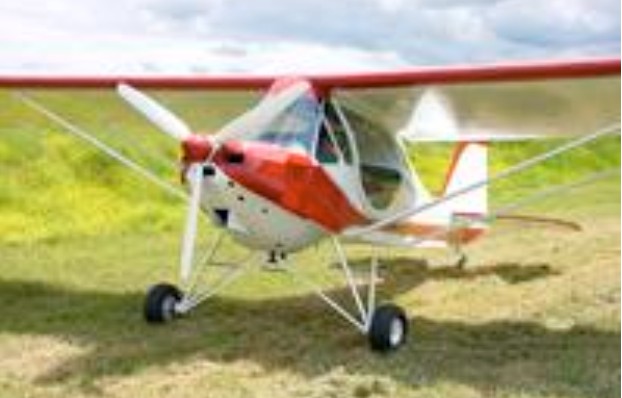
Sauper J300 Joker

Regularly updated, Sauper engineers have lately developed the 4th series with better manoeuvrability and responsiveness thanks to its shortened wings.

As a simple UL aircraft, it was sold only in a ready-to-fly version.

A classic design microlight single-engined aircraft with a high wing, two side-by-side seats, the structure is made of 25CD4S tubes of aeronautics steel. TIG weldings and tubes are protected from corrosion. The fuselage is covered with aeronautics Diatex 100 and 1500 fabric.

Fitted with complete double controls, 2 points security seatbelts, and Lexan F 5006 windscreen and windows, there is a large luggage area behind the seats. The mains have 600×6 tires with disc brakes. Two aluminium seat-tanks of47 litres are fitted.

J300 Joker 2009 Price: 40000 EURO
J300 Srs 2 2009 Price: 42000 EURO

J300 JOKER
Stall: 30 kt / 34 mph / 55 kmh
Cruise: 76 kt / 87 mph / 140 kmh
VNE: 107 kt / 123 mph / 198 kmh
Empty Weight: 275 kg / 606 lbs
MTOW Weight: 472 kg / 1041 lbs
Climb Ratio: 1000 ft/min / 5 m/s
Glide Ratio: 7
Take-off distance (50ft obstacle): 560 ft / 170 m
Landing distance (50ft obstacle): 490 ft / 150 m

J300 Serie 2 – 1996
Stall: 35 kt / 40 mph / 65 kmh
Cruise: 80 kt / 92 mph / 148 kmh
VNE: 110 kt / 127 mph / 204 kmh
Empty Weight: 270 kg / 595 lbs
MTOW Weight: 450 kg / 992 lbs
Climb Ratio: 1000 ft/min / 5 m/s
Glide Ratio: 10
Take-off distance (50ft obstacle): 330 ft / 100 m
Landing distance (50ft obstacle): 330 ft / 100 m

Sauper Aviation

Sauper Aviation
Aérodrome Du Breuil Bp1035
41010 Blois Cedex
France

French company, manufacture of microlight aircraft: J300 JOKER. The company developed a certified VLA on the same concept: Adv 01 PAPANGO. Services included: spreading, air monitoring, restorations in welding, painting and coverings.

Sandlin Bug

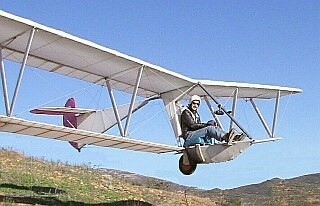
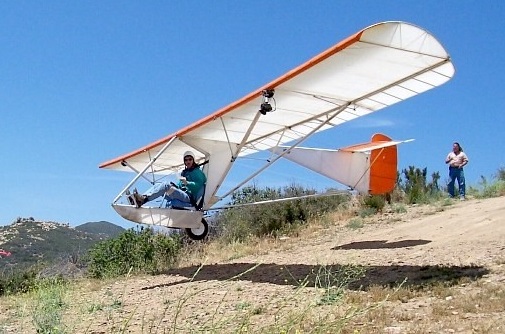
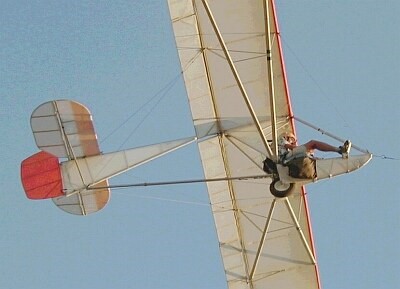
The Bug2 airchair biplane (or sesquiplane) first flew in Februauy of 1999. Bug 4 was intended to be an improved version of Bug2, and was considered superior.

The monoplane airchairs were a furthur development of the Bug4. Construction is of aluminum tubing and steel cable covered with a heat shrunk fabric.

Safety design aspects include:
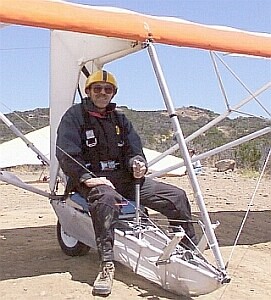
Extensive frangible structure around the pilot for crash impact protection
4 point safety belts
A hand deployed emergency parachute which is intended to bring the glider and pilot down together, tail first, so that the pilot is protected by the tail and wing structure during the parachute landing

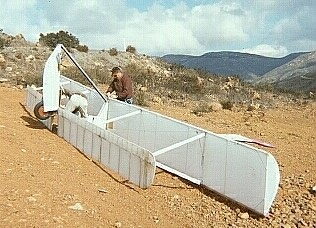
Construction of the Bug wheeled sailplane is from readily available materials without special welding, machining, or molds. The empty weight, for a not foot launchable glider, is substantially less than the ultralight regulatory weight limit; about the same weight as the pilot.

Quick assembly & roof rack transport make flying convenient. A Bug or Goat can be strapped down onto an ordinary hang glider rack, with no special saddles or pads.

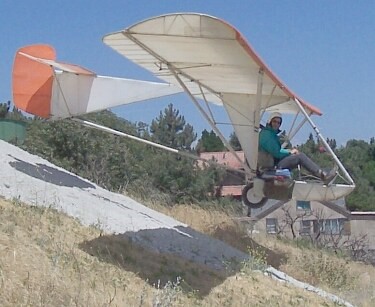
Bug2 and Bug4 have demonstrated casual and comfortable airchair soaring, drogue chute landings in small fields, and novice instruction on training hills. They have been towed by trucks, winches, and ultralight airplanes. The Bugs have soared high, if not far, and have always returned for a safe landing. An airchair can be launched by ultralight aerotow, car tow, winch cable, or just by rolling down an open slope.

Accomplishments of these biplanes include:
Self launch soaring by rolling down hillsides
Self launch training by rolling down hillsides
Car top transport on non-specialized racks

The Bugs fly at about the same speeds as a hang glider, readily mixing with hang glider and paraglider traffic. No formal performance measurements have been made, but all are in the hang glider range and can stay up in good lift conditions. The Bug has soared thousands of feet above take off altitude.

Sandlin has flown the Bug2 and Bug4 for soaring only, not aerobatics. He considers the structural redline (maximum safe airspeed) for flying to be 45 mph.

Bug2 and Bug4 performance has not been measured but seems to be about the same as a single surface hang glider. As of April 2010 only a single Bug4 is known to be currently flying .

Posting of the complete technical drawings of an aircraft on the Internet, freely available in the public domain for downloading and study.

Gallery

Sandlin Goat / Red Goat

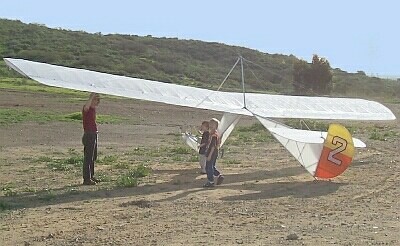
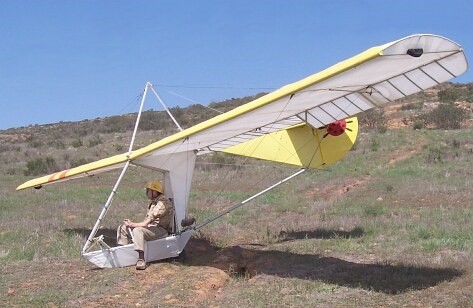
The Goat monoplane glider has been soaring in one version or another since the spring of 2003. The Goat is technically an ultralight sailplane (under United States weight rules) with conventional three axis controls, similar to the Bug4 and the commercial Super Floater. It is designed for slow speed recreational gliding and training. This glider ia an all purpose airchair, allowing comfortable open air soaring, good crash safety, quick assembly, and convenient car top transport.

The idea of an “airchair” is that it flies like a hang glider or paraglider but with improved stability, control, comfort, and crash safety. The glider can be kept at home and transported to the flying site on a simple car top rack. It can be assembled by one person in about 20 minutes. With a wing loading about the same as a hang glider, it flies and soars like a hang glider, making it compatible with many existing hang glider operations, using rolling launches, ground tows, or ultralight aerotows.

The varioius Goats feature:
Five or six major separable parts, the heaviest being the the wing panel at 35 to 42 lbs.
Emergency parachute, hang glider type, hand deployed 22 gore round canopy PDA, with bridle & swivel
16″ or 14″ diameter wheelbarrow or ultrlight aircraft wheel, tube tire
nose skid for braking (no wheel brake), tail skid at rear (or wheel)
drogue chute, hang glider type, 5 ft. diam. (flat octagonal) canopy, attached to main struts or flying cables, 27″ outboard from centerline on left side
tow hookup with weak link loop, to break at about 110% gross weight
Altimeter/variometer mounts on nose tube or strut, hang glider type
Quick assembly pins, handles & tapered ends for “drift pin” assembly, all fasteners attached to airframe
Flap panels in fixed position, or fixed trailing edge.
Four point seat belt
Conventional stick and rudder controls

There are no formal values established for performance, pilot weight, or maximum speeds or loads, because no rigorous tests have been performed to measure these values.

The Goat does not foot launch, but is either towed into the air or else launched by rolling down a hillside. Rolling launches are usually made at a site shared with hang gliders and paragliders. This glider flys very much like a hang glider and readily adapting to hang glider techniques and procedures. The Goat1 has made a cross country flight of more than sixty miles, reaching an altitude above 13,000 feet.

Goat1

The Goat1 made it’s first flight on February 1, 2003, and since then has been flying as a weekend soaring glider. It has proven to be a pleasant and practical glider for slope launching and local flying. It is easy to tow behind an ultralight airplane. The struts fold onto the wing for transport. As of December, 2009, Goat1 had new fabric and removable, folding main struts,and is now called the Red Goat.

Goat1

The biggest drawback to the Goat1 design was the large size and heavy weight of the main wing panel with regard to loading or unloading it onto a car top rack. The folded wing half weighs 42 pounds. The primary reason for the Goat2 design was to have a lighter wing panel to reduce the burden of assembly and loading.

Goat1

Goat2 is a simpler, lighter version of Goat1 with almost exactly the same significant dimensions. In contrast to Goat1, the wing and tail boom are cable braced (no struts) and a 14″ diameter ground roll tire is used instead of a 16″ tire. The elevator control lines now run directly to the elevator control arms without any push rod mechanisms, and the removal of the tail plane for storage and transport has been simplified.

Goat2 (February 2005)

Goat3 has a smaller wing than the other Goats, with a fancier, sailplane style airfoil. The struts are removed for transport, and the wing does not have folding panels on the trailing edge. The seat back and shoulder belts are fixed in place on the nose section and do not require attention during assembly.

The reduced wing area of Goat3 forces flying faster, and the new airfoil doesn’t seem to be producing any dramatic performance improvement. As it stands, it looks as if the larger wing with the simpler airfoil (as used by Goat1 & Goat2) may be a suiperior combination for an airchair. Goat3 probably won’t stay up in light conditions as well as the others.

Goat2 was light and eliminated the bulky struts, but all those long cables created their own transport and assembly problems. This led eventually to the creation of Goat4, which retained the cable braced wing but simplified a lot of the assembly mechanics.

Goat4 (March 2007)

Goat4 is essentially a Goat2 wing with Goat3 nose and tail.

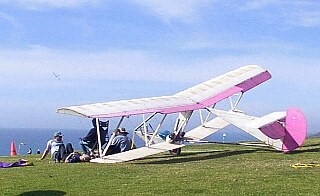
The gliders fly at about the same speeds as a hang glider, readily mixing with hang glider and paraglider traffic. No formal performance measurements have been made, but all are in the hang glider range and can stay up in good lift conditions. The Goats 1-4 have soared thousands of feet above take off altitude.

Goat1

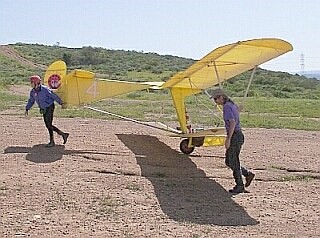
Slow flight provides the unique ability to self launch by rolling down open slopes, usually at the same mountain launch sites used by hang gliders and paragliders. This rolling launch has become a standard procedure for local weekend soaring. A launch slope of a vertical drop of about 17 feet over a rolling distance of 72 feet (so, the rolling distance is two wing spans for the Goat) is suitable.

Quick assembly & roof rack transport make flying convenient. A Goat can be strapped down onto an ordinary hang glider rack, with no special saddles or pads.

A Basic Ultralight Glider is not a hang glider (it cannot be foot launched) nor is it what is usually meant by an ultralight airplane (it has no engine). Its construction is “low tech”, at the hand drill and hacksaw level, for easy home building, from readily available materials (it is made mostly from aluminum tubing and steel cable with polyester fabric covering).

This is a home built glider, made with a low level of technology (no welding, no special machining, no molds or jigs, no spray rig) from readily available materials (mostly aluminum tubing, steel cable, aircraft bolts and heat shrink fabric). The Goat is a noncommercial project, with no product or plans for sale, but complete descriptive drawings of the Goat1 through Goat4 are on the Web. These drawings are freely available for whatever purpose the user may desire.

Gallery