Sky Paragliders Atis

Atis 2

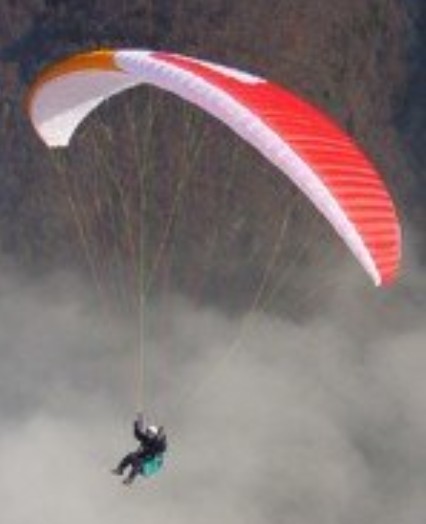
The first generation of the DHV 1-2 Atis glider was voted as the glider of a year by VOL LIBRE. The Atis 2 has new certification EN-B based on CEN 926-1 and 926-2, new profile, new layout and new experience.

(EN B equals the DHV 1-2 classification of the glider, the certification is different, and CEN 926-2 is different from DHV certification!)

The main changes compared to the first generation of the glider:
New profile with lighter ribs concept and higher speed range
New layout scheme
New design of stabilizers
Higher speed range with lower sink and higher glide efficiency
New, easy to use and highly efficient speed system
New geometry
New technology of the leading edge design
Trailing edge with velcro opening for easy cleaning of the canopy

Atis 2 (DHV 1-2) Price 2009: US$3,500.00

The Sky Paragliders Atis Acro model intended for Acro pilots is based in Sky’s intermediate glider, the Atis, released in 2002 in 3 sizes and about to have certification for the 4th, an XS (DHV 1-2). The Atis Acro had a good debut in the hands of pilot Tomas Lednik, who took the 3rd place at the past Oludeniz Air Games in Turkey with it. It is a small glider (XS size) and favoured with more speed and dynamic response than the serial model, thanks to a different plan layout.

ATIS 2SMLXL
Layout surface: 23,11 sq.m
Layout span: 10,86 m
Layout aspect ratio: 5,10
Projected surface: 20,69 sq.m
Projected span: 9,10 m
Projected aspect ratio: 4,00
Number of cells: 53
Weight of the glider: 5,0 kg
Take-off load: 60-80 kg
Trim speed: 37 km/h
Minimum speed: 23 km/h
Maximum speed: 48 km/h
Max. gliding ratio: 8,5
Min. sink rate: 1,15 m/s
Test: EN B

ATIS 2SMLXL
Layout surface: 25,00 sq.m
Layout span: 11,29 m
Layout aspect ratio: 5,10
Projected surface: 22,38 sq.m
Projected span: 9,47 m
Projected aspect ratio: 4,00
Number of cells: 53
Weight of the glider: 5,2 kg
Take-off load: 75-95 kg
Trim speed: 37 km/h
Minimum speed: 23 km/h
Maximum speed: 48 km/h
Max. gliding ratio: 8,5
Min. sink rate: 1,15 m/s
Test: EN B

ATIS 2SMLXL
Layout surface: 26,65 sq.m
Layout span: 11,66 m
Layout aspect ratio: 5,10
Projected surface: 23,86 sq.m
Projected span: 9,77 m
Projected aspect ratio: 4,00
Number of cells: 53
Weight of the glider: 5,4 kg
Take-off load: 87-110 kg
Trim speed: 37 km/h
Minimum speed: 23 km/h
Maximum speed: 48 km/h
Max. gliding ratio: 8,5
Min. sink rate: 1,15 m/s
Test: EN B

ATIS 2SMLXL
Layout surface: 28,83 sq.m
Layout span: 12,12 m
Layout aspect ratio: 5,10
Projected surface: 25,80 sq.m
Projected span: 10,16 m
Projected aspect ratio: 4,00
Number of cells: 53
Weight of the glider: 5,7 kg
Take-off load: 105-130 kg
Trim speed: 37 km/h
Minimum speed: 23 km/h
Maximum speed: 48 km/h
Max. gliding ratio: 8,5
Min. sink rate: 1,15 m/s
Test: EN B

Sky-Maxx Manufactory Sky-Maxx

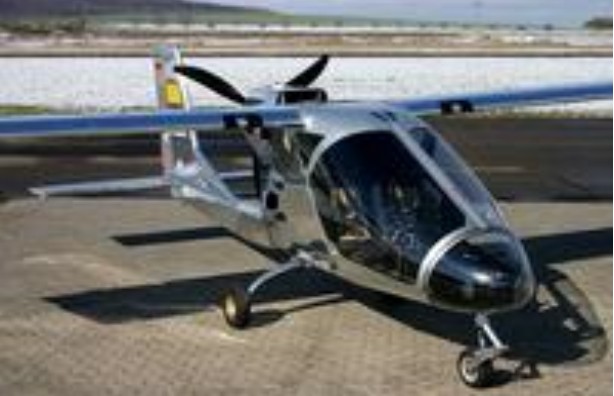
Sky-MAXX gives higher cruise speeds with aircraft in the Light Sports Aircraft (LSA/SLA) or microlight/ultralight category. Of full aluminium construction, Sky-MAXX is a conventional, three axis, non-strut-braced monoplane. It’s high lift wing, incorporating electrical flaps, produces short take-off and landing (STOL) performance, whilst maintaining a 180 km/h cruise. The two seat Sky-MAXX was designed with an all-metal duralumin alloy structure.

Several editions (tropical, desert, photography) “Ready for fly” or as a kit. 2009 Price: US$ 95,000 / EUR 80,750

Engine: Rotax 80-102 hp, HIRTH, BMW, Jabiru 6-cylinder
Empty Weight: 270 kg / 595 lbs
MTOW Weight: 750 kg / 1653 lbs
Stall: 35 kt / 40 mph / 65 kmh
Cruise: 108 kt / 124 mph / 200 kmh
VNE: 139 kt / 160 mph / 258 kmh
Climb Rate: 1400 ft/min / 7 m/s
Take-off distance (50ft obstacle): 100 ft / 30 m
Landing distance (50ft obstacle): 100 ft / 30 m

Skyacht Aircraft Alberto

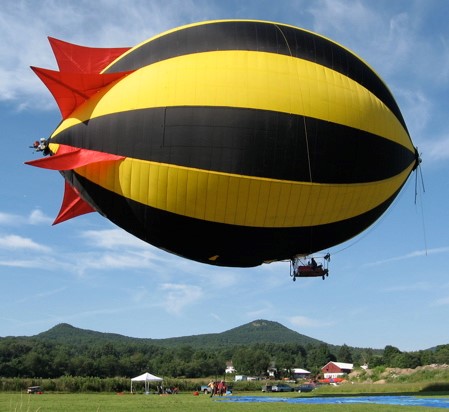
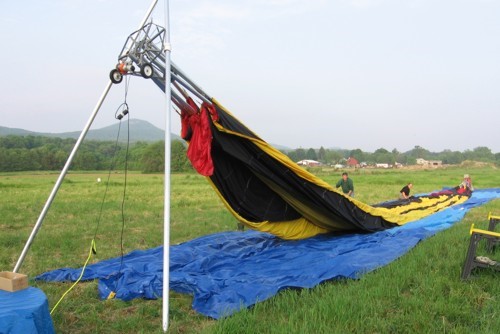
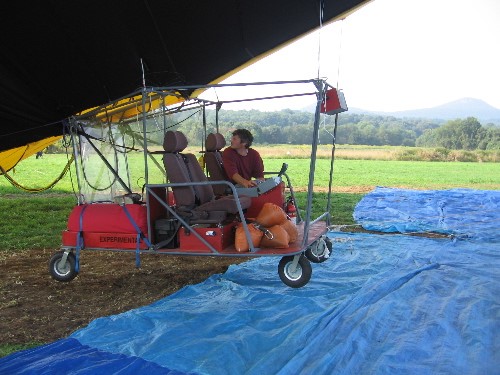
Since 2002 Skyacht Aircraft, Inc. has been developing Personal Blimp. The Personal Blimp uses hot air for lift and silent electric motors for propulsion. Initial flight tests are using a conventional gas-powered motor. Electric motors will be added once these initial tests are complete. Similarly, the initial flight tests are being made with conventional hot air balloon burners. Quiet burners were to be added later. The Personal Blimp flies “low, slow, and smooth.”

The Personal Blimp hull structure has three main components: 1) the fabric envelope, 2) a set of flexible ribs embedded within the fabric, and 3) a tensioning line that runs along the central axis of the hull.

The hull is a “tension structure” wherein the ribs are under compression and the fabric and tensioning line are under opposing tension.

What is new and different about the Personal Blimp hull design is the ease with which one can create a lightweight, sturdy, self-supporting (no fans required) airship envelope.

The fabric of the envelope has several continuous, tubular sleeves sewn into it running from nose to tail. The ribs are inserted into the sleeves. The ends of the ribs are held together at each end. The tensioning line is then connected between the two ends and the whole contraption is inflated by pulling on the tensioning line. As the tensioning line is made shorter the ribs are forced to bend or “bow” outward. The envelope continues to expand until eventually the fabric is pulled taut.

Different shapes can be designed by varying the composition and/or cross section of ribs along their length. For instance, making the ribs more flexible towards the nose gives a blunter shape to the front of the ship. Relatively stiffer ribs can also be used to get a longer, skinnier shape.

When not in use, the Personal Blimp can be deflated and folded for storage. The combination of ready buoyancy control and rapid deflation eliminates not only hangars but also the large ground crews.

The Personal Blimp has a rigid, but folding, skeleton to allow the envelope to retain its shape without requiring internal air pressurization. Patent (USPTO #6,793,180) for this unique structural design in September of 2004. The Personal Blimp’s rigid but foldable structure provides hardpoints at strategic locations (e.g. on the tail) for mounting systems such as the engine and propeller. With the engine/propeller mounted on the tail, the Personal Blimp can use vectored thrust for steering. This provides far greater maneuverability.

Since its first flight on October 27, 2006, the Alberto has completed more than 50 hours of flight testing. Work focuses on both refining its systems and further expanding its capabilities.

Gallery

Engine: 20 hp
Length: 102 Feet
Diameter: 70 Feet
Maximum Weight: 4,100 pounds
Size in Flight: 205,000 cubic feet
Size When Deflated/Folded: 1,500 cubic feet
Envelope – Nylon Fabric over Aluminium Ribs
Car, Nose and Tail Cones – Welded Steel Framework
Lifting Gas: Hot Air
Cruise Speed: 10 mph
Seats: 2

Skonkworks 24bis

AirVenture Oshkosh 2017

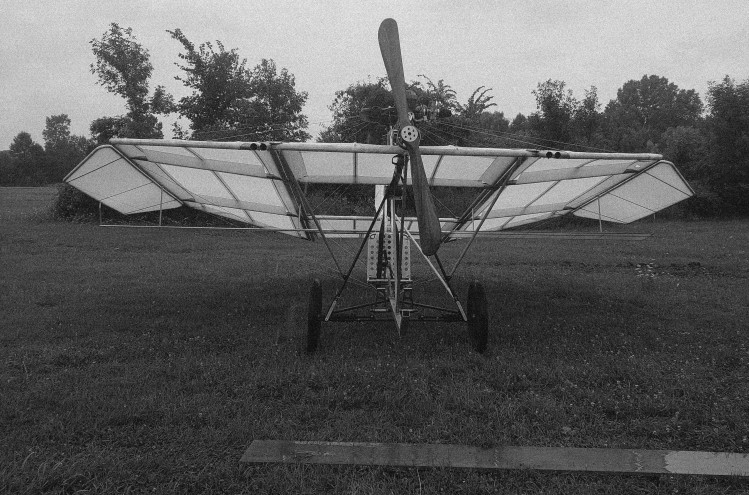
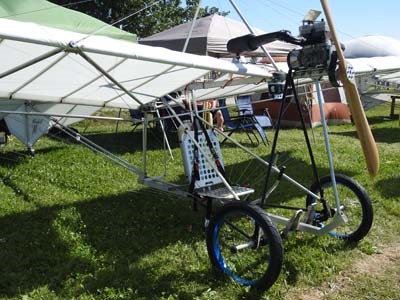
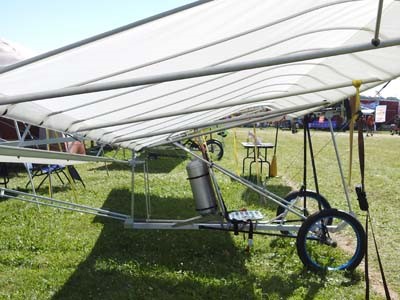
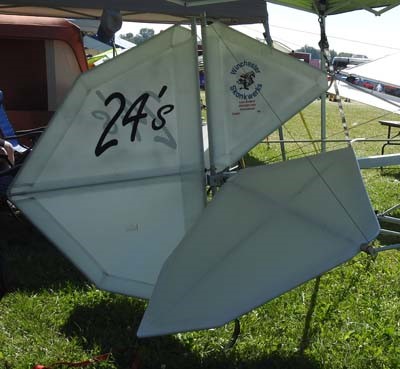
The 24 Bis (that’s what they call the example you see in the images) is a tribute to Alberto Santos Dumont.

The Winchester Skonkwerks Ultralight Research and Development Facility —shortened to Skonkwerks — represents a team from Larsen, Wisconsin. Skonkwerks honored Alberto by first building a 23 Bis and later the 24 Bis. The group describes itself as a “loosely knit organization of friends, flyers, and fanatics… tinkerers, builders, and bullsh###rs. We are engineers, designers, and dreamers hanging out in a little hangar screwing stuff together and making it fly.”

AirVenture Oshkosh 2017

Lee Fischer was the founder of this group of tinkerers that formed after he first showed a highly modified Robertson B1-RD. So much interest was shown in the Demoiselle style of aircraft that he decided to build a 23 Bis. At AirVenture 2015, his friend Mark Solper hinted that it would be “great project to build a pair of ‘evolved’ Demoiselles for a subsequent AirVenture.” This suggestion led to the 24 Bis.

Mark, Lee, and the whole merry band machined and welded the airframe and sewed Dacron wings, all the while learning both new skills and an appreciation for what Santos Dumont and his associates had done more than a hundred years earlier.

The aircraft was flown into Oshkosh.

AirVenture Oshkosh 2017

Weight — 240 pounds
Wing Span — 32 feet
Wing Area — 192 square feet
Never Exceed Speed — 45-50 mph
Stall Speed — 14-16
Engine — Rotax 447
Build Time — December 21, 2014 through June 21, 2015

Skonkworks 23bis

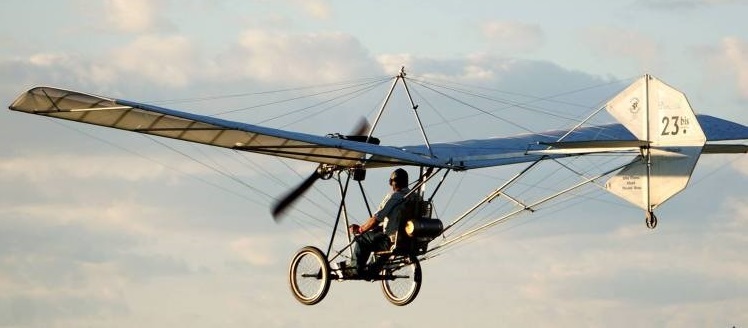
The Winchester Skonkwerks Ultralight Research and Development Facility — let’s shorten that to Skonkwerks — represents a team from Larsen, Wisconsin. Skonkwerks honored Alberto Santos Dumont by first building a 23 Bis and later the 24 Bis. The group describes itself as a “loosely knit organization of friends, flyers, and fanatics… tinkerers, builders, and bullsh###rs. We are engineers, designers, and dreamers hanging out in a little hangar screwing stuff together and making it fly.”

Lee Fischer was the founder of this group of tinkerers that formed after he first showed a highly modified Robertson B1-RD. So much interest was shown in the Demoiselle style of aircraft that he decided to build a 23 Bis. At AirVenture 2015, his friend Mark Solper hinted that it would be “great project to build a pair of ‘evolved’ Demoiselles for a subsequent AirVenture.” This suggestion led to the 24 Bis

Weight: 240#
Wing Span: 32′
Length: 19′
Wing Area @ Chord: 176 sq. ft.
Wing Area @ Camber: 192 sq. ft.
Wing Construction: Tube and Sewn Dacron

Skonkworks / Winchester Skonkwerks Ultralight Research and Development Facility

The original spelling is currently being used in Winchester Township Wi. Where a hanger was dubbed “The Skonkworks” by a neighbor in the early years. Used by a loosely knit informal organization of like-minded engineers/designers/tinkerers/builders/neighbors and fliers known as the “Lone Buzzerds” an ultralight club, operating out of the “Winchester Skonkworks” or sometimes “Squirrelworks” hanger in Larsen, Wi.
To avoid copyright infringement “Kelly Johnson’s” serious looking “skunk” was changed to a comical, whimsical black and white squirrel looking mascot wearing a red crash helmet and giving a smiling “thumbs up.”

The designation “skunk works”, or “skunkworks”, is widely used in business, engineering, and technical fields to describe a group within an organization given a high degree of autonomy, unhampered by bureaucracy; tasked with working on advanced or secret projects. In this case the spelling “Skonkworks” but in most cases; “Skonkwerks” is being used in jest to project an aura of something outside of the norm being worked on, developed or flown; while staying in touch with meager roots. The term fits well within the ultralight community as there is no direct oversight by any government organization, in addition ultralighters generally operate at the bottom of the aviation financial food chain. Not unlike “Li’lAbner” making “moonshine” from an odd variety of items, or whatever they had on hand.

Sklenar Tatra T-101.2

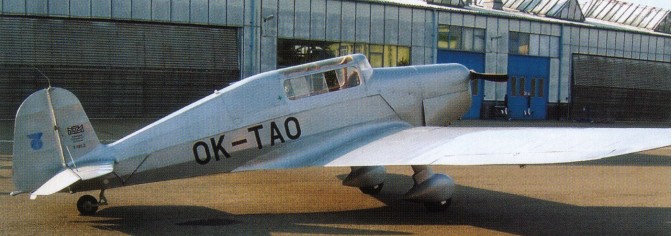
Over a 10 year period Jiri and Ivo Sklenar created a replica Tatra T-101 (designated T.101.2). An original 1938 Tarta T-100 engine was overhauled by the original Tatra Company, and apart from some safety and cost effective material compromises, the replica deviates little from the sole produced original aircraft.

The aircraft features a 13 metre span, one piece wooden wing with 11 fuel tanks. This allows for approximately 30 hours flying time.

The replica was first flown from Kunovice airport, Czechoslovakia, by Stanislav Sklenar on 29 September 2007.

Sikorsky SB-1 Defiant

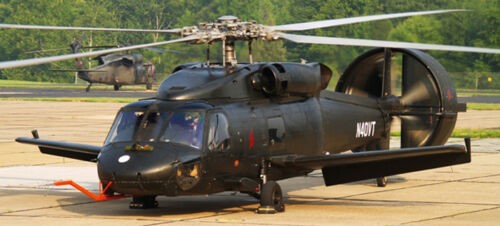
Sikorsky and development partner Boeing inched closer to the first flight of the SB-1 “Defiant” compound helicopter prototype this week, receiving FAA registration number N100FV and officially designating it the “S-100,” serial number MSN 0001. The SB-1 is Sikorsky’s entry into the Pentagon’s Future Vertical Lift (FVL) competition, a program that ultimately could result in deliveries of as many as 4,000 aircraft by 2030 under a contract potentially worth $100 billion and including significant foreign military sales.

First flight was anticipated by the end of this summer, but it appears that will now slip somewhat as it took Sikorsky longer than anticipated to work through a variety of technical issues, including main rotor blades and fashioning solutions to complex transmission issues related to power distribution between the main rotors and the thruster.

The SB-1 uses the same technology Sikorsky developed for its X2 and S-97 demonstration aircraft. A second S-97 recently resumed test flying after the first aircraft was substantially damaged during a hard landing a year ago at Sikorsky’s West Palm Beach, Florida test facility.

The SB-1 is slated to compete against Bell’s V-280 third-generation tiltrotor. It features an all-composite fuselage with seating for 12 fully kitted troops and a crew of four, a rigid coaxial main rotor system, an aft thruster with a clutch, and full fly-by-wire flight controls.

The SB-1 will initially be powered by a pair of Honeywell T-55 engines but will later be upgraded to the winner of the Future Affordable Turbine Engine (FATE) competition. The aircraft is expected to have a cruising speed of 250 knots.

Sikorsky S-97 Raider

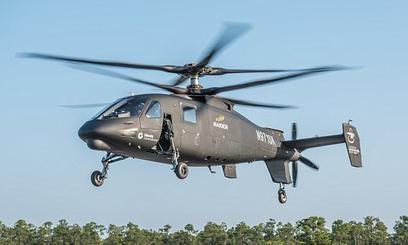
The Sikorsky S-97 Raider is a high-speed scout and attack compound helicopter based on the Advancing Blade Concept (ABC) with a coaxial rotor system. Sikorsky planned to offer it for the United States Army’s Armed Aerial Scout program, along with other possible uses.

First proposed in response to a Request for Information for the Armed Aerial Scout (AAS) program in March 2010, the S-97 was formally launched on 20 October 2010. It was intended as a contender for a United States Army’s requirement to replace the Bell OH-58D Kiowa Warrior. Other military roles are possible, the U.S. Special Operations Command having expressed interest in the S-97 as a replacement for the MH-6 Little Bird, and the possibility of adapting it for civilian applications also exists.

Sikorsky plans to build two prototypes of the S-97 as demonstrators. One prototype (P1) will be used for flight testing, while the second (P2) is planned for use as a demonstrator.

Sikorsky started construction of the two prototypes in October 2012. In September 2013, Sikorsky began final assembly of the first S-97 following delivery of the single-piece, all-composite fuselage by Aurora Flight Sciences. In February 2014, construction of the first S-97 prototype was one-quarter complete. Simulated bird strikes testing had been conducted on the fuselage at speeds of up to 235 kn (435 km/h; 270 mph), the S-97’s expected maximum flight speed. Drop tests were also performed to ensure the fuel tanks’ safety in the event of a crash.

Sikorsky targeted the S-97 for the AAS program, aiming for the helicopter to fly before the Army down-selected. Sikorsky invested $150 million and its 54 suppliers (who provide 90% of the parts) spent the remainder of a total of $200 million on two prototypes; production models aim to meet the program’s $15 million unit cost target. However, the Army ended the AAS program in late 2013. Budget projections for FY 2015 included retiring the U.S. Army’s OH-58 Kiowa fleet and transferring AH-64 Apache attack helicopters from U.S. Army Reserve and U.S. Army National Guard to the active Army to perform the aerial scout role. Sikorsky suggested the possibility of buying the S-97 to replace lost Apache for armed helicopter needs. Sikorsky proposes S-97 as FVL-CS1; the light scout helicopter.

The S-97 design includes variable speed rigid coaxial main rotors and a variable-pitch pusher propeller, making the S-97 a compound helicopter. Like the X2, it has fly-by-wire control and dynamic anti-vibration actuators to cancel out shaking. The main rotors have hingeless hubs and stiff blades, to improve low-speed handling and efficiency of hover. At high speeds, the close spacing of the hubs reduces drag. The stiff blades allow each rotor to have low lift on the retreating side of its rotor disk (reducing drag), whereas each rotor on a conventional coaxial rotor with “floppy” blades needs nearly equal lift distribution. The propeller relieves the rotor of propulsion, further reducing drag.

Maneuverability is improved compared with earlier helicopters because of the ability to tilt the coaxial rotors together or tilt each one differently, and because of the variable pitch propulsor and active elevons. At low speed the S-97 yaws by differential torque of the upper and lower rotor, at high speed it uses rudders.

The S-97 is capable of carrying up to six passengers, in addition to a flight crew of two in a side-by-side cockpit. However, the production S-97 is projected to be capable of flying with either one or two pilots, or autonomously. Space for a targeting sensor has been reserved, however not installed in the prototype aircraft.

Based on the technology from the Sikorsky X2 demonstrator, the prototype S-97s is powered by a General Electric YT706 turboshaft (the same engine used on the MH-60M Black Hawk). Compared to the OH-58D Kiowa, the S-97 has significantly increased performance goals, such as cruising speeds upwards of 200 knots while carrying weapons, turning at three times the force of gravity at 220kt, and a high hover efficiency (Figure of merit). Sikorsky also aims for an operating cost of $1,400 per flight hour.

Its avionics were powered on in June 2014, with rollout on 2 October 2014. The first flight of the S-97 occurred on 22 May 2015. It flew for 1 hour instead of the planned 30 minutes, completing three takeoffs and landings; forward, rearward and sideward. For this initial flight, the Raider was flown with its triplex fly-by-wire flight control system in backup degraded mode so as to focus on basic airworthiness in the low-speed regime. This begins a year-long flight test program of about 100 flight-hours to expand the flight envelope to meet Sikorsky’s key targets of 220-knot cruise speed carrying weapons, hover at 6,000 feet on a 95F day and 3g maneuverability at speed. Toward the end of Phase 1 testing, software will be upgraded to Block 2, bringing in the propulsor and articulating tail to increase speed and enable the full flight envelope. The second prototype (P2) was displayed to the public in October 2015. After two flight hours and a few months of testbench validation of the propulsion drivetrain, P1 is scheduled for higher speed some time in 2016.

On 3 August 2017, an S-97 prototype suffered what Sikorsky described as a hard landing at their flight test facility in West Palm Beach, Florida; both airline transport pilots received minor injuries. The NTSB factual report on the incident stated that the helicopter lifted into a low hover and immediately experienced excessive roll oscillations which lead to intermeshing of the counter-rotating coaxial rotor system, and a hard landing. Damage to the helicopter included collapsed landing gear, structural cabin damage, and dynamic component damage, including rotor blade tip separation of all rotor blades. Video of the accident sequence showed aircraft roll oscillations exceeding 60–degree angle of bank during the course of 5 seconds, during which the upper and lower rotors collided at the 1 o’clock position.

On 25 June 2019, the S-97 returned to flight testing and reached a speed of 190 knots.

Sikorsky and partner Boeing are to use the S-97’s technology and design process as a basis to develop the SB-1 Defiant, a high-speed rigid rotor co-axial rotorcraft, for the army’s Joint Multi-Role Technology Demonstrator (JMR TD) program.

Powerplant: 1 × General Electric YT706, 2,600 shp (1,900 kW)
Main rotor diameter: 1 (2 coaxial) × 34 ft (10 m)
Propeller: 1 x 6-bladed variable-pitch, clutchable pusher propeller (7 ft (2.1 m) diameter)
Length: 35 ft (11 m)
Gross weight: 8,945 lb (4,057 kg)
Max takeoff weight: 11,000 lb (4,990 kg)
Cruise speed: 250 mph (410 km/h, 220 kn) (with external weapons)
Never exceed speed: 280 mph (440 km/h, 240 kn)
Range: 350 mi (570 km, 310 nmi)
Endurance: 2 h 40 min
Service ceiling: 10,000 ft (3,000 m) at 95 °F (35 °C)
Crew: 0–2 pilots
Capacity: 6 troops
Armament: .50 cal gun with 500 rounds