Aviation Technology Group Inc,
Englewood CO.
USA
In 2005 projected the Javelin two-place fighter style, all-metal executive jet.
Aviation Technology Group Inc,
Englewood CO.
USA
In 2005 projected the Javelin two-place fighter style, all-metal executive jet.

The UK’s Ministry of Defence was pioneering an approach to building its next-generation Tempest fighter—by recycling retired Tornado jets. Instead of sourcing expensive foreign materials, old fighter jet parts are ground into a titanium-rich powder used for 3D printing new aircraft components.
Rolls-Royce has successfully tested these parts in an Orpheus engine, proving their viability. This initiative not only reduces costs but also strengthens supply chain resilience. With Italy and Japan also involved, the Tempest program is set to revolutionize sustainable aircraft manufacturing, with a planned first flight in 2026 and entry into service by 2035.
While this approach might sound crazy, it actually reduces the country’s reliance on foreign-sourced materials and points toward some incredible new ways to recycle old aircraft.
Introduced as a response to lingering concerns about how the global market for vital materials could be impacted by large-scale war between great powers, this is an area of increasing focus for the Future Combat Air Systems (FCAS) program. The FCAS is Britain’s overarching effort that includes the development of the crewed Tempest fighter.
“Through the expected lifecycle of the U.K.’s FCAS, we expect access to critical materials to be challenged, as global supply chains become increasingly disrupted and competitive. In parallel, there is a societal need to make the best use of the raw materials we already have,” explained the Future Combat Air System’s Sustainability Requirements Manager, identified only as “Squadron Leader Rob.”
To achieve this, rather than just scrapping old Tornado GR4s that were retired from active service in 2019 and then sourcing all the high-quality raw materials needed for the new Tempest fighter program from foreign countries, the U.K. will simply yank parts off of those old Tornados and feed them into an industrial grinder to produce a powder, called “feedstock.” This powder can then be used by industrial 3D printers to produce new components for new fighters.
The British Ministry of Defense, is collaborating with Rolls Royce in the effort.
In testing so far, Tornado engine compressor blades, which include a high quantity of titanium, were cleaned, ground up, and then used to 3D print a new nosecone and compressor blades for “Orpheus” the small engine Rolls Royce has in testing to mature technologies for the Tempest program.
With its new 3D-printed component, the Orpheus engine was then put through the wringer and managed to pass all suitability and safety tests.
“Tornado 2 Tempest is a bold, exciting and innovative project and a demonstration of how excellent collaboration between the MOD, industry and SME can deliver sustainable and technologically advanced solutions,” said Andrew Eady, Rolls-Royce Vice President for FCAS Sustainability.
This same recycling and 3D-printing process can be used for steel and aluminum components as well, which would further reduce waste, and allow the U.K. to have to mine and process fewer raw materials in the future.
“Not only can this solution reduce the costs and burden of sourcing critical and high-value metals, but it can also produce components that are lighter, strong and longer lasting than those made through traditional forging techniques, thereby further enhancing the MOD’s overall sustainability and effectiveness,” Thomas Powell, DRDT’s Strategic & Submarine Recycling Senior Commercial Manager, said in a Rolls Royce press release.
Construction of the first Tempest technology demonstrator began 2024, and the U.K., Italy, and Japan, which are also partner countries in the program, are hoping to see the aircraft make its first test flight in 2026, with the goal of getting these fighters into service by 2035.
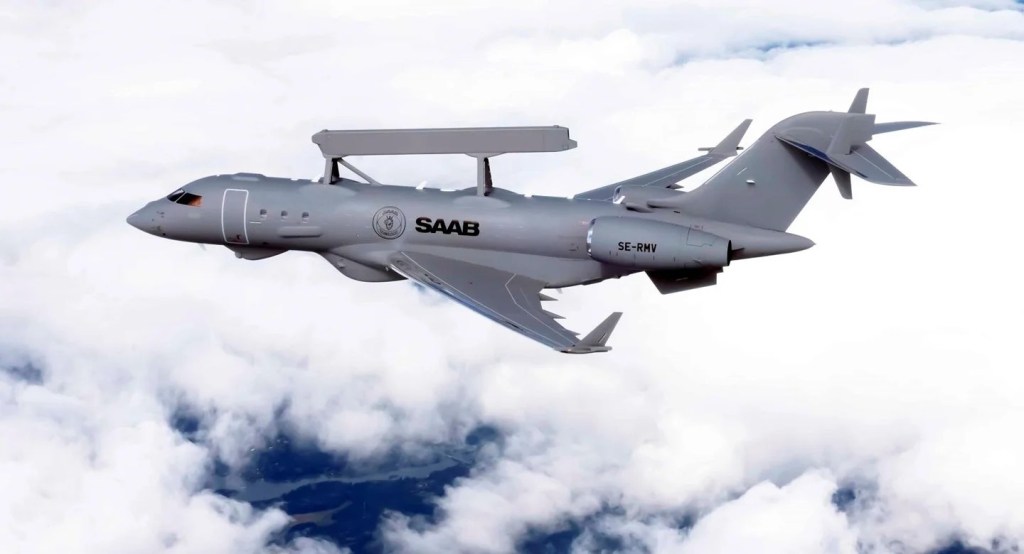
The Saab GlobalEye Airborne Early Warning and Control (AEW&C) aircraft uses the Bombardier Global 6000/6500 platform.

The Erieye radar system, installed on the GlobalEye aircraft, is capable of tracking airborne targets at a range of 650 km and ground targets at 425 km. Saab notes that the radar, thanks to its AESA (Active Electronically Scanned Array) technology, is sensitive enough to track drones at distances ranging from 100 km to 600 km.
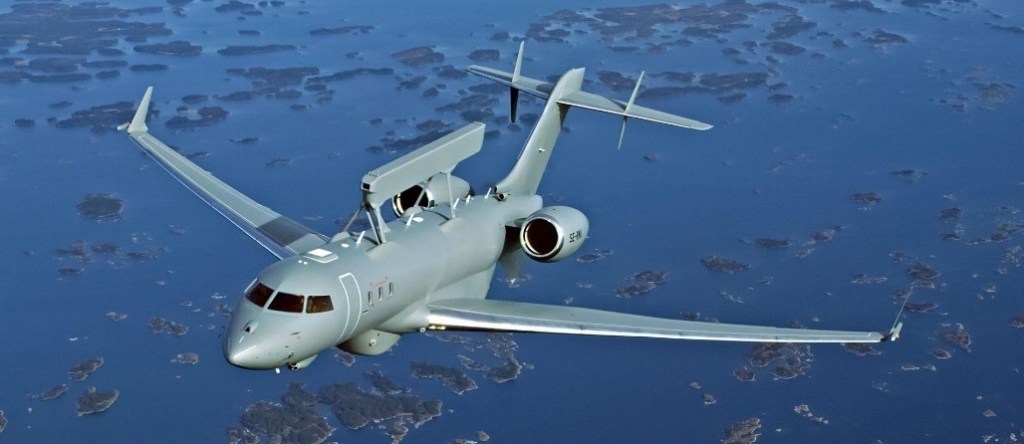
The Erieye radar system, developed by the Swedish company Saab Electronic Defence Systems, provides a 300-degree coverage, detecting airborne and maritime targets.
The system is used by the air forces of countries such as Sweden, Brazil, Pakistan, Thailand, Greece, Mexico, the United Arab Emirates, and Saudi Arabia. The installation platform varies depending on the customer’s needs.
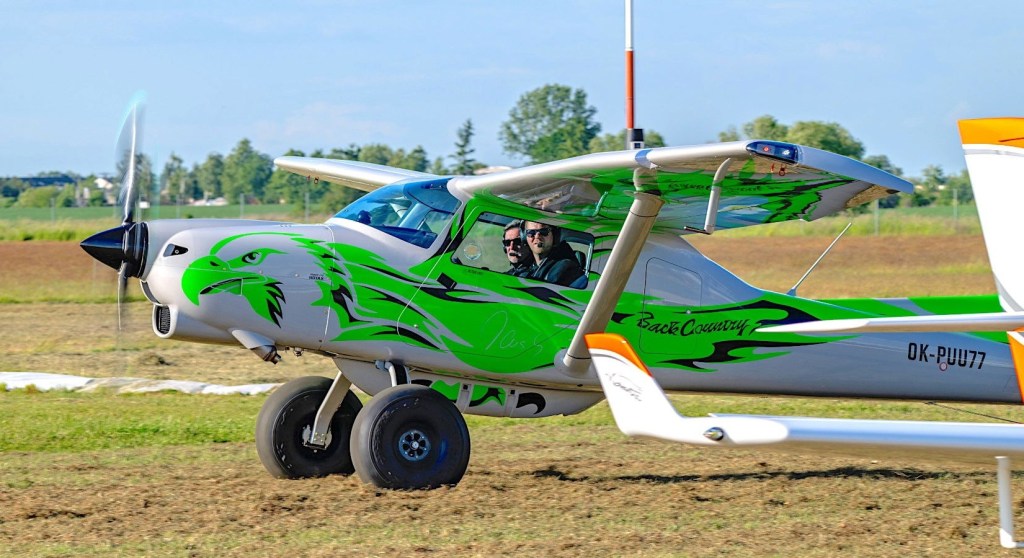
TL Sport Aircraft announced the latest addition to its fleet in July 2025, designed in the format of its predecessors like the TL-3000 Sirius, the Sirius BackCountry provides STOL (short takeoff and landing) performance.
Czech Republic-based TL Sport stated that the aircraft was engineered and designed specifically for the North American market. The BackCountry maintains a 156-mph cruise speed, while posting sub-200 foot landing capability and the ability to take off in less than 100 feet. The aircraft features an airframe constructed from a lightweight Carbon Kevlar composite mix along and supported by 26-inch Alaska Bush tires.
TL Sport made note that the Sirius BackCountry has creature comforts and sophisticated electronics, with heated leather seating and Garmin avionics, configurable for both VFR and IFR conditions.
Development of the aircraft was originally announced at the 2024 AirVenture.
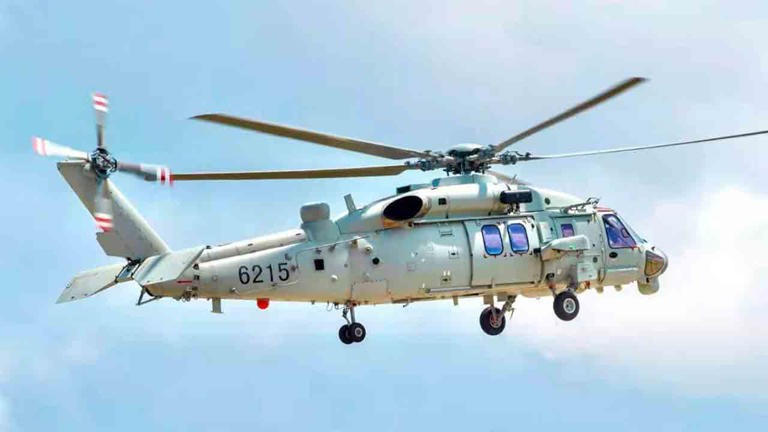
As part of this modernization, the Zhi-9S and Ka-52 helicopters were being replaced in 2025 by the new Zhi-20F anti-submarine helicopters aboard the fourth production batch of Type 052D guided-missile destroyers.
Zhi-20F Specifications:
Engines: two WZ-10 turboshaft engines, 2,100 – 2,700 hp
Length: 20 meters
Height: 5.3 meters
Maximum speed: 360 km/h
Cruising speed: 290 km/h
Maximum takeoff weight: 10 tons
Service ceiling: 6,000 meters
Flight range: 560 km
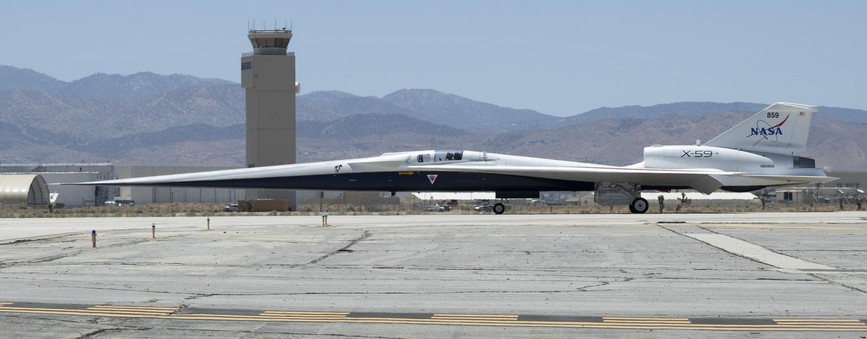
NASA’s X-59 quiet supersonic research aircraft has officially begun taxi tests, marking the first time this one-of-a-kind experimental aircraft has moved under its own power. NASA’s experimental X-59 jet is designed to fly faster than sound but also dampen the sonic “boom.”
Despite schedule delays in the early 2020s, the X-59 was delivered to NASA for flight testing in January 2025. Ground tests, including low-speed taxiing, began in mid-July, with a maiden flight expected later that year.
On July 18, 2025, NASA’s experimental X-59 supersonic research aircraft basked in golden light on the ramp at Lockheed Martin’s Skunk Works facility before being put through a series of ground tests.

The X-59 Quesst (Quiet SuperSonic Technology) is an experimental aircraft developed by Lockheed Martin’s Skunk Works for NASA, designed to achieve supersonic speeds with dramatically reduced noise, transforming the traditional sonic “boom” into a softer “thump.”
NASA test pilot Nils Larson and the X-59 team, made up of NASA and contractor Lockheed Martin personnel, completed the aircraft’s first low-speed taxi test at U.S. Air Force Plant 42 in Palmdale, California, on July 10, 2025.
Nils Larson is set to serve as pilot for first flight, with X-59’s crew chiefs – Matt Arnold from X-59 contractor Lockheed Martin and Juan Salazar from NASA.
The X-59’s life support system is designed to deliver oxygen at the aircraft’s cruising altitude of 55,000 feet. Larson will also wear a g-suit, similar to what fighter pilots wear.
The X-59 features an ejection seat and canopy adapted from a U.S. Air Force T-38 trainer, which comes equipped with essentials like a first aid kit, radio, and water.
The taxiing represents the X-59’s last series of ground tests before first flight. Over the coming weeks, the aircraft will gradually increase its speed, leading up to a high-speed taxi test that will take the aircraft just short of the point where it would take off.
During the low-speed tests, engineers and flight crews monitored how the X-59 handled as it moved across the runway, working to validate critical systems like steering and braking. These checks help ensure the aircraft’s stability and control across a range of conditions, giving pilots and engineers confidence that all systems are functioning as expected.

The X-59 is the centerpiece of NASA’s Quesst mission, which aims to demonstrate quiet supersonic flight by reducing the loud sonic boom to a quieter “thump.” Data gathered from the X-59 will be shared with U.S. and international regulators to inform the establishment of new, data-driven acceptable noise thresholds related to supersonic commercial flight over land.
Lockheed Martin Skunk Works in partnership with NASA, successfully completed the first flight of the X-59. The X-59 took off from Skunk Works’ facility at U.S. Air Force Plant 42 in Palmdale, California, before landing near NASA’s Armstrong Flight Research Center in Edwards, California. The X-59 performed exactly as planned, verifying initial flying qualities and air data performance on the way to a safe landing at its new home.

Skunk Works will continue to lead the aircraft’s initial flight test campaign, working closely with NASA to expand the X-59’s flight envelope over the coming months. Part of this test journey will include the X-59’s first supersonic flights, where the aircraft will achieve the optimal speed and altitude for a quiet boom. This will enable NASA to operate the X-59 to measure its sound signature and conduct community acceptance testing.
For more than a decade, Lockheed Martin Skunk Works and NASA have collaborated. Lockheed Martin Skunk Works is leading the design, build and flight test of the X-59 quiet supersonic technology (QueSST) X-plane. The technology demonstrator will be flown over populated areas to provide U.S. and international regulators with statistically valid data required to help approve new rules that could allow quiet commercial supersonic flight over land.

Launched in 2014, the TBM 900 brought 26 refinements aimed at improving both speed and efficiency. According to Daher, key enhancements included a redesigned engine cowling, a new five-blade composite propeller, and aerodynamic tweaks to the fuselage and winglets. These changes resulted in reduced drag and improved climb rates, allowing the TBM 900 to outperform its predecessor while consuming less fuel.
There were also subtle exterior changes introduced to reduce drag. These included a re-contoured tail cone and engine nacelle, and the addition of inner main landing gear doors. Additionally, cabin improvements made the aircraft quieter and more comfortable.

There are five versions of the TBM 900 series aircraft.
Introduced in 2017, the TBM 910 was designed to build upon the aerodynamic and structural improvements of the TBM 900 while focusing primarily on avionics advancements. The TBM 910 featured the Garmin G1000 NXi avionics suite, offering faster processing speeds, improved resolution, and enhanced connectivity options.

The aircraft’s performance remained largely similar to the TBM 900, but the new avionics provided pilots with a more intuitive and user-friendly experience. Features include improved touchscreen controls, ADS-B capabilities, and enhanced synthetic vision.

Introduced in 2019, the TBM 940 introduced an automatic throttle system, which helped pilots manage power settings more efficiently. This variant also featured autoland technology, as well as automatic deicing.
Additional refinements included improved cabin comforts, upgraded climate control, and enhanced noise reduction.
Introduced in 2022, the TBM 960 featured a digital e-throttle and Pratt & Whitney PT6E-66XT engine. The TBM 960 also includes an autoland system.

Additionally, this variant boasts a dual-channel full authority digital engine control (FADEC) feature – Daher calls this EPECS, which stands for Engine and Propeller Electronic Control System. The TBM 960 is the first aircraft in the TBM line to feature this. The TMB 960 also has an MTOW that is 221 lb (100 kg) greater, totaling 7,615 lb (3,454 kg).
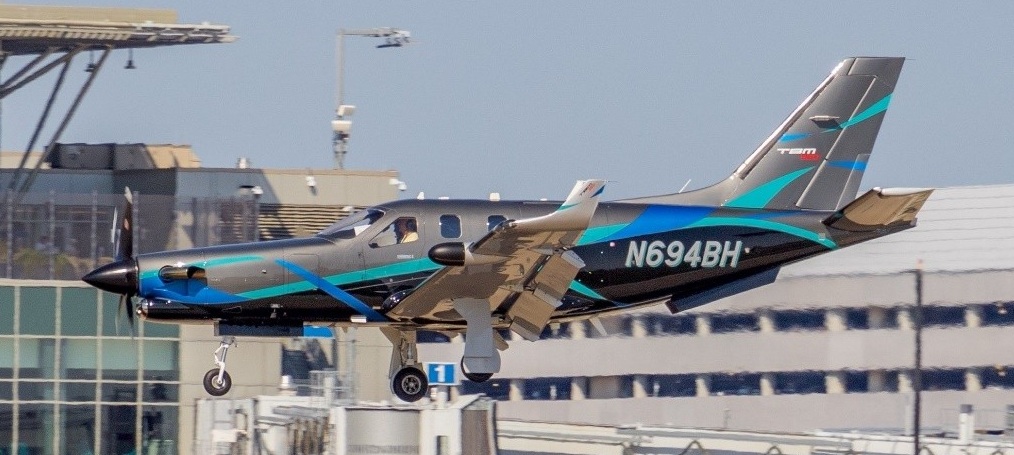
The TBM 960 replaced the 940, and was sold alongside the baseline TBM 910 model.
1,155 TBM series aircraft have been produced, as of July 2023. From its inception with the TBM 700 to the TBM 960.
TBM 900
Engine: Pratt & Whitney Canada PT6A-66D
Maximum cruise speed: 330 knots (380 mph, 611 km/h)
Range: 1,730 nautical miles (1,991 mi, 3,204 km)
Maximum takeoff weight (MTOW): 7,394 lbs (3,354 kg)
Service ceiling: 31,000 ft (9,449 m)
Fuel capacity: 292 US gal (1,105 L)
Seating capacity: 6
TBM 910
Engine: Pratt & Whitney Canada PT6A-66D
Maximum cruise speed: 330 knots (380 mph, 611 km/h)
Range: 1,730 nautical miles (1,991 mi, 3,204 km)
Maximum takeoff weight (MTOW): 7,430 lbs (3,370 kg)
Service ceiling: 31,000 ft (9,449 m)
Fuel capacity: 292 US gal (1,105 L)
Seating capacity: 6
TBM 940
Engine: Pratt & Whitney Canada PT6A-66D
Maximum cruise speed: 330 knots (380 mph, 611 km/h)
Range: 1,730 nautical miles (1,991 mi, 3,204 km)
Maximum takeoff weight (MTOW): 7,430 lbs (3,370 kg)
Service ceiling: 31,000 ft (9,449 m)
Fuel capacity: 292 US gal (1,105 L)
Seating capacity: 6
TBM 960
Engine: Pratt & Whitney Canada PT6E-66XT
Maximum cruise speed: 330 knots (380 mph, 611 km/h)
Range: 1,730 nautical miles (1,991 mi, 3,204 km)
Maximum takeoff weight (MTOW): 7,615 lbs (3,454 kg)
Service ceiling: 31,000 ft (9,449 m)
Fuel capacity: 292 US gal (1,105 L)
Seating capacity: 6

On 24 October 2024, Google co-founder Sergey Brin’s airship company LTA Research announced Pathfinder 1’s first if brief untethered flight at Nasa’s Moffett Field in California, part of the space agency’s Ames Research Center.
Pathfinder 1 is a fully rigid airship. This was the first flight of the first airship built by the Google cofounder’s company, the first time a classic rigid airship of this size had flown since the 1930s, and the first of a new generation of airships.
Pathfinder 1 is not a historical replica. It is a proof-of-concept airship designed to see if a rigid design can be updated with new materials. In particular, LTA Research wants to solve the problem of how to mass produce aircraft of this size.
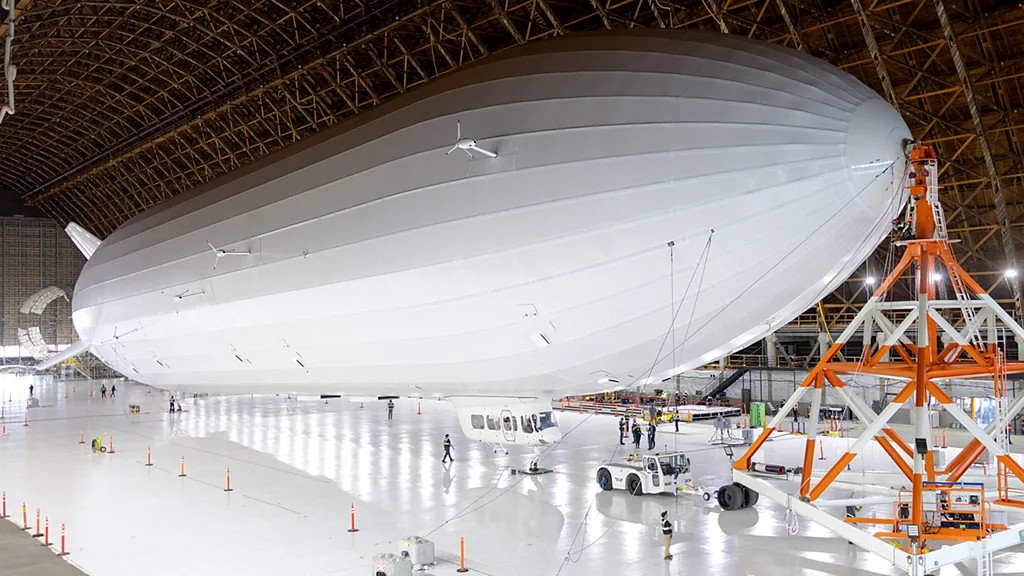
The fact that the giant rigid airship does not have tail fins in the traditional cross shape, but at an angle, is an example of such learning, because airships float up and down on a mooring mast and the bottom tail fin used to get damaged. Likewise, the airship’s engines are no longer inline but staggered along its length to reduce the wind, drag and vibration that they used to cause. It uses helium as a lifting gas.
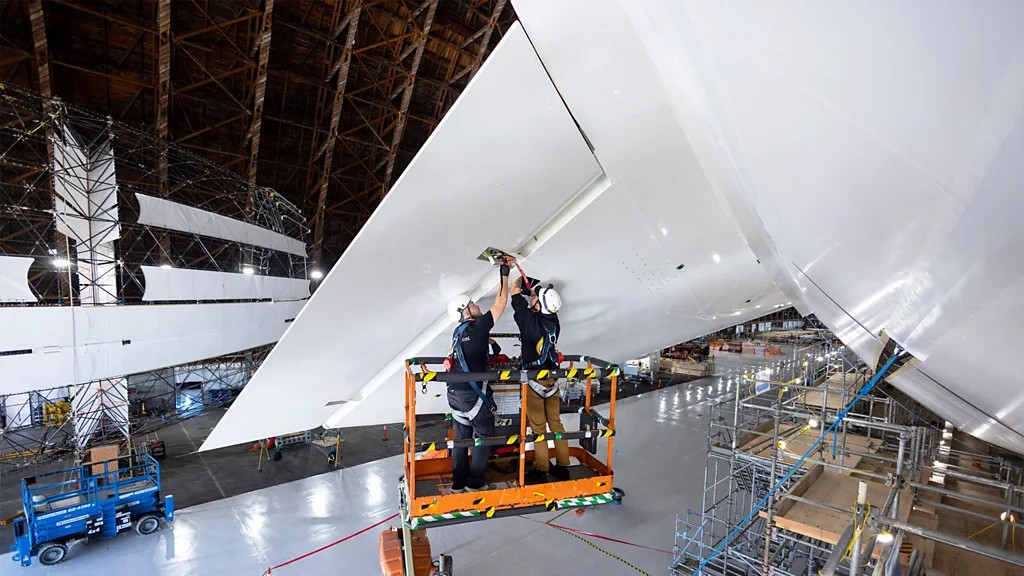
The first flight of Pathfinder 1 has been at least 12 years in the making. Brin’s interest in airships seems to have begun in 2012 around the same time as a modern semi-rigid Zeppelin NT (New Technology) airship began tourist flights from Moffett Field.
The following year he founded LTA Research Ltd and in 2017 his airship company began to lease space at Moffett Field and research began at the Akron Airdock. There they built a 12-engine, 50ft-long (15m) electric “baby airship” to test their technology.
The use of computerised controls, new and much stronger lightweight materials like carbon fibre and titanium to construct the complex skeleton of the rigid airship are just some of the ways the giant rigid airship has been brought into the 21st Century. So too are the use of flame-retardant synthetic materials for the envelope of the airship, sensors to monitor the helium and engines that can be rotated to provide vectored thrust.
In 2017 work started at Moffett Field on LTA’s smallest airship Pathfinder 1, and planning began in Akron on the Pathfinder 3, its successor which is planned to be one-third-larger. (There is no Pathfinder 2.)

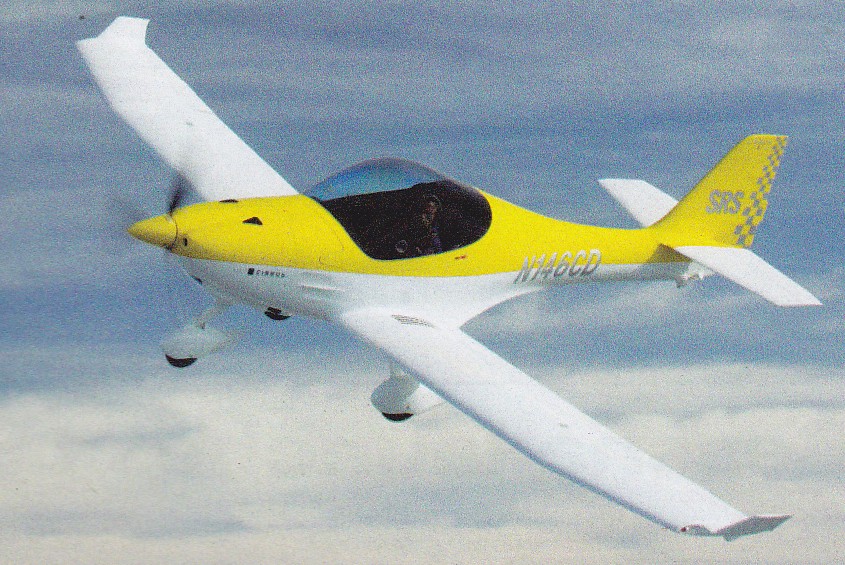
The Cirrus SRS (SR Sport) is the German B&F Fk 14 Polaris all-composites two-seat ultralight modified for US LSA regulations. First flowing in 1999, it was selected by Cirrus after a four-year evaluation of various designs. Powered by a 100 hp / 75 kW Rotax 912S, Cirrus will have to slow the aircraft down to meet the LSA’s 120 kt / 222 kph maximum cruise speed rules.

Aviation history was made by Banbury based Skyfly Technologies in 2025, when its Axe aircraft travel from Turweston Aerodrome in Northamptonshire to Bicester Airfield in Oxfordshire, and back again. Europe’s first airfield-to-airfield flight of a fully electric vertical take-off and landing (eVTOL) aircraft.
Skyfly’s chief technical officer and test pilot, Dr William Brooks, piloted the prototype craft for the test flight.
The outbound journey took 12 minutes and the return took eight minutes and Mr Brooks said the aircraft “performed very well”.
He added: “It has a gentle feel in turbulence, giving the impression of more span because of the motor masses at the tips.
“The comfort, outstanding view and lack of noise make for enjoyable flying.”
The aircraft can take off and land both vertically and conventionally and received the necessary UK Civil Aviation Authority clearance for flying in 2024.
The Axe features eight electric motors – two on each wingtip enclosed in a single nacelle – powered by high-capacity lithium batteries housed within the fuselage. These batteries are swappable and removable for convenient charging.
The prototype has now been readied for a trip to the United States at the end of July, where it will appear at EAA AirVenture in Oshkosh – an event for experimental aircrafts.
Specifications:
Aircraft type: eVTOL passenger aircraft (and has a hybrid-electric VTOL option)
Piloting: 1 pilot
Capacity: 1 pilot and 1 passenger (or 2 passengers when the aircraft becomes autonomous)
Cruise speed: 161 km/h (100 mph)
Range (batteries): 161 km (100 miles)
Range (with generator, a range extender): 322 km (200 miles)
Flight time: Unknown
Empty Weight: 182 kg (401 lb)
Maximum payload: 172 kg (379 lb)
Maximum takeoff weight: 600 kg (1,323 lb)
Propellers: 4 propellers
Electric motors: 8 electric motors
Power source: Batteries or batteries with a generator to produce electricity
Fuselage: Carbon fiber composite
Window: Canopy over cockpit
Wings: Canard wings (2 wings)
Tail: 1 rudder
Landing gear: Fixed tricycle wheeled landing
 All Aero