Stellar Astra / Albatross Flying Systems Cruiser

The Stellar Astra is an American ultralight trike that was designed by Allistair Wilson and produced by Stellar Aircraft of Bloomfield, Indiana. When it was available the aircraft was supplied as a complete ready-to-fly-aircraft. As of 2013 the company appears to be out of business and production complete.

The Astra was derived from a P&M Aviation trike design and intended to comply with the US light-sport aircraft category.

The Astra features a cable-braced hang glider-style high-wing, weight-shift controls, a two-seats-in-tandem open cockpit with a cockpit fairing, tricycle landing gear with wheel pants and a single engine in pusher configuration.

The aircraft is made from bolted-together aluminum tubing, with its double surface wing covered in Dacron sailcloth. Its 34.4 ft (10.5 m) span wing is supported by a single tube-type kingpost and uses an “A” frame weight-shift control bar. Powerplants that were factory available were the twin cylinder, air-cooled, two-stroke, dual-ignition 50 hp (37 kW) Rotax 503, the four cylinder, air and liquid-cooled, four-stroke, dual-ignition 80 hp (60 kW) Rotax 912UL and 100 hp (75 kW) Rotax 912ULS and the twin cylinder, air-cooled, four-stroke, dual-ignition 60 hp (45 kW) HKS 700E engine.

With the HKS powerplant the aircraft has an empty weight of 485 lb (220 kg) and a gross weight of 960 lb (435 kg), giving a useful load of 475 lb (215 kg).

The aircraft was produced under contract for Stellar Aircraft in India by Albatross Flying Systems, who also marketed the design in Asia as the Cruiser. In 2011, The Astra sold for US$23,495 with the HKS 700E engine.

Astra
Engine: 1 × HKS 700E, 60 hp (45 kW)
Propeller: 3-bladed composite
Wingspan: 34 ft 5 in (10.5 m)
Wing area: 168 sq ft (15.6 sq.m)
Empty weight: 485 lb (220 kg)
Gross weight: 959 lb (435 kg)
Maximum speed: 78 mph; 67 kn (125 km/h)
Cruise speed: 62 mph; 54 kn (100 km/h)
Stall speed: 37 mph; 32 kn (60 km/h)
Rate of climb: 450 ft/min (2.3 m/s)
Wing loading: 5.7 lb/sq ft (27.9 kg/sq.m)
Crew: one
Capacity: one passenger

Sportline Aviacija / Lak / Lithuanian Aviation Constructions / Experimentalnii Zavod Sportivnoi Aviatsii / Experimental Sports Aviation Factory

The Lithuanian Aviation Plant (now JSC “Sportinė Aviacija ir Ko”) Company was founded in 1969 and designed and manufactured highest quality gliders. In the course of its history the Company designed, tested and produced 20 different types and modifications of gliders and motor-gliders.

The first composite high performance glider BK.-7 “Lietuva” took-off in 1972. Since then, many other aviation projects were developed and manufactured best known of which are the 1978 Open class glider LAK-12; 15-18m class glider LAK-17a, Standard class gliders Genesis 2 and LAK-19; self- sustaining gliders LAK-17AT and LAK-19T; primary training glider LAK-16, open class ships LAK-20T and LAK-20M. The most popular member of the glider family is the Open Class glider LAK-12. Within 25 years, 253 units have been built and operated in 20 different countries. The LAK-12 was designed according to technical requirements and standards of the former Soviet Union, so called Norms of Flight Safety. In some cases, these Norms were stricter than the current European standards (CS-22).

Since 1996, Sportline Aviacija have worked on the American design standard class glider Genesis. Being the developer of the engineering part of the design, we completed the strength tests and calculations in accordance with JAR-22 standards. All works on obtaining type certificate in accordance with JAR-22 have been carried out and 26 units have been manufactured.

More than a thousand L-13 “BLANIK” gliders from all over the former Soviet Union and Bulgaria were overhauled in the plant.

Over the past 15 years after the company became private, LAK-17 type glider was developed and modified, and about 200 units of 15m and 18m class gliders were manufactured and delivered to the customers all over the world.

In 1999, the LAK factory was completely privatized, and a joint-stock company, Sportinë Aviacija, AB, was formed.

2002 launched a new open class glider, LAK-20 (two-seater version), and at the same time a turbo moto version of this glider as well. Few prototypes of the open class two-seater gliders LAK-20 and LAK-20M have been assembled, but the further development of the project has been frozen.

New modification of LAK-17 is the LAK-17B, which further evolved into a the most revolutionary and progressive product- the LAK-17B-FES (Front Electric Sustainer). The LAK-17B FES has been certified by EASA.

A Certificate issued by the Lithuanian Civil Aviation Authority, which grants the right to perform production of sailplanes, self-launching sailplanes as well as related products and parts.

LAK gliders are worldwide type certified, not only in Lithuania, but have type certificates for gliders in EASA, CAR, and other countries.

Apart from building gliders, the factory has capacities to develop a large variety of aviation or non-aviation composite structures and constructions. The testing facility can be employed for comprehensive analysis of projects and has its own strength test laboratory.

Sport Flight International Astra

Designed by Allistair Wilson and built in Bloomfield, Indiana, the Astra trike is built to exceed the Light Sport Aircraft standards. The Astra has wide comfortable seating and can be used for serious cross country flying or simply enjoying the scenery.

The Astra Trike is manufactured in the American Mid West and has been developed using British technology. Two engine options were available: the HKS 700E – 60 BHP – 2 cylinder – 4 stroke or the 4 cylinder- 4 stroke – Rotax 912. The Astra Trike has been designed and manufactured to comply with the requirements of BCAR Section S Issue 2, and the American Sportplane aircraft design category.

Many parts for the wing are manufactured by Sport Flight International, including the wing sail, storage bag, wing bag and packing set. Sport Flight International also manufacture the structural wing frame tubes for the Astra Trike. Bill Sherlock test flew the first complete Astra Trike at Shawnee airport, Bloomfield Indiana, on the 26th April 2005.

The Astra Trike is the product of years of research and development, bringing to America a world class trike, capable of effortless cross country flying, with the reliability of a four stroke engine at an affordable 2009 Price.

The Astra 912 is powered by the 80 hp Rotax 912 four cylinder four stroke engine, allowing the trike to cruise at 70 mph, and burn just over 3.0 gallons per hour. Maximum level speed is 80 mph, VNE is 90 mph. Stall speed occurs at 32 mph. Rate of climb 800-1100 feet per minute depending on load and density altitude. Take off run 180 – 250 feet depndent on load and dnsity altitude. Astra 15.6 m double surface wing. Composite front fairing with windshield, Instrument panel, and composite wheel pants.

Dual rear brakes with parking brake, Warp Drive composite 3-blade propeller, Polyurethane shock absorber suspension system, Fabric skirt, 11.5 gallon fuel tank, Rotax mechanical fuel pump system, Cast aluminum spoked wheels, Wide composite seat with folding backrest, Chrome Moly steel maingear, Rear seat nose-wheel steering. Dual stainless steel muffler system, Pod storage bag, 10-row oil cooler, all aluminum radiator.

Standard instrument fit on the Astra 912 are Airspeed Indicator, Sensitive Altimeter, Fuel gauge, Digital engine monitoring which includes dual CHT and quadruple EGT, Hour meter, Flight timer, Voltage, Oil temperature, Oil pressure, Tachometer and In-dash Compass. Available Options include: Ballistic Recovery System Parachute, Vertical Speed Indicator, Fuel computer, Lynx Radio antenna, Dual Strobe system, High intensity headlight, Complete Lynx system including, Helmets, Vizors, Headsets, Intercom (self or aircraft powered), Radio, PTT cable, Windshield extension, Gas lift strut to assist in lifting the wing during set-up and takedown.

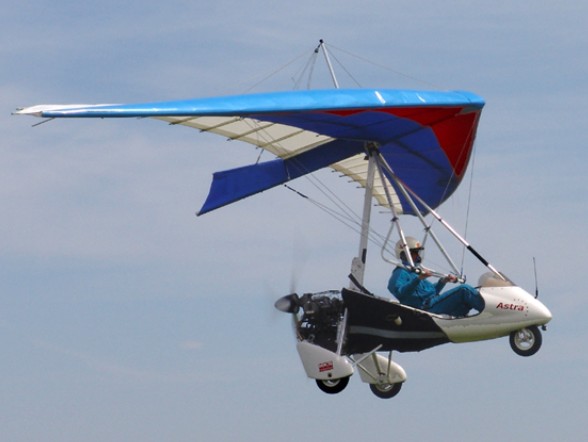
The Astra HKS is powered by the 60 hp Japanese HKS twin cylinder four stroke engine. This allows the trike to cruise at 55 – 65 mph, while burning just over 2.2 gallons per hour. Maximum level speed is 75 mph, VNE is 90 mph. Stall speed occurs at 32 mph Rate of Climb is 400 – 800 feet per minute depending on flight loads and density altitude. Astra 15.6 m double surface wing Composite front fairing with windshield and Instrument panel, composite wheel pants.

Dual rear brakes with parking brake, composite 3-blade propeller with reinforced leading edge, Polyurethane shock absorber suspension, Fabric skirt, 11.5 gallon fuel tank, Electric and mechanical fuel pump system, Cast aluminum spoked wheels, Wide composite seat with folding backrest, Chrome Moly steel maingear, Rear seat nose-wheel steering. Standard instrument fit on the Astra HKS are Airspeed Indicator, Sensitive Altimeter, Fuel gauge, Dual CHT, Dual EGT, RPM , Hourmeter, Voltmeter and In Dash Compass. Available Options include: Digital engine monitoring with warning light for out of range engine parameters, Jet Hot coating on the Muffler, Ballistic Recovery System Parachute, Vertical Speed Indicator, Fuel computer, Lynx Radio antenna,Dual Strobe system, headlight, Complete Lynx system including, Helmets, vizor, headsets, intercom (self or aircraft powered), Radio, PTT cable, Windshield extension, Gas lift strut to assist in lifting the wing during set-up and takedown.

The Astra S2 is powered by the 100 hp Rotax 912S four cylinder four stroke engine. A reliable, efficient and powerful engine that allows the trike an effortless cruise anywhere between 55 and 100 mph, and burn just over 3.5 gallons per hour. Maximum level speed is 105 mph, VNE is 115 mph. Stall speed occurs at 38 mph. Rate of climb is normally between 1000 -1300 feet per minute depending on load and density altitude. Take off run is typically 300 – 450 feet again dependent on load and density altitude. Astra S2 10.6 m double surface wing Composite front fairing with extended two piece windshield and Instrument panel, composite Pylon fairing and stabiliser wheel pants. Electric trim, Dual rear brakes with parking brake, composite 3-blade propeller with reinforced leading edge and prop spinner, Polyurethane maingear shock absorber suspension, Fabric skirt, 11.5 gallon fuel tank, Rotax mechanical fuel pump system, Cast aluminum spoked wheels, Wide composite seat with folding backrest, Chrome Moly steel maingear, Rear seat nose-wheel steering. Standard instrument fit on the Astra S2 are Airspeed Indicator, Sensitive Altimeter, Fuel gauge, Digital engine monitoring which includes dual CHT and quadruple EGT, Hour meter, Flight timer, Voltage, Oil temperature, Oil pressure, Tachometer and In-dash Compass. Available Options include: Ballistic Recovery System Parachute, Vertical Speed Indicator, Fuel computer, Lynx Radio antenna, Dual Streamlined Strobe System, High intensity headlight, Complete Lynx system including, Helmets, Vizors, Headsets, Intercom (self or aircraft powered), Radio, PTT cable, Windshield extension, Gas lift strut to assist in lifting the wing during set-up and takedown. Instructor Training Bars.
The Astra 503 is powered by the 54 hp Rotax 503 two cylinder four stroke engine. It powers the trike to a cruise speed between 55 and 65 mph, burning just over 4 gallons per hour. Maximum level speed is 70 mph, VNE is 90 mph. Stall speed occurs at 32 mph. Rate of climb is normally 250 -700 feet per minute depending on load and density altitude. Take off run is typically 200- 400 feet again dependent on load and density altitude. Astra A1 15.6 m double surface wing Composite front fairing with extended two piece windshield and Instrument panel, and wheel pants. Dual rear brakes with parking brake, composite warp drive 3-blade propeller, Polyurethane maingear shock absorber suspension, Fabric skirt, 11.5 gallon fuel tank, Rotax mechanical fuel pump system, Cast aluminum spoked wheels, Wide composite seat with folding backrest, Chrome Moly steel maingear, Rear seat nose-wheel steering. Standard instrument fit on the Astra 503 are Airspeed Indicator, Fuel gauge, Digital Altimeter and VSI, digital engine monitoring which includes dual CHT and dual EGT, Hour meter, Flight timer, Voltage, Tachometer and In-dash Compass. Available Options include: Ballistic Recovery System Parachute, Analogue Altimeter and Vertical Speed Indicator, Lynx Radio antenna, Dual Strobe System, High intensity headlight, Complete Lynx system including, Helmets, Vizors, Headsets, Intercom (self or aircraft powered), Radio, PTT cable, Windshield extension, Gas lift strut to assist in lifting the wing during set-up and takedown. Instructor Training Bars.

The Astra 103 is powered by the Rotax 503 two cylinder two cycle engine. This allows the trike a cruise speed between 55 and 63 mph, and burn just over 4 gallons per hour. Maximum level speed is 63 mph, VNE is 90 mph. Stall speed occurs at 25 mph. Rate of climb is normally between 300 and 500 feet per minute depending on load and density altitude. Take off run is typically 300 – 450 feet, again dependent on load and density altitude. Astra 103 10.6 m double surface wing. Composite front fairing with windshield and Instrument panel, and stabiliser wheel pants., Wooden 2 -blade propeller with protected leading edge, Bungee maingear shock absorber suspension, Fabric skirt, 5 gallon fuel tank, Rotax mechanical fuel pump system, Cast Nylon wheels, Wide fabric seat, Chrome Moly steel maingear. Standard instrument fit on the Astra 103 are Airspeed Indicator, Digital Altimeter and VSI, engine monitoring which includes dual CHT and dual EGT, Hour meter, Flight timer, Voltage, Tachometer. Available Options include: Ballistic Recovery System Parachute, Lynx Radio Antenna, Dual Streamlined Strobe System, High intensity headlight, Complete Lynx system including, Helmet, Vizor, Headset, Radio, PTT cable, Windshield extension, Gas lift strut to assist in lifting the wing during set-up and takedown.

Sport Copter Vortex

A single-seat partially enclosed autogyro, Sport Copter’s composite seats conform to the pilot’s shape, including the head, provide comfort as well as crucial support. Independent toe-operated hydraulic disc brakes are standard on all models. Its unique nose-wheel suspension operates independently from the rudder to make for smooth takeoffs and landings in crosswinds. Vortex reaches 100 mph with a 67-hp engine and has seating for one with a useful load of 460 pounds. Kits for the Vortex in 2001: US$20,400

Standard: semi-enclosure, folding rotor mast, pre-rotator, independent hydraulic disc brakes, new rotor head and roto-control Cyber Seat, nosewheel and main gear suspension.

Engine: Rotax 582, 67 hp
Rotor Blades: 25′ Sport Rotors
Height: 8.3 ft
Length: 12 ft
Disk span: 25 ft
Disk area: 490.8 sq.ft
Width: 7’4″
Empty wt: 350 lbs
Gross wt: 760 lbs
Fuel cap: 10 USG
Max speed: 100 mph
Cruise speed: 80 mph
Range: 170 sm
ROC: 1200 fpm
Take-off dist: 50 ft
Landing dist: 0-10 ft
Service ceiling: 13,000 ft
Seats: 1

Sport Copter II

Full Body Enclosure including Fire Wall w/ two removable doors, Heavy Duty Engine Mounts, Mechanical Prerotator System, 8.5” X 31’ Sport Rotors Rotor System w/ Adjustable Pitch , Rotor Brake, Independent Hydraulic Disc Brakes, toe actuated, Roto-Control System, Cyber Seats w/ Adjustable Seat Backs and Adjustable Lumbar.

Heavy Duty Suspension, rate sensing shocks w/ springs (11” of travel!), Nosewheel, full castering with suspension (offering self alignment), Spun Aluminum Wheels, strong lightweight wheels, Customized 27 Gal. Aluminum Fuel Cell, Landing Lights (2), Cockpit Interior Lighting.

The “Quick Build “, High Performance Kit: offers a pre-fabricated, one piece cabin, so that no gluing is required to assemble the Kit. The cost is $59,995.00 in 2009 (less engine and prop package).

Engine: Lycoming IO-360
Propeller: Sport Copter Controllable pitch, three-blade
Rotors: 8.5″ x 31′
Fuel Capacity: 27 gal
Min Speed: 10-20 mph
Cruise: 100 mph
Top Speed: 120 mph
Empty Weight: 1000 lbs
Useful Load: 650 lbs
Gross Weight: 1650 lbs
Cabin Width 49″
Aircraft Width: 81″
Height: 10′
Length: 15.5′
Seats: 2

Engine: Subaru, 160 hp
Max speed: 130 mph
Cruise speed: 100 mph
Range: 310 sm
ROC: 1200 fpm
Take-off dist: 50 ft
Landing dist: 0-10 ft
Fuel cap: 25 USG
Empty wt: 650 lb
Gross wt: 1300 lb
Height: 9.75 ft
Length: 17 ft
Disk span: 30 ft
Disk area: 706.7 sq.ft
Seats: 2

Spectrum RX-28 Beaver

Beaver SS

Single seat single engined high wing monoplane with conventional three axis control. Wing has swept back leading and trailing edges, and constant chord; conventional tail. Pitch control by elevator on tail; yaw control by fin mounted rudder; roll control by three-quarter span ailerons; control inputs through stick for pitch/roll and pedals for yaw. Wing braced from below by struts; wing profile double surface. Undercarriage has three wheels in tricycle formation; bungee suspension on all wheels. Push right go right nosewheel steering connected to yaw control. No brakes. Aluminium tube framework, with optional pod or full enclosure. Engine mounted at wing height driving pusher propeller.

Since a prototype, the aircraft has been changed considerably. It features almost full span ailerons of 10.0 ft (3.05 m) length, which should give very powerful roll control. Another change has been the inclusion of an optional pod, which can be extended as a further option to become a full cockpit enclosure, rather in the manner of a Birdman Chinook.

Spectrum says that the Beaver takes 30 hr to assemble from kit. Construction is of double surface, strut braced, high wing with aluminium spars and ribs. Stressed to + 7.5 G’s and – 3 G’s. Mylar reinforced leading edge for smooth air flow. Conventional 3-axis controls, centre mounted joy stick, rudder pedals, tricycle undercarriage (with castering nosewheel) and tail skid. Independent shock absorbers give excellent rough field capabilities.

In 1993, ASAP began providing parts and service for the existing Beaver RX550, RX28 and RX35 all aircraft manufactured by a company no longer operating. The demand to continue offering the Beaver aircraft as a kit was high and so in 1996 ASAP introduced the new Beaver RX 550 Plus with new wings, new tail, stronger shock system, better performance but still keeping with its famous docile easy flight of the original Beaver.
The ASAP Single seat Beaver SS standard kit includes: Beaver SS Airframe, Rotax 447 Engine – 40 hp pull-start, Engine accessories, Basic Instrument Package (EGT, CHT, RPM, Airspeed), GSC – 2 blade, 60″ TECH2 prop (ground adjustable, wooden blades w/composite leading edge, Single colour primer and paint package (Endura, 2 part catalyzed polyurethane), Ceconite covering material and edge tape, 3M Latex adhesive, Azusa Tires, nose wheel brakes.

The Beaver SS offers a high useful load with a maximum gross take-off weight of 650 pounds and a typical empty weight of 340 pounds, the Beaver offers more than 300 pounds of useful load. The Beaver SS has a newly designed and cleaner wing, and full span ailerons. Pre-cut, pre-drilled components combined with a modern Assembly Manual (light on cad drawings, heavy on photos) makes for easy assembly even for first time builders.

Cenconite fabric is attached to the structure using a 3M, water-based latex glue before being “shrunk to fit” with a simple home iron. The standard kit includes an educational video to show how. The Beaver kit even includes a high end, catylized polyurethane primer and paint package by Endura incorporating UV protection, flex agent, and instructions. The Standard Beaver SS kit includes everything needed to assemble the aircraft. Everything is jig drilled at the factory with all of the difficult work done.

Complete kit includes airframe, engine, engine accessories, 3 Bld GA prop, paint package, front brake, standard wheels, upright engine mount, instruments steerable nosewheel, ceconite fabric, adapts to floats and skis. Price 2009: US$13150

The Beaver SS first flew in 2000. In 2007 10 were built.

ASAP marketed in kit form the Beaver RX-550 tandem two-seat microlight (as a variant of Spectrum Beaver RX-550), the Beaver RX-28 two-seat training model, and the Chinook Plus 2 tandem two-seat microlight.

Engine: Rotax 277 (268cc) 28 hp
Static thrust: 210 lb
Prop: 127cm x 71 cm pitch
Empty wt: 252 lb
Max wt: 524 lb
Wing span: 31ft
Wing area: 148 sq.ft
Height: 5’8”
Length: 17’8”
Fuel cap: 5 USG
Construction: Aluminium: Dacron
Wing loading: 3.54 lbs/sq.ft
Power loading: 18.71 lbs/hp
Max speed: 72 mph
Cruise: 50 mph
Stall: 24 mph
Vne: 75 mph
Climb rate: 800 fpm @ 50 mph
Design limits: +7.5, -3g
Glide ratio: 8-1
Seats: 1

Beaver SS
Engine: Rotax 447, 40 hp
Engine range: 40-50 hp
Empty wt: 340 lbs
MTOW: 650 lb
Wingspan: 31 ft
Length: 17.6 ft
Wing area: 138 sq.ft
Fuel cap: 5 USG
Cruise: 67 mph
Stall: 30 mph
ROC: 800 fpm
Seats: 1
To dist: 90 ft
Ldg dist: 65 ft
Cockpit width: 39 inch

Aircraft Sales and Parts Ltd (ASAP)
Beaver SS-single place
Stall: 26 kt / 30 mph / 48 kmh
Cruise: 58 kt / 67 mph / 108 kmh
VNE: 78 kt / 90 mph / 145 kmh
Empty Weight: 154 kg / 340 lbs
MTOW Weight: 295 kg / 650 lbs
Climb Ratio: 850 ft/min / 4 m/s
Glide Ratio: 7:1
Take-off distance (50ft obstacle): 90 ft / 27 m
Landing distance (50ft obstacle): 75 ft / 23 m

Spacek SD-1 Minisport

A mostly wooden UL single seater. Ply cover over foam ribs on wood / carbon spar. Two piece wing, flaperons with mix mechanism, T Tail.

Non-aerobatic.

Plans, parts, and kits were available. 51 % quick build kit from Czech Republic. All fabricated metal pre-made and materials to complete supplied. 2009 Price: 7950 EURO

Kit cost with engine but no instruments NZ$28000.00 incl ballistic chute in 2013.

Engine: 36 HP 2 cyl 4 stroke
Reduction: geared belt 6000RPM about 4 /1
Span: ~6 m,
Length: ~4m
Empty Weight: 130 kg / 287 lbs
MTOW Weight: 240 kg / 529 lbs
Fuel capacity: 28 ltrs
Stall: 35 kt / 40 mph / 65 kmh
Cruise: 92 kt / 106 mph / 170 kmh
VNE: 110 kt / 126 mph / 203 kmh
Climb Rate: 400 ft/min / 2,5-4 m/s
Take-off distance (50ft obstacle): 820 ft / 250 m
Landing distance (50ft obstacle): 980 ft / 300 m