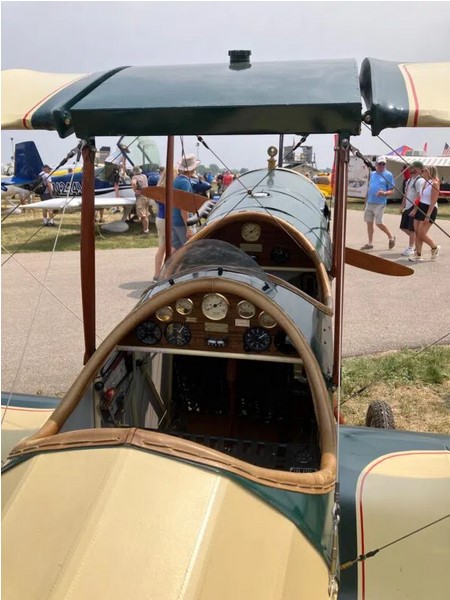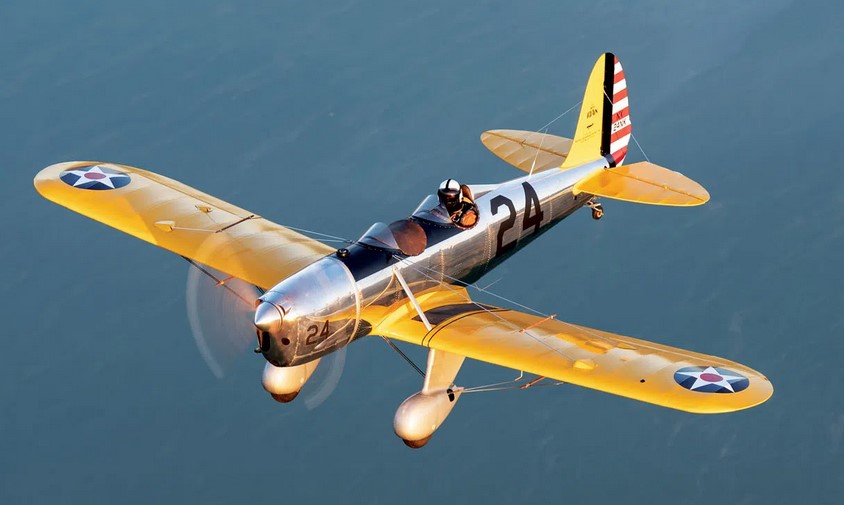
Timber Tiger Aircraft Ryan ST-L

Nick Pfannenstiel, founder of Timber Tiger Aircraft, in February 2015, they decided to move forward with the Ryan project, a major life change. Nick acquired a set of original blueprints for the ST and started working backwards from the drawings. His goal was to maintain the Ryan’s appearance while incorporating technical improvements. Trimming the aircraft’s size by just 5% provided the needed dimensions to work with numerous options and keep things manageable. The scaled-down Ryan ST was designated the ST-L.

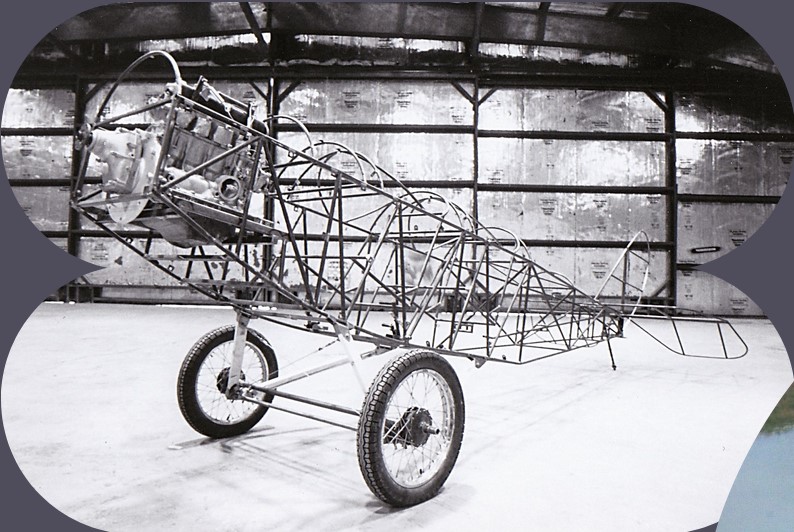
While the ST-L utilizes a semimonocoque fuselage like the original, the internal structure was redesigned from the ground up. There is a central steel bulkhead, which acts as the keystone for all of the aerodynamic stresses. This is heat treated after welding for strength. Steel wing stubs and landing gear complete the central attachments. Otherwise, the fuselage is composed of aluminum bulkheads and longerons. In order to preserve the Ryan’s pleasing lines, all bulkheads are positioned in the same locations as the originals. Other aspects of the airframe, including the tail feathers, wings and landing gear, also flow together nicely and fit the 95% scale replica perfectly.

Although it is 5% smaller than the ST, the ST-L actually has more room in the cockpit. “To create more space, we moved the rudder pedals to either side of the front seat rather than keeping them behind the seat like the original,” explained Nick. “So far, people up to 6 feet 5 have fit comfortably.”
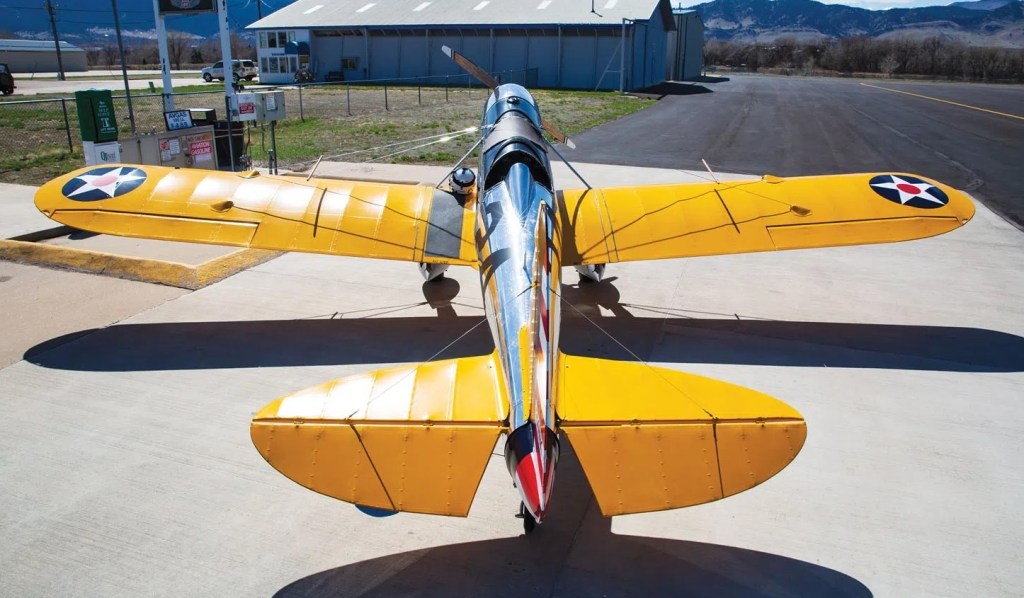
For the wings, an aluminum spar was used in place of the wood spar found on the ST. The airfoil was changed from the original NACA 2412 to a Riblett GA30U-612, like that of the Kitfox. The ribs are a bonded aluminum honeycomb, which provides added strength while saving weight, and they are coated with an epoxy primer for corrosion protection. The wings are covered with Superflite, and the paint is from Stewart Systems. For simplicity, the drag/anti-drag wires were switched to a drag truss.

The Ryan ST has a reputation for being squirrelly on landings, mostly because of the leading-link landing gear. This was replaced with a torque-link landing gear, making ground handling much easier.
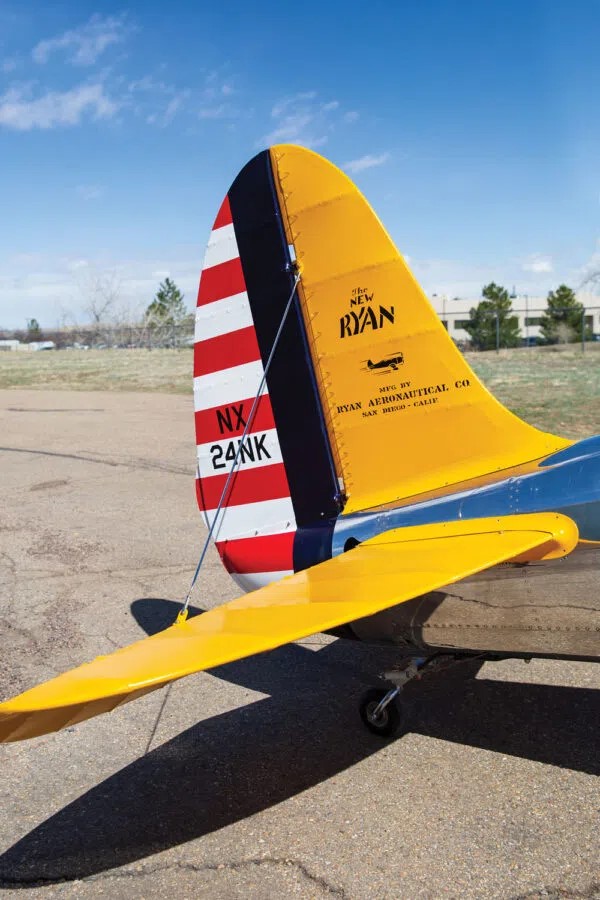
Because the ST-L was specifically designed to look as much like a real ST as possible, small details can make a big difference. Giving the illusion that a Menasco Pirate engine is lurking under the cowl is a four-pipe exhaust stack, although only two of the pipes actually do the job. Looking at the landing gear fairings, you can’t help but notice the mock rivets that help preserve the appearance of the original spats.
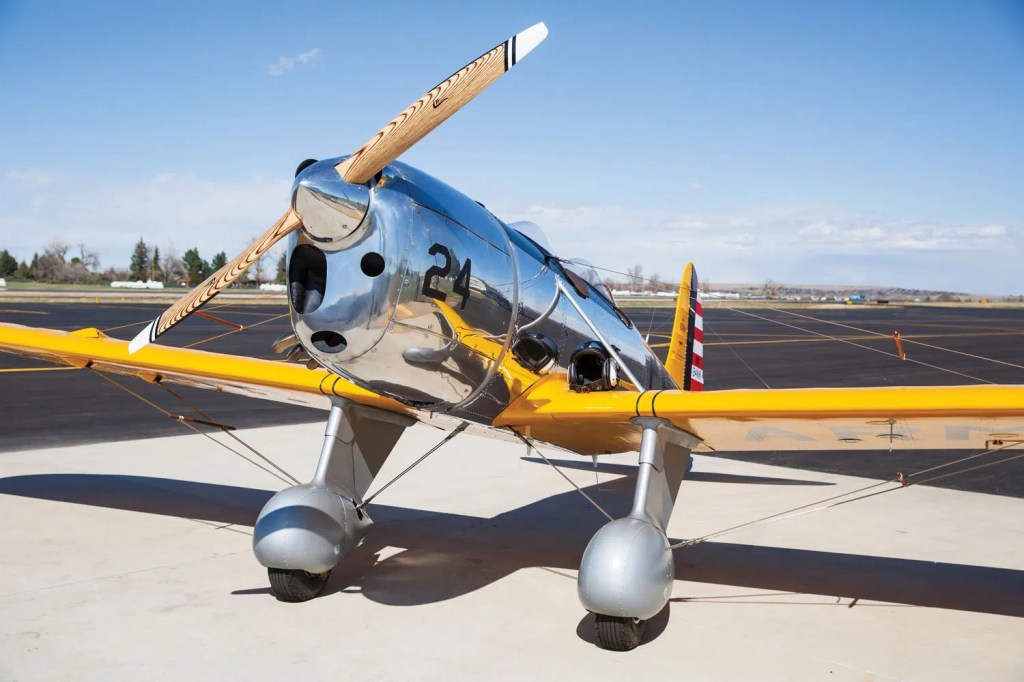
The handcrafted cow is formed by David and Maxwell Wenglarz at Wings Metal Work in San Pierre, Indiana.

At the end of construction, the ST-L came in 200 pounds lighter than the original ST.

The decision was made to go with a 100-hp Rotax 912 ULS, which fit perfectly under the cowl and has performed wonderfully in the prototype.

The ST-L kit is set up to create a natural progression where building one component naturally flows into the next. Starting with fuselage bulkhead Number 2, for example, the steel components are assembled first and everything else is added to this core. Structures and skins are predrilled where possible, but the tapered skins preclude predrilling all of the pieces. The builder will need to make a jig to build the fuselage. However, this is not required with the fully riveted quickbuild option.

Aluminum components are riveted into place using either solid or pulled rivets. For aesthetic reasons solid rivets are encouraged. The tail is composed of ribs attached to tubing, just like the original ST.

The wings can be constructed on a flat table and act as their own jig. Control cables have been replaced by push-pull tubes, and changes to the ST-L structure make wing rigging significantly easier than it was with the original ST. Other wing modifications include the change in airfoil and landing gear geometry, the addition of hydraulic toe brakes, simplification of the landing gear shock absorbers and using wire attachment fittings at the lower landing gear.

The finishing kit includes the handcrafted metal cowl to maintain the lines of the ST, as well as the firewall ring. The wheel pants and fairings for the gear legs, wing roots, stabilizer, rudder, gas cap and windshield are all fiberglass but can be made of aluminum if desired.

Build time is estimated at around 1500 hours for the standard kit, with significant time savings if the quickbuild fuselage option is selected. As of 2021, the estimated average cost to build is $75,000 to $90,000, but the price will vary from plane to plane depending on the engine and other options.

Timber Tiger ST-L
Powerplant: Rotax 912 ULS, 100 hp
Propeller: Performance Propeller, wood
Wingspan: 28.5 ft
Clipped wing option (6G limit): 1160 lb
Maximum gross weight: 1420 lb (1320 lb LSA)
Typical empty weight: 815 lb
Typical useful load: 605 lb (505 lb LSA)
Fuel capacity: 17.2 gal
Full-fuel payload: 502 lb (402 lb LSA)
Cruise speed: 80–113 kt
Climb rate (solo at 8000 ft): 800 fpm
Stall speed: 40 kt
Landing speed: 40–45 kt
Seating capacity: 2
Kit price: $42,700
Estimated completed price: $75,000–$90,000
Estimated build time: 1500 hr
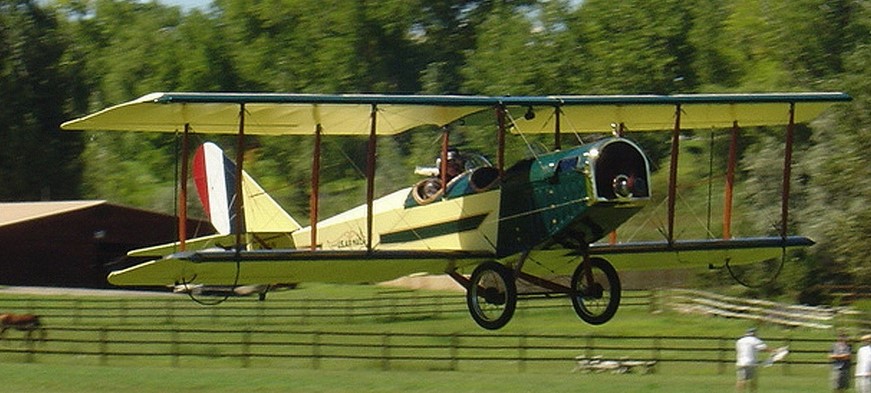
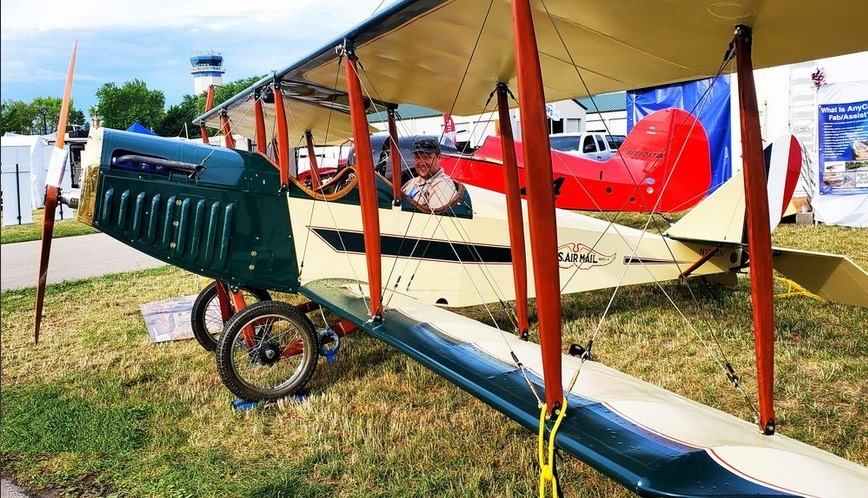
Timber Tiger Aircraft Early Bird Jenny

Timber Tiger Aircraft has made the Curtiss Jenny available to homebuilders. They have purchased the rights to sell Dennis Wiley’s Early Bird Jenny design as a kit, but with a twist. While Wiley’s Early Bird Jenny was a 67% scale replica, the kitted Jenny from Timber Tiger will be 75% scale.

Nick Pfannenstiel, Timber Tiger Aircraft President, said the basic kit is a welded steel fuselage with blueprints for the remainder of the airframe. Recognizing that a growing number of builders wish to do less work, additional kits will be offered to reduce build time and each builder can effectively build their kit à la carte, selecting the add-on kits they want without being forced to purchase items they don’t. “We’re trying to bring back a community of Early Bird Jenny builders. In addition to having a slightly larger fuselage, our kits will have CNC-machined components and improved hardware. To differentiate between the original plans-built version and our kit we are calling ours Gen 2.

Engineering and a structural analysis for the increased gross weight are complete and, while no factory prototype will be built before kits will ship, Pfannenestiel said there are no significant changes necessary to the existing, proven design.

Timber Tiger’s gross weight increase over the Gen 1 means you can now take larger passengers (just make sure you have at least 70 hp), and have dual controls.

The Gen2 has revised lines, with the contours pulled directly from original Curtiss drawings.

Simple aluminum tube spars, pre-stamped ribs, pre-routed wood struts, and more are all available, whether you prefer a more plans-built route (Basic Kit) or a more Deluxe Kit route (just add the options as you see fit).

The fuselage comes pre-welded in even the Basic Kit, meaning you have a massive jump start on your project. If you aren’t much of a welder, Timber Tiger Aircraft can finish all other welding for you, too.

Timber Tiger Aircraft will not support any airplanes built without a serial number from Early Bird Aircraft (Gen 1) or Timber Tiger Aircraft (Gen 2).

Gen2
Engine: 70-100 hp
Wingspan: 30 ft
Length: 20 ft 6 in
Empty weight: 600-700 lb
MAUW: 1200 lb
Cruise: 70 mph
Stall: 35 mph
ROC: up to 1000 fpm

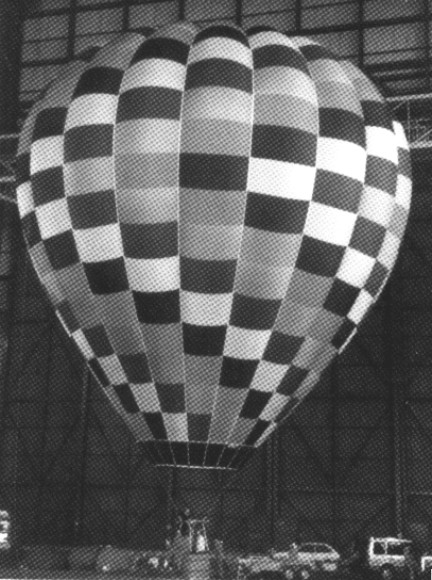
Thunder & Colt AX-8

AX-8-90 Srs.II

All AX8-90 and AX8-105 (S.2) are certified under Federal Aviation Administration USA B2EU

AX8-84

AX8-90
1972
Persons: 5
Diameter: 59 ft
Height: 72 ft
Volume: 90,000 cu.ft
Weight: 700 lb
Payload: 1971 lb
Burner: 16 Million BTU/hr
Fuel capacity: 40 USG
Cost: (1972): US$ 10,293
FAI AX-8

AX8-90
90,000 cu.ft
MAUW: 900 kg
2011 Price: US$26,730

AX-8-90 Srs.II
Capacity: 90,000 cu.ft

AX8-105
1972
Persons: 6
Diameter: 61 ft
Height: 74 ft
Volume: 105,000 cu.ft
Weight: 870 lb
Payload: 2299 lb
Burner: 16 Million BTU/hr
Fuel capacity: 60 USG
Cost: (1972): US$ 11,390
FAI AX-8

AX-8-105
105,000 cu.ft
2011 Price: US$27,635

Thunder & Colt

Colt made a name as a scrappy player in the industry, not to be underestimated. Perhaps because that image so resembled Thunder’s in the ’70s, the two companies merged in 1980. Thunder & Colt continued production of Colt balloons, bringing the marque’s ultimate output to 99 before production ceased.

Later in 1994, Airborne Group Plc (UK), and its various divisions, including Thunder & Colt Ltd., UK were placed into receivership. The hot air ballooning division, Thunder & Colt Ltd. (UK), was purchased in December 1994 by Cameron Balloons Ltd.

In 2011 T&C Balloons US, Inc. offers a complete line of sporting balloons from the one-man cloudhoppers, to the single and dual chariots, right up to the more traditional 77 and 90,000 cubic foot models. For 1995, the sport models were upgraded to include the Classic basket and the new adjustable Stratus double burners. T&C system prices are based on the following equipment: Series I (12-gore) envelope, Classic basket, adjustable double Stratus burners, two 15-gallon stainless steel tanks with jackets and straps and the Ball M55 instrument package. Our envelopes include a Nomex scoop, full Nomex protection in the throat, LongLife fabric in the parachute and top two panels and two paraclear inserts.

In 2011 T&C Balloons US, Inc. offers a complete range of ride balloons unequaled in their quality of construction and passenger comfort. The following sample system prices are based on the following equipment: A-type envelope (24 or 28-gore) with Nomex scoop and full Nomex throat, LongLife fabric in the parachute and top two panels with two paraclear inserts; double adjustable Status burners, two 15-gallon stainless steel tanks with jackets and straps, Ball M55 instruments and Classic T-partition baskets.

In 2011 Thunder & Colt offer a range of four different hot air airships. A standard two person gondola is suspended beneath either a chubby Mark 2 envelope or a slim line GD envelope. Each envelope design comes in a choice of sizes and has its own unique properties.

All T&C systems include your choice of color patterns, any full panel-any color at no extra charge. Other standard equipment includes a fire extinguisher, accessory bag and two strikers. Improvements to balloon and airship equipment are being made all the time.

Cloudhoppers are non-registered ultralight aircraft. Chariots and hot air airships are not US type-certified, but may be flown on British registration, as is the case with special shapes.

Thunder & Colt was bought by Cameron Balloons in 1995. At that time, the T&C factory in Shropshire was not profitable and production was moved to the Cameron factory in Bristol. T&C now operates as a separate division with its own sales and engineering staff, promotion, and model range. Despite the change in ownership, Thunder & Colt continues to lead a separate existence as an independent balloon manufacturer and has kept producing some of the finest hot air vehicles on the market.

Thunder & Colt was the first company to build a pressurized Hot Air Airship. From the very beginning their designs were well thought out. The four designs currently available are the AS-105 Mk II (105,000 cu. ft.), AS-120 Mk II (120,000 cu. ft.) and the AS-80 GD and AS-105 GD which were developed by GEFA-FLUG in Germany. (“GD” stands for “German Design”.) Thunder & Colt also developed the largest hot air airship in the world, the AS-261, to drop an observation platform in the canopy of tropical rainforests. In 1993 the ship was fitted with a larger replacement envelope manufactured by Lindstrand Balloons and has since been known as the AS-300. The main advantage of Thunder & Colt’s airship line is that all models feature internal catenary curtains for load suspension like real helium airships. This improves the aerodynamic shape and stability of the envelope.

At the 1996 Hot Air Airship World Championships in Aosta, Italy, the first three places were won by Thunder & Colt airships with the fourth place being held by a GEFA-FLUG AS 80 GD which features a standard T&C gondola and is also built at the T&C factory in Bristol, England.

T&C also produced the GA-42 non-rigid helium airship which was capable of carrying two people and featured state of the art fly by wire controls. The rights to the GA-42 design were acquired by the American Blimp Corporation when T&C was acquired by Cameron in 1995.

Thrush Aircraft Inc

Thrush Aircraft, Inc. acquired the production rights for the Ayres product line in June 2003. The headquarters and production facility are located in Albany, Georgia, with a 227,000 square foot office/manufacturing complex. The factory is equipped with a full complement of machinery including water jet, laser cutter, CNC brake, CNC machining centers, turning centers, roll form, hydro form, punch presses, heat treat, age, chemical treat processing, and much more.

Thrush Aircraft operate under the FAA-approved Production Certificate 5S0 and meet Mil-I-45208 inspection system requirements, Mil-Q-9858A quality system requirements and Mil-Standard-45662 calibration system requirements.

A number of aircraft projects have been produced under contract at the Albany facility, including the Myers 200, Lark Darter, CalAir A9 and A9B, Rockwell 112, and all Thrush aircraft since 1970. Subcontracts have been for several aerospace companies including the FedEx cargo conversion kit for Boeing 727, Lockheed aft quarter panels for the P3 Orion program, helicopter fuselages for the MD500, MD520, and MD600, British Aerospace 146 cargo door details, Aeronautical Engineers cargo door tooling and details for the 727 and 737, Pats, Inc. fuel tank inspection covers for Boeing, formed parts for Aeronca and Commander, and the design, tool development, and manufacture of kits for the OV10 for Dyncorp. The prior operations have also produced detail parts and tooling for Boeing to support the 727, 737, 747, 757, and 767 production lines.

The Albany Repair Station/Service Center was also responsible for the engineering, tooling development, parts manufacture, and installation of Stage 3 hush kits for the DC9, 727 and 737 aircraft. This program was performed for Airborne, US Air, TWA, Northwest, Southwest, Midwest, Canadian Air, Scandinavian, Value Jet/Air Tran, Federal Express, and Air France.

Thrush Aircraft has exclusively teamed with General Electric to produce the Thrush 510G powered by the GE H80 turbine engine. The H80 provides increased temperature margins to enhance hot-day takeoff performance and high-altitude cruise speeds. GE chose Thrush to launch this new engine.
Thrush Aircraft announced on October 10, 2012, that the Federal AviationAdministration had issued Type Certification for the new Thrush 510G. The 510G features the new GE H80 turboprop engine – a first for general aviation.

Certification marks the culmination of more than two years work by both Thrush and GE Aviation in concert with the FAA’s regional office in Atlanta. Final certification work for the dual cockpit version of the 510G was to get underway shortly after.

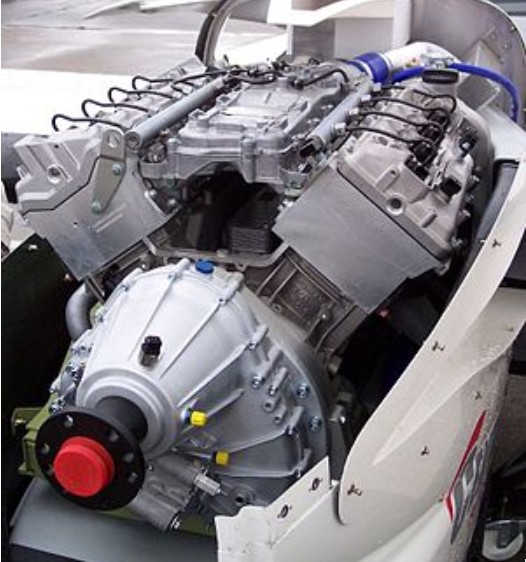
Thielert Centurion 4.0

Thielert Centurion 4.0

The Thielert Centurion is a series of Diesel cycle aircraft engines for general aviation built by Thielert. They are based on heavily modified Mercedes-Benz automotive engines.

All Centurion engines are water-cooled, turbocharged and employ a single-lever digital engine management system (FADEC). This simplifies engine management for the pilot, as well as improving reliability, as it prevents the engine being operated improperly. The series utilizes either jet fuel or diesel fuel. The high compression ratio of the engine combined with the digitally controlled fuel injection system mirrors similar advances in automotive technology.

Centurion series engines are always fitted with constant speed propellers driven through a reduction gearbox. The constant speed propeller and reduction gear result in a propeller tip speed that is 10-15% lower than comparable conventional avgas engines, reducing propeller noise.

The Diesel engine’s high compression results in better fuel efficiency and the higher operating rpm of the Centurion allows higher power to be developed from a smaller displacement, in comparison to conventional aircraft piston engines.

A Centurion engine complete with CSU, reduction gearbox, turbocharger and FADEC engine management system is considerably heavier than the more conventional Continental and Lycoming engines with which it competes, but this weight disadvantage is compensated for by the Centurion’s lower fuel consumption. Even though it lacks the magnetos and spark plugs of the conventional piston engines, the Centurion engines are considerably more complex.

The Centurion 4.0 was designed as a larger engine to replace the 300 hp (224 kW) gasoline engines, this new V8 design produces 350 hp (261 kW) and was developed from the Mercedes-Benz OM629 automobile engine. Initially equipped with two turbochargers, later changed to a larger single turbocharger. Certified only for Jet A & A1. After the insolvency of Thielert in April 2008 all work on the Centurion 4.0 was frozen.

Applications:
Cirrus SR-22 (STC)
Cessna 206 (STC)