U-Turn Flat Top

The Flat Top paramotor fixed has an incredibly strong and well designed cage & frame. Not a single cage strike has ever occurred with a Flat Top. The cage can’t be flexed into the prop unless you fold it in half with a major crash.
The Flat Top paramotor has also set the world records for speed, distance and altitude. 18,182 ft without assistance from thermals, 280 miles on only 3.5 gallons of gas and a cruise speed of 50 mph.

Flat Top 160 (Simonini Mini 4) Price 2009: US$6,900.00
Flat Top 200 (Simonini Mini 2 plus) Price 2009: US$6,900.00

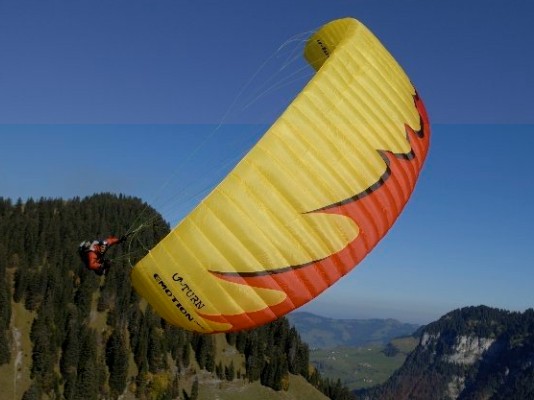
U-Turn Emotion

This DHV-1 canopy not only provides lots of fun in the air, but also much, much passive safety due to the AFS-system.

The aspect ratio of the Emotion has been slightly reduced in comparison to the Bodyguard, the reference model among the safest category 1 paragliders. Nevertheless constructor Ernst Strobl has decreased the curvature at the wing ends. The Emotion gains agility and improved handling reaction because of this. The AFS system provides the safety and security: The Automatic Flight Stabilization influences all cells and prevents in the majority of all cases unpleasant asymmetric deflations already during their initial phase.

The Emotion is delivered from the factory with a conventional harness. The Emotion can be made available optionally with the divided riser system. With this the Emotion can perform the B-stall safely, that is sinking at a rate of around 5m/s while still being fully manoeuverable with a glide ratio of 1:3,5. This for example makes it easier for inexperienced pilots to land on small landing areas which is more difficult to manage when the maximum gliding ratio has to be used without the B-stall technique. In any case the Emotion is very suitable for instruction purposes with both harness systems.

Another feature available for the Emotion is the MYLAR-FIX-system, the unique folding system to protect the sensitive leading edges and air intakes.

The Emotion was available in four colors and in the sizes XS (55 80kg), S (70 – 90kg), M (85 – 110kg) and L (100 -130kg).

Price 2009: US$3,500.00

U-Turn Obsession

The Obsession paraglider is from designer Ernst Strobl, with an aspect ratio of 5.55. The DHV 1-2 Obsession has the automatic flight stabilization system (AFS). The dynamic basic design of the glider canopy allows room for an increase in the AFS effectivity without the danger of losing enjoyment or performance potential. The wing area upon which the AFS system is effective has been increased by 20% in comparison to the Infinity II. This increase in the effectivity and further enhanced stability in turbulent conditions is successfully realized without degrading the fine tuned reactivity of the system.
Price 2009: US$3,700.00

The Obsession is situated between DHV 1-2 and DHV 2. It defines the cross-over point between maximum performance and the security level of DHV 1-2. The fantastic glide ratio, available even at full speed, is one of the significant properties of the glider. The obsession possesses the typical U-Turn long accelerator travel for exact control and high final speed. In addition the agility and manoeverability are second to none. All of the know-how from the development of the Acro-reference G-Force 360 has been applied to the very dynamic and direct handling of the Obsession. Very flat yet confined thermalling is the gliders trademark and the Obsession’s turning sink rate is extremely low.

The Obsession has a large number of upper cascade lines. The upper cascades are 40cm long, extremely thin 0.6mm Liros lines. This causes a better distribution of the forces across the paraglider canopy and a reduction of the single force per line and connection point. Ernst Stroble explains, “This higher count of topmost lines costs some slight performance reduction because of their air resistance, nevertheless by their employment I was able to construct the wing to have significantly higher performance with the same good resistance to collapse, so that these losses are more than overcompensated. Because of this design feature the OBSESSION is particularly resistant to collapses. Should a dangerous situation arise and the large secure performance region be exceeded then the canopy will give a corresponding feedback beforehand.

Strobl decided to use the glider fabric for the series production which had been tested so convincingly during the Trans Speed Europe by Mad Mike Küng at highest stress rates. It was clear after exhausting tests with several prototypes of different sizes: “An even lighter material did not show improvements neither during start, flying or landing” Strobl says. The selected material from Porcher Marine offers superior UV-resistance and overall mechanical stress resistance. In order to ensure the longevity of the paraglider and its second-hand value, not to mention the easy start behaviour, the Obsession also has the Mylar Fix System, which is implemented in the Infnity II and which has been universally applauded. Any unwanted creasing of the leading edges is prevented with a fixing loop system the paraglider stays in form and keeps within the original performance criteria.

The Obsession is not intended for beginners and it is not suitable for learning/beginners training purposes.

The Obsession was available in the sizes S (65-90 kg to be confirmed during the DHV-tests that are scheduled in the next weeks), M (80-110 kg) and L (100-130 kg). The characteristic U-Turn motif has been restyled and this gives the paraglider a very sporty, dynamic appearance.

US Aircraft A-67 Dragon

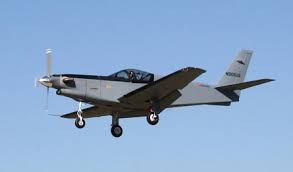
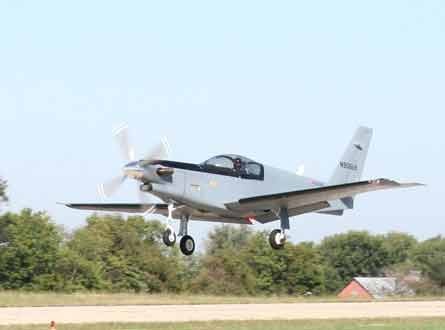
Start-up US Aircraft changed direction in its plans to develop a low-cost counter-insurgency aircraft for use in Afghanistan, Iraq and elsewhere. After funding design of the A-67 Dragon by US warbird restoration specialist Golden Aviation, it began working with Brazil’s Geometra on an aircraft based on a design by Josef Kovacs, former chief designer of Embraer’s EMB-312 Tucano trainer.

The original A-67 made its only flight in October 2006 in Missouri. The aircraft flew from Cassville, Missouri to Golden’s base at Monett Municipal Airport, ending with a landing gear collapse.

The Ohio-based company planed to base its A-67 on a scaled-up version of Kovacs’ K52, a general-aviation aircraft strongly resembling the Tucano, after testing a Brazilian-built prototype. US Aircraft planned to combine features from both designs, but where the original A-67 had side-by-side seating, the new design uses a tandem set-up.

Powered by a 1,250shp (930kW) Pratt & Whitney Canada PT6A-68 turboprop, the 4,620kg (10,200lb) gross-weight A-67 has an estimated maximum cruise speed of 381kt (706km/h) at 20,000ft (6,100m). Endurance will be 10h and external payload 1,620kg.

A subsidiary of US Technology, which produces the plastic media used for stripping paint from aircraft, US Aircraft was funding design work on the A-67, but sought private investors to complete development and begin production.

A-67 prototype
Engine: 1 × Pratt & Whitney PT6A-67 turboprop, 1,250 shp (930kW)
Prop: four-blade
Wingspan: 38 ft (11.6 m)
Wing area: 211 ft² (19.6 m²)
Empty weight: 4,800 lb (2,200 kg)
Max. takeoff weight: 10,200 lb (4,640 kg)
Maximum speed: 371 knots (427 mph, 687 km/h) at 20,000 ft
Range: 1,880 mi (3,008 km)
Service ceiling: 35,000 ft (11,000 m)
Rate of climb: 4,882 ft/min (1,488 m/min)
Wing loading: 35.1 lb/sq ft
Crew: 2

Urban Air UFM-10 Samba / Distar Air UFM-10 Samba

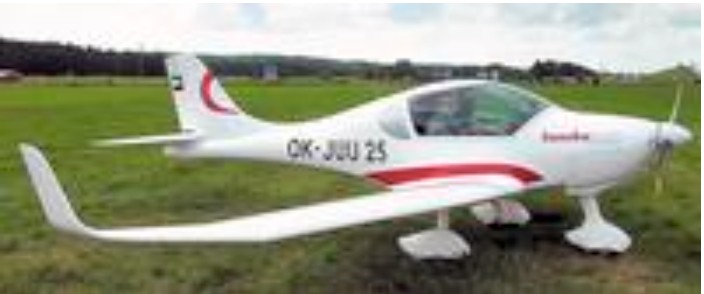
The Samba XXL is based on successful plane UFM-10 Samba. Excellent flight characteristics were preserved while the space for pilots was extended. That is why Samba XXL is ideal for travelling, training and towing sail planes.
SAMBA XXL – brief technical description:
The ultra-light plane Samba XXL is a double-seat, single-engine, self-carrying low-wing aeroplane with crew members sitting one next to each other. It is all-composite. The fuselage is made mainly of carbon laminate with local sandwich construction. The wing is of sandwich construction while the flanges are of carbon rowing.
The wing is equipped with a lifting flap with a slot. Positions of electrically adjustable flaps are 20° for take-off and 45° for land. The tail surfaces are of classic layout. The carriage is three-wheel with controlled front wheel and braked main wheels.
The main carriage legs consist of a laminate spring. Integrated fuel tanks (2 x 50 litres) are located in the wing leading edge.
The plane may be equipped with a towing device for sail planes towing with maximal climbing weight of 650 kg.
The Samba XXL may be equipped with removable wing extensions. 2009 Price: 50000 EURO

Samba XXL

Samba XXL
Stall: 35 kt / 40 mph / 65 kmh
Cruise: 119 kt / 137 mph / 220 kmh
VNE: 146 kt / 168 mph / 270 kmh
Empty Weight: 265 kg / 584 lbs
MTOW Weight: 472 kg / 1041 lbs
Climb Ratio: 1400 ft/min / 7,5 m/s
Glide Ratio: 1:18
Take-off distance (50ft obstacle): 490 ft / 150 m
Landing distance (50ft obstacle): 660 ft / 200 m

UP Ultralight Products / UP Europe / UP Delta

UP Ultralight Products
4054 W – 2825 N
Mountain Green UT, 84050
USA

Pasadena California, 1970. Pete Brock finishes his studies at the Art Center, a world-renowned school of industrial design, as its youngest graduate ever. Brock soon discovers a new passion: hang gliding- probably the most radical sport imaginable in the early 70s. While there are several glider models on the market there is only one common theme – they are all extremely dangerous. This also holds true for Pete’s first design, the Brock Redtail.

However, when Pete Brock gets together with the young designer Roy Haggard, a new concept is born. The Dragonfly is the first tenable post-Rogallo glider and becomes the flagship of their newly founded company, Ultralight Products. A series of successful designs follow, including the Condor with its world record duration flight of 16 hours, 4 minutes in 1979.

Helping the company gain success quickly is Pete Brock’s logo design. The UP arrow achieves cult status from the beginning and for many pilots characterises the spirit of hang gliding and later paragliding. The logo and the brand’s positive image attract the interest of various investors over the company’s three-decade history. The first is in 1980, when Yuseke Yamazaki, a Japanese investor, lays the foundation for UP’s success in Asia.

The year 1980 also marks the introduction of Roy Haggard’s pioneering development, the UP Comet. The Comet’s outrigger-free construction concept was revolutionary. Jim Lee sets the world distance record at 268 km with a Comet in 1981, and eventually the UP Comet becomes one of the biggest-selling hang gliders of all time. Success breeds followers, and the Comet is a natural target for copying. In 1982 Airwave, UP’s representative in Europe, produces the Magic, which is nothing more than a modified Comet.

In the mid-80s Pete Brock and Roy Haggard retire from the everyday business. Ownership and location of the firm change in the following years. Through the continued influence of Yuseke Yamazaki, UP becomes UP International, a wholly owned subsidiary of a Japanese parent company, Isomura, Inc. Encouraged by the success of the hang gliding business, Isomura diversifies the UP brand into windsurfing, UL-flying and fashion. In Japan one can find the UP arrow on the UP-Sports clothing line, and on T-shirts, jackets and socks. Even today at Venice Beach in Los Angeles one can find rollerbladers leaning against the UP arrow logo as they take breaks on park benches donated by the local UP surf shop in the mid-80s.

The TRX, the first production series hang glider with carbon tube elements, is developed at the UP Soaring Center in Salt Lake City under the guidance of UP’s new designer, Terry Reynolds. Despite various technical innovations, the TRX remains the last successful UP hang glider for some time.

Though UP is a latecomer to paragliding, the company hits the mark in 1990 with the relatively unknown Korean designer Gin Seok Song. The Flash, developed by Gin in the U.S. together with test pilot Greg Smith, is revolutionary. The Flash is the first paraglider with a perfectly smooth leading edge and has more performance than anything else on the market. The glider dominates in competition and becomes a bestseller. Yet the Flash remains Gin’s only design for UP since he is coaxed to another paragliding newcomer, Edel, with a lucrative offer.

At this time, Claus Bichlmeier is UP’s importer for the German-speaking markets.
Global Expansion from Germany

UP Europe
Ultralight Products Europe
1998: Altjoch 19 A, D-8243 kochel am See, GERMANY
By 1998 UP Delta had bought out aircraft manufacturer Thalhofer.

In 1992 Ernst Schneider establishes UP Europe in Sindelsdorf near Garmisch and all development and testing is carried out in Europe. Designer Rasso von Schlichtegroll, later co-founder of freeX, develops best-selling gliders like the Katana, the Vision and the tandem Pickup. Chief Test Pilot Ernst Strobl crowns his competition career in 1992 by winning the European Championship.

That same year Uli Wiesmeier wins the first Paragliding World Cup series on a Katana. In addition to his involvement in competition, Uli is responsible for UP’s public image. Uli’s advertising work, his eye for style in developing the Skywear line of clothing and his award-winning creativity in filmmaking all contribute greatly to ensuring that the UP thrives in paragliding. French UP pilot Richard Gallon wins the 1994 PWC. In 1995 the new World Champion Stephan Stiegler and top pilots like Peter Hensold, the Italian cross-country ace Eduard Taschler and Sebastian “Rambo” Bourquin become members of the UP team.

Motivated by UP’s success in paragliding, Ernst Schneider establishes a hang gliding department under the auspices of UP Europe. The original Salt Lake development team at the Soaring Center starts a separate company that eventually leads to the formation of Altair under the leadership of Dick Chainey and John Heiney. Bernd Weber, the manager of Thalhofer and co-founder of the rigid wing manufacturer A.I.R. takes charge of UP’s new hang gliding line. The Speed, UP’s first hang glider in nearly five years, is introduced in 1995, and the topless version, the Speed TL follows in 1997.

UP Europe Delta
1998: Salzstrasse 6, D-72589 Römerstein, GERMANY
In 1998 UP Europe was manufacturing the wings for the rigid wing Pegasus of Jurgen Lutz, having bought out aircraft manufacturer Thalhofer.

Ernst Schneider sells UP Europe, and the buyer is once again from Japan. The profitable entertainment group Daiichi Kosho is seeking to diversify from the Karaoke industry and is looking to the flying industry for an additional profit center. With the continually developed paragliders from Europe and their own paragliding schools domestically, “DK” quickly enjoys market leadership in Japan.

The Japanese invest substantially in UP Europe, where the workforce and the competition team are expanded. In 1997 half of the German League is flying UP’s new performance glider, the Escape. During this time, UP Europe relocates to offices north of Garmisch in Kochel am See, where up to 20 employees are working.

By this time, the paragliding boom is subsiding and high quality designs like those of the Escape, the Soul, and the Blues do not attain the market successes of their predecessors.

Daiichi Kosho and UP part ways in 1999. At the same time, Bernd Weber gives up the hang gliding part of the business. Of the several parties interested in the remaining paragliding business with the exceptional UP brand, the successful bidder is the Swede Christian Rönning. Flying since 1988, Christian is one of the pioneering paraglider pilots in Sweden. He also brings with him a wealth of experience gained as a management consultant to multinational firms in Asia.

At the end of 1999 Christian Rönning began UP anew with a substantially reduced, yet highly experienced staff at his side. Torsten Siegel, Georg Maier and former World Champion Stephan Stiegler were responsible for product development, and it was upon their know-how that the first UP Europe product line was based. A new era for UP was firmly established when in just one year UP progressed from the old designs to a whole new glider range including the Pulse, the Makalu, the Summit, the Gambit, the Sherpa, and the Gambit C. UP’s R&D department has since adopted a roughly three-year cycle for the renewal of gliders, which led to a number of even more succesful designs being launched, not least the World Champion 2003 winner called the Targa, the Serial Class reference wing for almost 4 years called the Trango, and later the successor to these, the Targa 2 which won the World Cup in 2004. Torsten Siegel eventually decided to pursue his career goals with Swing, and some time later Stephan Stieglair departed to form his own new brand called Air Design.

Since 2010 the new design team, which picks up the baton from the Stieglair/Siegel years, is headed by Czech industry old-timer Frantisek “Franta” Pavlousek and supported by both new faces and experienced people. In the former category not least German aerospace engineer Matthias Hartmann, who is a passionate hobby paraglider pilot, and Czech young test pilots Michal “Snajby” Sneiberg and Jirik “Jirka” Dlask, and in the latter category German lightweight guru Stefan “Boxi” Bocks.

University of Toronto UTAIS Ornithopter No.1

The UTAIS Ornithopter No.1, which “flew” in 2006 was designed by the University of Toronto. The light No.1 used a small motor to power its flapping wings. Realizing that a motor wasn’t enough to flap it off the ground, the designers also fitted the airplane with a jet engine booster to launch it into the air. The University claimed that most of the thrust was coming from the wings.

When the No.1 did its first test flight, it jumped off the runway for 14 seconds after the jet booster activated, traveled awkwardly for a third of a kilometer, nosed down, and crashed. The University claimed the test was a success.

Ultramagic sa / Ultramagic Balloons

Starting balloon flying in 1978 with a used balloon, after this they designed and built a much bigger balloon for an expedition to Africa. This trip in 1980, lasting 11 months, involved 40 flights and was from Zanzibar (Tanzania) to Kisiangani (Zaire). After this trip they started designing and building an Ultralight aircraft and created Ultramagic S.A. However during the Ultralight period, news had spread about the building of a balloon for the Africa adventure and more and more people started asking if they could build one for them. They had the experience of building balloons still had the sewing machines and had the Aeronautical organisation, so for strategic reasons, Ultramagic Ultralights became Ultramagic Balloons. This was the beginning and they have now built hundreds of balloons including many special shapes.

The annual production has now increased to between 80 and 100 balloons with approximately 80% being for export. Exporting to every part of the world including Japan, North America, South America, Europe and of course where it all began, Africa. In 1993 Ultramagic Balloons started a division for cold air inflatables which quickly became successful with over 4000 built. The annual production of inflatables is averaging over 500.

2012: Ultramagic, SA: Aeròdrom Gral. Vives, Apt. 171 – 08700 Igualada, Barcelona, Spain