Aero G800 / Gobosh G800 

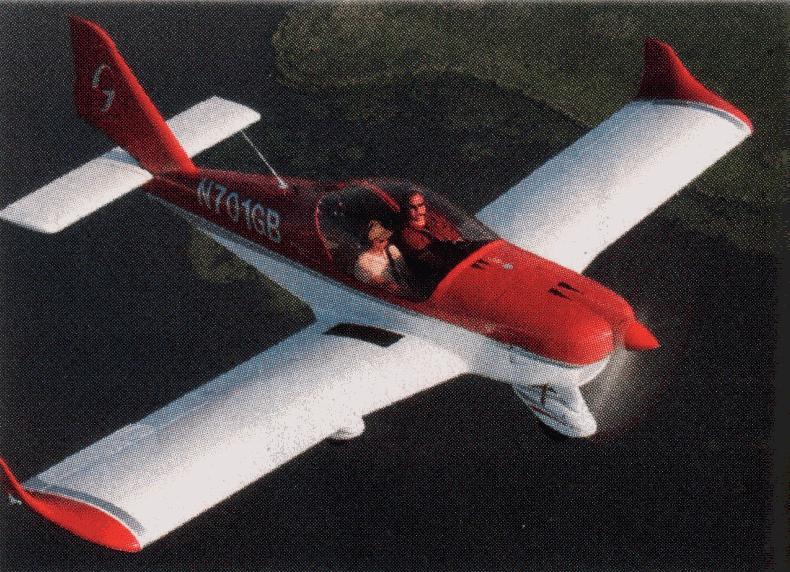
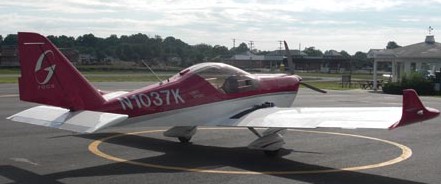
The Gobosh G800XP two seat composite aircraft.

GOBOSH 800XP
Engine: Rotax 912, 100 hp
TBO: 1500 hr
Propeller: Elprop 3-blade, fixed-pitch, composite
Prop Diameter: 68 in
Fuselage Length: 20ft 4 in
Cabin Width: 42 in
Empty Weight: 760 lbs
Gross weight: 1320 lb
Useful load: 560 lb
Payload full fuel: 386 lb
Useable Fuel: 29 USG
Max Range: 730 nm
Cabin width: 45 in
Max cruise: 119 kt
Best rate of climb, SL: 850 fpm
Service ceiling: 13,200 ft
Take-off Dist: 520 ft
Landing Dist: 550 ft
Take-off Dist 50ft: 1,050 ft
Landing Dist 50ft: 1,100 ft
Vso (kts.): 35 kt
Vs1: 45 kts
Best Rate of Climb [Vy]: 65 kts
Maneuvering Speed [Va]: 88 kts
Normal Operating Speed [Vno]: 110 kts
Never Exceed Speed [Vne]: 145 kts
New price 2009: $135,900

Aero G700 / AT-4 / Gobosh G700

G700S

The G700 is an Americanised version of Aero designer Tomasz Antoniewski’s certified AT-3.
To qualify the all-metal Gobosh G700S as an LSA, the wingspan was increased and among other things for the US market, the addition of winglets.
Even the least expensive model, the Sport Edition, includes the standard six instruments, Garmin GPS and transponder, wheelpants and leather seats. They all feature dual controls and mechanically operated split flaps.

The former Gobosh G700 lives on as the Aero AT-4, distributed by Aero AT USA of New Hampshire, in 2012. The AT-4 is made in Poland by Aero Ltd., the all-metal LSA derives from the AT-3, which was certified at a higher gross weight. AT-4 base price 2012: $105,550.

Aero AT-4

Gobosh G700S
Engine: Rotax 912S, 100 hp
TBO: 1500 hr
Prop: Elprop 3 blade composite
Cabin width: 41 in
Fuel cap: 18.5 USG
Full fuel payload: 390 lb
LSA MTOW: 1320 lb
Empty wt: 820 lb
Useful load, std: 500 lb
Max cruise speed: 116 kt
Vso: 39 kt
Best rate of climb, SL: 850 fpm
Takeoff ground roll: 380 ft
Landing ground roll: 686 ft
Base price 2009: US$106,950 to $123,900

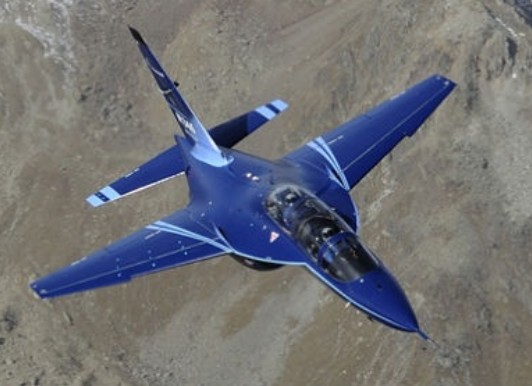
Aermacchi M-345

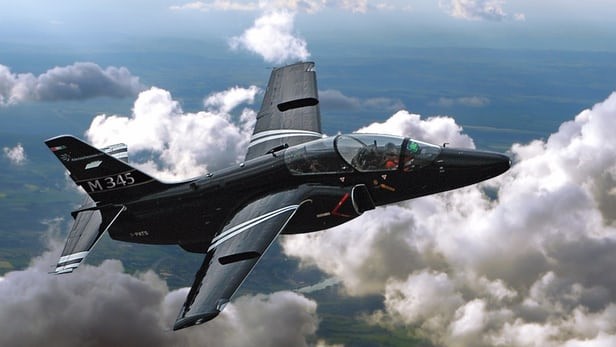
Italian aerospace company Leonardo’s military trainer aircraft, the M-345 was intended for the international market as both a trainer and an operational aircraft, and is designed for low price, and also low maintenance and operational costs. This is due in part to the airplane’s advanced avionics that includes the Health and Usage Monitoring System (HUMS), which monitors the state of the aircraft and reduces the need of general overhauls.

The M-345 also has an avionics suite that the company says is up to combat jet standards and includes Hands On Throttle And Stick (HOTAS) controls, Head up Display (HUD), and real-time Multi-Function Displays (MFD). The aircraft has pressure refuelling systems and an On-Board Oxygen Generation System (OBOGS) for greater efficiency and less need for ground crews.

On 29 December 2016, the prototype M-345HET (High Efficiency Trainer) tandem-seat basic jet trainer took to the skies over the Venegono Superiore airfield in Varese, Italy, under the command of test pilots Quirino Bucci and Giacomo Iannelli. According to the company, the 30-minute flight went off without incident.

Engine: 1 x Williams FJ44-4M-34 turbofan, 1,540 kg / 3,450 lb thrust
Wingspan: 8.47 m / 27.78 ft
Weight: 3,300 kg / 7,275 lb
Cruising speed: 400 kt / 460 mph / 740 km/h
Service ceiling: 40,000 ft / 12,000 m
Ferry range: 760 nm / 824 mi / 1,410 km

Aermacchi M-346 / Leonardo M-346 / Beechcraft M-346

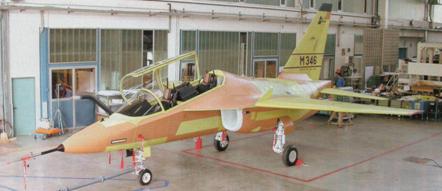
Powered by two 7,0001b thrust Honeywell F124 turbofans, the fly by wire M 346 advanced jet trainer was launched in January 2000 following cessation of the joint Italian/Russian Yak 130 technology development programme which ran from April 1996 to December 1999, accumulating some 300hr flying.
The prototype M-346 first flew in July 2004.

Textron will offer a US-made version of the Italian light jet under the designation Beechcraft M-346N.

In 2025 Textron Aviation Defense started a nationwide demonstration tour to promote its Beechcraft M-346N advanced jet trainer for the U.S. Navy. The M-346N took off from Beech Factory Airport in Wichita, Kansas, where it was assembled. The aircraft is part of a broader integrated training system originally developed by Leonardo and adapted for U.S. Navy needs by Textron under the Beechcraft name.

Assembled in the United States by Beechcraft, the M-346N is a tandem-seat, twin-engine jet equipped with digital flight controls, advanced avionics, and a modern cockpit layout. Features include a quadruple-redundant fly-by-wire system, Head-Up Displays (HUD), Large Area Displays (LAD), and hands-on throttle and stick controls in both cockpits. It also incorporates safety systems such as Automatic Ground Collision Avoidance (Auto-GCAS).

Powered by two Honeywell F124-GA-200 turbofan engines, the M-346N has a maximum cruise speed of over 590 knots and a service ceiling of 45,000 feet. Its features an elevated rear cockpit provides instructors with a clear field of view.

Textron says more than 100 M-346 aircraft built by Leonardo are already in service worldwide, logging over 150,000 flight hours by 2025. These numbers reflect a platform that has been tested and adopted by air forces in at least 20 countries.

Gallery

Engine: 2 x ITEC F124-GA-200, 6250 lb.
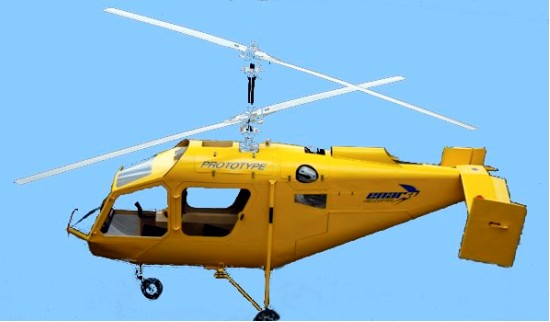
Aeris Naviter AN-2

A two seater, piston engine helicopter with a fully articulated coaxial rotor system. First introduced on 1/1/2011, the price (2012) was US$130000.

Engine: Lycoming IO 233 LSA, 115 hp
Rotor Diameter: 22.9 ft
Number of rotor blades: 4
Number of tail rotor blades: 0
Length: 17.3 ft
Height: 11.3 ft
Fuselage width: 2.6 ft
Gross Weight: 1320 lb
Empty Weight: 860 lb
Useful Load : 460 lb
Max. Range: 466 mi
Cruise Speed: 93 mph
Maximum Speed: 105 mph
Service Ceiling: 15000 ft
Seats: 2

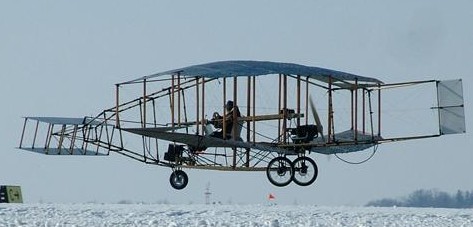
Aerial Experiment Association 2005 Welland Silver Dart Replica

The team began worked on the construction of the Silver Dart in July 2004.
The replica’s maiden flight was on February 22, 2009 in Baddeck, Nova Scotia, the location of the original plane’s inaugural flight in 1909.
The Welland Silver Dart replica – C-IIGY – drew hundreds of admirers on Saturday and Sunday, June 6 and 7 at the Russell Aviation Group’s Friendly Foes Above the Falls 2009 annual air show at Niagara Falls South Airport.

Aerial Experiment Association 2005 Inc

The Aerial Experiment Association 2005 Inc. is a not-for-profit Ontario corporation established in August 2005 in the Niagara region of Canada. It is made up of a small group of about 25 volunteers who have dedicated themselves to building and flying a replica of Canada’s first airplane, the Silver Dart. This is a very important Canadian heritage project that will form the centerpiece of a series of events celebrating the centennial of the Silver Dart’s first flight in Canada. This historic event took place on the frozen surface of Baddeck Bay near Baddeck, Nova Scotia on February 23rd 1909.

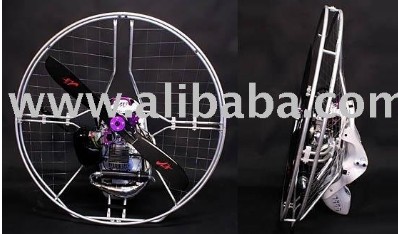
Adventure S4

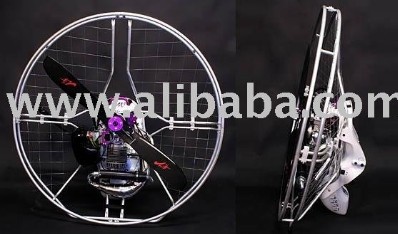
The Adventure S4 Paramotor features a Simonini 202cc Engine that has been tuned to produce 27HP. The yellow fiberglass body and integrated fuel tank paramotor can be foot-launched or attach it to the Wheely Trike for trike launching.
FOB Price 2010: US $2,565 – 2,700 / 2009

Adventure M3

Paramotor
FOB Price 2010: US $1,875 – 1,945

Specifications

The M3 is a foot launch Paramotor.

Feature and specification:

Tuned Exhaust
Hobbs meter on the hand throttle (hour meter for your engine)
Tachometer on the hand throttle
Contour fiberglass body that incorporates your motor and fuel tank in one location
PPG harness with 4 different adjustment points for torque and comfort
Electronic ignition and electric start are standard on all Adventure PPG’s–not an upgrade
Left handed throttle assembly to keep your dominate hand free
Tuned carb intake silencer
Preflight checklist on the battery compartment
Mirror in the harness for checking fuel level
No tools required for assembly (except the prop)
Wood Prop
Spare parts kit included

Engine:Tiger 160 cc (mono cylinder, 2 strokes, 22 Hp)
Electric starter : Electronic ignition, electric starter
Propeller : 2 blades, 45 inches, wood or carbon
Max Static Thrust : 138 lbs
Endurance : 2 to 3 hours (2.64 gal tank)
Empty Weight : 44 Lbs
Noise (max) : 52 dB ( at 300 ft)
Pilot weight : 210 lbs (depending on wing type and size)

Advanced Composite Design SUA-7

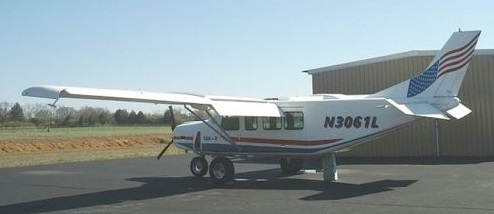
The Advanced Composite SUA-7 (for Sport Utility Aircraft, 7 seats) was designed by Andreas Montgomery and William K. Regester and built in the early 2000s (the company was known as KLS Composites at the time).

The aircraft was mostly made of composite materials and designed to accept automotive V8 engines, such as the GM (Chevrolet) 502 V8 engine that was installed on the prototype N3061L.

Construction started 2001 or 2002 and it was presented at the 2003 EAA Sun`n Fun but not flown. N3061L was actually flown in 2005.

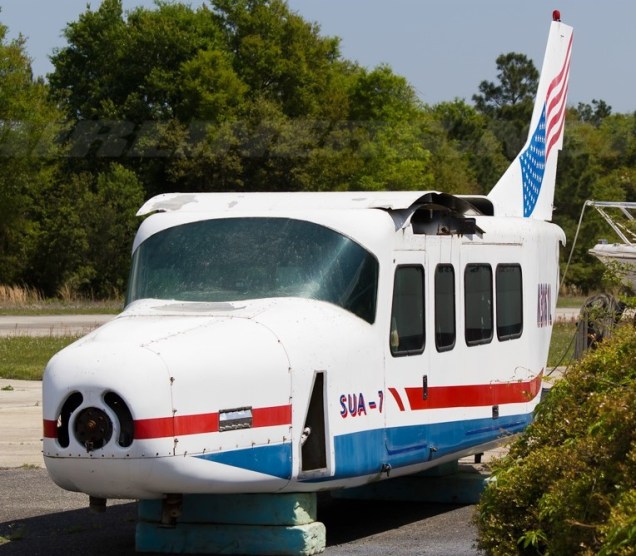
After disappointing performance on its early flight testing, the wings were discovered to be inadequate and a new pair of wings and nose gear was fitted in 2005. The new wings don’t fit tight to the fuselage like they used to. The radiator is in the back, which is the reason for the scoop on top of the fuselage.

On the first day of test flying with the new wings the nose gear got broken, and further improvements were made. From then on, the SUA-7 flew amazingly well, but the money behind the company pulled back and the plane has been sitting on the tarmac since.

Yulee – Nassau, Florida, USA – April 2015

SUA-7
Engine: GM (Chevy) 502 V8
Wingspan: 41ft 4in / later approx. 56ft
Length: 34ft 6in
Height: 13ft 4in
Est. max speed: 198 mph
Cruise: 178 mph
ROC: 1,200ft/minute
Service ceiling: 10,000ft
Seats: 7