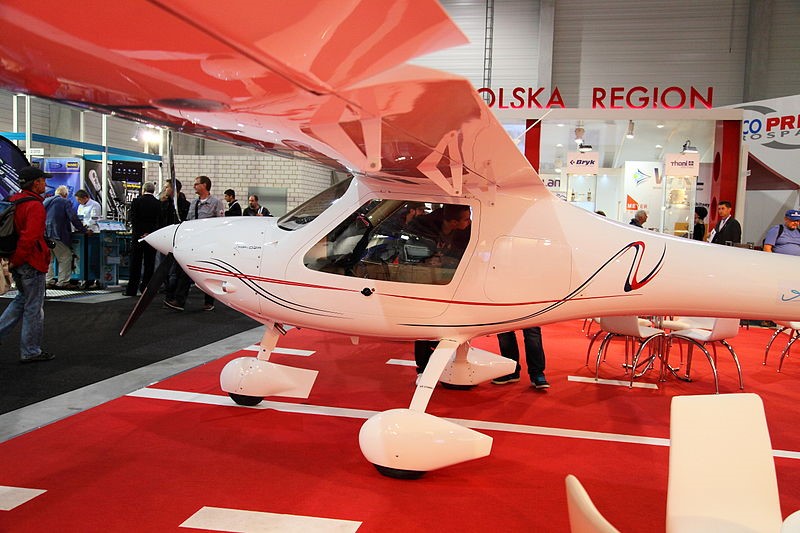
Aerolab LoCamp

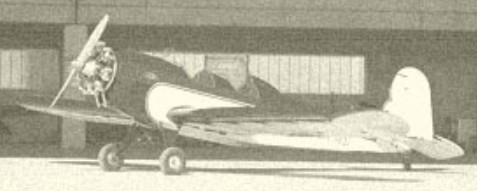
A two seat, low wing, single engine in tractor configuration, the LoCamp and HiCamp models are available as standard 49% kits. Of tandem configuration with individual open cockpits (pilot in the rear seat); central stick controls, rudder pedals and throttles for both seats. Two luggage compartments, both with 44 lb (20 kg) capacity, one in the front and one in the rear.
The untwisted, cantilever main wing features a rectangular planform with rounded tips, 3 degree dihedral from fuselage centerline and classical NACA4416 wing section at full span. The empennage features flat horizontal and vertical tail surfaces.
The wing structure features a classical twin aluminum spar; the spars, the molded wing ribs and flap/aileron components are made from sheets of Al 6082-T6 or 6061-T6. All aluminum parts are CNC machined and protected by Alodine; a further layer of wash primer is applied where the fabric is glued to the structure. LH and RH wings are mated to the fuselage through a center spar; the mating is achieved through conical pins. All the wing, flaps and ailerons are covered by fabric, riveted to the ribs. The fuselage structure features a TIG welded chromium molybdenum steel truss with integral wing fittings, vertical stabilizer, plywood frames and fabric covering. All the steel tubes are internally protected by a MIL-SPEC anti-corrosion treatment that leaves a waxy protective layer over the surface.
Push-pull rods for ailerons and elevator, 3/32in steel cables for rudder control. The aircraft is trimmed by the electrically actuated stabilizer. The wing flaps are electrically actuated as well.
The fixed main gear is on steel struts with rubber shock absorber, hydraulic disc brakes and 6.00 x 6 wheels. The swiveling tail-wheel is connected to the rudder, or it can be disconnected on the ground by removing a quick disconnect pin.
The 14 VDC electrical system is powered by one engine driven alternator/generator and provides power for the flaps, trim, fuel pump and radio rack. The fuel is kept in two internally fitted aluminum tanks (one in each wing root), total capacity 31.6 US gallons (120 lt).
The airframe can be equipped with different engines; firewall forward kits for the following engines were available: radial ROTEC R2800 (rated power 110 HP) and the MIKRON MIIIC (rated power 80 HP). Under development was the LOM M132A (rated power 120 HP). The engine drives a 2 blade wooden propeller.
The kit comes complete from firewall to tail, including the fuselage, tail, and landing gear steel structure completely finished and TIG welded; no additional welding necessary; the spar caps completely riveted ready for assembly; pre drilled aluminum wing ribs; 6.00 x 6 wheels and hydraulic brakes; covering material (Dacron) and finishing tapes; steel firewall; aluminum fuel tanks with fuel level indicator; pre-cut steel/aluminum tangs, brackets; machined parts ready for assembly; polycarbonate windscreen; ready to install hand made Italian leather finishing; fiberglass head rest; complete AN hardware; electric flap/trim actuator; 2 seats with 4 point harness.
The firewall forward kit (less engine) includes: engine mount, TIG welded, cowling; wooden propeller; complete fuel system, including gascolator and electric fuel pump; oil system; oil tank; complete hardware kit; and was available for the Rotec R2800 or Mikron IIIC engine.
Options include full epoxy coating to steel structures; wheel fairing; classic style engine instruments set (5 pcs); passenger seat instrument panel with electronic tachometer and passenger brake sys.

Engine: ROTEC R2800, 110 hp
Wing span: 29 ft10 in, 9,10 m
Wing gross area: 145.3 sq.ft, 13,5 sq.m
Wheel track: 5 ft 6 in, 1,68 m
Propeller dia: 72 in, 1,829 m
Empty weight: 848 lb, 385 kg
Useful load: 472 lb, 214 kg
Max T-O weight: 1320 lb, 599 kg
VNE: 132 mph, 115 kt, 213 kph
Max level speed @ S/L: 121 mph, 105 kt, 195 kph
T-O distance @ S/L: 820 ft, 250 m
Landing distance @ S/L: 656 ft, 200 m
Max range (with 30 min res): 455 nm
g limits: +4.0/-2.0
Fuel cap: 30 USG
Seats: 2 tandem
Cockpit width: 25 in
Undercarriage: tailwheel
Maneuvering speed (VA): 90 mph, 78 kt, 145 kph
Max cruise @ S/L (75%): 106 mph, 92 kt, 171 kph
Stalling speed clean @ S/L (Vs1): 45 mph, 39 kt, 72 kph
Stalling speed full flaps @ S/L (Vs0): 41 mph, 36 kt, 67 kph
Max rate of climb @ S/L, MTOP: 800 ft/min, 4 m/s
Aerolab Srl

Aerolab Srl was founded by Francesco Rizzi, Airbus Captain for Alitalia and EAA member since 1989, in 2001. The firm was supported by a group of financial partners and its mission is to produce charming flying machines as standard equipment.
With the Sport Camper family of aircraft it is possible to choose between three different aerodydamic layouts: the low wing “LoCamp”- the parasol wing “HiCamp” – the biplane “BiCamp”.

Aero-Kros MP02 Czajka

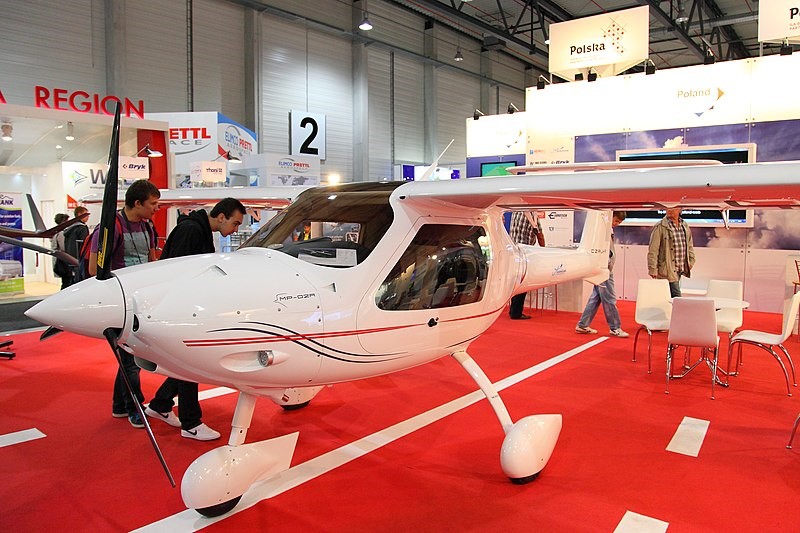
The Aero-Kros MP-02 Czajka (English: Lapwing) was designed and developed by Aero-Kros of Krosno, Poland, to comply with the Fédération Aéronautique Internationale microlight rules and US light-sport aircraft rules.

It features a cantilever high-wing, a two seats in side-by-side configuration enclosed cockpit, tricycle landing gear and a single engine in tractor configuration.

The aircraft is made from carbon-fiber-reinforced polymer. Its 9.72 m (31.9 ft) span wing employs Fowler flaps to keep the stall speed low enough for the FAI microlight category. The standard engine provided is the 100 hp (75 kW) Rotax 912ULS four-stroke powerplant which gives a cruise speed of 230 km/h (143 mph). The cockpit is 1.215 m (48 in) wide.

Introduced at the Friedrichshafen Aero show held in in 2009, the aircraft is supplied ready-to-fly.

Since March 2017 the design has been built by HMS Aviation, which is also located in Krosno, Poland.

Aero-Kros MP-02 Czajka
Powerplant: 1 × Rotax 912ULS, 75 kW (101 hp)
Wingspan: 9.72 m (31 ft 11 in)
Wing area: 10.2 m2 (110 sq ft)
Empty weight: 268 kg (591 lb)
Gross weight: 472.5 kg (1,042 lb)
Fuel capacity: 112 litres (25 imp gal; 30 US gal)
Wing loading: 46.3 kg/m2 (9.5 lb/sq ft)
VNE: 146 kt / 168 mph / 270 kmh
Maximum speed: 230 km/h (140 mph, 120 kn)
Cruise speed: 170 km/h (110 mph, 92 kn)
Stall speed: 65 km/h (40 mph, 35 kn)
Rate of climb: 6.5 m/s (1,280 ft/min)
Crew: one
Capacity: one passenger

Aero Engine Services Ltd / AESL

Aero Engine Services Ltd. was established at Hamilton, New Zealand, in 1954 by TEAL engineer, Alf Coleman, and until 1966 did engine repair and overhaul. The Cable Price Corporation, which introduced the FU24 to New Zealand, originally had a 57 per cent holding in AESL, but the company later became solely owned by James Aviation and Alf Coleman. Early 1967 acquired rights for Victa Airtourer (produced as AESL Airtourer) and later the Aircruiser, which was developed into the CT4 military trainer. Amalgamated 1 April 1973 with Air Parts (NZ) Ltd. to form New Zealand Aerospace Industries Ltd.

Aero Electric Aircraft Sun Flyer

Aero Electric Aircraft Corp One was working on a solar powered all-electric two-seater called the Sun Flyer, along with its development partners Bye Aerospace and German PC Aero.

AEAC started conducting research and development flights with a single-seat technology demonstrator at Centennial Airport (APA) near Denver. The concept airplane first flew out of Munich, Germany, in mid-July. Meanwhile, AEAC has been working on the design of a two-seat prototype of the Sun Flyer, which it hopes to fly sometime during 2015.

The technology demonstrator is equipped with a Geiger Engineering motor that generates 32 kW of power. Power is stored in several battery packs and the airplane is capable of flying for two hours without the supplement of solar energy. AEAC engineers estimate that the two-seat Sun Flyer will be able to fly for three to four hour in bright sunshine. Configuration plans for the Sun Flyer call for a side-by-side arrangement with a similar battery and electric motor setup as the technology demonstrator.

In addition to lower cost and cleaner flight, benefits of the solar-electric powered concept that AEAC’s CEO George Bye said have been confirmed with the technology demonstrator include low-noise, recharging on the ground and in flight and reduced maintenance due to fewer moving parts.

While the FAA still prohibits training flights with electric powered airplanes, the Sun Flyer is targeted to the training market. AEAC is collaborating on a complete training system with Redbird Flight Simulations and Spartan Aeronautical College. The company had not decided whether to pursue certification under Part 23 or the light sport aircraft rules.

Aerodyne Yogi

Yogi

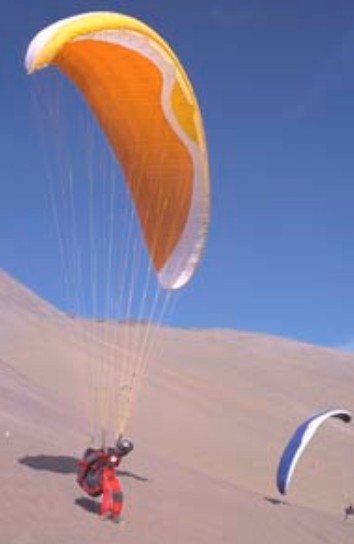
The Yogi gliders range is a school/beginners model, certified Afnor Standard, with 35 cells and aspect ratio of 4,6. Compared to FP’s Astair, it has a more progressive launching behaviour, “a bit less physical”, according to Aerodyne, and also with a better turn: “the glider rolls easier with the brake, but the stability is better”. It is available in 4 sizes, from XS to L.

Aerodyne Jumbe / Shani

Jumbe

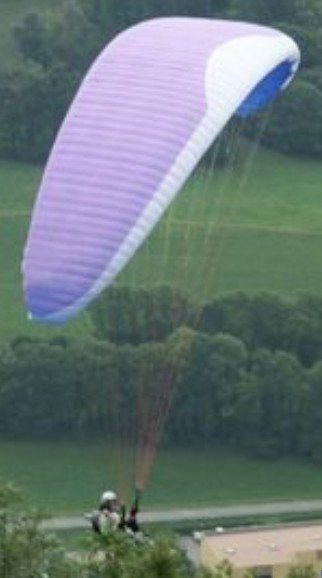
The intermediate Jumbe has been certified in sizes S, M and L in DHV 1-2, while the XS size passed Afnor Standard (57-68kg). The Jumbe keeps many features from its cousin (FP’s) Spirit. According to the design team, leaded by Michel Leblanc, “the brake travel has been increased, compared to the Spirit, and all the feedback we receive say that the Jumbe is also a bit more performant than the Spirit”. The factory has also created an extra-large version, called Shani, to be certified both as an XL solo glider and as a small Tandem (110-160kg).

Aerodyne Shaman

The Shaman is a performance glider created for experienced pilots, which retains many of the Blaster’s characteristics, such as its profile that “allows it to retain remarkable stability at high speed”, says the French company.
The Shaman was available in two versions: the standard version and the full race version, with trimmers and thin lines on the top portion of the suspension system
The company was working on the XS size of the Shaman (Afnor Performance in S, M & L).