Aeros AL-12

AL-12

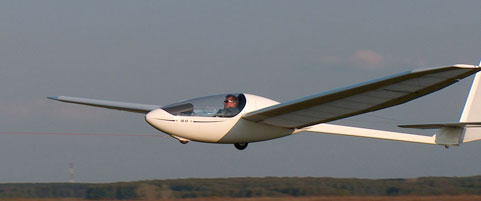
In 2005 the Aeros team took part in designing an entirely new product: the AL-12 ultralight sailplane and its powered version AL-12 M with a retractable power-unit.
The idea of a sailplane that could have some of the positive features of hang gliders and rigid wing gliders, and the possibility of soaring flight while using narrow thermals and “microlift”, to takeoff from hang gliding sites, and the simplicity of quick rigging and ease of transportation appealed.
The sailplane offered by Aeros takes off by air towing or winch towing, andallows mounting a retractable engine for autonomous takeoff and climb. The cockpit is equipped with adjustable pedals and seat back that can be adjusted to the pilot’s height up to 195 cm. There is a space for a backpack parachute. The sailplane can come complete with an optional rescue system.
For transportation purposes all control and stabilizing surfaces are removed, the cabin is detached, the wing with the tail beam is put into a package 0,2 x 0,58 x 5,7 m. The 0,6 x 0,86 x 3 m cockpit can be transported either as a whole assembly or in parts (cockpit, fuselage spine fairing, cockpit enclosure). The rigging takes around 40 minutes.
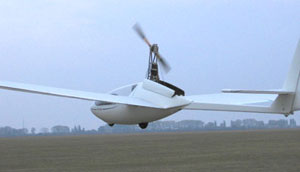
AL12M -Powered version ultralight sailplane

On October, 8, 2005 the first flight of a powered sailplane AL-12M with a retractable power-unit took place. The sailplane was piloted by its chief design engineer and the Aerola company top-pilot Nikolay Kononenko. The AL-12M had been brought to the take-off field on a car roof rack and within an hour and a half the sailplane was rigged up and prepared for tests. The power-unit is based on Solo-210 engine (16 hp) and provides for self-taxiing, take-off and acceptable climb rate.During the first day six flights were performed and included air restarts.

AL-12
Empty weight: 80 kg
Мах. takeoff weight: 185 kg
Wing span: 13.3 m
Sail area: 13 sq.m
Pilot weight: 60-110 kg
Stall speed: 34-40 km/h
Мах. Airspeed: 140 km/h
Best glide ratio: 27 (at 60 km/h)
Min. sink rate: 0.5-0.6 m/s (at 45 km/h)

AL-12M
Engine: Corsair Solo-210, 16 hp
Empty weight: 120 kg
Мах. takeoff weight: 220 kg
Wing span: 13.3 m
Sail area: 13 sq.m
Pilot weight: 60-100 kg
Stall speed: 39-45 km/h
Мах. Airspeed: 140 km/h
Best glide ratio: 27 (at 65 km/h)
Min. sink rate: 0.8 m/s (at 45 km/h)
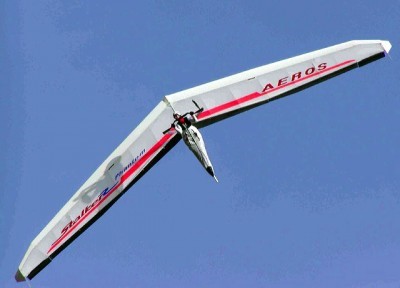
Aeros Phantom

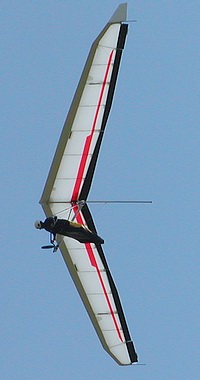
Being a further development of its predecessor – the 2004 Stalker rigid wing glider, the Phantom inherited the flight performance and comfort level while air towing. This became possible due to the increased rigidity of the wing as well as it’s aileron control system at the cost of only a couple of additional kilograms of weight, the Phantom gives the pilot more confidence and makes the endeavor of rigid wing flight more safe as well.

Compared with the Stalker, the Phantom features a wider nose angle and higher aspect ratio, more surface area of the ailerons and SPADDs, and an advanced control system allowing for decreased bar pressure at high speed.

A new RVG (rigid variable geometry) allows the pilot to lower the ailerons simultaneously in flight to increase trim speed and lighten the already light bar pressure for high speed runs. Ailerons make for much quicker roll rate as compared to spoileron rigids.

Phantom 145
Area: 13.5 sq.m
Wing span: 13.2 m
Aspect ratio: 12.9
Nose angle: 127°
Weight: 41 kg
Minimum pilot weight: 50 kg
Maximum pilot weight: 100 kg
Load weight: 50-100 kg
Breakdown length: 5.7 x 0.5 x 0.2 m
Min sink ratio: 0.65 m/s
Min airspeed: 33-35 km/h
Max airspeed: 110 km/h
Best glide ratio: 19

Aeros del Sur Manta         

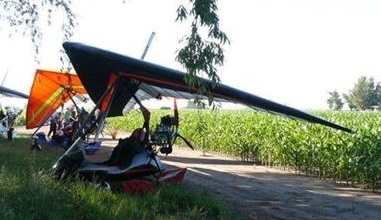
Aeros del Sur is the importer of Aeros products for Argentina. The Manta was designed by mating the Aeros Profi trike wing with a new, locally designed carriage. The Manta was designed to comply with the Fédération Aéronautique Internationale microlight category, including the category’s maximum gross weight of 472.5 kg (1,042 lb), with a ballistic parachute.

The aircraft is made from a mix of bolted-together aluminum and steel tubing, with its double surface wing covered in Dacron sailcloth. Its 10 m (32.8 ft) span wing is supported by a single tube-type kingpost and uses an “A” frame weight-shift control bar.

It features a cable-braced hang glider-style high-wing, weight-shift controls, a two-seats-in-tandem, open cockpit, tricycle landing gear with wheel pants and a single engine in pusher configuration.

The standard powerplant is a twin cylinder, liquid-cooled, two-stroke, dual-ignition 64 hp (48 kW) Rotax 582 engine, but the HKS 700E four-stroke, dual-ignition 60 hp (45 kW) engine is optional, as are Hirth and Simonini powerplants.

In production in 2013, the aircraft was supplied as a complete ready-to-fly-aircraft.

Engine: 1 × Rotax 582, 48 kW (64 hp)
Propeller: 3-bladed composite
Wingspan: 10 m (32 ft 10 in)
Wing area: 15.4 m2 (166 sq ft)
Gross weight: 472.5 kg (1,042 lb)
Fuel capacity: 50 litres (11 imp gal; 13 US gal)
Wing loading: 30.68 kg/m2 (6.28 lb/sq ft)
Crew: one
Capacity: one passenger

Aeroprakt Flirt

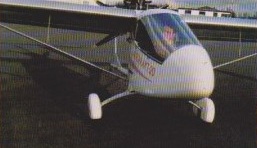
A tandem two seater, the Flirt is contructed of riveted sheet dural.

Ful GmbH arranged importation into Britain and changd the MAUW to 450 kg.

Engine: Rotax 582, 64 hp
Wing span: 11.38 m
Wing area: 15.68 sq.m
MAUW: 400 kg
Empty weight: 228 kg
Fuel capacity: 38 lt
Max speed: 150 kph
Cruise speed: 80-135 kph
Minimum speed: 45 kph
Climb rate: 5 m/s
Fuel consumption: 14 lt/hr
Seats: 2
Certification: VZ
Price (1998): 138,260 Fht

Aeroprakt A-36

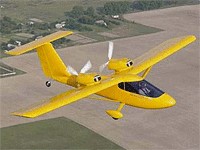
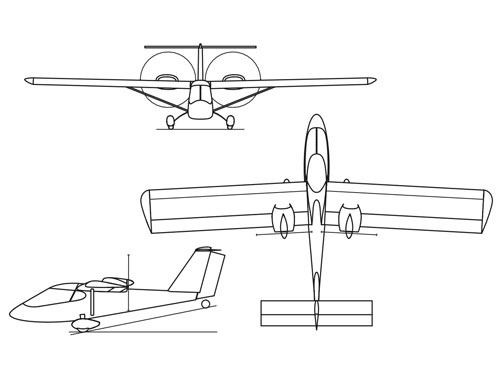
The A-36 is a light twin-engine two-seat airplane, designed to fly over hard-to-reach areas.

Equipped with two four-stroke Rotax-912S engines, the airplane has an all-metal wing, tail unit, rear fuselage, and fiberglass forward fuselage, main landing gear spring, engine cowlings and various fairings. A-36 has all-flying horizontal tail (stabilator), electrically driven trim tabs on horizontal tail and rudder, flight control system with side sticks in the cockpit. A-36 is capable of taking-off and continuing the flight using only one engine.

The airplane has side sticks, elbow rests, seats adjustable in flight, ventilation and an optional autopilot system. The A-36 has a luggage compartment designed for 100 kg (220 lb) of useful load.

The A-36 was produced on request.

Engines: 2 x Rotax-912S, 100 hp / 74 kW
Wing span: 11 m / 36.1 ft
Length: 7,1 m / 23.3 ft
Height: 2,3 m / 7.6 ft
Wing area: 15,4 sq.m / 166 sq. ft
Empty weight: 450 kg / 991 lb
Take-off weight: 750 kg / 1652 lb
Fuel capacity: 140 lt / 38 US gal
Stalling speed: 67 km/h / 42 mph
Landing speed: 70 km/h / 44 mph
Cruise speed: 220 km/h / 138 mph
Top level speed: 260 km/h / 163 mph
Rate of climb: 11 m/s / 2164 fpm
Rate of climb SE: 4 m/s / 787 fpm
Take-off run: 120 m / 393 ft
Landing run: 150 m / 492 ft
Practical ceiling: 8500 m / 27 869 ft
Practical ceiling SE: 4500 m / 14 754 ft
Maximum range (30 min res): 950 km / 513 nm
Maximum endurance: 6 hr

Aeroplanes DAR Solo

A single seater under FAR103 rules with a composite (Carbon Fiber) pod and metal wings. Price 2009: 6800 EURO. The Solo was only available as a kit
The wings are built by conventional sheet metal useing two spars, 12 ribs and metal skin. All parts are cut and bent on CNC equipment. Wing assembly is designed to be simple and straightforward. The rest of the airframe is a composite construction. Parts are made from carbon and glass fiber in temperature controlled vacuum molds. Sandwich construction techniques are also used to minimize weight and maximize strength. All airframe composite parts in the kit are completely finished, ready for final assembly. Experimental kit price 2009: 8000 EURO.

FAR103
Stall: 23 kt / 26 mph / 42 kmh
Cruise: 49 kt / 56 mph / 90 kmh
VNE: 65 kt / 75 mph / 120 kmh
Empty Weight: 110 kg / 243 lb
MTOW: 220 kg / 485 lb
Climb Rate: 600 fpm / 3 m/s
Glide Ratio: 10
Take-off distance (50ft obstacle): 330 ft / 100 m
Landing distance (50ft obstacle): 330 ft / 100 m

Experimental
Stall: 27 kt / 31 mph / 50 kmh
Cruise: 49 kt / 56 mph / 90 kmh
VNE: 70 kt / 81 mph / 130 kmh
Empty Weight: 115 kg / 254 lb
MTOW: 210 kg / 463 lb
Climb Rate: 600 fpm / 3 m/s
Glide Ratio: 8
Take-off distance (50ft obstacle): 490 ft / 150 m
Landing distance (50ft obstacle): 490 ft / 150 m

Aeroplanes DAR Speedster

The design team of Aeroplanes DAR had the goal to modify the existing model DAR-21. The first serious change was a new wing. The new wing results indicated a 17-20 percent better performance than the original design. The new airframe structure had reduced weight, while increasing the rigidity. The new technology gave better results kept the general outside lines. The DAR Speedster continued this with small changes. Many details have been redesigned and improved for aerodynamic reasons.
Price 2009: 30000 EURO

Stall: 32 kt / 37 mph / 60 kmh
Cruise: 108 kt / 124 mph / 200 kmh
VNE: 127 kt / 146 mph / 235 kmh
Empty Weight: 113 kg / 250 lb
MTOW: 204 kg / 450 lb
Climb Ratio: 1800 fpm / 9 m/s
Glide Ratio: 10
Take-off distance (50ft obstacle): 490 ft / 150 m
Landing distance (50ft obstacle): 490 ft / 150 m