2001: Affordaplane, 6817 Alafia Dr., Riverview, FL 33569, USA.
Built the Affordaplane
2001: Affordaplane, 6817 Alafia Dr., Riverview, FL 33569, USA.
Built the Affordaplane
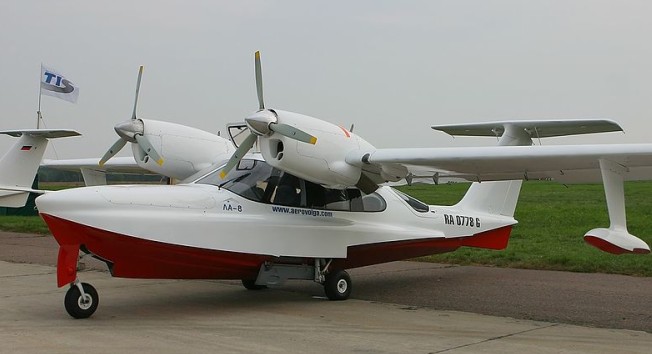
The AeroVolga LA-8 8 seat amphibious aircraft has its origin with the Chaika L-6, first flown in 2000, and its immediate successor the L-6M, promoted by AeroVolga and first flown in 2001. Both of these were twin engine, V-tailed amphibious aircraft, the latter differing in its hull design, undercarriage and maximum take-off weight. Chaika developed the L-6M into the L-4 and AeroVolga developed it into the LA-8. These are very different designs: the LA-8 has a T-tail and is some 25% longer than the L-4, with tricycle gear.
The LA-8 is largely built from plastic foam and PVC filled glass fibre sandwich. Its wing is divided into watertight compartments. The amphibian is a cantilever high wing monoplane with straight tapered wings; most of the sweep is on the trailing edge. First flown on 20 November 2004, the prototype originally had downturned wing tips but these were replaced with extended upturned tips by 2006 and by early 2011 a later aircraft had winglets which extended both above and below the tips. There is no dihedral. Its twin engines are placed above and ahead of the wing leading edge, as close to the centre-line as the clearance between propeller and fuselage allows. The prototype was powered by two LOM M337AK air-cooled six-cylinder supercharged inverted inline engines.
The basic version of the power plant (C-version) is two piston engines LOM PRAHA M337C-AV with take off power 235 HP. The engines are equipped with supercharge and timing fuel injection system. Time between scheduled maintenance of engines is 100 hours, motor oil replacing time is 200 hours.
The LA-8L variants have 175 kW (235 hp) Lycoming IO-540 air-cooled flat-sixes. Turboprop engines are TP-100 (250 HP) or АI-450 (300 HP).
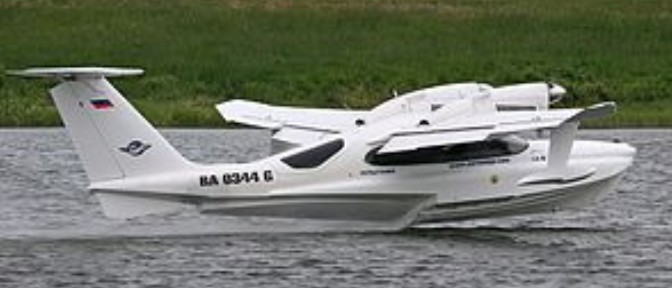
The two step hull is also subdivided into watertight compartments. Two fixed underwing stepped floats at about 75% span stabilize the aircraft on water. The cabin is under the wing, with two long continuous transparencies, one on each side plus two shorter panels in the main entry hatch in the rear roof behind the trailing edge. There is seating for eight, including one or two pilots. The LA-8’s T-tail has a slightly tapered, straight edged, swept fin with a sub-fin extension; both the rudder and the single piece, externally mass balanced elevator have electrically actuated trim tabs.
The LA-8 has a tricycle undercarriage with mainwheels retracting into the fuselage sides and the nosewheel retracting rearwards. A ballistic parachute is an option.
The aircraft has a composite high wing, with T-shaped stabilizer. The main fuel tanks with a capacity of 455 liters (for RS-version – 1 400 liters) are located in the wing of the aircraft. For C-version and L-version it is possible to install the additional fuel tanks in winglets, with total capacity 100 liters.
Two mooring rings are located on the lower surface of the wing, one – in the nose part, one – on the aft. Two cleats are located near the hatch. The cleats can be either fixed or retractable into frame.
There are four knots on the top of the aircraft, for which the aircraft can be lifted by crane onto the deck of the ship and the dock with using a standard four-point brace. The aircraft can be equipped with lifting eye bolts and two sling-adapters.
Ground power unit (GPU) is plugged to the standard onboard socket and allows starting the engines and charging on-board batteries.
The landing/taxi LED lights cluster is installed in the left wing. The quad xenon land light is installed in the right wing. The navigation lights (left and right) are located in the winglets, in the tail part of the fuselage the tail light and anti-collision light are installed, on the fin tip is located the parking light switched on in the water.
Landing gear is tricycle type, with the nose strut. Wheel suspension is wishbone, with gas-fluid absorbers. For manufacture of landing gear it is used special high-quality stainless steel and special coverings with high resistance to seawater. The specially designed landing gear allows to land on unpaved ground. The landing gear retraction/extension is performed by hydraulic drive; emergency main struts extension is performed under its own weight, the nose strut extension is performed by backup pneumosystem.
The emergency extension of all struts is performed under their own weight in RS-version. The working of hydraulic system and emergency pneumosystem is controlled by two pressure gauges mounted on the pilot’s instrument panel.
Indication of the landing gear position is designed specifically for amphibian aircraft, when landing on the water surface is performed with retracted landing gear. So the position of retracted landing gear is displayed as bright-blue color, extended – as yellow color. The additional visual control of position of the landing gear can be made by using panoramic mirrors located on the floats.
For controlling the aircraft when moving on water the different engine thrust or reverse thrust is used, for controlling the aircraft movement on land – separate braking wheels. The brakes are hydraulic, on control pedals. Both main wheels can be stopped by parking brake.
Control of the aircraft is possible from the right or left pilot’s seats which are equipped with control columns and pedals. For locking the elevators and ailerons when standing the safety pin with red marker is inserted into the control column support.
Autopilot is controlled from the central instrument panel and the button of autopilot emergency cutoff is on the control wheel. Control of engines, propellers and trimmers are located on the centre console between pilots.
Engine control levers allow operate as straight thrust as reverse thrust. In order to prevent the propellers transition to reverse mode during flight engine, control console is equipped with computer controlled reverse lever lock disabling reverse activation at speed over 100 km/h and more than 1 400 RPM.
Flaps are controlled by electric drive. The flaps position is controlled by indicator or visually. RS-version of the aircraft normally (other versions – optional) is equipped with automatic follower-up control system of the flaps, where required flap angle from 0 to 40 degrees is set by flap position selector, after that automatic equipment set the flaps into appointed position.
Pilot’s seats have a system of longitudinal movement which provides comfortable seating and adjustment for pilots which are from 160 to 200 cm in height. For convenient seat adjustment the handrail is mounted in the cabin. The design of the seat pan allows using individual anatomic cushion.
The main access door is located in the top tail part of fuselage and designed to provide boarding the aircraft as well on land as in water. The hatch opens up. The dimensions of hatch allow to load long-measuring freight and as well a patient on special stretcher. Gas jacks provide easy hatch opening and closing and locking device – fixing the hatch opened. Hatch lock mechanism provides a two-level protection against accidental opening, allowing, at the same time, almost instantaneous opening hatch, both inside and outside. To access to the cabin is used embedded folding ladder, the design of which allows, if necessary, to climb back on board for swimmers.
There are two emergency exits on left and right sides. Sliding transparent vents are embedded in windshield of hatches. At the top of the cabin there is the access hatch. The windscreen of the cabin is made from acrylic (PMMA) plastics, with improved athermical properties. The windshield is able to stand standard bird strike. The left windscreen of pilot can be equipped with electrical defrost heating for deicing and besides the left windscreen can be equipped with washer which feed water to remove salt stains.
In the cabin up to eight seats can be installed with two pilot seats included. The rear seats have fold-back and lockers under the seat pan. Each seat is equipped with a mandatory safety belt system.
Above each seat individual lighting, adjustable air ball vent and intercom are installed.
For baggage there are two storage compartments – in the nose of the aircraft and in the rear part of the cabin. For small items there are special pockets and niches. The aircraft LA-8C-RS can be equipped with lockable luggage racks.
The aircraft is equipped with two bilge pumps. De-icing system includes electric system of heating the pitot tube, the stall warning indicator, the left pilot windshield, the propeller and the leading edges of wing and tail. Using the M337C-AV engines with compressors and dispersed fuel injection allows eliminating such a dangerous effect as icing the intake system of the engine.
The aircraft is equipped with a speed computer-analyzer which prevents the reverse activation at speed exceeding 100 km/h, as well as the landing gear retraction at speed below 100 km/h. If necessary to retract or extend the landing gear at slow speed (for example on the water or at maintenance works) the lock should be turned off by special switch.
Each propeller is equipped with a centrifugal lock, making it impossible to shift the propeller blades to reverse at 1,400 RPM. Thus to prevent accidental reverse activation in flight there is backup locking system.
Basic power plant is based on the two engines LOM PRAHA M337C-AV with take-off power 235 HP and continuous power of 210 HP each. Each engine has six cylinders in line (capacity of 6 liters, 366 cubic inches). The engines are invert. Such design of the engine provides the minimum aerodynamic resistance of power plant. The engines are equipped with mechanical superchargers and keep power to altitude of 1 200 m. Also the engines are equipped with timing fuel injection which provides record low fuel consumption up to 0,195 kg (kw/h) and have automatic altitude fuel-air mixture correction
The German propeller MTV-12-D-C-F-R(M)/CFR190-53 with constant speed, hydraulic control, reverse and feathering are installed.
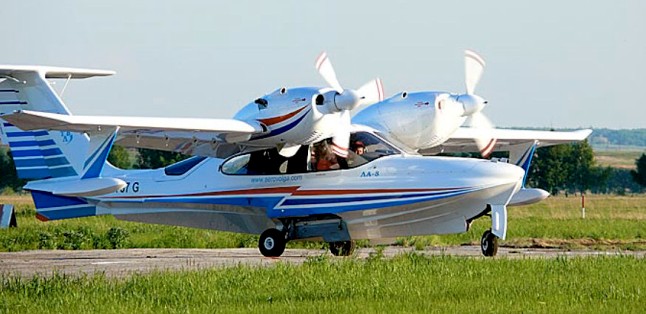
The aircraft can be equipped with LYCOMING 540 of 235HP to 300HP, as well as turboprop TP-100 or AI-450 engines with propellers “AVIA” or MT.
In case of using LYCOMING engines it is possible to install HOFFMAN V-123 propellers with increased starting thrust.
The aircraft can be equipped with auxiliary power unit with generator of 1 500W to increase the independency of the aircraft.
The main electrical network of the aircraft is DC 27V. Energy supply is DC generators. Basic battery of 24V/16 Ah or also the battery of 24V/20 ah can be installed.
Power supply of power-consuming devices such as de-icing devices is performed by AC 42V from the additional generators mounted on the engines. To be able to connect devices with a voltage of 12V can be installed static converter with power up to 250 W.
The main flight instrument is GARMIN G500 avionics display system certified for multiengine piston aircrafts with take off weight up to 5 700 kg and flight altitude up to 6 000 m. The display consists of two monitors.
For better maneuverability of the aircraft on the water is provided the small boat engine installation.
The design of the aircraft allows its quick (within 15 minutes) transformation from a passenger (main) version into cargo version. On the rails of the floor are installed strapping shoes for mooring cargo or cargo mash. Re-equipment of the aircraft is performed from passenger modification into air ambulance less than 30 minutes.
The design of the wing (version RS) allows to mount two underwing containers weighing up to 150 kg each.
It is possible to deliver LA-8 as hydroplane with fast mounted undercarriage (mounting and dismantling take not more 10 minutes) and removable ski set for winter operation. The useful load of LA-8H is 1180 kg (1215 kg for RS-version).
SPU “AeroVolga” offers a unique modification of the fire-monitoring aircraft LA-8 FF (2 person crew) with the possibility of taking onboard 1000 liters of water in the planing mode, water drop (foam-water mixture) during 2 sec from the altitude up to 5 m at speed of 180 km/h and duration for fire monitoring up to 5 hours.
The patrol modification of the aircraft based on LA-8C-RS with radio and video monitoring set of surrounding area can stay in the air up to 14 hours with crew of 4 people. The crew is provided by dry closet, galley and a place for rest for one person as well as multi-channel communication protected system
The first-aid modification of the aircraft based on LA-8C-RS with medical equipment weighing up to 180 kg allows two doctors to resuscitate a patient (injured) during the flight up to 5 hours (1000 km).
In 2013 the aircraft are delivered with airworthiness certificate under FAP-118 Russian Federation at the moment.
The LA-8 first prototype flew for the first time on 20 November 2004 with test pilot M.M. Emanov. The first production aircraft flew in August 2006 and the first Lycoming powered machine was completed in mid-2010.
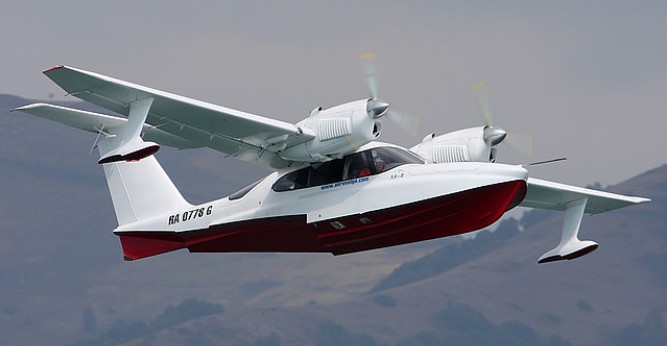
In 2006 the aircraft was modified with series 37 engines: М-337C with power increased by 25%, and specific fuel consumption reduced by 15%. In 2008 the Lycoming 540 (235 h.p.) engine was integrated.
The first flight tests of the LA-8 were carried out successfully. Takeoff from water showed good characteristics: exit to the glideslope is 45 km/h, take-off is 90 km/h, the length of takeoff of an empty plane is 200 meters. Prototyprs 1 and 2 conducted more than 200 hours of factory flight tests.
Certification works are carried out according to Russian aviation rules (АR-23,21) correspondent to international FAR; JAR.
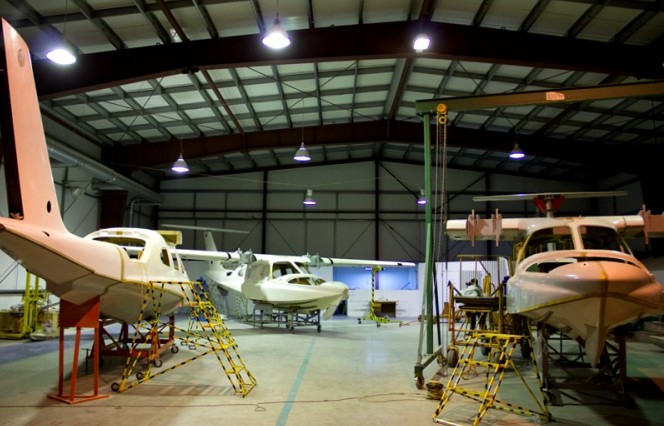
By mid-2012 six LA-8s had been produced for customers as well as the three prototypes. Two were with Russian operators, one flying around Lake Baikal and the other on Lake Seliger. Two went to an operator in Montenegro. Another five have been sold to Rimos Ltd for work in the Persian Gulf; by July 2012 two of these had been delivered.
Seagoing ability allows operating with wave height up to 0,6 m. Minimum length of runway is 400 m. Runway absolute altitude up to 1 500 m for piston version and 2 500 m for turboprop version.
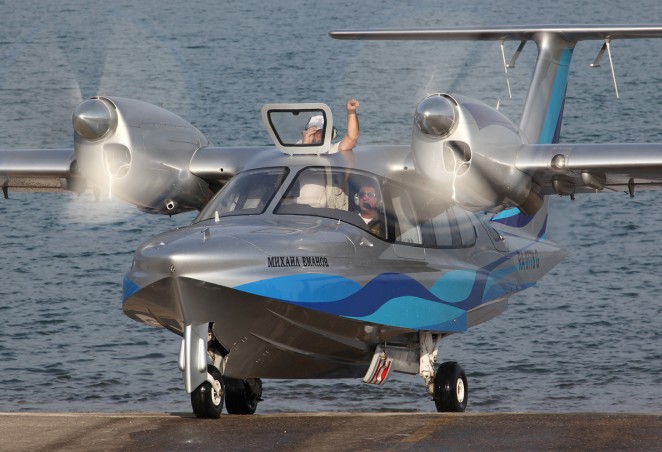
Variants:
LA-8C
Baseline version powered by 2x 175 kW (235 hp) LOM Praha M-337C-AV01.
LA-8L
2x 175 kW (235 hp) Lycoming IO-540B4B5 engines.
LA-8C-RS
Long range version of LA-8C, powered by 2x 175 kW (235 hp) LOM Praha M-337C-AV01.
LA-8L-RS
Long range version of LA-8L, 2x 175 kW (235 hp) Lycoming IO-540B4B5 engines.
LA-8HC
Flying boat / Hydroplane / skis based on the LA-8C
LA-8HL
Flying boat / Hydroplane / skis based on the LA-8L
LA-8LDM
High specification variant.
LA-8FF
Fire-fighting variant.
Specifications:
LA-8
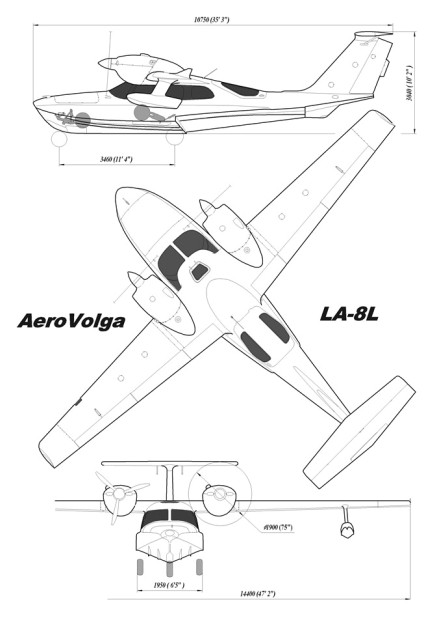
Length: 36,42 ft
Wing length: 46 ft
Ramp height: 11,15 ft
Maximum width of fuselage: 6,56 ft
Track of landing gear: 6 ft
Wheelbase of landing gear: 11,23 ft
Wing area: 217,4 sq.ft
Maximum takeoff weight: 5997 lb
Maximum useful comercial load: 1764 lb
Maximum fuel capacity (ferrying): 396,3 gal
Maximum altitude: 14760 ft
Maximum allowable speed: 189,5 ktas
Maximum speed of horizontal flight: 170,9 ktas
Cruise speed (economy): 146 ktas
Range (payload 1764 lb): nm (max)
Range max: 2160 nm
Endurance (max tow): 5,6 hr
Rate of climb: 787-1181 ft/min
Runway length land (max t.o.w.): 1148 ft
Runway length water level (max t.o.w.): 1476 ft
Landing speed (at maximum weight): 53 ktas
Maximum overload: +3,8 -1,9G
Passenger Cabin length: 11,32 ft
Passenger Cabin width: 5,381 ft
Passenger Cabin height: 4,068 ft
Cabin capacity: 130,7 cu.ft
Maximum length of cargo: 14,53 ft
Front upper access door: 1,47 х 1,90 ft
Rear upper access door: 5,545 x 4,232 ft
Emergency doors (left, right): 2,23 х 2,23 ft
LA-8C
Empty weight: 1 685 kg
Maximum take-off weight: 2 720 kg
Maximum useful load: 1 035 kg
Range 630 kg payload opt tip tanks: 1 400 km
LA-8C-RS
Engines: 2x 175 kW (235 hp) LOM Praha M-337C-AV01.
Empty weight: 1 650 kg
Maximum take-off weight: 2 720 kg
Maximum useful load: 1 070 kg
Maximum range: 4 000 km
LA-8L-RS
Engines: 2 × Lycoming IO-540B4B5 air-colled flat six, 175 kW (235 hp) each
Propellers: 3-bladed Hoffman HO-V123K, 1.95 m (6 ft 5 in) diameter
Length: 10.80 m (35 ft 5 in)
Wingspan: 15.00 m (49 ft 3 in)
Height: 3.14 m (10 ft 4 in)
Wing area: 22.10 sq.m (237.9 sq ft)
Airfoil: P-lll-15
Empty weight: 2,000 kg (4,409 lb)
Gross weight: 2,720 kg (5,997 lb)
Maximum speed: 259 km/h (161 mph; 140 kn)
Cruising speed: 220 km/h (137 mph; 119 kn) normal
Stall speed: 86 km/h (53 mph; 46 kn) power off, flaps down
Service ceiling: 5,000 m (16,404 ft)
g limits: +3.8/-1.9
Take-off run, land: 350 m (1,149 ft)
Take-off run, water: 450 m (1,477 ft)
Crew: One or two
Capacity: max 7 passengers.
AeroVolga was established in 2002 and deals with:
design of aircrafts of normal category;
production of aircrafts;
aircraft tests;
repair of aircrafts, which belong to the normal category according to the AP-23 (21).
In 2005 enterprise AeroVolga received operator’s certificate АОN No. AON 1005009.
NPO AeroVolga was licenses for the following types of activity:
License No. 3239-А-АТ-R of 14.12.2006. For Construction of aviation techniques, including aviation techniques of double duty. Activity type: construction of civil aircraft (EKPS classes 1510);
License No. 3240-А-АТ-P of 14.12.2006. For Production of aviation techniques, including aviation techniques of double duty. Activity type: production of civil aircraft (EKPS classes 1510);
License No. 3241-А-АТ-R of 14.12.2006. For Repair of aviation techniques, including aviation techniques of double duty. Activity type: repair of civil aircraft (EKPS classes 1510).
At the end of 2007 the first stage of the aerodrome and production complex near the settlement Krasniy Yar, Samara Region, 30 km. from Samara city was built. The capacity of the first stage is up to 15 aircrafts per year.
In 2013 NPO AeroVolga had the following services:
construction office;
office of the chief technologist
metrology and quality control office;
flight-experimental group, including service;
marketing office;
production division. Total number– 80 persons.
Aero Vodochody Ltd
After World War 2 the Czech aviation industry was nationalised under central control although the Aero 140 was sold under the Aero name.
Aero Vodochody Narodni Podnik Article
Aero Vodochody Narodni Podnik was established on July 1, 1953, perpetuating the old Czech name Aero.
Achieved technical distinction and international success during 1963-1974, when the major product (for several countries) was the Delfin jet trainer (first flown April 1959; more than 3,000 built). This was succeeded in production in late 1972 by the L-39 Albatros jet trainer and light attack aircraft (first flown November 1968), following its selection as standard jet trainer of all Warsaw Pact countries except Poland; the L-39 as part of training system, comprising also special simulator, ejection training simulator and mobile automatic test equipment.
Aero Vodochody received the Red Banner award of the Ministry of Engineering and UVOS seven times.
Renamed Aero Vodochody Ltd.
In May 1997 the Board selected a consortium made up of Boeing (90%), the former McDonnell Douglas, and CSA Czech Airlines (10%) to take a major stake in the company as strategic investors. Product range then comprised the L-39 Albatros, L-59, L-139 Albatros 2000 (using US engine and avionics) and L159 ALCA jet trainers and light combat aircraft, and the Ae 270 Ibis transport as a partner with AIDC in Ibis Aerospace.
The L159 did not sell and in 2004 the Czech government bought the firm back for a nominal sum.

The American Helicopter Society issued a a prize of $10,000 for the Igor I Sikorsky Human Powered Helicopter Competition in 1980. By May 2009 the prize was $250,000. The requirement was to lift off to a height of 3m/9.8ft and hover over a 10sq.m/107.6 sq.ft ‘box’ for one minute using only human power. More than 20 teams tried and failed.
The AeroVelo team 9the name derived from ‘aerodynamic’ and Velo, French for bicycle) was led by pilot and chief engineer Dr. Todd Reichert and co-chief engineer Cameron Robertson, and made up of students at the University of Toronto.
The Atlas four rotors each span nearly 21.3m/70 ft. The airframe is of very light carbonfibre tubes and polymer weighing only 52kg/115lb, with a highly modified bicycle frame pedalled by the pilot.
The Atlas received many incremental improvements during 18 months and on 13 June 2013 Altas flew for 64.11 seconds, reached a peak altitude of 3.3m/10.8ft, and drifted off-centre a maximum of 9.8m/32.2ft.
The American Helicopter Society declared the Toronto, Canada-based AeroVelo Atlas team the winners.

Until 2009, the Aeropro aircraft had the model name EuroFox for both the tricycle-gear and taildragger airplanes. To reflect the considerable development and evolution of the aircraft designs over the years, and with developments since the Aeropro aircraft have been delivered into the U.S. in the S-LSA category, the tricycle-gear aircraft model designation was changed to A240 and the taildragger aircraft given the model designation A220, and the aircraft sold in the U.S. and Canada are sold under our Aerotrek banner.
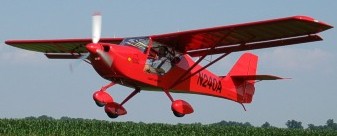
The Aerotrek A220 and A240 are factory-built two-seat aircraft, FAA-approved S-LSA (Special Light Sport Aircraft) that have a quick-folding wing design (only one-person, only 10 minutes).
Both the Aerotrek A220 and A240 are built in series-production.
The Aerotrek A220 taildragger has a range of 600+ miles, a cruise speed up to 120 mph, and a climb rate of over 1,000 fpm with the 100 hp engine. The cockpit has side-by-side seating, dual stick controls and is 44.1″ wide.
The Aerotrek A220 taildragger features a composite main landing gear and has wide-spaced main wheels to aid with cross-wind landings and takeoffs. The forward visibility of the A220 is helped by having clear polycarbonate doors for visibility out the side of the aircraft. The A220 also features a new dual toe brake system and larger tundra tires.
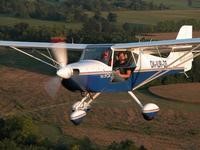
The Aerotrek A240 tricycle-gear and A220 taildragger S-LSA have payloads of 585- and 650-pound useful loads respectively, and more than 400 of them have been flying worldwide since 1990. Options include Dynon SkyView, tundra tires and a “well-equipped” price of US$84,950 (2012).
The Aerotrek A240 tricycle-gear and A220 taildragger S-LSA have payloads of 585- and 650-pound useful loads respectively, and more than 400 of them have been flying worldwide since 1990. Options include Dynon SkyView, tundra tires and a “well-equipped” price of US$84,950 (2012).

Aeropro CZ EuroFox
Empty Weight: 288 kg / 636 lb
MTOW Weight: 599 kg / 1320 lbs
Stall: 35 kt / 40 mph / 64 kmh
Cruise: 103 kt / 118 mph / 190 kmh
VNE: 111 kt / 128 mph / 206 kmh
Climb Rate: 1200 ft/min / 6 m/s
Glide Ratio: 14:1
Take-off distance (50ft obstacle): 400 ft / 122 m
Landing distance (50ft obstacle): 460 ft / 140 m
2009 Price: 39500 EURO
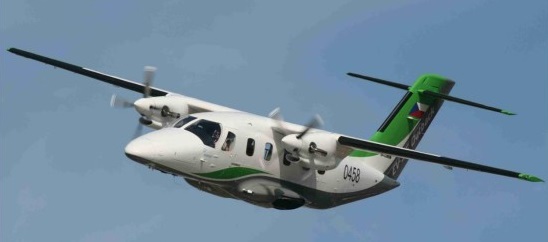
In 2004 Evektor announced its plan to design and construct a two-engined utility aircraft that would carry up to 14 passengers or 4000 lb (1800 kg) of cargo, and operate from unimproved fields and at high-altitude airports.
The EV-55 is of conventional high-wing utility design with a T-tail. The prototype aircraft is powered by Pratt & Whitney PT6A-21 turboprop engines (535 shaft horsepower), driving four-blade propellers. The wing is mounted atop a nearly-square fuselage, which has five windows per side. The trailing-link tricycle landing gear retracts into the nose section or pods on the lower fuselage. Expected maximum cruise speed is 220 knots (407 km/h).
The 5.02m x 1.61m cabin standard layout is five and four seats with a cargo compartment separated by a semi bulkhead and an L-410 sized double door at the rear. It is equipped with a full glass cockpit, Czech firm Avia makes the four-blade propellers and Aero Vodochody the landing gear.
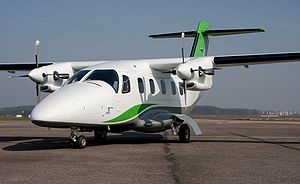
The first prototype, an EV-55M (military version), flew from Kunovice Airport in June 2011, with company pilot Josef Charvat and military pilot Maj. Jiri Hana at the controls. It was estimated at $2.1 to $2.2 million in 2012. The first production-conforming aircraft flew from Kunovice in April 2016.
In June 2018, its price was $4 million and two aircraft should finish development flights with 200 hours in 2016, for 500 total hours. Evektor secured enough investment to complete the certification process scheduled for 2017, with a minority investment from a Malaysian company backed by the country’s former premier Mahathir bin Mohamad, but not to begin full production.
With nine passengers, range is 800nm (1,480km), it can take-off in 410m and land in 520m and with more speed, range and short take-off and landing capability, it can replace ageing piston-twins.
The project’s development was suspended on 16 March 2017 due to “some uncertainties” with Evektor’s Malaysian investor.
By December 2018, it was touted as a basis for an EVE-55 hybrid electric aircraft conversion to fly in 2020, with only one PT6A-21 running a 400 kW (540 hp) generator in the rear compartment, for much lower noise, an 18% fuel saving and the same payload and performance: a 3 hours endurance and 40 minutes from electric power only.
EV-55
Engines: 2 × Pratt & Whitney Canada PT6A-21 turboprop, 399 kW (535 hp) each
Propellers: 4-bladed AVIA AV-844, 2.082 m (6 ft 10 in) diameter
Wingspan: 16.10 m (52.82 ft)
Length: 14.35 m (47 ft 1 in)
Height: 4.66 m (15.28 ft)
Empty weight: 2,597 kg (5,725 lb)
Max takeoff weight: 4,600 kg (10,141 lb)
Fuel capacity: 1,656 kg (3,651 lb)
Maximum speed: 410 km/h (250 mph, 220 kn) 10 000 ft
Stall speed: 119 km/h (74 mph, 64 kn) with flaps, 77 knots without
Range: 1,713 km (1,064 mi, 925 nmi) , 2,000 lb (907 kg) payload
Capacity: 1 776 kg / 3 915 lb payload, 14 pax
Crew: 2
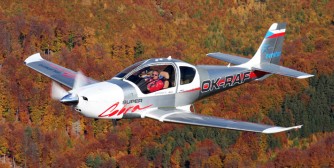
Initial work on the VUT100 Cobra project began in 2001 with the maiden flight made in November 2004.
October 2006 saw the maiden flight of the VUT100 SuperCobra.
The VUT 100 Cobra was designed to offer speed with cabin comfort and ergonomics, low cost of ownership and long range. Planned to be available in two versions differing by the power units: The VUT 100-120i is equipped with a Lycoming IO-360-A1B6 (200HP) and mt-propeller MTW-12. The VUT 100-131i is equipped with a Lycoming IO-580-B1A (315HP) and the mt-propeller MTV-9.
The VUT100 Cobra was designed to enable easy and fast access to the parts of the airframe which require inspections and maintenance and the number of nodes which require inspections and adjustment were minimized.
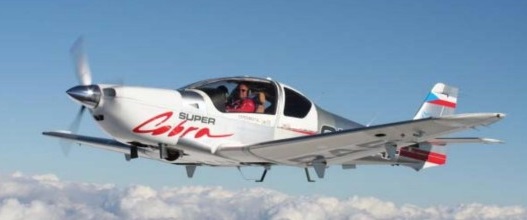
The development team designed the airframe from traditional duralumin using 3D design systems and optimized from the strength point of view by FEM methods.
VUT100-120i
Engine: Lycoming IO-360-A1B6, 200 hp
Propeller: Hartzell HC-F3YR-1RF
Diameter: 74 in / 188 cm
Type: 3 blade, constant speed
Length: 26.3 ft / 8 m
Wing span: 33.5 ft / 10.2 m
Internal cabin length: 122 in / 3.1 m
Seats: 4
Internal cabin width: 51.5 in / 1.31 m
Fuel usable: 90 USG / 340 lt
Internal cabin height: 48 in / 1.22 m
Max. take-off: 2,930 lb / 1,330 kg
Useful load: 1,105 lb / 500 kg
Max. level speed: 155 kts / 287 km/h
Max. rate of climb: 1,000 fpm / 5 m/s
Stall speed: 50 kts / 93 kph
Range: 1,080 nm / 2,000 km
Endurance: 8 hrs
Load factors: +3.8g -1.52g (Normal category) / +4.4g -1.76g (Utility category)
VUT100-131i
Engine: Lycoming IO-580-B1A, 315 hp
Propeller: Hartzell HC-F3YR-1RF
Diameter: 76 in / 193 cm
Type: 3 blade, constant speed
Length: 26.3 ft / 8 m
Wing span: 33.5 ft / 10.2 m
Internal cabin length: 122 in / 3.1 m
Seats: 4
Internal cabin width: 51.5 in / 1.31 m
Fuel usable: 90 USG / 340 lt
Internal cabin height: 48 in / 1.22 m
Max. take-off: 3,200 lb / 1,450 kg
Useful load: 1,260 lb / 570 kg
Max. level speed: 175 kts / 324 km/h
Max. rate of climb: 1,000 fpm / 5 m/s
Stall speed: 55 kts / 103 km
Range: 1,000 nm / 1,830 km
Endurance: 6 hrs
Load factors: +3.8g -1.52g (Normal category) / +4.4g -1.76g (Utility category)
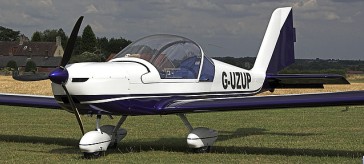
In 1996 Aerotechnik with Evektor began development of the EV-97 team Eurostar airplane.
A two-seat light or ultralight monoplane designed for sport/leisure flying, touring and training with limitation to non-aerobatic VFR operations. The Eurostar is aerodynamically controlled, single-engine, two-seat, low-wing, all metal plane with a fixed tricycle undercarriage and controllable nose wheel. The aircraft is equipped with four cylinder four stroke 80 HP Rotax 912 UL engine, optionally 100 HP Rotax 912 ULS or 80 HP Jabiru 2200.
Beginning in 2000 was the development of the EV-97 VLA airplane. This aircraft is called SportStar in US and EuroStar in Europe. Development of the SportStar version began in 2003.
By 2009, over 800 of the EuroStar had been delivered worldwide and the 2009 price was 50000 Euro.
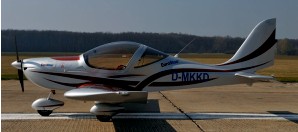
The EuroStar SL is an advanced ultralight airplane with 46.5 inches / 1.18 meters of shoulder room, new system of cockpit climate control, and state of the art glass cockpit avionics. During testing more than 450 spins in all configurations were carried out. The airplane was type approved by the Ministry of Defence of the Czech Republic and is operated by the Pilot Training Centre of the Czech Army for initial pilot training.
The EuroStar SL has an all metal anodised and corrosion-proofed aluminium airframe. It has all joints of construction riveted as well as bonded for durability and long fatigue life.
The EuroStar is certified for towing of the sailplanes up to 700 kilos (Duo Discus, Janus, Ventus, ASK 21, Ventus, Blanik etc.) and for towing of banners up to 140 sq.m.
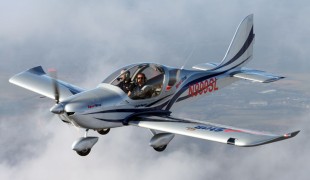
The SportStar MAX is an S-SLA aircraft business travel or training.
The airplane was the very first aircraft approved by the FAA (2005) in the U.S. S-LSA category and is holder of the prestigious “S-LSA Aircraft of the Year” honour from AeroNews Network (ANN).
The SportStar MAX with a re-designed, based on an EASA JAR-VLA certified pilot training airplane, airframe at 1320 lb / 600 kg MTOW provides up to 640 lb / 290 kg of useful load combined with range 700 nm / 1300 km, and was available as an IFR version. The SportStar MAX combines aerodynamic composite materials with an all-metal primary airframe structure.
The SportStar MAX build quality and reliability is based on Evektor´s certified aircraft production by the European Aviation Safety Agency (EASA), ISO 9001:2000 Quality Management System as well as LAMA certification.
The canopy gives 46.5 inches / 1.18 meters of shoulder room, and glass cockpit avionics.
The SportStar MAX has an all metal anodised and corrosion-proofed aluminium airframe with all joints of construction riveted as well as bonded. The SportStar is certified for towing of the sailplanes up to 700 kilos (Duo Discus, Janus, Ventus, ASK 21, Ventus, Blanik etc.) and for towing of banners up to 140 sq.m.
The SportStar is a Light Sport Aircraft (LSA) designed for pilot training, sport and leisure flying and touring with limitation to non-aerobatic VFR operations.
The Evektor fully certified (European EASA standard), general aviation-quality aircraft is conventionally powered (Rotax), and has evolved to the flagship Harmony and includes the SportStar MAX, both with all-metal construction, long range economy cruise at 110 knots by 2012. Base prices 2012: US$98,000 (MAX); US$102,000 (Harmony).
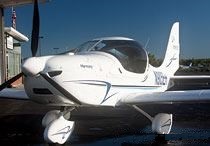
Evektor EV-97 Team Eurostar
Engine: Rotax 912 ULS, 100 hp
TBO: 1,500 hrs
Propeller: Fixed, on-ground or in-flight adjust
Cabin width: 46.5 in / 1.18 m
Length: 17 ft 7.5 in / 5.98 m
Height: 8 ft 1.6 in / 2.48 m
Wing span: 26 ft 7 in / 8.1 m
Empty weight: 609 lb / 276 kg
MTOW: 992 lb / 450 kg
Design load: +6 g / -3g
Max. baggage: 33 lb / 15 kg
Wing tanks cap: 17.17 USG / 65 lt
Vne: 270 km/h
Stall speed: 65 km/h
Maximum level speed: 240 km/h
Rate of climb: 7.5 m/s
Cruise 75% power: 200 km/h
Service ceiling: 6,000 m
Take-off distance: 200 m
Maximum range: 750 km
Landing distance: 300 m
Aerotow
Engine: Rotax 912 ULS, 100 hp
Prop: Woodcomp SR 3000XC electrically variable
Take-off run: 200-300m
TO dist 50ft: 450-600m
Climb speed: 100-120 kph
ROC: 2-3 m/sec
Cruise speed: 120-160 kph
Engine: Rotax 912 UL, 80 hp
TBO: 1,500 hrs
Propeller: Fixed, on-ground or in-flight adjustable
Cabin width: 46.5 in / 1.18 m
Length: 17 ft 7.5 in / 5.98 m
Height: 8 ft 1.6 in / 2.48 m
Wing span: 26 ft 7 in / 8.1 m
Empty weight: 609 lb / 276 kg
MTOW: 992 lb / 450 kg
Design load: +6 g / -3g
Max. baggage: 33 lb / 15 kg
Wing tanks cap: 17.17 USG / 65 lt
Vne: 270 km/h
Stall speed: 65 km/h
Maximum level speed: 220 km/h
Rate of climb: 5.0 m/s
Cruise 75% power: 180 km/h
Service ceiling: 6,000 m
Take-off distance: 280 m
Maximum range: 750 km
Landing distance: 300 m
Glide Ratio: 1:12
Evektor SportStar
Engine: Rotax 912ULS, 100 hp
TBO: 1500 hr
Prop: Fixed, ground adjustable
Wingspan: 28 ft 5 in / 8.65 m
Overall length: 19 ft 7.5 in / 5.98 m
Height: 8 ft 2 in / 2.48 m
Power loading: 12.1 lb/hp
Max ramp weight: 1212 lb
Gross weight: 1212 lb
MTOW US VG: 1,320 lb / 600 kg
Landing weight: 1212 lb
Empty weight, std: 680 lb / 309 kg
Useful load: 522-640 lb /237-291 kg
Useful fuel, std: 31.2 USG / 118 lt
Payload, full std. fuel: 355 lb
Seating: 2
Cabin width: 46.5 in / 1.18 m
Vne: 146 KIAS / 270 km/h
Maximum level speed: 115 KCAS / 213 km/h
Cruise 75% pwr: 100-110 kt
Fuel consumption 75%: 4.5-5.0 USG/hr
Stall speed: 40-46 kt / 74-83 kph
Best rate of climb SL: 840 fpm
Service ceiling: 13,100 ft
Takeoff ground roll: 620 ft / 190 m
Landing ground roll: 590 ft / 180 m
Baggage volume: 6.2 cu.ft / 175 lt
Max. baggage: 55 lb /25 kg
Design load: +6 g / -3g
Maximum range: 700 nm / 1,300 km
Total endurance: 8.5 hrs
Aerotow
Engine: Rotax 912 ULS, 100 hp
Prop: Woodcomp SR 3000XC electrically variable
Take-off run: 200-300m
TO dist 50ft: 450-600m
Climb speed: 100-120 kph
ROC: 2-3 m/sec
Cruise speed: 120-160 kph
Evektor Sportstar SL
Engine: Rotax 912 ULS / Rotax 912S (IFR)
Horsepower: 100
MTOW: 1320 lb
Empty weight, equipped: 745 lb
Useful load, std: 575 lb
Overall height: 8 ft 2 in
Overall length: 19 ft 7.5 in
Wingspan: 28 ft 5 in
Baggage volume: 6.2 cu. ft
Baggage capacity: 55lb
Wing tanks cap: 31.2 USG
Design load factors: +6/-3 G
Cabin width: 46.5 in
Vne: 146 KIAS
Vs: 45 KCAS
Vso: 40 KCAS
Max speed: 115 KCAS
Cruise 75% power: 110 KCAS
Range: 700 nm
Total endurance: 8.5 hr
Rate of climb, SL: 1020 fpm
Service ceiling: 15,500 ft
Takeoff ground roll: 620 ft
Landing ground roll: 590 ft
Aerotecknik Eurostar
Engine: Rotax 912, 80 hp
Wing span: 7.9 m
Wing area: 10.2 sq.m
MAUW: 480 kg
Empty weight: 275 kg
Fuel capacity: 50 lt
Max speed: 225 kph
Cruise speed: 185 kph
Minimum speed: 65 kph
Climb rate: 4.5 m/s
Fuel consumption: 9 lt/hr
Certification: Vz, CZ UL Z
Seats: 2
Price (1998): 98,850 DM
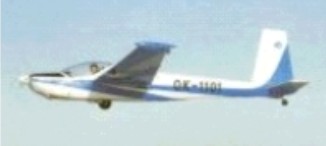
Designed by Karel Dlouhy in the middle of 70´s as a powered self-launching derivative of the LET L 13 Blanik, the Vivat uses a rear fuselage and wings very similar to the L 13. Of all metal with fabric covered control surfaces. The wings do not incorporate the flaps of the L 13, but retain the DFS type airbrakes. The center section and cockpit area are widened to make room for the two-place side- by-side seats. The main wheel is retractable, and the wingtip outrigger wheels fold back at the same time. The tail wheel is steerable, being linked to the rudder circuit. It can also be unlocked and be fully castoring outside the normal rudder-linked range. The Vivat was offered with a choice of engines, the SHE with the Czech Walter mikron, matched to a three position Hoffmann propeller, and the SL with a German Limbach fitted with a Muhlbauer electrically operated constant speed feathering propeller. The engine compartment is fitted with cooling shutters which can be closed to reduce drag when the engine is off. Both models were offered with a two wheel non-retractable landing gear as an alternative to the single retractable wheel with tip outriggers.
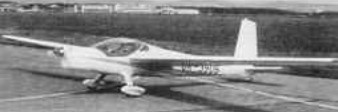
Around 200 units of the L-13 Vivat were successfully exported to USA, Canada, Australia, South Africa, Egypt, Israel, Germany, Sweden and many other countries.
Production of the L13 Vivat motorgliders ended circa 2005.
Vivat L 13
Engine: Walter Mikron III AE, 64bhp/ 48kW
Wing span: 16.8m / 55.1ft
Wing area: 20.2sq.m / 217.4sq.ft
Empty Weight: 500kg / 1102lb
Payload: 220kg / 485lb
Gross Weight: 720kg / 1587lb
Wing Load: 35.64 kg /sq.m / 7.3lb/sq.ft
Aspect ratio: 13.7
L/DMax: 24 @ 100 kph / 54 kt / 62 mph
Seats: 2
MinSink: 1.1 m/s / 3.60 fps / 2.13 kt
Airfoil: NACA 63(2)A-615, root; -612, tip
 All Aero