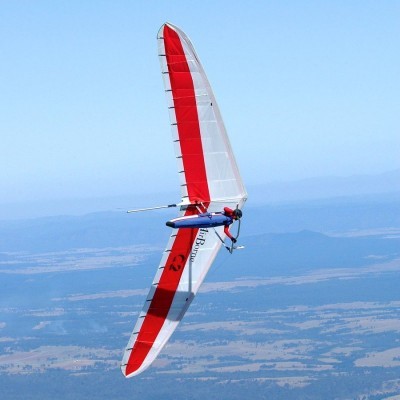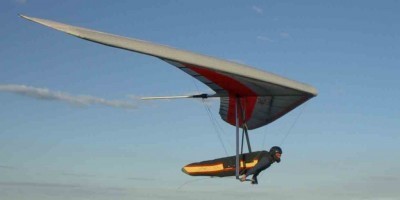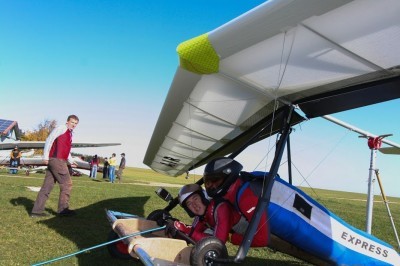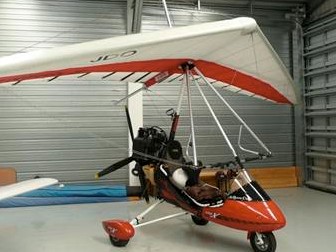
Airborne Windsports X-series Classic

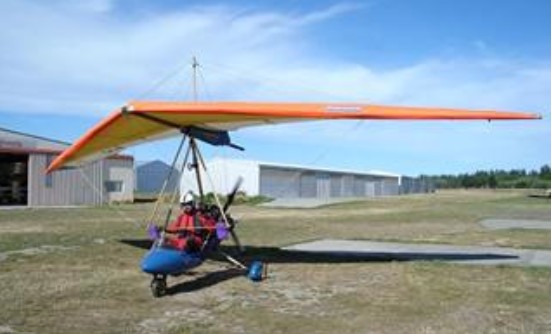
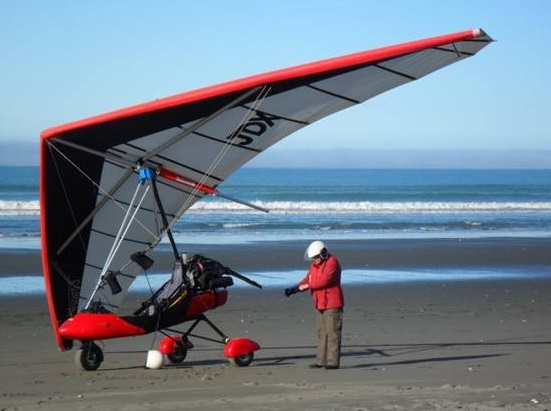
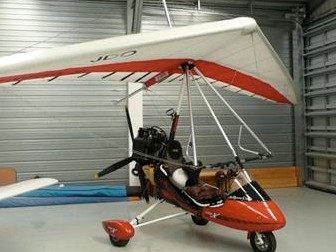
Classic trike / Streak 2 wing

Based on the Edge X base the X-Series Classic is a proven reliable and robust aircraft. Powered by the Rotax 582 65hp DCDI engine, the X-Series Classic offers the comfort of the fibreglass fairing, electric start and oil injection as standard features.
The Airborne X-Series Classic is quality built in accordance with Australian Civil Aviation Authority regulations.

X-Series Classic
Engine: Rotax Bombardier 912 UL 2, 80 hp
Reduction Ratio: 2.43:1
Prop: Bos3 68X58_SL ground adjustable 68 in
Pitch: 20 +/- 0.5 deg @ radius of 24″
MTOW: 450 kg / 992 lb
Ultimate load: +6g / -3g
Flight limits: +4g / -0g
Total max crew weight: 200 kg / 440 lb
Pilot weight Front: 55-100 kg / 121-220 lb
Pilot weight Rear: 0-100 kg / 0-220 lb
Empty weight: 260 kg / 573 lb
Wing Span: 9.97m / 32.7 ft
Wing Area: 13.5 sq m / 146 sq ft
Aspect Ratio: 6.6
Wing Weight: 50 kg / 110.23 lb
Overall Height: 3.65 m / 11.98 ft
Trike Width: 1.91 m / 6.27 ft
Trike Length: 2.745 m / 9.01 ft
Wheel Track: 1.7 m / 5.58 ft
Wheel Base: 1.89 m / 6.20 ft
Trike Height: 2.53 m / 8.30 ft
Cockpit Width: 0.7 m / 2.30 ft
Wing (Packed) Length: 5.6 m / 18.37 ft
Wing Length (Short Packed): 4.2 m / 13.78 ft
VNE: 85 kt / 157 kph / 98 mph
Cruise: 65 kt / 120 kph / 75 mph
Stall: 35 kt / 65 kph / 40 mph
Best Climb Rate: 825 ft/min / 4.2 m/sec
Best Climb Speed: 49 kt / 91 kph / 57 mph
Take off Distance to 50 ft: 247 m / 810 ft
Landing Distance from 50ft: 325 m / 1066 ft
Descent Rate 54 kt: 770 ft/min / 3.9 m/sec
Fuel Capacity: 70 lt / 18.5 USG
Range @ Cruise: 702 km / 436 sm
Maximum usable fuel 67 liters or 17.7 US Gal

XTC-912 / Cruze
Engine: Rotax Bombardier 912 UL 2, 80 hp
Propellor: Bos3 68X58_SL ground adjustable
Prop Diameter: 68″
Pitch: 20 +/- 0.5 deg @ radius of 24″
Reduction Ratio: 2.43:1
VNE: 73 kt / 135 km/hr / 84 mph
Cruise Speed @ MTOW: 50kts / 92km/hr / 57mph
Stall Speed @ MTOW: 33kts / 61km/hr / 38mph
Best Climb Rate(49 kt) @ MTOW: 976ft/min / 5.0m/sec
Take off Distance 50 ft: 210m / 689ft
Landing Distance @ MTOW from 50ft: 306m / 1004 ft
Descent Rate 54knots @ MTOW: 597 ft/min / 3.0 m/sec
Fuel Capacity: 70 lt / 18.5 USG
Max usable fuel: 67 lt / 17.7 US Gal
Range @ Cruise: 650 km / 403 miles
MTOW: 450 kg / 992 lb
Ultimate load: +6g / -3g
Flight limit: +4g / -0g
Max crew weight: 200 kg / 440 lb
Pilot weighs (Front seat): 55-100 kg / 121-220 lb
Pilot weights (Rear seat): 0-100 kg / 0-220 lb
Empty weight: 260 kg / 573 lb
Wing Span: 9.97 m / 32.7 ft
Wing Area: 14.4 sq m / 155 sq ft
Aspect Ratio: 6.6
Wing Weight: 51 kg / 112 lbs
Height: 3.65 m / 11.98 ft
Trike Width: 1.91 m / 6.27 ft
Trike Length: 2.745 m / 9.01 ft
Wheel Track: 1.7 m / 5.58 ft
Wheel Base: 1.89 m / 6.20 ft
Trike Height: 2.53 m / 8.30 ft
Cockpit Width: 0.7 m / 2.30 ft
Wing (Packed) Length: 5.6 m / 18.37 ft
Wing Length (Short Packed): 4.2 m / 13.78 ft

XT582 / Cruze
Engine: Rotax Bombardier 582 U L DCDI mod 99, 64.5 hp
Propeller: Bos3 68X58_SR ground adjustable 68″
Pitch: 19 +/- 0.5 deg @ radius of 24″
Reduction Ratio: 3.47:1
VNE: 73 kt / 135 km/hr / 84 mph
Cruise Speed: 50 kt / 92 km/hr / 57 mph
Stall Speed: 33 kt / 61 km/hr / 38 mph
Best Climb Rate(49 knots) @ MTOW: 721 ft/min / 3.7 m/sec
Best Climb Speed: 45 kt / 83 km/hr / 52 mph
Take off Dist 50 feet: 216 m / 216 m / 708 ft
Landing Distance 50 ft: 252 m / 252 m / 826 ft
Descent Rate 54knots @ MTOW: 597 ft/min / 3.0 m/sec / 597 ft/min
Fuel Capacity: 70 lt / 18.5 gal
Unusable fuel: 3 lt / 2kg
Range @ Cruise: 440 km / 272 miles
Max usable fuel: 67 lt / 17.7 US Gal
MTOW: 450 kg / 992 lb
Ultimate load @ MTOW: +6g / -3g
Flight limits @ MTOW: +4g / -0g
Max crew weight: 200 kg / 440 lb
Pilot weight (Front seat): 55-100 kg / 121-220 lb
Pilot weight (Rear seat): 0-100 kg / 0-220 lb
Max empty weight: 257 kg / 567 lb
Wing Span: 9.97 m / 32.7 ft
Wing Area: 14.4 sq m / 155 sq ft
Aspect Ratio: 6.9
Wing Weight: 51 kg / 112 lb
Overall Height: 3.65 m / 11.9 ft
Trike Width: 1.91 m / 6.3 ft
Trike Length: 2.85 m / 9.3 ft
Wheel Track: 1.7 m / 5.6 ft
Wheel Base: 1.89 m / 6.2 ft
Trike Height: 2.53 m / 8.3 ft
Cockpit Width: 0.7 m / 2.3 ft
Wing (Packed) Length: 5.6 m / 18.4 ft
Wing Length (Short Packed): 4.2 m / 13.8 ft

Classic Trike Base
Empty weight: 118 kg
Max. take off weight: 401 kg
Airframe: Aluminium Tube
No. of seats: 2
Fuel tank capacity Edge X: 44 lt
Minimum useable fuel Edge X Series: 37 litres
Edge X Classic
Classic / Streak 2B Wing
Wing weight: 49 kg
Aircraft total empty weight: 167 kg
Max. take off weight: 401 kg
Airframe: Aluminium Tube multi-sleeved
Wing span: 9.97 m
Wing area: 15.0 sq.m
Aspect ratio: 6.6:1
Nose angle: 130 degs
No. of seats: 2
Fuel tank capacity Edge X: 44 lt
Minimum useable fuel Edge X Series: 37 lt

Classic / Wizard 3 Wing
Wing weight: 47 kg
Aircraft total empty weight: 165 kg
Max. take off weight: 401 kg
Airframe: Aluminium Tube multi-sleeved
Wing span: 9.96 m
Wing area: 17.6 sq.m
Aspect ratio: 5.6:1
Nose angle: 121 degs
No. of seats: 2
Fuel tank capacity Edge X: 44 lt
Minimum useable fuel Edge X Series: 37 lt
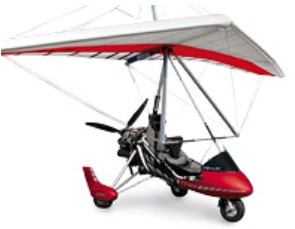
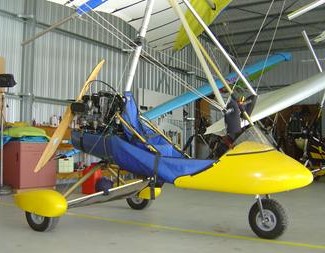
Airborne Windsports XT

XT-912 Tourer

The XT-912 Tourer is a flexwing microlight which uses the Streak or Cruze wing. The Streak-3 is the faster of the two wings with a hands-off trim speed of 56-60 knots compared to the Cruze with a trim speed of 47-52 knots. With the large capacity 70 litre fuel tank there is a potential range of 702 kilometres (436 miles) and optional dual rear disc brakes deliver stopping power for tight landing fields. The Skydat GX2 glass panel digital instrument features full engine and flight management readouts.
The XT can be set up easily by one person. The mast folds independently of the motor. A gas strut is used to help lift the wing onto the trike base and requires little effort.
High quality Fournales oleopneumatic rear shock absorbers are used on the rear, and the front uses double action adjustable shock absorbers. The XT comes standard with carb heating.
The XT-582 Tourer features all the refinements of the XT-912 base with the lower cost 582 Rotax 65hp dual ignition dual carburettor (DCDI) engine. The XTC-582 comes standard with the Cruze wing. The Cruze has a fully faired control frame with a trimmer control.The enclosed battens make for a super clean traing edge.
The 582 Tourer coupled with the Cruze wing has a faired aerodynamic control frame with trimmer control. The trimmer can be set to allow the aircraft to fly at set speeds within an 8 knot range. This feature is standard on all Streak-3 and Cruze wings. The Rotax 582 engine delivers a hands off cruise speed of around 52 knots with the Cruze wing. With XT seating and 70 litre fuel tank the XT-582 Tourer makes for a great cross country microlight. The 6” wheels allow the XT-582 Tourer to handle rough airstrips and dual rear disc brakes are available as an option.
Designed for flying around Australia and Alaska, the XT-912 Tundra with a Rotax 912 80hp is a rugged microlight that can handle extra rough or sandy terrain. Equipped with a faired cockpit, there is an optional tall windscreen for the XT-912 Tundra.
The XT-912 Tundra can be matched up with a variety of wings including the Merlin, Cruze and Streak-3. The wider wheel spats help the trike base track better with the faster Streak-3 wing. Powered by the Rotax and with optional dual rear disc brakes the XT-912 Outback has more than enough power for normal and towing flight.
The standard Skydat GX2 digital instrumentation features full engine and flight management with fuel flow and accumulated fuel usage in an easy to read glass panel.
The XT can be set up easily by one person. The mast folds independently and a gas strut is used to help lift the wing onto the trike base and requires little effort.
The XT-912 Outback standard features include the Rotax 912 Four Stroke 80hp, 70 litre fuel tank, a larger and more comfortable seat, larger instrument binnacle with room for extra instrumentation plus windscreen, optional Duratuff Bolly 3 blade propeller, and Tundra undercarriage standard.
The 912 XTOutback is Australian Civil Aviation Safety Authority Approved and tested to 6g positive and 3g negative under strict government control.
With all the refinements of the XT-912 base with the lower cost 582 Rotax 65hp dual ignition dual carburettor (DCDI) engine, the XTC-582 Tundra comes standard with the Cruze wing and big 6”x 8” Tundra Tires on 6” rims. The Cruze has a fully faired control frame with a trimmer control. The enclosed battens make for a super clean traing edge. The XT-582 Tundra coupled with the Cruze wing allows a hands off cruise speed of around 52 knots. State of the art digital instrumentation is standard with the Skydat GX2. It features full engine and flight management with fuel flow and accumulated fuel usage in an easy to read glass panel.

Airborne Windsports Climax / C2 / C4

Climax

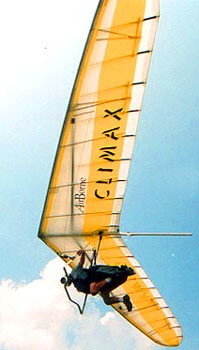
The 2000 Airborne Climax is a well rounded glider: recreational use, cross country flights or competition, it will do it all due to its light handling, plus easy takeoff and landing characteristics. It was available with 2 types of A frame, either standard or airfoiled aluminium tubes. Round carbon fiber crossbar. Aluminium alloy dive sticks and battons.

The Climax 13 is not for lightweight pilots, as it requires a high wing load.

Climax 2

The 2001 Climax 2 (C2) is for Advanced pilots.

Airborne C2-13

Standard with a full PX mylar sail, the Climax 2 was available in 13 and 14 sq.m.

Climax 2 Lite (C2 Lite)

The Climax 2 Lite (C2 Lite) for advanved pilots also appeared in 2001.

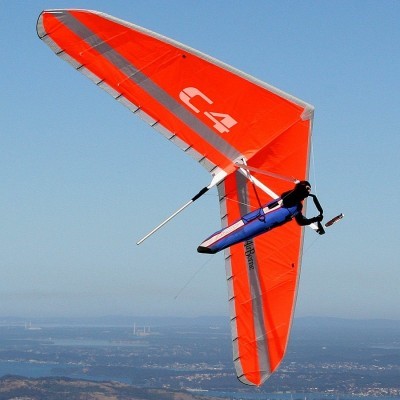
This third version of the Climax, the 2005 C4, was a success. Not only the crafting quality upped a level, but flying qualities are also remarkable concerning easy handling and pleasure. Taking off and landing are easy, the model earned in handling and speed. Overdrive requires very low effort, performances were in those of the top range models.

C4

The C4 VG Cam system is an efficient and simple way to change the geometry of the airframe in flight. The Cam levers extend the cross bars, thus changing the nose angle of the glider, which in turn tightens the sail to give an increased glide angle. This system allows the bottom rigging to remain tight in the loose VG setting, giving the pilot a much more solid feeling when ground handling for take-off. Because the cross bars do not change position, as with conventional VG systems, the static balance of the glider remains constant as does the anhedral. The centre section on the C4 is manufactured in house on a CNC miller and the cross bar wedge is made from solid 7075 alumininium. The cross bar ends are milled in house from solid 6061-T6 and are bonded into the carbon fibre cross bars. Stainless steel pins are used to connect the cross bar ends to the wedge plates. The CNC works to + or – 0.1 of a millimetre tolerance.

Manufactured in house on our CNC miller the nose wire clip allows for quick and easy attachement of nose wires, and the crossbar pullback on the C4 is easy with the 2:1 reduction. The pullback easily locates into the quickclip. The keel, and front and rear leading edges are made from 7075 aluminium.

The top control frame holes are finished off with neoprene.

Features include new airfoil profiles, new tip geometry, more double surface, taller keel pocket for a stable high speed airfoil at the centre section, a new under surface panel layout, reduced wing twist and exceptional sail constructed of PX 20 leading edge. The main sail is made from “Matrix” Polyester laminate with a 13-degree warp oriented X-Ply Polyester yarn. A light weight Taffeta is laminated to the cloth for extra durability.

Streamline clip tip battens are constructed from virtually maintenance free 7075-T6 tubing.

Optional features include Microdrag Control Frame, streamline Control Frame, and streamline Control Frame Option with Carbon Microdrag base bar. This option offers the advantages of the most comfortable carbon base bar in combination with the narrow streamline control frame uprights for an easy grip on foot launch.

Climax 13
Wing area: 13.1 m²
Wing span: 9.6 m
Aspect ratio: 7
Hang glider weight: 33 kg
Minimum pilot weight: 55 kg
Maximum pilot weight: 90 kg
Vne (Velocity Never To Exceed): 85 km/h
VA (Maximum Maneuvering Speed): 74 km/h
Maximum Speed at Minimum Wing Loading Vd: 115 km/h
Packed length: 4.9 m
Packed length short: 3.8 m
Number of battens: 28
Nose angle: 127°

Climax 14
Wing area: 14.3 m²
Wing span: 10.4 m
Aspect ratio: 8
Hang glider weight: 35 kg
Minimum pilot weight: 75 kg
Maximum pilot weight: 120 kg
Vne (Velocity Never To Exceed): 85 km/h
VA (Maximum Maneuvering Speed): 74 km/h
Maximum Speed at Minimum Wing Loading Vd: 115 km/h
Packed length: 5.3 m
Packed length short: 4.1 m
Number of battens: 30
Nose angle: 127°

C2 13
Wing area: 13.1 m²
Wing span: 9.6 m
Aspect ratio: 7
Hang glider weight: 33 kg
Minimum pilot weight: 55 kg
Maximum pilot weight: 90 kg
Maximum speed: 115 km/h
Max glide ratio speed: 56 km/h
Packed length: 4.9 m
Packed length short: 3.8 m
Number of battens: 28
Nose angle: 127°

C2 14
Wing area: 14.3 m²
Wing span: 10.4 m
Aspect ratio: 7.5
Hang glider weight: 36 kg
Minimum pilot weight: 75 kg
Maximum pilot weight: 120 kg
Maximum speed: 115 km/h
Max glide ratio speed: 56 km/h
Packed length: 5.3 m
Packed length short: 4.1 m
Number of battens: 30
Nose angle: 127°

C2 Lite 13
Wing area: 13.1 m²
Wing span: 9.6 m
Aspect ratio: 7
Hang glider weight: 33 kg
Minimum pilot weight: 55 kg
Maximum pilot weight: 90 kg
Maximum speed: 115 km/h
Max glide ratio speed: 56 km/h
Packed length: 4.9 m
Packed length short: 3.8 m
Number of battens: 28
Nose angle: 127°

C2 Lite 14
Wing area: 14.3 m²
Wing span: 10.4 m
Aspect ratio: 7.5
Hang glider weight: 36 kg
Minimum pilot weight: 75 kg
Maximum pilot weight: 120 kg
Maximum speed: 115 km/h
Max glide ratio speed: 56 km/h
Packed length: 5.3 m
Packed length short: 4.1 m
Number of battens: 30
Nose angle: 127°

C4-13
Sail Area: 12.7 sq m / 137 sq ft
Wing Span: 9.6 m / 31.5 feet
Aspect Ratio: 7.3
Nose Angle: 128-133 deg
Double Surface: 93%
Battens: 22 + 6
Glider Weight: 33 kg / 73 lb
Pack Up Length: 4.9 m / 16.1 ft
Short Pack Length: 3.8 m / 12.5 ft
Pilot Weight: 55 – 80 kg / 121 – 176 lb
Minimum speed: 40 km/h
Max glide ratio speed: 56 km/h
VNE: 85 km/h / 53 mph
Max Manoeuring Speed: 74 km/h / 46 mph
Steady State Speed: 125 km/h / 78 mph

C4-13.5
Sail Area: 13.5 sq m / 146 sq ft
Wing Span: 10.00 m / 32.8 feet
Aspect Ratio: 7.4
Nose Angle: 128-133 deg
Double Surface: 93%
Battens: 24 + 6
Glider Weight: 34 kg / 75 lb
Pack Up Length: 5.1 m / 16.7 ft
Short Pack Length: 4.0 m / 13.1 ft
Pilot Weight: 70 -100 kg / 154 – 220 lb
VNE: 85 kmh / 53 mph
Minimum speed: 40 km/h
Max glide ratio speed: 56 km/h
Max Manoeuring Speed: 74 km/h / 46 mph
Steady State Speed: 125 km/h / 78 mph
Certification: DHV

C4-14
Sail Area: 14.3 sq m / 154 sq ft
Wing Span: 10.4 m / 34.1 feet
Aspect Ratio: 7.5
Nose Angle: 128-133 degrees
Double Surface: 93%
Battens: 24 + 6
Glider Weight: 36 kg / 79 lb
Pack Up Length: 5.3 m / 17.3 ft
Short Pack Length: 4.1 m / 13.5 ft
Pilot Weight: 85 – 120 kg / 187 – 265 lb
VNE: 85 kmh / 53 mph
Minimum speed: 40 km/h
Max glide ratio speed: 56 km/h
Max Manoeuring Speed: 74 km/h / 46 mph
Steady State Speed: 125 km/h / 78 mph
Certification: DHV

Airborne Windsports Fun

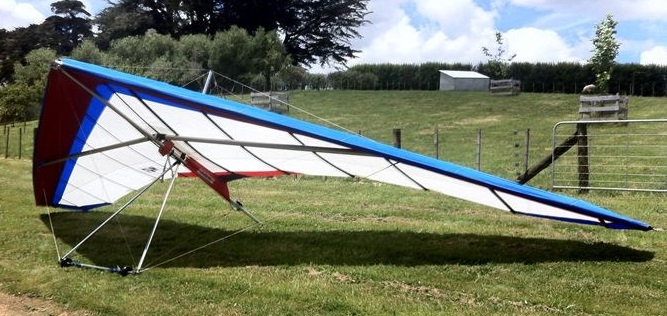
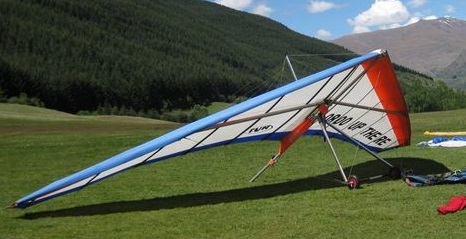
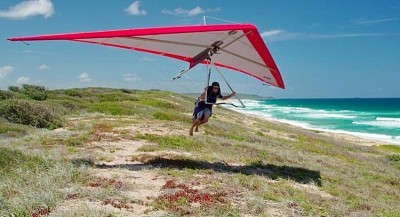
Designed to be fun to fly, light weight, quick and easy to set-up and able to fly the dunes, coastal cliff or inland thermals the 2001 Fun is light and well balanced, which makes this glider easy to launch and easy to land. A glider for the novice, or for experienced pilot’s who want to put the fun back into their sport, the The Fun was brought out in 1998, in three sizes; The FUN 160, 190, and 220 (Tandem).

Airborne Fun 190

With USHGMA certification, 7075-T6 airframe for strength and light weight (19 23 kg) the Fun can be flown prone or seated (with PG harness), and can be rigged both flat or on the A frame.

Fun

Features include Sky Floating handling and performance, Carbon Fiber washout rods, 7075-T6 battens, and a Ladder Hang Loop is available for tandem operators.

Airborn Fun 220 tandem glider

The Airborne Fun 2 appeared in 2012.

Fun 2

Gallery

FUN 160
Sail Area: 14.9 sq m / 160 sq ft
Wing Span: 9.07 m / 29.8 ft
Aspect Ratio: 5.5
Nose Angle: 118 deg
Double Surface: 26%
Battens: 13
Glider Weight: 19 kg / 42 lb
Assembly Time: 6 min
Pack Up Length: 5.31 m / 17.4 ft
Short Pack Length: 3.60 m / 11.8 ft
Pilot Weight: 50-90 kg / 110-198 lb
VNE: 80 km/h / 50 mph
Max. manoeuvring speed: 69 km/h / 43 mph
Steady state speed: 35 mph / 56 km/h
Round Down Tubes: Standard
Straight Base Tube: Standard
Faired Down Tubes: Not Available
Speed Bar: Option

FUN 190
Sail Area: 17.7 sq m / 190 sq ft
Wing Span: 10.1 m / 33.1 ft
Aspect Ratio: 5.8
Nose Angle: 118 deg
Double Surface: 26%
Battens: 13
Glider Weight: 23 kg / 51 lb
Assembly Time: 6 min
Pack Up Length: 5.9 0 m / 19.5 ft
Short Pack Length: 4.10 m / 13.4 ft
Pilot Weight: 70-120 kg / 154-265 lb
VNE: 80 km/h / 50 mph
Max. manoeuvring speed: 69 km/h / 43 mph
Steady state speed: 35 mph / 56 km/h
Round Down Tubes: Standard
Straight Base Tube: Standard
Faired Down Tubes: Not Available
Speed Bar: Option

FUN 220
Sail Area: 20.5 sq m / 220 sq ft
Wing Span: 10.8 m / 35.3 ft
Aspect Ratio: 5.7
Nose Angle: 118 deg
Double Surface: 26%
Battens: 13
Glider Weight: 28 kg / 62 lb
Assembly Time: 6 min
Pack Up Length: 6.34 m / 20.8 ft
Short Pack Length: 4.60 m / 15.0 ft
Pilot Weight: 85-187 kg / 187-412 lb
VNE: 65 km/h / 40 mph
Max. manoeuvring speed: 65 km/h / 40 mph
Steady state speed: 35 mph / 56 km/h
Round Down Tubes: Not Available
Straight Base Tube: Standard
Faired Down Tubes: Standard
Speed Bar: Option
Seats: 2

Airborne Windsports Sting

Sting 3

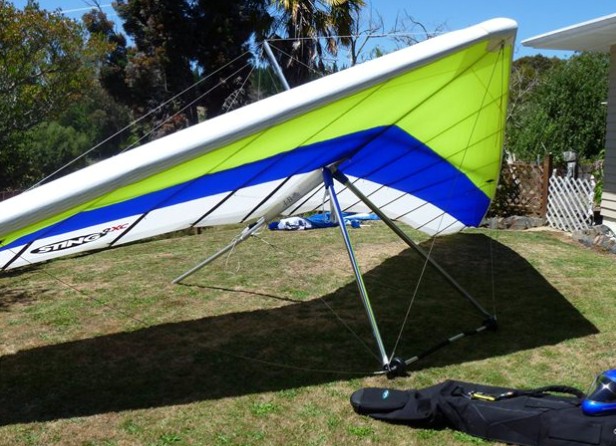
The Sting 2 is a recreational hang glider updated with 7075 airframe and battens, with faired king post, downtubes and speed bar as standard. The XC range also includes a VG system. Classed as Airbornes’ “recreational” glider the Sting is for the experienced pilot that desire reasonable performance with exceptional climb. A glider that is still very easy to launch and land.

Pilots who like to fly with a powered harness or lite trikes often use the 175 Sting. The Sting 175 has a light weight 7075-T6 main airframe and battens, and is easy to short pack. Standard configuration includes faired down tubes, speed bar with grips, PX 10 leading edge, variable geometry and enclosed battens.

The Sting 3 was available 154 and 168

The Sting 2 was being replaced by the Sting 3, and as of April 2010, only the 175 size was still in production. The consensus is that the Sting 3 is a step up in performance from the Sting 2, and may not be suitable for novice pilots. The Sting’s bottom surface covers 70 percent.

Sting 2 XC-175

The Sting 3 featured a much improved glide performance and ease of steering with the VG on. The Sting 3 has an increased range of travel on the VG system. Landing the Sting is fun, with great low speed handling authority right up to an easy flare and touch down.
The Sting 3 has a new luff curve at the heart of the design meaning that the sail has been entirely redesigned. The most recognisable difference is the undersurface layout and the increased amount of undersurface, particularly at the tips to improve the high speed glide performance.
Features include improved glide angle at inter thermal glide speeds, lighter roll control at low speeds, lighter roll control and more predictable docile stall with vg on, lighter pitch pressures and easy aerotow using a shoulder attached tow bridle and a wider range of travel for the variable geometry system.

Airborne Sting 3 – 168

The 2011 Sting 3 has an increased range of travel on the VG system. Landing the Sting is with low speed handling authority right up to an easy flare and touch down.

The Sting 3 has a new luff curve at the heart of the design meaning that the sail has been entirely redesigned. The sail most recognisable difference is the undersurface layout and the increased amount of undersurface, particularly at the tips to improve the high speed glide performance.

The Sting is constructed using 7075 airframe, fitted with faired king post, downtubes and speed bar as standard. The Sting includes a VG system as standard.

The cost in 2011 was $7500.

The Sting 3 uses the same control frame as the C4, with streamline downtubes, interchangeable control bar options including round speedbar with grips, airfoil aluminium and airfoil carbon control bars – all changed by pip pins. New are the 7075 airframe with the PX 10 leading edge, sail luff curve, airfoils, top surface, new under surface, with increased double surface area for long XC glides, and improved under surface control with an additional batten (all enclosed).

Airborne Sting 2 XC-175

Gallery

Sting 2 118
Wing area: 11 m²
Wing span: 7.88 m
Aspect ratio: 5.5
Hang glider weight: 20 kg
Minimum pilot weight: 45 kg
Maximum pilot weight: 65 kg
Maximum speed: 85 km/h
Packed length: 4.8 m
Packed length short: 3.4 m
Number of battens: 15
Nose angle: 121°

Sting 2 140
Wing area: 13 m²
Wing span: 8.5 m
Aspect ratio: 5.5
Hang glider weight: 24 kg
Minimum pilot weight: 50 kg
Maximum pilot weight: 75 kg
Maximum speed: 85 km/h
Packed length: 5.2 m
Packed length short: 3.6 m
Number of battens: 19
Nose angle: 121°

Sting 2 154
Wing area: 14.3 m²
Wing span: 9.09 m
Aspect ratio: 5.7
Hang glider weight: 26 kg
Minimum pilot weight: 60 kg
Maximum pilot weight: 90 kg
Maximum speed: 85 km/h
Packed length: 5.5 m
Packed length short: 3.9 m
Number of battens: 19
Nose angle: 121°

Sting 2 175
Wing area: 16.3 m²
Wing span: 9.8 m
Aspect ratio: 5.9
Hang glider weight: 30 kg
Minimum pilot weight: 80 kg
Maximum pilot weight: 135 kg
Maximum speed: 85 km/h
Packed length: 6 m
Packed length short: 4.2 m
Number of battens: 23
Nose angle: 121°

Sting 2X 118
Wing area: 11 m²
Wing span: 7.9 m
Aspect ratio: 5.5
Hang glider weight: 20 kg
Minimum pilot weight: 45 kg
Maximum pilot weight: 65 kg
Maximum speed: 85 km/h
Packed length: 4.8 m
Packed length short: 3.4 m
Number of battens: 15
Nose angle: 121°

Sting 2X 140
Wing area: 13 m²
Wing span: 8.5 m
Aspect ratio: 5.5
Hang glider weight: 24 kg
Minimum pilot weight: 50 kg
Maximum pilot weight: 75 kg
Maximum speed: 85 km/h
Packed length: 5.2 m
Packed length short: 3.6 m
Number of battens: 19
Nose angle: 121°

Sting 2X 154
Wing area: 14.3 m²
Wing span: 9.1 m
Aspect ratio: 5.7
Hang glider weight: 26 kg
Minimum pilot weight: 60 kg
Maximum pilot weight: 90 kg
Maximum speed: 85 km/h
Packed length: 5.5 m
Packed length short: 3.9 m
Number of battens: 19
Nose angle: 121°

Sting 2X 175
Wing area: 16.3 m²
Wing span: 9.8 m
Aspect ratio: 5.9
Hang glider weight: 30 kg
Minimum pilot weight: 80 kg
Maximum pilot weight: 135 kg
Maximum speed: 85 km/h
Packed length: 6 m
Packed length short: 4.2 m
Number of battens: 23
Nose angle: 121°

Sting II XC 154
Sail Area: 14.33 sq m / 154 sq ft
Wing Span: 9.1 m / 29.8 ft
Aspect Ratio: 5.7
Nose Angle: 121 deg
Double Surface: 70%
Battens: 19
Glider Weight: 26 kg / 57 lb
Assembly Time: 7 min
Pack Up Length: 5.5 m / 18.1 ft
Short Pack Length: 3.9 m / 12.8 ft
Pilot Weight: 60-90 kg / 132-198 lb
VNE: 85 km/h / 53 mph
Max manoeuvring speed: 74 km/h / 46 mph
Steady state speed: 35 mph / 56 km/h

Sting 2 XC 175
Sail Area: 16.28 sq m / 175 sq ft
Glider Weight: 30 kg / 66 lb
Wing Span: 9.8 m / 32.1 ft
Aspect Ratio: 5.9
Nose Angle: 121 deg
Double Surface: 70%
Pilot Weight: 80-135 kg / 176-298 lb
Skill Level: Novice SS/DS:
Battens: 23
Assembly Time: 8 min
Pack Up Length: 6.0 m / 19.7 ft
Short Pack Length: 4.2 m / 13.8 ft
VNE: 85 km/h / 53 mph
Max manoeuvring speed: 74 km/h / 46 mph
Steady state speed: 35 mph / 56 km/h
Double Surface KP/TL
Kingpost VG: Yes
Extras: Padded speed bar, faired down tubes, variable geometry, spring loaded batten tips, 7075 Aluminum

Sting 3 154
Sail Area: 14.33 sq m / 154 sq ft
Wing Span: 9.1 m / 29.8 ft
Aspect Ratio: 5.7
Nose Angle: 121 deg
Double Surface: 75%
Battens: 22
Glider Weight: 26 kg / 57 lb
Assembly Time: 7 min
Pack Up Length: 5.5 m / 18.1 ft
Short Pack Length: 3.9 m / 12.8 ft
Pilot Weight: 60-100 kg / 132-220 lb
VNE: 85 km/h / 53 mph
Max manoeuvring speed: 74 km/h / 46 mph
Steady state speed: 35 mph / 56 km/h

Sting 3 168
Sail Area: 15.60 sq m / 168 sq ft
Wing Span: 9.5 m / 31.1 ft
Aspect Ratio: 5.7
Nose Angle: 121 deg
Double Surface: 75%
Battens: 24
Glider Weight: 30 kg / 66 lb
Assembly Time: 8 min
Pack Up Length: 5.7 m / 18.7 ft
Short Pack Length: 4.1 m / 13.5 ft
Pilot Weight: 80-120 kg / 176-264.5 lb
VNE: 85 km/h / 53 mph
Max manoeuvring speed: 74 km/h / 46 mph
Steady state speed: 35 mph / 56 km/h

Airbet Girabet

The Airbet Girabet is a family of Spanish autogyros, designed and produced by Airbet of Barcelona. They are all supplied as complete ready-to-fly-aircraft. The Girabet family of designs all feature a single main rotor, tricycle landing gear and Rotax two-stroke and four-stroke engines mounted in pusher configuration. The aircraft fuselage is made from curved steel and aluminum tubing and mounts a cruciform tail. All rotor blades and other dynamic components are built by the company in-house. All models fit pre-rotators to shorten take-off distances.
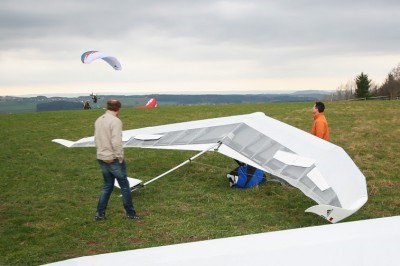
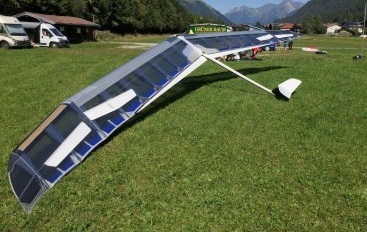
The Classic model, assembled, sold for €16,500 in 2011.

Variants:

Girabet Classic
Original single seat model, powered by a 50 hp (37 kW) Rotax 503 twin cylinder, air-cooled, two-stroke, dual-ignition powerplant. Its 7.30 m (24.0 ft) diameter rotor has a chord of 21 cm (8.3 in). The aircraft has an empty weight of 118 kg (260 lb) and a gross weight of 230 kg (510 lb), giving a useful load of 112 kg (247 lb). The company also offers a custom-built trailer for ground transportation and home storage.

Girabet 582
More powerful single seat model, powered by a 64 hp (48 kW) Rotax 582 twin cylinder, liquid-cooled, two-stroke, dual-ignition powerplant. Its 7.30 m (24.0 ft) diameter rotor has a chord of 21 cm (8.3 in). The aircraft has an empty weight of 120 kg (260 lb) and a gross weight of 230 kg (510 lb), giving a useful load of 110 kg (240 lb). Take-off roll with the pre-rotator is 20 m (65.6 ft).

Girabet 2
Side-by-side configuration two seat model intended for use as a trainer, powered by a 100 hp (75 kW) Rotax 912S four cylinder, air and liquid-cooled, four-stroke, dual-ignition powerplant. Its 8.40 m (27.6 ft) diameter rotor has a chord of 21 cm (8.3 in). The aircraft has an empty weight of 175 kg (386 lb) and a gross weight of 410 kg (900 lb), giving a useful load of 235 kg (518 lb).

Girabet 2 Sport
Side-by-side configuration two seat model intended for use as a cross country aircraft and equipped with a cockpit fairing and windshield. Powered by a 100 hp (75 kW) Rotax 912S four cylinder, air and liquid-cooled, four-stroke, dual-ignition powerplant, its 8.40 m (27.6 ft) diameter rotor has a chord of 21 cm (8.3 in). The aircraft has an empty weight of 220 kg (490 lb) and a gross weight of 450 kg (990 lb), giving a useful load of 230 kg (510 lb).

Airbet Girabet 582
Engine: 1 × Rotax 582, 48 kW (64 hp)
Propeller: 3-bladed composite
Main rotor diameter: 7.3 m (23 ft 11 in)
Empty weight: 120 kg (265 lb)
Gross weight: 230 kg (507 lb)
Fuel capacity: 42 litres (9.2 imp gal; 11 US gal)
Maximum speed: 140 km/h (87 mph; 76 kn)
Cruise speed: 105 km/h (65 mph; 57 kn)
Rate of climb: 9 m/s (1,800 ft/min)
Crew: one

AIR Atos

AIR ATOS 146

Production of the AIR Atos was held up due to the inability of DHV testing in Germany. Pitch testing was passed and was as expected.

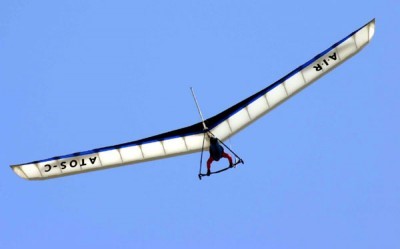
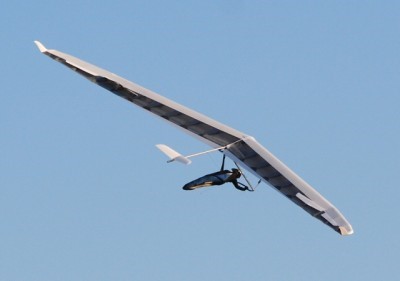
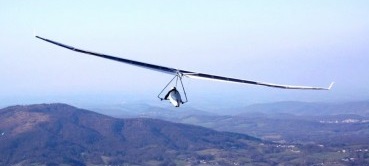
A rigid wing hang glider, with a tailplane for extra stability. The 1998 ATOS was for advanced pilots.

The ATOS C of 2002 was for advanced pilots.

ATOS C

The 2003 ATOS VX is for advanced pilots.

ATOS VX

The 2004 ATOS VS is for advanced pilots.

ATOS VS

The ATOS V of 2005 was for advanced pilots.

ATOS V

The 2005 ATOS VR was for advanced pilots.

ATOS VR

The ATOS VQ of 2007 was for advanced pilots.

ATOS VQ

The 2009 ATOS VRQ 2009 is for advanced pilots.

ATOS VRQ 2009

The ATOS VR10 of 2010 is for advanced pilots.

ATOS VR10

The ATOS VQ11T of 2011 was for advanced pilots.

ATOS VQ11T

The 2011 ATOS VR11T was for advanced pilots.

ATOS VR11T

The ATOS VR 190 BiPlace of 2013 was for advanced pilots

VR 190 Bi Place

The 2013 ATOS VR11T AF was for advanced pilots.

ATOS VR11T AF

The 2013 ATOS VRS is for advanced pilots.

ATOS VRS

The ATOS VQ Race of 2014 was for advanced pilots.

ATOS VQ Race

The ATOS VR+ of 2014 was for advanced pilots. The ATOS VR+15 of 2015 was for advanced pilots.

VR+15

Gallery

ATOS 146
Glide angle: 19-1

ATOS 02 S
Wing area: 11.6 m²
Wing span: 11.4 m
Aspect ratio: 11.3
Hang glider weight: 31 kg
Minimum pilot weight: 55 kg
Maximum pilot weight: 85 kg
Minimum speed: 34 km/h
Max glide ratio (L/H): 19
Minimum sink rate: 0.72 m/s
Packed length: 5.15 m

ATOS 02 N
Wing area: 13.6 m²
Wing span: 12.82 m
Aspect ratio: 12.1
Hang glider weight: 34 kg
Minimum pilot weight: 90 kg
Maximum pilot weight: 150 kg
Minimum speed: 30 km/h
Max glide ratio (L/H): 19
Minimum sink rate: 0.72 m/s
Packed length: 5.8 m

ATOS V
Wing area: 14.12 m²
Wing span: 12.8 m
Aspect ratio: 12.1
Hang glider weight: 38 kg
Minimum pilot weight: 90 kg
Maximum pilot weight: 150 kg
Max glide ratio (L/H): 19
Minimum sink rate: 0.7 m/s
Packed length: 5.79 m

ATOS VQ
Wing area: 14.2 m²
Wing span: 13.4 m
Aspect ratio: 12.64
Hang glider weight: 42 kg
Minimum pilot weight: 90 kg
Maximum pilot weight: 179 kg
Minimum sink rate: 0.65 m/s
Packed length: 5.15 m

ATOS VQ Race
Wing area: 14.2 m²
Wing span: 13.4 m
Hang glider weight: 37 kg
Minimum pilot weight: 85 kg
Maximum pilot weight: 179 kg
Maximum speed: 90 km/h

ATOS VQ11T
Wing area: 14.3 m²
Wing span: 13.8 m
Hang glider weight: 42 kg
Minimum pilot weight: 70 kg
Maximum pilot weight: 142 kg

ATOS VR
Wing area: 14.7 m²
Wing span: 13.8 m
Aspect ratio: 13.3
Hang glider weight: 44 kg
Minimum pilot weight: 80 kg
Maximum pilot weight: 150 kg
Minimum speed: 30 km/h
Maximum speed: 108 km/h
Max glide ratio (L/H): 19
Max glide ratio speed: 50 km/h
Minimum sink rate: 0.64 m/s

VR 190 Bi Place
Hang glider weight: 45 kg
Maximum pilot weight: 228 kg

VR+
Wing span: 14.50 m

VR+15
Wing area: 14.3 m²
Wing span: 13.8 m
Aspect ratio: 14.6
Hang glider weight: 41 kg
Minimum pilot weight: 70 kg
Maximum pilot weight: 139 kg
Minimum speed: 30 km/h
Maximum speed: 90 km/h
Max glide ratio (L/H): 19
Minimum sink rate: 0.65 m/s
Packed length short: 5 m

ATOS VR10
Wing area: 14.3 m²
Wing span: 13.8 m
Length: 13.4 m
Hang glider weight: 41 kg
Minimum pilot weight: 70 kg
Maximum pilot weight: 142 kg
Min. take-off weight: 90 kg
Max. takeoff weight: 183 kg
Minimum speed: 34 km/h
Maximum speed: 120 km/h
Max glide ratio (L/H): 19.6
Max glide ratio speed: 44 km/h
Minimum sink rate: 0.63 m/s
Transport dimensions: 5.15 x 0.48 x 0.2 m
Certification: 3E DHV

ATOS VR11T
Wing area: 14.3 m²
Wing span: 13.8 m
Aspect ratio: 13.4
Hang glider weight: 41 kg
Minimum pilot weight: 90 kg
Maximum pilot weight: 144 kg
Minimum speed: 29 km/h
Maximum speed: 110 km/h
Max glide ratio (L/H): 19
Max glide ratio speed: 43 km/h
Minimum sink rate: 0.63 m/s
Packed length: 5.15 m

ATOS VR11 AF
Wing area: 14.3 m²
Wing span: 13.8 m
Aspect ratio: 13.3
Hang glider weight: 43 kg
Minimum pilot weight: 70 kg
Maximum pilot weight: 180 kg
Minimum speed: 32 km/h
Maximum speed: 110 km/h
Max glide ratio (L/H): 19
Max glide ratio speed: 45 km/h
Minimum sink rate: 0.64 m/s
Packed length: 5.60 m

ATOS VRQ 2009
Wing area: 14.3 m²
Wing span: 13.8 m
Hang glider weight: 42 kg
Minimum pilot weight: 70 kg
Maximum pilot weight: 142 kg

ATOS VRS 135
Wing area: 12.2 m²
Wing span: 12 m
Aspect ratio: 12.2
Hang glider weight: 35 kg
Minimum pilot weight: 50 kg
Maximum pilot weight: 134 kg
Minimum speed: 33 km/h
Maximum speed: 100 km/h
Max glide ratio (L/H): 17
Max glide ratio speed: 40 km/h
Minimum sink rate: 0.70 m/s
Packed length: 4 m
Packed length short: 4 m

ATOS VS
Wing area: 11.79 m²
Wing span: 11.49 m
Aspect ratio: 11.8
Hang glider weight: 36 kg
Minimum pilot weight: 83 kg
Maximum pilot weight: 122 kg
Max glide ratio (L/H): 17.60
Minimum sink rate: 0.7 m/s
Packed length: 5.15 m

ATOS Vx
Wing area: 16 m²
Wing span: 14 m
Aspect ratio: 12.6
Hang glider weight: 48 kg
Minimum pilot weight: 110 kg
Maximum pilot weight: 222 kg
Max glide ratio (L/H): 20
Minimum sink rate: 0.7 m/s
Packed length: 5.79 m