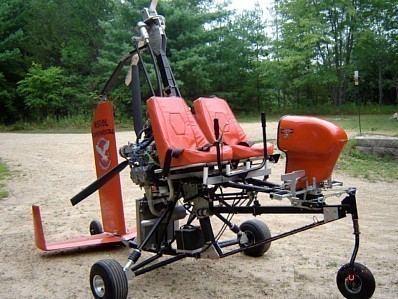
A two-seat, partially enclosed autogyro with options including an enclosure giving 10-15 mph higher cruise speed. Engine options include: 67 hp Rotax 582, 100-120 hp Arrow 1000cc. A Patrol version was available fully equipped with options. Prop: Warp Drive 60” or 68”. Rotor blades: 25’ x 8” Sky Wheels composite. Similar engines produce different results in the two-seater Commanders. Tandems reach speeds up to 120 mph with a 160-hp engine or 110 mph with a 110-hp Hirth F-30, while the side-by-side can get up to only 85 mph with the F-30. The kit price in 2001 for the Side-By-Side with the F-30 was $19,292, and without engine: $11,580.
Formed in May 1992, Air Command produces kits of autogyros. 1995-7: 702 Cooper Dr, Box 1345, Wylie, TX 75098, USA. In 2003, Air Command had a 465sq.m factory and seven employees. 2009: P.O. Box 1177, Caddo Mills Airport Building B, Caddo Mills, TX 75135, Phone: (903) 527-3335, Fax: (903) 527-3805
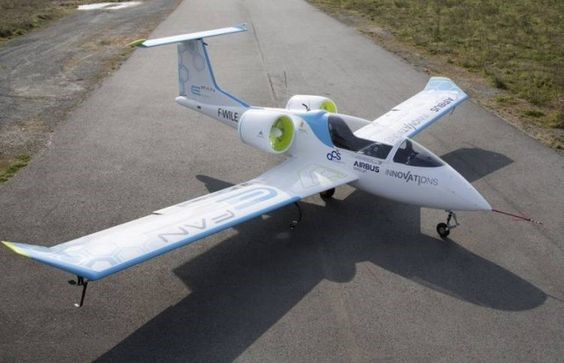
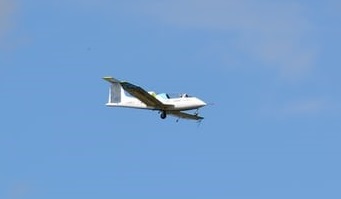
Airbus Group is developing an electric aircraft designed by Didier Esteyne, with Aero Composites Saintonge. The aircraft uses on-board lithium batteries to power the two electric motors and can carry one pilot and one passenger. First flown on 11 March 2014, a test flight was conducted in April 2014 at Mérignac Airport, France, landing in front of a large audience, the French Minister of Industry Arnaud Montebourg being one of them. At the 2014 Farnborough Airshow, Airbus announced that the E-Fan 2.0 will go into production by 2017 with a side-by-side seating layout.
The E-Fan aircraft was developed by Airbus Group in association with other consortium partners. The core development team consisted of ACS, EADS Innovation Works, Astrium, Eurocopter (now part of Airbus Group). EADS Innovation Works provided the overall project management and overall aircraft energy management system, while ACS provided support in the construction of all composite parts and mechanical assembly of the landing gear and flight controls.
Institut Pprime provided support for the design of the aircraft main spar and the wing. A3IP provided design, routing, prototyping and manufacture support in the production of tailor-made printed circuit boards for electrical networks. RF Tronic Ingénierie provided design and integration of the air-to-ground telemetry system and the flight data recorder, and also developed a software to display the technical flight parameters.
C3 Technologies provided spars and wings, while MAPAERO Aerospace Coatings provided high-quality paint for the aircraft. The propulsion systems were provided by Safran, Snecma, Labinal Power Systems and Aircelle.
The project evolved from the Cri-Cri electric plane, which Airbus used as a test bed and flying laboratory for developing the battery and energy management technology used in the E-Fan.
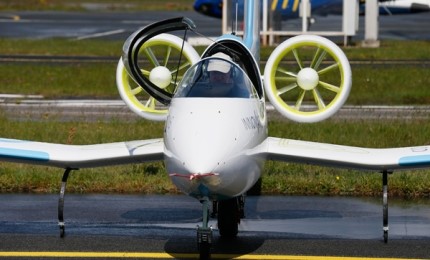
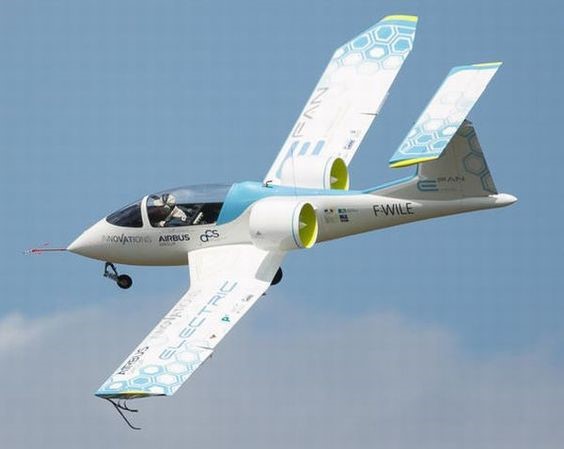
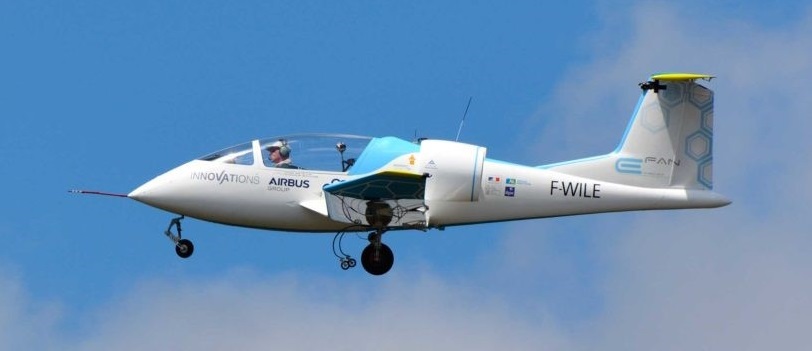
The E-Fan is an all-electric two-seat twin-motor low-wing monoplane of composite material structure. It has a T-tail and a retractable tandem landing gear with outrigger wheels. The two motors are mounted on either side of the rear fuselage.
Two production variants are planned, a two-seater E-Fan 2.0 for use as a trainer, and the E-Fan 4.0 four-seater. The E-Fan 4.0 appears identical to the E-Fan apart from a fuselage stretch. To increase flight duration the E-Fan 4.0 will have a hybrid-electric system that will have a small engine to charge the battery (like a range extender), which will increase its duration from 2 hours to 3.5 hours. First flight of the E-Fan 2.0 was planned for 2017 and the E-Fan 4.0 should follow in 2019.
The E-fan is of all-composite construction and is propelled by two ducted, variable-pitch fans spun by two electric motors totaling 60 kW of power. Ducting increases thrust while reducing noise, and having the fans mounted centrally provides better control. The motors moving the fans are powered by a series of 250-volt Lithium polymer battery packs made by South Korean company Kokam. The batteries are mounted in the inboard section of the wings. They have enough power for one hour and take one hour to recharge. An onboard backup battery is available to make an emergency landing if power runs out while airborne. The E-fan’s landing gear consists of a retractable fore and aft wheel, and a fixed wheel under the wings. Unusually for an aircraft, the main wheel is powered by a 6 kW electric motor, which allows the plane to be taxied without the main motors, and is able to accelerate it to 60 km/h (37 mph; 32 kn) for takeoffs. Having the takeoff run performed by the undercarriage relieves some of the burden on the flight motors.
A key technology on the E-Fan is its E-FADEC energy management system, which automatically handles the electrical systems. According to Airbus, this simplifies system controls and, since E-Fan is a trainer, eases the workload of instructors and students.
In December 2014 Airbus announced that DAHER-SOCATA will complete the design work on the aircraft and certify it. VoltAir, an Airbus subsidiary, developed the initial prototype and will work with Daher-Socata during the testing phase as the project manager. At this point the aircraft became the VoltAir E-Fan. BpiFrance Public Investment Bank will partially provide finance for the development.
On 30 April 2015 the company announced that the aircraft will be produced at Pau Pyrénées Airport, south-west France, at a new facility to be constructed in 2016, that will be near the DAHER-SOCATA plant at Tarbes. First deliveries were expected at the end of 2017 or early 2018.
On 9 July 2015, the E-Fan crossed the English Channel from Lydd Airport to Calais–Dunkerque Airport. It was flown by Didier Esteyne, the chief engineer of the E-Fan. Initially this was claimed as the first electric aircraft to cross the English Channel, but it has since been pointed out that there were previous such flights, including MacCready Solar Challenger as long ago as 1981, and Airbus now say it was the “first all-electric two-engine aircraft” to make the crossing. Siemens has sponsored electric equipment on the E-fan, but not motors.
In March 2017 Airbus abandoned its plan to produce the electric E-Fan two-seater as a ready-for-sale training aircraft. The French company says the pace of development in the electric aircraft field has moved its ambitions onwards. Stefan Schaffrath, media spokesman for Airbus, said “This plane has done its job. Today, a large part of the technologies developed for E-Fan is in new projects.”
Airbus points out that the E-Fan project started three years with two 30kW electric motors. Now Siemens, its partner in the project, is flying an Extra aerobatic aircraft with a 300kW electric motor, a progression of 10x in three years.
Variants
E-Fan Two-seat concept aircraft ad technology demonstrator, first flown March 2014. E-Fan 2.0 Proposed all-electric two-seat production variant, to fly 2017. E-Fan 4.0 Proposed hybrid-electric four-seat variant, to fly 2019; a kerosene fuelled generator will extend endurance from 2 h to 3 h 30 min. E-Thrust Proposed 90-seat regional jet based on the principles of the E-Fan.
Specifications E-Fan Powerplant: 2 × Electric motor, 30 kW (40 hp) Props: 2 x eight-blade ducted fans, 0.75 kN (266 lb st), thrust Battery: Lithium-ion 18650, with 207 Wh/kg per cel, total of 29 kWh Battery weight: 167 kg Wingspan: 9.50 m (31 ft 2 in) Length: 6.67 m (21 ft 11 in) Max takeoff weight: 550 kg (1,213 lb) Maximum speed est: 220 km/h (137 mph; 119 kn) Cruising speed est: 160 km/h (99 mph; 86 kn) Take-off speed: 110km/h Endurance: 45 min – 1 hr Lift-to-drag: 16:1 Crew: one Capacity: one passenger
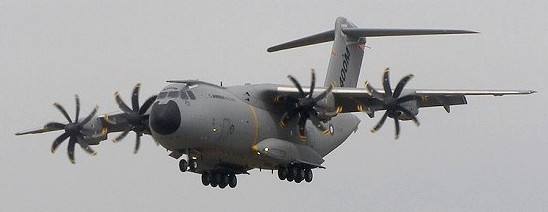
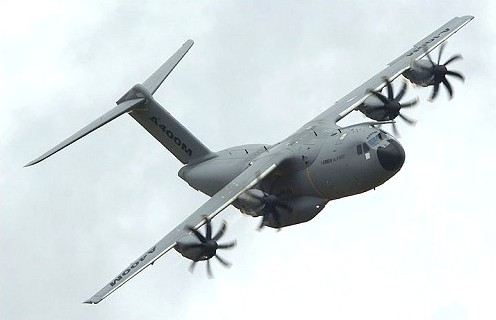
The Airbus A400M, also known as the Atlas, is a multi-national four-engine turboprop military transport aircraft. It was designed by Airbus Military as a tactical airlifter with strategic capabilities. The aircraft’s maiden flight, originally planned for 2008, took place on 11 December 2009 in Seville, Spain.
Engines: 4 x 8250kW Europrop TP400-D6 turboprops Wingspan: 42.4 m / 139 ft 1 in Length: 45.1 m / 148 ft 12 in Height: 14.7 m / 48 ft 3 in Max Take-off weight: 141000 kg / 310853 lb Empty weight: 76500 kg / 168655 lb Payload: 37000kg / 81571 lb Ceiling: 11300 m / 37050 ft Range w30 tonne: 2450 nm Range w20 tonne: 3550 nm Crew: 3-4
A400M Engines: 4 x Europrop TP400-D6 turboprops, 11,060 hp / 8250kW Wingspan: 42.4 m / 139 ft 1 in Length: 45.1 m / 148 ft 12 in Height: 14.7 m / 48 ft 3 in Max Take-off weight: 141000 kg / 310853 lb Empty weight: 76500 kg / 168655 lb Payload: 37000kg / 81571 lb Maximum Speed: 485mph (780kmh; 421kts) Ceiling: 11300 m / 37050 ft Range w30 tonne: 2450 nm Range w20 tonne: 3550 nm Maximum Range: 5,412miles (8,710km) Crew: 3-4
After years of research Airbus decided to proceed with the 8.8 billion A380 project in 1999, the final budget settling at about 12 billion. The double-decker layout would provide higher seat capacities and, hence, cost savings over a traditional design.
Originally known as the A3XX, the A380 is a double-deck, four-engined airliner. Airbus began engineering development work in June 1994 with key design aims including the ability to use existing airport infrastructure with little modifications to the airports, and direct operating costs per seat 15-20% less than those for the 747-400. With 49% more floor space and only 35% more seating than the previous largest aircraft, Airbus is ensuring wider seats and aisles for more passenger comfort. Using the advanced technologies, the A380 is also designed to have 10-15% more range, lower fuel burn and emissions, and less noise.
The A380’s wing has been designed to cope with a MTOW of 590t, albeit with some strenghtening required, allowing for a future stretch. The stronger wing and structure is used on today’s freighter version, the A380-800F. This approach sacrifices some fuel efficiency on the initial passenger model but the sheer size of the aircraft coupled with the significant advances in technology over the years should provide lower operating costs per passenger than the 747.
With orders and options from nine customers (Air France, Emirates (the first customer), Federal Express (the cargo model launch customer), International Lease Finance Corporation, Lufthansa, Qantas, Qatar Airways, Singapore Airlines, and Virgin Atlantic), the Airbus A380 was officially launched on December 19, 2000, and production started on January 23, 2002.
The upper deck extends the entire length of the fuselage allowing for a three-class configuration to seat 555 people, up to maximum of 853 in full economy class configuration. Airbus made the cockpit layout, procedures, and handling characteristics similar to those of other Airbus aircraft to reduce crew training costs. Accordingly, the A380 features a glass cockpit and side-stick flight controller driving the airplane by fly-by-wire technology.
Airbus operates 16 manufacturing sites across Europe, most of which produce parts for the new A380 airliner. First, the front and rear sections of the fuselage are loaded on an Airbus RORO ship, Ville de Bordeaux, in Hamburg, northern Germany, and are shipped to the United Kingdom. There the huge wings, which are manufactured at Filton in Bristol and Broughton in north Wales, are transported by barge to Mostyn docks where the ship adds them to its cargo. In Saint-Nazaire, western France, the ship trades the fuselage sections from Hamburg for larger, assembled sections, some of which include the nose. The ship unloads in Bordeaux. Afterwards, the ship picks up the belly and tail sections in Cadiz, southern Spain, and delivers them to Bordeaux.
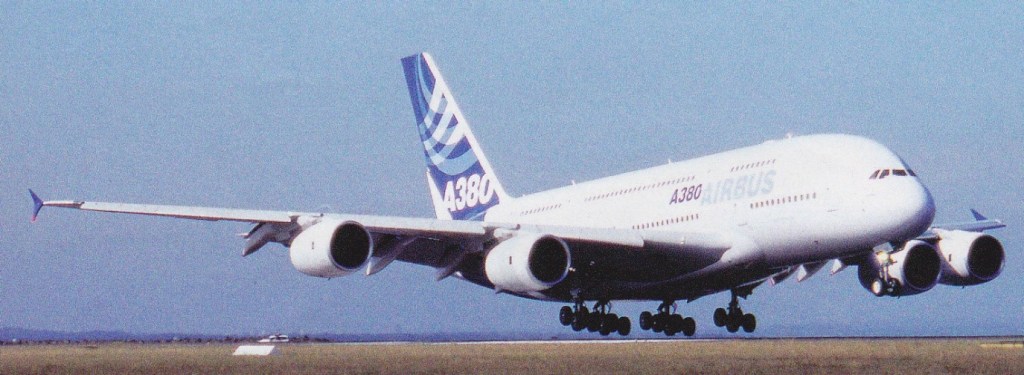
From there the A380 parts are transported by barge to Langon, and by road to an assembly hall in Toulouse. New wider roads, extra canal systems, and barges were developed to deliver the massive A380 parts. After assembly the aircraft are flown to Hamburg to be furnished and painted. Final assembly began in 2004, with first aircraft (MSN001) displayed in January 2005. The first A380 prototype was unveiled during a ceremony in Toulouse, on January 18, 2005. Its manufacturer’s serial number is 001, and is registered as F-WWOW.
The airliner took off for its maiden flight at 8:29 UTC (10:29 a.m. local time) on April 27, 2005, from runway 32L of Blagnac International Airport in Toulouse, France, taking off with a flight crew of six, 22 tons of flight test instrumentation and water ballasts.
The crew was made up of French test pilots Jacques Rosay (captain for the take-off and the initial part of the test flight) and Claude Lelaie (captain for the second part of the test flight including the landing), as well as three flight test engineers (Spanish, French, and German), and one French test flight engineer. With the recent Franco-German controversy over the leadership of EADS still fresh in mind, Airbus issued a statement to make it clear that the crew had been chosen not based on nationality, but based on competence.
The takeoff weight of the aircraft was 421 tonnes (464 US tons), or about 75 % of its maximum takeoff weight for commercial flights. This was the heaviest takeoff weight of any passenger airliner ever created. After takeoff the jet headed west toward the Bay of Biscay, then south over the northern Pyrenees Mountains and concluded with a low altitude fly-by over the town of Toulouse. The 233 minute flight involved conducting tests on its engines, hydraulics, and electronics, while the on-board test equipment recorded measurements for 150,000 different parameters and sent data back to computers on the ground.
The A380 was powered by Rolls-Royce Trent 900 engines and by mid-October 2005 had logged more than 100 flights and 350 hours in the air.
The second A380 first flew on 18 October 2005 followed by the third on 3 November.
The A380-800 has a maximum range of 15,000km (sufficient to fly from Chicago to Sydney nonstop), and a cruising speed of 1,050km/h.
The first A380 was revealed to the world in front of 4500 guests at Toulouse on 18 January 2005, dignitaries including the British and Spanish Prime Ministers, French President and German Chancellor.
In March 2006 Airbus successfully completed a passenger evacuation test of the A380 with 853 passengers, two pilots and 18 cabin crew evacuating an aircraft well within the required 90 seconds. The test was conducted in darkness and with half of the doors inoperative. The doors were not known in advance.
The Airbus A380 reached 1000 flying hours, the first aircraft reaching the milestone during a flight test on 27 April 2006. In December 2006 the A380 was awarded joint US and European certification.
Sixteen airlines had ordered the A380 as of June 18, 2005, including an order from AIG’s aircraft leasing unit, ILFC. A380 orders standing at 159, included 27 freighter versions. Break-even was estimated to be at 250 to 300 units. Airbus CEO, Noel Forgeard, had said he expected to sell 750 of the aircraft. Official prices have been withheld but it was estimated at $264 million.
Interestingly, the A380’s horizontal stabilizer measures 30.4 meters (100 feet), during takeoff the A380 wings flex upward by more than 4 meters (13 feet), and the external paint (primer and topcoat) on an A380 weighs 531 kg (1,171 lbs).
A380 F-WXXL cn002 at Sydney November 2006 after non-stop route proving from Johannesburg via the South Pole.
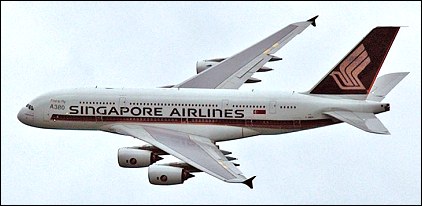
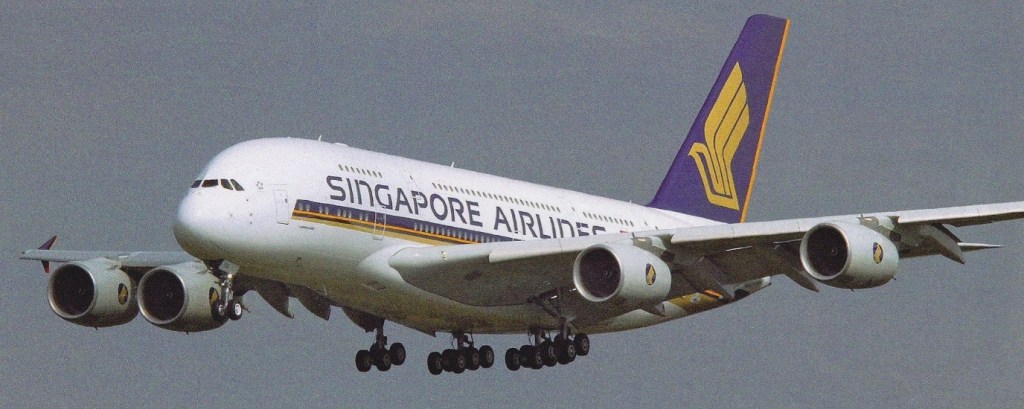
The first A380 commercial service was flown on 25 October 2007 with Singapore Airlines 9V-SKA.
First commercial flight
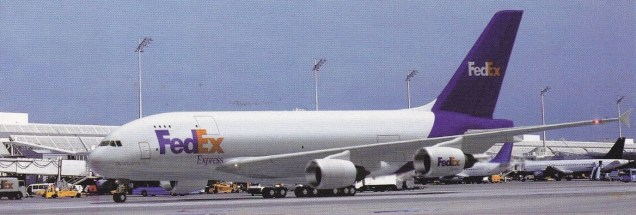
As launch customer for the A380-800F FedEx Express was to take delivery of three aircraft each in 2008, 2009 and 2010 followed by one in 2011.
After producing 251 A380s, production ended in 2021.
A380-800 Engines: 4 x Engine Alliance GP7270 or Rolls-Royce Trent 970/B turbofan, 72,000-84,000lb thrust Wing span: 79.8m / 261ft 10in Length: 73m / 239ft 6in Height: 24,1 m / 79ft 1in Operating weight empty: 275,000kg / 606,000lb Maximum Take-Off Weight: 1,234,589lbs (560,000kg) Maximum Speed: 634mph (1,020kmh; 551kts) Max cruising speed: M 0.88 / 903 kmh / 561 mph Long range cruising speed M 0.85 Maximum Range: 9,445miles (15,200km) Initial climb rate: 2,300 fpm Service Ceiling: 43,028ft (13,115m) Seats: 555 Cargo capacity: 38 LD3s or 13 pallets. Crew: 2
A380-800HGW Max takeoff weight: 560,000kg / 1,235,000lb Max cruising speed M 0.88 Long range cruising speed M 0.85 Range 15,100km / 8,150nm Service ceiling: FL430 Crew: 2
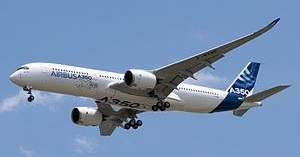
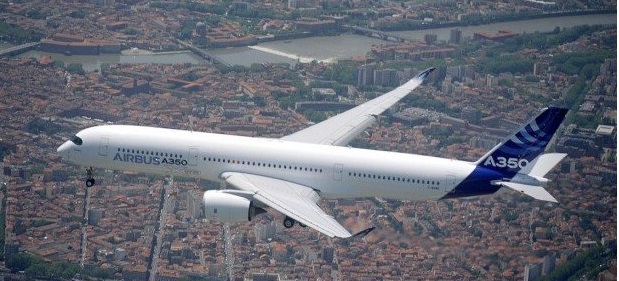
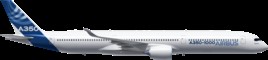
A350-941 F-WXWB during its maiden flight on 14 June 2013
The A350 was originally conceived in 2004 with new aerodynamics and engines while having a fuselage based on the A330. This was rejected by some prospective customers.
The original version of the A350 superficially resembled the A330 due to its common fuselage cross-section and assembly. A new wing, engines and a horizontal stabiliser were to be coupled with new composite materials and production methods applied to the fuselage to make the A350 an almost all-new aircraft. On 10 December 2004, the boards of EADS and BAE Systems, then the shareholders of Airbus, gave Airbus an “authorisation to offer (ATO)”, and formally named it the A350.
The A350 was planned to be a 250- to 300-seat twin-engine wide-body aircraft derived from the design of the existing A330. Under this plan, the A350 would have modified wings and new engines, while sharing the same fuselage cross-section as its predecessor. As a result of a controversial design, the fuselage was to consist primarily of Al-Li, rather than the carbon-fiber-reinforced polymer (CFRP) fuselage on the 787. It was to see entry in two versions: the A350-800 capable of flying 8,800 nmi (16,300 km) with typical passenger capacity of 253 in three-class configuration and the 300-seat (3-class) A350-900 with 7,500 nmi (13,900 km) range. It was designed to be a direct competitor to the 787-9, and 777-200ER. Development costs were projected to be €12 billion (US$15 billion or £10 billion).
Airbus faced criticism on the A350 project from the heads of two of their largest customers, International Lease Finance Corporation (ILFC) and GE Capital Aviation Services (GECAS). Called “a Band-aid reaction to the 787”, and “Having gone through the trouble of designing a new wing, tail, cockpit” and adding advanced new materials, Airbus “should have gone the whole hog and designed a new fuselage.” Airbus responded by stating they were considering improvements for the A350 to satisfy customer demands.
In 2006, Airbus renamed it the A350 XWB (extra wide body). The A350 is the first Airbus with both fuselage and wing structures made primarily of carbon-fiber-reinforced polymer. It can carry 250 to 350 passengers in a typical three-class seating layout, or maximum seating of 440 to 550 passengers, depending on variant. There was some previous speculation that the revised aircraft would be called the Airbus A370 or A280, with Airbus going as far as accidentally publishing an advertisement referring to the model as the “A280” on the Financial Times’s website.
On 13 June 2005 at the Paris Air Show, Middle Eastern carrier Qatar Airways announced that they had placed an order for 60 A350s. In September 2006 the airline signed a memorandum of understanding with General Electric to launch the GEnx-1A-72 for the aircraft. Emirates sought a more improved design and decided against ordering the initial version of the A350, then placed an order for A350 XWBs in 2007.
In 2006 Singapore Airlines announced an agreement to order 20 A350XWBs with options for another 20 A350XWBs.
The proposed new A350 was a new design also including a wider fuselage cross-section. The new A350 fuselage allows seating arrangements ranging from an 8-abreast low-density premium economy layout to a 10-abreast high-density seating configuration, allowing for a maximum seating capacity of 440–550 depending on variant. All A350 passenger models will have a range of at least 8,000 nmi (15,000 km). The redesigned composite fuselage provides higher cabin pressure and humidity, and lower maintenance costs.
On 1 December 2006, the Airbus board of directors approved the industrial launch of the A350-800, -900 and -1000 variants. First delivery for the A350-900 was scheduled for mid-2013, with the −800 and −1000 following on 12 and 24 months later, respectively. At a 4 December 2006 press conference, a few new technical details of the A350 XWB design were revealed, but no new customers were identified. Airbus indicated existing A350 contracts were under re-negotiation due to increases in prices compared to the original A350s contracted.
The change to the XWB design imposed a two-year delay into the original timetable and increased development costs from US$5.3 billion (€5.5B) to approximately US$10 billion (€9.7B). As as result the flight test schedule was compressed from the original 15 months to 12 months. A350 programme chief Didier Evrard stressed that the delays only affect the A350-900 and that the -800 and -1000 schedules remain unchanged.
Airbus confirmed in early September 2007 the adoption of composite fuselage frames for the aircraft structure. The composite frames will feature aluminium strips to ensure the electrical continuity of the fuselage (for dissipating lightning strikes). Airbus was to use a full mock up fuselage to develop the wiring, a different approach from the A380, on which the wiring was all done on computers.
Rolls-Royce agreed with Airbus to supply a new variant of the Trent engine for the A350 XWB, named Trent XWB. After the low-speed wind tunnel test, Airbus froze the static thrust at sea level for all three proposed variants in the 330–420 kN (74,000–94,000 lbf) range in 2010.
In January 2008, French-based Thales Group won the US$2.9 billion (€2 billion) 20-year contract to supply avionics and navigation equipment for the A350 XWB. US-based Rockwell Collins and Moog Inc were chosen to supply the horizontal stabiliser actuator and primary flight control actuation, respectively.
Airbus constructed 10 new factories in Western Europe and the US, with extensions carried out on 3 further sites. Among the new buildings was a £570 million (US$760 million or €745 million) composite facility in Broughton, Wales, which would be responsible for the wings. In June 2009, the National Assembly for Wales announced provision of a £28 million grant to provide a training centre, production jobs and money toward the new production centre. Another new construction facility was the composite rudder plant in China, which was opened in early 2011.
Airbus manufactured the first structural component in December 2009 and production of the first fuselage barrel began in late 2010 at its production plant in Illescas, Spain.
The forward fuselage of the first A350 aircraft was delivered to the factory on 29 December 2011. Final assembly of the first A350 static test model was started on 5 April 2012. Final assembly of the first flight-test A350 was completed in December 2012.
On 2 June 2013, Airbus powered up the Rolls-Royce Trent XWB engines on the A350 aircraft for the first time. The A350’s maiden flight took place on 14 June 2013 from the Toulouse-Blagnac Airport. As of December 2013, Airbus had received orders for 812 aircraft from 39 customers.
On 11 June 2014, Emirates cancelled an order for 70 A350s (50 A350-900s and 20 A350-1000s), which represented 9% of the A350 production backlog. Emirates president Tim Clark said that the airline was frustrated with the development of the A350-1000, including changes to the A350-1000 engines which were previously shared with the A350-900.
The A350 XWB is made out of 53% composites, 19% Al/Al-Li, 14% titanium, 6% steel and 8% miscellaneous.
October 2008 was the Airbus internal goal to freeze the design and Airbus expects 10% lower airframe maintenance cost and 14% lower empty seat weight than competing aircraft.
The new XWB fuselage has a constant width from door 1 to door 4. The double-lobe (ovoid) fuselage cross-section will have a maximum outer diameter of 5.97 m (19.6 ft), and internal diameter of 5.61 m (18.4 ft) wide at armrest level. It allows for an eight-abreast 2–4–2 arrangement in a premium economy layout, with the seats being 49.5 cm (19.5 in) wide between 5 cm (2.0 in) wide arm rests. In the nine-abreast, 3–3–3 standard economy layout, the XWB’s seat width is 45 cm (18 in). Overall, Airbus promises passengers more headroom, larger overhead storage space and wider panoramic windows than current Airbus models.
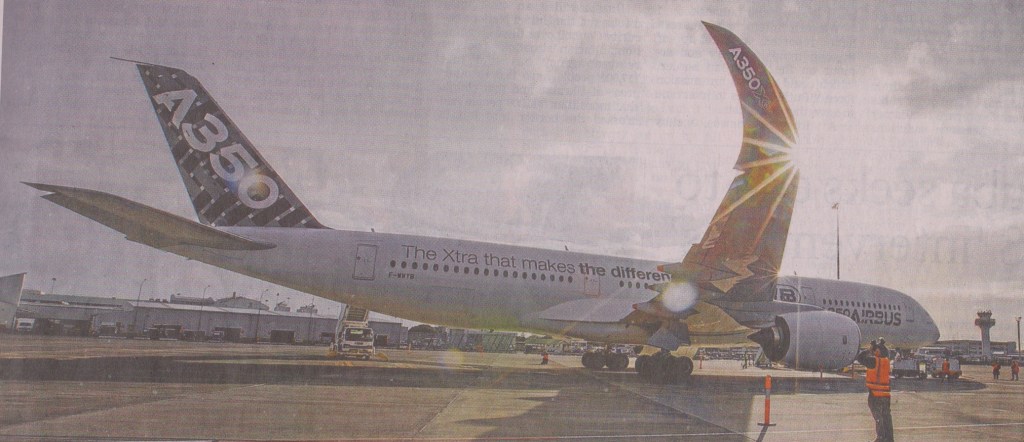
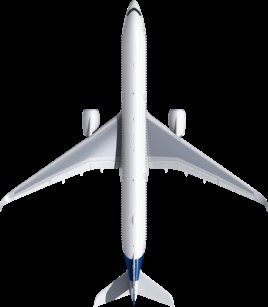
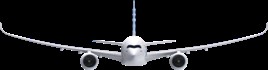
The A350 features new composite wings with a wingspan that is common to the three proposed variants. With an area of 443 m2 (4,770 sq ft), the wingspan is 64.8 m (213 ft). The wing tip will not have Airbus’ traditional wingtip fences, but instead will curve upwards over the final 4.4 metres (14 ft) in a “sabre-like” shape. The wing has a 31.9° sweep angle, helping to increase typical cruise speed to Mach 0.85 and maximum operating speed to Mach 0.89. The A350-1000 have a wing design with about a 4% increase in surface area.
A trailing-edge high-lift system has been adopted with an advanced dropped-hinge flap (similar to that of the A380), which permits the gap between the trailing edge and the flap to be closed with the spoiler. The wings are produced in a new £400M/46,000 square metres (500,000 sq ft) North Factory at Airbus Broughton, employing 650 workers, in a specialist facility constructed with £29M of support from the Welsh Assembly Government.
The XWB’s nose section configuration is derived from the A380 with a forward-mounted nosegear bay and a six-panel flightdeck windscreen. This differs substantially from the four-window arrangement in the original design and enables overhead crew rest areas to be installed further forward and eliminate any encroachment in the passenger cabin. The windscreen was revised to improve vision by reducing the width of the centre post. The upper shell radius of the nose section was increased.
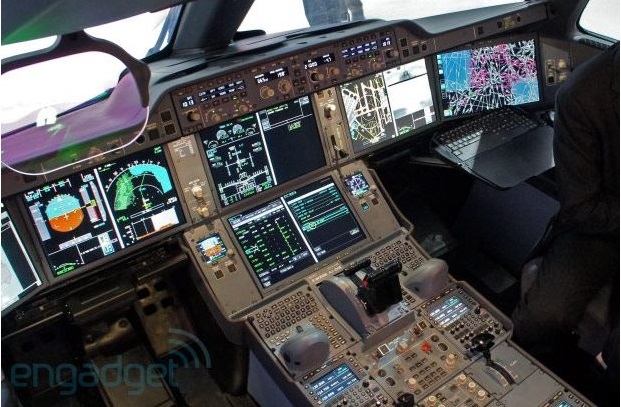
The cockpit adopted 38 cm (15 in) LCD screens. The six-screen configuration having two central displays mounted one above the other (the lower one above the thrust levers) and a single (for each pilot) primary flight/navigation display, with an adjacent on-board information system screen. The A350 XWB also features a head-up display.
The Trent XWB family has two basic engines to power the three A350 variants. The baseline 370 kN (83,000 lbf) thrust version for the A350-900 derated to 330 kN (74,000 lbf) and 350 kN (79,000 lbf) for the −800, upgraded 432 kN (97,000 lbf) thrust version to power the A350-1000. The higher-thrust version will have some modifications to the fan module—it will be the same diameter but will run slightly faster and have a new fan blade design—and run at increased temperatures allowed by new materials technologies from Rolls-Royce’s research. The basic 248 t MTOW −800 was to be offered with a 330 kN (74,000 lbf) sea-level-thrust rating, while the 279 t MTOW option to have 350 kN (79,000 lbf) thrust. Airbus also planed to offer a ‘hot and high’ rating option for Middle Eastern launching customers Qatar Airways, Emirates, and Etihad. This option had an increased thrust of 350 kN (79,000 lbf) at higher altitudes and temperatures.
Engine thrust-reversers and nacelles will be supplied by US-based UTC Aerospace Systems. The A350 XWB features a 1,268 kW (1,700 shp) Honeywell HGT1700 auxiliary power unit. Honeywell has also supplyed the air management system: the bleed air, environmental control, cabin pressure control and supplemental cooling systems. The ram-air turbine supplied by Hamilton Sundstrand and located in the lower surface of the fuselage. The generator requirement for the ram air turbine is 100 kVA.
In light of the Boeing 787 Dreamliner battery problems, in February 2013 Airbus decided to revert from Lithium-ion to the proven Nickel-cadmium technology although the flight test programme continued with the Lithium-Ion battery systems.
Each main undercarriage leg is attached to the rear wing spar forward and to a gear beam aft, which itself is attached to the wing and the fuselage. To help reduce the loads further into the wing, a double side-stay configuration was adopted.
Airbus devised a three-pronged main undercarriage design philosophy encompassing both four- and six-wheel bogies to ensure it can keep the pavement loading within limits. The A350-800 and A350-900 will both have four-wheel bogies, although the −800’s were be slightly shorter to save weight. Both fit in the same 4.1 m (13 ft) long bay. The proposed higher weight variant, the A350-1000 (and the A350-900R, which is being proposed to British Airways, with −900 size but with sufficient fuel capacity to allow nonstop London-Sydney flights) was to use a six-wheel bogey, with a 4.7 m (15 ft) undercarriage bay. French-based Messier-Dowty provide the main undercarriage for the −800 and −900 variant, and UTC Aerospace Systems will supply the −1000 variant. The nose gear will be supplied by Liebherr-Aerospace.
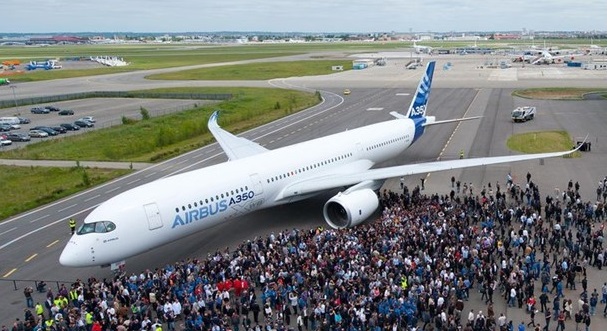
Airbus A350 (MSN001)
Variants Three variants of the A350 were launched in 2006. In July 2012, the A350-900 was scheduled to enter service in the second half of 2014; then the −800 in mid-2016, and −1000 in 2017.
A350-900 The A350-900 is the first A350 model and seats 314 passengers in a three-class cabin and 9-abreast layout. It has a standard design range target of 15,000 km (8,100 nmi). Airbus says that the A350-900 will have a decrease of 16% MWE per seat, a 30% decrease in block fuel per seat and 25% better cash operating cost than the Boeing 777-200ER. The −900 is designed to compete with the Boeing 777-200ER and replace the Airbus A340-300. The −900R variant would feature the higher engine thrust, strengthened structure and undercarriage of the −1000. Range of the A350-900R was estimated to 17,600 km (9,500 nmi), which would be boosted to about 19,100 km (10,315 nmi) by design improvements and be capable of non-stop flight from London-Heathrow to Auckland. The −900F freighter variant has also been proposed.
A350-1000 The A350-1000 has an 11-frame stretch over the −900 and was to enter service after the −800. It is the largest variant of the A350 family and was is to seat 350 passengers in a three-class cabin and 9-abreast configuration. It was to have a range of 15,600 km (8,400 nmi). The A350-1000 will feature a slightly larger wing than the −800/900 models; a trailing-edge extension increasing its area by 4%. This will extend the high-lift devices and the ailerons, making the chord bigger by around 400 mm, optimising flap lift performance as well as cruise performance. These and other engineering upgrades are necessary so that the −1000 model does not suffer a reduction in range.
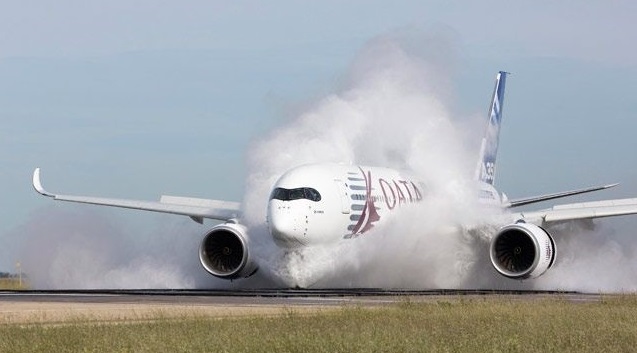
Airbus has successfully performed certification testing to demonstrate the A350 XWB’s ability to operate on wet runways in May 2014.
A350-900 MSN4
During water-ingestion tests at Istres-Le Tubé Air Base in the south of France, MSN4, one of the flight-test Airbus A350-900 jets, traveled through a trough containing at least a 22-millimeter (0.9-inch) depth of water.
The A350-900 traveled through the trough at a variety of speeds, starting at 60 knots (111 kilometers per hour) and successively increasing to around 140 knots (259 kilometers per hour). This pool measured 100 meters (328 feet) long by 29 meters (95 feet) wide.
The aircraft performed several runs in order to test various situations, including the use of reverse thrust while passing through the water trough.
The first four A350-900s had together accumulated around 1,600 flight-test hours and more than 350 flights by May 2014. A fifth aircraft, MSN5, was to join the flight-test fleet in weeks.
Preliminary A350-800 Cockpit crew: Two Seating, typical: 440 (maximum) Overall length: 60.54 m (198.6 ft) Wingspan: 64.8 m (213 ft) Wing area: 443 m2 (4,770 sq ft) Wing sweepback: 31.9° Overall height: 17.05 m (55.9 ft) Fuselage width: 5.96 m (19.6 ft) Seat width: 18.0 in (45.7 cm) std 9 abreast / 16.4 in (41.7 cm) 10 abreast high density economy Fuselage height: 6.09 m (20.0 ft) Cabin width: 5.61 m (18.4 ft) Maximum takeoff weight: 259 t (571,000 lb) Maximum landing weight: 193 t (425,000 lb) Maximum zero fuel weight: 181 t (399,000 lb) Manufacturer’s empty weight: 115.7 t (255,100 lb) Maximum cargo capacity: 28 LD3 or 9 pallets Cruise speed: M 0.85 (903 km/h, 561 mph, 487 kts, at 40,000 ft Maximum cruise speed: M 0.89 (945 km/h, 587 mph, 510 kts, at 40,000 ft Maximum range with pax: 15,300 km (8,260 nmi) Maximum fuel capacity: 129,000 l (34,100 US gal) Service ceiling: 43,100 ft (13,100 m) Engines: 2× RR Trent XWB Maximum thrust: 351 kN (79,000 lbf)
Preliminary A350-900 Engines: 2× RR Trent XWB Maximum thrust: 374 kN (84,000 lbf) Cockpit crew: Two Seating: 440 (maximum) Overall length: 66.89 m (219.5 ft) Wingspan: 64.8 m (213 ft) Wing area: 443 m2 (4,770 sq ft) Wing sweepback: 31.9° Overall height: 17.05 m (55.9 ft) Fuselage width: 5.96 m (19.6 ft) Seat width: 18.0 in (45.7 cm) std 9 abreast / 16.4 in (41.7 cm) 10 abreast high density economy Fuselage height: 6.09 m (20.0 ft) Cabin width: 5.61 m (18.4 ft) Maximum takeoff weight: 268 t (591,000 lb) Maximum landing weight: 205 t (452,000 lb) Maximum zero fuel weight: 192 t (423,000 lb) Manufacturer’s empty weight: 115.7 t (255,100 lb) Maximum cargo capacity: 36 LD3 or 11 pallets Cruise speed: M 0.85 (903 km/h, 561 mph, 487 kts, at 40,000 ft Maximum cruise speed: M 0.89 (945 km/h, 587 mph, 510 kts, at 40,000 ft Maximum range with pax: 14,350 km (7,750 nmi) Maximum fuel capacity: 138,000 l (36,500 US gal) Service ceiling: 43,100 ft (13,100 m)
Preliminary A350-1000 Engines: 2× RR Trent XWB Maximum thrust: 431 kN (97,000 lbf) Cockpit crew: Two Seating: 475 (maximum) Overall length: 73.88 m (242.4 ft) Wingspan: 64.8 m (213 ft) Wing area: ~460 m2 (5,000 sq ft) Wing sweepback: 31.9° Overall height: 17.05 m (55.9 ft) Fuselage width: 5.96 m (19.6 ft) Seat width: 18.0 in (45.7 cm) std 9 abreast / 16.4 in (41.7 cm) 10 abreast high density economy Fuselage height: 6.09 m (20.0 ft) Cabin width: 5.61 m (18.4 ft) Maximum takeoff weight: 308 t (679,000 lb) Maximum landing weight: 233 t (514,000 lb) Maximum zero fuel weight: 220 t (485,000 lb) Manufacturer’s empty weight: 115.7 t (255,100 lb) Maximum cargo capacity: 44 LD3 or 14 pallets Cruise speed: M 0.85 (903 km/h, 561 mph, 487 kts, at 40,000 ft Maximum cruise speed: M 0.89 (945 km/h, 587 mph, 510 kts, at 40,000 ft Range with pax: 14,800 km (7,990 nmi) Maximum fuel capacity: 156,000 l (41,200 US gal) Service ceiling: 43,100 ft (13,100 m)
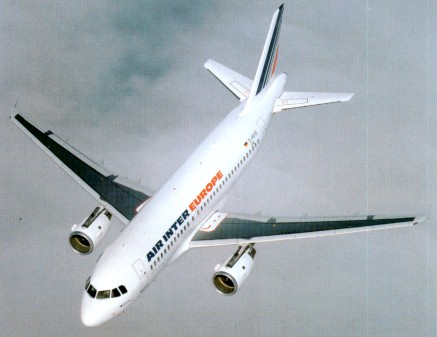
The 124-145 seat A319 followed the A321, in June 1993. A shortened fuselage (by 3.77 m) version of the A320 with a standard two-class cabin configuration and a range of up to 6500km with payload.
Essentially a seven-frame shrink of the A320 (it was originally designated the A320M-7), the A319 retains the wing of the A320, but the inboard spoilers are deleted. The cockpit and flight characteristics are identical to the A320 and its stretched derivative, the A321, which allows for Cross Crew Qualification. The A319 was launched officially in June 1993, although International Lease Finance Corp (ILFC) had already announced an order for six (plus two options) during the previous December. Two of these were placed with Swissair, which, in March 1994, became the first airline to place a firm order for the A319. The A319, assembled by Daimler-Benz Aerospace Airbus at Hamburg-Finkenwerder, was first flown on August 25, 1995, and was certificated by the European Joint Airworthiness Authorities (JAA) on April 10, 1996. 96 of the first 120 A319s ordered were to be powered by the CFM International CFM56-5. Flight certification tests of the international Aero Engines V2500-powered A319, which will be delivered to United, started on May 22 1996.
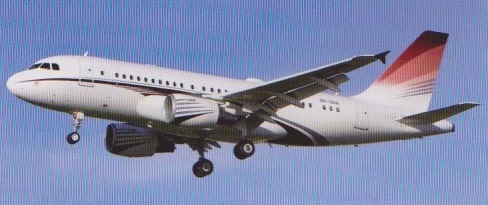
A319-115CJ 9H-SNA
The introduction of the A319 spelled the end of the Lufthansa Boeing 737s. According to Lufthansa, the CFM56-powered A319 consumes 58% less fuel per passenger seat than the 737-200 and 10% less than the bigger 737-300. By 1 July 1977 Lufthansa had taken delivery of 10 A319s, with 10 on order.
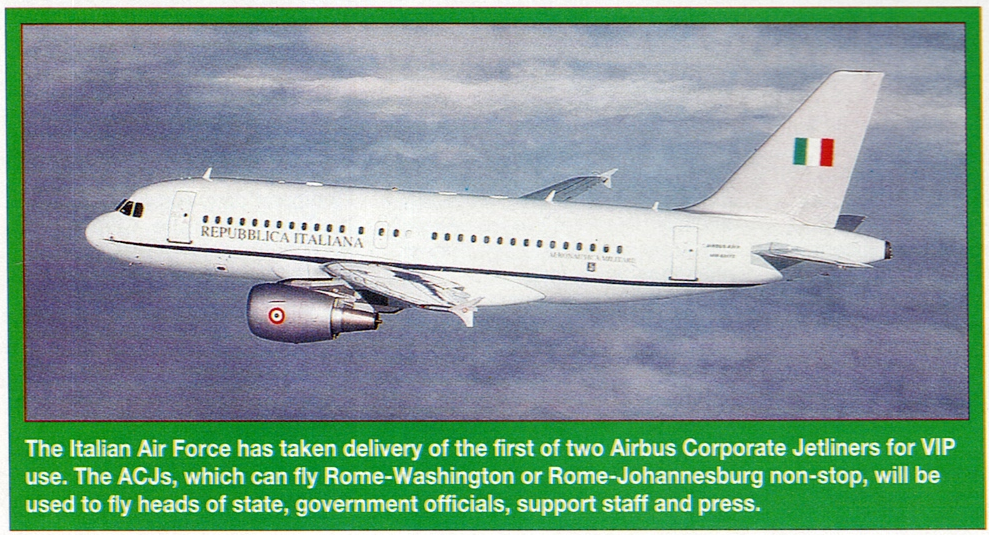
Based on the A319, the ACJ (Airbus Corporate Jet) differs mainly in having up to six extra fuel tanks in its cargo hold as well as a higher ceiling of 41,000 ft.
May 2000
Airbus announced its Airbus Corporate Jet (ACJ) at the 1997 Paris Air Show, based on the A319 airliner, the ACJ has a maximum range of 6000 nm / 11,115 km when fitted with six auxiliary fuel tanks. The auxiliary tanks are quickly removable and replaceable due to the A319/ACJ’s outwards opening cargo doors and quick release fuel plumbing and electrical Connections. They can be removed or replaced in as little as two hours. The ACJ was offered with both A319 powerplant options – the IAE V2500 or CFM56. The first ACJ flew on 12 November 1998, the 913th example of the A320 family off the line. It was delivered to Jet Aiation in Switzerland for outfitting the following month and handed over to its new owner – Mohamed Abdulmoshin Al Kharafi of Kuwait – a year later.
Airbus delivered corporate/VIP variations on the A320 theme including the A319LR with comfortable trans-Atlantic range carrying 48 business class passengers, and the A319 Executive which is basically the airliner with a VIP interior but no additional fuel.
Airbus Industries was first established on 29 May 1969, after the signing of a Franco-German agreement to go ahead with the Airbus 300. In December 1970, Airbus Industries was registered under French law as a GIE ( Groupement d’Intérêt Economique ) under the leadership of the ‘Airbus Founding Fathers’ – Franz-Josef Strauss, Henri Ziegler, Robert Bateille and Felix Kracht.
The first delivery of a production A300 was made in My 1974 to Air France.
The A300 programme, launched in May 1969, was initially a Franco-German venture, with the British aircraft industry participating on a private basis. Airbus Industrie, the organisation which was responsible for the management, marketing, sales and product support of the programme, was created in December 1970 as an equal partnership between Aerospatiale of France and Deutsche Airbus GmbH of Germany. The organisation was based at Toulouse, in the South of France, where it remains. Casa of Spain joined in 1971and in 1979 British Aerospace joined as a full partner. The consortium was owned by Aerospatiale of France (37.9 percent), DaimlerChrysler of Germany (37.9 percent), British Aerospace (20 percent) and CASA of Spain (4.2 percent), which are also the main industrial participants in design, development, and manufacture. Associate members of the consortium are Belairbus of Belgium and Fokker Aviation of the Netherlands. Airbus Industrie was restructured into a limited-liability company in 1999, divisions included Airbus Industrie Asia, formed with Alenia of Italy to develop a new airliner in partnership with AVIC of China and ST Aero of Singapore; Airbus Military Company to develop the FLA military freighter (taking over from former Euroflag; and Large Aircraft, founded in 1996 to progress work on the ultra-large A3XX airliner. On 11 July 2001, EADS and BAE Systems completed the final procedures to make the new integrated Airbus company a formal legal entity.
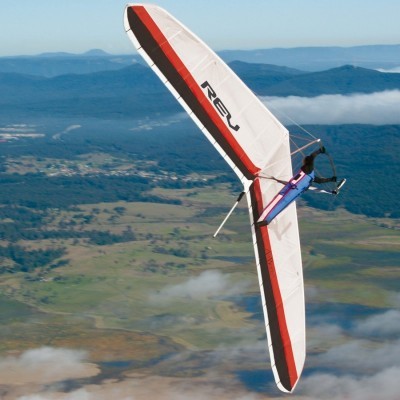
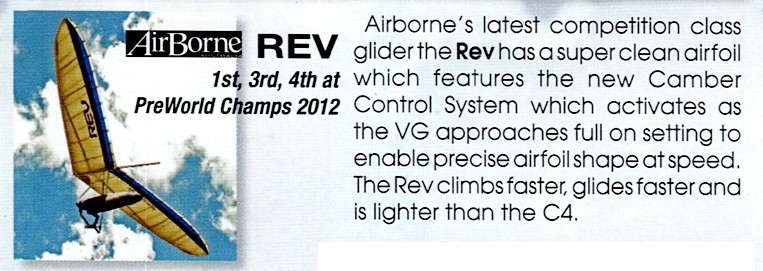
An aluminum / carbon composite structure, the Rev abandons the cam overdrive in favor of a conventional system; high speed profile control system (on the first 4 battens). A very nice working sail (the air inlets are minimized to the maximum.
In flight the Airborne lands without problem, a return to neutral present, and a tendency to “smooth” turbulence is good.



 All Aero