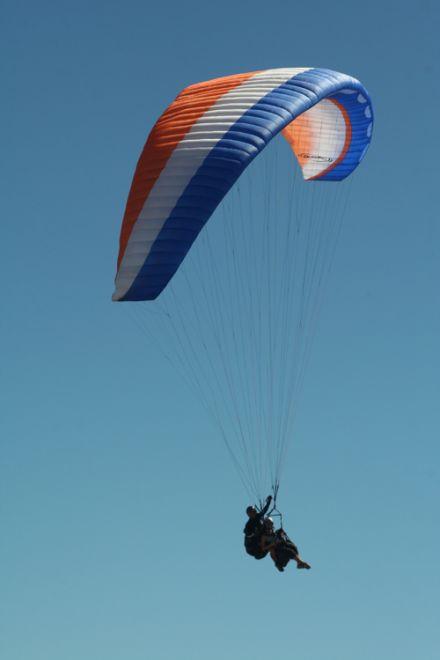
The Airwave Scenic is a tandem glider between high performance and working tandem. The DHV-1 (trimmer released) Scenic with a new aerodynamic profile and effective brake line distribution for unusual low landing speeds, has eternal trimmers: 2:1 reduction halves load and wear on trimmers, a partly closed leading edge, and wing flex system. The second generation of the Scenic tandem boasts a better glide angle, an improved sink rate and handles even more like a solo than the original. It comes delivered with negative trimmers to slow the wing down and make flying with heavy passengers lighter on your arms. Positive trimmers to accelerate the wing for big distance gliding and flying with lighter passengers easier are available on request. Minute changes to the panel shaping and cut of the cloth improved both handing and performance. We also made some Changes to the lower surfaces of the cell entries create a cleaner, more tensioned leading edge, which has again improved performance. The Scenic 2 is made from the hybrid cloth. The wing is one kilogram lighter than its predecessor making not only light wind launches easier but making the glider easy and less tiring to fly over long periods. Price 2008 EUR 3150.
Scenic XL Projected area: 37,4 Sq m Flat area: 43,9 Sq m Weight excl bag: 10,0 kg Number of main lines: 3/4/3/2 Flat aspect ratio: 5,1 Root cord: 3,62 m Weight range: 140-220 kg Trim speed: 38-42 Km/h Top speed: 46 Km/h Certification: DHV 1-2
SCENIC 2 Tandem Projected area: 37.4 Sq m Flat area: 43.0 Sq m Weight excl bag: 10 kg Number of main lines: 3/4/3/2 Cells: 77/53 Flat aspect ratio: 5.1 Root cord: 3.62 m Weight range: 140-220 kg Trim speed: 38-42 Km/h Top speed: 46 Km/h Certification: DHV 1-2
The Cobra sports wing has high performance for its class and is as close to being a true three-line glider as possible. It supersedes the top selling Mustang2. Technology fed down from the Magic5 has given the Cobra a very low sink rate and an outstanding glide. This significant leap in performance comes from two important areas of development. The Cobra has a new hybrid line configuration. For most of the span there are only three lines, except high up in the centre of the wing where short D lines branch off to give greater stability. The result is a 15% reduction line from the Mustang2, with the total length dropping 60m, from 385m to 326m. A new airfoil design and internal airflow management has helped increase the aspect ratio from 5.7 on the Mustang2 to 5.95. Price 2008 EUR 2925.
Cobra M
Cobra S Linear scaling factor: 0,96 Projected area: 20,31 sq.m Flat area: 23,89 sq.m Weight excl bag: 5,8 kg Total line length: 313 m Height: 7,38 m Number of main lines: 3/4/3 Cells: 57 Flat aspect ratio: 5,95 Projected aspect ratio: 4,37 Root cord: 2,48 m Flat span: 11,926 m Weight range: 65 – 90 kg Trim speed: 39 Km/h Top speed: 52 Km/h Min sink: 1 m/sec Best glide: 9 Certification: EN:C LTF 2
COBRA M Linear scaling factor: 1 Projected area: 22,04 sq.m Flat area: 25,92 sq.m Weight excl bag: 6,2 kg Total line length: 326 m Height: 8,01 m Number of main lines: 3/4/3 Cells: 57 Flat aspect ratio: 5,95 Projected aspect ratio: 4,37 Root cord: 2,58 m Flat span: 12,423 m Weight range: 80 – 105 kg Trim speed: 39 Km/h Top speed: 52 Km/h Min sink: 1 m/sec Best glide: 9 Certification: EN:C LTF 2
COBRA L Linear scaling factor: 1,04 Projected area: 23,70 sq.m Flat area: 28,04 sq.m Weight excl bag: 6,7 kg Total line length: 353 m Height: 8,33 m Number of main lines: 3/4/3 Cells: 57 Flat aspect ratio: 5,95 Projected aspect ratio: 4,37 Root cord: 2,68 m Flat span: 12,920 m Weight range: 100 – 120 kg Trim speed: 39 Km/h Top speed: 52 Km/h Min sink: 1 m/sec Best glide: 9 Certification: EN:C LTF 2
COBRA XL Linear scaling factor: 1,08 Projected area: 25,71 sq.m Flat area: 30,23 sq.m Weight excl bag: 7,23 kg Total line length: 380,25 m Height: 8,66 m Number of main lines: 3/4/3 Cells: 57 Flat aspect ratio: 5,95 Projected aspect ratio: 4,37 Root cord: 2,78 m Flat span: 13,417 m Weight range: 115-140 kg Trim speed: 39 Km/h Top speed: 52 Km/h Min sink: 1 m/sec Best glide: 9 Certification: uncertified
Ultra-weight gliders aren’t just for descents nowadays. Fabric technology and paraglider design has advanced so much that, despite its light weight, the Alpine is a fully functioning, soarable paraglider capable of cross country flight. The standard Alpine is based on the DHV 1 Gecko beginner wing. The two designs share the same sail, line configuration and certification. To create the Alpine the Gecko was analysed in every detail to reduce its weight. The sail was changed from 39 g/m_ with a 45 g/m_ leading edge, to 27 g/m_ with a 35 g/m_ leading edge, the Mylar edging tape has been changed to a lighter nylon tape, the line attachments have lighter weight reinforcing, the risers change to super lightweight Dyneema webbing and the removable speed system has been redesigned to be effective, yet light-weight. On the Alpine even the seams are sewn differently to reduce weight. The Alpine weighs 3.2 Kg in the S size, 3.5 Kg in the M and 3.9 Kg in the L. The Alpine Extreme was designed as an ultra-lightweight glider and is only 17.5 m (flat) and is both fast and manoeuvrable. It can be used as either a lightweight for small pilots, or as a mini glider for when the wind’s too strong to fly a normal wing. The Alpine Extreme is a one off design without certification. The Alpine Extreme weighs in at a lightweight 2.7 Kg. This is a very small and lightweight all purpose glider. Designed as a small, fun and safe glider of just 17.5sq meters, this wing is both fast and stable. Launch is very easy in everything from nil wind to very strong winds. Landing in no wind is fast but as the glider slows up nicely on the brakes it is possible to make a nice landing even in nil wind. With a trim speed of 43km/h with a total flying weight of 90kg, the ‘Alpine Extreme’ will penetrate in a strong wind when most other paragliders have to stay on the ground. Top speed with speed bar is 55km/h. The minimum sink rate with an all up weight of 60kg is around 1m/sec. With a flying weight of 90kg minimum sink is around 1.6m/sec. Best glide is between 7 and 8 depending on wing loading. The wing can also be flown by small pilots of weight as low as 35kg and the design target for safety and stability, is as a lowend 1-2 class glider, though if you fly this wing heavy the reactions will be much more dynamic than a 1-2 wing. Price in 2009 EUR 2300.
ALPINE S Projected area: 20.10 sq.m Flat area: 23.58 sq.m Weight excl bag: 3.2 kg Total line length: 390 m Height: 7.10 m Number of main lines: 3/4/3 Cells: 34 Flat aspect ratio: 4.99 Root cord: 2.66 m Weight range: 60-85 kg Trim speed: 35 Km/h Top speed: 45 Km/h Min sink: 1.0 m/sec Best glide: 7.5 Certification: EN B/ LTF 1
ALPINE M Projected area: 22.27 sq.m Flat area: 26.12 sq.m Weight excl bag: 3.5 kg Total line length: 416 m Height: 7.44 m Number of main lines: 3/4/3 Cells: 34 Flat aspect ratio: 4.99 Root cord: 2.81 m Weight range: 80-105 kg Trim speed: 35 Km/h Top speed: 45 Km/h Min sink: 1.0 m/sec Best glide: 7.5 Certification: EN B/ LTF 1
ALPINE L Projected area: 24.55 sq.m Flat area: 28.80 sq.m Weight excl bag: 3.9 kg Total line length: 441 m Height: 7.80 m Number of main lines: 3/4/3 Cells: 34 Flat aspect ratio: 4.99 Root cord: 2.95 m Weight range: 100-125 kg Trim speed: 35 Km/h Top speed: 45 Km/h Min sink: 1.0 m/sec Best glide: 7.5 Certification: EN B/ LTF 1
ALPINE Extreme Projected area: 15.05 sq.m Flat area: 17.53 sq.m Weight excl bag: 2.7 kg Total line length: 297,5 m Height: 6.86 m Number of main lines: 3/4/3 Cells: 34 Flat aspect ratio: 4.99 Root cord: 2.29 m Weight range: 55-100 kg Trim speed: 38 / 42 Km/h Top speed: 55 / 60 Km/h Min sink: 1.0 m/sec Best glide: 7.5 Certification: load test
Himalaya Projected area: 16.89 sq.m Flat area: 20.00 sq.m Weight excl bag: 2.1 kg Total line length: 205 m Height: 6.56 m Number of main lines: 3/3 Cells: 34 Flat aspect ratio: 4.86 Root cord: 3.62 m Weight range: 65-105 kg Trim speed: 42 Km/h Top speed: 50 Km/h Min sink: 1.2 m/sec Best glide: 7.5
The Burn is a freestyle wing with a high trim speed and a small surface area. The Burn’s high wing loading make it perfect for SAT’s, tumbles, reversals, McTwists and all acro manoeuvres. The Slingshot is the full-blown acro wing that can tackle the latest generation of ‘extreme’ acro manoeuvres like the Infintie Tumble. It comes in two sizes and sits above the very Burn and Burn Extreme acro wings in the range. It delivers impeccable handling during helicopters, SATs and Tumbles and its new profile and special trimming give it enough energy to pull off even the most vertical of manoeuvres, like the Infinite Tumble. Taking the Mustang XS, some modifications to the general trim of the wing gave it more energy in dynamic manoeuvres, and closing off some of the cell entries towards the tip to give better SAT characteristics. An extra set of E lines offer greater support across the chord when the wing is helicoptered. The result is a glider that is designed and reinforced for full blown acro, is stable and pressured in all manoeuvres and comes in two sizes. The Slingshot is in two sizes, the 17.5 sq.m for normal acro flying and 16 sq.m for top end acro manoeuvres like the Infinite Tumble. Although the Slingshot 16 is more dynamic than the 17.5, it is harder to fly in certain manoeuvres due to the increase in wing loading and energy. The one characteristic of the Slingshot is the way the wing recovers. Even from the most radical situation the Slingshot wants to return to normal flight and fly on. Price in 2009 EUR 2580.
BURN Projected area: 18.35 sq.m Flat area: 20.93 sq.m Weight excl bag: 4.7 kg Total line length: 359 m Height: 7.50 m Number of main lines: 3/4/3/2 Cells: 94/57 Flat aspect ratio: 5.72 Root cord: 2.41 m Weight range: 50-70 kg Trim speed: 40 Km/h Top speed: 60 Km/h Certification: Load Test
BURN XE Projected area: 15.88 sq.m Flat area: 18.53 sq.m Weight excl bag: 4.2 kg Total line length: 307 m Height: 6.70 m Number of main lines: 3/4/3/2 Cells: 94/57 Flat aspect ratio: 5.61 Root cord: 2.24 m Weight range: 40-55 kg Trim speed: 40 Km/h Top speed: 60 Km/h Certification: Load Test
SLINGSHOT 17.5 Projected area: 15.14 sq.m Flat area: 17.49 sq.m Weight excl bag: 4.7 kg Total line length: 337 m Height: 6.54 m Number of main lines: 3/4/3/3 Cells: 56 Flat aspect ratio: 5.96 Root cord: 2.15 m Weight range: 60-105 kg Trim speed: 45 Km/h Top speed: 55 Km/h Certification: None
SLINGSHOT 16 Projected area: 13.70 sq.m Flat area: 16.01 sq.m Weight excl bag: 4.4 kg Total line length: 329 m Height: 6.23 m Number of main lines: 3/4/3/3 Cells: 56 Flat aspect ratio: 6.07 Root cord: 1.96 m Weight range: 40-100 kg Trim speed: 45 Km/h Top speed: 55 Km/h Certification: None
The original Magic was the first certified glider with a semi-closed leading edge and this system has been developed further to produce a progressive transition between the open center of the wing to the closed tip – giving the correct sized opening at each position across the span.
The Magic 1 was the first certified paraglider with closed cells in 2000. The Magic 3 is the replacement for the successful Magic (Magic 2 disappeared as an unsatisfactory prototype). Airwave remarks that the glider received DHV 2 for the trim speed tests and DHV 2/3 for the accelerated tests, which is “even better than the DHV grades for the original Magic, and considering that the performance and speed of the Magic 3 are considerably better than the original Magic this is pretty impressive”. The design of the Magic 3 shows superior performance and safety being more stable and easier to fly than the original Magic, and only gets DHV 2-3 rating for the accelerated asymmetric tests – the glider is DHV 2 or better on all other tests. During testing in Texas, Bruce Goldsmith was able to set a new distance to goal world record of 273 km on an early proto of the Magic 3, the final version is much better than that glider. The main improvements pilots will immediately notice is the better glide performance and greater stability at speed. The leading edge is completely solid even at full bar.
On the 21st of december 2005 the Magic 4, a high performance serial class racer, became the first true ‘three-liner’ paraglider to pass the DHV tests. 3 rows of lines have significantly less drag then 4 rows and this gives more performance by reducing the line length by around 70meters. The Magic is from the drawing board of Bruce Goldsmith and incorporates design features such as;
Open and Closed Leading Edge Cells
Two Types of Diagonal Ribs
New Panel Shaping Technology
Built to Last
Wing-Flex System
Low stall speed, giving low negative tendancy, large brake range and low stall speed. The AR is 6.22 on all sizes of the Magic 4 and they feature a 5 riser system with 12mm Kevlar reinforced webbing. This riser system is taken directly from the FR2 and has proved itself both simple and extremely effective and easy to use. The technology of closed cells gives seamless integrate into the wing giving smooth and progressive inflation as well as reducing wasteful air spillage during glide at all speeds. The Magic 4 has a wing arc that is neither high nor low but a happy medium. What is new though is the way the arc is distributed though the wing: in an exponential way. This arc is partly responsible for the handling of the wing. The topsail is a hybrid mixture of cloths. Gelvenor on the leading edge of the top surface and lightweight porcher on the back part and the lower surface.
Magic 4
The Magic 4 high performance glider from Airwave includes many of the technical innovations from their race machine, the Magic FR2. The main characteristic of the new Magic is the use of only 3 rows of lines all the way from the glider down to the risers, which means significantly less drag and more performance. It took Airwave’s R&D team five years to develop the 3-line concept into a glider with good safety and handling. With 67 cells and an aspect ratio of 6,22, the manufacturer’s data quotes trim speed at 39k/h, with 55k/h top speed and a glide over 10. The wing is made of a hybrid mixture of cloths, with Gelvenor on the leading edge of the top surface and lightweight Porcher on the back part and the lower surface. This produces a light and long lasting glider. The Magic 4 was available in 4 sizes.
The Magic 5 is a high performance wing for long distance cross country flying and competition use. It’s directly developed from the Magic 4 and incorporates a lot of the developments made with the FR Series. The X-Brace of the FR series is used on the Magic 5. This single X of reinforcing webbing in the middle of the wing gives a centrally reinforced region of stiffness and creates a stronger, more collapse resistant wing. This gives a higher level of stability and sink rate throughout the speed range. Instead of using the same style of internal rib across the chord, the Magic5 uses a different style of rib at the front from the back. Combining the new internal ribs with a racy profile has created a wing with an exceptional sink rate, yet with great stability at speed. By redesigning the speed system so that it adjusts the camber of the wing as it is accelerated, it’s a near perfect combination for racing and big distance flying. Price in 2009 at EUR 3110.
Magic 5
The Magic FR competition paraglider is a synthesis of the best results from the research and development program for the ‘Ten’ prototypes, but with a completely new structure derived technology developed for the ‘Sport2’, which has transformed the stability and performance at speed. The research program that has resulted in the Magic FR has been focussed entirely on high speed flight. The aim has been to develop a wing that is the best in the world, in terms of performance and stability at speed – useable performance that allows you to fly without compromising strategic decisions because of glider characteristics – allows you to really work the climbs and then maximise performance by selecting true speed to fly even in strong conditions, when the correct McCready speed to fly is in the high 50s or even 60s. The Magic FR has a best glide in excess of 10:1, but the glide performance remains very good even at 60km/h, where the glide angle is still around 8:1. The FR2 is a radically different glider from the original Magic FR. The main design innovations that have gone into this wing are: 1) 3 rows of lines. This means that the glider has around 70 linear meters of line less than a conventional 4 line glider, which is a significant drag reduction. This change alone increases glide by around 0.5 points, but the difference increases massively with speed.There is weight saving. There are less lines, less risers and less tabs, which helps to reduce the overall weight of the wing. The FR2 weighs just 5kg in the bag. 2) The XXX system of diagonal bracing provides extra rigidity to the wing without any disadvantages. 3) The aspect ratio has been increased without increasing the curvature of the wing, which means that the projected aspect ratio has gone up from 4.5 (on the Magic FR) to 5.5 (on the FR2), which has a correspondingly huge effect on wing efficiency. This means you can achieve the same sink rate with a wing of smaller size, but of course the smaller glider is more heavily loaded, giving higher stability and better glide at high speed, faster top speed, and better handling. The FR2 sizes are therefore around 2.5 square meters smaller for the same pilot weight as the Magic FR. By keeping the normal curvature the performance has been increased without having to sacrifice roll stability. The FR2 is easy to launch both facing the wing or back to the wing. Launch should be done using the central A risers which are marked red for this purpose. There is absolutely no tendancy for the tips to come up first during launch. Trimmers should be set at the red mark (neutral position). In Flight, trim speed is 42km/h and stall speed around 24km/h. The trim speed is around 3 to 4 km/h faster than a typical paraglider. Top speed is 65km/h with the speed system block to block. The FR2 flies better with little brake. Even in thermals the FR2 has its best sink rate with only little use of the brakes. Tuck resistance is considerably better at higher speeds, and you can even fly through thermals with the speed bar still on. It almost feels like the wing gets more stable the more you apply the speed bar. There is a significant performance improvement over the FR2 in terms of sink rate as well as glide with the FR3. The FR3 out climbs the FR2 in weak conditions and the minimum sink rate is better. The flat aspect ration is 8.0 on the FR3 and the projected aspect ratio of the FR3 is 5.5 which is exactly the same as the FR2, so in terms of wing safety and wing inertia the aspect ratio is effectively the same. This is because of the high arc. The FR3 is similar in safety to the FR2, with no additional pilot skills required. The pullies on the risers of the FR3 are 24cm apart. This is much more than the 15cm on the FR2. Developed from Bruce Goldsmith’s World Championship winning glider, the FR4 has proven itself to out perform the FR3 in both sink rate and glide. The FR4 has a little less arc than the FR3, but has the same projected aspect ratio so that flat aspect ratio is actually slightly less down from 8.0 on the FR3 to 7.7. Price in2009 EUR 3420. The Magic FR5 is significantly different to all the previous gliders in the FR series. The FR5 has 81 cells and the line layout is significantly different due to the quest to reduce line drag. The wing has more cells because the span is so much larger and the line layout has only 2 C lines per side instead of the usual 3. The third A and B line are joined together saving another lower line. This design feature means more performance but it also means that B lining and big ears are no longer possible. If you want to go down fast you will have to spiral dive. The arc and the profile are also significantly different to previous FR’s. The arc is very circular resulting in a wing with lovely handling and turn coordination and there is very little wobble or oscillation considering the high aspect ratio and the flat arc. The glider has a lot more internal reinforcing and the snake like plastic wire in the nose gives improved high speed stability. The risers are equipped with a very effective trimmer system that gives a speed range of 13km/h using just the trimmers. When the risers are all level the trim speed is around 42 km/h which makes the glider feel fast. Top speed is just under 70 km/h.
Experience Then came my beautiful 177 Magic 4 Full Race, a dream to take off and fly, but the landings…. what a mission. Flare to early and you gain 20 feet, with the keel going 3 feet it to the ground. Flare too late and it is time to replace at least one up right, most because they are 8 feet long and there is no way to keep them of the ground. Mr. Green
Magic Small Projected area: 21,44 sq.m Flat area: 24,44 sq.m Weight excl bag: 6,5 kg Total line length: 375 m Height: 7,78 m Number of main lines: 3/4/3/2 Cells: 107/71 Flat aspect ratio: 6,03 Root cord: 2,54 m Weight range: 65-90 kg Trim speed: 37 Km/h Top speed: 53 Km/h Certification: DHV 2-3
Magic Medium Projected area: 26,52 sq.m Flat area: 26,52 sq.m Weight excl bag: 7,0 kg Total line length: 390 m Height: 8,1 m Number of main lines: 3/4/3/2 Cells: 107/71 Flat aspect ratio: 6,03 Root cord: 2,65 m Weight range: 80-100 kg Trim speed: 37 Km/h Top speed: 53 Km/h Certification: DHV 2-3
Magic Large Projected area: 28,68 sq.m Flat area: 28,68 sq.m Weight excl bag: 7,6 kg Total line length: 405 m Height: 8,42 m Number of main lines: 3/4/3/2 Cells: 107/71 Flat aspect ratio: 6,03 Root cord: 2,76 m Weight range: 95-120 kg Trim speed: 37 Km/h Top speed: 53 Km/h Certification: DHV 2-3
Magic 3 Small Projected area: 21,65 sq.m Flat area: 24,67 sq.m Weight excl bag: 6,9 kg Total line length: 367 m Height: 7,9 m Number of main lines: 3/4/3/2 Cells: 117/71 Flat aspect ratio: 6,03 Root cord: 2,54 m Weight range: 65-85 kg Trim speed: 37 Km/h Top speed: 55 Km/h Best glide: 9,1 Certification: DHV 2-3
Magic 3 Medium Projected area: 23,49 sq.m Flat area: 26,77 sq.m Weight excl bag: 7,5 kg Total line length: 382 m Height: 8,2 m Number of main lines: 3/4/3/2 Cells: 117/71 Flat aspect ratio: 6,03 Root cord: 2,65 m Weight range: 80-105 kg Trim speed: 37 Km/h Top speed: 55 Km/h Best glide: 9,1 Certification: DHV 2-3
Magic 3 Large Projected area: 25,41 sq.m Flat area: 28,95 sq.m Weight excl bag: 8,1 kg Total line length: 397 m Height: 8,5 m Number of main lines: 3/4/3/2 Cells: 117/71 Flat aspect ratio: 6,03 Root cord: 2,76 m Weight range: 100-125 kg Trim speed: 37 Km/h Top speed: 55 Km/h Best glide: 9,1 Certification: DHV 2-3
Magic 4 XS Linear scaling factor: 0,92 Projected area: 18,47 sq.m Flat area: 21,87 sq.m Weight excl bag: 5,2 kg Total line length: 300 m Number of main lines: 3/4/3 Cells: 67 Flat aspect ratio: 6,22 Projected aspect ratio: 4,38 Root cord: 2,333 m Projected span: 8,997 m Weight range: 50-75 kg Trim speed: 39 Km/h Top speed: 55 Km/h Min sink: 1 m/sec Best glide: 10 Certification: load
Magic 4 S Linear scaling factor: 0,96 Projected area: 20,11 sq.m Flat area: 23,81 sq.m Weight excl bag: 5,6 kg Total line length: 308 m Number of main lines: 3/4/3 Cells: 67 Flat aspect ratio: 6,22 Projected aspect ratio: 4,38 Root cord: 2,435 m Projected span: 9,388 m Weight range: 65-90 kg Trim speed: 39 Km/h Top speed: 55 Km/h Min sink: 1 m/sec Best glide: 10 Certification: DHV 2-3
Magic 4 M Linear scaling factor: 1 Projected area: 21,82 sq.m Flat area: 25,84 sq.m Weight excl bag: 6,1 kg Total line length: 321 m Number of main lines: 3/4/3 Cells: 67 Flat aspect ratio: 6,22 Projected aspect ratio: 4,38 Root cord: 2,536 m Projected span: 9,779 m Weight range: 80-105 kg Trim speed: 39 Km/h Top speed: 55 Km/h Min sink: 1 m/sec Best glide: 10 Certification: DHV 2-3
Magic 4 ML Linear scaling factor: 1,02 Projected area: 22,70 sq.m Flat area: 26,88 sq.m Weight excl bag: 6,3 kg Total line length: 327 m Number of main lines: 3/4/3 Cells: 67 Flat aspect ratio: 6,22 Projected aspect ratio: 4,38 Root cord: 2,587 m Projected span: 9,975 m Weight range: 90-115 kg Trim speed: 39 Km/h Top speed: 55 Km/h Min sink: 1 m/sec Best glide: 10 Certification: DHV 2-3
Magic 4 L Linear scaling factor: 1,04 Projected area: 23,60 sq.m Flat area: 27,95 sq.m Weight excl bag: 6,6 kg Total line length: 334 m Number of main lines: 3/4/3 Cells: 67 Flat aspect ratio: 6,22 Projected aspect ratio: 4,38 Root cord: 2,637 m Projected span: 10,170 m Weight range: 100-125 kg Trim speed: 39 Km/h Top speed: 55 Km/h Min sink: 1 m/sec Best glide: 10 Certification: DHV 2-3
MAGIC 5 S Projected area: 20.07 sq.m Flat area: 23.48 sq.m Weight excl bag: 5.5 kg Total line length: 310 m Height: 7.336 m Number of main lines: 3/4/3 Cells: 63 Flat aspect ratio: 6.4 Root cord: 2.386 m Weight range: 65-90 kg Trim speed: 39 Km/h Top speed: 55 Km/h Min sink: 1 m/sec Best glide: 10 Certification: LTF 2-3
MAGIC 5 M Projected area: 21.78 sq.m Flat area: 25.48 sq.m Weight excl bag: 6.0 kg Total line length: 323 m Height: 7.960 m Number of main lines: 3/4/3 Cells: 63 Flat aspect ratio: 6.4 Root cord: 2.485 m Weight range: 80-105 kg Trim speed: 39 Km/h Top speed: 55 Km/h Min sink: 1 m/sec Best glide: 10 Certification: LTF 2-3
MAGIC 5 L Projected area: 23.11 sq.m Flat area: 27.03 sq.m Weight excl bag: 6.4 kg Total line length: 343 m Height: 8.199 m Number of main lines: 3/4/3 Cells: 63 Flat aspect ratio: 6.4 Root cord: 2.560 m Weight range: 105-120 kg Trim speed: 39 Km/h Top speed: 55 Km/h Min sink: 1 m/sec Best glide: 10 Certification: LTF 2-3
Magic FR SM Linear scaling factor: 0,97 Projected area: 21,00 sq.m Flat area: 24,15 sq.m Weight excl bag: 7,7 kg Total line length: 342 m Height: 8,00 m Number of main lines: 3/4/3/2 Cells: 124-75 Flat aspect ratio: 6,26 Projected aspect ratio: 4,74 Root cord: 2,43 m Flat span: 12,30 m Projected span: 9,97 m Weight range: 80-97 kg Trim speed: 39 Km/h Top speed: 65 Km/h Min sink: 0,97 m/sec Best glide: 10,2 Certification: Load Test
Magic FR M Linear scaling factor: 1 Projected area: 22,60 sq.m Flat area: 26,00 sq.m Weight excl bag: 8,2 kg Total line length: 358 m Height: 8,30 m Number of main lines: 3/4/3/2 Cells: 124-75 Flat aspect ratio: 6,26 Projected aspect ratio: 4,74 Root cord: 2,53 m Flat span: 12,76 m Projected span: 10,35 m Weight range: 90-109 kg Trim speed: 39 Km/h Top speed: 65 Km/h Min sink: 0,97 m/sec Best glide: 10,2 Certification: Load Test
Magic FR L Linear scaling factor: 1,04 Projected area: 24,29 sq.m Flat area: 27,94 sq.m Weight excl bag: 8,9 kg Total line length: 398 m Height: 8,61 m Number of main lines: 3/4/3/2 Cells: 124-75 Flat aspect ratio: 6,26 Projected aspect ratio: 4,74 Root cord: 2,62 m Flat span: 13,23 m Projected span: 10,72 m Weight range: 100-123 kg Trim speed: 39 Km/h Top speed: 65 Km/h Min sink: 0,97 m/sec Best glide: 10,2 Certification: Load Test
Magic FR 2 FR 20 Linear scaling factor: 1 Projected area: 17,66 sq.m Flat area: 20,25 sq.m Weight excl bag: 4,9 kg Total line length: 324 m Height: 7,8 m Number of main lines: 3/4/3 Cells: 124/75 Flat aspect ratio: 7,15 Root cord: 2,06 m Flat span: 12,04 m Projected span: 9,83 m Weight range: 82-92 kg Trim speed: 42 Km/h Top speed: 65 Km/h Min sink: 0,95 m/sec Best glide: 11,00 Certification: Load Test
Magic FR 2 FR 21,5 Linear scaling factor: 1,03 Projected area: 18,69 sq.m Flat area: 21,46 sq.m Weight excl bag: 5,1 kg Total line length: 339 m Height: 8,11 m Number of main lines: 3/4/3 Cells: 124/75 Flat aspect ratio: 7,18 Root cord: 2,11 m Flat span: 12,41 m Projected span: 10,14 m Weight range: 88-98 kg Trim speed: 42 Km/h Top speed: 65 Km/h Min sink: 0,95 m/sec Best glide: 11,10 Certification: Load Test
Magic FR 2 FR 23 Linear scaling factor: 1,06 Projected area: 19,75 sq.m Flat area: 22,67 sq.m Weight excl bag: 5,5 kg Total line length: 333 m Height: 8,33 m Number of main lines: 3/4/3 Cells: 124/75 Flat aspect ratio: 7,18 Root cord: 2,17 m Flat span: 12,76 m Projected span: 10,42 m Weight range: 96-106 kg Trim speed: 42 Km/h Top speed: 65 Km/h Min sink: 0,95 m/sec Best glide: 11,20 Certification: Load Test
Magic FR 2 FR 24 Linear scaling factor: 1,1 Projected area: 21,04 sq.m Flat area: 24,13 sq.m Weight excl bag: 5,9 kg Total line length: 364 m Height: 8,6 m Number of main lines: 3/4/3 Cells: 124/75 Flat aspect ratio: 7,18 Root cord: 2,17 m Flat span: 13,14 m Projected span: 10,73 m Weight range: 105-120 kg Trim speed: 42 Km/h Top speed: 65 Km/h Min sink: 0,95 m/sec Best glide: 11,30 Certification: Load Test
Magic FR3-20 Linear scaling factor: 0,88 Projected area: 16,79 sq.m Flat area: 20,34 sq.m Weight excl bag: 4,4 kg Total line length: 278 m Number of main lines: 3/4/3 Cells: 124-75 Flat aspect ratio: 8,00 Projected aspect ratio: 5,5 Root cord: 1,73 m Flat span: 12,75 m Projected span: 9,60 m Weight range: 70-85 kg Trim speed: 40 Km/h Top speed: 65 Km/h Min sink: 0,95 m/sec Best glide: 11 Certification: load test
Magic FR3-22 Linear scaling factor: 0,92 Projected area: 18,22 sq.m Flat area: 22,07 sq.m Weight excl bag: 4,7 kg Total line length: 290 m Number of main lines: 3/4/3 Cells: 124-75 Flat aspect ratio: 8,00 Projected aspect ratio: 5,5 Root cord: 1,97 m Flat span: 13,28 m Projected span: 10,00 m Weight range: 80-95 kg Trim speed: 40 Km/h Top speed: 65 Km/h Min sink: 0,95 m/sec Best glide: 11 Certification: load test
Magic FR3-24 Linear scaling factor: 0,96 Projected area: 19,77 sq.m Flat area: 23,95 sq.m Weight excl bag: 5 kg Total line length: 304 m Number of main lines: 3/4/3 Cells: 124-75 Flat aspect ratio: 8,00 Projected aspect ratio: 5,5 Root cord: 2,14 m Flat span: 13,83 m Projected span: 10,42 m Weight range: 90-105 kg Trim speed: 40 Km/h Top speed: 65 Km/h Min sink: 0,95 m/sec Best glide: 11 Certification: load test
Magic FR3-26 Linear scaling factor: 1 Projected area: 21,45 sq.m Flat area: 25,99 sq.m Weight excl bag: 5,5 kg Total line length: 322 m Number of main lines: 3/4/3 Cells: 124-75 Flat aspect ratio: 8,00 Projected aspect ratio: 5,5 Root cord: 2,23 m Flat span: 14,41 m Projected span: 10,86 m Weight range: 100-115 kg Trim speed: 40 Km/h Top speed: 65 Km/h Min sink: 0,95 m/sec Best glide: 11 Certification: load test
Magic FR3-28 Linear scaling factor: 1,04 Projected area: 23,20 sq.m Flat area: 28,11 sq.m Weight excl bag: 6 kg Total line length: 348,28 m Number of main lines: 3/4/3 Cells: 124-75 Flat aspect ratio: 8,00 Projected aspect ratio: 5,5 Root cord: 2,31 m Flat span: 14,99 m Projected span: 11,29 m Weight range: 110-125 kg Trim speed: 40 Km/h Top speed: 65 Km/h Min sink: 0,95 m/sec Best glide: 11 Certification: load test
MAGIC Competition FR4-19 Projected area: 16.57 sq.m Flat area: 19.37 sq.m Weight excl bag: 4.3 kg Total line length: 271 m Height: 7.02 m Number of main lines: 3/4/3 Cells: 124-75 Flat aspect ratio: 7.65 Root cord: 1.97 m Weight range: 70-85 kg Trim speed: 40 Km/h Top speed: 65 Km/h Min sink: 0.95 m/sec Best glide: 11 Certification: Load Test
MAGIC Competition FR4-21 Projected area: 17.98 sq.m Flat area: 21.01 sq.m Weight excl bag: 4.9 kg Total line length: 295 m Height: 7.32 m Number of main lines: 3/4/3 Cells: 124-75 Flat aspect ratio: 7.65 Root cord: 2.05 m Weight range: 80-95 kg Trim speed: 40 Km/h Top speed: 65 Km/h Min sink: 0.95 m/sec Best glide: 11 Certification: Load Test
MAGIC Competition FR4-23 Projected area: 19.51 sq.m Flat area: 22.80 sq.m Weight excl bag: 5.5 kg Total line length: 320 m Height: 7.63 m Number of main lines: 3/4/3 Cells: 124-75 Flat aspect ratio: 7.65 Root cord: 2.14 m Weight range: 90-105 kg Trim speed: 40 Km/h Top speed: 65 Km/h Min sink: 0.95 m/sec Best glide: 11 Certification: Load Test
MAGIC Competition FR4-25 Projected area: 21.51 sq.m Flat area: 25.14 sq.m Weight excl bag: 6.4 kg Total line length: 339 m Height: 8.01 m Number of main lines: 3/4/3 Cells: 124-75 Flat aspect ratio: 7.65 Root cord: 2.24 m Weight range: 100-120 kg Trim speed: 40 Km/h Top speed: 65 Km/h Min sink: 0.95 m/sec Best glide: 11 Certification: Load Test
MAGIC FR5 FR5-20 Linear scaling factor: 0,96 Projected area: 17,15 sq.m Flat area: 20,51 sq.m Weight excl bag: 6 kg Total line length: 292 m Number of main lines: 2/4/2 Cells: 81 Flat aspect ratio: 8,50 Projected aspect ratio: 6,07 Root cord: 1,92 m Flat span: 12,68 m Projected span: 10,20 m Weight range: 80- 90 kg Trim speed: 40 Km/h Top speed: 70 Km/h Min sink: 0,95 m/sec Best glide: 11,5 Certification: load calc
MAGIC FR5 FR5-22 Linear scaling factor: 1 Projected area: 18,61 sq.m Flat area: 22,25 sq.m Weight excl bag: 6,4 kg Total line length: 317 m Number of main lines: 2/4/2 Cells: 81 Flat aspect ratio: 8,50 Projected aspect ratio: 6,07 Root cord: 2,01 m Flat span: 13,21 m Projected span: 10,62 m Weight range: 90 – 100 kg Trim speed: 40 Km/h Top speed: 70 Km/h Min sink: 0,95 m/sec Best glide: 11,5 Certification: load calc
MAGIC FR5 FR5-24.5 Linear scaling factor: 1,05 Projected area: 20,52 sq.m Flat area: 24,53 sq.m Weight excl bag: 6,7 kg Total line length: 336 m Number of main lines: 2/4/2 Cells: 81 Flat aspect ratio: 8,50 Projected aspect ratio: 6,07 Root cord: 2,11 m Flat span: 13,87 m Projected span: 11,15 m Weight range: 100 – 110 kg Trim speed: 40 Km/h Top speed: 70 Km/h Min sink: 0,95 m/sec Best glide: 11,5 Certification: load calc
MAGIC FR5 FR5-27 Linear scaling factor: 1,1 Projected area: 22,62 sq.m Flat area: 27,05 sq.m Weight excl bag: 7,2 kg Total line length: 384 m Number of main lines: 2/4/2 Cells: 81 Flat aspect ratio: 8,50 Projected aspect ratio: 6,07 Root cord: 2,32 m Flat span: 15,26 m Projected span: 12,27 m Weight range: 110 – 122 kg Trim speed: 40 Km/h Top speed: 70 Km/h Min sink: 0,95 m/sec Best glide: 11,5 Certification: load calc
The 2010 beginner glider from Airwave, the Gecko, a straight forward, no nonsense, cost effective paraglider that is perfect for school use or early days. The Gecko has passed the stringent CEN A (23A,1B) test level of certification. Built to be forgiving in launch and ground handling, the Gecko climbs overhead with a very smooth motion and has no tendency to overshoot, no matter how hard and aggressive you are with it. Even if the glider comes up off to one side it’s very easy to correct and continue with the launch. By bringing the centre lines together and reducing the amount of roll the Gecko feels incredibly secure, even to a novice. Internally it uses a box construction within the wing to give greater stability at the front of the wing. The A’s and B’s are closer together than normal so the profile is thicker and more stable than usual. This make the leading edge feel like a rigid box and makes the wing more stable and resistant to collapse. Even if pulling too hard on the A’s during the launch the glider won’t collapse, and hanging on the B-lines, the glider just carries on flying, it won’t stall because of this feature. By increasing the brake range, a pilot can fly with their hands locked down without stalling, to make the Gecko almost bombproof. Price 2010: EUR 2280
Gecko Small Linear scaling factor: 0,95 Projected area: 20,10 sq.m Flat area: 23,58 sq.m Weight excl bag: 4,4 kg Total line length: 390 m Height: 7,10 m Number of main lines: 3/4/3 Cells: 34 Flat aspect ratio: 4,93 Root cord: 2,66 m Weight range: 60-85 kg Trim speed: 35 kph Top speed: 45 kph Min sink: 1,0 m/sec Best glide: 7,5 Certification: EN B/LTF 1
Gecko Medium Linear scaling factor: 1 Projected area: 22,27 sq.m Flat area: 26,12 sq.m Weight excl bag: 4,8 kg Total line length: 416 m Height: 7,44 m Number of main lines: 3/4/3 Cells: 34 Flat aspect ratio: 4,93 Root cord: 2,81 m Weight range: 80-105 kg Trim speed: 35 kph Top speed: 45 kph Min sink: 1,0 m/sec Best glide: 7,5 Certification: EN B/LTF 1
Gecko Large Linear scaling factor: 1,05 Projected area: 24,55 sq.m Flat area: 28,80 sq.m Weight excl bag: 5,2 kg Total line length: 441 m Height: 7,80 m Number of main lines: 3/4/3 Cells: 34 Flat aspect ratio: 4,93 Root cord: 2,95 m Weight range: 100-125 kg Trim speed: 35 kph Top speed: 45 kph Min sink: 1,0 m/sec Best glide: 7,5 Certification: EN B/LTF 1
In 2002 Airwave Gliders broke another performance barrier with the Ten, the first paraglider to achieve a glide angle of 10:1. The FR (Full Race) series soon followed.
Airwave was created in 1979, originally as a Hang Glider manufacturer on the Isle of Wight. Graham Deegan was a sail designer and Rory Carter specialised in the hardware design.
Airwave’s early successes were on the Magic series of Hang Gliders, with a team of British pilots who dominated the World Hang Gliding Competition circuit for over ten years.
Pacific Windcraft (USA) became part of Airwave circa 1983, from Pacific Airwave to PacAir. In 1986 PacAir closed the doors.
Airwave Gliders’ production moved to China in the middle of 1997 but the company’s headquarters remains on the Isle of Wight.
1998: Elm Lane, Shalfleet, Newport, UK PO30 4JY Isle of Wight, UK
Even though sales of Airwave gliders were strong, the company was in a deep financial crisis. As a result of this Bruce left and the old Airwave collapsed and folded.
The production of the Xtrem started 1.5 year before Airwave UK shut down. Only about 40 were produced mostly shipped to the US, Brazil, Japan and some in France. Its newer version is called the Xbow, was certified in the 138 (140 Sq ft) version 4 months before the factury shutdown (35 sold in 3 months).
After running Wills Wing Europe in the early 1990´s, in November 1999, Markus Villinger took over Airwave and the company moved to his home town of Stubai, in the Austrian Alps.
Industriegebeit zone A2 A-6166 Fulpmes Austria
Hang Gliders are made in the Airwave factory, while paragliders are manufactured by subcontractors.
Bruce Goldsmith, an engineer, joined Airwave in May 2000, set up Airwave Paragliders and started designing Airwave’s paragliders from his home in Greolieres, France.
Starting in spring 2005 Airwave have been doing wind tunnel testing as well as Computational Fluid Dynamics (CFD) analysis to study the gliders as well as the traditional full scale test flying procedures.
Founded 1958 in Wichita Falls, Texas, Leland Snow became Air Tractor president. Derived from the S2B he had designed and built in the fifties, Snow started design work on a new cropduster. In 1972 he obtained a small business loan, rented a building back in Olney and started to build jigs and tooling for what was to become the Air Tractor AT-300 – a conventional layout crop-duster powered by a Pratt and Whitney R-985-AN1 of 450hp. Has built more than 1,650 Air Tractors, with radial pistonengined AT-401B (can be converted to turboprop power), turboprop-powered AT-402A (available since 1997), higher-powered AT-402B with 680 shp engine, heavier and 1,100 shp turboprop-engined AT-502A, 680 shp AT- 502B, AT-503A two-seater for agricultural work and training, AT-602 with 1,050 shp engine and the second largest Air Tractor model, AT-802 two-seater and the largest of all Air Tractors suited to agricultural and firefighting roles (first flown 1990), and AT-802 single-seat verson, available for purchase.
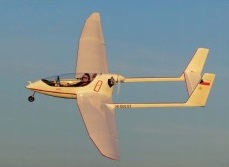
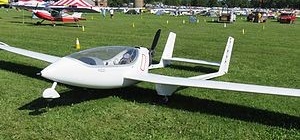
The Airsport Song is a Czech ultralight aircraft, designed by Marek Ivanov to comply with the LTF-L 120 kg, US FAR 103 Ultralight Vehicles and English SSDR categories. It features a cantilever low-wing, twin-booms, a single seat enclosed cockpit, fixed tricycle landing gear and a single engine in pusher configuration. The Song has been produced in both a twin–tail and inverted V-tail layout. In most configurations, the Song includes a Galaxy GRS 3/270 ballistic parachute rescue system.
The Song is made from composites. Its polyhedral wing comes in two optional spans: 7.5 m (24.6 ft) (with flaperons) and 11.2 m (36.7 ft) (with ailerons and either spoilers or flaps). Standard engines available are the 20.5 hp (15 kW) Bailey V5 four-stroke and the 35 hp (26 kW) Verner JCV 360 four-stroke powerplant.
Randall Fishman of Electric Aircraft Corporation produces an electric-powered version of the Song, the Electric Aircraft Corporation ElectraFlyer-ULS.
Song SW-V Engine: 1 × Bailey V5 Single Cylinder, 15.3 kW (20.5 hp) Wingspan: 11.2 m (36 ft 9 in) Wing area: 10.5 m2 (113 sq ft) Length: 5.9 m (19 ft 4 in) Empty weight: 110 kg (243 lb) Gross weight: 220 kg (485 lb) Fuel capacity: 25 litres (5.5 imp gal; 6.6 US gal) Maximum speed: 201 km/h (125 mph, 109 kn) Cruise speed: 80 km/h (50 mph, 43 kn) Stall speed: 50 km/h (31 mph, 27 kn) Never exceed speed: 140 km/h (87 mph, 76 kn) Rate of climb: 1.5 m/s (300 ft/min) with Bailey V5, (5 m/s with Verner JCV 360) Crew: one

 All Aero