Aviat Husky A-1

A-1B

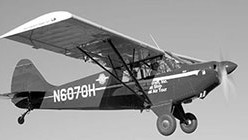
The Husky A1-A, conceptually based on the Piper Super Cub, is a completely new design, created in 1986 and fully certified in 1987. The prototype was N6070H. By 2008 over 650 had been made and were in use all over the world.

The taildragger Husky A-1B continues the tradition with tremendous short and soft field abilities even with a healthy load and functions on wheels, floats or skis.
Aviat refined the design in 2005, improving the ailerons and flaps, as well as offering the Husky with an optional 200 hp powerplant and composite, 82-inch propeller.
The FAR 23 certified A-1B Husky takes off in 200 feet and lands in 350 feet fully loaded. On water takeoff it takes six seconds. With a useful load of 800 pounds, 20,000 ft service ceiling, top speed of 145 miles per hour, 33 miles per hour power on stall and 800 nautical mile range.

Featuring a STOL Clark-Y wing, the first production was in 1987. Price $105,000 (1998). 395 had been produced by the end of 1997 (including Christen production).

A-1C Husky

The A-1C increases its useful load by 192 pounds, and can carry up to 842 lbs, and can fly 800 miles without refueling. 60% Span semi-fowler flaps allow shorter take-offs and landings and removal of spades and the installation of advanced performance ailerons stability during flight, as well as during take-offs and landings. The aileron is mass and aerodynamically balanced. The aileron has a deeper chord and shorter span.
The A-1C has a stick force pressure that is about four pounds. Designed to provide three flap settings, 10°, 20° and 30°, the handle activates the flaps with considerably shorter travel. The leverage point for deployment is always in front of the pilot. The handle offers better leverage, takes less effort and is less cumbersome to operate.
The A-1B-160, A-1C-180 and 200 were designed to meet rigid government specs. It is certified to fly with a gross weight in excess of a full ton.
Optional is the 200hp Lycoming IO-360 A1D6 engine in place of the standard 180 hp O-360 engine. The IO-360 is equipped with a positive-flow fuel injection system that offers much better fuel distribution. Fuel injection also eliminates the requirement for carburetor heat and its associated controls. This IO-360 is an angle valve engine, as opposed to the parallel valve O-360. The IO-360 used in the Husky is equipped with a mass-balanced crankshaft. The IO-360 weighs some 23 pounds more than an O-360, due largely to the mass balancers. The 80″ Hartzell Constant Speed propeller comes standard. Also available with this engine package, is the 205cm MT propeller, which is close to 20 pounds lighter than a metal prop. The lighter prop makes the basic weight of the 200-hp powerplant package nearly unchanged from a 180-hp model with a metal prop.
The 200-hp installation includes a second oil cooler and a cowl flap to better manage engine temperatures. The switch to an angle valve engine, the addition of the cowl flap, and other modifications wouldn’t fit in a standard Husky cowling, so Aviat designed a new cowling.
Aviat were one of the first manufacturers to introduce the airbag in an aircraft. The airbags are much like those found in automobiles. The difference being that the Husky’s airbags deploy away from the pilot or passenger. Airbags are mounted in seat belt webbing and follow the path of least resistance, beginning with zero pressure in the bag.

The 2002 Husky Pup is a 160hp Piper J-3 Cub lookalike for $110,000.

Gallery

Aviat Husky A-1B-200
Engine: Lycoming IO-360-A1D6, 200 hp
TBO: 2000 hrs
Propeller: MTV-15-B/205-58
Wingspan: 35 ft. 6 in.
Overall length: 22 ft. 7 in.
Height: 7 ft. 5 in.
Wing area: 183 sq. ft
Wing loading: 10.9(lbs./sq. ft
Power loading: 10 lbs./hp
Airfoil: Modified Clark Y
Landing gear type: Fixed tailwheel
Gross weight: 2000 lb
Max landing weight: 2000 lb
Empty weight, std.: 1320 lb
Useful load, std.: 680 lb
Fuel capacity, std.: 52 USG
Baggage capacity: 50 lb
Payload, full std. fuel: 380 lb
Seating: 2
Cabin width: 48 in
Cabin height: 27 in
Max range: 828 nm
Dirty stall speed: 53kt
Best rate of climb, SL: 1700 fpm
Service ceiling: 20,000 ft
Takeoff ground roll: 265 ft
Takeoff over 50 ft: 780 ft
Landing ground roll: 398 ft
Landing over 50 ft: 1025 ft

Aviat A-1B-180
Engine: Lycoming O-360-A1P, 180 hp
TBO: 2000 hr
Fuel: 100LL
Propeller: Hartzell CS 76 in
Landing Gear type: Conv. (bungees)
Max ramp weight: 2000 lb
Gross weight: 2000lb
Empty weight, std.: 1190lb
Max landing weight: 2000 lb
Usable fuel, std.: 50 USgal
Wingspan: 35 ft. 6 in.
Overall length: 22 ft. 6 in.
Height: 6 ft. 8 in.
Wing area: 183 sq. ft
Wing loading: 10.9 lb/sq. ft
Airfoil: Modified Clark Y/USA 35B
Power loading: 10 lb/hp
Wheel track: 6 ft. 7 in.
Wheel size: 8.00 x 6 in (31-in. tundra, optional)
Seating capacity: 2
Cabin doors: 1
Cabin width: 24 in
Cabin height: 49 in
Baggage capacity: 50lb
Cruise speed 75% power @6,500 ft: 121 kt
Cruise speed 55% power @6,500 ft: 113 kt
Max range (with reserve) 75% power: 617 nm
Max range (with reserve) 55% power: 645 nm
Stall speed (gear, flaps down, power off): 37kt
Stall speed (gear, flaps down, power on): 29 kt
Best rate of climb: 1500 fpm
Service ceiling): 20,000 ft
Takeoff ground roll: 150 ft
Landing ground roll: 250 ft
Flaps Extend Speed: 80 mph
Aft Stowage: 9.3 cubic feet /30 pounds

AVIAT HUSKY A-1C-200
Engine: Lycoming O-360-A1P, 200 hr
TBO: 2000hr
Propeller: CS Hartzell
Overall length: 22 ft. 7 in.
Overall height: 7 ft. 5 in.
Wingspan: 35 ft. 6 in.
Wing area: 183 sq. ft
Wing loading: 12 lb/sq. ft
Power loading: 11 lb/hp
Cabin width: 27 in
Cabin height: 48 in
Empty weight, std.: 1320 lb
Gross weight, std.: 2200 lb
Useful load, std.: 880 lb
Payload, full fuel: 580 lb
Fuel capacity: 50 USgal
Baggage capacity: 50 lb
Seats: 2 (tandem)
Cruise speed, 75% power: 144 mph
Range, 55% power: 828 sm
Best rate of climb, SL: 1700 fpm
Takeoff ground roll: 265 ft
Takeoff over 50 ft obstacle: 780 ft
Landing ground roll: 398 ft
Landing over 50 ft obstacle: 1025 ft
Vx: 67 mph
Vy: 73 mph
Va: 113 mph
Vne: 153 mph
Vso: 53 mph
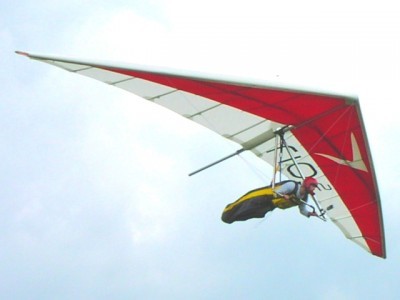
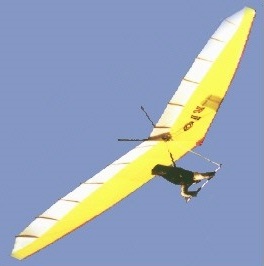
Avian Rio

Rio

The Rio is a sports glider (formerly referred to as intermediate) which is faster than a Skyfloater, lighter and easier to fly than a typical kingposted CFX glider. The price inc VAT was £2399 in 1999.

The United Kingdom’s Avian built the Rio novice-intermediate glider from 1999 to 2011. Replaced with the Rio2 which has a VG.

Rio 15
Wing area: 15 m²
Wing span: 9.4 m
Aspect ratio: 6
Hang glider weight: 25.3 kg
Pilot Weight: 61-95 kg
Minimum speed: 24 km/h
Maximum speed: 88 km/h
Max glide ratio (L/H): 10
Minimum sink rate: 0.96 m/s
Packed length: 5.6 m
Packed length short: 3.68 m
Number of battens: 20
Nose angle: 120°
Double surface: 55%

Aviaimpex Yanhol / Angel

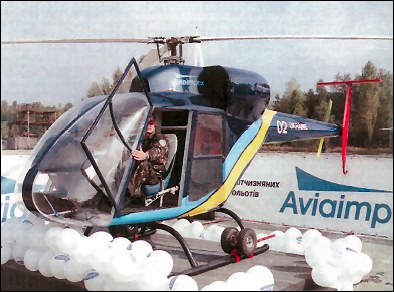
With the prototype structurally complete, the Aviaimpex Yanhol was displayed to the media on 31 August 2001. First flight was planned for June 2002.
Of pod-and-boom configuration, with T-tail and landing skids, the three seat helicopter has three-blade main and two-blade tail rotors.
COSTS: US$120.000 in Ukraine; US$150.000 export (2002),

Enghines: Two Rotax 912 ULS, 73.5kW.
Main rotor diameter: 8.28m
Tail rotor diameter: 1.30m
Length: 7.45m
Height: 2.475m
Max. take-off weight: 870kg
Empty weight: 524kg
Max. payload: 350kg
Max. speed: 184km/h
Max. cruising speed: 165km/h
Range max. fuel: 340km

AVIC Special Vehicle Research Institute A2C

AC2-L

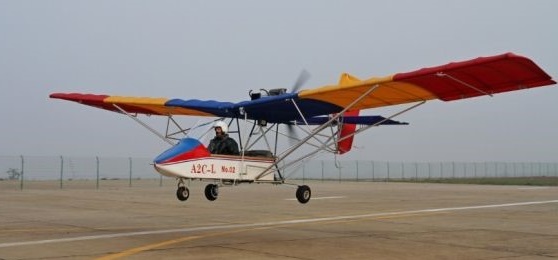
The A2C-L ultra-light aircraft was developed by the AVIC Special Vehicle Research Institute after the A2C seaplane achieved commercial success. The aircraft is transformed and updated from the seaplane and finished its test flight in 2012.

The A2C seaplane is the first ultra-light aircraft that obtained a certificate of model design approval and a production permit issued by the Civil Aviation Administration of China.

An ultra-light aircraft independently developed by China, it got the special flight permit and completed its delivery test flight on 11 March 2016. Nearly 100 A2C planes have been sold to regions including Sichuan, Hubei, Anhui, Inner Mongolia and Xinjiang.

Avicopter AC313 / Changhe AC313

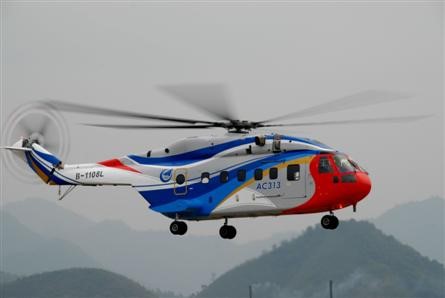
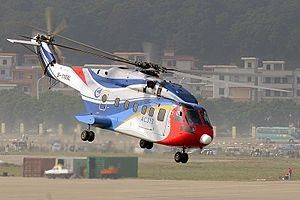
The 13.8t AC313 an updated design based on the earlier Harbin Z-8, itself a development of the Aérospatiale Super Frelon. The general designer of AC313 is Mr. Xu Chaoliang (徐朝梁), and the deputy general designer of AC313 is Mr. Li Jiayun (李家云). It is designed to carry 27 passengers, has a reported maximum range of 900 kilometres, and a maximum payload of 13.8 tonnes.

The rotorcraft has already been redesigned once to conform to updated certification standards—the CAAC refused the manufacturer’s application to certify the Z-8 for civil use in 2004. The CAAC determined then that an aircraft certified to military standards in China in the 1970s was not a candidate for civil use now. That appears to have sent the design authority, the China Helicopter Research and Development Institute, back to the drawing board to develop the considerably revised AC313.

The aircraft has new main and tail rotors, and a fuselage using composite material. With three Pratt & Whitney Canada PT6B-67A engines, the AC313 is a single-rotor helicopter with tail rotors, tandem pilot seating, and a non-retractable landing gear. Although based on a 1960s design, the AC313 has been developed to use composite materials for the rotor blade and titanium main rotor. Composite materials are used on 50% of the helicopter and titanium is used for the remainder. The interior comes equipped with a modern integrated digital avionics system and has a cabin height of 1.83 m and 23.5 cu.m in space. In terms of cargo, it can carry up to 4 tonne internally or 5 tonnes on a sling. AC313 is equipped with electronic flight instrument system.

The prototype first flew at Jingdezhen, Jiangxi on 18 March 2010 and made it first public demonstration flight at the Zhuhai Air Show in November 2010.

Built by Avicopter (AVIC Helicopter Company), the AC313 is only the second helicopter to be able to operate in the Qinghai-Tibet Plateau, first being Sikorsky S-70C Black Hawk. The flight testing period for the 13-tonne AC313 was conducted in Hulunbuir City, Inner Mongolia, starting in January 2011 where it was tested to operate in extremely low temperatures as low as minus 46degC marking the scope of Asia’s largest tonnage helicopter meeting the mission requirements of the cold climate and the Earth’s polar regions. The helicopter also set its speed record of 336 km per hour during the testing period. The AC313 became the first China-made aircraft authorized by China’s civil aviation authority in January to fly in high-altitude regions of over 4,500 meters above the sea level.

AC313 has received a Type Certificate issued by the Civil Aviation Administration of China (CAAC).

Following Chinese certification, the first 5 AC313 were to be delivered to Flying Dragon Special Aviation, in 2011. Avicopter has plans to certify the AC313 for sales in Europe and the United States. Xu Chaoliang, the chief designer of the helicopter, said the company has so far received 32 orders from national and international customers.

Like other Chinese aircraft, it has high-altitude operations as a key objective, so that it can fly from bases on the Tibet-Qinghai plateau. The CAAC has certified it to operate from fields as high as 4,500 meters (14,800 ft.).

Equipped with advanced instrument landing system, the helicopter can be used in blizzard weather in plateau regions. It can seat up to 27 passengers and two crew, has a maximum range of 900km (485nm) and is designed for transport, cargo, search and rescue, fire-fighting, offshore exploration and medical evacuation missions, Avicopter says.

CAIH, a wholly owned subsidiary of the China Aviation Industry Corp, was expected to produce 300 helicopters annually by 2015.

Gallery

Avicopter AC301 / AC311 / Changhe AC311

In conjunction with the June certification of the AC311, Avicopter announced orders for 62 of the single-engine, 2.2-ton aircraft from state enterprises, some linked with the manufacturer. The order figure is large for the local market, but it is unclear whether the contracts are binding, since “orders” announced by Chinese manufacturers sometimes do not represent binding contracts, especially when the customer is a state firm.

The AC311 can carry six people and has a 900-kg (2,000-lb.) maximum load capacity, 620-km (385-mi.) range, 4-hr. endurance and 242-kph (150-mph.) maximum cruise speed. “The tips of the main rotor blades are elliptical, improving aerodynamic efficiency and reducing aerodynamic noise,” the manufacturer says.

The rotorcraft is similar to and follows the configuration of the Eurocopter AS350 Squirrel, an unauthorized copy of which Avicopter builds as the AC301. The Chinese company says it has independently developed the AC311 using three-dimensional digital techniques and that it has been designed in accordance with international airworthiness standards. Industry officials say Eurocopter did not help. Honeywell has supplied its LTS101-700D-2 engine for the program, but Turbomeca signed an agreement with Avic unit China South Aviation Industry to cooperate on the Arriel 2B1A for the AC311. Avicopter says the AC311’s dynamic components are designed to be long-lasting, but it gives no figures.

Preliminary design was completed in 2009 and detail design and engineering development in March 2010. First flight occurred the following November. In 2011, the company said it would be certified by the end of that year.

AVIC AG600 / TA-600 / Kunlong

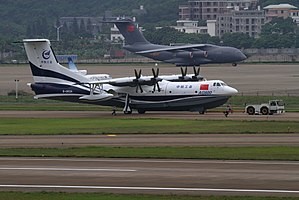
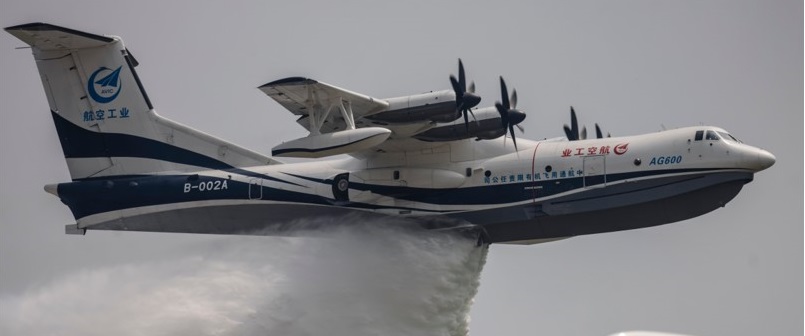
The AVIC AG600, code named Kunlong (鲲龙), also known as TA-600, is one of China’s three “big plane projects” approved by the State Council of China in 2009, along with the Xi’an Y-20 and C919. It is intended for both civil and military roles. In civil use, as an aerial firefighter it will be capable of dropping 12 tonnes of water, while in search and rescue operations it will accommodate up to 50 passengers. It is also intended to meet China’s strategic defence needs in the South China Sea area.

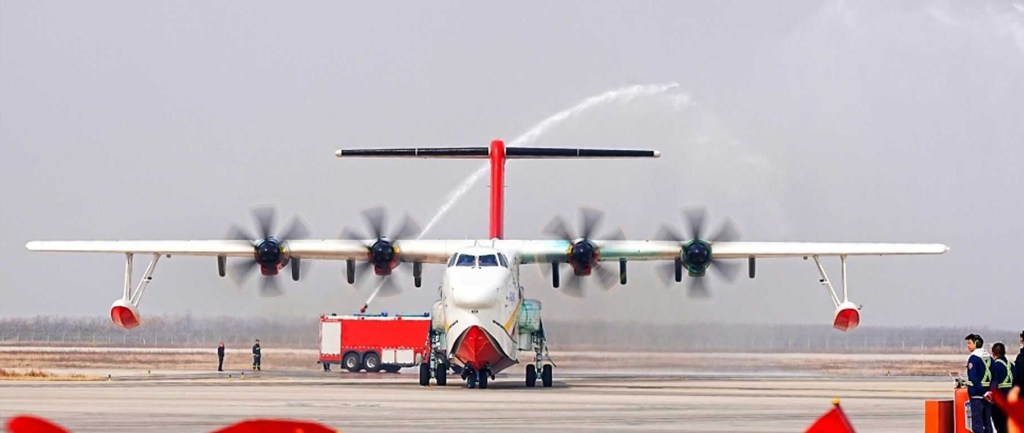
It was designed by the Aviation Industry Corporation of China (AVIC). The aircraft was developed by a group of 70 aircraft component manufacturers and research teams in association with more than 150 institutes across 20 provinces and municipalities in China. Over the years, its silhouette has been slowly revised by way of modified float supports, a more blended, better-contoured cockpit roofline, and a “T-style” tail unit (as opposed to the split vertical tail fins of the SH-5). On the whole, the aircraft has continued use of flying boat basics – high, shoulder-mounted wings, two engines installed at each wing, and a boat-like hull for water landings. The hold will also support seating for up to 50 passengers. The resulting aircraft has proven heavier than previously planned at approximately 107,000lb, up from the original 98,000lb. The added weight has altered the expected operational range, reduced from 3,200 miles to 3,100 miles. The AVIC AG600 is an amphibious aircraft having the hull of a flying boat for waterborne operations along with a wheeled retractable undercarriage for alighting on land. The prototype AG600, built by CAIGA, has a wingspan of 38.8 metres (127 ft) and is powered by four turboprop engines. The type of engine is WJ-6, a modified Chinese-made version of the Soviet Union’s Ivchenko AI-20 series. It is designed to have a maximum takeoff weight of 53.5 t (118,000 lb) and a maximum range of over 5,000 km (3,100 mi).

The aircraft is powered by four Chinese-made WJ-6 turboprop engines driving four six-bladed constant speed propellers. WJ-6 is a license-built copy of the Ivchenko AI-20 engine and generates a power output of 3,805kW (5,103hp).

The mid and forward fuselage sections of the aircraft were completed in December 2014 and March 2015 respectively. The horizontal and vertical tail was completed by January 2016. The prototype was rolled out on 23 July 2016 at the Zhuhai AVIC factory. Its maiden flight was made from the runway of Jinwan Civil Aviation Airport in Zhuhai, Guangdong on 24 December 2017, at 09:39 China Standard Time. 17 orders had been received from Chinese customers before the flight.

On March 2, 2025, China announced that the AG600, the country’s domestically developed large amphibious seaplane, has successfully completed its flight testing phase and is on the verge of receiving its type certificate from the Civil Aviation Administration of China (CAAC).

According to a statement from the Aviation Industry Corporation of China (AVIC), the state-owned aerospace giant overseeing the aircraft’s development, the AG600 prototype conducted its final flight test on the morning of Friday, March 1, 2025, at a civil aviation testing center in Pucheng, located in Shaanxi Province. This successful flight concludes a two-year testing program, which saw the aircraft complete a total of 2,014 flights spanning 3,560 hours.

The AG600 program was officially approved by the Chinese government in June 2009, with research and development kicking off later that year. The program saw the collaboration of tens of thousands of engineers and researchers from over 160 domestic institutes, enterprises, and universities. The first prototype of the AG600 was constructed in 2014 and completed in July 2016. After its debut flight in December 2017 at Zhuhai in Guangdong Province, the aircraft has undergone extensive testing across various regions of China.

The aircraft can take-off and land from 1,500m-long, 200m-wide and 2.5m-deep water. It has the capacity to collect 12t of water in 20 seconds and can carry up to 370t of water on a single tank of fuel. The AG600 can perform take-off and landing in severe weather conditions with a wave height of 2m. The maximum take-off weight of the aircraft is 53.5t on runways and 49t on water.

AG600 aircraft received two option orders at the 10th Airshow China held in Zhuhai in November 2014, bringing the total option orders to 17.

AG600
Engines: 4 × WJ-6 turboprops, 3,805 kW (5,103 hp) each
Propellers: 6-bladed constant speed
Wingspan: 38.8 m (127 ft 4 in)
Length: 36.9 m (121 ft 1 in)
Height: 12.1 m (39 ft 8 in)
Max takeoff weight: 53,500 kg (117,947 lb)
Maximum speed: 570 km/h (354 mph; 308 kn)
Cruise: 500 kph
Stall: 220 kph
Range: 4,500 km (3,418 mi; 2,970 nmi)
Service ceiling: 10,500 m (34,400 ft)
Capacity: 50 passengers

AVIAD Zigolo MG12

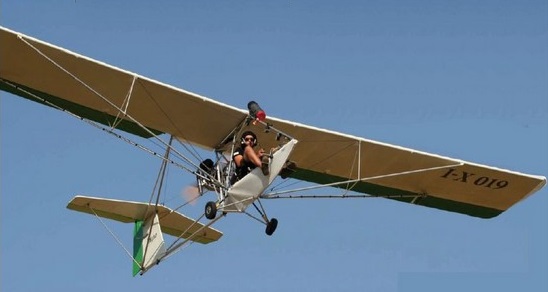
The AVIAD Zigolo MG12 is a SSDR (Single Seat De-Regulated) ultralight motor glider. This aircraft meets the USA FAA FAR Part 103 rules for UL (SSDR) aircraft in USA, China, and other countries. It is a conventional full 3-axis aircraft.

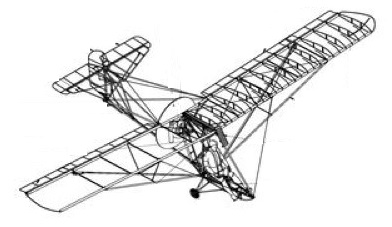
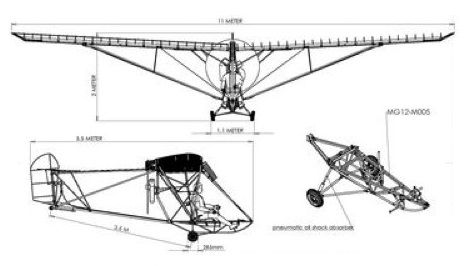
The AVIAD Zigolo MG12 is specifically designed for simple construction and low cost of ownership, it has a traditional tubular frame structure and simple bonded fabric covering. It has excellent slow flight characteristics and a short landing and take off distance of 130 feet.

The rear mounted pusher engine with propeller and the fuel tank are also contained within the airframe. The joy stick mounted engine throttle control further simplifies the aircraft’s three axis flight controls. It incorporates a forward pilot cockpit protected by the fuselage frame work and providing a wide field of view.

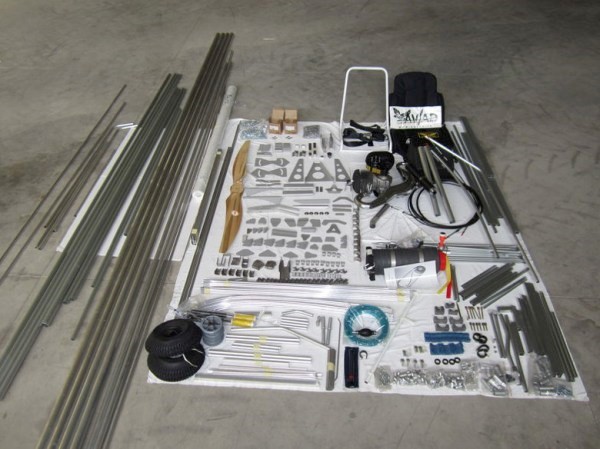
The Zigolo MG12 Kit does not require specialist knowledge or equipment for assembly. The drawings are very detailed and provide a step by step guide for assembly. The individual drawings contain a parts list of required components, which are easily identified by the initials engraved on them.

The Design Drawings are shared online and are made easily accessible for kit builders. All parts are accurately cut, perforated and folded. The assembly process only requires the correct part selection and correct positioning prior to fixing with either bolt or rivet to complete each sub-assembly / module. The complete aircraft’s final assembly can be undertaken either within the workshop or in the hangar and does not require any excessive space for construction.

The Zigolo MG12 kit requires less than 100 hours for assembly. The aircraft modules once completed can be rigged and ready to fly in 1 hour and offer easy transportation by truck, pick-up or trailer. The new wing remove system means the wings can be removed in just a couple minutes each.

It is a motor-glider. The glide ratio (L/D) is nowhere near that of a glider but due to its’ large wing and therefore very low wing loading the sink rate is reasonably low. The turn radius is so tight and slow it is easy for novice glider pilots to stay in thermals.

The Zigolo is available as a finished aircraft. Ultralights do not have any 51% build rule like the experimental class but can be offered ready to fly. Should a builder choose to fly outside the Part 103 rules the Zigolo has been inspected and approved as an E-AB kit and can be found on the FAA list of approved kits.

Base price was $12,000 (2017) and that includes EVERYTHING but finish paint. Engine & prop as well.

Engine: Vittorazi Moster 185, 25 hp at 7800 rpm
Wingspan: 11.1m / 36.4 ft
Wingarea: 15.8 sq.m / 170 sq.ft
Length: 5.5 m / 18 ft
Aspect ratio: 7.9
Dihedral: 3 deg
Empty weight: 102 kg / 225 lb
Max weight: 220 kg / 485 lb
Fuel burn: 6 lt/hr / 1.6 GPH
Fuel burn 30kg thrust: 3.5 lt/hr / 0.92 GPH
Stall: 35 kph / 22 mph
Cruise 6800 rpm: 68 kph / 42 mph
Vne: 95 kph / 58 mph
ROC: 2 m/s / 394 fpm
Sink rate: 1.4 m/s / 276 fpm
Glide ratio: 11-1
Manoeuvring speed: 65 kph / 40 mph
Range: 95 km / 59 miles
Load factor: +4 / -2 G
Safety factor: 1.5 G
Tailplan span: 3 m / 9.8 ft
Height at rudder: 1.3 m / 4.3 ft
Power loading: 7 kg/hp 15.4 lb/hp
Wing loading: 11 kg/sq.m / 2.23 lb/sq.ft
TO dist: 40m / 131 ft
TO dist to 50ft: 180m / 590 ft