German airship manufacturer.
CargoLifter AG had completed in 2000, work on a giant hangar for assembly of prototypes and series variants of its CL 160 beavy-lift dirigible.
Work on the first full-scale prototype is expected to begin at year’s end, 2000.
2000->
Capella Javelin / T-Raptor
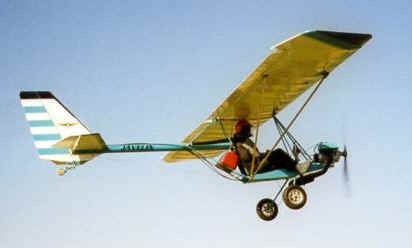
The Capella Javelin is a family of American open cockpit, high wing, tractor configuration, conventional landing gear-equipped ultralight aircraft that were designed by J. Reid Howell and produced in kit form by Capella Aircraft of Austin, Texas and intended for amateur construction.
First flying in 1998, the single seat Javelin I was designed to comply with the American FAR 103 ultralight regulations, including that category’s maximum 254 lb (115 kg) empty weight. The 2001 cost was US$6000 without engine, propeller, instruments or covering supplies.
The design features an open frame fuselage of welded 4130 steel tubing, with the pilot’s and passenger’s seats bolted to the frame. The horizontal stabilizer and tail fin are also constructed of welded steel tubes. The wing is framed from riveted aluminium tubing with all flying surfaces covered in doped aircraft fabric. The wing is equipped with full span ailerons.
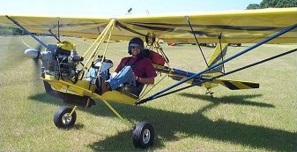
The conventional landing gear includes sprung-steel main gear and a similarly sprung steerable tail wheel. The open cockpit design provides good visibility while taxiing.
The standard engine supplied by the manufacturer for the single seat version was the 28 hp (21 kW) Rotax 277, but it was reported that the aircraft was underpowered with that engine installed. The throttle control is of a unique motorcycle grip type.
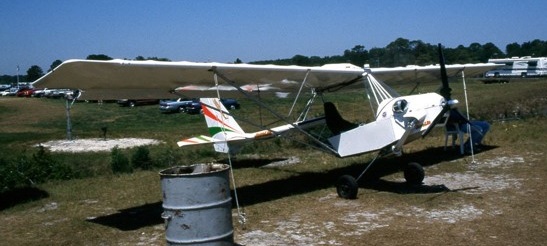
Original factory kit options included a cockpit pod and windshield, brakes and steel tube powder coating.
The single-seat Javelin was developed into a tandem two-seater, designated the Javelin II and then further developed into the T-Raptor ultralight trainer. The T-Raptor uses a wider and more enclosed fuselage, with optional bubble-windowed doors, to allow cool weather flying and was intended to be marketed to ultralight schools.
Capella Aircraft went out of business in late 2007, and the type is no longer in production.
Variants:
Javelin I
Single seat open cockpit ultralight
Engine: 1 × Rotax 277, 28 hp (21 kW)
Wingspan: 28 ft 0 in (8.53 m)
Wing area: 112 sq ft (10.4 sq.m)
Length: 18 ft 0 in (5.49 m)
Height: 6 ft 0 in (1.83 m)
Empty weight: 240 lb (109 kg)
Gross weight: 575 lb (261 kg)
Fuel capacity: 5 US gallons (19 litres)
Maximum speed: 63 mph (101 km/h, 55 kn)
Cruise speed: 60 mph (97 km/h, 52 kn)
Stall speed: 26 mph (42 km/h, 23 kn)
Range: 140 mi (220 km, 120 nmi)
Service ceiling: 12,500 ft (3,800 m)
Rate of climb: 400 ft/min (2.0 m/s)
Seats: one
Javelin II
Two seats-in-tandem open cockpit ultralight trainer powered by a 50 hp (37 kW) Rotax 503 engine. It was reported as being in development in 1998 and forecast to be available at the end of 1998.
T-Raptor
Two seats-in-tandem ultralight trainer powered by a 50 hp (37 kW) Rotax 503, 64 hp (48 kW) Rotax 582 or 60 hp (45 kW) HKS 700E four stroke engine. The T-Raptor has an expanded-width steel cage to provide a more enclosed cockpit and is a development of the Javelin II.
CLASS Cadi / BushCaddy
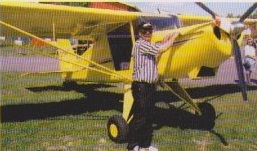
The prototype Cadi was designed by Jean Potbin of Lac St. Jean, Quebec, as a trainer and bushplane. It was intended to be powered by a Rotax 912 of 80 hp.
Potbin began selling kits in 1994 and delivered more than 50 before the program was taken over by Sean Gilmore. Gilmore had built a Cadi and had flown it for a year but was not satisfied with its construction and handling, so he tore it apart and started over. After the third version he turned to an engineer at Canadair to improve the design.
The Cadi was re-engineered to include a stiffened cabin and higher-stressed wings, as well as being convertible from wheels to floats or skies within 2 hours. The new design features a kickout windshield and was renamed BushCaddy.
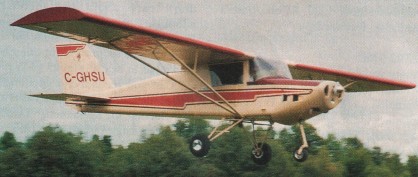
The Bush Caddy was developed as a bush plane and performs equally well on wheels, skis or floats. The 44 to 47 inch cabin, doors that swing upwards under the wing and side by side deluxe adjustable seating afford even a 6 foot plus pilot easy access and a comfortable ride.
The full span windshield, door wide windows and low instrument panel provide excellent visibility. Pilot controlled heating and ventilation allow for all weather comfort anytime of year.
The Bush Caddy satisfies all the needs of the dedicated bush pilot. Low landing speeds combined with superior control and stability makes access to places that bush pilots dream of a reality. With more than a 4 hour fuel range the Bush Caddy is an excellent cross country aircraft. This is truly an aircraft capable of flying anywhere, anytime of year.
Flexibility is the principal characteristic of the versatile Bush Caddy kit. Models can be customized to suit all needs. The R80 ultra-light version can be entirely factory assembled, painted and custom equipped. The Voyageur model transforms from a taildragger to a trike in hours.
Designed as a rugged Canadian bush plane, the BUSH CADDY features:
Modern aerodynamics and superb engineering result in super STOL performance.
Solid rivet cabin construction pre-jigged and pre-punched.
All-metal airframe – easy to assemble, economical, tough and durable
Major components, pre-jigged and pre-drilled.
Wide comfortable cabin – from 44 “on the R-80 to 47” on the L-164
Many options to choose from – cargo doors, sky lights, interior finishes and more
Big payload – the BushCaddy will lift its own empty weight in payload
Wheels, skis and floats available
Engine options from 80 hp on the R-80 to 250 hp on the L-164
20 to 60 plus gallon fuel capacity
Super STOL performance – take off run as short as 75 feet.
Exceptional rate of climb to get you out of tight spots.
Customization for special needs available
Builder assistance available.
The wing is fitted with two spars, both with bent-up C sections made from 6061-T6 sheet aluminium. The forward spad is 5.9 inches high and located 5.5 inches aft of the leading edge; the rear spar is 37.5 inches farther aft, with a 4.7 inch height. Each wing half has 11 stamped 6061-T6 ribs. Ailerons each span 6 feet and have a 17 inch chord with a C-shape leading edge spar. They are aluminium skinned and are cable and pushrod activated.
Optional flaps are of similar construction. The wings are braced by 3 inch wide extruded aluminium struts. Twelve US gallon fuel tanks, with aluminium tops, are installed in each wing root.
The fuselage is made in three sections – nose, main, and tail – and is of box construction, with a four-corner, 4 inch radius structure. It has seven 0.016 gauge 6061-T6 stamped bulkheads with U-shape stringers on the sides, top and bottom. Two three-sided box frames, built of 0.050 gauge, 0.125 inch angles, are placed in the aft fuselage to support the tail. The cabin area employs a 6061-T6 L extrusion internal structure, with a 0.040 gauge belly pan and 0.032 gauge lower side skins.
Internal cabin width and height are both 44 inch. The side-by-side seats are adjustable and easily removed. Swing-up doors provide access to the cabin. The standard baggage area, aft of the seats, holds 15 cu.ft/75 lb.
Tailspan is 8 ft 7 in, and all surfaces contain tapered C-shape frames and ribs, also made from 6061 sheet metal. The stabiliser’s forward spar is positioned 7 inches aft of the leading edge. The rear spar is at the trailing edge. The rudder is 4 ft 2 in high, has a 15 in chord, and contains six ribs.
The rudder is controlled by cable and the elevator by pushrod. Skins are primarily 0.016 gauge. Solid rivets are used in the internal structure and to attach the skins in the cabin area, and Avex blind rivets are used elsewhere in the fuselage, the wings and the empennage. The main landing gear is a Cub type, with bungee-cord shocks. Cleveland wheels and brakes are fitted with Matco master cylinders. Tires are 6.00×6 McCreary.
The tailwheel is a castering/steerable design incorporating an O-ring sealed dust cap and a 4.5 in wheel. Maingear tread is 7 fee, and the wheelbase is 14 ft 7 in.
The R-80 model can be built as an experimental (amateur built) aircraft, or as a Canadian Advanced Ultralight Aeroplane, (AULA) built to the LAMAC Design Standards 10141. Powered by a Rotax or Jabiru engines, with a roomy cabin, CNC pre-jigged and constructed with aluminum angle and solid rivets. Side by side seating on fully adjustable removable seats are standard. A large baggage compartment, low stall speed and easy handling makes this model the perfect training aircraft.
The R-80 is either factory built (AULA Canada only) or in kit form. And to make it flexible, you can order the kit in sub-kits, starting with the fuselage first, then the cabin and lastly the wings.
The BushCaddy R80 kit has been evaluated and determined to meet the 51% rule.
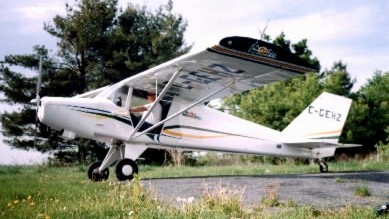
The R-80 AULA Deluxe model taildragger with a Rotax engine sold for $89,500CAD in 2008.
The BushCaddy Sport AULA Taildragger/Trike convertible model with the Rotax 912S, 100 hp or Jabiru 3300, 120 hp sold for $92,900 CAD in 2008 completed. The R80 kit, less engine, engine mount, instruments, wheels, brake, and interior finish, but including cowling, fibreglass nose bowl and float mounts, sold for US$12,621 in 2001.
Rotax Model 100 hp or Jabiru 120 hp engine.
The L120 is the 1500 lbs. version of the R80, but beefed up to allow for a larger range of engine choices including the Continental 0-200 or Lycoming 0-235. It is a two place side by side with standard center stick. Available on wheels (trike or taildragger) skis and floats. It is shown here on Full Lotus 1650 floats, amphibious metal floats and wheels. The same rugged solid construction that is standard on all the BushCaddy models is designed into the R120. This is an excellent all-season, all-terrain hard working little bush plane. It side slips so well, and is off the ground in such a short distance that flaps are not necessary. They are however available as options if you wish them . NOTE: The R120 has now been approved by engineering for a gross weight of 1700 lbs.
The L120 choice of engines includes:
Rotax 912 – 912S – 914
Continental 65 – 85 – 90 – 100 hp
PZL Franklin 120 hp
Subaru conversion (weight max. 220 lb.)
Jabiru 120 hp
The L120 kit, less engine, engine mount, instruments, wheels, brake, and interior finish, but including cowling, fibreglass nose bowl and float mounts, sold for US$13,027 in 2001.
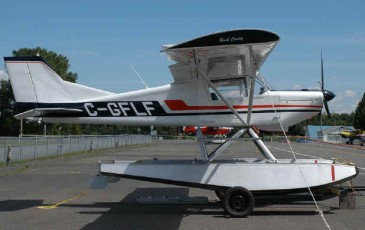
The L160 is a two seater with room for a child’s seat in the back. This model evolved from the R120 and was designed for pilots requiring a float plane with optimum fuel economy and payload. At 2200 gross you have a generous 1100 lbs of payload. Center stick, great visibility and a large roomy cabin are additional features. The two front seats are adjustable and removable. This is the perfect mid-size bush plane for hunting and fishing trips.
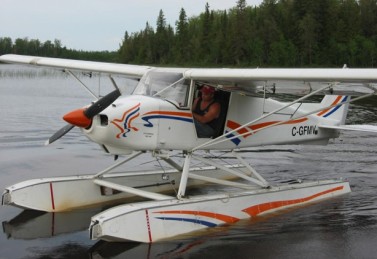
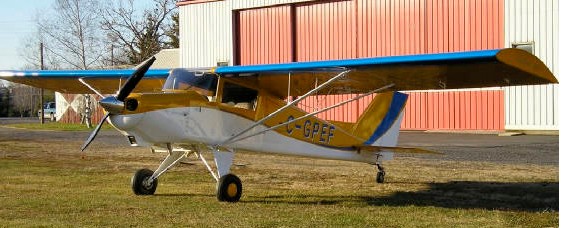
The L160 kit, less engine, engine mount, instruments, wheels, brake, and interior finish, but including cowling, fibreglass nose bowl and float mounts, sold for US$15,526 in 2001.

The four place L164 is powered by a Lycoming IO-350 of 180 hp. All BushCaddy kits and components, including fuel tanks, are made of aircraft grade aluminium.
The BushCady L164 four seater, at 2500 gross, this model will accommodate 1200 lbs plus of payload. Featuring two large main doors with optional hinged windows, four fully adjustable and removable seats with hinged backs to allow for easy entry into the back, and featuring our unique “caddy storage” compartments under the cushions. A generous cabin and cargo bay with standard cargo door. Your kit comes complete with wheels, brakes, engine cowling, nose bowl – all you add is paint, engine and instruments. Flight testing the L164 has resulted in better than expected STOL and climb performance. A cargo version “C” model of this aircraft is also available for those who want a total utility aircraft.
The fast build kit includes Cabin, doors and seats pre-jigged, pre-drilled and pre- assembled; fuselage fully built and riveted closed; vertical, horizontal stabilizers, rudder and elevators all pre-built, skins pre-punched and ready to rivet; wings fully built, and jigged for washout, pre-punched with top of wing riveted closed, bottom of wings tacked riveted for inspection.
The convertible-gear Voyager, with its taildragger-to-trike option, was available in two models and allows owners to switch gear in a few hours. Float fittings are also included in the Voyager option.
Club Aeronautique Delisle Cadi
Engine: Rotax 912, 80 hp
Wing span: 9.75 m
Wing area: 16 sq.m
MAUW: 544 kg
Empty weight: 274 kg
Fuel capacity: 90 lt
Max speed: 160 kph
Cruise speed: 142 kph
Minimum speed: 50 kph
Climb rate: 4.5 m/s
Seats: 2
Fuel consumption: 12 lt/hr
Price (1998): Can$50,000
Kit price (1998): Can$15,000
R80
Engine: Rotax 912 – 80 h.p.
Undercarriage: wheels
Length: 22 ft. 1in.
Height: 6 ft
Wing span: 32 feet
Wing area: 168 sq. ft.
Ceiling: 10,000 ft.
Max weight: 1232 lbs
Empty weight: 680 lbs.
Useful load: 552 lbs.
Cruise 75%: 95 mph
Vne: 130 mph
Va: 68 mph
Stall power off: 32 mph
Take off: 266 ft. asphalt, 282 ft grass, 305 ft. softfield
Rate of climb: 850 f.p.m.
R80
Engine: Rotax 912 – 80 h.p.
Undercarriage: floats
Length: 22 ft. 1in.
Height: 6 ft 10 in
Wing span: 32 feet
Wing area: 168 sq. ft.
Ceiling: 10,000 ft.
Max weight: 1232 lbs
Empty weight: 835 lbs
Useful load: 397 lbs
Cruise 75%: 87 mph
Vne: 130 mph
Va: 76 mph
Stall power off: 38 mph
Take off: 15 secs
Rate of climb: 600 f.p.m.
R80
Engine: Rotax 912S 100 h.p.
Undercarriage: wheels
Length: 22 ft. 1in.
Height: 6 ft
Wing span: 32 feet
Wing area: 168 sq. ft.
Ceiling: 12,000 ft.
Max weight: 1232 lbs
Empty weight: 680 lbs
Useful load: 552 lbs
Cruise 75%: 100 mph
Vne: 130 mph
Va: 68 mph
Stall power off: 32 mph
Take off: 200 ft asph.
Rate of climb: 930 f.p.m
R80
Engine: Rotax 912S 100 h.p.
Undercarriage: floats
Length: 22 ft. 1in.
Height: 6 ft. 10 in
Wing span: 32 feet
Wing area: 168 sq. ft.
Ceiling: 12,000 ft.
Max weight: 1232 lbs
Empty weight: 835 lbs
Useful load: 397 lbs
Cruise 75%: 91 mph
Vne: 130 mph
Va: 76 mph
Stall power off: 38 mph
Take off: 15 secs
Rate of climb: 750 f.p.m.
R80
Engine: Rotax 914, 115 h.p.
Undercarriage: wheels
Length: 22ft.1in.
Height: 6 ft
Wing span: 32 feet
Wing area: 168. sq. ft
Ceiling: 12,000 ft.
Max weight: 1232 lbs`
Empty weight: 680 lbs.
Useful load: 552 lbs.
Cruise 75%: 105 mph
Vne: 130 mph
Va: 68 mph
Stall power off: 34 mph
Take off: 200 ft. asph.
Rate of climb: 1000 fpm
R80
Engine: Rotax 914, 115 h.p.
Undercarrige: floats
Length: 22ft.1in.
Height: 6 ft. 10 in.
Wing span: 32 feet
Wing area: 168. sq. ft
Ceiling: 12,000 ft.
Max weight: 1232 lbs`
Empty weight: 835 lbs
Useful load: 397 lbs
Cruise 75%: 100 mph
Vne: 130 mph
Va: 80 mph
Stall power off: 40 mph
Take off: 15 secs
Rate of climb: 800 f.p.m.
R80
Engine: Jabiru 3300
Undercarriage: wheels
Length: 22 ft. 1in.
Height: 6 ft
Wing span: 32 feet
Wing area: 168 sq. ft.
Ceiling: 10,000 ft.
Max weight: 1232 lbs
Empty weight: 694 lbs
Useful load: 538 lbs
Cruise 75%: 115 mph
Vne: 130 mph
Va: 68 mph
Stall power off: 34 mph
Take off: 200 ft asph.
Rate of climb: 1000 f.p.m.
R80
Engine: Jabiru 3300
Undercarriage: floats
Length: 22 ft. 1in.
Height: 6 ft 10 in.
Wing span: 32 feet
Wing area: 168 sq. ft.
Ceiling: 10,000 ft.
Max weight: 1232 lbs
Empty weight: 848 lbs
Useful load: 384 lbs
Cruise 75%: 100 mph
Vne: 130 mph
Va: 84 mph
Stall power off: 34 mph
Take off: 15 secs.
Rate of climb: 850 f.p.m.
L120
Engine: Rotax 912S, 100 hp
Hp range: 65-130
Wing span: 34 feet
Wing chord: 63 inches
Wing area: 168 sq. ft
Wing loading: 8.9 lb. per sq. ft
Length: 22 ft. 1 in.
Cabin width: 44 in.
Cabin height: 46 in.
Fuel capacity: 20 or 34 imp. gallons
Empty weight: 823 lb.
Maximum gross take off weight: 1500 lb. – (1700 lbs on approval from CLASS)
Useful load: 677 lb.
Fuel consumption: 4 imp. gal per hour
G loading: +5.7 / -3.8
Maximum speed (v.n.e.): 130 m.p.h.
Cruising speed at 75% power: 110 m.p.h.
Cruising speed 60% power: 90 m.p.h.
Power off stall: 34 m.p.h.
Flap extended stall speed: 32 m.p.h.
Rate of climb 1500 lbs: 800 f.p.m.
Service ceiling: 16,000 feet
Take off 1500 lbs: 200 feet
Take off (floats): 15 to 30 sec. (1500 lb.)
L160
Engine: Lycoming 0-320, 160 hp
Wing span: 36 feet
Wing chord: 63 inches
Wing loading: 11.6 lb. per sq. ft
Length: 23 ft. 10 in.
Cabin width: 44 in.
Cabin height: 46 in.
Fuel capacity: 38 imp. Gallons
Empty weight: 1098 lb.
Maximum gross take off weight: 2200 lb.
Useful load: 1102 lb.
Fuel consumption: 7 imp. gal per hour
‘G’ loading: +5.3 / -3.2
Maximum speed (vne): 150 m.p.h.
Cruising speed at 75% power: 115 m.p.h.
Cruising speed 60% power: 105 m.p.h.
Power off stall: 42 m.p.h.
Flap extended stall speed: 37 m.p.h.
Rate of climb (full load): 850 f.p.m.
Rate of climb (1200lb): 1300 f.p.m.
Service ceiling: 13,000 feet
Take off (2200 lb): 360 feet
Take off (1600 lb): 250 feet
Take off (floats): 15 to 30 sec. (1500 lb)
L164
Engine: Lycoming I0-360 L2A, 180 hp
Propeller: Sensenich 76EM8
Hp range: 160 to 250
Length: 25.5 feet
Wing Span: 36 feet
Cabin Width: 47 inches
Cabin Height: 52.5 inches
Wing Chord: 63 inch
Gross weight: 2500 lbs.
Empty weight: 1350 to 1450 lbs
Useful load: 1050 to 1150 lbs
Fuel Capacity: 60 US gallons
Rate of climb: 1200 fpm
Take off run: 200 ft. at gross
Stall: 38 mph
Max.Cont Airspeed Vh: 135 mph IAS/128.5 mph CAS
Cruise Speed: 115 mph IAS
G Loading: +5.3 / -3.2 limit, +3.8 / -1.9 normal category
Seats: 4
L164
Engine: Franklin 220 hp
Undercarriage: floats
Propeller: Constant speed
Average Take off run: 15 to 20 seconds
Voyager
Canadian Light Aircraft Sales & Services Inc / CLASS / Club Aeronautique Delisle Incorporated / CADI / Bushcaddy International Inc
The company started as a flight training operation called Club Aeronautique Delisle Incorporated (CADI), based in Lac Saint-Jean, Quebec. It was founded by Jean Eude Potvin who designed the CADI R-80 and put it into production as a kit aircraft in 1994. He went on to design and build the R-120 and L-160.
Club Aeronautique Delisle Incorporated / CADI
1998:
3690, avenue Grande-Decharge
G0W 1LO Delisle
Qebec
Canada
Sean Gilmore and Marlene Gill started a flight training venture at Montréal/Saint-Lazare Aerodrome, operating a CADI R-80 aircraft. Impressed with the design they became distributors for Potvin, handling marketing outside of Quebec. In 1998 Potvin expressed a desire to retire and Gilmour and Gill bought CADI, including the rights to the R-80, R-120 and L-160 aircraft designs. They renamed the company Canadian Light Aircraft Sales and Service, commonly called CLASS. Between 1998 and 2001 Potvin still produced parts, as CLASS assumed production. Potvin retired in 2001.
To preserve the CADI name the aircraft line was called BushCaddy, a play on the abbreviation and the meaning of one who carries. To expand production the company moved to larger accommodation at nearby Les Cedres, Quebec. By 2005 they had five employees with Gilmore doing the design and engineering work and Gill handling the marketing and financial aspects. Gilmore designed the Bushcaddy L-162 Max and L-164.
2009: 177-179 Joseph Carrier, Vaudreuil-Dorion, Qc., J7V 5V5, Canada
In about 2010 Gilmore and Gill retired and sold the company to Tony Watkin, an Australian who relocated it to Lachute, Quebec and renamed it after the aircraft line itself, Bushcaddy International Inc.
In November 2012 the company moved production to the Cornwall Regional Airport at Summerstown, Ontario and also accepted a contract with the airport to operate the UNICOM radio service.
Canadair CRJ 700 / CRJ 900

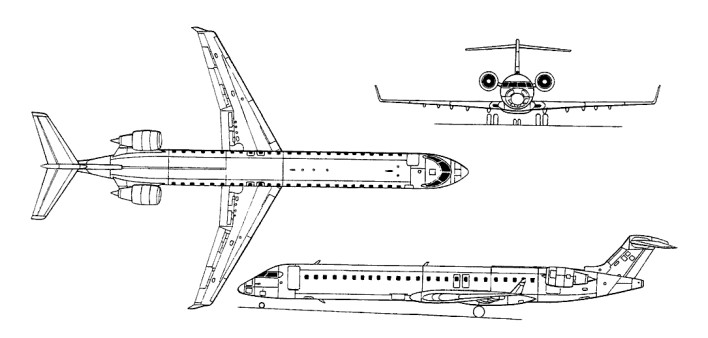
The CRJ 700 (originally known as the CRJ X) was a stretched 70 ¬seater, launched with a firm order for four aircraft from the French company Brit Air.
Compared to the CRJ100/200 re¬gional jets from which it’s descended and with which it shares Collins ProLine 4 avionics, the CRJ700 features a fuselage stretch of 186 inches, new General Electric CF34 8C1 engines, a larger horizontal tail, leading edge slats and an APU in the tail cone instead of the equipment bay. Other changes in¬clude raising the passenger windows by 4.5 inches, lowering the floor an inch, and expanding the interior cabin by an inch to a total width of eight feet, five inches. The airplane’s commonality with the CRJ100s and 200s allow operators with both types an advantage in spares as well as pilot training. The GE engines are capable of 13,790 pounds of thrust with Automatic Power Reserve
On May 27, 1999, the evening before its official rollout, Bombardier’s CRJ700, new 70 passenger Canadair Regional Jet airliner, made its first flight. The CRJ700 took off from Montreal, Canada’s Dorval Airport at 6:18 in the evening with test pilots, Craig Tylski and Chuck Ellis, on a test flight that lasted two hours and eight minutes.
The public debut was at Farnborough International Air Show on 23 July 2000, and Transport Canada certification achieved 22 December 2000.
The first customer delivery, to Brit Air of France, was in February 2001, followed by deliveries to Horizon Air and Lufthansa CityLine in May 2001.
The CRJ900 was originally CRJ700 Msn 10001, and the airframe was converted with two plugs of 90in (2.28m) and 62in (1.57m).
The prototype retained the CRJ-700 wings, landing gear and engines, and was first flown on 21 February 2001, from Montreal-Mirabel, piloted by Chuck Ellis, Craig Tylski and Jeff Hyde.
The public debut was at the Paris Air Show on 14 June 2001, and first production aircraft first flown on 20 October 2001. Transport Canada certification was achieved on 9 September 2002, followed by FAA approval 25 October 2002 and JAA certification 23 December 2002.
The first customer delivery, to Mesa Air, was on 3 February 2003.

VERSIONS
CRJ-700
68-seat version in standard and extended range (ER) weight options.
Engine: 2 x General Electric CF 34 8C1, 61313 N
Length: 106.66 ft / 32.51 m
Height: 24.836 ft / 7.57 m
Wingspan: 76.247 ft / 23.24 m
Wing area: 738.733 sq.ft. / 68.63 sq.m
Max take off weight: 51255.2 lb / 23245.0 kg
Weight empty: 30109.3 lb / 13655.0 kg
Max. speed: 464 kt / 860 km/h
Cruising speed: 442 kt / 818 km/h
Service ceiling: 41011 ft / 12500 m
Wing load: 69.5 lb/sq.ft / 339.0 kg/sq.m
Range: 1701 nm / 3150 km
Crew: 2
Payload: max. 8527kg
CRJ-701
70-seat version in standard and extended range (ER) weight options.
CRJ-900
Standard version.
Length : 106.60 ft / 32.51 m
Height: 24.836 ft / 7.57 m
Wingspan: 76.247 ft / 23.24 m
Wing area: 738.733 sq.ft. / 68.63 sq.m
Max take off weight: 51255.2 lb / 23245.0 kg
Weight empty: 30109.3 lb / 13655.0 kg
Max. speed: 464 kt / 860 km/h
Cruising speed: 442 kt / 818 km/h
Service ceiling: 41011 ft / 12500 m
Wing load: 69.5 lb/sq.ft / 339.0 kg/sq.m
Range: 1701 nm / 3150 km
Engines: 2 x General Electric CF 34 8C1, 61313 N
Crew: 2
Payload: 70 pax (max. 8527kg)
900ER
Extended-range version.
900ER European
As 900ER but with maximum T-O weight limited to 36,995kg to minimise weight-related charges when operating in European airspace.
900LR
Long-range version.
900LR European
As 900LR hut with maximum T-O weight limited to 37,995kg.

Cameron P-51
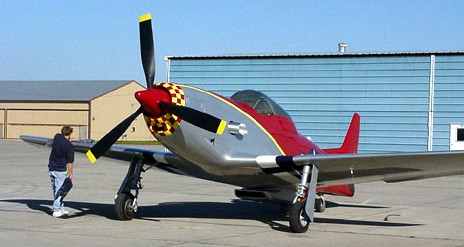
The P-51 is a full size Carbon Fiber Mustang manufactured by Cameron and Son’s Aircraft. This aircraft is available with a 1450 hp turbine, or can be fitted with a Rolls Merlin. It is capable of speeds in the mid 400mph range. There are three options on the canopy, the standard P-51D, a 9ft bubble, or a low profile racing canopy. Also available are standard P-51D wing tips. The cockpit features dual controls. The kit is built from 12 major components, making it the fewest part count aircraft of its kind.
Cruise: 420 mph
Stall: 87 mph
Range: 580 sm
Rate of climb: 4200 fpm
Takeoff dist: 1250 ft
Landing dist: 1750 ft
Engine: Allison, 1750 hp
HP range: 1150-3500 hp
Fuel capacity: 250 USG
Empty weight: 4500 lb
Gross weight: 6000 lb
Length: 36 ft
Wing span: 37 ft
Wing area: 233 sq.ft
Seats: 2
Landing gear: tailwheel
Cameron & Sons Aircraft
2009: Cameron and Son’s Aircraft:
Coeur d’Alene Airport
Built a P-51 replica
Cameron Van Gogh

Adding an artistic flavour is a three dimensional replica of Van Gogh’s painting Self-portrait with Grey Felt Hat.
Cameron Balloons of the United Kingdom used digital technology to piece the balloon together and it was launched in 2003 at Van Gogh’s birthplace in the Netherlands.
Cameron EGG-65
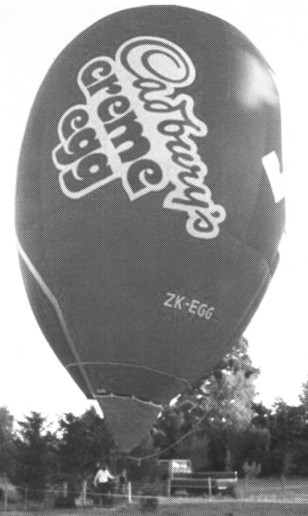
First registered to Cameron Balloons of Bristol, UK, on 11-02-2000 was the 65,000 cu.ft “EGG-65” G-OZEG. This is a two-person balloon built to order for Cadbury’s in the UK to advertise one of their products. The balloon has only three hours on it, all done in NZ before 2003. Cadbury now has no finan-cial interest in the balloon, which was cancelled from the UK register on 17-04-02. Cameron Balloons offered the unit to Andy Nicholson, the NZ dealer, and it became ZK-EGG, with Balloon Affair out of Christchurch.
Capacity: 65,000 cu.ft.
Seats: 2.
Cameron Balloons
Cameron Balloons is a company established in 1971 in Bristol, England by Don Cameron to manufacture hot air balloons. Cameron had previously, with others, constructed ten hot air balloons under the name Omega. Production was in the basement of his house, moving in 1972 to an old church in the city. In 1983 Cameron Balloons moved into its current premises in the former Robinsons paper bag/printing factory (built in 1887 in the Bedminster area of the city). In 1989 the company received the Queen’s Award for Export.
Output has grown to around 500 balloons per year. As of December 2007[update], Cameron Balloons accounted for 1,073 of the 1,553 hot air balloons registered with the United Kingdom Civil Aviation Authority.[1] Cameron Balloons is also famous for its special shapes, the first being Robertson’s Golly, constructed in 1975. Most special shapes are made for commercial advertising, but some have been bought privately. Notable amongst these private buyers is the late Malcolm Forbes of Forbes magazine, who commissioned a number of special shapes, including Harley-Davidson motorbike, Sphinx, bust of Beethoven, French Chateau, Pagoda and Minaret.
The Bedminster factory occupies three floors. Most factory space (first and second floors) is devoted to laying out the hundreds of yards of fabric which is sewn together by machinists. If the detail on the balloon is intricate, to save cost and weight, the designs may be sprayed or painted on instead.
The company also makes airships, helium balloons and static inflatables. It has been involved in record breaking balloon flight attempts including trans-Atlantic, altitude and distance records.
1982: Cameron Balloons, 3600 Elizabeth Road, Ann Arbor, Michigan 48103, USA.
Cameron builds balloons varying in envelope size from 31,000 to 210,000 cubic feet (the company also built a 500,000 cubic foot, 32 ¬passenger monster for Heineken). Standard equipment includes an inflation scoop, instru¬ments in an oak case, appropriate number of tanks, fire extinguisher and envelope bag. Prices range from $7,285 to $24,000 in 1982.
Later in 1994, Airborne Group Plc (UK), and its various divisions, including Thunder & Colt Ltd., UK were placed into receivership. The hot air ballooning division, Thunder & Colt Ltd. (UK), was purchased in December 1994 by Cameron Balloons Ltd.
Cameron has integrated the Thunder & Colt product range, notably the AS-series hot air airships, into its own catalogue, while Sky’s products have been discontinued. Lindstrand Balloons continues to operate as an independent company with separate management and its own designs and products.
In the late-1990s, Cameron Balloons and its owner Don Cameron acquired two-thirds ownership of Lindstrand Balloons. Cameron bought the majority stake in Lindstrand Balloons from Rory McCarthy, a British industrialist associated with Richard Branson, who had invested in Lindstrand to support Branson’s series of record-setting balloon flights. The remaining third of the company is owned by its founder Per Lindstrand.
Despite Cameron’s ownership, Lindstrand Balloons continues to operate as an independent company with separate management and its own distinct designs and products. Per Lindstrand also independently operates a separate company, Lindstrand Technologies, which designs and builds gas balloons, innovative buildings, specialized aerospace equipment (including an advanced parachute for the Beagle 2 Mars-lander) and inflatable structures including aircraft hangars, plugs for fire-containment for road tunnels and flood prevention systems.
 All Aero